
Europe Green Packaging Market Size, Share, Trends and Forecast by Packaging Type, End-Use Industry, and Country, 2026-2034
Europe Green Packaging Market Summary:
The Europe green packaging market size was valued at USD 109.07 Billion in 2025 and is projected to reach USD 180.56 Billion by 2034, growing at a compound annual growth rate of 5.76% from 2026-2034.
The Europe green packaging market is growing at a rapid rate due to rising environmental awareness among consumers and organizations operating within Europe. The strict norms embracing sustainable practices, as well as the rising focus of organizations to minimize their carbon footprint, are fueling the adoption of green packaging solutions. The trend of adopting circular economy concepts, as well as growing investment in recyclable, reusable, and biodegradable materials, is largely impacting the Europe packaging market.
Key Takeaways and Insights:
- By Packaging Type: Recycled content packaging dominates the market with a share of 49% in 2025, driven by the widespread adoption of recycled paper, plastic, metal, and glass materials across industries seeking to meet sustainability mandates and reduce virgin material consumption throughout the supply chain.
- By End-Use Industry: Food industry leads the market with a share of 38% in 2025, owing to stringent food safety regulations requiring sustainable packaging solutions and rising consumer preference for environmentally responsible food packaging that maintains product freshness while minimizing ecological impact.
- By Country: Germany dominates the market with a share of 26% in 2025, backed by Germany’s robust regulatory framework, including the Packaging Act, a well-developed recycling infrastructure, and an industrial base that emphasizes environmental responsibility across manufacturing sectors.
- Key Players: The Europe green packaging market exhibits a moderately fragmented competitive structure, with established multinational corporations and regional manufacturers competing across various segments through innovation, sustainability initiatives, and strategic partnerships throughout the value chain.
The Europe green packaging market is witnessing strong growth driven by multiple factors. Rising environmental awareness among consumers is fueling demand for sustainable packaging across sectors. In December 2024, Tetra Pak received the ‘Resource Efficiency’ Award for its paper‑based barrier material, which increases renewable content to 90% and reduces carbon footprint by up to one‑third, reflecting rapid innovation in the region. Stricter regulations, including the EU Packaging and Packaging Waste Regulation, are pushing manufacturers and brands to adopt recyclable and biodegradable solutions. Major retailers and consumer goods companies are setting ambitious sustainability targets, accelerating green packaging adoption across supply chains. The growing circular economy, coupled with concerns over plastic pollution in oceans and landfills, is further shifting consumer preferences toward eco-friendly, reusable, and recycled-content packaging.
Europe Green Packaging Market Trends:
Accelerated Transition to Mono-Material Packaging Solutions
European manufacturers are increasingly adopting mono‑material packaging to improve recyclability and simplify waste processing. In 2025, Masterpress joined the EU-funded BeFORE Barrier for Recycling initiative to test its single-layer, high-barrier mono-material pouch under real recycling conditions, highlighting industry efforts across Belgium, Germany, and Poland. This move tackles the challenges posed by multi-layer packaging, while brand owners collaborate with suppliers to redesign containers using single polymers that preserve barrier performance and remain compatible with existing recycling systems.
Rising Adoption of Bio-Based and Compostable Materials
The European green packaging sector is seeing strong growth in bio-based and compostable materials from renewable sources. Plant-based polymers, cellulose films, and packaging from agricultural waste are emerging as alternatives to conventional plastics. In June 2025, the BIOSUPPACK project developed compostable packaging from brewer’s spent grain, converting agricultural by-products into high-value biopolymers for food, cosmetics, and household uses. This trend reflects consumer demand for packaging that safely returns to nature and supports the agricultural circular economy across Europe.
Integration of Digital Watermarks and Smart Packaging Technologies
European packaging innovators are increasingly using digital watermarks and intelligent packaging to improve sorting accuracy and material traceability in recycling. In April 2025, the HolyGrail 2.0 initiative, backed by EU brands and partners like Digimarc and Pellenc ST, completed industrial trials in Germany, demonstrating scalable detection of rigid packaging waste. These invisible codes enable automated systems to identify materials for higher-quality recycling and allow consumers to access sustainability information via smartphone scanning, supporting transparency and circular economy goals.
.webp)
Market Outlook 2026-2034:
The Europe green packaging market outlook remains exceptionally positive, driven by continuous regulatory advancement and evolving consumer preferences toward sustainable consumption patterns. Investment flows into recycling infrastructure modernization and bio-based material production facilities are expected to accelerate market expansion throughout the forecast period. The harmonization of packaging standards across EU member states will create unified opportunities for manufacturers while reducing compliance complexity. The market generated a revenue of USD 109.07 Billion in 2025 and is projected to reach a revenue of USD 180.56 Billion by 2034, growing at a compound annual growth rate of 5.76% from 2026-2034.
Europe Green Packaging Market Report Segmentation:
|
Segment Category |
Leading Segment |
Market Share |
|
Packaging Type |
Recycled Content Packaging |
49% |
|
End-Use Industry |
Food Industry |
38% |
|
Country |
Germany |
26% |
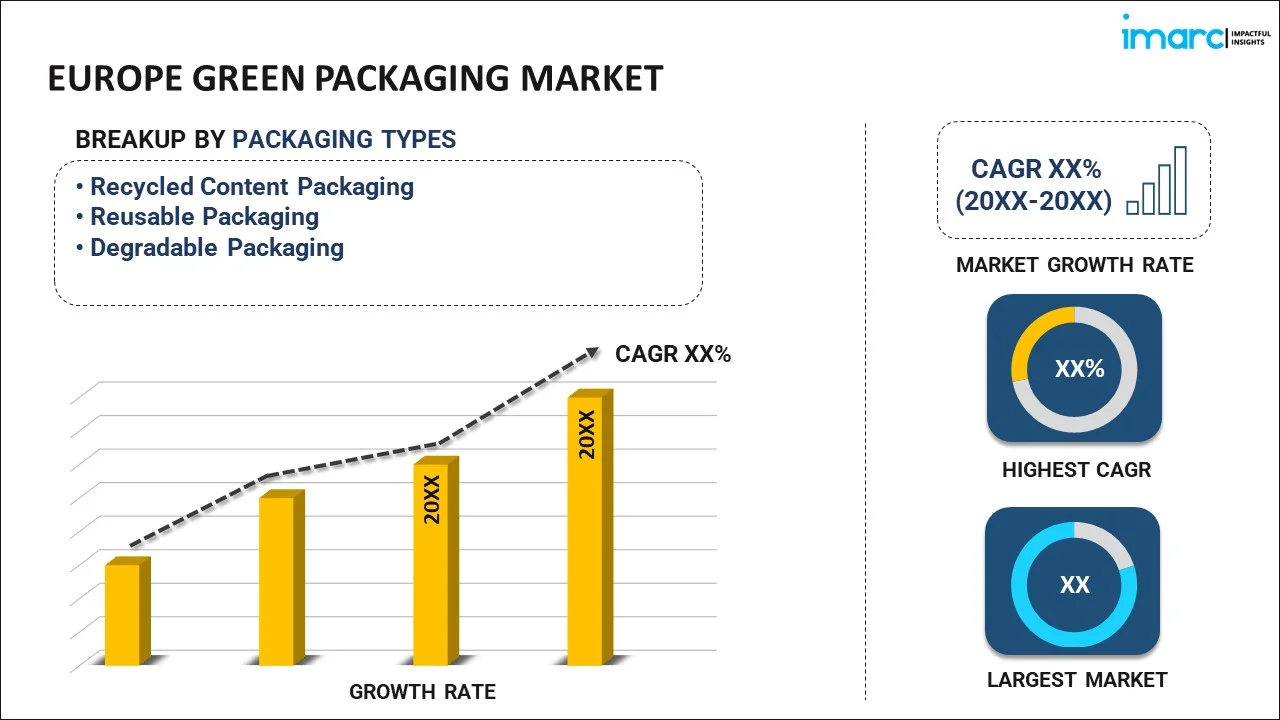
Packaging Type Insights:
To get more information of this market, Request Sample
- Recycled Content Packaging
- Paper
- Plastic
- Metal
- Glass
- Others
- Reusable Packaging
- Drum
- Plastic Container
- Others
- Degradable Packaging
The recycled content packaging dominates with a market share of 49% of the total Europe green packaging market in 2025.
Recycled content packaging has emerged as the foundation of green packaging in Europe, with an established collection infrastructure across member countries. Paper packaging made from recycling is currently leading this category due to its recyclability and consumer acceptance as an environmentally friendly packaging solution over its virgin counterparts. An efficient recycling system for paper products is responsible for this recycling rate, making them recyclable again for packaging production.
The relevance of this segment is further bolstered by significant investments in plastic recycling technological development tools that utilize both mechanical and chemical processes to turn post-consumer plastic products into food-grade packaging containers. However, food packaging products made from metal and glass continue to fare well owing to their infinite recyclable properties, which give both beverage and cosmetics brands a high degree of importance with respect to sustainability.
End-Use Industry Insights:
- Food Industry
- Beverage Industry
- Healthcare Industry
- Personal Care Industry
- Others
The food industry leads with a share of 38% of the total Europe green packaging market in 2025.
The food industry is a key driver of Europe’s green packaging market, owing to its high consumer engagement and extensive packaging requirements. Stringent EU food safety and sustainability regulations encourage the adoption of solutions that preserve product quality while minimizing environmental impact. As a result, retailers and manufacturers are increasingly shifting toward recyclable, compostable, and eco-friendly packaging options to satisfy both regulatory obligations and growing consumer demand for sustainable products.
The segment can be aided by innovative barrier technologies that ensure sustainability through the use of materials for maintaining the freshness of food. Fresh produce, dairy products, baked goods, and prepared meals are embracing paper packaging alternatives rapidly. The rising meal kit and convenience foods market creates an amplified increase in the adoption of sustainable packaging solutions catering to the requirements of a consumer seeking healthier living environments, especially within Europe.
Country Insights:
- Germany
- France
- United Kingdom
- Italy
- Spain
- Others
Germany exhibits a clear dominance with a 26% share of the total Europe green packaging market in 2025.
The factor that is contributing to the dominance of the European green packaging industry in the German packaging market is the efficient waste management infrastructure that the country provides. The Packaging Act of Germany promotes high recycling rates and sustainable packaging practices. The packaging act helps ensure that high rates of material recovery are provided through the use of deposit-return schemes and waste collection programs.
The diverse and strong industrial base in Germany, most notably in paper-based packaging manufacturing, propels it as an emerging destination for green packaging manufacturing and innovation in this region too. The German companies’ lead in innovations in bio-based materials and recycling technologies helps spread these technologies in European markets. The combined efforts of strict policies and innovations in this niche along with consumer awareness of sustainability in Germany contribute to favorable conditions for growth in markets for green packaging.
Market Dynamics:
Growth Drivers:
Why is the Europe Green Packaging Market Growing?
Stringent Regulatory Framework and Extended Producer Responsibility Implementation
The European Union has established one of the world’s most comprehensive regulatory frameworks for packaging sustainability, driving strong adoption of green solutions. In December 2024, the EU adopted the revised Packaging and Packaging Waste Regulation (PPWR), introducing mandatory recyclability targets and recycled content requirements for all packaging across member states. Extended Producer Responsibility schemes shift financial and operational packaging waste responsibilities to manufacturers, incentivizing sustainable design. These regulations provide clear market signals that promote recyclable, reusable, and biodegradable packaging while discouraging excessive or non-recyclable materials throughout the supply chain.
Escalating Consumer Environmental Consciousness and Purchasing Preferences
European consumers rank among the world’s most environmentally conscious, shaping purchasing decisions and brand loyalty through sustainability considerations. A survey found that 84% of Europeans actively check recyclability information on packaging, highlighting the influence of sustainability at the point of sale. Rising concerns over plastic pollution, climate change, and resource depletion are driving demand for eco-friendly packaging. Millennials and Gen Z, in particular, prefer brands with genuine environmental commitment, prompting companies to treat sustainable packaging not just as a differentiator but as a core expectation.
Corporate Sustainability Commitments and Circular Economy Investments
Major European and multinational corporations are driving green packaging market growth through ambitious sustainability commitments. Unilever, for instance, aims for all its plastic packaging to be reusable, recyclable, or compostable by 2025 and plans to halve virgin plastic use by 2026 as part of its circular economy strategy. Leading consumer goods companies, retailers, and food service providers are targeting full packaging recyclability or compostability, supported by investments in recycling infrastructure, material innovation, and supply chain transformation. Europe’s shift toward a circular economy reinforces these efforts by enabling continuous recovery and reintegration of packaging materials.
Market Restraints:
What Challenges the Europe green packaging Market is Facing?
Higher Production Costs and Price Sensitivity
Green packaging materials and production processes often command premium pricing compared to conventional alternatives, creating adoption barriers particularly among price-sensitive market segments. The current economic environment and inflationary pressures further heighten cost sensitivity among consumers and businesses, potentially slowing the transition toward sustainable packaging solutions. Smaller manufacturers may struggle to absorb increased packaging costs while maintaining competitive product pricing.
Technical Performance Limitations of Sustainable Materials
Certain green packaging materials face performance challenges in matching the barrier properties, durability, and shelf-life extension capabilities of conventional petroleum-based plastics. Applications requiring stringent protection against moisture, oxygen, or contamination may find current sustainable alternatives insufficient without compromising product quality. Ongoing material science research is addressing these limitations, though full parity with traditional materials remains a development priority.
Recycling Infrastructure Gaps and Regional Disparities
Despite advanced recycling systems in leading markets, significant infrastructure gaps persist across European regions, limiting the effective recovery and processing of certain packaging materials. Variations in collection systems, sorting capabilities, and processing technologies between member states create challenges for packaging designed for recyclability. The lack of harmonized composting infrastructure particularly constrains the growth of biodegradable and compostable packaging segments.
Competitive Landscape:
The Europe green packaging market exhibits a moderately consolidated competitive structure characterized by the presence of established multinational packaging corporations alongside specialized sustainable packaging providers. Leading players are differentiating themselves through continuous material innovation, expanding recycled content capabilities, and strategic partnerships across the packaging value chain. Companies are investing substantially in research and development to enhance the performance characteristics of sustainable materials while maintaining cost competitiveness. The competitive landscape is evolving rapidly as traditional packaging manufacturers accelerate their sustainability transformations while pure-play sustainable packaging specialists scale their operations to meet growing demand. Strategic acquisitions and joint ventures are reshaping market dynamics as companies seek to strengthen their sustainable packaging portfolios.
Recent Developments:
- In August 2025, Coveris unveiled its next‑generation recyclable and paper-based packaging at FachPack 2025. Under its “No Waste” strategy, the company highlighted mono‑material paper substrates for bars and cereals, advancing circular economy solutions and reinforcing sustainability goals in the packaging sector.
Europe Green Packaging Market Report Coverage:
| Report Features | Details |
|---|---|
| Base Year of the Analysis | 2025 |
| Historical Period | 2020-2025 |
| Forecast Period | 2026-2034 |
| Units | Billion USD |
| Scope of the Report |
Exploration of Historical Trends and Market Outlook, Industry Catalysts and Challenges, Segment-Wise Historical and Future Market Assessment:
|
| Packaging Types Covered |
|
| End Use Industries Covered |
Food Industry, Beverage Industry, Healthcare Industry, Personal Care Industry, Others |
| Countries Covered | Germany, France, United Kingdom, Italy, Spain, Others |
| Customization Scope | 10% Free Customization |
| Post-Sale Analyst Support | 10-12 Weeks |
| Delivery Format | PDF and Excel through Email (We can also provide the editable version of the report in PPT/Word format on special request) |
Frequently Asked Questions About the Europe Green Packaging Market Research Report Report
The Europe green packaging market size was valued at USD 109.07 Billion in 2025.
The Europe green packaging market is expected to grow at a compound annual growth rate of 5.76% from 2026-2034 to reach USD 180.56 Billion by 2034.
Recycled content packaging dominated the Europe green packaging market with a share of 49%, driven by mature recycling infrastructure, regulatory mandates for recycled content, and widespread adoption across multiple industries seeking to reduce virgin material consumption.
Key factors driving the Europe green packaging market include stringent EU regulatory frameworks, escalating consumer environmental awareness, corporate sustainability commitments, circular economy investments, and growing demand for recyclable and biodegradable packaging materials.
Major challenges include higher production costs for sustainable materials, technical performance limitations compared to conventional plastics, recycling infrastructure gaps across certain regions, regulatory complexity, and the need for continued investment in material innovation.
Need more help?
- Speak to our experienced analysts for insights on the current market scenarios.
- Include additional segments and countries to customize the report as per your requirement.
- Gain an unparalleled competitive advantage in your domain by understanding how to utilize the report and positively impacting your operations and revenue.
- For further assistance, please connect with our analysts.
 Request Customization
 Speak to an Analyst
 Request Brochure
 Inquire Before Buying
Benefits of Customization
- Personalize this research
- Triangulate with your data
- Get data as per your format and definition
- Gain a deeper dive into a specific application, geography, customer, or competitor
- Any level of personalization
Get in Touch With Us
UNITED STATES
Phone: +1-201-971-6302
INDIA
Phone: +91-120-433-0800
UNITED KINGDOM
Phone: +44-753-714-6104
Email: [email protected]
Client Testimonials




.webp)




.webp)













Related Reports

Choose your plan
*Please note that the prices mentioned below are starting prices for each bundle type. Kindly contact our team for further details.*
Single User License
- 1 User License, Access on 2 Devices
- PDF Report + Excel Dataset (Password Protected)
- Lifetime Access
- No Printing Rights
- 10% Free Report Customization
- 10–12 Weeks of Analyst Support
Five User License
- Access for 5 Users, 2 Devices per User
- PDF Report + Excel Dataset (Password Protected)
- Lifetime Access
- Dedicated Account Manager
- 12–14 Weeks of Analyst Support
- No Printing Rights
- 15% Free Report Customization
- 25% Discount on Your Next Purchase
Corporate User License
- Unlimited User Access (Within Your Organization)
- PDF Report + Excel Dataset
- Lifetime Access
- Dedicated Account Manager
- 14–20 Weeks of Analyst Support
- No Printing Rights
- 20% Free Report Customization
- 30% Discount on Your Next Purchase
Essential Insights
What's included:
3 reports
- Lifetime Access
- PDF Reports
- Excel Datasets
- 2 Weeks of Free Analyst Support
- 2 User Licenses
- Access on 2 Devices
- Printing Rights
- Complimentary PowerPoint (PPT) Version
- Complimentary License Upgrade
Professional Access
What's included:
5 reports
- Lifetime Access
- PDF Reports
- Excel Datasets
- 8 Weeks of Free Analyst Support
- 2 User Licenses
- Access on 2 Devices
- Printing Rights
- Complimentary PowerPoint (PPT) Version
- Complimentary License Upgrade
Business Advantage
What's included:
8 reports
- Lifetime Access
- PDF Reports
- Excel Datasets
- 14 Weeks of Free Analyst Support
- 2 User Licenses
- Access on 2 Devices
- Printing Rights
- Complimentary PowerPoint (PPT) Version
- Complimentary License Upgrade
Enterprise Intelligence
What's included:
10 reports
- Lifetime Access
- PDF Reports
- Excel Datasets
- 20 Weeks of Free Analyst Support
- 2 User Licenses
- Access on 2 Devices
- Printing Rights
- Complimentary PowerPoint (PPT) Version
- Complimentary License Upgrade