
Europe Indoor Farming Market Size, Share, Trends and Forecast by Facility Type, Crop Type, Component, Growing System, and Country, 2026-2034
Europe Indoor Farming Market Summary:
The Europe indoor farming market size was valued at USD 14.76 Billion in 2025 and is projected to reach USD 32.03 Billion by 2034, growing at a compound annual growth rate of 8.99% from 2026-2034.
The Europe indoor farming market is experiencing robust expansion driven by rising urbanization, increasing demand for locally grown and pesticide-free produce, and growing emphasis on sustainable agricultural practices. Technological advancements in LED lighting, climate control systems, and automation are enhancing operational efficiency across greenhouse and vertical farming facilities. Government initiatives supporting sustainable agriculture, combined with heightened consumer awareness regarding food safety and environmental responsibility, are accelerating market adoption. The integration of artificial intelligence and precision farming technologies is transforming production capabilities while reducing resource consumption, positioning the country as a global leader in controlled environment agriculture and strengthening Europe indoor farming market share.
Key Takeaways and Insights:
-
By Facility Type: Greenhouse dominates the market with a share of 47.09% in 2025, owing to established infrastructure, lower operational costs compared to vertical farms, and superior energy efficiency. The widespread adoption of glass and plastic greenhouses enables year-round cultivation of high-value crops while benefiting from natural sunlight supplementation.
-
By Crop Type: Fruits, vegetables, and herbs lead the market with a share of 96.56% in 2025. This dominance reflects strong consumer demand for fresh, locally sourced produce including tomatoes, cucumbers, lettuce, and herbs, with indoor cultivation ensuring consistent quality and year-round availability regardless of seasonal variations.
-
By Component: Hardware represents the largest segment with a market share of 89.22% in 2025, driven by substantial capital investments in LED lighting systems, HVAC equipment, climate control infrastructure, and irrigation technologies essential for establishing controlled environment agriculture facilities.
-
By Growing System: Soil-based exhibits a clear dominance in the market with 41.63% share in 2025, reflecting the continued preference for traditional greenhouse cultivation methods that combine controlled environments with familiar growing practices, particularly among established horticultural operations.
-
By Country: Germany is the biggest country with 24% share in 2025, driven by strong government support for sustainable agriculture, advanced technological infrastructure in urban centers like Berlin and Munich, and increasing investments in rooftop greenhouses and vertical farming facilities.
-
Key Players: Key players drive the Europe indoor farming market by investing in advanced automation technologies, expanding cultivation capacity, developing energy-efficient systems, and forming strategic partnerships with retailers. Their focus on innovation, sustainability certification, and product quality enhancement strengthens market competitiveness and consumer confidence.
The Europe indoor farming market is advancing rapidly as governments, agricultural enterprises, and technology providers collaborate to address food security challenges and sustainability objectives. Rising urban populations and shrinking arable land are compelling the adoption of space-efficient cultivation methods that maximize yield per square meter. Continued urbanization across the country is intensifying pressure on conventional food supply networks while reducing available agricultural land for traditional farming practices. This demographic shift aligns with evolving consumer preferences toward pesticide-free and traceable produce, accelerating demand for controlled environment agriculture. Technological breakthroughs in LED lighting efficiency, automated harvesting systems, and AI-powered crop monitoring are reducing operational costs while improving productivity. Furthermore, regulatory frameworks promoting carbon footprint reduction are incentivizing investments in renewable energy integration and resource-efficient farming infrastructure. Strategic partnerships between technology developers, agricultural operators, and retail networks are strengthening supply chain resilience and expanding market access for indoor-grown produce across the country.
Europe Indoor Farming Market Trends:
Integration of Artificial Intelligence and Automation Technologies
The Europe indoor farming market growth is being accelerated by widespread adoption of artificial intelligence and automated systems across cultivation facilities. Advanced sensor networks collect real-time data on environmental conditions, enabling precise adjustments to lighting, temperature, humidity, and nutrient delivery. Machine learning algorithms analyze crop growth patterns to optimize harvest timing and predict yield outcomes. In November 2023, Urban Crop Solutions introduced modernized vertical farming technology at the Limburgerhof facility of BASF in Germany, showcasing research-focused indoor farm solutions designed to enhance agricultural precision and productivity.
Emergence of Hybrid Vertical-Greenhouse Models
Industry consolidation is accelerating the development of hybrid farming systems that combine traditional greenhouse infrastructure with vertical cultivation technologies. These integrated models leverage the cost advantages of natural sunlight in greenhouses while incorporating vertically stacked growing chambers for propagation and high-value crop production. Major greenhouse operators are increasingly adopting vertical farms specifically for seedling propagation, optimizing space utilization and improving transplant quality. This convergence enables facilities to balance operational efficiency with production flexibility, responding to diverse market demands throughout seasonal cycles.
Advancement of Carbon Capture and Circular Sustainability Practices
Sustainability-focused innovation is reshaping indoor farming operations through carbon capture integration and closed-loop resource management systems. Greenhouse operators are transitioning from fossil-fuel-derived CO2 supplementation to direct air capture technologies that reduce emissions while supporting photosynthesis. Netherlands-based Skytree is developing on-site CO2 capture technology specifically designed for greenhouse applications, aligning with European Commission objectives identifying carbon capture and utilization as a strategic priority. This circular approach encompasses renewable energy adoption, water recirculation, and nutrient recycling to minimize environmental footprints.
.webp)
Market Outlook 2026-2034:
The Europe indoor farming market is positioned for sustained expansion as stakeholders address food security priorities and sustainability imperatives through controlled environment agriculture investments. Continued technological advancements in energy-efficient lighting, automated harvesting, and precision climate management will enhance operational viability across facility types. The market generated a revenue of USD 14.76 Billion in 2025 and is projected to reach a revenue of USD 32.03 Billion by 2034, growing at a compound annual growth rate of 8.99% from 2026-2034. Strategic partnerships between technology providers, agricultural enterprises, and retail networks will strengthen supply chain integration while expanding market access for indoor-grown produce.
Europe Indoor Farming Market Report Segmentation:
|
Segment Category |
Leading Segment |
Market Share |
|
Facility Type |
Greenhouse |
47.09% |
|
Crop Type |
Fruits, Vegetables, and Herbs |
96.56% |
|
Component |
Hardware |
89.22% |
|
Growing System |
Soil-based |
41.63% |
|
Country |
Germany |
24% |
Facility Type Insights:
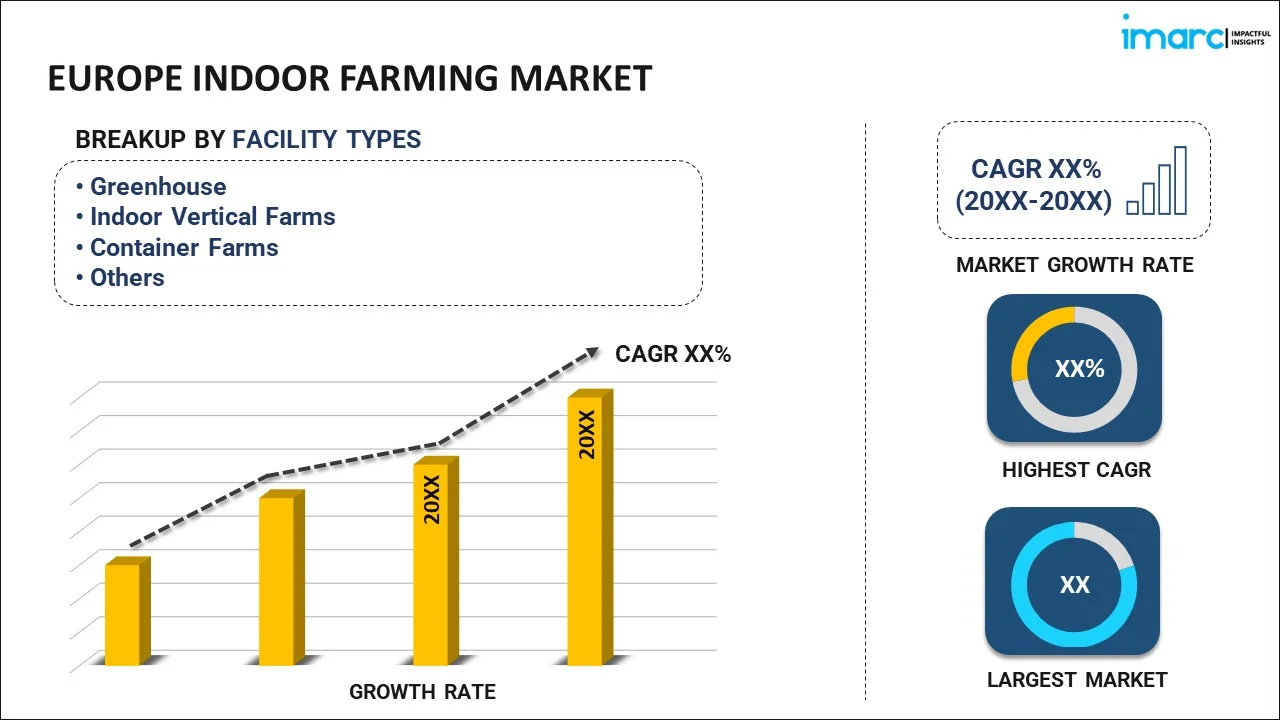
- Greenhouse
- Indoor Vertical Farms
- Container Farms
- Indoor Deep Water Culture
- Others
Greenhouse dominates with a market share of 47.09% of the total Europe indoor farming market in 2025.
Greenhouses maintain their dominant position in the Europe indoor farming market due to established infrastructure networks, lower energy requirements compared to fully enclosed vertical farms, and proven operational economics. The ability to harness natural sunlight significantly reduces lighting costs while enabling cultivation of diverse crop varieties including tomatoes, cucumbers, peppers, and ornamental plants. European greenhouse operators benefit from decades of accumulated expertise in climate management, pest control, and yield optimization that supports commercial-scale production. The mature supply chain ecosystem connecting growers with equipment manufacturers, seed suppliers, and distribution partners further reinforces greenhouse competitiveness across country markets.
Advanced glass greenhouse technologies incorporating automated ventilation, heating systems, and supplemental LED lighting are enhancing year-round productivity across the country. The Netherlands remains the epicenter of greenhouse innovation, with the Westland cluster hosting leading technology developers and research institutions driving continuous improvement in cultivation methodologies. In November 2024, Hazera launched a high-tech research and development greenhouse spanning five hectares in Made, Netherlands, advancing tomato variety development with disease resistance and enhanced flavor profiles that strengthen the segment's competitive advantage.
Crop Type Insights:
- Fruits, Vegetables, and Herbs
- Lettuce
- Spinach
- Kale
- Tomato
- Herbs
- Bell and Chilli Peppers
- Strawberry
- Cucumber
- Others
- Flowers and Ornamentals
- Annuals
- Perennials
- Ornamentals
- Others
- Others
Fruits, vegetables, and herbs lead with a share of 96.56% of the total Europe indoor farming market in 2025.
The fruits, vegetables, and herbs segment commands an overwhelming market share driven by sustained consumer demand for fresh, locally produced edible crops throughout the year. Leafy greens including lettuce, spinach, and kale thrive particularly well under controlled indoor conditions, with LED lighting configurations optimized for chlorophyll synthesis and rapid growth cycles. Tomatoes and cucumbers represent the cornerstone of European greenhouse production, with Dutch cultivation facilities achieving exceptional yields through intensive growing practices and advanced climate management systems. The segment benefits from established retail partnerships that prioritize consistent quality and year-round supply reliability.
Indoor strawberry cultivation is emerging as a high-growth category with specialized LED top-lighting systems enhancing pollination and protecting flavor compounds for premium market positioning. Herbs including basil, mint, and cilantro command attractive margins due to short production cycles and strong foodservice demand. The Netherlands has deployed extensive LED infrastructure within its greenhouse facilities, demonstrating the scale of technological investment supporting edible crop production across the country. Consumer willingness to pay premium prices for pesticide-free produce continues strengthening demand fundamentals throughout the forecast period.
Component Insights:
- Hardware
- Structure
- LED Lights
- HVAC
- Climate Control System
- Irrigation Systems
- Others
- Software
- Web-based
- Cloud-based
Hardware exhibits a clear dominance with 89.22% share of the total Europe indoor farming market in 2025.
Hardware components constitute the foundational investment requirement for indoor farming facilities, encompassing the physical infrastructure and equipment essential for controlled environment agriculture operations. Modern horticultural LED fixtures deliver precisely calibrated light spectra that optimize photosynthesis while minimizing energy consumption, with advanced systems demonstrating significant efficiency improvements compared to traditional lighting solutions. Climate control systems incorporating heating, ventilation, and air conditioning equipment ensure stable growing conditions essential for consistent crop quality throughout seasonal variations and external weather fluctuations.
Irrigation infrastructure encompassing drip systems, fertigation equipment, and water recirculation technologies enables resource-efficient cultivation that dramatically reduces water consumption compared to conventional field agriculture. Structural components including greenhouse frames, covering materials, and vertical racking systems represent substantial capital outlays during facility establishment, requiring careful engineering to maximize growing space utilization. Hardware investments account for the majority of initial setup costs for indoor farming facilities across Europe, underscoring the segment's pivotal role in market development. Continuous technological advancement in sensor networks, automated monitoring systems, and precision equipment is driving operational improvements while enhancing return on infrastructure investments.
Growing System Insights:
- Aeroponics
- Hydroponics
- Aquaponics
- Soil-based
- Hybrid
Soil-based represents the leading segment with a 41.63% share of the total Europe indoor farming market in 2025.
Soil-based cultivation systems maintain their market leadership position through compatibility with established greenhouse infrastructure and familiarity among traditional horticultural operators. These systems leverage natural soil or substrate media including rockwool and coco coir to support root development while benefiting from controlled environment advantages such as climate regulation and pest protection. The transition from open-field farming to protected soil-based cultivation represents an accessible entry point for agricultural enterprises seeking to improve yield consistency and product quality. Growers appreciate the operational simplicity and reduced technical complexity compared to soilless alternatives, enabling gradual technology adoption without extensive workforce retraining.
Hydroponics represents the fastest-growing cultivation methodology, with systems delivering mineral nutrient solutions directly to plant roots without soil intermediaries. Growing demand for fresh produce combined with water scarcity concerns positions hydroponics for accelerated adoption, particularly for leafy greens and herb production. The Netherlands pioneered commercial-scale hydroponic greenhouse operations, with leading technology providers including Priva equipping high-tech greenhouses worldwide with automation systems that optimize nutrient delivery and environmental control. This Dutch expertise continues driving global innovation in soilless cultivation technologies.
Country Insights:
- Germany
- France
- United Kingdom
- Italy
- Spain
- Others
Germany dominates with a market share of 24% of the total Europe indoor farming market in 2025.
Germany leads the Europe indoor farming market through strong governmental support for sustainable agriculture and advanced technological capabilities concentrated in major urban centers. Municipalities in Berlin, Hamburg, and Munich are accelerating zoning approvals for rooftop greenhouses and basement vertical farms to address urban food production demands. State-backed loan programs supporting smart sensor investments are stimulating digital technology adoption across the agricultural sector, positioning Germany as the continent's fastest-growing market with projected expansion outpacing country averages through the forecast period. The country's robust manufacturing base provides competitive advantages in equipment sourcing and facility construction.
The German market benefits from proximity to leading research institutions and technology developers driving innovation in automation, LED efficiency, and climate management systems. Consumer demand for locally-grown, pesticide-free produce aligns with national sustainability objectives, creating favorable conditions for indoor farming expansion. Strong retail networks actively seeking domestic supply partnerships further strengthen market fundamentals. In January 2025, Avisomo secured EUR 5 Million in Series A funding to expand vertical farming operations across European markets including Germany, demonstrating continued investor confidence in controlled environment agriculture despite broader economic uncertainties.
Market Dynamics:
Growth Drivers:
Why is the Europe Indoor Farming Market Growing?
Rising Consumer Demand for Locally-Grown and Pesticide-Free Produce
European consumers are increasingly prioritizing fresh produce cultivated without synthetic pesticides, driving substantial demand for indoor farming outputs. Health consciousness and environmental awareness are reshaping purchasing behaviors, with shoppers willing to pay premium prices for traceable, sustainably-grown vegetables and herbs. Indoor farming facilities positioned near urban population centers deliver superior freshness while eliminating long-distance transportation requirements that compromise product quality and increase carbon emissions. Retail partnerships between indoor farmers and major supermarket chains are expanding consumer access to vertically-farmed produce, validating market viability and accelerating category growth. The United Kingdom relies heavily on imported salad throughout the year, with dependency intensifying during winter months when domestic outdoor production ceases entirely. This import reliance presents significant domestic production opportunities for indoor farming operators capable of delivering consistent year-round supply. Growing consumer trust in controlled environment agriculture is strengthening demand fundamentals across premium produce categories.
Supportive Government Policies and Sustainability Initiatives
Government policies across Europe are creating favorable conditions for indoor farming investment through subsidies, tax incentives, and research funding programs targeting sustainable agriculture development. The European Green Deal framework emphasizes reducing agricultural carbon footprints while enhancing food system resilience, aligning with indoor farming capabilities for resource-efficient production. National initiatives across member states demonstrate strong public commitment to controlled environment agriculture advancement through dedicated funding allocations and innovation programs. The Common Agricultural Policy directs substantial resources toward climate action, supporting transitions toward sustainable farming practices that indoor cultivation methods readily satisfy. Urban planning frameworks increasingly accommodate indoor farming facilities within mixed-use developments, facilitating integration of food production into metropolitan environments. country development agencies actively promote agricultural technology clusters that concentrate expertise and accelerate innovation. These coordinated policy efforts are reducing investment barriers while strengthening the commercial case for controlled environment agriculture expansion.
Technological Advancements in LED Lighting and Automation Systems
Continuous improvements in LED horticultural lighting efficiency are transforming indoor farming economics by reducing energy consumption while optimizing plant growth outcomes. Modern LED systems deliver precisely tuned light spectra that maximize photosynthetic efficiency across different growth stages and crop varieties, with manufacturing costs declining substantially over the past decade. Automation technologies including robotic harvesting, automated transplanting, and AI-powered environmental monitoring are addressing labor constraints while improving operational consistency. Cloud-based farm management platforms integrate data from extensive sensor networks within each facility to autonomously regulate lighting intensity, nutrient concentrations, and atmospheric conditions. Machine learning algorithms continuously optimize growing parameters based on real-time crop performance data.
Market Restraints:
What Challenges the Europe Indoor Farming Market is Facing?
High Initial Capital Investment Requirements
The establishment of indoor farming facilities requires substantial upfront capital expenditure for infrastructure, equipment, and technology systems that present barriers to market entry. Building and maintaining high-tech vertical farms demands significant investments that vary considerably depending on location, facility size, and system complexity. Advanced lighting arrays, climate control infrastructure, and automation technologies collectively represent major financial commitments during facility development. These capital requirements limit participation to well-funded enterprises and restrict expansion among smaller agricultural operators seeking market entry.
Energy Consumption and Operational Cost Pressures
Indoor farming facilities face significant energy consumption demands, particularly fully enclosed vertical farms requiring artificial lighting throughout cultivation cycles. Energy costs represent major operational expenses that impact profitability, especially during periods of elevated electricity prices affecting European markets. Vertical farms consume substantially more energy per unit of produce compared to greenhouses utilizing natural sunlight, creating competitive disadvantages against traditional cultivation methods during energy price volatility.
Regulatory Fragmentation Across European Markets
Inconsistent regulatory frameworks across European Union member states introduce compliance complexity and consumer confusion regarding indoor farming classifications. The European Food Safety Authority has not issued specific protocols for soilless indoor cultivation, leaving interpretation to national authorities. This regulatory ambiguity deters retail partnerships and prevents effective communication of sustainability benefits, hindering market expansion and consumer confidence building across the country.
Competitive Landscape:
The Europe indoor farming market features a diverse competitive landscape encompassing established greenhouse operators, emerging vertical farming enterprises, and technology solution providers. Companies are differentiating through proprietary cultivation systems, energy efficiency innovations, and retail partnership development to secure market positioning. Strategic investments in automation technologies and AI-powered farm management platforms are enabling operational scale improvements while reducing labor dependencies. Market consolidation is accelerating as financially resilient operators acquire distressed assets and expand facility networks. Partnerships between indoor farmers and major retailers are strengthening supply chain integration while validating commercial viability of controlled environment agriculture for fresh produce categories.
Europe Indoor Farming Report Coverage:
| Report Features | Details |
|---|---|
| Base Year of the Analysis | 2025 |
| Historical Period | 2020-2025 |
| Forecast Period | 2026-2034 |
| Units | Billion USD |
| Scope of the Report | Exploration of Historical and Forecast Trends, Industry Catalysts and Challenges, Segment-Wise Historical and Predictive Market Assessment:
|
| Facility Types Covered | Greenhouse, Indoor Vertical Farms, Container Farms, Indoor Deep Water Culture, Others |
| Crop Types Covered |
|
| Components Covered |
|
| Growing Systems Covered | Aeroponics, Hydroponics, Aquaponics, Soil-based, Hybrid |
| Regions Covered | Germany, France, United Kingdom, Italy, Spain, Others. |
| Customization Scope | 10% Free Customization |
| Post-Sale Analyst Support | 10-12 Weeks |
| Delivery Format | PDF and Excel through Email (We can also provide the editable version of the report in PPT/Word format on special request) |
Frequently Asked Questions About the Europe Indoor Farming Market Report
The Europe indoor farming market size was valued at USD 14.76 Billion in 2025.
The Europe indoor farming market is expected to grow at a compound annual growth rate of 8.99% from 2026-2034 to reach USD 32.03 Billion by 2034.
Greenhouse dominates the market with a share of 47.09%, driven by established infrastructure networks, superior energy efficiency compared to fully enclosed facilities, and proven operational economics enabling year-round cultivation of diverse high-value crops.
Key factors driving the Europe indoor farming market include rising consumer demand for locally-grown and pesticide-free produce, supportive government sustainability policies, technological advancements in LED lighting and automation systems, increasing urbanization reducing arable land, and growing retail partnerships expanding distribution channels.
Major challenges include high initial capital investment requirements, significant energy consumption and operational cost pressures, regulatory fragmentation across EU member states, skilled labor shortages, and competitive pressure from lower-cost imports produced through traditional agricultural methods.
Need more help?
- Speak to our experienced analysts for insights on the current market scenarios.
- Include additional segments and countries to customize the report as per your requirement.
- Gain an unparalleled competitive advantage in your domain by understanding how to utilize the report and positively impacting your operations and revenue.
- For further assistance, please connect with our analysts.
 Request Customization
 Speak to an Analyst
 Request Brochure
 Inquire Before Buying
Benefits of Customization
- Personalize this research
- Triangulate with your data
- Get data as per your format and definition
- Gain a deeper dive into a specific application, geography, customer, or competitor
- Any level of personalization
Get in Touch With Us
UNITED STATES
Phone: +1-201-971-6302
INDIA
Phone: +91-120-433-0800
UNITED KINGDOM
Phone: +44-753-714-6104
Email: [email protected]
Client Testimonials




.webp)




.webp)













Related Reports

Choose your plan
*Please note that the prices mentioned below are starting prices for each bundle type. Kindly contact our team for further details.*
Single User License
- 1 User License, Access on 2 Devices
- PDF Report + Excel Dataset (Password Protected)
- Lifetime Access
- No Printing Rights
- 10% Free Report Customization
- 10–12 Weeks of Analyst Support
Five User License
- Access for 5 Users, 2 Devices per User
- PDF Report + Excel Dataset (Password Protected)
- Lifetime Access
- Dedicated Account Manager
- 12–14 Weeks of Analyst Support
- No Printing Rights
- 15% Free Report Customization
- 25% Discount on Your Next Purchase
Corporate User License
- Unlimited User Access (Within Your Organization)
- PDF Report + Excel Dataset
- Lifetime Access
- Dedicated Account Manager
- 14–20 Weeks of Analyst Support
- No Printing Rights
- 20% Free Report Customization
- 30% Discount on Your Next Purchase
Essential Insights
What's included:
3 reports
- Lifetime Access
- PDF Reports
- Excel Datasets
- 2 Weeks of Free Analyst Support
- 2 User Licenses
- Access on 2 Devices
- Printing Rights
- Complimentary PowerPoint (PPT) Version
- Complimentary License Upgrade
Professional Access
What's included:
5 reports
- Lifetime Access
- PDF Reports
- Excel Datasets
- 8 Weeks of Free Analyst Support
- 2 User Licenses
- Access on 2 Devices
- Printing Rights
- Complimentary PowerPoint (PPT) Version
- Complimentary License Upgrade
Business Advantage
What's included:
8 reports
- Lifetime Access
- PDF Reports
- Excel Datasets
- 14 Weeks of Free Analyst Support
- 2 User Licenses
- Access on 2 Devices
- Printing Rights
- Complimentary PowerPoint (PPT) Version
- Complimentary License Upgrade
Enterprise Intelligence
What's included:
10 reports
- Lifetime Access
- PDF Reports
- Excel Datasets
- 20 Weeks of Free Analyst Support
- 2 User Licenses
- Access on 2 Devices
- Printing Rights
- Complimentary PowerPoint (PPT) Version
- Complimentary License Upgrade