
Latin America Artificial Intelligence Market Size, Share, Trends and Forecast by Type, Offering, Technology, System, End-Use Industry, and Country, 2026-2034
Latin America Artificial Intelligence Market Summary:
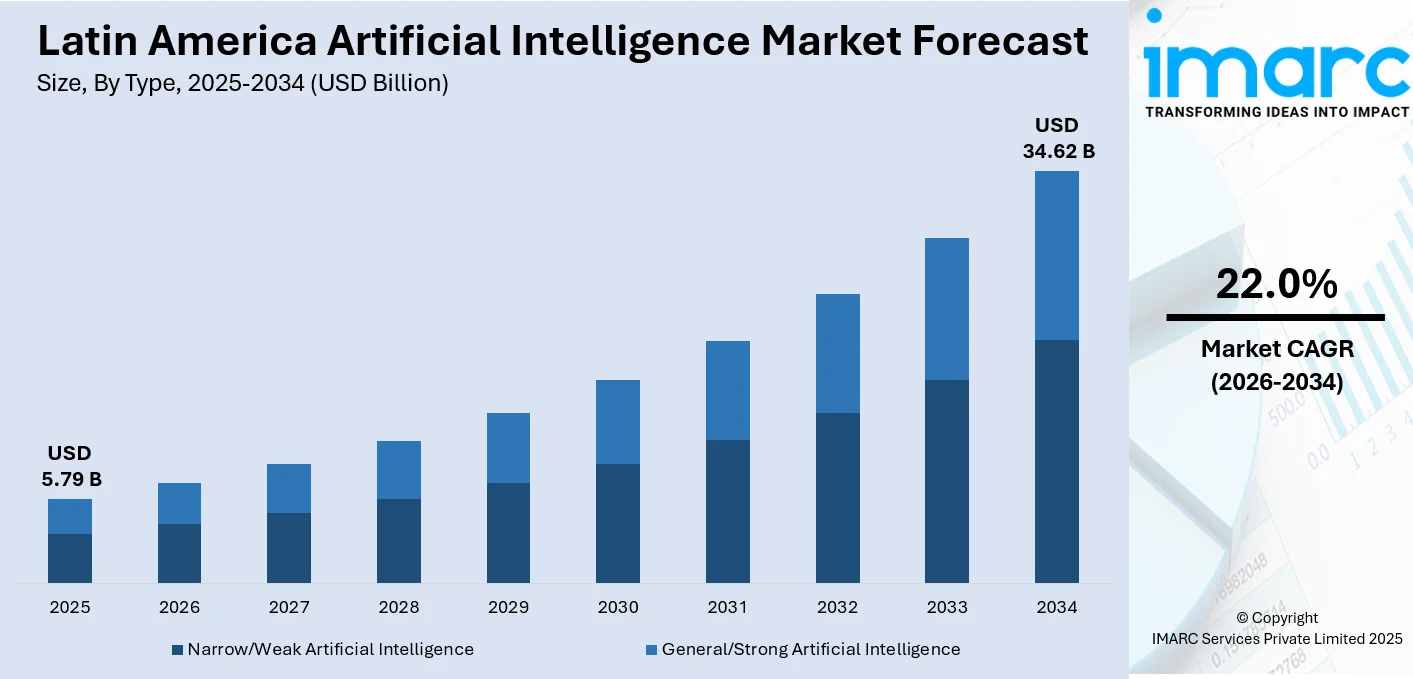
The Latin America artificial intelligence market size increased from USD 5.79 Billion in 2025 to USD 7.06 Billion in 2026 and is projected to reach USD 34.62 Billion by 2034, growing at a compound annual growth rate of 22.0% from 2026-2034.
The Latin America artificial intelligence market is experiencing robust expansion driven by accelerating digital transformation across key economic sectors including finance, healthcare, and manufacturing. Growing governmental support through national AI strategies and substantial public-private investments are creating favorable conditions for technology adoption. The proliferation of cloud-based AI solutions, coupled with increasing enterprise demand for automation and data-driven decision-making, is reshaping business operations throughout the region. Advancements in machine learning capabilities, expanding internet penetration, and rising consumer expectations for intelligent services are positioning Latin America as an emerging hub for AI innovation. These dynamics are collectively strengthening the Latin America artificial intelligence market share.
Key Takeaways and Insights:
-
By Type: Narrow/weak artificial intelligence dominates the market with a share of 81.8% in 2025, owing to its practical applicability across diverse business functions, proven commercial viability, and alignment with current enterprise requirements for task-specific automation and optimization solutions.
-
By Offering: Software leads the market with a share of 36.71% in 2025, driven by increasing deployment of AI-powered software solutions in enterprise operations, including chatbots, analytics tools, and automation platforms that enhance productivity and decision-making capabilities.
-
By Technology: Machine learning represents the largest segment with a market share of 38.85% in 2025, reflecting strong adoption in financial services for credit risk modeling, fraud detection, and real-time transaction monitoring applications across banking institutions.
-
By System: Intelligence systems exhibit a clear dominance with a 29.6% share in 2025, attributed to growing enterprise demand for integrated AI solutions capable of autonomous decision-making, pattern recognition, and cognitive computing functionalities.
-
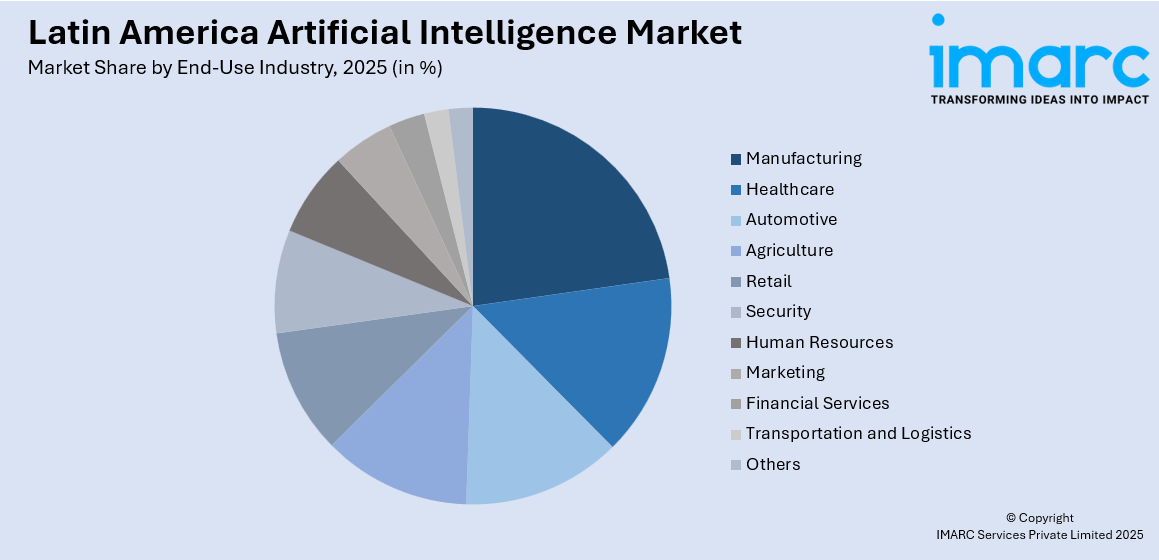
By End-Use Industry: Manufacturing holds the majority of the market share at 17.4% in 2025, driven by accelerating adoption of predictive maintenance, quality control automation, and Industry 4.0 practices transforming production lines across Brazil and Mexico.
-
By Country: Brazil is the biggest country with 25% share in 2025, driven by its robust technology ecosystem, substantial government investment through the Brazilian Artificial Intelligence Plan, and major multinational infrastructure commitments.
-
Key Players: Key players drive the Latin America artificial intelligence market by expanding cloud infrastructure, developing localized AI solutions, investing in regional data centers, and forming strategic partnerships with governments and enterprises to accelerate adoption, enhance service delivery, and strengthen competitive positioning across diverse industry verticals.
To get more information on this market Request Sample
The Latin America artificial intelligence market is advancing rapidly as governments, enterprises, and technology providers collaborate to build robust digital ecosystems across the region. Countries are implementing comprehensive national AI strategies with substantial funding allocations to drive innovation and technological sovereignty. In July 2024, Brazil launched the Brazilian Artificial Intelligence Plan (PBIA) 2024-2028 with an estimated investment of 23.03 Billion reais (approximately USD 4 Billion) dedicated to AI infrastructure and development and business innovation projects. The plan encompasses support for supercomputer development, talent training initiatives, and AI applications across public services including healthcare, education, and agriculture. Major multinational technology companies are significantly expanding their regional presence, with cloud infrastructure investments creating foundational capabilities for enterprise AI adoption. The convergence of government commitment, private sector investment, and growing digital literacy is establishing Latin America as an increasingly important player in the global AI landscape, fostering innovation while addressing regional development challenges and Latin America artificial intelligence market growth.
Latin America Artificial Intelligence Market Trends:
Accelerating Cloud-Based AI Solution Adoption
Cloud-hosted AI architectures and application programming interfaces are dramatically reducing deployment costs and enabling broader market access across Latin America. Small-to-medium enterprises previously limited by hardware investment requirements are now implementing AI for customer service automation, logistics optimization, and analytics-driven decision-making. Subscription-based models and platform-as-a-service offerings are democratizing access to sophisticated machine learning capabilities. The rapid acceleration in cloud-first AI strategies among regional businesses demonstrates growing enterprise preference for scalable, cost-effective solutions over traditional on-premise infrastructure investments.
Expansion of Generative AI Applications
Generative AI technologies are gaining substantial traction across Latin America as startups and established enterprises leverage these capabilities for content creation, marketing optimization, and customer engagement enhancement. Digital agencies are rapidly adopting AI-powered tools to streamline campaign development and improve user interaction quality. Academic institutions are contributing to regional capability building through dedicated research initiatives. Leading universities across the region have introduced dedicated generative AI research laboratories, focusing on ethical use cases and developing localized language models tailored for Spanish and Portuguese speakers to serve regional market requirements.
Smart City Initiatives Driving Urban AI Integration
Smart city initiatives are accelerating AI adoption throughout Latin America as municipalities seek to improve urban infrastructure, traffic management, and energy efficiency. AI-powered systems are being integrated into public services including surveillance, waste management, and water distribution networks. Governments are partnering with technology firms to deploy intelligent solutions for sustainable urban development. In October 2024, Gorilla Technology Group announced a strategic collaboration with NC Digy Smart Cities LLC, AECOM and Protactics to transform urban landscapes across Latin America and United States through next-generation smart city implementations leveraging advanced AI technologies for infrastructure optimization.
Market Outlook 2026-2034:
The Latin America artificial intelligence market outlook remains highly promising as the region positions itself for sustained expansion driven by converging technological, economic, and policy factors. Digital transformation initiatives across manufacturing, financial services, healthcare, and retail sectors continue accelerating enterprise AI adoption. Government commitments to national AI strategies coupled with substantial private sector investments are creating robust foundations for innovation ecosystems. The market generated a revenue of USD 5.79 Billion in 2025, which is expected to reach USD 7.06 Billion in 2026 and further grow to USD 34.62 Billion by 2034, growing at a compound annual growth rate of 22.0% from 2026-2034. Expanding cloud infrastructure, growing availability of AI talent, and increasing enterprise digitalization are strengthening regional capabilities. Cross-border collaborations between local innovators and global technology leaders are enhancing research capacity and accelerating product development cycles to meet evolving market demands.
Latin America Artificial Intelligence Market Report Segmentation:
|
Segment Category |
Leading Segment |
Market Share |
|
Type |
Narrow/Weak Artificial Intelligence |
81.8% |
|
Offering |
Software |
36.71% |
|
Technology |
Machine Learning |
38.85% |
|
System |
Intelligence Systems |
29.6% |
|
End-Use Industry |
Manufacturing |
17.4% |
|
Country |
Brazil |
25% |
Type Insights:
- Narrow/Weak Artificial Intelligence
- General/Strong Artificial Intelligence
Narrow/weak artificial intelligence dominates with a market share of 81.8% of the total Latin America artificial intelligence market in 2025.
Narrow artificial intelligence systems designed for specific task execution represent the predominant technology deployment across Latin American enterprises seeking practical automation solutions. These specialized AI applications excel in defined operational contexts including customer service chatbots, predictive analytics engines, recommendation algorithms, and process automation tools. The technology's proven reliability, lower implementation complexity, and demonstrable return on investment make it particularly attractive for organizations beginning their AI transformation journeys. The overwhelming majority of AI implementations across the region utilize narrow AI applications due to their immediate business applicability and proven commercial viability.
The dominance of narrow AI reflects regional market maturity levels and practical enterprise requirements for technologies delivering measurable operational improvements within existing business frameworks. Financial institutions extensively deploy narrow AI for fraud detection and credit scoring, while retail organizations leverage these systems for inventory optimization and personalized marketing. Manufacturing facilities implement narrow AI for predictive maintenance and quality assurance applications. The technology's ability to integrate with legacy systems while providing tangible efficiency gains continues driving adoption across diverse industry verticals, establishing narrow AI as the foundational layer of artificial intelligence infrastructure throughout Latin America.
Offering Insights:
- Hardware
- Software
- Services
Software leads with a share of 36.71% of the total Latin America artificial intelligence market in 2025.
AI software solutions encompassing enterprise applications, analytics platforms, and automation tools represent the largest offering segment as organizations prioritize intelligent capabilities enhancing operational efficiency. Cloud-based software delivery models have significantly lowered adoption barriers, enabling businesses of varying sizes to access sophisticated AI functionalities through subscription arrangements. The proliferation of chatbots, virtual assistants, and intelligent automation platforms reflects growing enterprise demand for customer-facing and back-office AI applications. The rapid acceleration in cloud-hosted AI software adoption demonstrates shifting enterprise preferences toward flexible, scalable deployment models.
The software segment's leadership position stems from its versatility across industry applications and relatively lower capital requirements compared to hardware-intensive deployments. Enterprises increasingly favor platform-based AI solutions offering scalability, regular capability updates, and reduced maintenance burdens. Analytics software enabling data-driven decision-making, customer relationship management tools incorporating AI functionalities, and robotic process automation platforms are experiencing particularly strong demand. Local governments have supported AI software ecosystem development through funding programs and regulatory sandboxes, encouraging startups and smaller enterprises to build innovative applications addressing regional market requirements and driving sustained segment expansion.
Technology Insights:
- Machine Learning
- Natural Language Processing
- Context-Aware Computing
- Computer Vision
- Others
Machine learning represents the largest segment with a 38.85% share of the total Latin America artificial intelligence market in 2025.
Machine learning technologies enabling systems to improve performance through experience without explicit programming have achieved widespread adoption across Latin American industries seeking data-driven optimization capabilities. Financial sector applications demonstrate particularly strong penetration, with major banks leveraging machine learning for credit risk modeling, fraud detection, and algorithmic trading strategies. Healthcare organizations are implementing ML-powered diagnostic tools and treatment recommendation systems. The technology's critical role in regional financial services infrastructure continues expanding as institutions recognize its potential for enhancing security and operational efficiency.
Government initiatives promoting AI research have further accelerated machine learning adoption throughout the region. Public and private institutions have launched numerous machine learning-focused projects, significantly enhancing domestic capabilities and fostering innovation ecosystems. Agricultural applications leveraging ML for crop yield optimization, pest detection, and resource management represent growing use cases across major agricultural economies. The technology's versatility in addressing diverse analytical requirements from predictive maintenance in manufacturing to personalized recommendations in retail continues driving segment leadership.
System Insights:
- Intelligence Systems
- Decision Support Processing
- Hybrid Systems
- Fuzzy Systems
Intelligence systems exhibit a clear dominance with a 29.6% share of the total Latin America artificial intelligence market in 2025.
Intelligence systems incorporating cognitive computing capabilities, autonomous decision-making functionalities, and adaptive learning mechanisms represent the leading system category across Latin American AI deployments. These integrated platforms combine multiple AI technologies including machine learning, natural language processing, and knowledge representation to deliver comprehensive intelligent solutions. Enterprise applications range from sophisticated customer service automation to complex supply chain optimization requiring real-time analytical processing. The systems' ability to handle unstructured data, recognize patterns, and generate actionable insights drives adoption among organizations pursuing digital transformation objectives.
The segment benefits from growing enterprise recognition that standalone AI components deliver limited value compared to integrated intelligence systems capable of end-to-end process automation. Financial services organizations deploy intelligence systems for comprehensive risk management spanning credit assessment, fraud prevention, and regulatory compliance. Telecommunications providers leverage these platforms for network optimization and customer experience enhancement. The convergence of improved processing capabilities, expanded data availability, and maturing AI algorithms continues strengthening intelligence system performance, enabling increasingly sophisticated applications across Latin American industries seeking competitive advantages through artificial intelligence adoption.
End-Use Industry Insights:
Access the comprehensive market breakdown Request Sample
- Healthcare
- Manufacturing
- Automotive
- Agriculture
- Retail
- Security
- Human Resources
- Marketing
- Financial Services
- Transportation and Logistics
- Others
Manufacturing holds the largest share at 17.4% of the total Latin America artificial intelligence market in 2025.
Manufacturing sector adoption of artificial intelligence technologies is transforming production capabilities across Latin America as facilities implement predictive maintenance, quality control automation, and intelligent process optimization solutions. Brazil and Mexico lead regional manufacturing AI integration, leveraging established industrial bases and growing technology infrastructure investments. Industry 4.0 initiatives incorporating connected sensors, real-time analytics, and autonomous systems are modernizing factory operations. The Latin American smart manufacturing market continues expanding significantly, driven by accelerating AI solution integration to enhance operational efficiency and product quality across diverse manufacturing subsectors.
AI applications in manufacturing span production planning optimization, equipment performance monitoring, defect detection systems, and supply chain coordination functionalities. The adoption of cloud and edge computing in conjunction with AI enables real-time data processing, remote monitoring, and autonomous decision-making on factory floors. Customized AI algorithms tailored for specific industrial processes are driving innovation, enhancing product quality, and reducing operational downtime. Government initiatives supporting AI innovation hubs, research incentives, and pilot project funding are encouraging broader technology adoption among small and medium manufacturing enterprises previously constrained by implementation complexity and cost considerations.
Country Insights:
- Brazil
- Mexico
- Argentina
- Colombia
- Chile
- Peru
- Others
Brazil is the largest country with 25% share of the total Latin America artificial intelligence market in 2025.
Brazil maintains regional leadership in artificial intelligence adoption driven by its robust technology ecosystem, substantial government investment commitments, and major multinational infrastructure expansions establishing foundational capabilities for AI innovation. The country's diversified economy spanning finance, agriculture, manufacturing, and services creates extensive application opportunities for AI technologies addressing varied sectoral requirements. In September 2024, Microsoft announced a USD 2.7 billion investment over three years to expand cloud and AI infrastructure in Brazil, representing one of the largest technology investments in Latin American history and significantly strengthening regional digital capabilities.
The Brazilian government's comprehensive AI strategy demonstrates strong commitment to technological advancement and innovation ecosystem development. The Brazilian Artificial Intelligence Plan allocates substantial funding for AI research, infrastructure development, and business innovation projects over a multi-year period. The initiative encompasses support for developing advanced supercomputing capabilities, talent training programs, and AI applications across public services including healthcare, education, and agriculture. Brazil's established startup ecosystem, growing pool of technology talent, and increasing collaborations between academia and corporations position the country as Latin America's primary AI hub and strategic entry point for international firms targeting regional market opportunities.
Market Dynamics:
Growth Drivers:
Why is the Latin America Artificial Intelligence Market Growing?
Substantial Government Investment and National AI Strategies
Latin American governments are implementing comprehensive national artificial intelligence strategies with substantial funding commitments to establish technological sovereignty and drive economic development through AI innovation. These strategic initiatives encompass infrastructure development, talent cultivation, research support, and regulatory framework establishment creating favorable conditions for AI ecosystem growth. Brazil's government has demonstrated exceptional commitment through its national artificial intelligence plan, allocating significant resources across infrastructure development, business innovation projects, and public service applications. Mexico has attracted considerable AI investments through government partnerships alongside local universities and global technology companies focusing on developing AI talent pipelines and research capabilities. Chile's updated National Artificial Intelligence Policy positions the country as a regional leader with particular strengths in data infrastructure, advanced human capital, research, and connectivity supporting sustained AI development.
Major Multinational Technology Investments in Regional Infrastructure
Global technology leaders are significantly expanding their Latin American presence through substantial infrastructure investments creating foundational capabilities for enterprise AI adoption across the region. These commitments encompass data center expansions, cloud infrastructure development, and comprehensive digital skilling programs enhancing regional technological capacity. Major technology corporations have announced multi-billion dollar investments to expand cloud and AI infrastructure across key markets including Brazil and Mexico, representing some of the largest technology investments in Latin American history. Strategic agreements between multinational technology firms and international financial institutions are identifying and improving investment prospects in digital transformation across the region. These multinational investments strengthen regional digital infrastructure while elevating local ecosystems through upskilling programs and innovation incentives.
Accelerating Enterprise Digital Transformation Across Key Sectors
Comprehensive digital transformation initiatives across manufacturing, financial services, healthcare, and retail sectors are driving sustained enterprise demand for AI technologies delivering operational efficiency improvements and competitive advantages. Organizations increasingly recognize AI's potential to enhance productivity, automate repetitive processes, and improve customer engagement quality. Financial institutions extensively deploy AI for fraud detection, credit risk assessment, and personalized service delivery. Healthcare organizations implement AI-assisted diagnostic tools and telemedicine platforms incorporating intelligent patient triage capabilities. Manufacturing facilities leverage AI for predictive maintenance, quality control automation, and production optimization. The share of companies adopting AI across Latin America has grown substantially in recent years, demonstrating accelerating digital transformation momentum. International development organizations indicate AI can meaningfully increase annual economic growth across the region, underscoring technology's substantial potential contribution to regional economic development.
Market Restraints:
What Challenges the Latin America Artificial Intelligence Market is Facing?
Persistent AI Talent Shortage and Brain Drain
The lack of specialized AI talent remains the most significant barrier to technology adoption across Latin America, with advanced training programs insufficient and concentrated in limited countries. The talent gap relative to the global average continues widening, associated with accelerated brain drain as qualified specialists seek opportunities in more developed markets. Organizations struggle to recruit and retain professionals with expertise in machine learning, data science, and AI engineering disciplines essential for successful implementation.
High Implementation Costs and Integration Complexity
Integrating AI into existing enterprise systems requires significant investment in infrastructure, training, and customization that many organizations find prohibitive. Small and medium enterprises face particular challenges including limited access to capital, insufficient technical resources, and low technological readiness constraining adoption capabilities. Implementation complexity creates extended deployment timelines and uncertainty regarding return on investment, causing organizations to delay or limit AI initiatives despite recognizing potential benefits.
Infrastructure Gaps and Digital Connectivity Limitations
Uneven digital infrastructure development across Latin America creates significant barriers to AI adoption, particularly in rural and semi-urban areas lacking robust connectivity and computing resources. Many regions face insufficient data center capacity, limited broadband access, and unreliable power supply constraining technology deployment. These infrastructure limitations restrict the ability of organizations outside major urban centers to implement AI solutions, creating geographic disparities in technology adoption and limiting market expansion potential.
Competitive Landscape:
The Latin America artificial intelligence market exhibits increasing competitive intensity as global technology giants expand regional presence alongside emerging local innovators developing solutions addressing specific market requirements. Major international participants compete through cloud infrastructure investments, partnership programs, and localized service offerings. Regional companies are differentiating through specialized applications addressing language-specific requirements, industry-focused solutions, and intimate understanding of local business environments. Strategic collaborations between multinational corporations and local enterprises are accelerating capability development and market penetration. Competition centers on cloud-based service scalability, machine learning algorithm sophistication, natural language processing capabilities supporting Spanish and Portuguese, and comprehensive integration services enabling enterprise AI adoption.
Recent Developments:
-
In September 2025, Google Cloud unveiled transformative AI technologies at a customer event in Sao Paulo, announcing that its Sao Paulo cloud region would host Trillium, the company's sixth-generation TPU, marking the first deployment of this advanced AI hardware in Latin America. The company also introduced Capacita+ program targeting training of 200,000 professionals in generative AI across ten countries.
Latin America Artificial Intelligence Market Report Scope:
| Report Features | Details |
|---|---|
| Base Year of the Analysis | 2025 |
| Historical Period | 2020-2025 |
| Forecast Period | 2026-2034 |
| Units | Billion USD |
| Scope of the Report |
Exploration of Historical Trends and Market Outlook, Industry Catalysts and Challenges, Segment-Wise Historical and Future Market Assessment:
|
| Types Covered | Narrow/Weak Artificial Intelligence, General/Strong Artificial Intelligence |
| Offerings Covered | Hardware, Software, Services |
| Technologies Covered | Machine Learning, Natural Language Processing, Context-Aware Computing, Computer Vision, Others |
| Systems Covered | Intelligence Systems, Decision Support Processing, Hybrid Systems, Fuzzy Systems |
| End-Use Industries Covered | Healthcare, Manufacturing, Automotive, Agriculture, Retail, Security, Human Resources, Marketing, Financial Services, Transportation and Logistics, Others |
| Countries Covered | Brazil, Mexico, Argentina, Colombia, Chile, Peru, Others |
| Customization Scope | 10% Free Customization |
| Post-Sale Analyst Support | 10-12 Weeks |
| Delivery Format | PDF and Excel through Email (We can also provide the editable version of the report in PPT/Word format on special request) |
Frequently Asked Questions About the Latin America Artificial Intelligence Market Report
The Latin America artificial intelligence market size increased from USD 5.79 Billion in 2025 to USD 7.06 Billion in 2026.
The Latin America artificial intelligence market is expected to grow at a compound annual growth rate of 22.0% from 2026-2034 to reach USD 34.62 Billion by 2034.
Narrow/weak artificial intelligence dominated the market with a share of 81.8%, driven by its proven commercial viability, lower implementation complexity, immediate business applicability for task-specific automation, and alignment with current enterprise requirements for measurable operational improvements within existing systems.
Key factors driving the Latin America artificial intelligence market include substantial government investments in national AI strategies, major multinational technology infrastructure expansions, accelerating enterprise digital transformation, and growing cloud-based AI solution adoption.
Major challenges include persistent AI talent shortages and brain drain, high implementation costs and integration complexity, infrastructure gaps limiting rural connectivity, regulatory uncertainty, and insufficient investment relative to global averages.
Need more help?
- Speak to our experienced analysts for insights on the current market scenarios.
- Include additional segments and countries to customize the report as per your requirement.
- Gain an unparalleled competitive advantage in your domain by understanding how to utilize the report and positively impacting your operations and revenue.
- For further assistance, please connect with our analysts.
 Request Customization
 Speak to an Analyst
 Request Brochure
 Inquire Before Buying
Benefits of Customization
- Personalize this research
- Triangulate with your data
- Get data as per your format and definition
- Gain a deeper dive into a specific application, geography, customer, or competitor
- Any level of personalization
Get in Touch With Us
UNITED STATES
Phone: +1-201-971-6302
INDIA
Phone: +91-120-433-0800
UNITED KINGDOM
Phone: +44-753-714-6104
Email: [email protected]
Client Testimonials




.webp)




.webp)













Related Reports

Choose your plan
*Please note that the prices mentioned below are starting prices for each bundle type. Kindly contact our team for further details.*
Single User License
- 1 User License, Access on 2 Devices
- PDF Report + Excel Dataset (Password Protected)
- Lifetime Access
- No Printing Rights
- 10% Free Report Customization
- 10–12 Weeks of Analyst Support
Five User License
- Access for 5 Users, 2 Devices per User
- PDF Report + Excel Dataset (Password Protected)
- Lifetime Access
- Dedicated Account Manager
- 12–14 Weeks of Analyst Support
- No Printing Rights
- 15% Free Report Customization
- 25% Discount on Your Next Purchase
Corporate User License
- Unlimited User Access (Within Your Organization)
- PDF Report + Excel Dataset
- Lifetime Access
- Dedicated Account Manager
- 14–20 Weeks of Analyst Support
- No Printing Rights
- 20% Free Report Customization
- 30% Discount on Your Next Purchase
Essential Insights
What's included:
3 reports
- Lifetime Access
- PDF Reports
- Excel Datasets
- 2 Weeks of Free Analyst Support
- 2 User Licenses
- Access on 2 Devices
- Printing Rights
- Complimentary PowerPoint (PPT) Version
- Complimentary License Upgrade
Professional Access
What's included:
5 reports
- Lifetime Access
- PDF Reports
- Excel Datasets
- 8 Weeks of Free Analyst Support
- 2 User Licenses
- Access on 2 Devices
- Printing Rights
- Complimentary PowerPoint (PPT) Version
- Complimentary License Upgrade
Business Advantage
What's included:
8 reports
- Lifetime Access
- PDF Reports
- Excel Datasets
- 14 Weeks of Free Analyst Support
- 2 User Licenses
- Access on 2 Devices
- Printing Rights
- Complimentary PowerPoint (PPT) Version
- Complimentary License Upgrade
Enterprise Intelligence
What's included:
10 reports
- Lifetime Access
- PDF Reports
- Excel Datasets
- 20 Weeks of Free Analyst Support
- 2 User Licenses
- Access on 2 Devices
- Printing Rights
- Complimentary PowerPoint (PPT) Version
- Complimentary License Upgrade