Maleic Acid Price Falls 16.2% in Japan, 10.3% in China — Q1 2026 Update
13-May-2026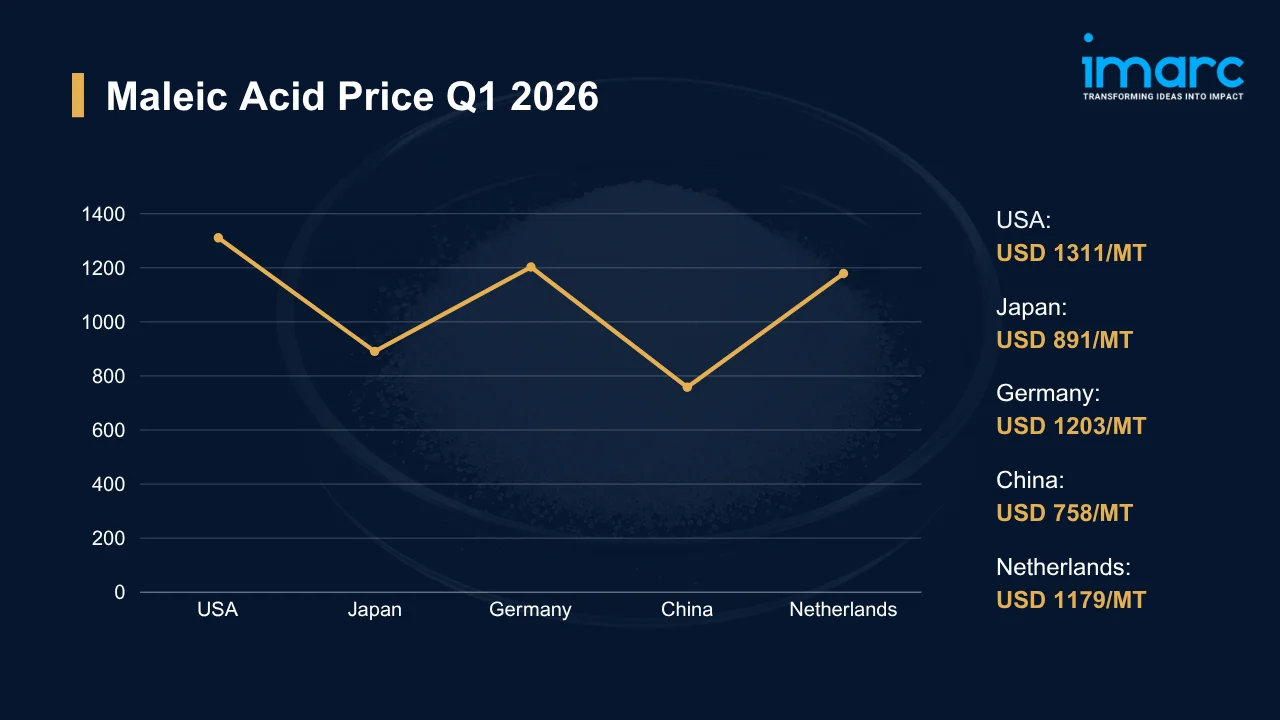
Summary:
Q1 2026 closed lower across all five tracked maleic acid markets, with every region settling below December levels under the weight of soft resin, coatings, and construction offtake throughout the entire period. Across the tape, maleic acid prices stayed firmly under pressure throughout. Declines ran from 4.6% to 16.2%. On the geopolitical side, the backdrop deepened the strain. Brent crude surged about 6.08% in late April 2026 to USD 118.03 per barrel as disruptions in the Strait of Hormuz worsened, as reported by Al Jazeera.
Maleic Acid Price Q1 2026:
Regional prices (USD per MT) and QoQ changes Q1 2026 vs Q4 2025:
| Region | Price (USD/MT) | QoQ Change | Direction |
|---|---|---|---|
| USA | 1311 | -4.6% | ↓ Decline |
| Japan | 891 | -16.2% | ↓ Decline |
| Germany | 1203 | -5.2% | ↓ Decline |
| China | 758 | -10.3% | ↓ Decline |
| Netherlands | 1179 | -6.1% | ↓ Decline |
To access real-time prices Request Sample
Kindly note: IMARC's pricing database tracks maleic acid price movements across major global markets.
What Moved Prices:
USA:
- During Q1 2026, USA maleic acid prices fell to USD 1311/MT, a 4.6% QoQ decline. Benzene prices along the Gulf Coast remained stable throughout the quarter, while UPR converters delayed new contracts, and coatings manufacturers relied on their current stock instead of making new purchases during March. Across the tape, the maleic acid price chart drifted lower.
- Imports from Asia kept landed offers competitive across distribution channels, freight stayed flat through the entire quarter, and procurement teams ran down December inventory before stepping back into the market for fresh material. On the demand side, construction and automotive offtake never picked up. Sellers were left with no real leverage on offer levels into March.
Japan:
- In Q1 2026, Japanese maleic acid prices fell sharply to USD 891/MT, a 16.2% QoQ slide and the steepest move on the tracked tape, reflecting unusually weak chemical and polymer-sector buying. Across Kawasaki and Tokyo-area converters, engagement was minimal through March. Production runs at regional plants stayed normal, leaving material easy to find.
- Across auto and chemical-intermediate buyers, demand drifted without ever finding momentum. Downstream operating rates eased into March, procurement at the major manufacturing hubs leaned on cost discipline over volume, and the major buying centers prioritized inventory drawdown rather than fresh commitments. With output from regional petrochemical complexes steady, the oversupply only thickened.
Germany:
- During Q1 2026, German maleic acid prices slipped to USD 1203/MT, off 5.2% QoQ. Mittelstand converters stayed measured through the entire quarter, EU coatings demand was steady but unspectacular, and Rhine corridor logistics costs gave sellers nothing especially surprising to work with on cost recovery. With no margin tailwind, offer levels drifted lower into March.
- European producers ran their plants normally through the quarter, the distribution network stayed well stocked, and uneven recovery across automotive and construction end uses left little room for sellers to push prices higher into March. With non-European importers further pressuring the offer side, sellers found no traction. Procurement teams remained broadly defensive across the period.
China:
- During Q1 2026, Chinese maleic acid prices dropped to USD 758/MT, down 10.3% QoQ. Yangtze corridor producers operated at full rates through the entire quarter, downstream resin and chemical-intermediate buyers stayed light on volume, warehouse stocks kept building across the eastern provinces, and offtake never recovered. To clear material, sellers cut offers aggressively.
- Output from leading producers remained steady, inventory continued to rise, and the accumulation pushed spot offers throughout the quarter as buyers depleted current stocks rather than placing new orders. Across the downstream base, plastic additive, resin, and coatings demand crawled. Industrial activity stayed thin throughout March.
Netherlands:
- During Q1 2026, Dutch maleic acid prices dropped to USD 1179/MT, off 6.1% QoQ. Rotterdam-cleared imports came in steady through the period, ARA distribution kept inventory comfortable, and downstream construction and coatings buyers held back consistently through the entire quarter on broadly cautious sentiment. Across the buying side, procurement volumes stayed thin into March.
- Imports from regional and Asian suppliers kept the inventory cushion comfortable across the ARA hubs through the entire quarter, and composite and coatings producers consumed enough to keep things ticking but not enough to bid offers higher into March. Across Rotterdam-area logistics nodes, costs went sideways throughout. Sellers held no real leverage on offer levels.
Maleic Acid Price Outlook After the Israel–Iran–USA Conflict:
Rising Energy Costs and Feedstock Pressure for Maleic Acid: With the conflict redrawing global energy markets, maleic acid producers might absorb higher benzene and n-butane costs in the coming months. Freight bills will firm in step. Producers may also face tighter operating margins as utilities and transportation expenses continue climbing across key manufacturing hubs.
Regional Demand Volatility and Pricing Uncertainty in Maleic Acid: Across the major buying regions, maleic acid demand might fragment further through 2026 as construction, automotive, and packaging users rework order books in response to shifting cost expectations and a shakier macro picture. Spot premiums will widen unevenly across the tape. With geopolitical risk hanging over the year, European and Asian importers might push major commitments into H2.
Immediate Market Reaction:
As the Israel–Iran–USA conflict unfolds, the maleic acid market is absorbing immediate stress along the feedstock supply routes that pass through Middle Eastern shipping. European and Asian producers, dependent on benzene and n-butane derivatives that flow through Persian Gulf and Red Sea corridors, might see input availability tighten if Cape of Good Hope rerouting and bunker surcharges persist through the second half. Across regions, the maleic acid price index might respond unevenly. Asia-based suppliers will keep a pricing edge from feedstock proximity. Meanwhile, European converters face widening landed-cost differentials.
Impact on Maleic Acid Prices:
The conflict might trigger several key changes in the maleic acid market:
- Feedstock Cost Escalation: Higher benzene and n-butane prices, on the back of stronger crude benchmarks and tighter petrochemical feedstock availability across Middle Eastern and Asian production zones, might pass through to maleic acid production costs at the major manufacturing hubs. At the producer level, margin compression looks unavoidable. Producers will push to recover input costs through firmer offers, even where downstream demand is soft and converters resist any meaningful upward repricing.
- Logistics and Freight Surcharges: With Cape of Good Hope rerouting now baked into Asia–Europe maleic acid trade flows, longer voyage times and stronger bunker fuel costs will keep delivered prices elevated for European and Mediterranean buyers through the back half of 2026. Spot freight surcharges might add several points to landed cost in the near term. In response, procurement teams will reach for earlier cover.
- Demand-Side Hesitation: Construction, automotive, and coatings users might delay non-essential purchases as broader macro uncertainty stemming from the conflict pushes capex commitments and consumer-facing investment plans across the major industrial regions to the side. For unsaturated polyester resins, a major maleic acid derivative, order books will soften further into mid-2026. Converters might also pivot toward lower-priced regional supply where the math allows, accelerating import substitution.
Taken together, these forces will keep maleic acid prices in a higher and more volatile range than pre-conflict levels, with regional differentials widening as supply, freight, and demand factors pull in different directions. Sellers will lock in feedstock cover early. On the buy side, procurement teams might lean toward shorter-cycle deals through 2026, prioritizing flexibility.
Supply Chain Disruptions:
Maleic acid supply chains run right through the exposed routes: benzene and n-butane feedstocks moving along Persian Gulf shipping lanes, and Asia–Europe cargoes pushed around the Cape of Good Hope under sustained risk. With Hormuz access restricted, tanker capacity for petrochemical cargoes might tighten. Conflict-adjacent freight rates will firm in the near term. In mid-March 2026, Iranian attacks knocked out 17% of Qatar's LNG export capacity, sidelining 12.8 Million Tons per year for three to five years.
Producers will work the obvious playbook by routing volumes through alternative ports, pre-buying feedstock cover to lock in critical supply, or pushing downstream contracts onto indexed structures tied directly to upstream benzene and crude benchmarks across the regions. With longer Cape voyages adding bunker burn and transit time to Asia–Europe flows, landed costs will sit elevated through 2026 even after geopolitical headlines ease. On the buy side, regional supply might win out over imports where the price math justifies the switch.
Global Market Overview:
Globally, the maleic acid industry reached a volume of 118.5 Thousand Tons in 2025. Market projections indicate steady growth, with the industry expected to reach 183.5 Thousand Tons by 2034, with a compound annual growth rate (CAGR) of 4.98% during 2026-2034. Coatings, unsaturated polyester resins, and chemical intermediates will lead the demand pull, with automotive, construction, agriculture, and packaging end users underpinning steady volumes through the forecast horizon. Evolving sustainability rules and feedstock diversification will shape the global maleic acid price trend.
Recent Highlights & Strategic Developments:
Recent strategic moves within the industry further illustrate evolving dynamics:
- In August 2025, a study investigated activated carbon cloths (ACC) for the recovery of maleic acid as a substitute for both particulate and monolithic electrosorptive systems. ACC characterization indicated a mildly acidic nature (pHpzc 6.18) and an amorphous structure, affecting both adsorption and electrical charging. Results showcased ACCs’ ability for effective electrosorptive recovery, even in the presence of competing ions, providing a sustainable option for industrial use.
Maleic Acid Price Forecast (2026):
Near-term maleic acid prices will follow the energy-cost arc of the conflict. Across end-use segments, demand recovery will stay uneven. Procurement caution might run through Q3, and any pullback in geopolitical risk could open a stabilization window as feedstock supply chains slowly normalize across petrochemical hubs into the back half of 2026.
If hostilities deepen, maleic acid prices will face renewed upward pressure as energy and logistics costs grind higher, risk premiums widen, and import substitution stalls in regions reliant on conflict-adjacent supply. Producers near the conflict zone might cut output, tightening global availability. Conversely, a diplomatic off-ramp would ease freight rates and restore feedstock flow, with prices drifting toward pre-conflict levels by late 2026. These dynamics will shape the maleic acid price forecast through the year.
Strategic Takeaways:
Looking ahead, the maleic acid market is expected to push through a noisier pricing environment shaped by feedstock supply, geopolitical risk, and uneven downstream demand across automotive, construction, coatings, and resin segments. Disciplined planning and active hedging will be central for procurement teams managing cost exposure across the 2026 contract cycle.
To navigate this complex landscape, stakeholders should:
- Track Regional Price Differentials: Monitor maleic acid price moves across the USA, Japan, Germany, China, and the Netherlands every quarter. Use the spread data carefully to time spot purchases, refine sourcing decisions, and find cost-saving procurement windows for buyers.
- Monitor Geopolitical Risk Exposure: Track escalation in the Israel–Iran–USA conflict closely and gauge how shifts in hostility levels might hit maleic acid feedstock availability and logistics costs. Set internal alert thresholds that fire procurement or hedging action when triggered.
- Diversify Supply Chain Routes: Evaluate alternative sourcing geographies and shipping corridors to lower dependence on conflict-exposed trade lanes for maleic acid imports. Secondary supplier deals and contingency freight arrangements will deliver critical resilience if primary routes face sudden disruption.
- Adjust Procurement Strategy for Conflict Conditions: Adopt flexible contract structures with price reopener clauses and force majeure provisions to protect against geopolitical spikes in maleic acid markets. Precautionary inventory buffers might soften the blow if supply tightens abruptly across major regions.
- Benchmark Feedstock Cost Pass-Through: Track upstream benzene and n-butane price moves alongside maleic acid price per MT benchmarks to gauge producer margin compression. Indexed contract pricing helps align purchase costs with the underlying input cost dynamics across major suppliers.
- Strengthen Supplier Relationship Management: Build closer engagement with primary maleic acid producers in stable jurisdictions to lock in allocation priority during periods of tight market conditions. Long-term contractual commitments also unlock real transparency on production schedules and capacity planning.
Subscription Plans & Customization:
IMARC offers flexible subscription models to suit varying needs:
- Monthly Updates — 12 deliverables/year
- Quarterly Updates — 4 deliverables/year
- Biannual Updates — 2 deliverables/year
Each includes detailed datasets (Excel + PDF) and post-report analyst support.

Get in Touch With Us
UNITED STATES
Phone: +1-201-971-6302
INDIA
Phone: +91-120-433-0800
UNITED KINGDOM
Phone: +44-753-714-6104
Email: sales@imarcgroup.com
Client Testimonials




.webp)




.webp)












