
Vietnam Animal Feed Market Size, Share, Trends and Forecast by Type, Product, and Region, 2026-2034
Vietnam Animal Feed Market Summary:
The Vietnam animal feed market size was valued at USD 2.24 Billion in 2025 and is projected to reach USD 3.5 Billion by 2034, growing at a compound annual growth rate of 4.98% from 2026-2034.
Vietnam's animal feed market is experiencing robust expansion driven by the country's flourishing livestock and aquaculture sectors. The increasing domestic consumption of meat and seafood products, coupled with rising disposable incomes and urbanization, continues to fuel demand for high-quality, nutritionally balanced animal feed formulations. Government initiatives promoting sustainable livestock production and modern farming practices are further accelerating market development across the nation.
Key Takeaways and Insights:
-
By Type: Poultry animal feed dominates the market with a share of 30% in 2025, driven by the rising demand for affordable protein sources and the expansion of commercial poultry farming operations across the country.
-
By Product: Fodder leads the market with a share of 54% in 2025, owing to the increasing demand for high-quality forage to support livestock production and sustainable farming practices.
-
By Region: Northern Vietnam represents the largest segment with a market share of 28.3% in 2025, supported by concentrated livestock farming activities and well-established feed manufacturing infrastructure.
-
Key Players: The Vietnam animal feed market exhibits a moderately competitive landscape characterized by the presence of both multinational corporations and established domestic manufacturers. Market participants are increasingly focusing on advanced feed formulations, precision nutrition technologies, and sustainable production practices to strengthen their competitive positioning across different livestock segments.
The Vietnam animal feed industry is undergoing a significant transformation driven by the country's rapidly expanding livestock and aquaculture sectors. Rising household incomes and changing dietary preferences toward protein-rich foods have substantially increased meat consumption, creating sustained demand for nutritionally optimized feed products. The government's regulatory framework under the Law on Animal Husbandry promotes quality standards and food safety, encouraging manufacturers to invest in advanced feed formulation technologies. The shift from traditional household farming to semi-industrial and commercial production models has accelerated the adoption of compound feeds that enhance animal growth rates and improve feed conversion efficiency. Notably, the poultry and swine industries together account for most of the meat production, with the aquaculture sector emerging as a high-growth segment driven by strong domestic seafood consumption and export opportunities.
Vietnam Animal Feed Market Trends:
Integration of Advanced Feed Additives and Precision Nutrition
The Vietnamese animal feed industry is witnessing a significant shift toward precision nutrition and advanced feed additives, including probiotics, prebiotics, enzymes, and amino acids. Manufacturers are increasingly incorporating these functional ingredients to enhance gut health, improve immunity, and optimize feed conversion ratios. The adoption of artificial intelligence and data analytics in feed formulation is enabling producers to develop customized nutritional solutions that maximize livestock productivity while minimizing waste, reflecting the industry's commitment to scientific advancement and efficiency optimization.
Expansion of Commercial Farming and Industrial Production Models
Vietnam is experiencing a structural transformation from traditional household-based livestock rearing to commercial and semi-industrial farming operations. This transition is driving substantial demand for standardized compound feeds that ensure consistent nutritional quality and support large-scale production requirements. Feed manufacturers are responding by expanding production capacities and establishing modern feed mills equipped with automated processing systems, biomass energy integration, and quality control technologies to meet the evolving needs of commercial livestock enterprises. For instance, in September 2024, Aboitiz Foods Group inaugurated the Gold Coin Feedmill Long An facility in Ben Luc District, Long An Province, situated within Nhut Chanh Industrial Park. Spanning 3.8 hectares and backed by a total investment of USD 45 million, the new factory is designed to produce 300,000 tons of animal feed annually. With this addition, Aboitiz Foods’ total production capacity in Vietnam now reaches 1.1 million tons per year, strengthening its position in the domestic animal feed and nutrition market.
Growing Focus on Sustainable and Plant-Based Feed Solutions
Environmental sustainability has emerged as a defining trend in Vietnam's animal feed sector, with manufacturers increasingly adopting plant-based feed formulations and eco-friendly production practices. The industry is transitioning away from animal-derived ingredients toward sustainable plant protein sources, reducing environmental impact while minimizing disease transmission risks. This shift aligns with government initiatives promoting green livestock production and international standards compliance, positioning Vietnamese feed producers to capture growing export opportunities in environmentally conscious global markets.
Market Outlook 2026-2034:
The Vietnam animal feed market is set for steady growth over the forecast period, driven by increasing demand for meat, the expansion of aquaculture activities, and ongoing modernization in livestock farming. Investments from foreign companies in feed production facilities are strengthening domestic manufacturing capacity, while government initiatives supporting local production are enhancing technological capabilities and efficiency. Together, these factors are fostering a more robust and competitive feed industry, enabling producers to meet rising consumption needs and improve overall productivity across the country’s livestock and aquaculture sectors. The market generated a revenue of USD 2.24 Billion in 2025 and is projected to reach a revenue of USD 3.5 Billion by 2034, growing at a compound annual growth rate of 4.98% from 2026-2034.
Vietnam Animal Feed Market Report Segmentation:
|
Segment Category |
Leading Segment |
Market Share |
|
Type |
Poultry Animal Feed |
30% |
|
Product |
Fodder |
54% |
|
Region |
Northern Vietnam |
28.3% |
Type Insights:
To get detailed segment analysis of this market, Request Sample
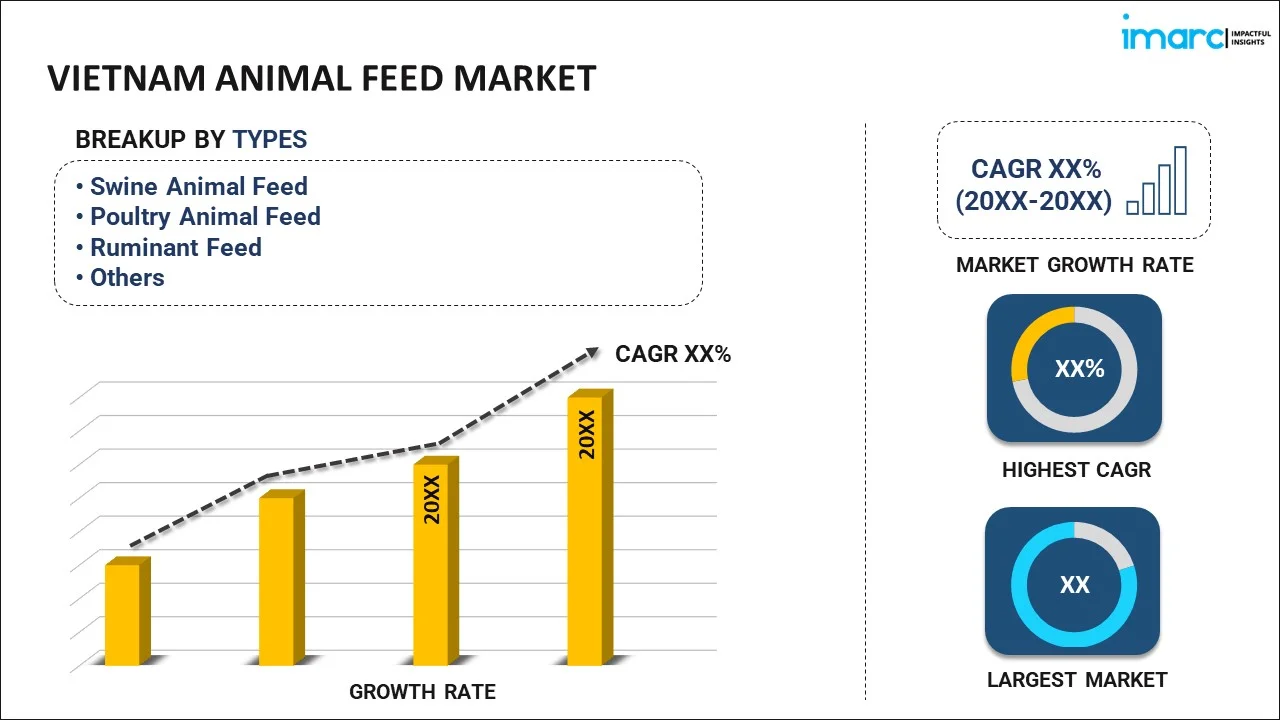
- Swine Animal Feed
- Poultry Animal Feed
- Ruminant Feed
- Aquatic Feed
- Others
The poultry animal feed dominates with a market share of 30% of the total Vietnam animal feed market in 2025.
The poultry animal feed segment maintains its leading position in Vietnam's animal feed market, driven by the substantial growth in commercial poultry farming operations and rising consumer demand for affordable protein sources. Chicken has emerged as a preferred meat choice among Vietnamese consumers due to its cost-effectiveness compared to pork and beef, accelerating the expansion of poultry production facilities nationwide. Feed manufacturers are developing specialized poultry formulations enriched with immune-boosting additives and optimized nutrient profiles to address disease prevention concerns and enhance production efficiency.
The segment benefits from the industry's shift toward intensive farming practices that require standardized, nutritionally complete feed products. Manufacturers are investing in research and development to create advanced poultry feed solutions that improve growth rates, egg production quality, and overall flock health. The expansion of modern feed mills with automated processing capabilities is enabling producers to meet the growing volume requirements of large-scale poultry enterprises while maintaining consistent product quality and nutritional standards across the country's diverse farming operations.
Product Insights:
- Fodder
- Forage
- Others
The fodder leads with a share of 54% of the total Vietnam animal feed market in 2025.
Fodder maintains a commanding position in Vietnam's animal feed product landscape, accounting for more than half of the total market share. This dominance reflects the widespread adoption of fodder-based feeding systems across the country's diverse livestock operations, from traditional family farms to modern commercial enterprises. The increasing emphasis on sustainable agricultural practices has strengthened demand for high-quality fodder products that support animal health while optimizing production costs for farmers across all scales of operation.
Technological advancements in agricultural practices have significantly enhanced fodder crop quality and yield, making these products more attractive to livestock producers seeking nutritious and cost-effective feeding solutions. The growing focus on animal welfare and organic farming standards has further elevated the importance of fodder in balanced livestock nutrition programs. Manufacturers are responding to market demands by developing improved fodder varieties and processing methods that maximize nutritional content while extending shelf life and storage capabilities for distribution across Vietnam's varied geographic regions.
Region Insights:
To get detailed regional analysis of this market, Request Sample
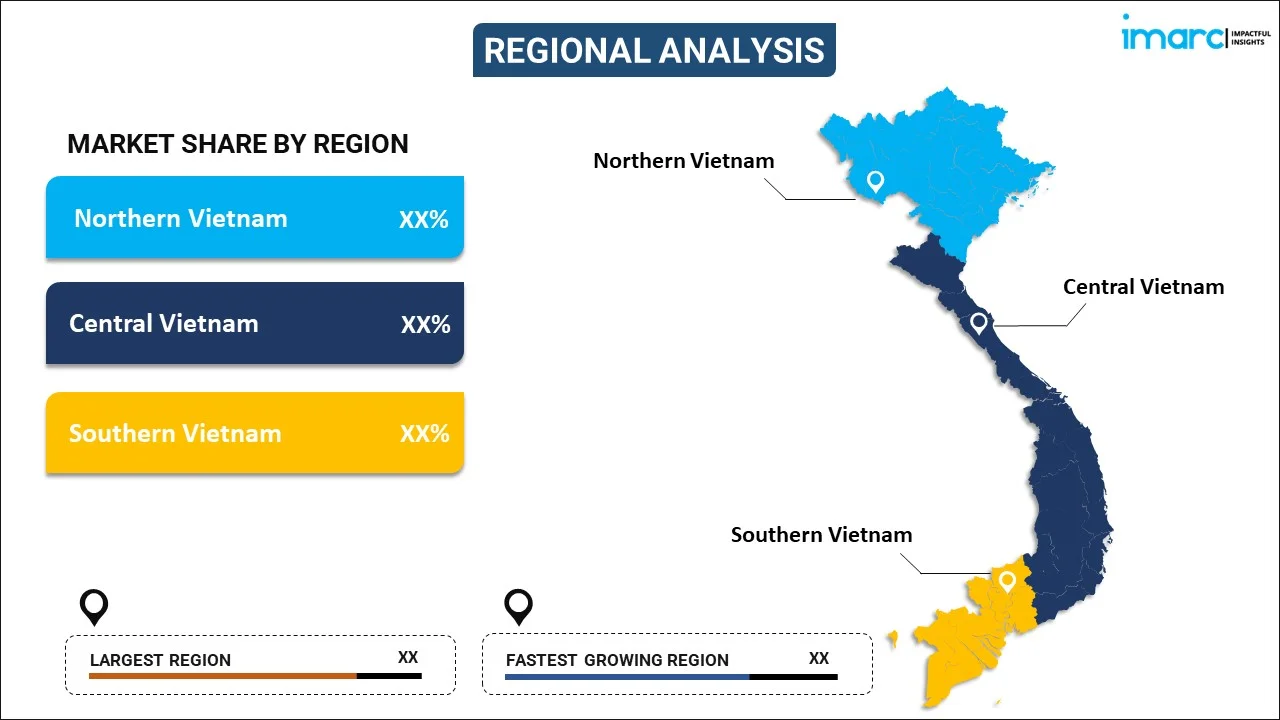
- Northern Vietnam
- Central Vietnam
- Southern Vietnam
Northern Vietnam exhibits a clear dominance with a 28.3% share of the total Vietnam animal feed market in 2025.
Northern Vietnam has established itself as the leading regional market for animal feed, supported by concentrated livestock farming activities in the Red River Delta and surrounding provinces. The region benefits from well-developed agricultural infrastructure, proximity to major consumption centers, and established distribution networks that facilitate efficient feed delivery to farming operations. Government investments in breeding programs and veterinary services have strengthened the region's livestock production capabilities, driving sustained demand for quality animal feed products.
The Northern region's diverse agro-climatic conditions support various livestock species, including pigs, poultry, and cattle, creating broad-based demand across multiple feed categories. Modern feed manufacturing facilities concentrated in industrial zones near Hanoi and surrounding provinces ensure reliable supply chains and competitive pricing for regional farmers. The area's cooler climate compared to southern regions provides favorable conditions for livestock health, supporting higher production efficiency and contributing to the sustained growth of the animal feed market across Northern Vietnam's agricultural landscape.
Market Dynamics:
Growth Drivers:
Why is the Vietnam Animal Feed Market Growing?
Rising Meat and Seafood Consumption Driven by Economic Development
Vietnam's sustained economic growth and rising disposable incomes are fundamentally transforming dietary patterns across the nation, with consumers increasingly incorporating protein-rich foods into their daily meals. In 2023, Vietnam imported fresh and processed meat products valued at approximately USD 1.5 billion, totaling around 783,800 tonnes, ranking it as the 27th largest global market for meat imports. The country’s primary meat suppliers were China, accounting for 15.9% of imports, followed by the United States at 8.3% and Japan at 7.7%, highlighting Vietnam’s reliance on a mix of regional and international sources to meet domestic demand. The growing middle-income group is also increasing demand for improved meat products, which are giving rise to massive needs for nutritionally optimized livestock feed, which will facilitate greater livestock productivity. The urbanization process is accelerating this change as urban consumers show a higher demand for a variety of protein sources, such as poultry, pork, and seafood, which requires an increase in the capacity to produce feed to meet new consumption trends. The structural demand increase of animal feed products of all types of livestock is further strengthened by the governmental attention to food security and nutritional improvement programs.
Expansion of Commercial Livestock and Aquaculture Operations
The Vietnamese livestock sector has been undergoing a fundamental transition from traditional, household-based farming to commercial and semi-industrial production models that call for standardized compound feed products. Large-scale poultry and swine operations are spread all over the country, encouraged by investments both from local companies and foreign direct investment, with advanced farming technologies and management methods. The aquaculture industry is a particularly dynamic growth segment, with shrimp and fish farming operations expanding to meet both strong domestic consumption and export demand for Vietnamese seafood products. This structural shift toward commercial farming creates sustained growth opportunities for feed manufacturers capable of delivering consistent quality products at competitive prices.
Technological Advancements in Feed Production and Formulation
New technologies being developed in animal feed production are raising the standards of product quality and production efficiencies within the animal feed industry in Vietnam. Modern processing machines, automated micro-dosing systems, as well as nutrition technologies are being applied by companies to design specialized animal feed formulas that can address animal health and productivity. The addition of functional components such as probiotics, prebiotics, enzymes, and amino acids to animal feeds is being done to address health concerns associated with livestock, as well as to improve the efficiency of animal feed conversion. Research & development (R&D) efforts being undertaken by major companies are generating advanced animal feed solutions suited to the livestock needs of Vietnam.
Market Restraints:
What Challenges the Vietnam Animal Feed Market is Facing?
Heavy Dependence on Imported Raw Materials
The animal feed industry in Vietnam is still reliant on imported raw materials such as soybeans and corn, making it vulnerable to global price fluctuations. Being reliant on imports affects the cost of production due to profitability issues within the industry. fluctuations in exchange rates also pose an additional challenge in dealing with input costs.
Disease Outbreaks Impacting Livestock Production
The Vietnamese animal farming industry periodically must deal with diseases like African Swine Fever and Bird Flu, which act as significant disruptors to the pattern of feed consumption. The diseases require culling activities, which ultimately lowers the number of animals and, during the initial stages, feed consumption as well.
Fragmented Small-Scale Farming Structure
Despite consolidation trends, a substantial portion of Vietnam's livestock production remains fragmented among small-scale household farms with limited purchasing power and technical capabilities. These traditional operations often rely on informal feeding practices, limiting market penetration for commercial compound feeds and constraining the overall growth potential of the organized animal feed industry.
Competitive Landscape:
The Vietnam animal feed market exhibits a moderately concentrated competitive structure characterized by the presence of established multinational corporations alongside prominent domestic manufacturers. Market participants compete across multiple dimensions including product quality, pricing strategies, distribution network coverage, and technical support services for livestock farmers. Leading manufacturers are investing substantially in production capacity expansion, advanced feed formulation technologies, and research capabilities to strengthen their competitive positioning. The industry landscape continues to evolve as foreign direct investment flows into feed manufacturing infrastructure, while domestic players leverage local market knowledge and established distribution relationships to defend their market positions across different regional and livestock segments.
Recent Developments:
-
In December 2025, Vietnam Agribusiness Limited inaugurated its second soybean crushing line at Phu My Industrial Park, adding significant processing capacity to produce nearly two million tonnes of soybean meal annually, meeting approximately thirty percent of Vietnam's domestic animal feed demand.
-
In June 2024, Japfa Comfeed opened a factory expansion project in Binh Xuyen district with a significant investment to enhance animal feed production capacity in Northern Vietnam.
-
In January 2024, a major international feed producer inaugurated a state-of-the-art premix plant in Binh Duong province to produce high-quality premix products tailored to Vietnam's growing animal feed market requirements.
Vietnam Animal Feed Market Report Coverage:
| Report Features | Details |
|---|---|
| Base Year of the Analysis | 2025 |
| Historical Period | 2020-2025 |
| Forecast Period | 2026-2034 |
| Units | Billion USD |
| Scope of the Report | Exploration of Historical and Forecast Trends, Industry Catalysts and Challenges, Segment-Wise Historical and Predictive Market Assessment:
|
| Types Covered | Swine Animal Feed, Poultry Animal Feed, Ruminant Feed, Aquatic Feed, Others |
| Products Covered | Fodder, Forage, Others |
| Regions Covered | Northern Vietnam, Central Vietnam, Southern Vietnam |
| Customization Scope | 10% Free Customization |
| Post-Sale Analyst Support | 10-12 Weeks |
| Delivery Format | PDF and Excel through Email (We can also provide the editable version of the report in PPT/Word format on special request) |
Frequently Asked Questions About the Vietnam Animal Feed Market Report
The Vietnam animal feed market size was valued at USD 2.24 Billion in 2025.
The Vietnam animal feed market is expected to grow at a compound annual growth rate of 4.98% from 2026-2034 to reach USD 3.5 Billion by 2034.
The Poultry animal feed represents the largest market share at 30% in 2025, driven by rising consumer demand for affordable protein sources and the expansion of commercial poultry farming operations across the country.
Key factors driving the Vietnam animal feed market include rising meat and seafood consumption driven by economic development, expansion of commercial livestock and aquaculture operations, technological advancements in feed production, and government initiatives promoting sustainable livestock production.
Major challenges include heavy dependence on imported raw materials exposing manufacturers to global price volatility, periodic disease outbreaks affecting livestock production and feed demand, fragmented small-scale farming structures limiting commercial feed adoption, and supply chain logistics constraints across diverse geographic regions.
Need more help?
- Speak to our experienced analysts for insights on the current market scenarios.
- Include additional segments and countries to customize the report as per your requirement.
- Gain an unparalleled competitive advantage in your domain by understanding how to utilize the report and positively impacting your operations and revenue.
- For further assistance, please connect with our analysts.
 Request Customization
 Speak to an Analyst
 Request Brochure
 Inquire Before Buying
Benefits of Customization
- Personalize this research
- Triangulate with your data
- Get data as per your format and definition
- Gain a deeper dive into a specific application, geography, customer, or competitor
- Any level of personalization
Get in Touch With Us
UNITED STATES
Phone: +1-201-971-6302
INDIA
Phone: +91-120-433-0800
UNITED KINGDOM
Phone: +44-753-714-6104
Email: [email protected]
Client Testimonials




.webp)




.webp)













Related Reports

Choose your plan
*Please note that the prices mentioned below are starting prices for each bundle type. Kindly contact our team for further details.*
Single User License
- 1 User License, Access on 2 Devices
- PDF Report + Excel Dataset (Password Protected)
- Lifetime Access
- No Printing Rights
- 10% Free Report Customization
- 10–12 Weeks of Analyst Support
Five User License
- Access for 5 Users, 2 Devices per User
- PDF Report + Excel Dataset (Password Protected)
- Lifetime Access
- Dedicated Account Manager
- 12–14 Weeks of Analyst Support
- No Printing Rights
- 15% Free Report Customization
- 25% Discount on Your Next Purchase
Corporate User License
- Unlimited User Access (Within Your Organization)
- PDF Report + Excel Dataset
- Lifetime Access
- Dedicated Account Manager
- 14–20 Weeks of Analyst Support
- No Printing Rights
- 20% Free Report Customization
- 30% Discount on Your Next Purchase
Essential Insights
What's included:
3 reports
- Lifetime Access
- PDF Reports
- Excel Datasets
- 2 Weeks of Free Analyst Support
- 2 User Licenses
- Access on 2 Devices
- Printing Rights
- Complimentary PowerPoint (PPT) Version
- Complimentary License Upgrade
Professional Access
What's included:
5 reports
- Lifetime Access
- PDF Reports
- Excel Datasets
- 8 Weeks of Free Analyst Support
- 2 User Licenses
- Access on 2 Devices
- Printing Rights
- Complimentary PowerPoint (PPT) Version
- Complimentary License Upgrade
Business Advantage
What's included:
8 reports
- Lifetime Access
- PDF Reports
- Excel Datasets
- 14 Weeks of Free Analyst Support
- 2 User Licenses
- Access on 2 Devices
- Printing Rights
- Complimentary PowerPoint (PPT) Version
- Complimentary License Upgrade
Enterprise Intelligence
What's included:
10 reports
- Lifetime Access
- PDF Reports
- Excel Datasets
- 20 Weeks of Free Analyst Support
- 2 User Licenses
- Access on 2 Devices
- Printing Rights
- Complimentary PowerPoint (PPT) Version
- Complimentary License Upgrade