
Vietnam Commercial Real Estate Market Size, Share, Trends and Forecast by Type, and Region, 2026-2034
Vietnam Commercial Real Estate Market Summary:
The Vietnam commercial real estate market size was valued at USD 20.10 Billion in 2025 and is projected to reach USD 63.02 Billion by 2034, growing at a compound annual growth rate of 13.54% from 2026-2034.
Vietnam's commercial real estate market is experiencing robust expansion driven by substantial foreign direct investment inflows, rapid urbanization, and the country's strategic positioning within global supply chains. The sector benefits from favorable government policies that support infrastructure development, eco-friendly construction practices, and the expansion of industrial zones across key economic corridors connecting major metropolitan areas with emerging satellite cities.
Key Takeaways and Insights:
-
By Type: Industrial dominates the market with a share of 26% in 2025, driven by the relocation of global manufacturing operations to Vietnam's cost-competitive industrial corridors, rising demand for modern warehousing facilities supporting e-commerce fulfillment, and the development of high-tech production zones catering to electronics and semiconductor manufacturing industries.
-
By Region: Northern Vietnam leads the market with 42% revenue share in 2025, attributed to Hanoi's economic prominence as the national capital, extensive industrial park development in surrounding provinces such as Bac Ninh and Hai Phong, and superior connectivity through ports, highways, and international airports facilitating cross-border trade activities.
-
Key Players: The Vietnam commercial real estate market exhibits a moderately competitive landscape characterized by the presence of both international property consultancies and domestic real estate developers. Market participants are increasingly focusing on sustainable development practices, technology-integrated building solutions, and strategic portfolio diversification across office, industrial, logistics, and hospitality segments to capture emerging opportunities.
Vietnam's commercial real estate sector has emerged as a cornerstone of the nation's economic transformation, attracting unprecedented capital flows from international investors seeking diversification from traditional Asian markets. The market's expansion trajectory is underpinned by Vietnam's participation in numerous free trade agreements, including the Comprehensive and Progressive Agreement for Trans-Pacific Partnership and the European Union-Vietnam Free Trade Agreement, which have enhanced the country's appeal as a manufacturing and logistics hub. The government's commitment to infrastructure modernization, encompassing expressway networks, metro systems, and airport expansions, is creating transit-oriented development corridors that unlock new commercial real estate opportunities in previously underserved regions. For instance, the approval of major industrial zones spanning thousands of hectares across provinces, including Hai Phong, Da Nang, and Long An, during recent quarters demonstrates sustained momentum in industrial and logistics property development to accommodate relocating multinational manufacturers.
Vietnam Commercial Real Estate Market Trends:
Accelerating Adoption of Green Building Certifications
Commercial property developers are increasingly prioritizing environmental sustainability through green building certifications, including LEED, EDGE, and the locally developed LOTUS standards. This shift is driven by growing tenant preferences for energy-efficient buildings, particularly among multinational corporations with stringent environmental, social, and governance commitments. Green-certified properties are commanding premium rental rates while offering long-term operational cost advantages through reduced energy consumption and enhanced resource efficiency. For instance, Vietnam currently has 559 certified green buildings, marking a twofold increase compared with 2023. Sustainable solutions have been implemented across many of these developments, including major projects such as the Lego manufacturing facility in the former Binh Duong province, the Pandora factory, Daikin’s headquarters, C.P. Group’s office building, and the Celesta Rise residential complex.
Rise of Technology-Integrated Smart Buildings
The adoption of advanced digital technologies is reshaping commercial buildings across Vietnam’s key cities, elevating both operational performance and tenant experience. Property developers are deploying artificial intelligence-driven management systems, Internet of Things-enabled monitoring, and building information modeling to streamline energy consumption, strengthen security measures, and enhance day-to-day efficiency. These smart building capabilities support data-driven decision-making and lower operating costs, while also aligning with sustainability goals. As a result, technologically enabled properties are increasingly preferred by tenants seeking efficient, future-ready, and well-connected office environments.
Expansion of Co-working and Flexible Office Solutions
Vietnam’s office market is experiencing rapid expansion in co-working and flexible workspace offerings as businesses adapt to changing work models and a growing startup culture. Hybrid and remote working arrangements are prompting companies to favor scalable office solutions that can be adjusted as workforce needs fluctuate. Demand is particularly strong in central business districts, where both established operators and emerging providers are increasing supply. These flexible formats offer cost efficiency, shorter lease commitments, and collaborative environments, making them attractive to enterprises of all sizes.
Market Outlook 2026-2034:
Vietnam's commercial real estate sector is positioned for sustained expansion throughout the forecast period, supported by favorable macroeconomic fundamentals, continued foreign direct investment momentum, and comprehensive infrastructure development programs. The industrial and logistics segment is expected to maintain its leadership position as global manufacturers continue diversifying supply chains toward Vietnam's competitive production environment. Government initiatives aimed at streamlining regulatory frameworks, enhancing urban planning coordination, and promoting sustainable development practices will further strengthen market attractiveness for domestic and international investors. The market generated a revenue of USD 20.10 Billion in 2025 and is projected to reach a revenue of USD 63.02 Billion by 2034, growing at a compound annual growth rate of 13.54% from 2026-2034.
Vietnam Commercial Real Estate Market Report Segmentation:
| Segment Category | Leading Segment | Market Share |
|---|---|---|
| Type | Industrial | 26% |
| Region | Northern Vietnam | 42% |
Type Insights:
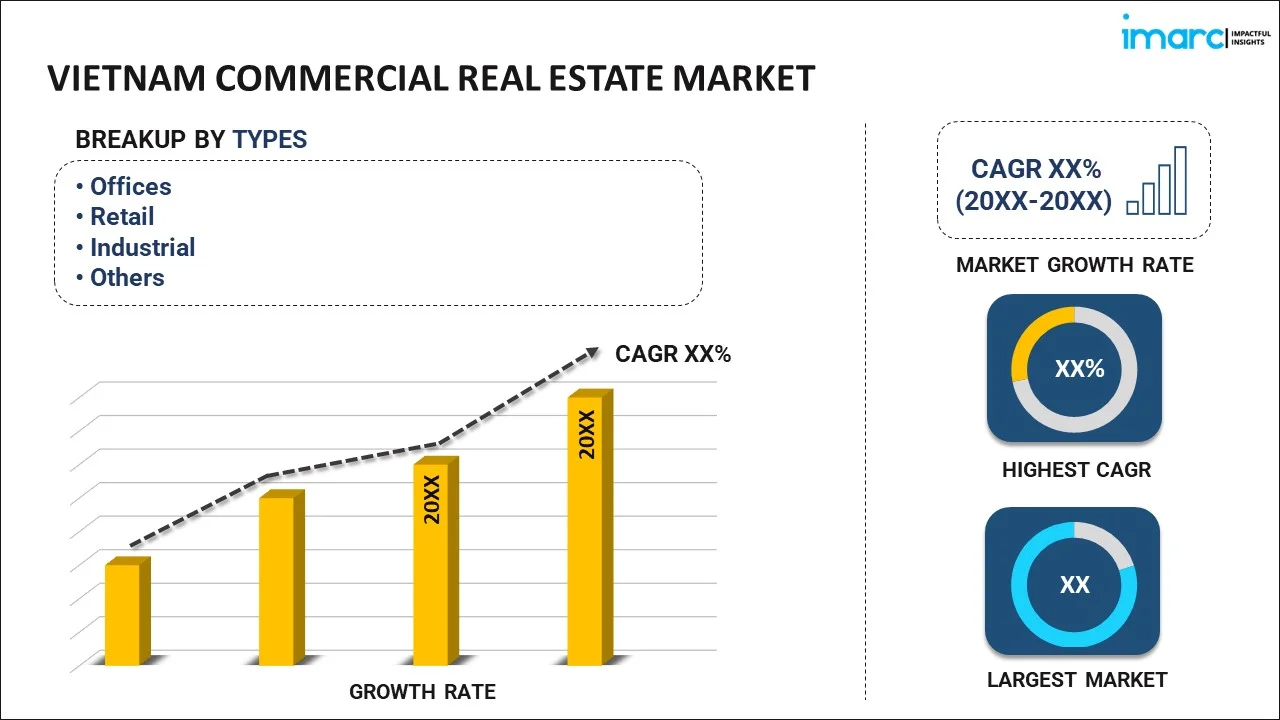
To get detailed segment analysis of this market, Request Sample
- Offices
- Retail
- Industrial
- Logistics
- Multi-family
- Hospitality
The industrial dominates with a market share of 26% of the total Vietnam commercial real estate market in 2025.
Vietnam's industrial real estate segment has emerged as the fastest-growing property category, propelled by the strategic repositioning of global manufacturing supply chains toward Southeast Asian markets. The segment benefits from Vietnam's competitive labor costs, favorable investment incentives, and participation in comprehensive trade agreements that provide preferential market access to major economies. Industrial parks across Northern and Southern Vietnam are experiencing elevated occupancy rates as multinational corporations establish production facilities for electronics, automotive components, textiles, and consumer goods manufacturing.
The development of ready-built factories and modern warehousing facilities has accelerated to meet immediate tenant requirements, while build-to-suit solutions cater to specialized manufacturing operations requiring customized specifications. Provinces surrounding major metropolitan areas are witnessing intensive industrial zone development, with thousands of hectares receiving investment approval to accommodate anticipated demand growth from domestic and international manufacturers seeking to leverage Vietnam's strategic advantages in the regional production ecosystem.
Regional Insights:
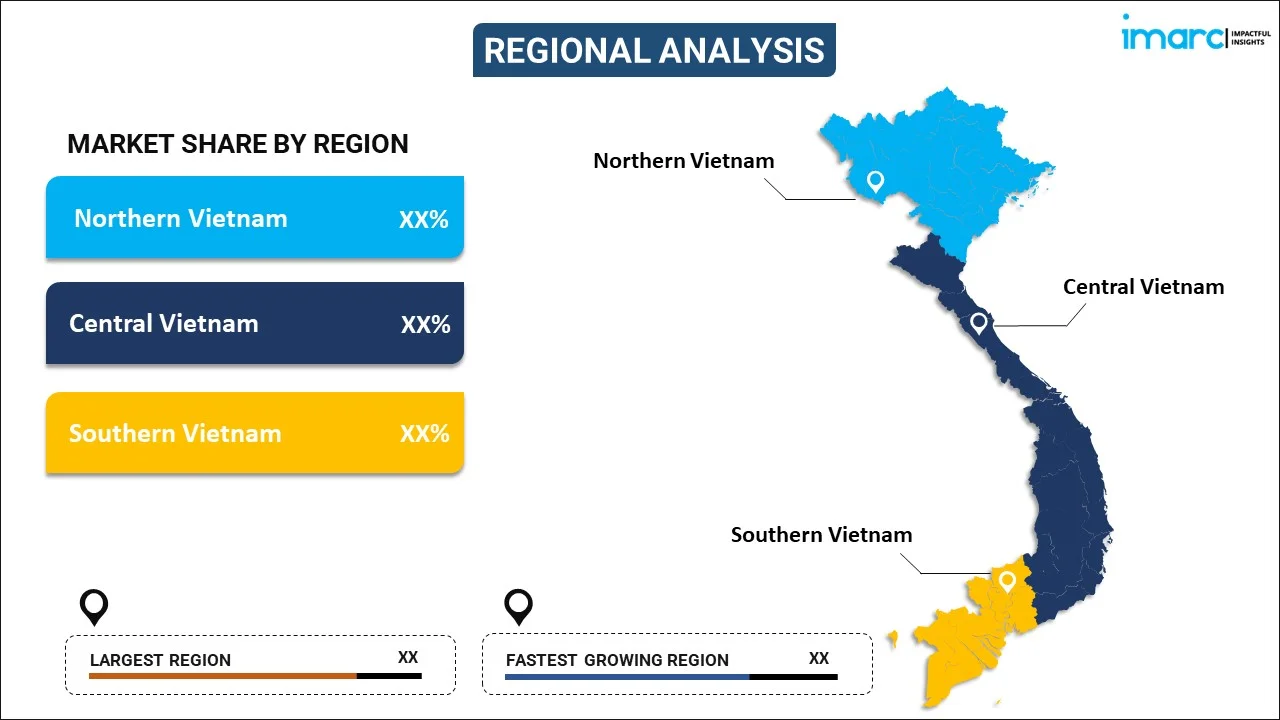
To get detailed regional analysis of this market, Request Sample
- Northern Vietnam
- Central Vietnam
- Southern Vietnam
Northern Vietnam leads with a share of 42% of the total Vietnam commercial real estate market in 2025.
Northern Vietnam's commercial real estate dominance stems from Hanoi's status as the national political and economic center, complemented by the region's extensive industrial infrastructure spanning provinces including Bac Ninh, Hai Phong, and Quang Ninh. The region has attracted substantial foreign direct investment in high-technology manufacturing, particularly in electronics, semiconductor assembly, and automotive component production. Superior port connectivity through Hai Phong and Lach Huyen deep-water terminals facilitates efficient export operations, enhancing the region's appeal for logistics-intensive industries.
Hanoi's office market continues expanding with Grade A developments attracting multinational corporate tenants seeking quality premises in the capital's central business district and emerging suburban locations. The region's retail segment benefits from rising consumer purchasing power and increasing international tourist arrivals, driving demand for modern shopping centers and mixed-use commercial developments that combine retail, entertainment, and hospitality functions within integrated complexes serving diverse customer segments.
Market Dynamics:
Growth Drivers:
Why is the Vietnam Commercial Real Estate Market Growing?
Sustained Foreign Direct Investment Inflows
Vietnam has consolidated its position as a preferred destination for foreign direct investment in manufacturing and industrial operations, creating sustained demand for commercial real estate across multiple property categories. Global corporations are establishing regional headquarters, production facilities, and distribution centers throughout the country to leverage competitive operational advantages and strategic market access. The government's proactive approach to investment facilitation, including streamlined approval processes and attractive fiscal incentives, continues attracting capital commitments from diverse source markets. This investment momentum translates directly into heightened requirements for industrial parks, office complexes, and supporting commercial infrastructure, driving market expansion throughout the forecast period.
Comprehensive Infrastructure Development Programs
Vietnam's ambitious infrastructure modernization agenda is fundamentally reshaping commercial real estate development patterns and unlocking previously inaccessible locations for property investment. Major expressway corridors linking urban centers with industrial zones are reducing transportation times and logistics costs, enhancing the viability of developments beyond established metropolitan boundaries. Metro rail systems under construction in Hanoi and Ho Chi Minh City are creating transit-oriented development opportunities around station precincts, while airport expansions are supporting hospitality and commercial growth in tourism destinations. These infrastructure improvements are extending the geographic footprint of commercially viable real estate investment while improving connectivity that enhances property values in established markets.
Rapid E-commerce Expansion Driving Logistics Demand
The accelerating growth of Vietnam's e-commerce sector is generating substantial demand for modern logistics infrastructure, including warehouses, distribution centers, and last-mile delivery facilities. The Vietnam e-commerce market size reached USD 31.4 Billion in 2025. Looking forward, IMARC Group expects the market to reach USD 250.2 Billion by 2034, exhibiting a growth rate (CAGR) of 25.94% during 2026-2034. Online retail penetration continues rising as consumers increasingly embrace digital shopping channels, requiring retailers and platform operators to expand fulfillment capabilities throughout the country. This structural shift in consumer behavior is driving investment in purpose-built logistics properties featuring automation capabilities, temperature-controlled storage, and cross-docking facilities optimized for high-velocity distribution operations. The logistics real estate segment is experiencing elevated absorption rates as e-commerce operators compete for scarce premium facilities in strategic locations serving major population centers.
Market Restraints:
What Challenges is the Vietnam Commercial Real Estate Market Facing?
Rising Construction Material Costs and Supply Constraints
The increasing prices of key building materials such as sand, stone, cement, and steel, among others, are straining the economics of development and project feasibility studies. Shortages in the supply of certain areas have added to the strains of pricing and forced developers to re-arrange project budgets and project schedules as they seek alternative sources of materials or building technologies to ensure profitability.
Complex Regulatory and Administrative Procedures
The regulatory framework of commercial real estate development comprises several stages of approvals and interactions between various governmental structures, despite the current ongoing approaches of reforming the situation. Coming up with land-use planning and environmental appraisals, as well as construction permitting processes, can prolong the project schedules and escalate the cost of development, especially within large-scale integrated developments that cut across various functional categories.
Skilled Workforce Availability Constraints
The construction industry experiences difficulties in hiring and maintaining competent technical employees in different trades, critical in the provision of quality commercial buildings. The wage pressures are building up due to the shortage between the demand and the supply of experienced workers, and this has led to an increase in the cost of projects and a possible quality issue in the case of developers hiring labor resources that are less qualified.
Competitive Landscape:
Vietnam's commercial real estate market exhibits a dynamic competitive landscape characterized by the active participation of international property consultancies, regional developers, and domestic real estate companies across various market segments. Leading international firms provide comprehensive services spanning investment advisory, property management, leasing, and valuation, while leveraging global expertise and capital networks to facilitate cross-border transactions. Domestic developers are strengthening competitive positions through portfolio diversification, strategic land banking, and partnerships with foreign investors seeking local market knowledge and development capabilities. The industrial and logistics segment has attracted specialized developers focused on ready-built factory and warehouse products tailored to manufacturing tenant requirements. Competition is intensifying in premium office and retail segments as new supply enters major markets, compelling landlords to differentiate offerings through enhanced amenities, flexible lease terms, and sustainability credentials that appeal to quality-conscious tenants prioritizing modern, efficient premises.
Recent Developments:
-
In December 2025, Vietnam's industrial real estate sector recorded strong recovery momentum with registered foreign direct investment in the first eleven months reaching 33.69 billion dollars, while disbursed capital totaled an estimated 23.6 billion dollars, representing the highest level in five years and demonstrating sustained investor confidence.
-
In December 2025, Vietnam marked a major national milestone by launching and commissioning 234 large-scale projects simultaneously across the country in celebration of the 14th National Congress of the Communist Party. The coordinated ceremonies, held at 9:00 a.m. on December 19, took place in 34 provinces and cities and were attended by Prime Minister Pham Minh Chinh, National Assembly Chairman Tran Thanh Man, along with deputy prime ministers, cabinet members, and local government leaders.
Vietnam Commercial Real Estate Market Report Coverage:
| Report Features | Details |
|---|---|
| Base Year of the Analysis | 2025 |
| Historical Period | 2020-2025 |
| Forecast Period | 2026-2034 |
| Units | Billion USD |
| Scope of the Report | Exploration of Historical Trends and Market Outlook, Industry Catalysts and Challenges, Segment-Wise Historical and Future Market Assessment:
|
| Types Covered | Offices, Retail, Industrial, Logistics, Multi-family, Hospitality |
| Regions Covered | Northern Vietnam, Central Vietnam, Southern Vietnam |
| Customization Scope | 10% Free Customization |
| Post-Sale Analyst Support | 10-12 Weeks |
| Delivery Format | PDF and Excel through Email (We can also provide the editable version of the report in PPT/Word format on special request) |
Frequently Asked Questions About the Vietnam Commercial Real Estate Market Report
The Vietnam commercial real estate market size was valued at USD 20.10 Billion in 2025.
The Vietnam commercial real estate market is expected to grow at a compound annual growth rate of 13.54% from 2026-2034 to reach USD 63.02 Billion by 2034.
The industrial segment dominated the market with a share of 26% in 2025, driven by sustained foreign direct investment in manufacturing operations, rising demand for modern warehousing and logistics facilities, and Vietnam's strategic positioning within global supply chain diversification strategies.
Key factors driving the Vietnam commercial real estate market include sustained foreign direct investment inflows, comprehensive infrastructure development programs encompassing expressways, metro systems, and airports, rapid e-commerce expansion generating logistics demand, and increasing adoption of green building practices aligned with sustainability commitments.
Major challenges include rising construction material costs and supply constraints affecting project economics, complex regulatory and administrative procedures extending development timelines, skilled workforce availability constraints in the construction sector, and intensifying competition in premium segments as new supply enters established markets.
Need more help?
- Speak to our experienced analysts for insights on the current market scenarios.
- Include additional segments and countries to customize the report as per your requirement.
- Gain an unparalleled competitive advantage in your domain by understanding how to utilize the report and positively impacting your operations and revenue.
- For further assistance, please connect with our analysts.
 Request Customization
 Speak to an Analyst
 Request Brochure
 Inquire Before Buying
Benefits of Customization
- Personalize this research
- Triangulate with your data
- Get data as per your format and definition
- Gain a deeper dive into a specific application, geography, customer, or competitor
- Any level of personalization
Get in Touch With Us
UNITED STATES
Phone: +1-201-971-6302
INDIA
Phone: +91-120-433-0800
UNITED KINGDOM
Phone: +44-753-714-6104
Email: [email protected]
Client Testimonials




.webp)




.webp)













Related Reports

Choose your plan
*Please note that the prices mentioned below are starting prices for each bundle type. Kindly contact our team for further details.*
Single User License
- 1 User License, Access on 2 Devices
- PDF Report + Excel Dataset (Password Protected)
- Lifetime Access
- No Printing Rights
- 10% Free Report Customization
- 10–12 Weeks of Analyst Support
Five User License
- Access for 5 Users, 2 Devices per User
- PDF Report + Excel Dataset (Password Protected)
- Lifetime Access
- Dedicated Account Manager
- 12–14 Weeks of Analyst Support
- No Printing Rights
- 15% Free Report Customization
- 25% Discount on Your Next Purchase
Corporate User License
- Unlimited User Access (Within Your Organization)
- PDF Report + Excel Dataset
- Lifetime Access
- Dedicated Account Manager
- 14–20 Weeks of Analyst Support
- No Printing Rights
- 20% Free Report Customization
- 30% Discount on Your Next Purchase
Essential Insights
What's included:
3 reports
- Lifetime Access
- PDF Reports
- Excel Datasets
- 2 Weeks of Free Analyst Support
- 2 User Licenses
- Access on 2 Devices
- Printing Rights
- Complimentary PowerPoint (PPT) Version
- Complimentary License Upgrade
Professional Access
What's included:
5 reports
- Lifetime Access
- PDF Reports
- Excel Datasets
- 8 Weeks of Free Analyst Support
- 2 User Licenses
- Access on 2 Devices
- Printing Rights
- Complimentary PowerPoint (PPT) Version
- Complimentary License Upgrade
Business Advantage
What's included:
8 reports
- Lifetime Access
- PDF Reports
- Excel Datasets
- 14 Weeks of Free Analyst Support
- 2 User Licenses
- Access on 2 Devices
- Printing Rights
- Complimentary PowerPoint (PPT) Version
- Complimentary License Upgrade
Enterprise Intelligence
What's included:
10 reports
- Lifetime Access
- PDF Reports
- Excel Datasets
- 20 Weeks of Free Analyst Support
- 2 User Licenses
- Access on 2 Devices
- Printing Rights
- Complimentary PowerPoint (PPT) Version
- Complimentary License Upgrade