Hemp Price Falls 4.2% in France, 3.1% in Spain — Q4 2025 Update
23-Mar-2026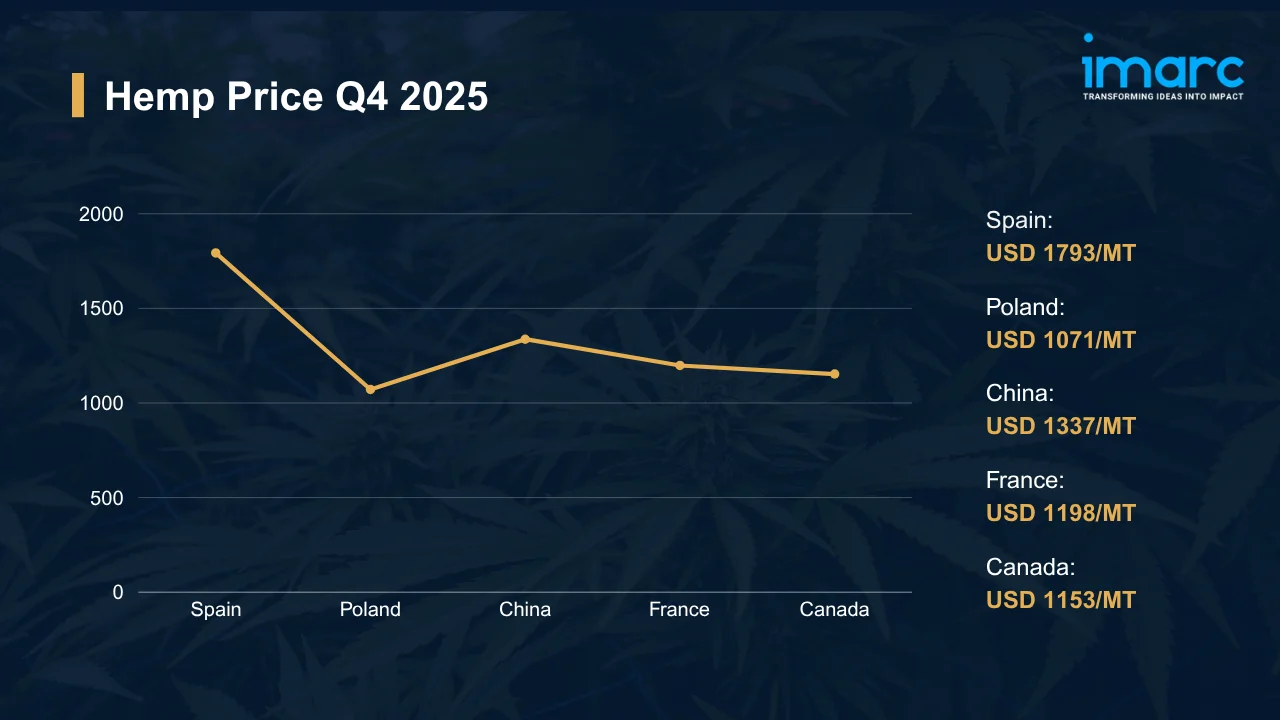
Summary:
Q4 2025 brought broad price softening across all five tracked hemp markets, as adequate crop output and muted downstream demand from fiber, food-grade, and industrial processors set the tone for the quarter. In these markets, Hemp prices fell between 1.7% to 4.2% quarter-on-quarter. Stable logistics and weak export pull left little room for recovery. The ongoing Israel–Iran–USA conflict carries a measurable macroeconomic cost. According to Kristalina Georgieva, managing director of the International Monetary Fund, each 10% rise in oil prices, if they remain elevated for a significant part of the year, will increase global inflation by 0.4% points, a development that may exert upward pressure on hemp market prices.
Hemp Price Q4 2025:
Regional prices (USD per MT) and QoQ changes Q4 vs Q3 2025:
| Region | Price (USD/MT) | QoQ Change | Direction |
|---|---|---|---|
| Spain | 1793 | -3.1% | ↓ Decline |
| Poland | 1071 | -1.7% | ↓ Decline |
| China | 1337 | -2.8% | ↓ Decline |
| France | 1198 | -4.2% | ↓ Decline |
| Canada | 1153 | -2.3% | ↓ Decline |
To access real-time prices Request Sample
Kindly note: IMARC’s pricing database tracks hemp price movements across major global markets.
What Moved Prices:
Spain:
- In Q4 2025, due to steady harvest output and stable domestic stockpiles, hemp prices in Spain dropped to USD 1793/MT. Manufacturers of biocomposites and textiles decreased their procurement activity, which slowed the pace of demand. Any upward correction was thwarted by the availability of imports from Eastern European countries.
- Throughout the quarter, logistics conditions in Spain's main agricultural corridors remained favorable, maintaining steady supply flow and minimizing any cost-driven price increases. The hemp price chart for Spain shows a considerable decline, with processors demonstrating little desire to replenish safety stock in light of the quarter's healthy supply and inventory background.
Poland:
- In Q4 2025, hemp prices in Poland fell to USD 1071/MT, as agricultural supply remained ample and local processors adopted cautious purchasing strategies. Fiber processing units faced weak end-market demand, and limited export pull from neighboring markets weighed further on overall pricing sentiment.
- The hemp price trend in Poland mirrors the broader European market: adequate supply consistently outpacing cautious downstream demand. Stable cultivation conditions and predictable harvesting cycles ensured uninterrupted raw material flow, keeping buyers in no rush to commit to forward purchases beyond immediate processing requirements.
China:
- During Q4 2025, hemp prices in China fell to USD 1337/MT as manufacturing activity slowed across textile and specialty fiber segments. In order to stay competitive, Chinese suppliers had to modify their offer levels as export orders decreased due to a decline in foreign demand. Meanwhile, adequate domestic manufacturing completely eliminated the possibility of supply shortages.
- Yiwu and Guangzhou converter hubs' controlled inventory levels offered a steady cushion against any unexpected surge in demand. Sellers' capacity to raise prices was constrained by the low level of domestic FMCG absorption and the lack of growth in export inquiries. The quarter remained solidly in bearish territory as a result of this dynamic.
France:
- In Q4 2025, hemp prices in France fell to USD 1198/MT as the market for insulation and building materials slowed, and manufacturers faced little offtake from green building initiatives. A sufficient supply was guaranteed by stable agricultural yields, and any attempt at price recovery was further constrained by import parity pricing from nearby nations.
- Transport availability remained consistent throughout France's agricultural corridors, averting the emergence of logistics-driven cost escalation. Relying on current inventories, downstream purchasers in the composites and specialty industrial segments refrained from making volume commitments. Through the conclusion of Q4, this stance kept the French hemp market's attitude generally unfavorable.
Canada:
- In Q4 2025, as demand from food-grade processors and nutraceutical producers significantly decreased in comparison to the previous period, hemp prices in Canada dropped to USD 1153/MT. Due to slowing export orders from foreign clients delaying purchases, sellers with excess inventory from previous procurement cycles adopted more competitive pricing strategies.
- The main hemp-growing regions of Canada had dependable inland logistics that provided steady delivery without raising costs. Replenishment timetables were cautiously adjusted by wellness and textile buyers, who continued to be in a restocking lull. As the year came to a finish, this trend decreased market activity and kept mood generally muted.
Hemp Price Outlook After the Israel–Iran–USA Conflict:
Feedstock and Energy Cost Pressures on Hemp Production: Hemp production is energy-intensive. Processing, drying, and transport draw from fuel sources currently facing severe cost pressure. As of March 16, 2026, Brent crude oil prices surged more than 40% since the conflict began, reaching near USD 105 per barrel. Hemp processors might see meaningful escalation in input costs if this energy pricing environment persists through the first half of 2026.
Regional Market Exposure and Hemp Price Volatility: Hemp markets in Europe, North America, and Asia all face varying degrees of exposure to conflict-driven price instability. With geopolitical risk premiums being embedded across energy and freight, processor buying decisions might shift towards shorter contract windows and increased spot-market caution. Hemp price direction will depend heavily on how long the Hormuz disruption persists.
Immediate Market Reaction:
The hemp market is absorbing early signals from the conflict across its key supply and trade nodes. European processing hubs in France and Poland, where hemp is closely tied to fiber and construction material demand, face rising energy cost expectations that might translate into upward pressure on production and transport expenses. The hemp price index remains unsettled, with buyers across North America and Asia reassessing procurement schedules in response to elevated logistics risk. Supply routes between key producing regions and downstream conversion centers face increasing uncertainty as the conflict reshapes freight cost assumptions.
Impact on Hemp Prices:
The conflict might trigger several key changes in the hemp market:
- Energy Cost Pass-Through to Processing Expenses: Hemp processing relies on fuel-intensive operations, including drying, degumming, and mechanical separation. All of these operations face rising input costs as global energy prices climb in response to the Hormuz disruption. If fuel costs remain elevated through the first half of 2026, hemp processors in Europe and North America will likely face margin compression or be forced to pass costs downstream to fiber and food-grade buyers.
- Freight Rate Escalation on Export Routes: As major shipping carriers suspend or restrict Persian Gulf transits, hemp exports from China and other Asia-Pacific origins face longer rerouted voyages around the Cape of Good Hope, adding extra days of transit time and higher freight costs per container. European importers sourcing Asian hemp varieties might encounter supply delays and elevated CIF costs, creating spot market tightness across multiple end use segments.
- Demand Uncertainty Across Hemp End-Use Sectors: The conflict-driven macroeconomic shock, spanning rising inflation, contracting consumer purchasing power, and slowing industrial output, might dampen end-market demand for hemp across its key application segments, from packaging and textiles to wellness products and construction materials. Buyers across North America and Europe might defer restocking decisions until conditions clarify, keeping sentiment broadly cautious and preventing near-term price recovery even where supply remains adequate.
Taken together, these three pressures, encompassing rising energy costs, elevated freight rates, and weakening downstream demand, will keep hemp prices subject to renewed volatility even as Q4 fundamentals remain largely soft. Markets relying on long-haul sea freight for supply are likely most exposed and those with domestic sourcing options might weather the disruption with significantly less price dislocation.
Supply Chain Disruptions:
The hemp supply chain depends on maritime corridors, which are under pressure from the Strait of Hormuz crisis. Chinese hemp exports to European and North American processors rely on routes that leading carriers have suspended or rerouted around the Cape of Good Hope. According to Al Jazeera, as of March 18, 2026, vessel traffic through the Strait of Hormuz dropped by more than 95%. This rerouting might substantially raise CIF landed costs and add more weeks to hemp delivery timelines.
Although possibilities are still limited by the concentrated geography of global hemp growing, hemp processors will need to investigate contingency sourcing from domestic or regional origins in cases where direct maritime access is impeded. As war-risk contagion spreads through larger freight markets, European producers in France, Poland, and Spain may also have to pay more for insurance. If interruptions persist well into mid-2026, import-dependent economies like the USA and Canada will need to create precautionary inventory buffers to fill any supply shortfalls.
Global Market Overview:
Globally, the hemp industry was valued at USD 7.1 Billion in 2025. Market projections indicate steady growth, with the industry expected to reach USD 23.5 Billion by 2034, with a compound annual growth rate (CAGR) of 14.20% during 2026-2034. Expanding adoption across wellness, food ingredients, construction materials, and industrial composites is fueling this growth. Advancements in processing technologies and broadening regulatory acceptance across major economies are enabling wider hemp utilization while rising sustainability goals reinforce demand across diverse value chains.
Recent Highlights & Strategic Developments:
Recent strategic moves within the industry further illustrate evolving dynamics:
- In December 2025, Hemp Hop unveiled the opening of a new cannabis dispensary in Houston, Texas, expanding its retail footprint in the state and broadening consumer access to its hemp and cannabis product range. The company confirmed that hemp and cannabis innovation would remain core pillars of its long-term growth strategy.
- In October 2025, Charlotte’s Web Holdings, Inc. launched Knockout Hemp THC Sleep Gummies as part of an expansion of its Brightside product line. The hemp-based formulation was aimed at supporting deeper and more consistent sleep, reinforcing Charlotte’s Web’s position in the functional hemp wellness category.
Hemp Price Forecast (2026):
The simultaneous pressures of conflict-driven energy cost inflation and cautious downstream purchasing across fiber, food-grade, and industrial segments will continue to have an impact on hemp prices in the near future. It is anticipated that procurement hesitancy will continue into the first half of 2026, with buyers reluctant to replenish stockpiles until energy prices stabilize or geopolitical circumstances indicate a more obvious way forward.
Hemp prices will rise as rising energy and freight costs reduce processor margins in North America and Europe, particularly if the conflict worsens and Hormuz outages continue past Q1 2026. High logistical exposure may cause producers to reduce output, which would tighten availability. In contrast, a diplomatic solution might stabilize freight routes and enable markets to return to the fundamentals of supply and demand. These combined dynamics will continue to shape the hemp price forecast throughout the year ahead.
Strategic Takeaways:
Looking ahead, the hemp market is expected to grow steadily, fueled by rising adoption in wellness, textiles, construction materials, and industrial composites, with regulatory acceptance continuing to broaden across major economies. Long-term structural demand drivers remain intact, even as near-term pricing and supply dynamics face disruption from geopolitical and macroeconomic headwinds.
To navigate this complex landscape, stakeholders should:
- Monitor Regional Price Differentials: Track quarterly hemp pricing variations across all five covered regions to identify cost-efficient procurement windows. Benchmarking hemp price per MT against current contract rates will help procurement teams pinpoint arbitrage opportunities and optimize sourcing strategies.
- Monitor Geopolitical Risk Exposure: Track escalation in the current conflict and assess how shifts in hostility might affect hemp pricing, feedstock availability, and logistics costs. Establish internal thresholds that trigger procurement or hedging action when key risk indicators shift.
- Adjust Procurement Strategy for Conflict Conditions: Adopt flexible contract structures, including price reopener clauses and force majeure provisions, to protect against geopolitical price spikes in hemp procurement. Precautionary inventory buffers might reduce exposure if supply tightens abruptly due to conflict-related disruptions.
- Track Upstream Feedstock and Energy Costs: Monitor energy price movements closely as rising fuel costs will directly affect hemp processing and logistics expenses. Correlate feedstock price shifts with procurement timing decisions to avoid absorbing avoidable cost escalation across the value chain.
- Explore Specialty and Premium Grade Segments: Identify growing demand pockets in CBD-rich extracts and high-value fiber grades that might command meaningful price premiums well above standard commodity benchmarks. Targeting these niches helps organizations maintain revenue stability during periods of broader market softening.
Subscription Plans & Customization:
IMARC offers flexible subscription models to suit varying needs:
- Monthly Updates — 12 deliverables/year
- Quarterly Updates — 4 deliverables/year
- Biannual Updates — 2 deliverables/year
Each includes detailed datasets (Excel + PDF) and post-report analyst support.
.webp)
Get in Touch With Us
UNITED STATES
Phone: +1-201-971-6302
INDIA
Phone: +91-120-433-0800
UNITED KINGDOM
Phone: +44-753-714-6104
Email: [email protected]
Client Testimonials




.webp)




.webp)












