Benzene Price Increases 19.0% in Northeast Asia, 14.5% in Middle East — Q1 2026 Update
30-Apr-2026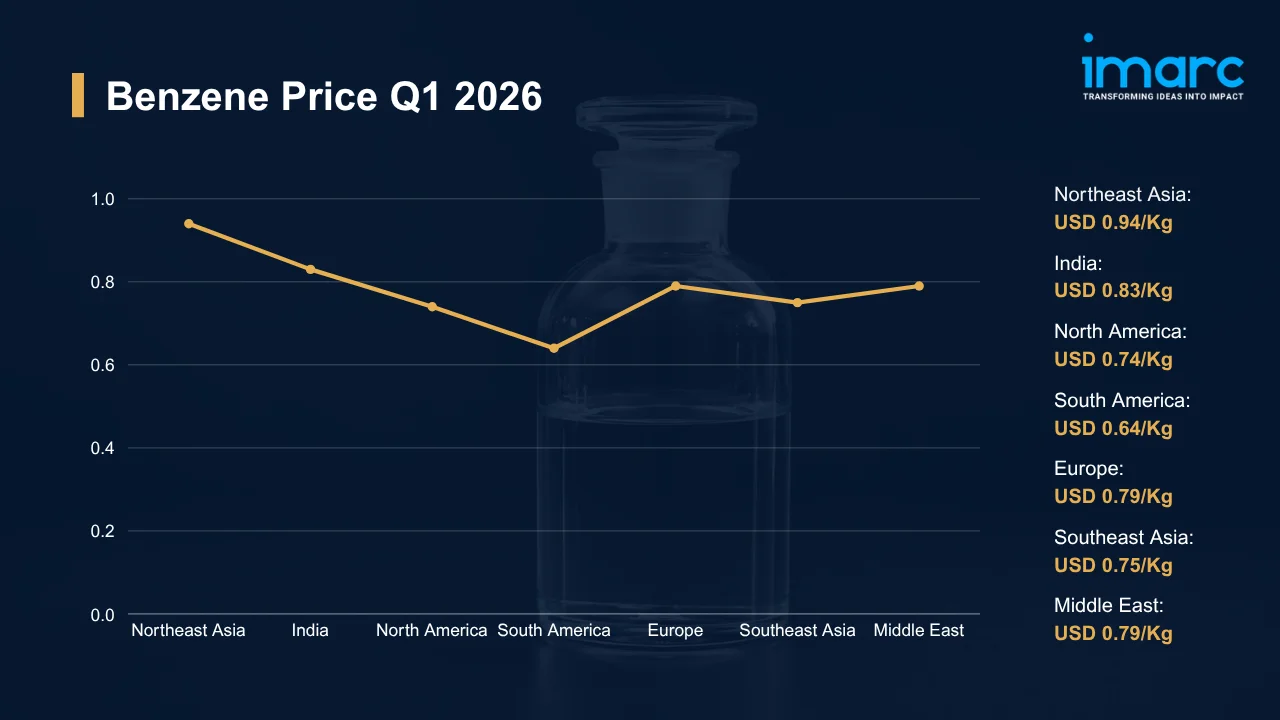
Summary:
Q1 2026 brought a split outcome across the tracked benzene markets, with four regions advancing and three posting declines. Tighter naphtha availability, combined with conflict-driven feedstock cost pressure and recovering downstream consumption, lifted benzene prices across select buying centers, while weaker procurement and elevated inventory weighed on regional offer levels through the quarter. Quarter-on-quarter, benzene prices moved between a 13.5% decline and a 19.0% gain. As of March 30, 2026, Brent crude oil futures climbed close to USD 116 a barrel, driven by supply disruptions and geopolitical tensions arising from the Israel–Iran–USA conflict.
Benzene Price Q1 2026:
Regional prices (USD per KG) and QoQ changes Q1 2026 vs Q4 2025:
| Region | Price (USD/KG) | QoQ Change | Direction |
|---|---|---|---|
| Northeast Asia | 0.94 | +19.0% | ↑ Growth |
| India | 0.83 | +6.4% | ↑ Growth |
| North America | 0.74 | -10.8% | ↓ Decline |
| South America | 0.64 | -13.5% | ↓ Decline |
| Europe | 0.79 | +1.3% | ↑ Growth |
| Southeast Asia | 0.75 | -3.8% | ↓ Decline |
| Middle East | 0.79 | +14.5% | ↑ Growth |
To access real-time prices Request Sample
Kindly note: IMARC’s pricing database tracks benzene price movements across major global markets.
What Moved Prices:
Northeast Asia:
- In Q1 2026, benzene prices in Northeast Asia climbed sharply to USD 0.94/KG, lifted by tightening naphtha availability as regional steam crackers cut operating rates in response to Middle East feedstock disruption. Styrene and phenol producers rebuilt inventory as petrochemical derivative demand stabilized through the quarter.
- Force majeure declarations from multiple Asian naphtha-based crackers drove up spot premiums and squeezed availability further. The benzene price chart for Northeast Asia captured steep monthly gains through the quarter, as restocking by downstream polymer, resin, and specialty chemical manufacturers supported firmer offer levels into March alongside elevated Singapore naphtha benchmarks.
India:
- During Q1 2026, benzene prices in India firmed to USD 0.83/KG as disrupted naphtha flows through the Strait of Hormuz pushed up landed feedstock costs and tightened import availability. Resin and adhesive manufacturers lifted procurement modestly, though the absolute gain stayed below the sharper moves seen across Northeast Asia.
- Stable domestic supply from local refiners partly cushioned buyers against the full impact of import disruption. Export inquiries from Middle East and Southeast Asian converters picked up through February, though logistics constraints and elevated freight quotes kept trade volumes below the levels producers had planned for the quarter.
North America:
- In Q1 2026, benzene prices in North America eased to USD 0.74/KG as styrene and resin producers ran through inventory built up late in 2025. Gulf Coast feedstock flows remained steady, and ethane-based cracker advantage insulated regional benzene supply from the naphtha tightness gripping Asia.
- Softer automotive assembly and seasonal slowdown in construction-related polymer demand weighed on buying activity across the quarter. Import competition from Canadian refiners pressured spot offers further, while downstream converters held procurement tight as they waited for clearer signals on Q2 demand before committing to forward volumes.
South America:
- In Q1 2026, benzene prices in South America dropped sharply to USD 0.64/KG on the back of weakening demand from petrochemical derivatives and softer industrial activity. Styrene and phenol producers trimmed operating rates, releasing accumulated inventory into an already cautious market and amplifying downward pressure on regional offers.
- Brazilian real volatility discouraged import commitments even as landed costs from Asian origins trended lower through the quarter. São Paulo and Buenos Aires distribution hubs carried ample inventory into February, and cautious buying from automotive and construction-linked polymer converters kept transaction volumes muted across all major buying segments.
Europe:
- In Q1 2026, benzene prices in Europe edged marginally higher to USD 0.79/KG, reflecting the narrow interplay between conflict-driven feedstock cost pressure and persistent demand weakness. Styrene and caprolactam consumption stayed subdued, capping any sharper upside despite the upward drift in crude and naphtha benchmarks.
- Rhine-corridor logistics ran smoothly for much of the quarter, allowing steady inland distribution from Rotterdam and Antwerp terminals. Automotive and construction sector demand softness continued to cap converter procurement volumes, while competitive offers from Asian suppliers re-routed away from the Gulf held regional price gains in check.
Southeast Asia:
- In Q1 2026, benzene prices in Southeast Asia slipped to USD 0.75/KG as weaker end use demand from packaging and textile segments capped upward momentum. Regional producers kept operating rates stable, and balanced output against muted converter buying kept the market in a range despite broader petrochemical volatility.
- Singapore-based converters worked through previously accumulated stocks rather than chasing replacement cargoes at firmer prices. Thai and Malaysian producers maintained steady export flows within the ASEAN bloc, while Northeast Asian spillover demand, visible earlier in January, faded as downstream restocking activity plateaued by late February.
Middle East:
- In Q1 2026, benzene prices in the Middle East rose sharply to USD 0.79/KG as conflict-linked feedstock tightness, constrained regional refinery output, and stronger export pull from Asian buyers lifted offer levels materially. Producers in the Gulf faced mixed logistics conditions, which tightened spot availability through February and March.
- War-risk insurance premiums and freight surcharges for Gulf-origin cargoes climbed through the quarter, pushing up landed costs for Asian buyers who continued to seek alternative sources. Domestic plastics and resin industry demand recovered modestly, absorbing some local surplus while export flexibility remained constrained by ongoing shipping disruptions.
Benzene Price Outlook After the Israel–Iran–USA Conflict:
Feedstock Cost Escalation and Benzene Margin Pressure: Conflict-driven naphtha tightness is reshaping cracker economics across Asia. Benzene producers face sustained margin compression as Singapore naphtha benchmarks stay elevated, forcing operators to weigh output against shrinking spreads while cautious downstream buyers refuse to absorb the full cost uplift. Across the Western hemisphere, refiners with ethane access sit on firmer ground. The cost wedge might widen further.
Regional Benzene Price Volatility and Demand Realignment: Amid ongoing conflict exposure, benzene price direction hinges on how quickly downstream sectors absorb higher input costs. Asian buying centers will likely carry a sustained war premium as naphtha-based cracker economics remain strained, while Western markets might see ethane-advantaged producers outperform import-dependent converters facing tighter margins. Forward demand signals across automotive, packaging, and resin segments stay mixed, complicating procurement planning.
Immediate Market Reaction:
As hostilities intensify, the benzene market responds through multiple fast-moving channels. Gulf-based naphtha and aromatics production faces direct exposure, while Asian crackers reliant on Middle East feedstock imports absorb immediate cost shocks. The benzene price index across key Asian buying centers has already reflected double-digit monthly gains in response to tightened supply. Rerouted shipments around the Cape of Good Hope add 10 to 14 days to transit, lifting landed costs for European and South American buyers. Short-covering by downstream converters might sustain the upward bias through the next restocking cycle.
Impact on Benzene Prices:
The conflict might trigger several key changes in the benzene market:
- Elevated Feedstock and Energy Costs: Sustained naphtha price premiums across Asian markets will continue to lift benzene production costs, forcing cracker operators to recalibrate output targets across integrated complexes. Producers might pass through higher variable costs only partially given uneven downstream demand, which could compress processing margins through mid-2026 as crude-linked input volatility persists and war-risk premiums remain embedded in regional feedstock pricing structures across the Asian and European bases.
- Supply-Side Dislocation: Persistent disruption to Gulf-origin aromatic flows will redraw trade routes as Asian buyers seek alternative benzene cargoes from North American and European suppliers. Spot premiums might widen across benchmark pricing hubs, and producers with flex-feed or ethane-based cracker capacity will likely capture a structural cost advantage over naphtha-dependent operators during the extended disruption window, reshaping regional competitive dynamics and compelling buyers to reassess their long-term supply relationships.
- Demand Uncertainty and Procurement Caution: End-use industries spanning polymers, resins, synthetic fibers, and specialty chemicals might delay procurement decisions as input cost volatility challenges budget planning. Styrene and phenol producers will likely operate on tighter inventory cycles while monitoring benzene spot quotes daily, and cautious downstream buying could dampen the pass-through effect, leaving refiners and aromatic producers to absorb a greater share of margin compression.
Taken together, these pressures will keep benzene prices volatile through the first half of 2026, with directional momentum tied closely to conflict evolution. Feedstock tightness, supply reroutes, and wary procurement behavior might reinforce one another, and buyers who lock in flexible sourcing arrangements today will navigate the turbulence more effectively than spot-dependent peers.
Supply Chain Disruptions:
Disruption to the Strait of Hormuz, a critical conduit for Gulf-origin naphtha and aromatics, will continue to reshape benzene supply routes across the Asia-Pacific trade. In early March 2026, daily freight rates for LNG tankers were up more than 40% following disruptions at Qatari facilities— a signal of broader upward pressure on bunker and tanker economics. Spot premiums for benzene cargoes shipping through alternative corridors might widen further as carriers pass war-risk insurance and emergency bunker surcharges into landed prices.
Alternative routing around the Cape of Good Hope might add 10 to 14 days to transit times for Asia-bound benzene and feedstock cargoes. Producers will likely rebuild strategic inventory at alternate ports, yet container capacity constraints across the global fleet mean buffer buildups take longer than usual this year. Converters with flexible supply contracts might secure priority allocation, while spot-dependent buyers face prolonged uncertainty as the wider dislocation of shipping containers unwinds gradually across global trade lanes.
Global Market Overview:
Globally, the benzene industry was valued at USD 68.2 Billion in 2025. Market projections indicate steady growth, with the industry expected to reach USD 88.1 Billion by 2034, with a compound annual growth rate (CAGR) of 2.80% during 2026-2034. Growth reflects expanding downstream consumption across styrene, cumene, cyclohexane, and phenol derivatives, supporting demand from plastics, synthetic fibers, and resins. The broader benzene price trend will continue responding to crude oil volatility, refinery throughput shifts, and regulatory pressure on aromatics handling.
Recent Highlights & Strategic Developments:
Recent strategic moves within the industry further illustrate evolving dynamics:
- In March 2025, ADNOC and OMV combined their polyolefin operations by merging Borouge and Borealis, simultaneously acquiring Nova Chemicals in a USD 13.4 Billion transaction. The move created a global petrochemical leader with expanded capability in benzene-derived value chains across multiple regions.
Benzene Price Forecast (2026):
Near-term benzene prices will stay closely tied to conflict-driven feedstock cost volatility and recovery patterns across downstream consumption sectors. Procurement caution might persist among converters through the first half of 2026, and any easing of Middle East tensions could open a window for stabilization as alternative supply flows gradually normalize across Asian and European trade routes.
If hostilities escalate further, benzene prices will likely face renewed upward pressure as crude oil, naphtha, and shipping costs climb in tandem, widening risk premiums across regional trade lanes. Asian producers might curtail cracker output if naphtha scarcity worsens, tightening global availability. Conversely, a diplomatic resolution will ease freight rates and restore feedstock flows, allowing prices to drift toward pre-conflict levels by late 2026 — dynamics that will continue shaping the benzene price forecast.
Strategic Takeaways:
Looking ahead, the benzene market is expected to navigate a volatile 2026, shaped by geopolitical pressure, shifting feedstock economics, and evolving downstream consumption patterns across key end-use sectors. Procurement agility, supply chain flexibility, and disciplined risk management will separate the most resilient buyers from those exposed to spot price volatility.
To navigate this complex landscape, stakeholders should:
- Monitor Regional Price Differentials: Track monthly benzene price per KG across key supply regions to identify cost-saving procurement windows before they close. Benchmark landed costs against prevailing contract rates and regional differentials to guide optimal sourcing decisions each quarter.
- Monitor Geopolitical Risk Exposure: Track escalation dynamics in the current conflict and assess how shifts in hostility levels might affect benzene pricing, feedstock availability, and overall logistics costs. Establish internal alert thresholds that trigger timely procurement or hedging action.
- Diversify Supply Chain Routes: Evaluate alternative sourcing geographies and shipping corridors to reduce dependence on conflict-exposed trade lanes and vulnerable chokepoints. Secondary supplier agreements and contingency freight arrangements will provide critical operational resilience if primary routes face sustained disruption.
- Adjust Procurement Strategy for Conflict Conditions: Adopt flexible contract structures with reopener clauses and force majeure provisions to guard against geopolitical price spikes across the supply base. Precautionary inventory buffers and hedging instruments will reduce exposure if supply tightens abruptly mid-cycle.
- Monitor Upstream Feedstock Costs: Track naphtha, crude oil, and ethylene benchmark movements daily to anticipate shifts in benzene production economics. Use upstream signals to time contract negotiations and identify early warning indicators of cost inflation down the value chain.
- Explore Specialty and Premium Segments: Evaluate higher-margin benzene applications in specialty chemicals, engineering plastics, and pharmaceutical intermediates to diversify revenue streams. Strategic positioning in premium segments will help offset volatility in commodity-grade pricing during periods of acute global market disruption.
Subscription Plans & Customization:
IMARC offers flexible subscription models to suit varying needs:
- Monthly Updates — 12 deliverables/year
- Quarterly Updates — 4 deliverables/year
- Biannual Updates — 2 deliverables/year
Each includes detailed datasets (Excel + PDF) and post-report analyst support.

.webp)
Get in Touch With Us
UNITED STATES
Phone: +1-201-971-6302
INDIA
Phone: +91-120-433-0800
UNITED KINGDOM
Phone: +44-753-714-6104
Email: [email protected]
Client Testimonials




.webp)




.webp)












