Blueberries Prices in the USA Reach USD 4,658/MT Amid Stable Domestic Demand
28-Jan-2026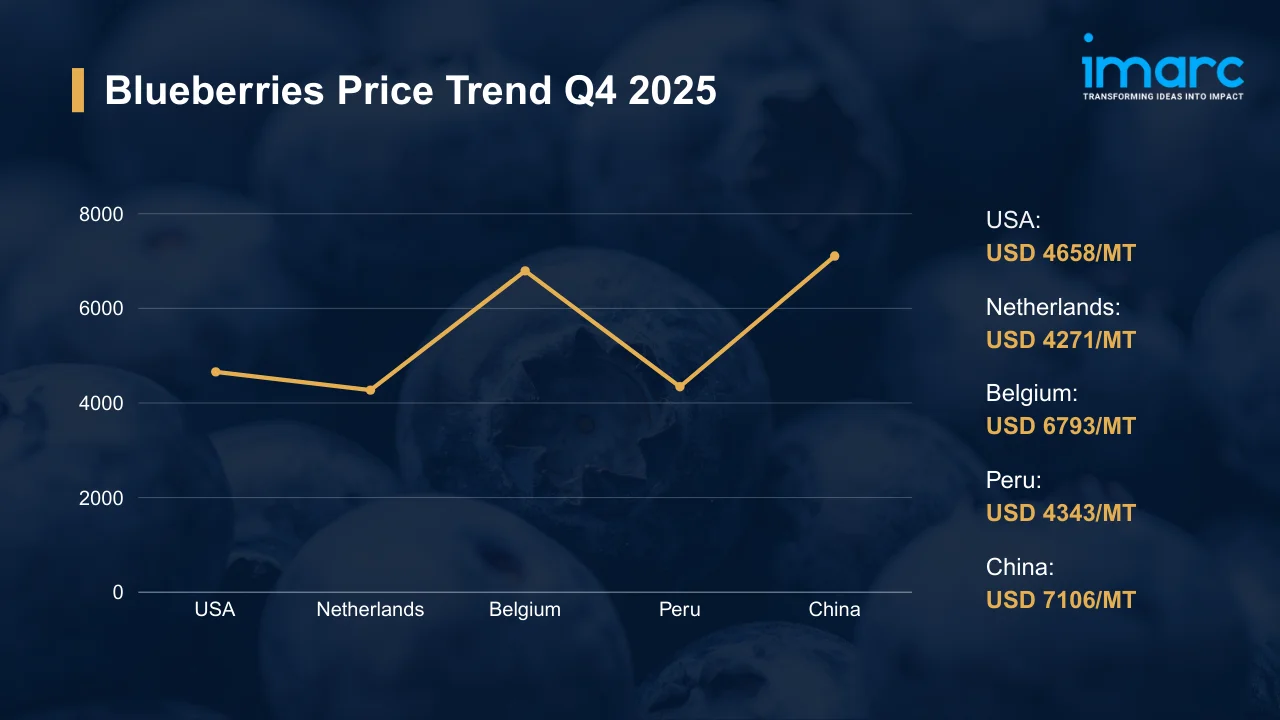
Blueberries are small, round fruits distinguished by their characteristic deep blue-purple coloration and a flavor profile that balances sweetness with subtle tartness. These nutrient-dense berries are harvested from shrubs and are highly valued for their potent antioxidant content. They find extensive application across the food industry and are consumed fresh, frozen, or dried. They are widely utilized in processed goods, including jams, juices, baked products, and breakfast items. Their pricing sensitivity stems from factors, such as seasonal harvest cycles, weather conditions affecting crop yields, import-export dynamics, and fluctuating consumer demand patterns.
Global Market Overview:
Globally, the blueberries industry reached a volume of 2.10 Million Tons in 2025. Market projections indicate steady growth, with the industry expected to reach 2.71 Million Tons by 2034, expanding at a CAGR of 2.88% during 2026-2034. The sector's expansion is underpinned by heightened consumer preference for fresh and functional fruits, broadening utilization in processed food and beverage (F&B) applications, and enhanced year-round availability facilitated by globalized supply networks and improved cold-chain logistics infrastructure. Rising awareness around healthy eating habits is encouraging consumers to include blueberries in their daily diets, especially due to their antioxidant and immunity-boosting properties. Food manufacturers are also using blueberries more widely in snacks, dairy products, and ready-to-drink (RTD) beverages to meet clean-label and natural ingredient demand.
Blueberries Price Trend Q4 2025:
Regional prices (USD per MT) and QoQ changes vs Q3 2025:
| Region | Price (USD/MT) | QoQ Change | Direction |
|---|---|---|---|
| USA | 4658 | +2.69% | ↑ |
| Netherlands | 4271 | -2.20% | ↓ |
| Belgium | 6793 | -3.10% | ↓ |
| Peru | 4343 | -3.60% | ↓ |
| China | 7106 | -6.30% | ↓ |
To access real-time prices Request Sample
What Moved Prices:
- USA: Prices climbed to USD 4658/MT during Q4 2025, as steady demand from both retail chains and foodservice operators kept the market well-supported throughout the quarter. Distributors maintained active buying programs in anticipation of holiday consumption patterns, which historically drive stronger offtake during this period. On the supply side, domestic growers were transitioning between harvest cycles, which created a gap that left buyers more reliant on imported volumes to fill orders. This combination of sustained demand and constrained near-term availability gave suppliers enough pricing power to push quotes higher as the quarter progressed.
- Netherlands: The Dutch market pricing eased to USD 4271/MT during Q4 2025, as regional wholesalers pulled back on procurement activity amid signs that downstream movement was losing steam. Buyers found themselves in a comfortable position with ample supply flowing in from competing European origins as well as steady shipments arriving from overseas producers, which collectively reduced any sense of urgency to secure volumes. Most market participants opted to work through existing inventory positions before committing to fresh purchases, and this cautious stance translated into softer pricing as sellers adjusted expectations to reflect the more relaxed buying environment.
- Belgium: Prices settled lower at USD 6793/MT during Q4 2025, following a noticeable cooling in export demand from neighboring European destinations that had previously absorbed Belgian-sourced volumes. Retail sales did not quite meet expectations during the period, and with adequate stock levels already sitting in warehouses, buyers adopted a more conservative procurement strategy rather than building additional inventory. Competitive pricing from alternative sourcing regions added further pressure during negotiations, as suppliers found themselves needing to sharpen their offers to remain attractive against the backdrop of well-supplied markets and hesitant buyers across the continent.
- Peru: Prices eased to USD 4343/MT during Q4 2025, despite the fact that production shipments were strong and there were no issues with export infrastructure. The problem was not on the supply side, as producers were able to provide plenty of product, but rather that demand from major importing countries was not as strong as expected to begin the period. Buyers realized that there was plenty of product available and that it would not be in short supply anytime in near future, so they decided to hold back on their orders.
- China: Prices retreated to USD 7106/MT during Q4 2025, as consumer appetite for premium fruit categories showed signs of fatigue. Domestic production came through at healthy levels, which meant importers did not need to chase overseas volumes as aggressively as they might have in tighter supply years. Distributors took a measured approach to inventory management, preferring to align their purchases closely with near-term sales visibility rather than speculating on future demand. This selective buying behavior, combined with improved local availability, created an environment where prices drifted lower through the period.
Drivers Influencing the Market:
Several factors continue to shape blueberries pricing and market behavior:
- Seasonal Harvest Patterns: Regional production cycles significantly impact supply availability. Transitional periods between domestic and imported supplies create periodic tightness, particularly in North American markets during shoulder seasons when local harvests conclude.
- Consumer Demand Dynamics: Sustained interest in health-oriented foods continues to bolster consumption. Retail and foodservice channels maintain steady offtake, with premium segments showing particular resilience across developed markets. Convenience-driven formats, such as ready-to-eat (RTE) packs and blended fruit offerings, are further supporting volume stability.
- Global Trade Flow Shifts: Tariff implementations and trade policy adjustments have redirected export flows. Peruvian exporters have increasingly pivoted towards Asian markets, particularly China, while US imports face evolving duty structures. This realignment is influencing seasonal pricing patterns and supplier diversification strategies.
- Cold-Chain Infrastructure: Enhanced logistics networks and improved refrigerated transport capabilities have extended global supply reach. Year-round availability benefits from sophisticated storage solutions enabling fresh product movement across continents. These improvements are also helping reduce spoilage rates and maintain consistent quality standards.
- Competitive Supply Dynamics: Major producing nations, including Chile, Mexico, and Peru, continue to expand cultivation areas. This heightened competition creates pricing pressure, particularly during overlapping harvest periods when multiple origins simultaneously supply global markets.
Recent Highlights & Strategic Developments:
Recent strategic moves within the industry further illustrate evolving dynamics:
- In December 2025: Vietnam's Ministry of Agriculture and Environment revealed that Australian blueberry producers commenced exports to Vietnam. The Australian Trade and Investment Commission and Berries Australia formally inaugurated this trade corridor, establishing blueberries as the seventh Australian fruit variety permitted entry into the Vietnamese market.
- In May 2024: Innocent Drinks launched the Blueberry Focus Super Smoothie, broadening its Super Smoothies lineup to feature a health-oriented choice for consumers mindful of their wellness. Loaded with blueberries, strawberries, apples, rhubarb, spirulina, and supplementary vitamins, the smoothie appealed to those looking for improved health advantages.
Outlook & Strategic Takeaways:
Looking ahead, the blueberries market is expected to maintain its growth trajectory heading into 2026, supported by continued health consciousness among consumers and expanding processed food applications, while supply-side dynamics, particularly from major Latin American exporters, will shape pricing trajectories across key consuming regions.
To navigate this complex landscape, stakeholders should:
- Monitor Price Volatility Closely: Track seasonal price fluctuations and regional harvest schedules to optimize procurement timing. Establishing forward contracts during anticipated supply peaks can mitigate cost exposure during scarcity periods.
- Diversify Sourcing Geography: Cultivate supplier relationships across multiple producing regions, including Peru, Chile, and emerging origins. Geographic diversification provides supply security against weather disruptions or trade policy changes affecting individual markets.
- Assess Trade Policy Implications: Remain vigilant regarding tariff developments and bilateral trade agreements affecting major trade corridors. Policy shifts across regions can rapidly alter competitive dynamics and landed cost calculations.
- Leverage Cold-Chain Innovations: Evaluate logistics partners' cold-chain capabilities and invest in quality-preserving transport solutions. Extended shelf life through superior handling enables access to distant markets while minimizing spoilage losses.
- Track Consumer Trends: Monitor evolving preferences for organic, locally-sourced, and functional fruit products. Premium positioning opportunities exist for suppliers capable of meeting certified sustainability standards and quality specifications.
- Evaluate Inventory Strategies: Balance stockholding costs against supply security requirements. Frozen and processed product formats offer greater flexibility options for extended storage and managing demand variability throughout the year.
Subscription Plans & Customization:
IMARC offers flexible subscription models to suit varying needs:
- Monthly Updates – 12 deliverables/year
- Quarterly Updates – 4 deliverables/year
- Biannual Updates – 2 deliverables/year
Each includes detailed datasets (Excel + PDF) and post-report analyst support.

.webp)
Get in Touch With Us
UNITED STATES
Phone: +1-201-971-6302
INDIA
Phone: +91-120-433-0800
UNITED KINGDOM
Phone: +44-753-714-6104
Email: [email protected]
Client Testimonials




.webp)




.webp)












