BOPP Film Price Falls 11.8% in Brazil, 7.4% in the USA Q4 2025 Update
18-Mar-2026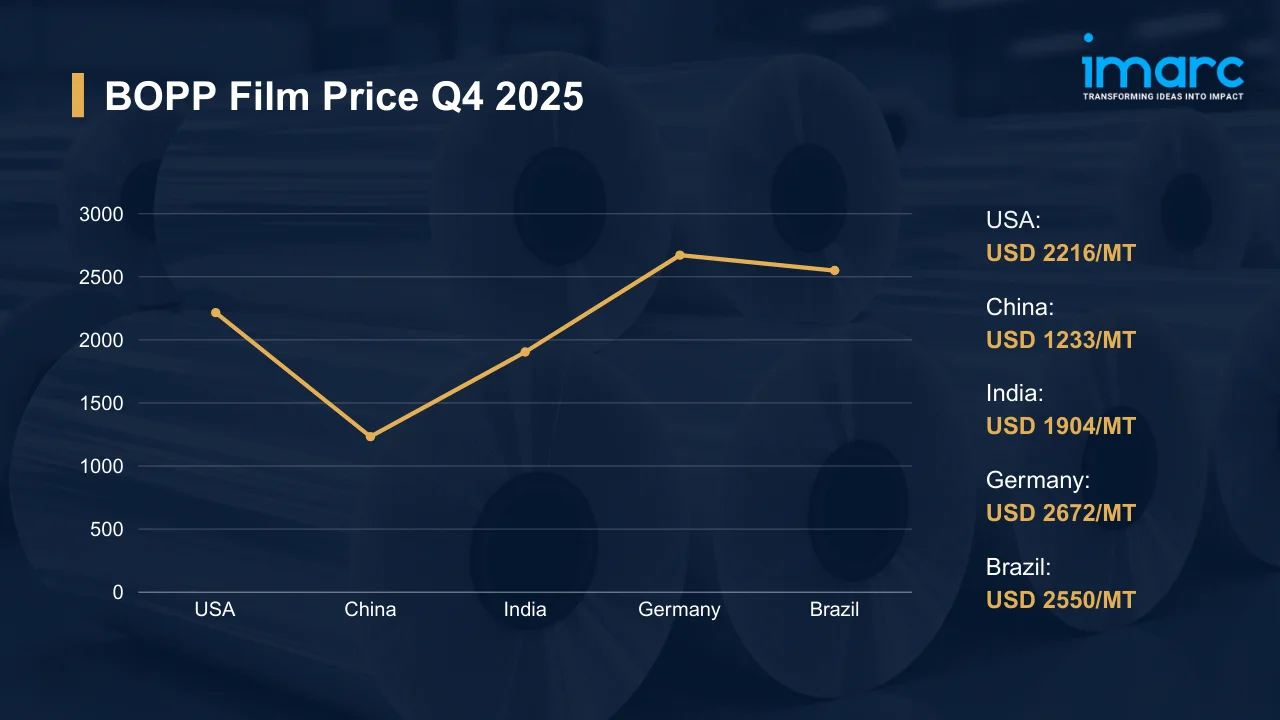
Summary:
Q4 2025 delivered a mixed pricing outcome across the tracked BOPP film markets, with three regions recording declines and two posting gains. Subdued packaging demand and competitive Asian imports weighed on prices in the USA, China, and Brazil, while India and Germany advanced on seasonal restocking and firming feedstock costs. Across declining markets, BOPP film prices fell 1.7%–11.8% quarter-on-quarter. According to Al Jazeera, as of March 8, 2026, the Israel–Iran–USA conflict disrupted approximately one-fifth of global crude oil and natural gas supply, a development that may amplify price volatility in the quarters ahead.
BOPP Film Price Q4 2025:
Regional prices (USD per MT) and QoQ changes Q4 vs Q3 2025:
| Region | Price (USD/MT) | QoQ Change | Direction |
|---|---|---|---|
| USA | 2216 | −7.4% | ↓ Decline |
| China | 1233 | −1.7% | ↓ Decline |
| India | 1904 | +16.5% | ↑ Growth |
| Germany | 2672 | +1.5% | ↑ Growth |
| Brazil | 2550 | −11.8% | ↓ Decline |
To access real-time prices Request Sample
Kindly note: IMARC’s pricing database tracks BOPP film price movements across major global markets.
What Moved Prices:
USA:
- In Q4 2025, BOPP film prices in the USA declined to USD 2216/MT, driven by continued caution across the packaging sector amid macroeconomic uncertainty and limited new order activity. Conservative procurement persisted throughout the quarter, supported by sufficient domestic inventories and stable polypropylene feedstock costs that gave buyers little urgency to secure additional volumes. In the USA, the BOPP film price chart reflected a consistent downward trajectory through the period.
- Competitive import supply from Asian producers exerted sustained downward pressure on market negotiations, reducing domestic supplier pricing leverage considerably. Balanced freight conditions avoided logistics-driven cost escalation, while e-commerce and food packaging activity remained moderate, failing to generate the restocking cycle that could have reversed the prevailing bearish market tone.
China:
- In Q4 2025, BOPP film prices in China eased to USD 1233/MT, as softened export demand from Southeast Asia and restrained domestic buying from the food and consumer goods sectors limited overall price momentum. Production rates remained steady while feedstock polypropylene costs stayed range-bound, removing any cost-driven rationale for an upward price correction during the quarter.
- Port-related congestion and logistical delays at key export hubs created delivery uncertainty, adding to buyer caution across downstream segments. Competitive pricing from other regional producers further capped pricing power, as converters maintained lean inventory positions and avoided large-volume commitments ahead of a clearer demand recovery signal.
India:
- In the fourth quarter of 2025, prices in India climbed to USD 1904/MT, supported by a seasonal uptick in consumption from the food packaging and FMCG segments as the post-monsoon demand cycle gathered pace. Downstream converters showed improved buying interest, particularly from labeling and flexible packaging producers serving domestic consumer goods manufacturers.
- Feedstock polypropylene costs remained broadly stable, though intermittent supply tightness at certain domestic manufacturing units provided modest upward cost support. Export inquiries from Middle East and Southeast Asian buyers contributed additional lift, helping sustain the price gain through the quarter despite a month-on-month softening recorded in September 2025.
Germany:
- In Q4 2025, BOPP film prices in Germany rose to USD 2672/MT, a 1.5% increase from USD 2632/MT in Q3 2025. The uptick was supported by modest restocking activity among packaging converters ahead of the year-end demand period, alongside a firming of polypropylene feedstock costs that encouraged producers to push for slightly higher offer prices across European markets.
- Competitive import pressure from Asian suppliers remained present but was partially offset by longer lead times driven by conflict-related shipping rerouting around the Cape of Good Hope. Buyers accepted modest price increases given tightening spot availability, while some converters moved to secure forward volumes in anticipation of continued logistics cost inflation into early 2026.
Brazil:
- In Q4 2025, BOPP film prices in Brazil fell to USD 2550/MT, declining sharply from elevated levels recorded in September. The adjustment was prompted by a normalization of buying actions after a phase of proactive inventory accumulation in the previous quarter, as the food and beverage (F&B) industry returned to a requirement-based purchasing strategy.
- Import availability remained adequate throughout the quarter, with competitive offers from Asian exporters filling supply gaps and capping price recovery. Inflationary pressures continued to weigh on consumer spending and industrial output, while currency volatility added further uncertainty to procurement planning among Brazilian packaging converters.
BOPP Film Price Outlook After the Israel–Iran–USA Conflict:
Rising Crude Oil Prices and Petrochemical Cost Pressure: The ongoing conflict involving the USA, Israel, and Iran is generating significant turbulence across global energy and petrochemical markets, with direct implications for BOPP film production costs. Polypropylene, the primary feedstock for BOPP film manufacturing, is a crude oil derivative. Global LNG prices rose nearly 60% since hostilities began. This development might substantially inflate input costs for BOPP film producers across all major manufacturing regions.
Geopolitical Risk Premium and BOPP Film Price Volatility: The conflict introduces a significant geopolitical risk premium into BOPP film pricing, making it difficult for producers and buyers to forecast costs and availability with confidence. Energy market instability is widening bid-ask spreads in BOPP film negotiations and slowing the pace at which market corrections can occur. This pricing opacity might persist for several months, keeping price direction highly sensitive to any escalation or de-escalation in hostilities.
Procurement Behavior and Inventory Strategies:
Key Factors Influencing the BOPP Film Price?
Immediate Market Reaction
As the Israel–Iran–USA conflict intensifies, global BOPP film markets are registering mounting uncertainty. The near-closure of the Strait of Hormuz restricts polypropylene feedstock movements critical for BOPP film production across Asia and Europe. The BOPP film price index remains under pressure as conflict-driven energy cost volatility reshapes buyer behavior and procurement timelines across key markets. Near-term BOPP film price trajectories might shift significantly depending on how rapidly hostilities evolve and whether key trade corridors can be reopened to commercial shipping.
Impact on BOPP Film Prices
The conflict might trigger several key changes in the BOPP film market:
- Polypropylene Feedstock Cost Escalation: Rising crude oil prices and Gulf supply disruptions might push polypropylene costs sharply higher, directly increasing BOPP film manufacturing expenses and eroding producer margins across all major output centers. As feedstock availability tightens in Asian and European supply chains, manufacturers might face a difficult choice between absorbing cost increases or passing them downstream, with price sensitivity among converters limiting effective pass-through capability.
- Logistics and Freight Cost Premium: Cape of Good Hope rerouting will add extra transit days to Asia-Europe trade lanes, inflating delivered BOPP film costs and widening the pricing gap between origin and destination markets. As shipping capacity on alternative routes tightens and port congestion builds at key transshipment hubs, delivery lead times will extend further, forcing buyers to either secure supply early at higher cost or risk shortfalls in production inputs.
- Demand Substitution and Converter Caution: Conflict-driven price spikes might prompt downstream converters to evaluate alternative packaging substrates or reduce overall consumption volumes temporarily, constraining BOPP film demand. As end use brands absorb rising packaging costs, some might delay new product launches or reformulate packaging specifications, creating short-term demand softness that limits producers’ ability to fully recover escalating input costs through adjustments to final pricing.
Taken together, these pressures might establish a new cost-linked pricing floor for BOPP film across Asia and Europe, reversing the downtrend observed through Q4 2025. Producers operating in geographically insulated markets will likely face elevated inbound demand as buyers redirect procurement, reinforcing regional price divergence that might persist well into 2026.
Supply Chain Disruptions
BOPP film supply chains face acute disruption as the near-closure of the Strait of Hormuz restricts polypropylene feedstock movements and finished film shipments across key trade lanes. Producers reliant on Gulf-region PP imports are exploring alternative sourcing, but congestion at rerouting hubs limits flexibility. Between 1 March and 13 March 2026, a total of 16 ships were struck while transiting the Strait of Hormuz and at anchorage, presenting the possibility of maximum disruption to supply chain operations.
Producers in conflict-adjacent regions might curtail output as operational risk intensifies, while buyers in Europe and South America will face longer lead times and elevated landed costs. Alternative routing through Oman’s Duqm port might offer partial relief, though terminal capacity there remains under considerable strain. Market participants are expected to increasingly shift toward regional suppliers, accelerating short-term trade realignments.
Global Market Overview:
Globally, the BOPP film industry was valued at USD 23.0 Billion in 2025. Market projections indicate steady growth, with the industry expected to reach USD 33.8 Billion by 2034, at a compound annual growth rate (CAGR) of 4.14% during 2026–2034. Broad demand from the food, pharmaceutical, and consumer goods packaging sectors continues to propel market expansion. Sustainability-driven shifts towards recyclable mono-material packaging, rising e-commerce penetration in emerging economies, and advancing biaxial orientation technologies reinforce a positive BOPP film price trend over the long-term forecast horizon.
Recent Highlights & Strategic Developments:
Recent strategic moves within the industry further illustrate evolving dynamics:
- In June 2025, Cosmo First, a significant figure in the sectors of packaging, lamination, labeling, and synthetic paper, declared the successful initiation of a new BOPP Film Line with a capital expenditure exceeding INR 400 Crores at the company’s manufacturing facility in Aurangabad, Maharashtra.
- In June 2025, Dhunseri Ventures Limited revealed the launch of a BOPP film manufacturing plant in Kathua, Jammu. The facility was intended to enhance the group's ability in BOPP films, an essential material used in the flexible packaging, labeling, and laminating sectors.
- In June 2025, Brückner and Yangzhou Boheng launched a new BOPET film production line that utilized composite current collector film technology (CCCF). For the current collector film, two lines for BOPP and BOPET films were planned to start production in early 2026. Energy technologies, such as batteries, supercapacitors, and solar panels, could improve performance by utilizing ultra-thin current collector films.
- In April 2025, Innovia Films unveiled a new graphics film coater at its UK location, enhancing its eco-friendly, PVC-free Rayoart series. It strengthened the fast and recyclable BOPP film production, resulting in a reduced environmental impact. The initiative aligned with the ‘New Plastics Economy Program’ and Innovia's commitment to eco-friendly solutions.
BOPP Film Price Forecast (2026):
BOPP film pricing in the near future will continue to be susceptible to changes in polypropylene costs that are directly related to the trajectories of crude oil prices influenced by the Israel-Iran-USA conflict. As geopolitical risk and feedstock volatility continue to generate uncertainty across important production and trading countries, buyers may experience price swings that are far greater than the narrow ranges seen during the majority of 2025.
BOPP film prices will probably rise in most areas as polypropylene feedstock costs rise and transportation costs rise if hostilities worsen and the Strait of Hormuz is essentially closed for a long time. Producers in areas vulnerable to violence may reduce their activities, which would tighten the world's supply. Conversely, a de-escalation or negotiated ceasefire might allow energy markets to stabilize, with these combined dynamics continuing to shape the BOPP film price forecast for the year ahead.
Strategic Takeaways:
Looking ahead, the BOPP film market is expected to navigate a period of heightened uncertainty driven by geopolitical disruption, feedstock volatility, and shifting demand patterns. Long-term fundamentals remain supportive, underpinned by robust packaging sector growth, rising adoption of recyclable film grades, and expanding demand from the food, pharmaceutical, and e-commerce sectors.
To navigate this complex landscape, stakeholders should:
- Monitor Regional Price Differentials: Track BOPP film pricing across USA, China, India, Germany, and Brazil monthly to identify cost-saving procurement windows. Benchmarking BOPP film price per MT against prevailing contract rates enables procurement teams to capture favorable sourcing opportunities and avoid overpaying during periods of regional price divergence.
- Monitor Geopolitical Risk Exposure: Track escalation dynamics in the current conflict and assess how shifts in hostility levels might affect BOPP film pricing, polypropylene feedstock availability, and logistics costs. Establish internal alert thresholds that trigger procurement or hedging action before market conditions deteriorate further.
- Diversify Supply Chain Routes: Evaluate alternative sourcing and shipping corridors to reduce exposure to conflict-impacted Strait of Hormuz routes. Secondary supplier agreements and contingency freight arrangements will provide supply chain resilience if primary BOPP film trade lanes face disruption or prolonged closure due to the ongoing conflict.
- Adjust Procurement Strategy for Conflict Conditions: Adopt flexible contract structures, including price reopener clauses and force majeure provisions, to protect against geopolitical price spikes in BOPP film markets. Precautionary inventory buffers might reduce exposure if polypropylene supply tightens abruptly due to sustained Strait of Hormuz disruption.
- Explore Sustainable Film Grades: Evaluate growing demand for bio-based and recyclable BOPP film grades gaining traction among sustainability-focused brands globally. Producers investing early in eco-friendly alternatives might secure premium contracts and build differentiated market positions that provide insulation from commodity price volatility.
Subscription Plans & Customization:
IMARC offers flexible subscription models to suit varying needs:
- Monthly Updates — 12 deliverables/year
- Quarterly Updates — 4 deliverables/year
- Biannual Updates — 2 deliverables/year
Each includes detailed datasets (Excel + PDF) and post-report analyst support.

Get in Touch With Us
UNITED STATES
Phone: +1-201-971-6302
INDIA
Phone: +91-120-433-0800
UNITED KINGDOM
Phone: +44-753-714-6104
Email: [email protected]
Client Testimonials




.webp)




.webp)












