Calcium Powder Price Falls 2.2% in India, 2.2% in Netherlands — Q1 2026 Update
29-Dec-2025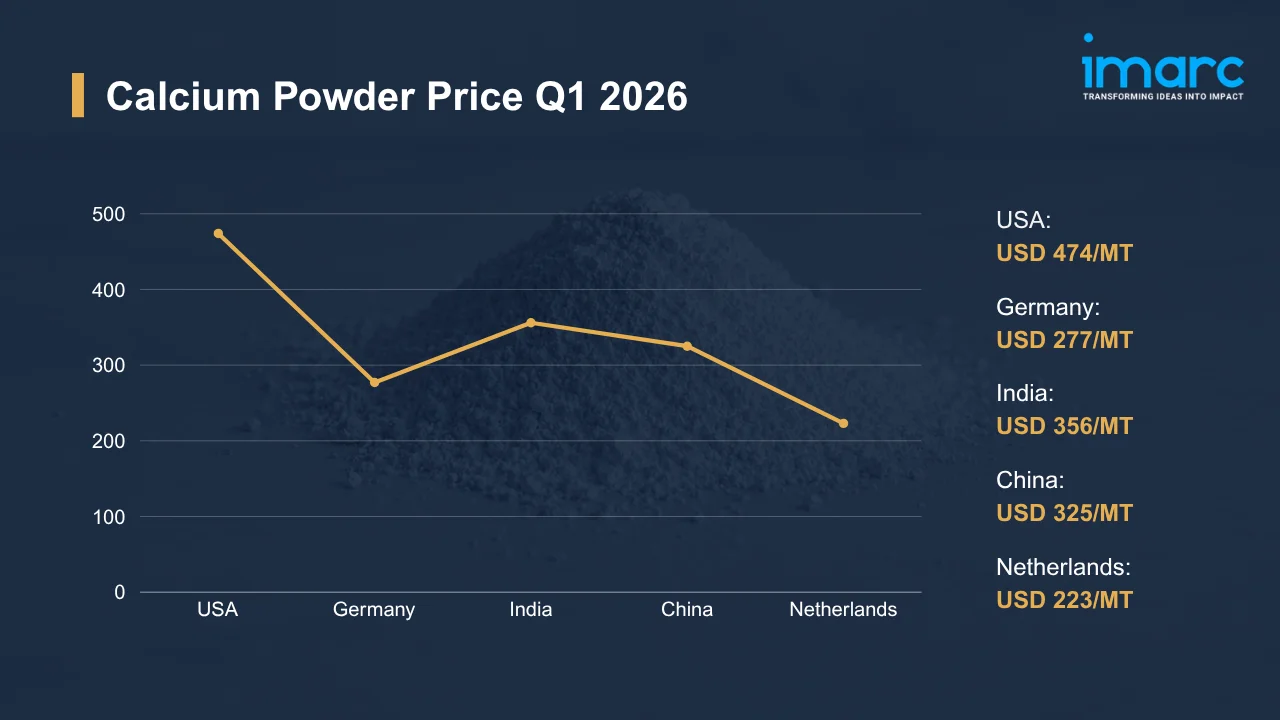
Summary:
Calcium powder markets split sharply through Q1 2026. With North America's strengthening in construction and pharmaceutical demand, four import-dependent areas experienced declines because of fluctuating demand and ongoing conflict issues throughout March. Across producer hubs, cement-additive restocking and pharma-grade procurement drove pricing dynamics, with quarter-on-quarter swings in calcium powder prices stretching from 2.2% declines to an 8.8% gain. Brent crude jumped 51% in March 2026, one of the largest monthly oil price surges on record, adding fresh cost volatility to the calcium powder outlook.
Calcium Powder Price Q1 2026:
Regional prices (USD per MT) and QoQ changes Q1 2026 vs Q4 2025:
| Region | Price (USD/MT) | QoQ Change | Direction |
|---|---|---|---|
| USA | 474 | +8.8% | ↑ Growth |
| Germany | 277 | -1.4% | ↓ Decline |
| India | 356 | -2.2% | ↓ Decline |
| China | 325 | -1.8% | ↓ Decline |
| Netherlands | 223 | -2.2% | ↓ Decline |
To access real-time prices Request Sample
Kindly note: IMARC's pricing database tracks calcium powder price movements across major global markets.
What Moved Prices:
USA
- During Q1 2026, calcium powder prices in the USA climbed to USD 474/MT, an 8.8% rise from Q4 as construction and pharma-sector demand strengthened across major industrial corridors. Tighter domestic production limited supply through March.
- Construction-segment buyers locked in volumes ahead of expected Q2 project ramps. Across the quarter, the calcium powder price chart for North America reflected firm upward momentum supported by structured procurement, organized Gulf Coast logistics, and limited import inflows from Asian origins.
Germany
- In Q1 2026, calcium powder prices in Germany softened to USD 277/MT, slipping 1.4% as moderated industrial demand met sufficient supply across the converter base. Stable processing economics offered no upward push through March.
- Within the Mittelstand processor base, procurement caution mirrored a weak industrial backdrop, while limited competition from neighboring European suppliers reinforced downward pressure and kept offer levels subdued. Specialty-grade demand stayed flat across the quarter.
India
- In Q1 2026, calcium powder prices in India eased to USD 356/MT, a 2.2% drop as construction and chemical demand softened. Steady domestic output kept inventories comfortable through March, blunting any spot-market urgency.
- Across the agritech and food-supplement segments, post-winter restocking failed to translate into active calcium powder buying, with regional distributors holding comfortable stock positions. Inland transport ran smoothly, while Middle East export inquiries stayed muted through quarter end.
China
- During Q1 2026, calcium powder prices in China fell to USD 325/MT, down 1.8% as demand from metallurgy and construction applications moderated, though production remained balanced across major manufacturing hubs. Buyers stayed disciplined.
- Within the Guangzhou and Yiwu converter clusters, downstream absorption weakened against Q4, while Southeast Asian export demand stayed flat and offered little support to domestic supplies. Currency stability removed forward-buying incentive, though organized port logistics kept material flowing through coastal channels.
Netherlands
- In Q1 2026, calcium powder prices in the Netherlands edged down to USD 223/MT, a 2.2% decline as construction and industrial-mineral demand cooled. Rotterdam's organized import flows kept warehouse stock adequate.
- Across specialty and pharmaceutical-grade segments, demand stayed weak through the quarter and prevented any price recovery, while Rotterdam's energy costs held seasonally stable. EU regulatory compliance and balanced converter procurement limited upward pressure on local processors.
Calcium Powder Price Outlook After the Israel–Iran–USA Conflict:
Energy Markets and Feedstock Costs: Across global energy markets, the Israel–Iran–USA conflict is lifting input costs that flow directly into calcium powder production. Mining, kiln calcination, and drying remain among the most energy-intensive steps in the value chain. Heightened fuel and electricity price volatility is therefore directly translating into higher production costs for calcium powder manufacturers, tightening margins across the value chain.
Regional Demand Uncertainty and Price Volatility: Energy-intensive kiln processing could face mounting cost pressures through Q2 as macroeconomic uncertainty disrupts industrial purchasing patterns across regions reliant on calcium powder. Construction delays and deferred infrastructure spending will likely suppress demand through mid-2026. Currency swings add another layer of complexity for importers, and price volatility will widen across import-dependent markets.
Immediate Market Reaction:
Across Asian production hubs, elevated freight and energy costs are pushing calcium powder offers higher, while buyers in import-reliant regions trim forward commitments and pivot to shorter contracts. Distributor sentiment stays cautious. Procurement teams across Europe and South Asia are avoiding speculative buying and reassessing inventory positions against the live conflict backdrop, with the broader calcium powder price index reflecting the resulting regional volatility. Contract negotiations now incorporate force-majeure language tied to Middle East shipping conditions.
Impact on Calcium Powder Prices:
The conflict might trigger several key changes in the calcium powder market:
- Energy input cost escalation: Calcium powder production relies on energy-intensive operations across mining, kiln calcination, and drying, so sustained spikes in fuel and power costs will compress producer margins through mid-2026 and force pass-through pricing across regional manufacturing hubs and downstream processors. Margin pressure is sharpest in import-dependent regions.
- Freight and logistics premiums: Maritime insurance hikes and rerouting around the Cape of Good Hope are adding transit time and surcharges to Asia-Europe and Asia-Americas calcium powder shipments, with container line premiums likely persisting into mid-2026. Producers may absorb a portion. Container surcharges should keep climbing.
- Inventory and procurement shifts: Elevated geopolitical risk is pushing buyers to rebuild safety stocks at higher cost and accelerate procurement cycles, straining availability in European and South Asian distribution networks. Import-reliant regions are turning to intra-regional sourcing, creating localized price spreads and premiums for secured non-conflict-routed supply.
These pressures will compound rather than offset each other across import-reliant markets. Energy, freight, and procurement timing pull calcium powder prices into a more volatile trajectory, with the ultimate impact hinging on how long the strait disruption persists and whether alternative routes stabilize through Q2.
Supply Chain Disruptions:
Pressure is mounting across freight, energy, and feedstock channels as vessels increasingly bypass the Suez Canal and reroute around Africa's southern tip, adding weeks to Asia-Europe and Asia-Americas transit times for industrial materials. In late March 2026, the Strait of Hormuz closure cut roughly 11 Million barrels of daily global oil flows. Cost compounding could escalate through Q2.
Across major trade lanes, producers might respond by adjusting routing arrangements, building regional inventory buffers, and renegotiating freight commitments with carriers. European buyers will likely shift toward intra-EU and North African suppliers to minimize transit risk. Cost pressures from feedstock, energy, and shipping should compound through mid-2026, pushing landed calcium powder prices higher across import-dependent regions as supply chains realign.
Global Market Overview:
The global calcium powder market was valued at USD 54.04 Billion in 2025 and is projected to reach USD 92.91 Billion by 2034, at a 6.21% CAGR during 2026-2034. Across pharmaceuticals, food fortification, plastics modification, and agriculture, multiple demand drivers are sustaining the market. Each calcium powder price trend signal in 2026 must be read against this longer-term expansion. Regulatory support in nutraceuticals and infrastructure spending will drive sustained consumption growth.
Recent Highlights & Strategic Developments:
- In November 2025, Caltron Clays and Chemicals reinforced its position as a leading Indian active absorbable calcium powder manufacturer, advancing a high-bioavailability formulation for clinical and nutraceutical applications and strengthening its role in calcium-based ingredient supply.
Calcium Powder Price Forecast (2026):
Through Q2 and Q3 2026, calcium powder prices will hinge on the interaction between construction demand, mineral processing activity, and energy costs flowing from the Israel–Iran–USA conflict. European and Asian buyers should stay cautious as energy markets recalibrate, with margins under pressure across import-reliant processors.
If geopolitical tensions persist, calcium powder prices will face upward pressure from rising energy costs and wider freight premiums on Asia-Europe and Asia-Americas routes, while supply tightens as producers in conflict-adjacent zones cut output. A diplomatic breakthrough could ease shipping expenses and restore feedstock availability, allowing prices to normalize by late 2026. Procurement teams should monitor the calcium powder price forecast closely as competing scenarios drive the trajectory.
Strategic Takeaways:
Looking ahead, the calcium powder market is expected to navigate a phase of mixed regional pricing, energy cost pass-through, and shifting procurement behavior shaped by ongoing geopolitical pressures. Steady growth across pharmaceuticals, food fortification, construction, and industrial mineral processing will anchor longer-term demand even as near-term volatility tests buyer resilience.
To navigate this complex landscape, stakeholders should:
- Monitor Regional Price Differentials: Track the spread between North American gains and European or Asian softness to identify arbitrage windows and adjust regional sourcing strategies. Cross-regional benchmarking supports tighter procurement decisions and contract renewals across multiple grades through 2026.
- Monitor Geopolitical Risk Exposure: Track escalation dynamics in the Israel–Iran–USA conflict and assess how shifts in hostility levels might affect calcium powder pricing, feedstock availability, and logistics costs. Establish internal alert thresholds that trigger procurement or hedging action.
- Diversify Supply Chain Routes: Evaluate alternative sourcing geographies and shipping corridors to reduce dependence on conflict-exposed maritime trade lanes. Secondary supplier agreements and contingency freight arrangements will provide critical operational resilience if primary routes face prolonged disruption events.
- Monitor Feedstock Cost Dynamics: Track natural gas, electricity, and limestone cost movements to identify margin pressure and supplier shifts. Early visibility into feedstock dynamics will enable strategic procurement timing and forward-buying decisions across multiple cycles in 2026.
- Adjust Procurement Strategy for Conflict Conditions: Adopt flexible contract structures with price reopener clauses and force majeure provisions to protect against geopolitical price spikes across grades. Precautionary inventory buffers might reduce exposure if supply tightens abruptly across the second half of 2026.
- Benchmark Procurement Against Regional Contracts: Compare monthly calcium powder price per MT against regional benchmark contracts to spot favorable buying opportunities across markets. Use these comparisons to strengthen negotiation leverage with suppliers across multiple grades and regions through 2026.
Subscription Plans & Customization:
IMARC offers flexible subscription models to suit varying needs:
- Monthly Updates — 12 deliverables/year
- Quarterly Updates — 4 deliverables/year
- Biannual Updates — 2 deliverables/year
Each includes detailed datasets (Excel + PDF) and post-report analyst support.

.webp)
Get in Touch With Us
UNITED STATES
Phone: +1-201-971-6302
INDIA
Phone: +91-120-433-0800
UNITED KINGDOM
Phone: +44-753-714-6104
Email: [email protected]
Client Testimonials




.webp)




.webp)












