Chrome Price Increases 2.5% in South Korea, Falls 2.1% in Netherlands — Q1 2026 Update
31-Mar-2026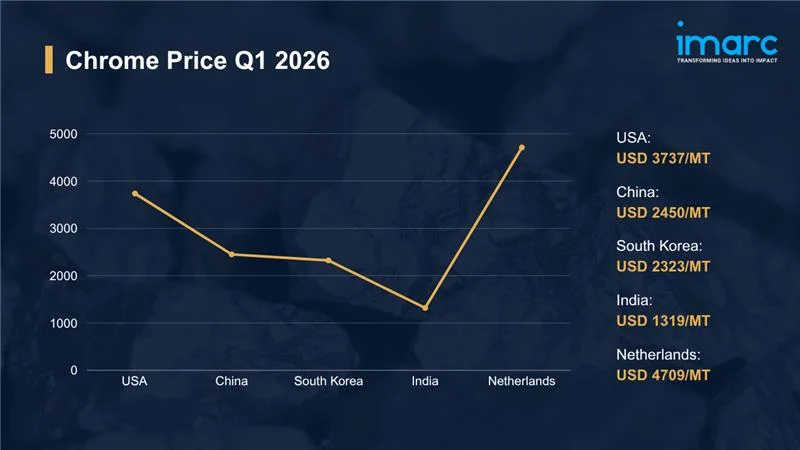
Summary:
Q1 2026 brought broad price recovery across chrome markets as mill procurement regained pace and ore supply tightened. Chrome prices moved between a 2.1% decline and a 2.5% gain QoQ, with four of five markets posting increases driven by firming ferrochrome demand and constrained ore availability. Smelting energy costs are climbing. As of March 8, 2026, global oil prices surged over 25% since the conflict's outbreak, a cost headwind that might amplify chrome price volatility into mid-2026.
Chrome Price Q1 2026:
Regional prices (USD per MT) and QoQ changes Q1 vs Q4 2025:
| Region | Price (USD/MT) | QoQ Change | Direction |
|---|---|---|---|
| USA | 3737 | +1.4% | ↑ Growth |
| China | 2450 | +2.0% | ↑ Growth |
| South Korea | 2323 | +2.5% | ↑ Growth |
| India | 1319 | +2.1% | ↑ Growth |
| Netherlands | 4709 | -2.1% | ↓ Decline |
To access real-time prices Request Sample
Kindly note: IMARC’s pricing database tracks chrome price movements across major global markets.
What Moved Prices:
USA:
- In Q1 2026, USD 3737/MT was the chrome price the USA market settled at, a 1.4% QoQ gain reflecting resumed procurement among stainless steel producers and alloy manufacturers. Domestic run rates at ferrochrome plants along the Gulf Coast improved through the quarter, pulling spot availability progressively tighter by March.
- Capping spot price gains, competitive import availability from South Africa and Kazakhstan kept domestic buyers in a diversified sourcing stance throughout Q1. The chrome price chart for the quarter reflected a gradual upward recovery, with Gulf Coast ferrochrome consumers benefiting from stable trans-Pacific freight conditions and improved inventory visibility heading into Q2.
China:
- In Q1 2026, chrome prices in China climbed to USD 2450/MT, a 2.0% QoQ advance driven by expanding stainless steel mill output across Guangdong and Zhejiang hubs. Renewed procurement from chrome plating and chemical sectors added a secondary demand layer, pushing domestic ore call-offs above Q4 2025 levels by mid-quarter.
- Port congestion at Tianjin and Qingdao eased in January, allowing import cargoes from South Africa and Kazakhstan to clear with shorter dwell times. Against a backdrop of Hormuz-linked freight volatility, buyers nonetheless kept a cautious stance on forward inventory buildup, balancing operational needs against delivery uncertainty throughout Q1.
South Korea:
- In Q1 2026, at USD 2323/MT, South Korean chrome prices posted the quarter's strongest QoQ gain of 2.5% as export-driven stainless steel production schedules recovered and alloy manufacturers accelerated ferrochrome purchasing. Renewing downstream orders from automotive OEMs and appliance manufacturers provided the clearest demand signal the market had recorded since Q2 2025.
- Constrained by elevated freight charges on the Cape of Good Hope rerouting from Southern Africa, ore arrivals maintained upward landed cost pressure throughout Q1 2026. Procurement teams adopted shorter-duration contracts to preserve sourcing flexibility, keeping average CIF benchmarks elevated despite steady domestic ferrochrome production rates and improving mill utilization levels.
India:
- In Q1 2026, chrome prices in India advanced to USD 1319/MT, a 2.1% QoQ increase driven by strengthened ferrochrome producer procurement as active downstream manufacturing schedules accelerated. Odisha-based mining operations returned to near-normal output after Q4 2025 disruptions, tightening the domestic ore balance and sustaining upward price pressure through March.
- Electricity and coking coal costs remained elevated across Indian smelting facilities, compressing converter margins and limiting aggressive spot discounting throughout the quarter. With export inquiries from Southeast Asian and Middle Eastern buyers keeping offtake volumes firm, import parity pricing from South Africa reinforced local producers’ competitive standing through Q1.
Netherlands:
- In Q1 2026, chrome prices in the Netherlands fell to USD 4709/MT, a 2.1% QoQ decline as European stainless steel processors reduced intake volumes amid weaker end-user demand and Hormuz-linked logistics uncertainty. Import reliance remained high, but buyers shifted firmly toward contract volumes to manage delivery risk and cap spot market exposure.
- Rerouting of ore vessels via Cape of Good Hope extended delivery lead times from South African and Turkish origins, raising landed costs and complicating short-term supply planning across the Dutch converter base. Against this backdrop, Rotterdam stocking levels stayed adequate for near-term needs, yet procurement strategies shifted firmly toward contract coverage, limiting spot market activity through Q2 2026.
Chrome Price Outlook After the Israel–Iran–USA Conflict:
Rising Smelting Energy Costs and Feedstock Pressure for Chrome: Ferrochrome smelting requires between 3,500 and 4,000 kWh per output Ton, making it acutely sensitive to electricity price movements. As of March 11, 2026, European natural gas prices reached 50 euros per megawatt-hour amid the conflict, pushing power tariffs higher across smelting regions reliant on gas-fired generation. Rising electricity costs might lift ferrochrome benchmarks through Q2 2026.
Geopolitical Uncertainty and Demand Shifts Across Chrome Markets: Geopolitical uncertainty might reshape chrome demand as industrial buyers scale back capital commitments and reassess production targets. Facing elevated energy costs, steel-consuming sectors might moderate chrome procurement throughout Q2, while construction-exposed markets in South and East Asia sustain comparatively firmer absorption. Such demand divergence will likely shape regional price direction well into the second half of 2026.
Immediate Market Reaction:
Chrome markets worldwide feel the conflict’s cost pressures most acutely in ferrochrome smelting and ore logistics. With South African, Indian, and Kazakhstani producers accounting for most global refined chrome output, the oil price surge is pushing power generation costs higher across all three regions. The chrome price index reflects these pressures through widening landed cost spreads and tighter spot availability on major trade routes. Across importing hubs in East Asia and Northern Europe, war-risk insurance surcharges compound the freight premium already embedded in CIF delivery benchmarks, sharpening the market’s exposure to conflict-driven logistics costs.
Impact on Chrome Prices:
The conflict might trigger several key changes in the chrome market:
- Energy Cost Escalation in Ferrochrome Smelting: Ferrochrome smelting is highly energy-intensive, placing it among the most electricity-sensitive processes in metals production. Escalating power tariffs driven by conflict-linked LNG supply disruption might increase smelting costs across South African, Indian, and Kazakhstani facilities, compressing margins and signaling output adjustments that will likely reflect in Q2 contract pricing cycles.
- Import Freight Premium and Supply Chain Exposure: Chrome ore traveling from South Africa routes exclusively via the Cape of Good Hope, adding 10 to 14 transit days per voyage and materially increasing per-MT freight costs. Depending on vessel class and applicable war-risk insurance premiums, buyers in South Korea, China, and the Netherlands might face higher landed ore costs compared to pre-conflict CIF benchmarks.
- Regional Demand Divergence and Downstream Hesitation: Geopolitical uncertainty is prompting steel mills in energy-cost-sensitive markets to reassess Q2 production targets, with some operators considering reduced blast furnace utilization to protect margins. Where chrome-intensive alloy demand ties to government-backed infrastructure programs, particularly in South Asia, procurement volumes might remain resilient, creating a demand divergence that will shape QoQ price trajectories.
Taken together, energy cost escalation, rising freight premiums, and demand divergence will likely sustain an upward cost bias in chrome pricing through mid-2026. Demand-side hesitation might temporarily offset this pressure in some markets, but volatile landed costs will likely shift contract benchmarks at the next quarterly pricing cycle.
Supply Chain Disruptions:
Chrome ore supply chains route predominantly via the Cape of Good Hope, adding extra days to voyage times from South African and Kazakhstani origins to East Asian and European consuming markets. Constrained by suspended Gulf sailings, vessel capacity remains tight across affected bulk carrier routes. On March 2, 2026, Maersk, MSC, Hapag-Lloyd, and CMA CGM suspended Strait of Hormuz operations, accelerating freight cost increases across bulk commodity lanes serving major chrome ore trade flows.
South African and Kazakhstani producers are evaluating alternative logistics pathways, with some exploring multimodal routing through eastern African ports to maintain delivery reliability. Straining just-in-time replenishment models at South Korean and Dutch importing mills, extended transit times are elevating safety stock requirements across Q2 procurement plans. Buyers are extending procurement horizons to six to eight weeks and building buffer stocks to absorb route delays, a shift that will elevate working capital requirements and might sustain CIF benchmark pressure through mid-2026.
Global Market Overview:
Globally, the chrome industry was valued at USD 546.32 Million in 2025. Market projections indicate steady growth, with the industry expected to reach USD 809.45 Million by 2034, with a compound annual growth rate (CAGR) of 4.47% during 2026-2034. Underpinned by stainless steel production expansion and the widening adoption of corrosion-resistant alloys across automotive, construction, and industrial manufacturing segments, demand continues to broaden beyond traditional applications. Refractory and electroplating sector activity reinforces the positive chrome price trend across global markets.
Recent Highlights & Strategic Developments:
Recent strategic moves within the industry further illustrate evolving dynamics:
- In October 2025, Outokumpu progressed its EVOLVE strategy to enhance the manufacture of carbon-free materials, emphasizing chromium metal and enriched ferrochrome. The firm designated approximately USD 45 Million for a new pilot facility in New Hampshire, US, expected to commence operations in early 2027. The pilot facility will generate enriched ferrochrome containing 65% chrome and chromium metal exceeding 90% chrome, enhancing its specialty metals operations.
Chrome Price Forecast (2026):
Near-term chrome prices will remain sensitive to conflict-driven energy cost movements and evolving downstream demand signals from the stainless steel and alloy sectors. With procurement caution expected to persist among alloy manufacturers and steel mills in energy-intensive regions through Q2 2026, any easing of geopolitical risk might open a pathway toward cost stabilization as logistics networks gradually normalize.
Should hostilities intensify and Strait of Hormuz closures extend through Q2, chrome prices will face renewed upward pressure as energy and freight costs climb and ferrochrome output contracts in high-cost smelting regions. Conversely, a diplomatic resolution might ease freight rates and restore LNG supply flows, allowing smelting electricity costs to ease and chrome prices to trend toward pre-conflict benchmarks by H2 2026. Either scenario will determine the chrome price forecast for the remainder of the year.
Strategic Takeaways:
Looking ahead, the chrome market is expected to sustain a broadly positive pricing trajectory through 2026, supported by recovering stainless steel demand and incremental tightening in global ore supply. Energy cost volatility and geopolitical risk from the ongoing conflict represent the primary forces capable of disrupting this positive growth trajectory.
To navigate this complex landscape, stakeholders should:
- Monitor Regional Price Differentials: Track quarterly price variations across the five core chrome markets to identify cost-efficient procurement windows and arbitrage opportunities. Establish benchmarking protocols that compare landed CIF costs against prevailing contract rates to support sourcing decisions each quarter.
- Benchmark Against Market Rates: Systematically track chrome price per MT across spot and contract channels to identify real-time procurement cost gaps and tactical sourcing windows. Regular quarterly benchmarking against prevailing market rates will improve negotiation positioning and overall buying efficiency.
- Monitor Geopolitical Risk Exposure: Track conflict escalation dynamics and assess how hostility shifts might affect chrome pricing, feedstock availability, and key logistics costs. Establish internal alert thresholds that trigger procurement or hedging action when risk metrics exceed defined levels.
- Diversify Supply Chain Routes: Evaluate alternative chrome ore sourcing and shipping corridors to reduce over-reliance on conflict-exposed trade lanes and logistics nodes. Secondary supplier agreements and contingency freight arrangements will provide critical supply resilience if primary routes face disruption.
- Adjust Procurement Strategy for Conflict Conditions: Adopt flexible contract structures with price reopener clauses and force majeure provisions to protect against geopolitical price spikes and delivery failures. Precautionary chrome ore buffer stocks might reduce cost exposure if supply tightens abruptly.
- Track Ore Origin and Production Cost Dynamics: Monitor mining output and production cost developments in South Africa and Kazakhstan to anticipate upstream supply-side pricing signals early. Quarterly supply balance assessments will help procurement teams improve timing and positioning before contract renewal windows open.
Subscription Plans & Customization:
IMARC offers flexible subscription models to suit varying needs:
- Monthly Updates — 12 deliverables/year
- Quarterly Updates — 4 deliverables/year
- Biannual Updates — 2 deliverables/year
Each includes detailed datasets (Excel + PDF) and post-report analyst support.
Get in Touch With Us
UNITED STATES
Phone: +1-201-971-6302
INDIA
Phone: +91-120-433-0800
UNITED KINGDOM
Phone: +44-753-714-6104
Email: [email protected]
Client Testimonials




.webp)




.webp)












