Corn Oil Price Increases 4.6% in Spain, 4.0% in Germany — Q1 2026 Update
11-May-2026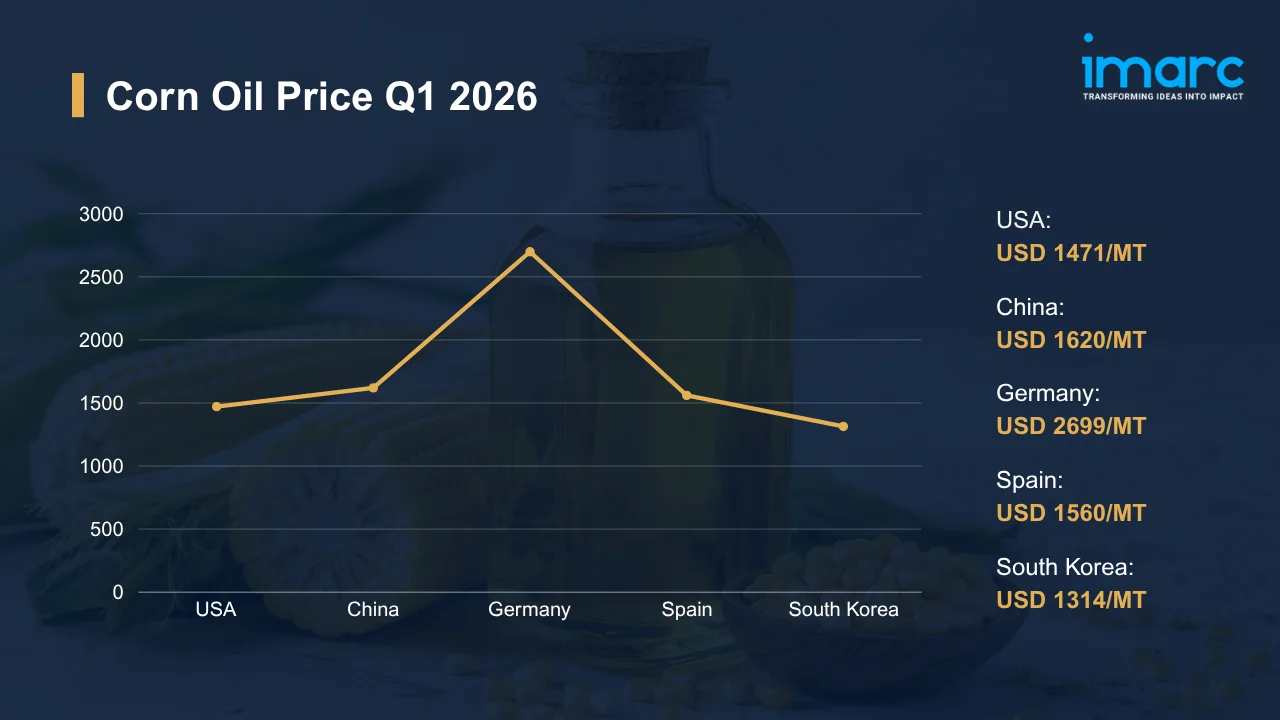
Summary:
Across every corn oil market IMARC tracks, Q1 2026 turned firm. Food processing pull and biodiesel demand lifted corn oil prices, while controlled crushing rates kept supply on the tighter side of balance and stable feedstock availability removed the usual downward drag from corn pass-through. Quarter-on-quarter, prices climbed between 1.0% and 4.6%. Sitting behind this firmer tone is the ongoing Israel–Iran–USA conflict, which according to Al Jazeera suspended about a fifth of global crude and natural gas supply through the Strait of Hormuz in early March 2026.
Corn Oil Price Q1 2026:
Regional prices (USD per MT) and QoQ changes Q1 2026 vs Q4 2025:
| Region | Price (USD/MT) | QoQ Change | Direction |
|---|---|---|---|
| USA | 1471 | +3.4% | ↑ Growth |
| China | 1620 | +1.2% | ↑ Growth |
| Germany | 2699 | +4.0% | ↑ Growth |
| Spain | 1560 | +4.6% | ↑ Growth |
| South Korea | 1314 | +1.0% | ↑ Growth |
To access real-time prices Request Sample
Kindly note: IMARC's pricing database tracks corn oil price movements across major global markets.
What Moved Prices:
USA:
- In Q1 2026, US corn oil prices climbed to USD 1471/MT. Food processing demand stayed firm through the quarter. Behind the move sat steady biodiesel pull from Gulf Coast blenders, controlled crushing rates at major Midwest mills, and a corn complex that refused to soften, leaving refiners with little reason to discount.
- Across the quarter, inland logistics held up. The corn oil price chart showed a steady upward trajectory through January, February, and March, with packaged food converters and foodservice channels keeping procurement on routine cycles rather than chasing inventory ahead of feedstock moves. Behind it, RFS-driven biodiesel mandates provided a forward demand floor.
China:
- During Q1 2026, China corn oil prices firmed to USD 1620/MT. Pulling the move was steady offtake from food manufacturers and industrial users in Guangdong and Yangtze Delta clusters, alongside disciplined crushing margins that kept the supply curve flat rather than oversupplied. CNY dynamics shaped landed-cost decisions on incoming cargoes.
- Import activity continued to shape pricing. With CNY softness raising the local-currency cost of imported palm and soybean oils, the relative competitiveness of corn oil edged up, particularly across foodservice channels in second-tier cities where price-sensitive blenders rotate between substitute oils every few weeks. Crusher margins held steady enough to discourage inventory liquidation.
Germany:
- In the first quarter of 2026, German corn oil prices stepped up to USD 2699/MT. Driving the move were food processing converters across the Mittelstand belt and biofuel blenders working against firm RED III mandates, with refiners running just under nameplate to keep feedstock margins intact. Industrial application offtake stayed flat but firm.
- Across the import-dependent German market, any feedstock cost rise transmits quickly. Rhine corridor logistics ran clean enough through winter that no freight-led volatility entered ex-mill quotations, with Mittelstand buyers locking in contractual volumes rather than testing spot and EU sustainability rules anchoring long-cycle sourcing. Behind it, specialty edible oil applications absorbed the price step quietly.
Spain:
- During Q1 2026, Spanish corn oil prices firmed to USD 1560/MT. Sitting underneath the move were balanced supply conditions, firm demand from food processors clustered around Catalonia and Valencia, and steady consumption from edible oil applications that built through January, February, and March without spilling into spot speculation. Export inquiries pulled supply marginally tighter.
- Buyers across the chain stayed cautious. Anchoring quarterly offtake were Mediterranean snack and bakery manufacturers, while export inquiries from neighboring European markets and selective North African routes added incremental upward pressure on ex-mill quotations and landed costs across the southern European corridor through Q1. Refiner production tracked feedstock arrivals reasonably well.
South Korea:
- In Q1 2026, South Korean corn oil prices inched higher to USD 1314/MT. Driving the modest gain was steady demand from food manufacturers and industrial blenders combined with the country's structural import reliance, which transmits global supply tightness into landed-cost pressure at Busan, Incheon, and Pyeongtaek terminals. Domestic consumption stayed even through March.
- Across the quarter, KRW-USD movements shaped procurement timing. Frying oil and packaged food channels supported consistent throughput, while industrial-grade applications added a smaller but reliable demand layer that anchored monthly production planning across refiners and contracted import partners feeding into the first quarter close. Behind the demand, regional logistics held up without disruption.
Corn Oil Price Outlook After the Israel–Iran–USA Conflict:
Rising Energy Costs and Feedstock Pressure for Corn Oil: Crude oil volatility from the conflict might keep transport and refinery costs elevated across corn oil supply chains. Per CNBC, in late April 2026, Brent and WTI futures were up around 60% since the joint US-Israeli strikes on Iran began on February 28, with Brent recently trading near USD 114.01 per barrel as supply disruption in the Persian Gulf overrides early-cycle optimism. Bunker surcharges and freight loadings will compound effects through 2026.
Regional Demand Uncertainty and Price Volatility for Corn Oil: Across major consuming regions, importers might delay non-essential commitments while conflict trajectory remains unclear. Edible oil substitution is reshaping near-term demand allocation, with refiners across Asia and Europe reporting cautious sentiment around forward contract execution and revising downstream offtake assumptions through the first half of 2026. Looking forward, FX exposure will amplify landed-cost differentials across Asia-Pacific and European markets.
Immediate Market Reaction:
Corn oil refiners are recalibrating sourcing strategies as Strait of Hormuz disruptions reshape Middle East trade flows and lengthen alternative voyage profiles, with European processors showing the sharpest sensitivity to elevated freight costs. Across the Pacific, Asian buyers face new pressures. Rerouted vegetable oil cargoes are landing in coastal Chinese ports and Korean terminals at higher delivered cost. Spot markets remain unsettled, and the corn oil price index might stay volatile through 2026 as demand-side caution and supply-side bottlenecks compound. Across the Mediterranean, refiners are competing harder for tanker capacity, while inland European converters might encounter delayed feedstock arrivals.
Impact on Corn Oil Prices:
The conflict might trigger several key changes in the corn oil market:
- Energy and Freight Cost Pass-Through: Corn oil refiners might face elevated bunker costs and rising tanker rates, lifting per-ton production economics. With war-risk insurance loads stacking on top of standard freight rates, these surcharges will pass through to converter contracts and translate into firmer ex-mill quotations across Asia, Europe, and the Americas through 2026. In response, spot markets might react first to these moves. Long-term contracts will reset on a lag.
- Risk Premium Loading on Imports: Importers might absorb wider risk premiums on Middle East-routed and adjacent cargoes. Pulling in additional war-risk insurance loads on top of extended transit times, vessels diverted around the Cape of Good Hope will see rising landed costs for corn oil and competing edible oils unevenly across geographies. In Asia and the Mediterranean, markets will feel the sharpest near-term impact. Domestic-sourced regions absorb cost increases through gradual contract resets.
- Substitution Pressure Across the Edible Oil Complex: Corn oil might see shifting demand allocation as buyers reassess pricing differentials against palm, soybean, and sunflower oils. Meanwhile, Black Sea sunflower exposure tightens further. With palm supplies relatively unaffected by Middle East routing, corn oil will sit in the middle of substitution dynamics through 2026, gaining share in some price-sensitive food processing segments while ceding ground in others depending on regional landed-cost outcomes.
These pressures combined will keep the corn oil market sensitive through 2026, with refiners, importers, and converters navigating shifting risk premiums and substitution flows across major buying regions for the foreseeable horizon. Even during ceasefire windows, spot volatility might persist. Contract markets will absorb cost transmission gradually as new pricing benchmarks establish.
Supply Chain Disruptions:
Strait of Hormuz routing changes might disrupt corn oil supply chains, particularly for cargoes feeding Mediterranean and South Asian refiners. Across major routes, vegetable oil tanker availability tightens. As crude carriers compete for limited insurance capacity, edible oil shipments face delayed schedules.
Refiners are exploring alternative sourcing routes, with European processors pivoting toward Black Sea sunflower oil flows and South American soybean oil cargoes as partial substitutes for Middle East-adjacent corn oil through the spring trade cycle. Heading into Q2, restocking deferrals from Q1 leave importers with slimmer buffers. Across North America, producers see firmer export inquiries from Asian buyers seeking risk-diversified suppliers. Cost escalation pathways will evolve as freight surcharges, insurance premiums, and currency exposure interact across the global edible-oil complex.
Global Market Overview:
Globally, the corn oil industry was valued at USD 6.94 Billion in 2025. Market projections indicate steady growth, with the industry expected to reach USD 11.92 Billion by 2034, with a compound annual growth rate (CAGR) of 6.20% during 2026-2034. Anchoring long-term demand is expanding food processing applications globally. With rising consumer preference for healthier edible oils combined with industrial adoption in bio-based products and renewable diesel, structural support across the broader corn oil price trend extends firmly through 2034.
Recent Highlights & Strategic Developments:
Recent strategic moves within the industry further illustrate evolving dynamics:
- In August 2025, Kazakhstan's Agriculture Ministry announced a new corn deep processing facility in the Turkistan region, designed to strengthen domestic processing capacity for value-added outputs including starches, sweeteners, and corn oil.
- In February 2025, Cargill confirmed its plan to fully acquire SJC Bioenergia, a Brazilian corn oil producer, to expand its renewable energy and biofuel operations through integrated processing tied to agricultural feedstocks.
Corn Oil Price Forecast (2026):
Through mid-2026, near-term corn oil prices will remain sensitive to conflict-driven energy costs. Procurement caution might persist among edible oil buyers in the second quarter. If geopolitical risk eases, a window for price stabilization could open as feedstock supply, refining throughput, and shipping channels gradually normalize toward pre-conflict operating baselines through the second half of 2026.
If geopolitical hostilities intensify further, corn oil prices will likely face renewed upward pressure. Energy and logistics costs will climb. Across major trade routes, risk premiums might widen, while producers in conflict-exposed zones could curtail throughput, tightening global availability for refiners. Conversely, a sustained diplomatic resolution might ease freight rates and restore feedstock supply flows, creating downward momentum that will gradually reset the corn oil price forecast for the second half of 2026.
Strategic Takeaways:
Looking ahead, the corn oil market is expected to remain structurally sensitive. Conflict-driven energy volatility, evolving food and biodiesel demand, buyer procurement caution, freight market normalization, and feedstock cost interplay will collectively shape near-term pricing trajectories across regional hubs, key processing corridors, and major global trade routes throughout the year.
To navigate this complex landscape, stakeholders should:
- Monitor Regional Price Differentials: Map quarterly pricing variations across key supply regions to identify cost-saving procurement windows. Build benchmarking protocols that compare landed costs against prevailing contract rates, helping optimize sourcing decisions across refining and processing hubs each quarter.
- Monitor Geopolitical Risk Exposure: Track escalation dynamics in the current conflict and assess how shifts in hostility levels might affect corn oil pricing, feedstock availability, and logistics costs. Establish internal alert thresholds that trigger procurement or hedging action promptly.
- Diversify Feedstock Supply Channels: Identify alternative corn and feedstock suppliers beyond current vendor portfolios to mitigate concentration risk. Secure secondary supply agreements that automatically activate during periods of primary source disruption, capacity constraint, or geopolitical interference across sourcing regions.
- Diversify Supply Chain Routes: Evaluate alternative sourcing geographies and shipping corridors to reduce dependence on conflict-exposed lanes. Secondary supplier agreements and contingency freight arrangements will provide critical resilience if primary routes face disruption or extended closure scenarios in 2026.
- Adjust Procurement Strategy for Conflict Conditions: Adopt flexible contract structures with price reopener clauses and force majeure provisions to protect against geopolitical price spikes. Precautionary inventory buffers might reduce exposure if supply tightens abruptly during Middle East trade disruptions in 2026.
- Track Feedstock Cost Movements: Monitor corn and adjacent grain price movements that drive corn oil price per MT calculations. Build internal cost models that incorporate feedstock volatility into pricing decisions and contract negotiations across procurement teams every quarter consistently.
Subscription Plans & Customization:
IMARC offers flexible subscription models to suit varying needs:
- Monthly Updates — 12 deliverables/year
- Quarterly Updates — 4 deliverables/year
- Biannual Updates — 2 deliverables/year
Each includes detailed datasets (Excel + PDF) and post-report analyst support.

.webp)
Get in Touch With Us
UNITED STATES
Phone: +1-201-971-6302
INDIA
Phone: +91-120-433-0800
UNITED KINGDOM
Phone: +44-753-714-6104
Email: sales@imarcgroup.com
Client Testimonials




.webp)




.webp)












