Diamond Prices in the USA Remain Firm at USD 4,407 per Carat Amid Stable Luxury Demand
06-Feb-2026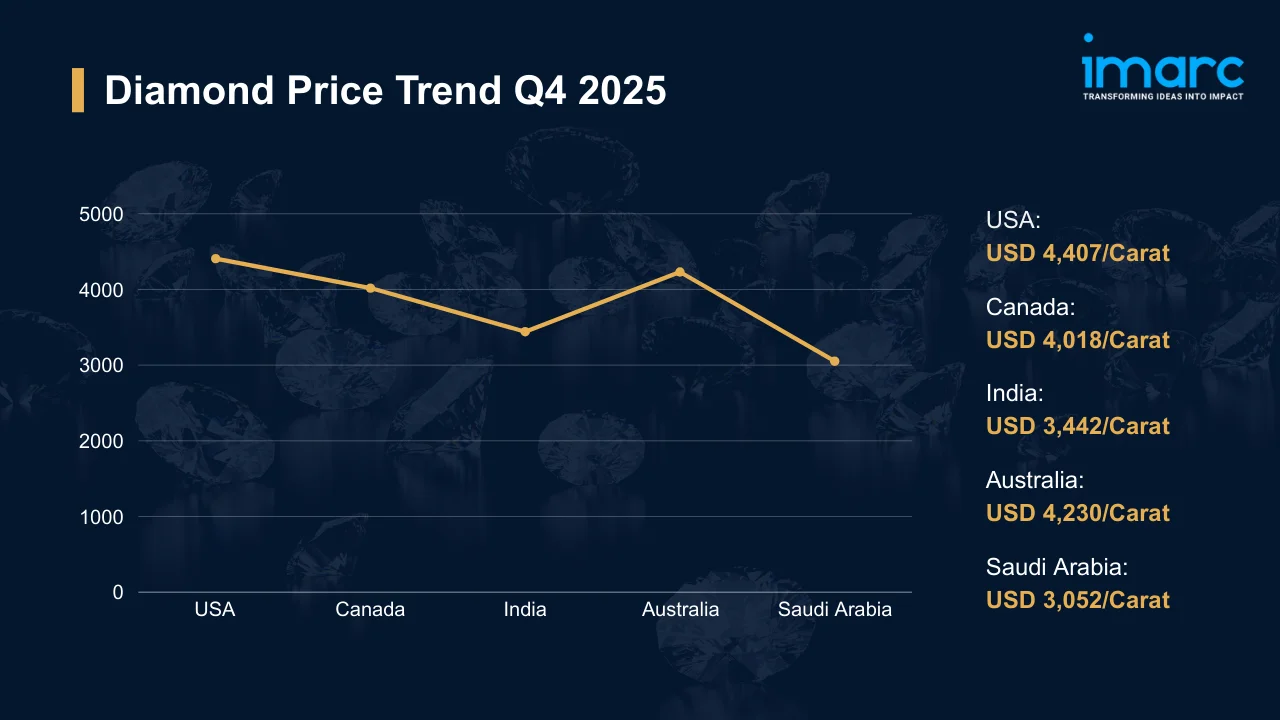
Diamond is a naturally occurring crystalline allotrope of carbon distinguished by its unmatched hardness, exceptional brilliance, and superior thermal conductivity. Formed deep within the Earth’s mantle under extreme pressure and temperature, diamonds reach the surface through volcanic eruptions embedded in kimberlite and lamproite formations. Their unique tetrahedral bonding structure accounts for remarkable physical and optical properties, making them indispensable both in high-end jewelry and in industrial operations, such as cutting, drilling, grinding, and polishing. Diamond-tipped tools remain critical across the mining, construction, and precision manufacturing sectors. Their pricing is acutely sensitive to shifts in consumer demand for luxury goods, mining production volumes, the growing presence of laboratory-grown alternatives, currency fluctuations, and evolving geopolitical conditions.
Global Market Overview:
Globally, the diamond industry reached a volume of 126.70 Million Carats in 2025. Market projections indicate steady growth, with the industry expected to reach 144.87 Million Carats by 2034, with a compound annual growth rate (CAGR) of 1.50% during 2026-2034. The industry is underpinned by resilient jewelry consumption, expanding luxury retail networks, improved manufacturing technologies, and sustained demand for high-quality polished stones across developed and emerging economies. Furthermore, the sector continues to witness growing investment in traceability platforms and ethical sourcing initiatives, which are reshaping how consumers and businesses engage with the diamond supply chain. Technological progress in both chemical vapor deposition and high-pressure high-temperature synthesis methods has also prompted a broader reassessment of competitive pricing strategies among market participants, adding further complexity to the overall industry outlook.
Diamond Price Trend Q4 2025:
Regional prices (USD per Carat) and QoQ changes vs Q3 2025:
| Region | Price (USD/Carat) | QoQ Change | Direction |
|---|---|---|---|
| USA | 4,407 | -2.89% | ↓ |
| Canada | 4,018 | -1.90% | ↓ |
| India | 3,442 | -2.91% | ↓ |
| Australia | 4,230 | -1.99% | ↓ |
| Saudi Arabia | 3,052 | -1.90% | ↓ |
To access real-time prices Request Sample
What Moved Prices:
- USA: During Q4 2025, diamond prices in the USA declined to USD 4,407/Carat as the retail jewelry sector encountered tempered consumer spending patterns following the holiday procurement window. Polished stone inventories gradually accumulated across midstream participants, which put downward pressure on wholesale prices. The competitiveness of imported rough shipments was further reduced by the US dollar's rising against a number of trading currencies, while big retailers' conservative restocking practices resulted in lower transactional volumes. The rate of incoming shipments was further hindered by logistical issues at a few port facilities, which exacerbated the nationwide improvement in market sentiment.
- Canada: Canadian diamond prices decreased to USD 4,018/Carat in Q4 2025 as major northern mining enterprises intended to limit their output. As part of planned production changes, the Gahcho Kué mine processed lower-grade ore throughout the quarter, which decreased the amount of premium raw material available. Due to transportation constraints in remote areas, export volumes were periodically revised, and local jewelry producers used cautious procurement practices in response to erratic demand projections. Although cost pressures were somewhat mitigated by currency depreciation versus the US dollar, the overall pricing trajectory remained mildly negative through the end of the quarter.
- India: Diamond prices in India fell to USD 3,442/Carat in the fourth quarter of 2025 as Gujarati polishing facilities ran at maximum capacity. Following US tariff announcements harming Indian diamond imports, which put pressure on export-oriented processing operations, international order flows from Western markets significantly weakened. Rough procurement costs became more volatile due to currency fluctuations, which forced cutting and polishing plants to adopt cautious purchase practices. The cautious market strategy that defined the quarter was evident in the manufacturers' careful management of inventory turnover and decreased throughput across numerous large sites.
- Australia: Australian diamond prices dropped to USD 4,230/Carat in the fourth quarter of 2025 as several Western Australian mining companies reduced extraction output due to periodic equipment maintenance cycles. The timing of downstream deliveries to buyers in Asia and Europe was impacted by sporadic delays in export logistics at important shipping terminals. Softer auction realizations during the era were a result of inconsistent demand from Southeast Asian markets. Additional price volatility was brought about by currency fluctuations versus key trading partners, and producers adjusted their supply plans to reflect the current state of measured demand.
- Saudi Arabia: During Q4 2025, diamond prices in Saudi Arabia edged down to USD 3,052/Carat despite continued expansion within the luxury retail segment aligned with Vision 2030 objectives. Import-dependent supply chains experienced modest cost adjustments linked to elevated insurance premiums and extended customs processing timelines. Consumer purchasing activity, while still supported by improving retail infrastructure, exhibited a slight deceleration compared with the preceding quarter. The relative strength of the riyal against select source currencies moderated landed costs to some extent, but overall market sentiment reflected a cautious approach among regional importers and jewelry retailers.
Drivers Influencing the Market:
Several factors continue to shape diamond pricing and market behavior:
- Lab-Grown Diamond Competition: The accelerating penetration of laboratory-grown diamonds into both bridal and fashion jewelry segments has imposed sustained downward pressure on natural stone valuations. With production costs falling steadily due to advances in chemical vapor deposition technology, synthetic alternatives capture a growing share of consumer expenditure, compelling traditional producers to reassess their pricing and marketing approaches.
- Shifting Consumer Preferences: Modern consumers, particularly younger buyers, are increasingly prioritizing value, transparency, and personalization in jewelry purchases. This shift is influencing demand patterns, with buyers becoming more selective about size, design, and perceived value rather than focusing solely on traditional prestige factors.
- Evolving Bridal Jewelry Trends: Changing wedding customs and a rise in smaller, more intimate ceremonies are reshaping bridal jewelry spending. Couples are increasingly allocating budgets towards experiences rather than large stones, influencing demand for modestly sized diamonds and alternative jewelry formats.
- Ethical Sourcing and Traceability Expectations: Growing awareness around responsible mining practices is pushing buyers to seek ethically sourced diamonds with transparent supply chains. Producers investing in traceability, certification, and sustainability reporting are better positioned to maintain consumer trust and protect long-term demand.
- Inventory Management and Supply Discipline: Diamond producers are becoming more cautious in managing supply to avoid oversaturation. Adjustments in production volumes and sales strategies are increasingly used to stabilize prices and align supply more closely with fluctuating market demand.
Recent Highlights & Strategic Developments:
Recent strategic moves within the industry further illustrate evolving dynamics:
- In May 2025, Burgundy Diamond Mines established a strategic global alliance with luxury jewelry brands to export and promote its ‘fancy yellow’ diamonds globally. The agreement, made between Burgundy Diamond Mines Ltd., André Messika Ltd., and Crossworks Manufacturing Ltd., sought to introduce Burgundy’s sustainably sourced Canadian diamonds to leading jewelry brands.
Outlook & Strategic Takeaways:
Looking ahead, the diamond market is expected to maintain steady growth momentum, driven by rising consumer demand for luxury jewelry, increasing bridal jewelry purchases, and growing interest in customized and ethically sourced diamonds. Strong branding by leading jewelers and wider online retail penetration are further supporting long-term market expansion.
To navigate this complex landscape, stakeholders should:
- Monitor Regional Price Differentials Closely: Establish systematic benchmarking protocols to compare landed costs across major sourcing markets on a quarterly basis. Leverage these comparisons to identify favorable procurement windows and optimize purchasing decisions in response to shifting regional valuations.
- Diversify Rough Diamond Supply Sources: Reduce concentration risk by expanding supplier networks beyond traditional channels to include emerging producing nations. Engage with multiple mining operations across different geographies to ensure continuity of supply amid evolving ownership structures and production adjustments.
- Assess Trade Policy Developments Proactively: Track tariff announcements and import regulation changes affecting major diamond corridors, such as the US-India trade route. Prepare contingency sourcing strategies that account for potential duty escalations and customs procedural delays impacting landed cost structures.
- Evaluate Lab-Grown Diamond Market Positioning: Conduct periodic assessments of synthetic diamond pricing trends and consumer preference shifts within target retail segments. Align product assortment and marketing strategies accordingly to maintain competitive positioning against the growing synthetic segment.
- Hedge Currency Exposure Strategically: Implement forward contract mechanisms and currency hedging instruments to mitigate the impact of exchange rate volatility on procurement budgets. Review hedging positions regularly to reflect updated forecasts for key currency pairs.
- Track Mining Output and Inventory Signals: Review production reports from major miners to anticipate shifts in rough diamond availability. Correlate output guidance revisions with downstream inventory levels to calibrate restocking cycles appropriately.
- Strengthen Traceability and Ethical Sourcing Credentials: Invest in provenance verification systems and blockchain-based tracking platforms to meet rising consumer expectations for transparent supply chains. Prioritize partnerships with certified responsible mining operations to enhance brand integrity.
Subscription Plans & Customization:
IMARC offers flexible subscription models to suit varying needs:
- Monthly Updates — 12 deliverables/year
- Quarterly Updates — 4 deliverables/year
- Biannual Updates — 2 deliverables/year
Each includes detailed datasets (Excel + PDF) and post-report analyst support.

Get in Touch With Us
UNITED STATES
Phone: +1-201-971-6302
INDIA
Phone: +91-120-433-0800
UNITED KINGDOM
Phone: +44-753-714-6104
Email: [email protected]
Client Testimonials




.webp)




.webp)












