Ethanol Price Increases 8.9% in South America, 3.8% in Northeast Asia — Q1 2026 Update
21-Apr-2026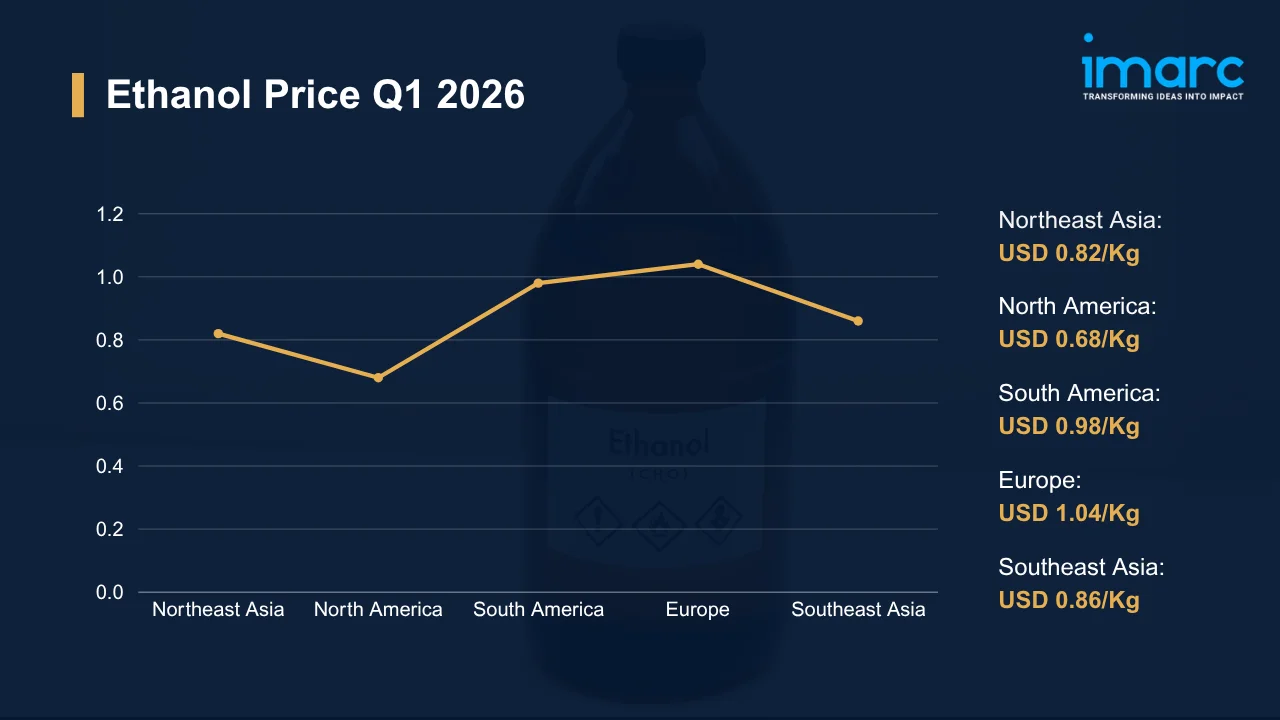
Summary:
Q1 2026 delivered no consensus in the tracked ethanol markets. Pulling in opposite directions, biofuel mandate obligations and conflict-driven energy pricing lifted ethanol prices in three tracked geographies while industrial demand softness and comfortable production capacity pushed two others lower, a spread running from a 4.4% quarterly decline to an 8.9% advance. Brent crude futures surged as much as 13% to USD 82.37 a barrel in early March trading as the Israel–Iran–USA conflict disrupted Middle Eastern energy flows.
Ethanol Price Q1 2026:
Regional prices (USD per KG) and QoQ changes Q1 2026 vs Q4 2025:
| Region | Price (USD/KG) | QoQ Change | Direction |
|---|---|---|---|
| Northeast Asia | 0.82 | +3.8% | ↑ Growth |
| North America | 0.68 | −4.2% | ↓ Decline |
| South America | 0.98 | +8.9% | ↑ Growth |
| Europe | 1.04 | - | - |
| Southeast Asia | 0.86 | −4.4% | ↓ Decline |
To access real-time prices Request Sample
Kindly note: IMARC’s pricing database tracks ethanol price movements across major global markets.
What Moved Prices:
Northeast Asia:
- In Q1 2026, Northeast Asian ethanol prices cleared at USD 0.82/KG, a 3.8% recovery that few buyers had anticipated going into January. Few market participants had positioned for it. Post-New Year restocking across chemicals and solvents pulled procurement off Q4 2025 lows, while the crude oil surge elevated petroleum-based alternatives’ relative cost, keeping incremental ethanol demand positive through February.
- Ample supply from corn- and cassava-based manufacturers capped the recovery’s reach. Throughout Q1, buyers replenished lean stockpiles through measured spot purchases rather than large-volume forward commitments, a level of caution absent in prior upcycles when procurement confidence ran high and producers held pricing leverage. The ethanol price chart for Northeast Asia captures this restrained, partial rebound.
North America:
- During Q1 2026, North American ethanol prices fell to USD 0.68/KG, registering a 4.2% quarterly decline. That regional softness predated the conflict. Abundant domestic corn from a strong harvest maintained low feedstock costs across major Midwest distilleries, while post-holiday fuel blending demand fell sharply after the peak summer-driving calendar reset, leaving producers with comfortable stocks and blenders with no urgency to restock.
- North American ethanol markets stayed effectively decoupled from the conflict’s energy dynamics through Q1. Domestic production capacity runs on corn economics rather than petroleum-linked feedstock pricing, which meant the crude oil surge in March produced no meaningful upward transmission into North American distiller costs or blender procurement incentives. Blenders watched and waited.
South America:
- In Q1 2026, South American ethanol prices climbed to USD 0.98/KG, the sharpest quarterly gain across all tracked markets at 8.9%. Two forces ran in the same direction. Mandatory fuel blending requirements sustained robust domestic consumption while rising crude oil prices made sugarcane-based biofuel economically attractive enough to pull Brazilian mill allocation decisively away from sugar and toward ethanol.
- Inter-harvest supply tightness had already reduced available sugarcane volumes before the conflict added a new biofuel demand pull, compressing the pool directed toward ethanol while mills simultaneously diverted cane allocation toward the higher-margin fuel blend. The market priced scarcity rather than optimism.
Europe:
- In Q1 2026, European ethanol prices opened and closed the quarter at USD 1.04/KG. European markets told a misleading story. Rising through February on firming biofuel mandates and energy cost support, prices then retreated as conflict-driven macro uncertainty dampened industrial and non-fuel sector confidence, dragging values back to where the quarter began.
- Wheat and sugar beet costs provided margin floor support for European distillers through mid-Q1. That cushioned the impact. EU blending mandates held volume, but industrial solvent and pharmaceutical buyers pulled back sharply on spot purchasing as conflict-driven uncertainty filtered into manufacturing capital allocation decisions, particularly among converters managing energy cost exposure.
Southeast Asia:
- In Q1 2026, Southeast Asian ethanol prices declined to USD 0.86/KG. The direction was the same as Q4 2025. At 4.4%, the quarterly fall exceeded Q4’s negligible drop, reflecting an acceleration of demand weakness rather than a reversal, as pharmaceutical, personal care, and industrial solvent buyers kept procurement well below seasonal norms throughout the period.
- Supply remained long throughout Q1. Feeding that availability, cassava- and molasses-based manufacturers ran output at rates sufficient to maintain comfortable inventory across major regional hubs, preventing any price recovery from gaining traction as subdued export demand from neighboring markets added a second layer of downward pressure. Feedstock cost declines removed sellers’ incentive to hold firm on valuations.
Ethanol Price Outlook After the Israel–Iran–USA Conflict:
Rising Energy Costs and Feedstock Price Pressure for Ethanol: Elevated urea prices are reshaping the feedstock cost picture for corn-based ethanol producers, with ammonia also trending higher. Energy costs are rising fast. Higher grain production costs linked to fertilizer and diesel price inflation might tighten feedstock economics for ethanol distillers across North America and Northeast Asia before mid-2026.
Regional Price Volatility and Demand Uncertainty for Ethanol: Demand conditions are splitting along a crude oil fault line. Tied to fuel blending mandates, South America and parts of Southeast Asia might see incremental demand uplift as crude oil prices make biofuel economics increasingly attractive for regional refiners and distributors operating under compliance obligations. Tracking industrial calendars rather than energy benchmarks, mandate-free markets are pricing a different kind of uncertainty.
Immediate Market Reaction:
Across the ethanol market, two transmission channels are active simultaneously. The first runs through biofuel demand: as crude oil prices rise, fuel-blending economics improve in mandate-driven markets, making the ethanol price index a moving target for procurement teams tracking weekly shifts. Running through feedstock, the second channel sees corn and sugarcane production costs rising as fertilizer and diesel prices respond to the Gulf disruption. Pulling back on spot commitments, Southeast Asian industrial buyers are reducing exposure. Ethanol trade flows between Asia-Pacific producers and European buyers might require rerouting if Middle Eastern corridors stay constrained.
Impact on Ethanol Prices:
The conflict might trigger several key changes in the ethanol market:
- Energy-Linked Demand Uplift: As crude oil prices continue to surge, biofuel blending economics tilt in ethanol’s favor across fuel-intensive economies. Refiners are noticing the dynamics. Mandatory blending obligations are doing the rest: South America and parts of Southeast Asia will see volume support sustained or amplified as blending economics work against petroleum alternatives and procurement teams adjust their forward purchase volumes accordingly.
- Feedstock Cost Escalation: Margin compression is coming for corn-based ethanol producers. High energy costs are transmitting into agricultural production expenses, with diesel for farm equipment and nitrogen fertilizer inputs rising sharply since the conflict escalated, eroding the cost floor that producers had relied on through the first months of the year. Ethanol producers in corn-dependent markets might face compressed margins as feedstock costs outpace spot prices.
- Trade Route and Distribution Disruptions: With major container shipping companies suspending Strait of Hormuz transits, ethanol trade flows connecting Southeast Asian exporters to Middle Eastern buyers will face extended lead times and meaningfully higher freight costs. Logistics costs are already rising fast. Export-oriented producers might redirect volumes toward alternative markets at lower netback returns, while importers in conflict-adjacent regions encounter supply uncertainty as rerouting around Africa’s Cape of Good Hope adds substantial transit time.
The net impact varies by region. Driven by biofuel demand uplift, mandate-driven markets might find price floors even as production cost inflation and logistics disruptions compress margins across the supply chain for producers facing elevated grain or freight cost exposure through 2026. Feedstock cost exposure will prove most decisive.
Supply Chain Disruptions:
Three supply chain pressure points are active for ethanol. Shipping lane closures at the Strait of Hormuz, elevated war-risk insurance premiums for Gulf transits, and rerouted Southeast Asian export flows now circling Africa’s Cape of Good Hope are collectively raising landed costs across all import-dependent markets. The Containerized Freight Index jumped more than 10% in March 2026, a cost escalation that hits cassava-based Southeast Asian ethanol exporters hardest given their dependence on Gulf-adjacent shipping corridors.
Producers with integrated logistics operations might pivot toward Indian Ocean corridors skirting southern Africa. These alternative routes add substantial cost. Brazilian sugarcane-based producers face lower direct route disruption but higher fertilizer input costs from the conflict’s Strait of Hormuz squeeze, limiting capacity to expand export volumes even as elevated biofuel demand signals might otherwise justify higher throughput rates. With shorter regional supply chains than Asian or South American counterparts, North American corn distillers still face growing upstream feedstock uncertainty that might constrain production economics through mid-2026.
Global Market Overview:
Globally, the ethanol industry was valued at USD 109.5 Billion in 2025. Market projections indicate steady growth, with the industry expected to reach USD 159.1 Billion by 2034, with a compound annual growth rate (CAGR) of 4.11% during 2026–2034. Expanding biofuel mandates, pharmaceutical demand, and growing specialty chemical applications are driving long-term market growth globally. Policy support for renewable fuels strengthens long-term demand. Tracking the evolving ethanol price trend remains central to procurement and investment strategy in 2026.
Recent Highlights & Strategic Developments:
Recent strategic moves within the industry further illustrate evolving dynamics:
- In January 2025, Advanta Seeds and Baidyanath Biofuels Private Ltd announced a strategic partnership to advance ethanol production in India, supporting the country’s goal of achieving 20% ethanol blending with petrol by 2025–26 as outlined under the National Biofuels Policy.
- In January 2025, RCM Technologies launched its NEXT program, designed to transform ethanol plant expansion projects by increasing production capacity and improving energy efficiency without requiring the replacement of major existing equipment.
Ethanol Price Forecast (2026):
Divergence, not convergence, is the 2026 story for ethanol. Through the first half of the year, biofuel blending markets will retain price floors tied to elevated crude benchmarks and regulatory mandates, while industrial-use markets might face ongoing pressure as manufacturing sector demand stays subdued and procurement confidence remains hostage to geopolitical risk premiums.
Should the Strait of Hormuz stay blocked, biofuel markets will face upward price pressure while producer margins narrow as grain feedstock costs stay elevated, a squeeze that might extend well into Q3 2026. Depending on the conflict’s arc, industrial application demand destruction may also accelerate. A diplomatic resolution, by contrast, might ease freight rates, stabilize crude benchmarks, and restore feedstock supply lines, setting conditions for the ethanol price forecast to trend lower through year-end 2026.
Strategic Takeaways:
Looking ahead, the ethanol market is expected to maintain its long-term growth trajectory, underpinned by expanding biofuel mandates, rising industrial demand, and growing pharmaceutical applications that collectively underpin structural consumption growth across all major economies. Near-term pricing dynamics through 2026 will remain sensitive to geopolitical developments and evolving feedstock shifts.
To navigate this complex landscape, stakeholders should:
- Track Regional Price Differentials: Monitor quarterly pricing variations across key supply regions, referencing the ethanol price per KG to identify cost-efficient procurement windows. Establishing benchmarks that compare landed costs against contract rates will help procurement teams optimize sourcing decisions.
- Assess Feedstock Cost Exposure: Evaluate how corn, sugarcane, and cassava price swings transmit into regional ethanol production costs, focusing on pass-through risk at peak harvest volatility windows. Price scenarios linking feedstock benchmarks to production cost projections sharpen procurement budget accuracy.
- Monitor Blending Mandate Developments: Track policy changes in biofuel blending requirements across North America, Europe, and South America to anticipate regulatory-driven demand shifts. Mandate expansions or reductions will directly influence procurement volumes and long-term contract positioning for ethanol buyers.
- Monitor Geopolitical Risk Exposure: Track escalation dynamics in the current conflict and assess how shifts in hostility levels might affect ethanol pricing, feedstock availability, and logistics costs globally. Establish internal alert thresholds that trigger procurement review or hedging action.
- Diversify Supply Chain Routes: Evaluate alternative sourcing geographies and shipping corridors to reduce dependence on conflict-exposed trade lanes for ethanol imports. Secondary supplier agreements and contingency freight arrangements will provide critical resilience if primary routes face sustained trade disruption.
- Adjust Procurement Strategy for Conflict Conditions: Adopt flexible contract structures with price reopener clauses and force majeure provisions to protect against geopolitical price spikes in ethanol markets. Precautionary inventory buffers might reduce exposure if supply tightens abruptly due to conflict escalation.
Subscription Plans & Customization:
IMARC offers flexible subscription models to suit varying needs:
- Monthly Updates — 12 deliverables/year
- Quarterly Updates — 4 deliverables/year
- Biannual Updates — 2 deliverables/year
Each includes detailed datasets (Excel + PDF) and post-report analyst support.

Get in Touch With Us
UNITED STATES
Phone: +1-201-971-6302
INDIA
Phone: +91-120-433-0800
UNITED KINGDOM
Phone: +44-753-714-6104
Email: [email protected]
Client Testimonials




.webp)




.webp)












