Fatty Acid Prices Update: IMARC Group Reveals Latest Regional Trends and Forecast Insights
08-Jun-2026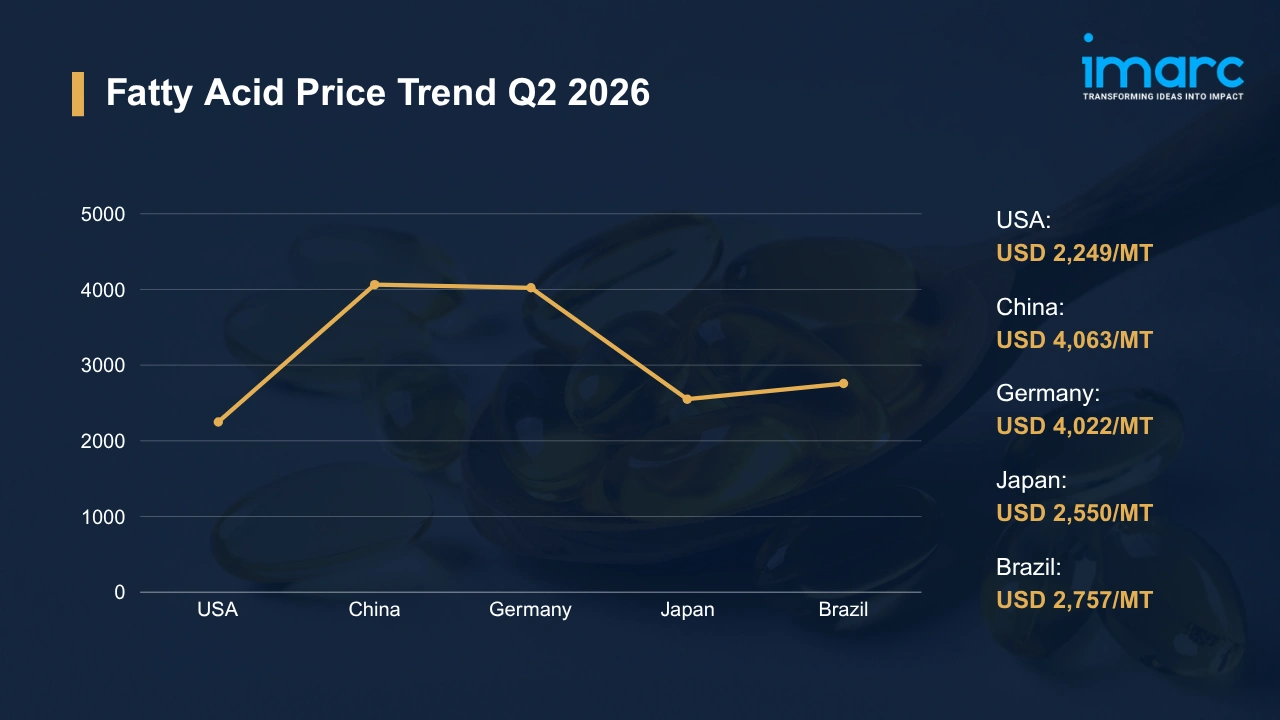
Fatty acid is a long-chain organic carboxylic acid. Derived from vegetable oils, animal fats, and oleochemical streams as saturated or unsaturated variants, it underpins soap manufacturing, personal care formulations, biodiesel blending, lubricants, and specialty chemicals globally. Upstream feedstock costs, energy inputs during fractional distillation, ocean freight dynamics, and oleochemical sector demand cycles together shape fatty acid prices, with cost trajectories across each variable influencing quarterly settlement levels.
Global Market Overview:
Globally, the fatty acid industry was valued at USD 32.6 Billion in 2025. Market projections indicate steady growth, with the industry expected to reach USD 50.5 Billion by 2034, with a compound annual growth rate (CAGR) of 4.84% during 2026-2034. Driven by expanding global soap and detergent production, biodiesel blending, and personal care applications, broader oleochemical market growth sustains the fatty acid price trend.
Fatty Acid Price Trend Q2 2026:
Regional prices (USD per MT) and QoQ changes Q2 2026 vs Q1 2026:
| Region | Price (USD/MT) | QoQ Change | Direction |
|---|---|---|---|
| USA | 2,249 | +1.23% | ↑ |
| China | 4,063 | +5.23% | ↑ |
| Germany | 4,022 | +0.78% | ↑ |
| Japan | 2,550 | +3.34% | ↑ |
| Brazil | 2,757 | +2.56% | ↑ |
To access real-time prices Request Sample
What Moved Prices:
USA:
- In Q2 2026, fatty acid prices in the USA rose to USD 2,249/MT as soap, detergent, and biodiesel manufacturers increased procurement after earlier restocking pauses. Gulf Coast supply remained broadly stable. Cautious prior-quarter inventory drawdowns prompted buyers to step back into spot markets, pushing Q2 settlement prices higher.
- Competitive import offers from Asian origins kept landed costs attractive, while personal care formulators and lubricant-grade converters contributed incremental volumes to Q2 order books. Stable transpacific freight rates supported import economics. The fatty acid price chart through Q2 2026 reflected a consistent, measured upward trajectory.
China:
- During Q2 2026, fatty acid prices in China climbed to USD 4,063/MT, the sharpest QoQ increase among tracked regions, as downstream surfactant producers, coatings manufacturers, and plastics converters ramped procurement significantly. Restocking urgency strengthened through the period. Better export order flow from key Asian trading partners also supported seller confidence throughout the quarter.
- Palm oil and oleochemical feedstock costs firmed meaningfully through Q2 2026, widening Chinese producers’ cost-basis requirements and limiting their willingness to accept lower settlement prices despite buyer resistance. Domestic plant utilization rates improved steadily. Adding further upward support, export inquiries from Southeast Asian and Middle East buyers reinforced Q2 2026 market sentiment.
Germany:
- In Q2 2026, fatty acid prices in Germany edged up to USD 4,022/MT as industrial surfactant formulators, lubricant producers, and rubber additive manufacturers maintained measured procurement patterns against a backdrop of moderate demand conditions. Underlying industrial demand remained broadly constructive. Balanced regional supply limited the scale of upside price movement.
- Competitive import availability from Asian origins kept pressure on European contract negotiations, as steady cargo arrivals gave buyers leverage to contain landed cost increases. Rapeseed oil values softened through the quarter. Resilient downstream scheduling from specialty chemical manufacturers sustained base-level trading volumes in German markets through Q2 2026.
Japan:
- During Q2 2026, fatty acid prices in Japan climbed to USD 2,550/MT as cosmetics formulators, detergent manufacturers, and specialty chemical producers resumed procurement following prior-period inventory drawdowns. Import costs firmed alongside rising feedstock values. Confidence among domestic suppliers improved, strengthening the upward trend in settlements noted throughout Japanese trading networks.
- Coordinated import planning and efficient port operations ensured smooth material inflow for buyers with tight production schedules. Limited excess inventory in oleochemical grades tightened spot conditions. Through Q2 2026, structured procurement from personal care formulators and pharmaceutical intermediate producers anchored consistent baseline volume, supporting the measured price gain recorded across Japanese channels.
Brazil:
- In Q2 2026, fatty acid prices in Brazil rose to USD 2,757/MT, reflecting demand recovery across soap manufacturing, detergent production, and agrochemical blending segments after the prior quarter’s subdued activity. Overall market procurement sentiment improved noticeably. Domestic soy-based feedstock dynamics and import parity pricing provided upward cost support through Q2.
- BRL rate fluctuations complicated import pricing for Brazilian buyers in Q2 2026, with Asian cargo offers serving as the key benchmark for contract negotiations. Providing structural floor support, biodiesel blending requirements sustained baseline procurement volumes. Consistent buying from São Paulo-area converters and agrochemical-grade demand reinforced Brazil’s measured quarterly price gain.
Drivers Influencing the Market:
Several factors continue to shape fatty acid pricing and market behavior:
- Soap, Detergent, and Personal Care Sector Demand: Baseline fatty acid procurement is anchored by soap manufacturers, detergent formulators, and personal care producers globally. Seasonal production schedules govern buying patterns. Urbanization across developing markets expands household product consumption, while premiumization trends in personal care elevate fatty acid grade specifications and generate periodic demand surges.
- Upstream Vegetable Oil and Tallow Feedstock Costs: Vegetable oils and tallow are the core fatty acid feedstocks. Collectively setting the upstream cost base, palm oil, soy oil, and rapeseed oil feed directly into fatty acid manufacturing economics across producing regions. Per the FAO, the Vegetable Oil Price Index averaged 192.0 points in June 2026, up 23.3% from year-ago levels, with firmer palm and rapeseed quotations lifting feedstock acquisition costs for producers globally.
- Energy Expenditure in Fractional Distillation and Hydrogenation: Natural gas and electricity account for a substantial portion of fatty acid production costs, particularly across energy-intensive fractional distillation and catalytic hydrogenation stages. Elevated energy costs compress producer margins. Per the EIA, the Henry Hub natural gas spot price averaged USD 3.52/MMBtu in 2025, a 56% increase from 2024’s record-low annual average, elevating the energy cost baseline for industrial chemical manufacturers including fatty acid producers.
- Ocean Freight and Logistics Economics: Container shipping rates on Asia-North America and Asia-Europe corridors directly influence fatty acid landed costs for importing regions. Volatile rates often override production cost signals in spot market negotiations. Movements in the fatty acid price index across import-dependent markets like Germany and Japan track closely with transoceanic freight benchmarks, as landed-cost differentials between regional and Asian-origin supplies determine buyer sourcing decisions each quarter.
- Environmental and Regulatory Compliance: Tightening environmental regulations governing wastewater treatment, effluent discharge, and chemical safety at oleochemical processing facilities impose rising compliance expenditures on fatty acid producers. Registration obligations under chemical safety frameworks add administrative cost. Across jurisdictions with stringent enforcement, particularly in the European Union and key Asia Pacific markets, compliance cost escalation progressively factors into producer pricing structures and contract offer floors.
- Trade Policy and Currency Dynamics: Import tariff adjustments, anti-dumping measures, and export restrictions across oleochemical-producing countries periodically reshape cost competitiveness for fatty acid buyers. Such rate movements amplify price volatility. Against the USD, movements in BRL, CNY, and JPY alter import parity pricing in Brazil, China, and Japan, where currency-sensitive procurement strategies can shift quarter-on-quarter purchasing volumes and influence assessed price levels each period.
Recent Highlights & Strategic Developments:
Recent strategic moves within the industry further illustrate evolving dynamics:
- In November 2025, Artelo Biosciences published a peer-reviewed article in Drug Discovery Today examining the role of fatty acid binding protein 3 in cancer biology, with findings underscoring the therapeutic potential of targeting lipid metabolism pathways across oncology and related clinical applications.
Outlook & Strategic Takeaways:
Looking ahead, the fatty acid market is expected to expand, supported by expanding soap and detergent production in developing markets, rising personal care consumption across Asia Pacific, and growing biodiesel blending mandates. Upstream feedstock cost trajectories, energy input pricing, and evolving trade policy frameworks will remain the pivotal determinants of the fatty acid price forecast through the decade ahead.
To navigate this complex landscape, stakeholders should:
- Monitor Regional Price Differentials: Track quarterly pricing variations across USA, China, Germany, Japan, and Brazil to identify cost-saving procurement windows. Establish benchmarking protocols that compare landed costs against prevailing contract rates for optimal sourcing decisions.
- Assess Freight Market Developments: Monitor container shipping rate trends on Asia-North America and Asia-Europe corridors to anticipate landed cost movements. Negotiate logistics contracts with rate adjustment clauses tied to prevailing spot freight market benchmarks.
- Evaluate Downstream Demand Indicators: Track end-use sector activity in soap manufacturing, personal care, and biodiesel production across principal consumption regions. Cross-reference the fatty acid price per MT against downstream demand indices to optimize inventory positioning and procurement timing.
- Review Regulatory Compliance Expenditures: Audit compliance costs associated with chemical safety, effluent discharge, and storage handling obligations across operating jurisdictions. Identify process efficiencies that reduce regulatory burden without compromising oleochemical production safety standards.
- Strengthen Currency Exposure Management: Implement hedging strategies for procurement denominated in volatile currencies to stabilize landed cost projections across major sourcing regions. Coordinate treasury and procurement functions to align foreign exchange coverage with import payment schedules.
- Explore Emerging Application Segments: Investigate growth potential in pharmaceutical intermediates, bio-based lubricants, and specialty ester applications for portfolio diversification. Engage research partners to evaluate commercial viability of novel fatty acid derivatives that may expand addressable market demand.
Subscription Plans & Customization:
IMARC offers flexible subscription models to suit varying needs:
- Monthly Updates: 12 deliverables/year
- Quarterly Updates: 4 deliverables/year
- Biannual Updates: 2 deliverables/year
Each includes detailed datasets (Excel + PDF) and post-report analyst support.

Get in Touch With Us
UNITED STATES
Phone: +1-201-971-6302
INDIA
Phone: +91-120-433-0800
UNITED KINGDOM
Phone: +44-753-714-6104
Email: [email protected]
Client Testimonials




.webp)




.webp)












