Global Vinyl Ester Resin Prices in Q1 2026: USA Reaches USD 4,557/MT Amid Strong Industrial Demand
29-Jun-2026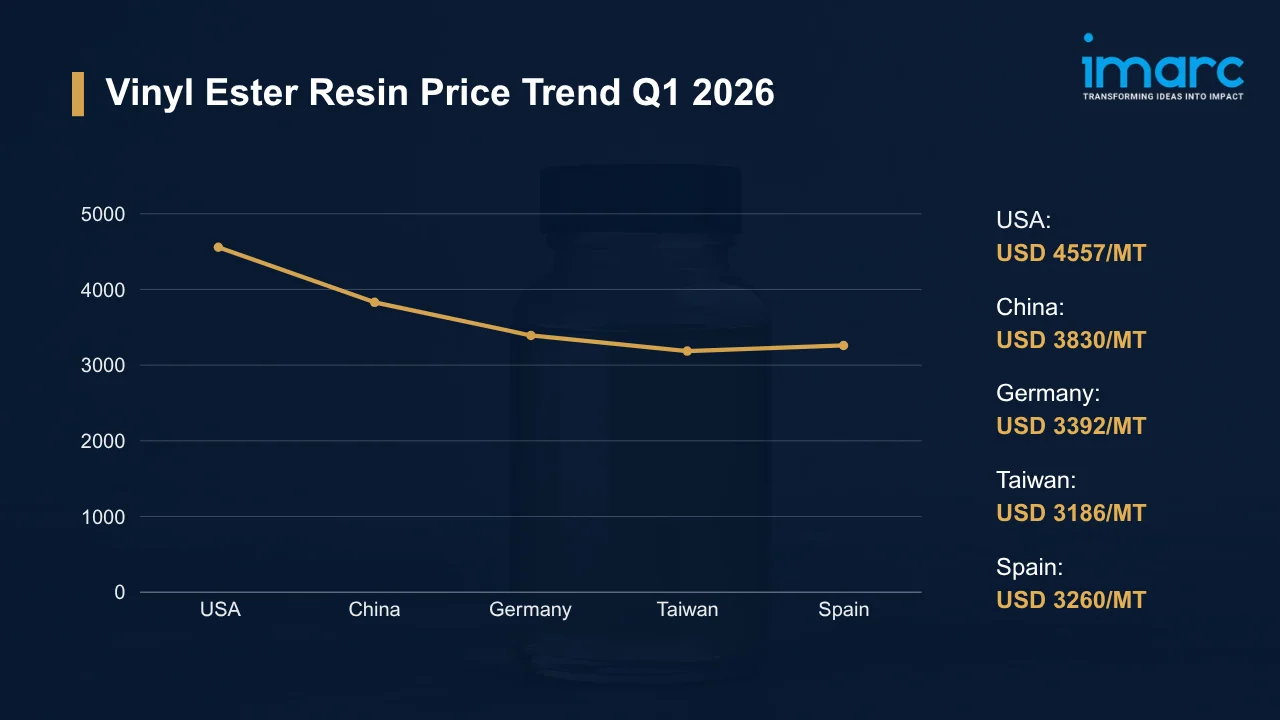
Vinyl ester resin is a thermosetting polymer made by reacting epoxy resin with unsaturated monocarboxylic acids, most commonly methacrylic or acrylic acid. The resulting material pairs epoxy-grade mechanical strength with faster cure processing, delivering high resistance to corrosion, chemicals, heat, and moisture. Vinyl ester resin prices are governed by epoxy resin intermediates, methacrylic acid, and styrene monomer costs, alongside energy expenditure during esterification and curing, ocean freight economics on Asia-to-West trade lanes, and demand cycles across marine composites, wind energy blade fabrication, chemical processing equipment, and corrosion-resistant storage infrastructure.
Global Market Overview:
Globally, the vinyl ester resin industry reached a volume of 835.3 Thousand Tons in 2025. Market projections indicate steady growth, with the industry expected to reach a volume of 1,136.4 Thousand Tons by 2034, with a compound annual growth rate (CAGR) of 3.48% during 2026-2034. Corrosion-resistant infrastructure buildout across chemical plants, wastewater treatment networks, and offshore marine structures anchors volume growth. Wind energy blade manufacturing and chemical-grade storage tank construction extend the vinyl ester resin price trend beyond traditional demand corridors, broadening the commodity's end-use base through the forecast period.
Vinyl Ester Resin Price Trend Q1 2026:
Regional prices (USD per MT) and QoQ changes Q1 2026 vs Q4 2025:
| Region | Price (USD/MT) | QoQ Change | Direction |
|---|---|---|---|
| USA | 4,557 | +1.34% | ↑ |
| China | 3,830 | +2.15% | ↑ |
| Germany | 3,392 | +4.44% | ↑ |
| Taiwan | 3,186 | +3.40% | ↑ |
| Spain | 3,260 | +3.06% | ↑ |
To access real-time prices Request Sample
What Moved Prices:
USA:
- At USD 4,557/MT in Q1 2026, US vinyl ester resin prices extended their recovery as buyers who had drawn down inventories through Q4 2025 re-entered the spot market in force. Marine composite fabricators, corrosion-resistant tank producers, and construction repair contractors all lifted order volumes through the quarter. Feedstock offers from resin intermediates and styrene-linked inputs stayed firm, and the vinyl ester resin price chart tracked a consistent upward path through March.
- Gulf Coast supply chains ran without notable disruption, keeping domestic availability balanced but not loose. Import flows from Asia stayed thin, as competitive US domestic pricing gave buyers little incentive to source offshore. Pre-season procurement from infrastructure contractors added further demand pressure, narrowing spot availability and sustaining the quarter's price gains into the final weeks.
China:
- During Q1 2026, vinyl ester resin prices in China climbed to USD 3,830/MT as composite fabricators and anticorrosion coating producers reversed the cautious procurement stances held through the seasonal slowdown. Chemical processing equipment builders, flue gas desulfurization system suppliers, and construction-linked resin converters all returned to the market, lifting order books from depressed Q4 levels.
- Firm resin intermediate and styrene feedstock costs kept producer offer floors elevated, even where distributor hub inventories remained residually elevated. Export inquiries from Southeast Asian buyers supplemented domestic demand. Guangzhou and Yiwu-area converter clusters increased intake as downstream order visibility improved through February and March, sustaining the upward price trajectory.
Germany:
- In the first quarter of 2026, vinyl ester resin prices in Germany rose to USD 3,392/MT, the strongest percentage gain of any tracked region at 4.44% QoQ. Corrosion-resistant lining contractors, wind energy nacelle and blade component producers, and marine composite fabricators all stepped up procurement as production schedules firmed. Buyers who had deferred purchasing through Q4 2025 returned with larger-than-usual spot inquiries.
- Constrained import availability amplified domestic pricing power. Anti-dumping measures on Chinese epoxy resin limited Asian material flows into Europe, reducing competitive downward pressure on regional producer offers. Styrene-linked feedstock costs kept seller margins under pressure, yet supply remained tight enough to support the pass-through of input cost increases into contract and spot settlements through the quarter.
Taiwan:
- Vinyl ester resin prices in Taiwan reached USD 3,186/MT in Q1 2026 as procurement from electronics chemical storage producers, marine composite fabricators, and corrosion-resistant infrastructure builders all strengthened. Inventory drawdowns through Q4 2025 left domestic buyers in a restocking posture, and purchasing activity picked up steadily from January onward as downstream order visibility improved.
- Feedstock pressure kept supplier offers firm across the quarter. Resin intermediate and styrene-linked production costs provided a cost floor that limited negotiating room for buyers even where some distributor-level stock remained. Port operations at Kaohsiung ran smoothly, supporting timely material movement. Export-facing composite manufacturers reported improving inbound orders from regional chemical and construction markets through March.
Spain:
- In Q1 2026, vinyl ester resin prices in Spain rose to USD 3,260/MT as construction composite producers, marine fabricators, storage tank builders, and anticorrosion coating converters all accelerated procurement after weeks of purchasing restraint. Inventory rebuilding drove a firmer spot tone from early January, with buyers absorbing available material at progressively higher offer levels through the quarter.
- EU anti-dumping investigations on Asian epoxy resin effectively capped import competition, leaving regional producers able to pass higher feedstock costs into transaction prices without triggering buyer substitution. Resin intermediate and styrene-linked production expenses stayed elevated across southern European supply chains, reinforcing the cost support behind the quarter's price gains and limiting scope for offer reductions.
Drivers Influencing the Market:
Several factors continue to shape vinyl ester resin pricing and market behavior:
- Corrosion-Resistant Equipment and Wind Energy Demand: Chemical processing plants, wastewater operators, marine fabricators, and storage tank builders collectively anchor baseline consumption of vinyl ester resin. Wind energy expansion adds a fast-growing second pillar. According to the Global Wind Energy Council, global wind capacity additions hit a record 165 GW in 2025, up 40% year-on-year, with vinyl ester and epoxy-based matrix resins embedded in blade composite construction. That build rate directly extends long-run resin procurement volumes and supports the vinyl ester resin price index across producing regions.
- Upstream Feedstock Cost Dynamics: Epoxy resin intermediates, methacrylic acid, and styrene monomer together set the production cost floor for vinyl ester resin batches, with each feedstock transmitting its own price volatility into finished-product offers. Anti-dumping duties on Chinese epoxy resin imports in the EU and the US tightened the competitive supply picture through 2025, reducing Asian pricing pressure on regional producers. Feedstock availability squeezes typically run one to two production cycles ahead of price firming, giving procurement teams a useful lead indicator.
- Energy Expenditure in Production: Esterification and batch curing are energy-intensive steps; natural gas and industrial electricity costs therefore carry direct weight on vinyl ester resin production economics. European producers absorbed sustained industrial gas procurement costs through 2025, compressing margins and shaping offer levels. Persistent energy cost gaps between North America, Europe, and Asia shift the cost competitiveness of each producing region and alter trade flow patterns when differentials widen.
- Ocean Freight and Logistics Economics: Container rates on Asia-to-West corridors determine the landed cost competitiveness of imported vinyl ester resin relative to domestic supply. Drewry's World Container Index registered USD 2,213 per 40ft container in late December 2025, marking a fourth consecutive weekly increase as Asia-Europe and Transpacific rates firmed ahead of Q1 contract negotiations. Spot rate movements on these lanes flow directly into freight surcharge structures, shaping whether buyers source offshore or stay with domestic suppliers.
- Environmental and Regulatory Compliance: Styrene emission controls during vinyl ester resin manufacturing, and chemical safety requirements for epoxy compound handling and waste disposal, add incremental operating costs at every tier of the supply chain. European chemical safety registration frameworks and equivalent North American regimes raise testing and documentation burdens that filter progressively into market pricing. Producers developing low-styrene formulations absorb additional R&D amortization costs, which further shape the pricing environment across jurisdictions with active enforcement.
- Trade Policy and Currency Dynamics: Anti-dumping measures on epoxy resin imports in the EU and the US restructured the competitive landscape through 2025, constraining low-cost Asian supply and restoring margin headroom for regional producers. Euro-to-dollar movements alter import parity economics for European buyers and shift the attractiveness of Asian export offers in dollar-denominated markets. In Taiwan and China, where most production is export-oriented, exchange rate swings against the euro or dollar translate into immediate changes in pricing competitiveness and order flow.
Recent Highlights & Strategic Developments:
Recent strategic moves within the industry further illustrate evolving dynamics:
- In September 2025, researchers introduced a composite coating based on vinyl ester resin, engineered to strengthen metal protection against corrosion. Covalent grafting of a reactive fluoropolymer with epoxy resin and acrylic acid produced measurable gains in mechanical strength, water repellency, and corrosion resistance over conventional vinyl ester formulations, with durability and protection-life metrics outperforming baseline systems in controlled testing.
Outlook & Strategic Takeaways:
Looking ahead, the vinyl ester resin market is expected to expand steadily through 2034, backed by corrosion-resistant infrastructure investment, accelerating wind energy blade production, and composite adoption across marine, chemical processing, and construction rehabilitation applications in both mature and emerging markets. Feedstock cost trajectories for epoxy resin intermediates, methacrylic acid, and styrene, together with trade policy developments on Asian epoxy imports, will remain the pivotal variables shaping the vinyl ester resin price forecast across producing and consuming regions.
To navigate this complex landscape, stakeholders should:
- Assess Freight Market Developments: Watch container rate movements on Asia-to-Europe and Transpacific corridors to anticipate landed cost shifts for imported material. Build rate adjustment clauses into logistics contracts tied to Drewry WCI or equivalent spot benchmarks to manage exposure.
- Evaluate Downstream Demand Indicators: Track order books and capacity utilization rates in wind energy blade fabrication, marine composite production, and corrosion-resistant infrastructure to anticipate demand-driven price inflections. Align inventory positioning with identified demand cycles to avoid overstocking during lulls.
- Review Regulatory Compliance Expenditures: Audit operating costs tied to styrene emission controls, epoxy handling regulations, and chemical safety registration in each active jurisdiction. Target process efficiencies that reduce compliance overhead without creating safety or regulatory exposure.
- Strengthen Currency Exposure Management: Hedge procurement denominated in euro, CNY, or TWD to stabilize landed cost projections in import-reliant markets. Align treasury coverage windows with anticipated import payment schedules to minimize unhedged foreign exchange risk.
- Explore Emerging Application Segments: Assess commercial potential in floating offshore wind, hydrogen storage vessels, and advanced wastewater composites as next-phase end-use markets. Partner with research institutions to evaluate novel low-styrene resin formulations targeting these application segments.
- Monitor Regional Price Differentials: Track quarterly pricing variations across the USA, Europe, and Asia to identify cost-saving procurement windows. Benchmark landed vinyl ester resin price per MT against prevailing regional contract rates to pinpoint the lowest-cost sourcing option each quarter.
Subscription Plans & Customization:
IMARC offers flexible subscription models to suit varying needs:
- Monthly Updates: 12 deliverables/year
- Quarterly Updates: 4 deliverables/year
- Biannual Updates: 2 deliverables/year
Each includes detailed datasets (Excel + PDF) and post-report analyst support.

Get in Touch With Us
UNITED STATES
Phone: +1-201-971-6302
INDIA
Phone: +91-120-433-0800
UNITED KINGDOM
Phone: +44-753-714-6104
Email: [email protected]
Client Testimonials




.webp)




.webp)












