Glycerin Price Update: Sustained Growth Across Key Markets in Q1 2026
22-Jun-2026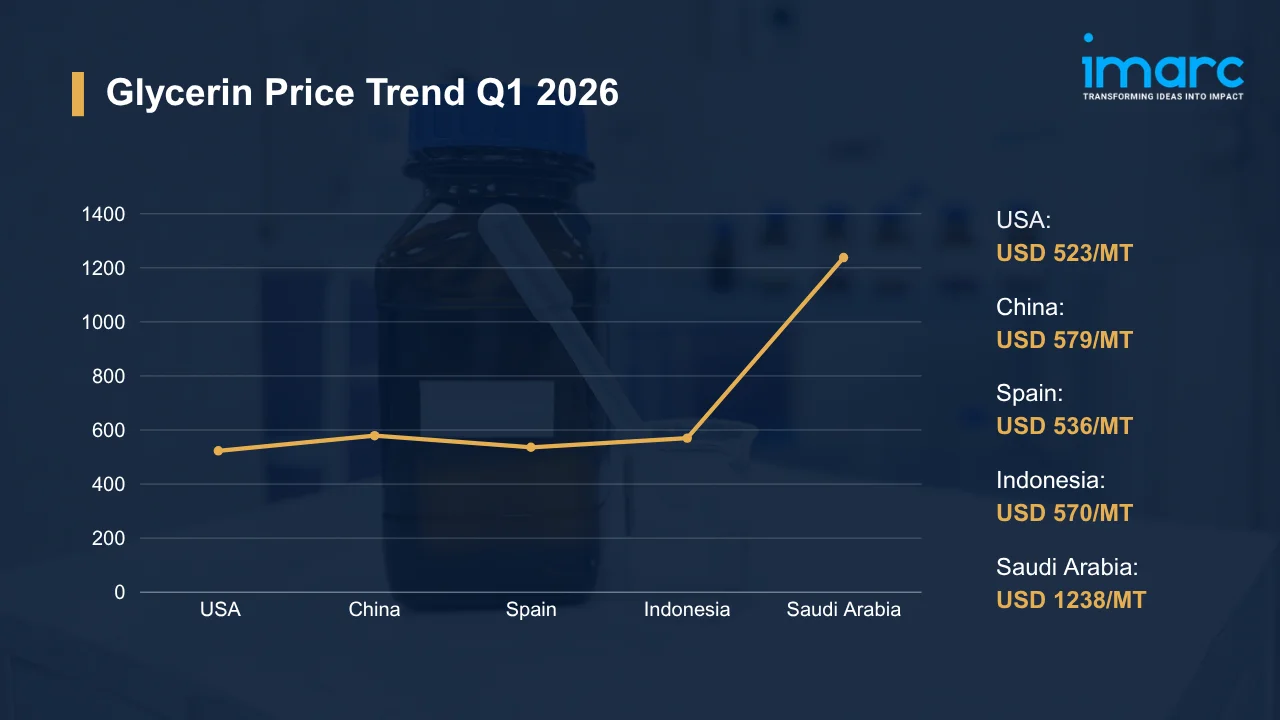
Glycerin is a colorless, odorless, viscous polyol liquid derived chiefly as a co-product of biodiesel transesterification, fatty acid splitting, and soap saponification. Valued across the personal care, pharmaceutical, food and beverage, and chemical synthesis sectors, it commands consistent procurement volumes from global manufacturers requiring hygroscopic and non-toxic humectants. Glycerin prices are shaped by upstream biodiesel production economics and feedstock palm or soy oil cost dynamics, energy expenditure during distillation and purification, ocean freight rates on Asia-origin corridors, and seasonal demand cycles within personal care and drug formulation industries.
Global Market Overview:
Globally, the glycerin industry was valued at USD 2.3 Billion in 2025. Market projections indicate steady growth, with the industry expected to reach USD 3.5 Billion by 2034, with a compound annual growth rate (CAGR) of 4.64% during 2026-2034. Broadening pharmaceutical-grade excipient requirements and clean-label food additive adoption are drawing incremental procurement volumes into the market, while the glycerin price trend is further shaped by expanding personal care formulation activity across Southeast Asia, Latin America, and the Middle East. Biodiesel blending mandates in Indonesia, Brazil, and the EU reinforce crude co-product supply flows that feed into global refining channels, adding structural depth to available volumes.
Glycerin Price Trend Q1 2026:
Regional prices (USD per MT) and QoQ changes Q1 2026 vs Q4 2025:
| Region | Price (USD/MT) | QoQ Change | Direction |
|---|---|---|---|
| USA | 523 | +10.21% | ↑ |
| China | 579 | +9.76% | ↑ |
| Spain | 536 | +10.23% | ↑ |
| Indonesia | 570 | +10.86% | ↑ |
| Saudi Arabia | 1,238 | +10.70% | ↑ |
To access real-time prices Request Sample
What Moved Prices:
USA:
- In Q1 2026, glycerin prices in the USA climbed to USD 523/MT as personal care manufacturers and pharmaceutical formulators accelerated procurement after early-quarter inventory drawdowns outpaced replenishment. At USD 523/MT, the glycerin price chart traced a steep upward curve through January and February, underscoring the scale of the supply tightening across Gulf Coast distribution points.
- Constrained crude glycerin output from domestic biodiesel plants operating at reduced utilization tightened spot availability considerably. Buyers adjusted contract volumes upward to secure forward supply, and CIF import offers from Southeast Asian origins firmed in parallel, leaving limited room for downward price negotiation throughout the quarter.
China:
- During Q1 2026, glycerin prices in China reached USD 579/MT, lifted by post-Lunar New Year restocking activity among FMCG producers and personal care converters. Domestic biodiesel output held flat, and refinery turnaround schedules at several coastal plants curtailed crude glycerin throughput, concentrating supply pressure within inland distribution channels.
- Refined glycerin export demand from Southeast Asian buyers drew volumes away from the domestic market, compressing available spot supply for local buyers. CNY depreciation against the US dollar raised the landed cost of import alternatives, and that cost disadvantage reinforced domestic sellers' pricing leverage through the quarter.
Spain:
- In Q1 2026, glycerin prices in Spain advanced to USD 536/MT as European personal care ingredient buyers rebuilt positions ahead of the spring manufacturing season. Contracted biodiesel-derived glycerin feedstock volumes across several EU refining hubs had thinned through the prior quarter, tightening physical availability entering the period.
- Firmer container freight rates on Asia-Europe corridors elevated the landed cost of imported refined glycerin from Asian origins, prompting buyers to engage domestic suppliers at higher offer levels. Pharmaceutical- and food-grade specification requirements under EU regulatory frameworks sustained a structural quality premium, anchoring assessed values above general-market benchmarks.
Indonesia:
- In the first quarter of 2026, glycerin prices in Indonesia reached USD 570/MT, underpinned by the B40 biodiesel mandate that kept palm-based transesterification complexes running at high utilization rates. Refinery offtake contracts with international buyers absorbed incremental crude glycerin co-product volumes at firm price levels, supporting assessed market values through the period.
- Across the archipelago, downstream personal care and soap producers increased refined glycerin procurement as consumer goods production run rates accelerated. Port throughput at Tanjung Priok stayed efficient through the quarter, supporting timely export shipments and containing the logistical bottleneck risk that had pressured price assessments in earlier periods.
Saudi Arabia:
- Glycerin prices in Saudi Arabia reached USD 1,238/MT in Q1 2026 as pharmaceutical and personal care manufacturers across the GCC intensified procurement activity. Asia-Gulf container freight rates on principal import corridors added to CIF landed cost levels, and the pegged-currency framework insulated buyers from exchange rate volatility while locking in the import cost increase.
- Jebel Ali free-zone storage facilities consolidated refined glycerin consignments from multiple origins, providing regional buyers with access to blended supply pools. Tighter global supply conditions limited competitive re-offer activity, and formulation demand from high-purity pharmaceutical-grade buyers sustained a widening premium spread over benchmarks in other regional markets.
Drivers Influencing the Market:
Several factors continue to shape glycerin pricing and market behavior:
- Personal Care and Pharmaceutical Sector Demand: Sustained absorption by personal care formulators and pharmaceutical manufacturers anchors baseline procurement volumes for glycerin globally. Moisturizer, serum, and topical drug formulations require consistent high-purity supply, and expanding healthcare access across emerging economies reinforces offtake. Seasonal cosmetic product launch cycles introduce periodic demand spikes that tighten spot availability ahead of key retail windows, shaping the glycerin price index across both crude and refined market segments.
- Upstream Biodiesel Supply and Feedstock Dynamics: Glycerin supply is structurally linked to biodiesel production through the transesterification co-product relationship, making blending mandate shifts and plant utilization rates a primary determinant of crude glycerin market availability. Per the IEA's Renewables 2025 report, US biodiesel output dropped 40% from Q1 2024 to Q1 2025, compressing North American crude glycerin supply at a point when downstream refinery demand was recovering. Policy-driven output volatility across major producing regions creates cascading tightness in refined glycerin availability and sustains upward pricing pressure.
- Energy Expenditure in Glycerin Refining and Purification: Upgrading crude glycerin to pharmaceutical- and personal-care-grade specifications requires energy-intensive distillation, ion-exchange, and deodorization processing. Natural gas and electricity cost dynamics in the EU, China, and Southeast Asia directly shape the operating cost structure of refinery operators in these regions. Producers in higher-energy-cost environments embed incremental processing costs into offered prices, compressing margins when downstream buyers limit price acceptance during periods of broader market softness.
- Ocean Freight and Logistics Economics: Container shipping rate movements on Asia-Europe and Asia-North America trade lanes materially shape the landed cost of glycerin for import-dependent markets. Elevated CIF basis costs for refined glycerin arriving at European and North American ports constrain the competitive advantage of lower-cost Asian origin supply.
- Environmental and Regulatory Compliance Requirements: Regulatory frameworks governing pharmaceutical excipient purity, food additive traceability, and chemical handling standards impose compliance expenditures that embed progressively into assessed market prices. USP-grade certification and REACH registration in Europe introduce testing, documentation, and audit costs for producers and distributors operating across multiple jurisdictions. Buyers sourcing certified-origin or sustainability-traced glycerin face structural price premiums over technical-grade supply, widening quality-tier spread differentials across market segments.
- Trade Policy and Currency Dynamics: Import tariff structures, biodiesel blending mandate adjustments, and bilateral trade framework shifts alter the competitive positioning of glycerin supply from different origin countries. Currency volatility in Indonesia and Malaysia, where palm-based biodiesel and glycerin production is concentrated, affects the US dollar-denominated export competitiveness of these origins in global spot markets. Buyers operating in peg-currency environments benefit from procurement cost predictability, while those in floating-rate markets absorb additional exchange rate risk into total landed costs.
Recent Highlights & Strategic Developments:
Recent strategic moves within the industry further illustrate evolving dynamics:
- In February 2026, a study underscored the increasing promise of ozonized glycerin in cosmetics and skincare products because of its improved therapeutic benefits. Research showed that ozonized glycerin enhanced skin hydration, aided wound healing, reinforced skin barrier proteins, and diminished inflammation more effectively than regular glycerin. The technology demonstrated antibacterial, antiviral, and anti-inflammatory properties via stabilized ozone release. Researchers noted enhanced wound healing and defense against elastin breakdown, highlighting ozonized glycerin as a potential breakthrough for superior skincare, antiaging, and skin rejuvenation products.
Outlook & Strategic Takeaways:
Looking ahead, the glycerin market is expected to sustain steady expansion through 2034, supported by growing pharmaceutical-grade excipient demand, broadening personal care formulation activity across emerging economies, and rising biodiesel blending mandates that expand crude co-product availability. Feedstock palm and soy oil cost trajectories, refinery energy economics, and evolving purity certification requirements will collectively shape the glycerin price forecast across supplier cost structures and key regional distribution channels.
To navigate this complex landscape, stakeholders should:
- Assess Freight Market Developments: Monitor container shipping rate movements on Asia-Europe and Asia-North America corridors to anticipate CIF landed cost shifts ahead of contract renewal cycles. Negotiate logistics agreements with rate adjustment mechanisms tied to prevailing Drewry WCI benchmark levels.
- Evaluate Downstream Demand Indicators: Track personal care, pharmaceutical, and food-grade sector activity indices and order books across principal consumption regions on a quarterly basis. Align inventory positioning with demand cycle signals to avoid overstocking during seasonal procurement lulls.
- Review Regulatory Compliance Expenditures: Audit current costs tied to USP-grade certification, REACH registration, and food additive traceability obligations across operating jurisdictions. Identify process efficiencies that reduce compliance burden without compromising product quality or certification standing.
- Strengthen Currency Exposure Management: Implement hedging strategies for procurement denominated in Indonesian rupiah or Malaysian ringgit to stabilize landed cost projections from palm-origin supply chains. Coordinate treasury and procurement functions to align foreign exchange coverage windows with anticipated import payment timelines.
- Explore Emerging Application Segments: Investigate growth potential in bio-based chemical synthesis, sustainable aviation fuel co-processing, and industrial fermentation as portfolio diversification pathways. Engage with technology partners to evaluate commercial viability of glycerin-derived intermediates that expand addressable demand beyond traditional end-use sectors.
- Monitor Regional Price Differentials: Track quarterly pricing variations across the USA, China, Spain, Indonesia, and Saudi Arabia to identify cost-saving procurement windows. Benchmarking landed glycerin price per MT against prevailing contract rates enables procurement teams to make data-driven sourcing decisions.
Subscription Plans & Customization:
IMARC offers flexible subscription models to suit varying needs:
- Monthly Updates: 12 deliverables/year
- Quarterly Updates: 4 deliverables/year
- Biannual Updates: 2 deliverables/year
Each includes detailed datasets (Excel + PDF) and post-report analyst support.

Get in Touch With Us
UNITED STATES
Phone: +1-201-971-6302
INDIA
Phone: +91-120-433-0800
UNITED KINGDOM
Phone: +44-753-714-6104
Email: [email protected]
Client Testimonials




.webp)




.webp)












