Penicillin G Sodium Price Increases 1.4% in France, 1.2% in Germany — Q1 2026 Update
08-Apr-2026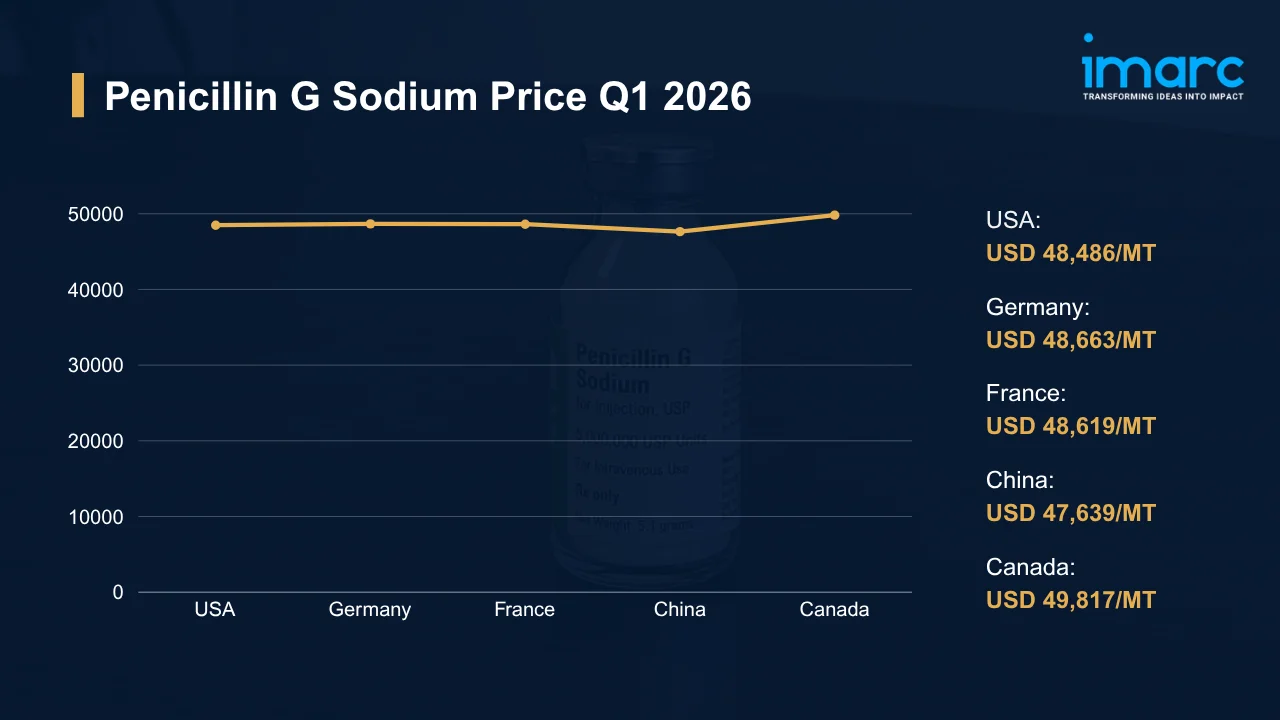
Summary:
Q1 2026 was beneficial for penicillin G sodium sellers. Penicillin G sodium prices climbed between 0.9% and 1.4% QoQ across all five tracked markets, with fermentation cost escalation holding the advance in place. Running orderly throughout the period, supply offered little resistance to the pricing direction. Before the Israel–Iran–USA conflict began, roughly 20% of global oil supply flowed through the Strait of Hormuz, which is currently shut to commercial traffic, creating an energy squeeze threatening to amplify pharmaceutical input costs ahead.
Penicillin G Sodium Price Q1 2026:
Regional prices (USD per MT) and QoQ changes Q1 2026 vs Q4 2025:
| Region | Price (USD/MT) | QoQ Change | Direction |
|---|---|---|---|
| USA | 48,486 | +0.9% | ↑ Growth |
| Germany | 48,663 | +1.2% | ↑ Growth |
| France | 48,619 | +1.4% | ↑ Growth |
| China | 47,639 | +1.1% | ↑ Growth |
| Canada | 49,817 | +1.1% | ↑ Growth |
To access real-time prices Request Sample
Kindly note: IMARC’s pricing database tracks penicillin G sodium price movements across major global markets.
What Moved Prices:
USA:
- In Q1 2026, penicillin G sodium in the USA reached USD 48,486/MT, up 0.9% QoQ, with hospital procurement holding firm and improved fermentation yields preventing supply tightness from materializing. The buyer side held calm throughout. Keeping within a manageable cost range, inland logistics shielded teams from distribution-side escalation through the period.
- Restrained spot activity defined the USA market through Q1 2026, with buyers drawing from existing forward contracts rather than chasing offers as prices gradually firmed. The penicillin G sodium price chart captures this procurement discipline: energy-linked cost pressures at fermentation facilities provided the underlying floor for the upward pricing bias.
Germany:
- During Q1 2026, penicillin G sodium prices in Germany climbed to USD 48,663/MT, a 1.2% QoQ gain driven by consistent demand from pharmaceutical formulators across the European manufacturing base. Energy cost increases at domestic facilities reinforced the upward move, making a Q1 2026 price softening an unlikely outcome even before supply factors were considered.
- Controlled import availability across the EU prevented an oversupply scenario, and producers with substantial energy tariff exposure maintained firm offer pricing throughout the period as compliance costs added further upward pressure. Downstream antibiotic formulators adjusted procurement cautiously rather than negotiating aggressively, leaving the market firmly in sellers’ hands through Q1.
France:
- France posted the steepest gain of any tracked market. In Q1 2026, penicillin G sodium reached USD 48,619/MT, a 1.4% QoQ advance fueled by firm hospital demand and active healthcare distributor replenishment cycles that consistently outpaced any restocking fatigue from Q4 2025, keeping spot availability constrained and offers supported.
- Upstream raw material costs remained firm, with producers embedding energy and compliance expenses directly into quoted prices rather than absorbing them. Cross-border European trade supported supply continuity across the quarter, though export commitments from French facilities occasionally pulled inventory away from the domestic spot market, adding a subtle tightening effect on local availability.
China:
- Reaching USD 47,639/MT in Q1 2026, penicillin G sodium prices in China advanced 1.1% QoQ as stable fermentation output met consistent demand from domestic pharmaceutical manufacturers. Environmental compliance monitoring and regulatory oversight contributed additional cost pressure, preventing the margin-driven price softening that buyers might have anticipated in an otherwise stable supply environment.
- Throughout Q1 2026, fermentation plants operated at steady rates, keeping inventory turnover efficient and preventing spot market accumulation from building pressure on offer levels. Port operations at major Chinese export hubs functioned without incident, allowing outbound shipments to proceed on schedule at FOB rates that reflected the energy cost adjustments already embedded in producer pricing.
Canada:
- During Q1 2026, penicillin G sodium in Canada climbed to USD 49,817/MT, a 1.1% QoQ increase reflecting stable healthcare sector demand and consistent import flows from the United States. With domestic production limited, Canada remained structurally import-dependent, meaning cross-border logistics and USA supplier pricing exerted direct influence on landed costs through the period.
- Through the quarter, procurement discipline held firm. With buyers managing inventory against firm import prices rather than building precautionary stock ahead of potential supply constraints, offer levels stayed anchored, and the market avoided the inventory-driven tightening that would have pushed procurement teams toward spot purchasing for penicillin G sodium.
Penicillin G Sodium Price Outlook After the Israel–Iran–USA Conflict:
Rising Energy Costs and Fermentation Input Price Pressure for Penicillin G Sodium: Fermentation costs are the key vulnerability. Being electricity-intensive throughout, the fermentation process means crude price spikes transmit directly into operating budgets. India, a major pharmaceutical intermediates supplier, depends on the Strait of Hormuz for roughly 40% of its crude oil, an exposure that might push penicillin G sodium fermentation input costs sharply higher if the conflict persists.
Regional Price Volatility and Demand Uncertainty for Penicillin G Sodium: Which buyers absorb the conflict’s cost ripple and which can pass it through is H1 2026’s key market question. Penicillin G sodium landed costs might widen differentials between high-import markets like Canada and more self-sufficient European producers, creating pricing asymmetries that could reshape near-term order flow across the antibiotic value chain. Tracking FOB-to-CIF spread widening is essential.
Immediate Market Reaction:
How quickly supply corridors normalize will define penicillin G sodium’s pricing direction through 2026. The penicillin G sodium price index reflects dual upward pressure from crude oil cost escalation and Hormuz logistics inflation. Across Asia, fermentation facilities that supply the majority of global penicillin G sodium output operate on assumptions of cheap energy and functional freight access, both of which the current conflict is now actively undermining. Pharmaceutical procurement desks in Europe and North America are watching closely. Whether that uncertainty might sustain pricing momentum or instead drive demand moderation remains the market’s key unanswered question.
Impact on Penicillin G Sodium Prices:
The conflict might trigger several key changes in the penicillin G sodium market:
- Energy-Linked Fermentation Cost Escalation: Penicillin G sodium fermentation burns electricity at scale, making every crude oil price surge a direct production cost input before a freight variable is added. Margins tighten quickly under these conditions. Operating at current utilization rates, producers might face margin compression within weeks if Brent oil prices elevate, and will likely pass unabsorbed costs to pharmaceutical buyers via contract revisions or spot surcharges.
- Logistics Cost Escalation and Supply Chain Delays: Rerouted around the Cape of Good Hope, Asian penicillin G sodium shipments now add up to 14 transit days and carry materially higher war-risk insurance costs per delivery, pushing CIF offer levels upward before buyers at destination absorb a single unit. CIF landed rates will rise materially. With importers across Europe and North America yet to renegotiate landed cost benchmarks, Q2 margins are likely to tighten as the shipping escalation flows through.
- Feedstock and Raw Material Availability Pressure: Petrochemical solvents and reagents essential to penicillin G sodium synthesis move through the same Gulf corridors now under active disruption, and the supply pipeline is visibly thinning. Spot feedstock costs are rising fast. Having fewer realistic alternative routes at comparable cost levels, procurement teams might find availability windows compressed enough to force spot purchasing at rates well above contracted benchmarks.
Penicillin G sodium buyers face a compounding cost environment. Converging across fermentation inputs, freight corridors, and feedstock channels, energy escalation, logistics delays, and supply tightening create a cost burden that routine contract management will not fully offset, and adaptive procurement strategies might prove essential to control exposure as the conflict persists.
Supply Chain Disruptions:
Asian penicillin G sodium exporters route both their energy supply and pharmaceutical freight through the Strait of Hormuz, leaving them highly exposed to current disruptions. Commercial traffic has largely halted, while military tensions disrupt shipping flows, raising procurement costs and creating congestion at UAE hubs that previously served as key consolidation points.
India and China, accounting for the largest share of global penicillin G sodium output, are actively evaluating Cape of Good Hope rerouting as their primary freight alternative, a detour that adds up to 14 transit days and substantially widens FOB-to-CIF cost differentials. Across the distribution chain, buffers are thinning. Moving quickly on alternative supplier agreements and revised lead time frameworks might prove essential, as sustained Hormuz disruption will eventually make current stock positions inadequate for European and North American buyers.
Global Market Overview:
Globally, the penicillin G sodium industry reached a volume of 71.4 Thousand Tons in 2025. Market projections indicate steady growth, with the industry expected to reach 93.6 Thousand Tons by 2034, at a compound annual growth rate (CAGR) of 2.96% during 2026-2034. Driven by healthcare investment, antibiotic demand climbs. Reflecting that expansion, the penicillin G sodium price trend points to consistent upward cost pressure from energy-intensive fermentation requirements, pharmaceutical manufacturing investment growth, and regulatory compliance evolution shaping production economics globally.
Recent Highlights & Strategic Developments:
Recent strategic moves within the industry further illustrate evolving dynamics:
- In May 2025, a recent pharmacokinetic study underscored difficulties in enhancing benzylpenicillin, or penicillin G, for prolonged application in rheumatic heart disease and syphilis. Researchers discovered that at extremely low concentrations, the medication displayed greater distribution and elimination. Cystatin C-based eGFR among renal markers was a superior predictor of drug clearance compared to creatinine measures. The results backed precision dosing methods and could inform the creation of better long-acting formulations to improve adherence and therapeutic efficacy globally.
Penicillin G Sodium Price Forecast (2026):
Conflict-driven energy shifts will keep near-term penicillin G sodium prices sensitive to variables procurement teams cannot control through contract design alone. Caution defines the market right now. Across European and North American buying segments, purchasing strategies are likely to stay conservative through mid-2026, with buyers reluctant to extend commitments until the conflict’s energy and logistics impact becomes clearer.
Should hostilities deepen significantly through Q3 2026, penicillin G sodium prices will face sustained upward pressure as CIF costs widen, freight premiums climb, and fermentation energy expenses remain elevated across production markets. Procurement teams might accelerate forward contract coverage. Conversely, a diplomatic de-escalation might restore freight normalization and compress energy costs toward pre-conflict levels, and improving market conditions will drive the penicillin G sodium price forecast toward stability through the year’s latter months.
Strategic Takeaways:
Looking ahead, the penicillin G sodium market is expected to sustain steady volume growth through 2034, underpinned by expanding antibiotic demand across developing healthcare systems, rising pharmaceutical investment, and consistent clinical adoption globally. Geopolitical instability and energy cost volatility represent the primary near-term risks to pricing stability and volume expansion.
To navigate this complex landscape, stakeholders should:
- Monitor Regional Price Differentials: Quarterly pricing across the five tracked markets can diverge, creating real procurement windows for cost-conscious buyers. Benchmarking the penicillin G sodium price per MT against active contract rates identifies when spot sourcing offers a genuine cost advantage.
- Monitor Geopolitical Risk Exposure: Escalation dynamics in the Israel–Iran–USA conflict can shift penicillin G sodium pricing and logistics costs rapidly. Internal alert thresholds that trigger procurement or hedging responses might prevent reactive decisions under acute time pressure when market conditions move fast.
- Diversify Supply Chain Routes: Alternative sourcing geographies outside Gulf-linked corridors are now a practical necessity, not a contingency plan. Secondary supplier agreements and pre-arranged freight options will provide the resilience needed if primary penicillin G sodium routes remain disrupted through mid-year.
- Adjust Procurement Strategy for Conflict Conditions: Price reopener clauses and force majeure provisions protect against geopolitical spikes that fixed-rate structures cannot absorb. Precautionary inventory buffers of 30 to 45 days might reduce exposure if penicillin G sodium availability tightens abruptly under conflict conditions.
- Track Fermentation Input Costs: Upstream energy and raw material costs telegraph penicillin G sodium price moves weeks ahead of formal contract renegotiations. Regular input benchmarking positions procurement teams to act early rather than react after offer levels have already moved against them.
- Monitor Regulatory and Environmental Compliance: Pharmaceutical manufacturing regulations in China and India are subject to tightening cycles that directly reduce penicillin G sodium output capacity when enforcement intensifies. Proactive sourcing strategy adjustments might prevent supply shortfalls from disrupting procurement continuity in key buyer markets.
Subscription Plans & Customization:
IMARC offers flexible subscription models to suit varying needs:
- Monthly Updates — 12 deliverables/year
- Quarterly Updates — 4 deliverables/year
- Biannual Updates — 2 deliverables/year
Each includes detailed datasets (Excel + PDF) and post-report analyst support.
Get in Touch With Us
UNITED STATES
Phone: +1-201-971-6302
INDIA
Phone: +91-120-433-0800
UNITED KINGDOM
Phone: +44-753-714-6104
Email: [email protected]
Client Testimonials




.webp)




.webp)












