Polyamide Price Update: Sustained Growth Across Key Markets in Q1 2026
22-Jun-2026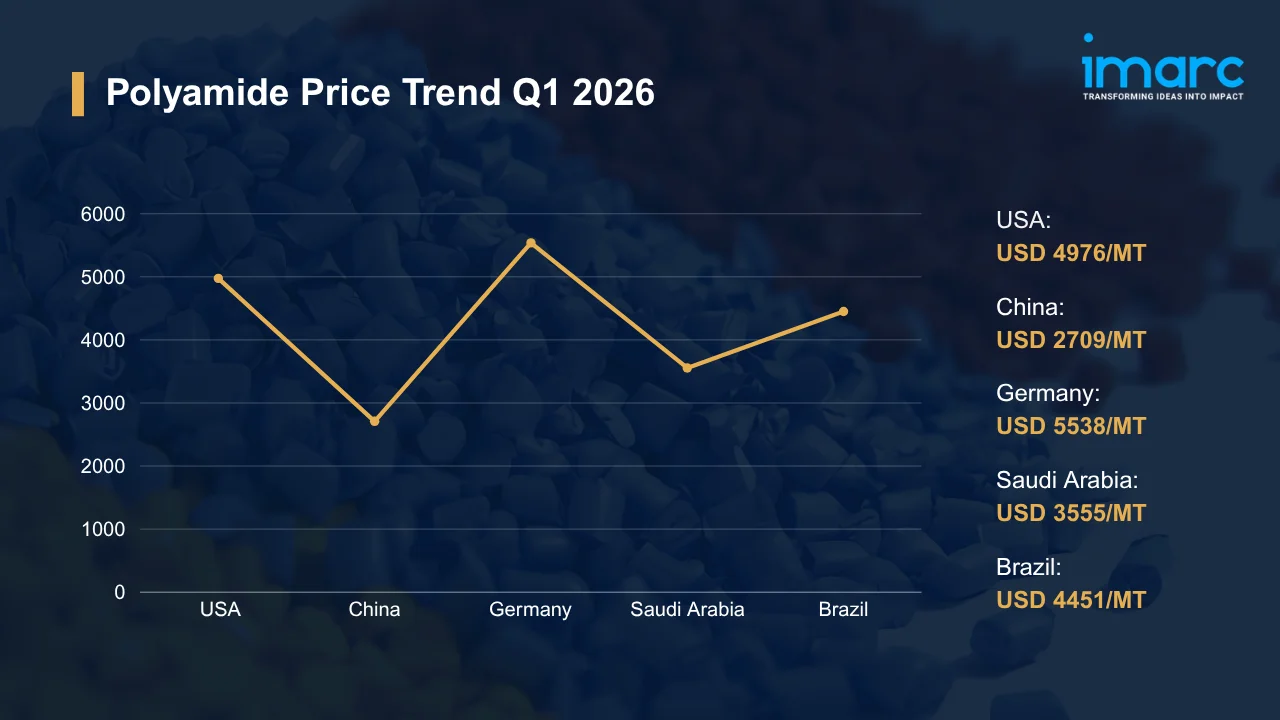
Classified as a synthetic condensation polymer, polyamide is constructed from repeating amide-bonded units delivering mechanical strength, heat resistance, and chemical durability across demanding industrial environments. Found throughout automotive assemblies, electrical and electronics hardware, textile manufacturing, flexible packaging lines, and precision-engineered components, polyamide prices are shaped by upstream caprolactam and adipic acid feedstock costs, energy consumption during polymerization, container freight rates on major trade lanes, and cyclical output patterns in automotive and consumer-goods production.
Global Market Overview:
Globally, the polyamide industry was valued at USD 37.3 Billion in 2025. Market projections indicate steady growth, with the industry expected to reach USD 57.7 Billion by 2034, with a compound annual growth rate (CAGR) of 4.83% during 2026-2034. Lightweighting imperatives in automotive manufacturing and widening adoption in electrical insulation and electronics housings anchor near-term consumption growth, while increasing penetration in flexible packaging and technical fibers sustains the polyamide price trend across procurement cycles in all major regions.
Polyamide Price Trend Q1 2026:
Regional prices (USD per MT) and QoQ changes Q1 2026 vs Q4 2025:
| Region | Price (USD/MT) | QoQ Change | Direction |
|---|---|---|---|
| USA | 4,976 | +5.43% | ↑ |
| China | 2,709 | +4.20% | ↑ |
| Germany | 5,538 | +1.98% | ↑ |
| Saudi Arabia | 3,555 | +4.56% | ↑ |
| Brazil | 4,451 | +5.23% | ↑ |
To access real-time prices Request Sample
What Moved Prices:
USA:
- In Q1 2026, polyamide prices in the USA advanced to USD 4,976/MT, a 5.43% QoQ gain driven by broad-based demand recovery across automotive, packaging, and engineering plastics converters. Procurement desks that had trimmed purchases during the prior inventory-correction cycle re-entered the spot and contract market, tightening prompt availability at Gulf Coast distribution points.
- Pushed higher by firmer caprolactam costs at North American feedstock producers, offer levels from domestic suppliers held firm throughout the period. Industrial plastic processors resumed regular buying schedules after months of disciplined restraint, and the polyamide price chart for Q1 2026 traced a steady northward path reinforced by recovering order books across primary end-use segments.
China:
- During Q1 2026, at USD 2,709/MT, polyamide prices in China registered a 4.20% QoQ rise as downstream converters serving the fibers and molded components segments returned to active procurement after a subdued prior quarter. Benzene and cyclohexane cost inflation filtered through the domestic production chain, prompting nylon chip and resin producers to revise offer levels upward.
- Export enquiries from overseas buyers contributed to firmer sentiment, though the depth of domestic competition among Chinese polyamide producers kept gains measured. Inventory positions at nylon chip facilities declined from the elevated prior-quarter overhang, giving sellers clearer visibility to push contract and spot prices toward cost-recovery thresholds.
Germany:
- In the first quarter of 2026, polyamide prices in Germany rose to USD 5,538/MT as input cost escalation in European upstream feedstock chains prompted producers to revise offers across contract and spot channels. Automotive manufacturers sustaining procurement for connector housings, insulation components, and under-the-hood nylon parts generated consistent pull-through demand during the period.
- Across the electrical and industrial manufacturing segments, order recovery translated into steadier purchasing schedules, preventing buyers from exploiting the kind of destocking leverage seen in prior quarters. Constrained margin flexibility at European polyamide producers reinforced the firmer pricing environment, leaving little room for negotiated discounts regardless of individual buyer volume.
Saudi Arabia:
- In Q1 2026, polyamide prices in Saudi Arabia climbed to USD 3,555/MT as packaging manufacturers, consumer goods producers, and industrial end-users all registered improved procurement activity. Feedstock cost pass-through by import-origin suppliers reinforced the upward pricing stance, and regional buyers increased order volumes to replenish inventory drawn down through a cautious Q4 2025.
- Supported by the pegged-currency framework common across Gulf markets, import cost calculations remained predictable throughout the quarter, limiting sharp intra-period volatility. Free-zone throughput at Saudi ports operated without significant disruption, and Asia-Gulf container freight remained stable enough to prevent landed cost spikes that could have amplified price pressure beyond fundamental levels.
Brazil:
- During Q1 2026, polyamide prices in Brazil advanced to USD 4,451/MT as recovering vehicle production schedules lifted automotive component manufacturers' procurement of engineering-grade nylon, while packaging converters and textile processors added concurrent demand support. Import-dependent buyers absorbed higher replacement costs as global polyamide offers firmed in line with feedstock and freight developments.
- Driven by BRL depreciation against the US dollar, the effective local-currency cost of imported cargoes arriving through Sao Paulo hubs rose through the quarter, prompting earlier-than-usual purchasing by cost-sensitive processors. Suppliers adjusted quotation levels in step with stronger global trends, and restocking momentum across downstream facilities sustained the upward pricing trajectory through March.
Drivers Influencing the Market:
Several factors continue to shape polyamide pricing and market behavior:
- Automotive and Industrial Sector Demand: Under-the-hood assemblies, connectors, and structural plastic components in passenger vehicles rely on nylon grades chosen for their heat tolerance and mechanical endurance, making automotive OEM procurement a foundational demand driver. Industrial machinery and electrical manufacturing segments provide complementary volumes, stabilizing baseline consumption through seasonal demand cycles in automotive production.
- Upstream Feedstock Cost Dynamics: Caprolactam, the precursor for nylon 6, and adipic acid plus hexamethylenediamine for nylon 6,6 are each derived from benzene and cyclohexane chains, creating a direct cost transmission pathway from crude-linked petrochemicals to finished polyamide. Maintenance outages at caprolactam facilities or raw material availability gaps propagate cost pressure through finished polyamide offers within weeks, compressing negotiation windows for procurement teams on short-term contracts.
- Energy Expenditure in Polymerization: Polyamide production depends on energy-intensive polymerization and extrusion stages where natural gas and electricity costs constitute a meaningful share of total manufacturing overhead. Per the EIA, the US benchmark Henry Hub spot price averaged USD 3.67 per MMBtu in 2025, raising cost floors for thermally intensive polymer operations. Shifts of this magnitude in energy pricing continue to shape the polyamide price index at North American and European production sites.
- Ocean Freight and Logistics Economics: Landed polyamide costs for import-reliant markets in Europe, the Gulf, and Latin America fluctuate materially with container shipping rates on Asia-Europe and Transpacific corridors. Drewry's World Container Index recorded a 3% week-on-week increase to USD 3,549 per 40ft container as of June 11, 2026, as an early peak season and active capacity management by major carriers tightened spot availability. Rising CIF landed costs on inbound polyamide cargoes translate directly into floor support for regional market pricing.
- Environmental and Regulatory Compliance: Chemical safety frameworks including REACH in Europe and parallel regimes in North America and Asia require polyamide producers and distributors to meet registration, substance evaluation, and environmental discharge standards that carry tangible compliance costs. Extended producer responsibility schemes targeting synthetic polymers layer additional administrative obligations onto manufacturers supplying consumer-facing sectors. Over time, cumulative regulatory overhead filters into market pricing across jurisdictions where enforcement is most stringent.
- Trade Policy and Currency Dynamics: Import tariff schedules affecting polyamide and its precursors reshape cost competitiveness between domestic producers and Asian exporters in key Western markets. BRL and INR depreciation against the US dollar raises effective procurement costs for Brazilian and Indian converters, generating periodic demand softening in otherwise growth-oriented markets. Adjustments to nylon precursor trade flows, whether from quota changes or bilateral agreements, can rebalance feedstock economics for regional producers within a single contract cycle.
Recent Highlights & Strategic Developments:
Recent strategic moves within the industry further illustrate evolving dynamics:
- In January 2026, Arkema commenced commercial operations at its new Rilsan Clear transparent polyamide unit in Singapore, establishing the largest regional capacity for this specialty grade and tripling global Rilsan Clear output. The USD 20 Million investment extended Arkema's footprint in Asia's high-performance polymer market, positioning the company to capture growing demand for transparent engineering plastics across electronics and optical applications in the region.
Outlook & Strategic Takeaways:
Looking ahead, the polyamide market is expected to sustain gradual volume and revenue growth through 2034, supported by persistent automotive lightweighting adoption, expanding electrical and electronics applications, and deepening penetration in flexible packaging and industrial fiber segments. Caprolactam and adipic acid feedstock cost trajectories will remain the pivotal variable shaping the polyamide price forecast, with energy benchmarks and trade policy shifts adding secondary but recurring pressure on producer margin structures across all major regions.
To navigate this complex landscape, stakeholders should:
- Assess Freight Market Developments: Review container shipping rate trends on Asia-Europe and Transpacific corridors at regular intervals to anticipate landed cost movements before they reach final invoice stages. Logistics contracts structured with freight rate adjustment mechanisms tied to published indices provide cost visibility and limit exposure to spot rate spikes.
- Evaluate Downstream Demand Indicators: Track automotive production output, electronics order books, and packaging converter utilization rates across principal consumption regions on a rolling basis. Aligning procurement volumes with forward demand signals reduces the risk of inventory overhang during period of output softening across key end-use sectors.
- Review Regulatory Compliance Expenditures: Audit compliance costs tied to polyamide handling, storage classification, and environmental discharge obligations under applicable frameworks in each operating jurisdiction. Targeted operational improvements that lower regulatory overhead without compromising chemical safety or certification requirements protect margin against rising compliance-cost trajectories.
- Strengthen Currency Exposure Management: Implement hedging programs for procurement payments denominated in BRL, INR, or other volatile currencies to stabilize landed cost projections across import-dependent operations. Treasury and procurement functions coordinated around aligned foreign exchange coverage windows reduce the surprise element of currency-driven cost escalation at contract renewal.
- Explore Emerging Application Segments: Investigate commercial opportunities in bio-based polyamide grades, specialty PA products targeting EV structural and thermal management applications, and circular polymer portfolios built on mass-balance recycled content. Early engagement with research and supply partners in these categories positions procurement organizations ahead of demand inflections before mainstream adoption tightens supply and prices.
- Monitor Regional Price Differentials: Track quarterly pricing movements across the USA, Germany, China, Saudi Arabia, and Brazil to identify sourcing windows with favorable cost spreads. Benchmarking polyamide price per MT against prevailing contract rates across these geographies enables procurement teams to time purchases and capture import arbitrage opportunities before contract cycles close.
Subscription Plans & Customization:
IMARC offers flexible subscription models to suit varying needs:
- Monthly Updates — 12 deliverables/year
- Quarterly Updates — 4 deliverables/year
- Biannual Updates — 2 deliverables/year
Each includes detailed datasets (Excel + PDF) and post-report analyst support.

Get in Touch With Us
UNITED STATES
Phone: +1-201-971-6302
INDIA
Phone: +91-120-433-0800
UNITED KINGDOM
Phone: +44-753-714-6104
Email: [email protected]
Client Testimonials




.webp)




.webp)












