Praseodymium Neodymium Alloy Price Falls 3.1% in Germany, 2.1% in Russia — Q1 2026 Update
13-Apr-2026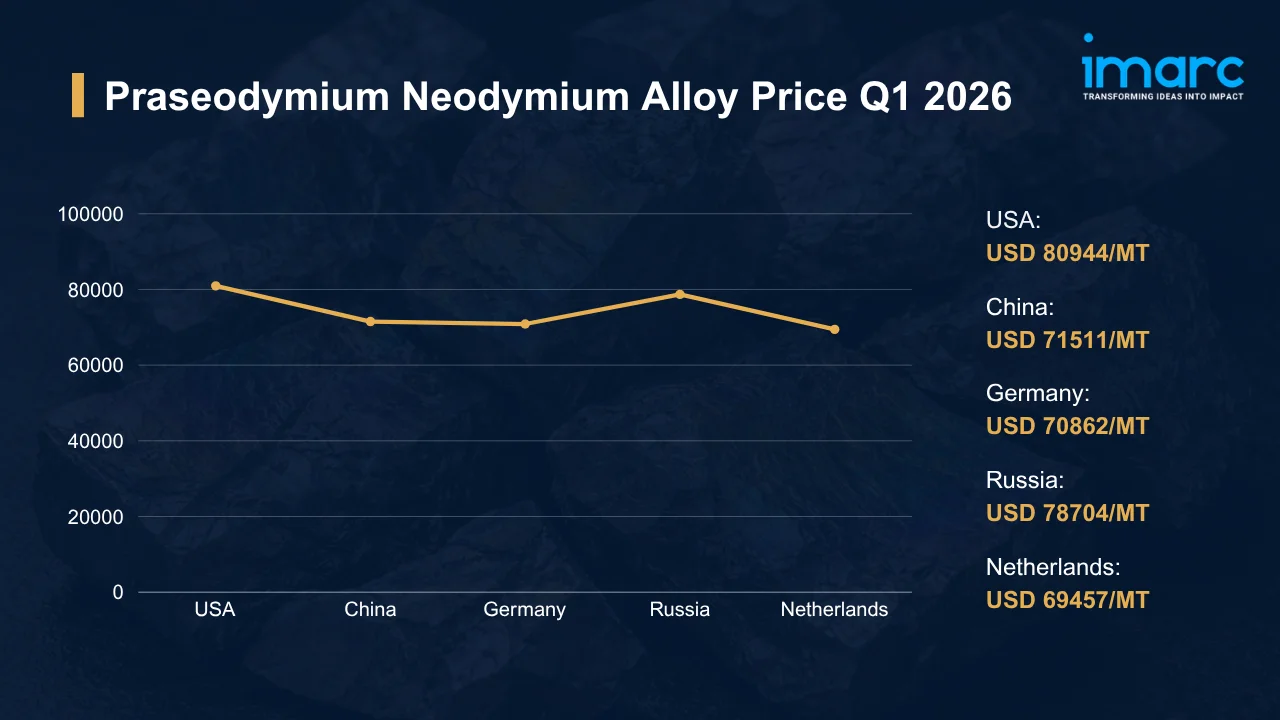
Summary:
Throughout Q1 2026, praseodymium neodymium alloy markets produced a split outcome as clean energy sector demand from electric vehicle (EV) drivetrains and wind turbine producers collided with subdued industrial procurement across three of five tracked regions. Praseodymium neodymium alloy prices moved between a 1.6% decline and a 3.6% gain QoQ. Constrained by mining quotas, supply-side tightness sustained those gains. As of March 8, 2026, the Israel–Iran–USA conflict suspended roughly one-fifth of global crude oil and gas supply, amplifying energy cost risks across rare earth processing.
Praseodymium Neodymium Alloy Price Q1 2026:
Regional prices (USD per MT) and QoQ changes Q1 2026 vs Q4 2025:
| Region | Price (USD/MT) | QoQ Change | Direction |
|---|---|---|---|
| USA | 80944 | +2.6% | ↑ Growth |
| China | 71511 | +3.6% | ↑ Growth |
| Germany | 70862 | -3.1% | ↓ Decline |
| Russia | 78704 | -2.1% | ↓ Decline |
| Netherlands | 69457 | -1.6% | ↓ Decline |
To access real-time prices Request Sample
Kindly note: IMARC’s pricing database tracks praseodymium neodymium alloy price movements across major global markets.
What Moved Prices:
USA:
- At USD 80944/MT in Q1 2026, praseodymium neodymium alloy prices in the USA gained 2.6% QoQ, pushed by firm demand from permanent magnet producers supplying EV drivetrains and wind turbine systems. Underlying supply conditions stayed tight through Q1. With limited domestic rare earth processing and heavy import reliance, the market rarely kept pace with clean energy and defense sector demand growth.
- Downstream magnet producers managed inventory conservatively. Not one restocking surge materialized to strain available spot volumes. Throughout the quarter, the praseodymium neodymium alloy price chart for North America held its upward slope, reflecting the region’s persistent structural supply deficit against growing magnet production and clean energy demand.
China:
- During Q1 2026, praseodymium neodymium alloy prices in China reached USD 71511/MT, a 3.6% QoQ gain driven by government-controlled production quotas and strong domestic consumption from electronics and EV magnet manufacturers. Export inquiries from Western buyers competed with domestic offtake, keeping available volumes tight and reinforcing upward price momentum.
- Regulatory oversight on rare earth mining held alloy supply to disciplined levels throughout the quarter. That tightness mattered most at the spot level, where EV battery and wind turbine magnet producers competed for prompt material. Overseas buyers deepened their inquiries as alternative supply geographies failed to offer comparable alloy grades at competitive CIF prices.
Germany:
- In Q1 2026, praseodymium neodymium alloy prices in Germany fell to USD 70862/MT, declining 3.1% QoQ as subdued demand from automotive component and heavy machinery manufacturers left import supply adequate relative to actual consumption. Balanced inventory across distribution channels removed any restocking urgency among buyers.
- Mittelstand manufacturers and automotive producers continued avoiding large-volume commitments, with uncertain order books driving procurement caution through March. Against this backdrop, the praseodymium neodymium alloy price trend in Germany held a downward bias through the quarter, as import-origin availability consistently outpaced actual consumption requirements at key distribution points.
Russia:
- In Q1 2026, praseodymium neodymium alloy prices in Russia came in at USD 78704/MT, easing 2.1% QoQ as stable domestic production and moderated demand from heavy industry and defense manufacturing left the market in balance. Export volumes stayed consistent but provided insufficient pull to meaningfully tighten local availability.
- Shaped by evolving trade route dynamics and persistent logistical constraints, procurement behavior among midstream manufacturers skewed toward measured buying through the quarter. Producers maintained controlled distribution strategies, though the absence of any strong domestic demand momentum from Russian industrial sectors limited all scope for price recovery.
Netherlands:
- During Q1 2026, praseodymium neodymium alloy prices in the Netherlands slipped to USD 69457/MT, easing 1.6% QoQ as trading activity moderated and import volumes through European distribution channels held steady. Consumption from downstream industrial users tracked at balanced but uninspired levels. Buyers saw little incentive to restock aggressively under those conditions.
- Across European distribution hubs, procurement sentiment remained cautious through the quarter, with end users managing stock levels conservatively amid uncertain downstream order flow. Warehousing costs edged higher, but stable import supply availability consistently capped sellers’ ability to reclaim price ground lost relative to Q4 2025.
Praseodymium Neodymium Alloy Price Outlook After the Israel–Iran–USA Conflict:
Rising Energy Costs and Rare Earth Processing Pressure for Praseodymium Neodymium Alloy: Rare earth separation and alloy refining are energy-intensive at every processing stage, making global oil price disruption a direct input cost risk for praseodymium neodymium alloy producers. Fluctuations in crude oil prices are increasing concerns about higher electricity and fuel costs for processing facilities across China and Europe alike.
Regional Demand Uncertainty and Price Volatility for Praseodymium Neodymium Alloy: Geopolitical escalation might reorder demand patterns for praseodymium neodymium alloy as buyers across Europe and North America reassess procurement commitments under heightened price uncertainty. European industrial users face margin pressure from energy cost pass-throughs, while Asian buyers might accelerate purchasing to lock in supply before further disruption. The market’s dependence on Chinese rare earth refining deepens this structural exposure.
Immediate Market Reaction:
Procurement sentiment is tightening across Western praseodymium neodymium alloy markets. Insulated from direct Strait of Hormuz disruption by China’s dominance of rare earth refining, the alloy sector’s most immediate vulnerability lies in energy cost pass-through rather than raw supply shock, making near-term cost forecasting difficult for magnet producers and industrial buyers alike. Against broader commodity market volatility, the praseodymium neodymium alloy price index is drawing renewed scrutiny from procurement teams in the USA and Europe, while trade nodes in Germany and the Netherlands face mounting logistics cost escalation and lengthening lead times from rerouted carriers.
Impact on Praseodymium Neodymium Alloy Prices:
The conflict might trigger several key changes in the praseodymium neodymium alloy market:
- Energy Cost Escalation in Processing: Praseodymium neodymium alloy production relies on high-temperature rare earth reduction and alloy refining processes that consume substantial electricity and fuel at every stage. Sustained oil price elevation will raise operating costs for facilities in China and Europe alike. Where those increases are absorbed internally, refiner margins compress; where passed through to buyers, contract and spot offer prices drift upward, compressing downstream magnet producer margins through Q2 2026.
- Procurement Frontloading and Spot Market Tightening: Buyers in defense, EV, and clean energy sectors might front-load spot purchases to hedge against further supply disruption, pulling demand forward from Q2 2026 into the current procurement window. That behavioral shift will tighten available spot volumes in Western markets even where underlying industrial demand has otherwise moderated, providing price support that runs ahead of actual consumption signals and complicating near-term price discovery.
- Logistics Cost Elevation and CIF Premium Widening: Rerouted vessels and extended transit times through alternative shipping corridors translate directly into elevated CIF delivery prices for praseodymium neodymium alloy cargoes reaching European buyers. Freight surcharges, war-risk insurance premiums, and longer voyage times will widen the spread between Asian producer export prices and European delivered cost benchmarks, making near-term contract renegotiation a practical necessity for exposed buyers.
Combined, these pressures might produce a bifurcated market through Q2 2026, with supply-secured buyers holding cost positions while exposed buyers face elevated CIF prices and stretched lead times. Whether energy markets stabilize or escalate further will determine how far praseodymium neodymium alloy prices move beyond their Q1 2026 trajectories in Western consuming regions.
Supply Chain Disruptions:
Praseodymium neodymium alloy supply chains carry specific maritime exposure: refined alloy from China must reach European and North American markets via shipping corridors passing near or through the Strait of Hormuz. Tanker and carrier disruption is already evident in transit data. In early March 2026, Maersk suspended all Strait of Hormuz vessel crossings until further notice, warning of significant delays to Persian Gulf port services, a development that directly extends alloy delivery windows and elevates CIF costs for Western buyers.
Producers servicing European markets might pre-position inventory at Rotterdam or Antwerp transshipment hubs ahead of anticipated delivery delays. Where that pre-positioning proves impractical, lead times stretch and delivered costs rise above prior contract benchmarks. Alternative overland corridors through Central Asia exist but carry additional handling complexity and cost premiums. Running into Q2 2026, prolonged disruption might trigger spot market tightening across markets softening through Q1, potentially reversing price declines in Germany and the Netherlands if logistics constraints persist longer than buyers anticipate.
Global Market Overview:
Globally, the praseodymium neodymium alloy industry was valued at USD 5.27 Billion in 2025. Market projections indicate steady growth, with the industry expected to reach USD 7.68 Billion by 2034, at a compound annual growth rate (CAGR) of 4.28% during 2026-2034. Driven by EV and wind turbine manufacturing expansion, rare earth magnet demand continues growing. Advances in rare earth recycling technology improve supply sustainability, while growing magnet adoption across robotics, defense, industrial automation, and aerospace extends the market’s long-term growth runway globally.
Recent Highlights & Strategic Developments:
Recent strategic moves within the industry further illustrate evolving dynamics:
- In November 2025, USA Rare Earth, Inc. completed its acquisition of Less Common Metals Ltd. (LCM), securing access to samarium, samarium cobalt, and neodymium praseodymium metal alloys. The deal propelled USAR’s goal to create a completely integrated rare earth supply chain, covering upstream raw materials to the production of finished magnets.
Praseodymium Neodymium Alloy Price Forecast (2026):
With conflict-driven energy costs and rerouted carrier disruptions both weighing on near-term price stability, Western buyers of praseodymium neodymium alloy face a more uncertain procurement environment in Q2 2026 than Q1 conditions suggested. Procurement caution will persist into early Q2. By contrast, Chinese domestic demand might sustain a pricing floor that limits how far global markets soften.
If hostilities intensify, praseodymium neodymium alloy prices will likely face renewed upward pressure as energy and logistics costs climb across supply chains. Producers in conflict-exposed regions might curtail output. Tightening global alloy availability will widen CIF premiums for European buyers, while diplomatic de-escalation might ease freight rates and stabilize energy costs enough to allow prices to moderate toward pre-conflict levels by mid-2026. These dynamics will continue shaping the praseodymium neodymium alloy price forecast through the year.
Strategic Takeaways:
Looking ahead, the praseodymium neodymium alloy market is expected to sustain growth, driven by accelerating EV adoption, expanding wind turbine programs, and growing demand for high-performance magnets across industrial automation sectors. Price volatility persists in the near term. Through 2026, geopolitical disruptions and energy cost movements will shape the trajectory.
To navigate this complex landscape, stakeholders should:
- Track Regional Price Differentials: Monitor quarterly pricing variations across the USA, China, Germany, Russia, and the Netherlands to identify cost-optimal procurement windows. Compare landed CIF costs against prevailing contract benchmarks to identify sourcing arbitrage opportunities across key rare earth supply geographies.
- Monitor Geopolitical Risk Exposure: Track escalation dynamics in the current conflict and assess how shifts in hostility levels might affect praseodymium neodymium alloy pricing, feedstock availability, and logistics costs. Establish internal alert thresholds that trigger procurement or hedging action.
- Diversify Supply Chain Routes: Evaluate alternative sourcing geographies and shipping corridors to reduce dependence on conflict-exposed trade lanes. Secondary supplier agreements and contingency freight arrangements will provide critical supply chain resilience if primary maritime routes face sustained disruption.
- Adjust Procurement Strategy for Conflict Conditions: Adopt flexible contract structures with price reopener clauses and force majeure provisions to guard against geopolitical price spikes across procurement cycles. Precautionary inventory buffers might reduce exposure if alloy supply tightens abruptly as conflict-driven logistics disruptions deepen.
- Benchmark Against Upstream Rare Earth Cost Movements: Monitor praseodymium neodymium alloy price per MT against prevailing rare earth oxide benchmark costs to assess margin compression risk. Price gaps between oxide feedstock and refined alloy signal where producer profitability faces the most acute vulnerability to energy cost escalation.
- Monitor Regulatory Developments in Rare Earth Mining: Track changes to rare earth mining quota policies and environmental compliance requirements in key producing regions, with China’s regulatory environment holding particular importance. Tightening constraints might reduce alloy supply and create upside pricing risk that warrants proactive procurement planning.
Subscription Plans & Customization:
IMARC offers flexible subscription models to suit varying needs:
- Monthly Updates — 12 deliverables/year
- Quarterly Updates — 4 deliverables/year
- Biannual Updates — 2 deliverables/year
Each includes detailed datasets (Excel + PDF) and post-report analyst support.

Get in Touch With Us
UNITED STATES
Phone: +1-201-971-6302
INDIA
Phone: +91-120-433-0800
UNITED KINGDOM
Phone: +44-753-714-6104
Email: [email protected]
Client Testimonials




.webp)




.webp)












