Q1 2026 Silicone Rubber Prices: USA at USD 9,511/MT While China Remains the Lowest-Cost Producer
01-Jul-2026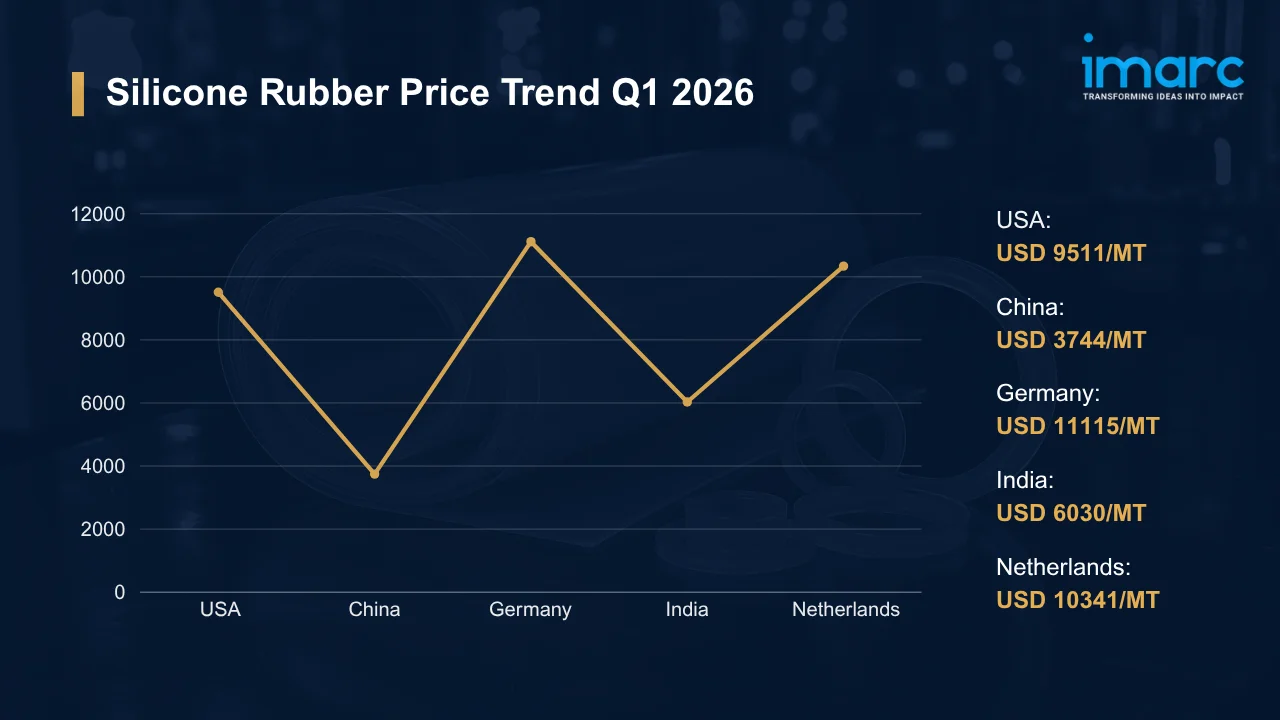
Built on a silicon-oxygen backbone with organic pendant groups, silicone rubber offers excellent thermal stability along with outstanding resistance to ozone, ultraviolet radiation, weathering, and environmental degradation. Silicone rubber prices govern procurement decisions across automotive sealing, medical tubing, wire insulation, construction sealants, kitchenware, and aerospace moldings. Upstream silicon metal and siloxane intermediate costs, energy intensity in compounding and vulcanization, and container freight rates on Asia-origin corridors collectively set the commodity's quarterly price floor.
Global Market Overview:
Globally, the silicone rubber industry was valued at USD 13.89 Billion in 2025. Market projections indicate steady growth, with the industry expected to reach USD 22.33 Billion by 2034, with a compound annual growth rate (CAGR) of 5.42% during 2026-2034. Driven by accelerating electric vehicle (EV) adoption, expanding medical device manufacturing, and urban construction programs across Southeast Asia and Latin America, the silicone rubber price trend reflects broadening end-use diversification. Electronics miniaturization and photovoltaic module sealing are opening additional consumption channels, extending demand beyond the commodity's traditional automotive and construction core.
Silicone Rubber Price Trend Q1 2026:
Regional prices (USD per MT) and QoQ changes Q1 2026 vs Q4 2025:
| Region | Price (USD/MT) | QoQ Change | Direction |
|---|---|---|---|
| USA | 9,511 | +6.09% | ↑ |
| China | 3,744 | +8.65% | ↑ |
| Germany | 11,115 | +7.76% | ↑ |
| India | 6,030 | +6.13% | ↑ |
| Netherlands | 10,341 | +6.89% | ↑ |
To access real-time prices Request Sample
What Moved Prices:
USA:
- In Q1 2026, silicone rubber prices in the USA climbed to USD 9,511/MT as automotive, healthcare, construction, and electrical converters stepped up procurement after a cautious fourth quarter. Buyers moved to close inventory gaps ahead of spring production ramp-ups, pushing spot order volumes above typical seasonal levels through March.
- Gulf Coast logistics costs held firm, limiting downside pressure from competing offshore offers. Producers managed operating rates carefully to avoid surplus accumulation, maintaining offer discipline through the period. The silicone rubber price chart traced a steady upward path from January through March, supported by restrained seller discounting and consistent inbound order flow across all major grade types.
China:
- During Q1 2026, silicone rubber prices in China rose to USD 3,744/MT as electronics assembly, automotive component, and industrial molding converters re-entered the spot market following cautious fourth-quarter purchasing. Fourth-quarter inventory drawdowns left buyers with limited buffer stock, driving stronger replenishment through February and March.
- Feedstock support from silicone intermediate markets strengthened producer pricing confidence. CNY exchange rate stability reduced currency-related cost uncertainty for import-exposed downstream accounts. Domestic order flow improved month-on-month, while export allocations from Chinese producers remained disciplined, preventing the supply overhang that had weighed on prior-quarter values.
Germany:
- In Q1 2026, silicone rubber prices in Germany advanced to USD 11,115/MT, with renewed procurement from automotive, industrial machinery, medical device, and electrical insulation processors driving the quarterly gain. Converters stepped up purchasing after the inventory reduction phase of late 2025 created supply gaps that tightened spot availability into January.
- Across the European supply chain, elevated energy, labor, and logistics costs sustained producer offer levels throughout the quarter. Firmer CIF prices on Asia-Europe import lanes capped downward pressure from competing Asian material. Structured contract purchasing among specialty-grade accounts provided additional support, as compliance requirements kept buyers aligned with certified supply chains.
India:
- During Q1 2026, silicone rubber prices in India moved higher to USD 6,030/MT, with automotive parts fabricators, electrical goods manufacturers, healthcare converters, and construction sealant producers all registering stronger procurement volumes. Buyers covered production needs ahead of the March quarter-end, generating consistent spot demand through the period.
- Suppliers raised offer levels as imported feedstock costs and Asia-India ocean freight firmed. Rupee softness against the US dollar added a further cost increment to each CIF import consignment, reinforcing the upward drift in assessed landed values. Domestic availability remained adequate, though higher replacement costs from East Asian origins limited seller flexibility on discounts.
Netherlands:
- In Q1 2026, silicone rubber prices in the Netherlands rose to USD 10,341/MT as European demand for elastomers used in automotive sealing, medical components, industrial molding, and electrical applications gathered pace. Regional buyers returned to the market following earlier destocking, placing stronger orders across both spot and contract channels.
- On the supply side, freight, compliance, and feedstock pressures on Asia-Europe corridors held import costs firm. Sellers maintained disciplined pricing as available inventory was not excessive. Rotterdam port operations ran without material disruption, yet replacement cost economics from Asian origins left suppliers with little incentive to offer concessions on spot tonnage.
Drivers Influencing the Market:
Several factors continue to shape silicone rubber pricing and market behavior:
- Automotive and EV Sector Demand: At USD 9,511/MT in the USA and USD 11,115/MT in Germany, Q1 2026 prices reflected the scale of automotive and EV-driven consumption growth reshaping silicone elastomer procurement. Per the IEA Global EV Outlook 2025, global electric car sales were on track to exceed 20 Million units in 2025, representing more than one quarter of all new cars sold worldwide. Battery seals, thermal management gaskets, cable insulation, and high-voltage connector boots all require specialty silicone rubber grades whose performance thresholds cannot easily be met by alternative elastomers.
- Upstream Silicon Metal and Siloxane Intermediate Costs: According to the USGS Mineral Commodity Summaries 2026, the January through October 2025 average US silicon metal price fell approximately 21% below the 2024 annual average, attributed to oversupply, weak demand from the aluminum and chemical sectors, and elevated polysilicon stock availability. That upstream cost relief proved short-lived, however, as tightening siloxane intermediate supply and recovering downstream demand pushed final-stage input expenses back upward through Q1 2026. Tracking the silicone rubber price index against silicon metal spot values illustrates how tightly feedstock cycles translate into finished elastomer valuations.
- Energy Expenditure in Compounding and Vulcanization: Natural gas and electricity constitute a meaningful share of total production cost in silicone rubber compounding, mixing, and thermal curing. Manufacturing sites in Germany, the Netherlands, and North America are especially exposed to regional power tariff and gas price movements. Costs may moderate during periods of mild weather and adequate gas storage, though tightening capacity utilization at European chemical plants rapidly transmits any energy price spike into finished product pricing.
- Ocean Freight and Logistics Economics: Container shipping rates on Asia-Europe and Asia-North America corridors set the effective import cost floor for silicone rubber sourced from Chinese and other Asian producers. Firmness in freight through Q1 2026 sustained landed cost levels at Netherlands and German ports, capping competitive pressure from lower-cost Asian material. Buyers in import-reliant markets time procurement decisions around freight rate trajectory signals to manage CIF cost exposure.
- Regulatory and Product Compliance Standards: FDA, EU REACH, and IEC certification requirements for medical-grade, food-contact, and electrical-insulation silicone rubber grades impose above-average quality assurance expenditures on producers and importers alike. Compliance costs filter into pricing across specialty applications, widening the spread between commodity and high-specification grades. Tightening REACH restrictions on certain cyclosiloxane intermediates add reformulation and testing burdens that are gradually absorbed into buyer-facing valuations.
- Trade Policy and Currency Dynamics: Antidumping measures, import tariff schedules, and preferential trade agreements shape the relative competitiveness of silicone rubber from Chinese, European, and North American producers in third-country markets. Currency depreciation in import-dependent markets such as India amplifies CIF replacement costs for each overseas consignment, reinforcing the upward price bias even when origin FOB values hold stable. Buyers operating across multiple currency zones build exchange rate assumptions directly into landed cost benchmarks.
Recent Highlights & Strategic Developments:
Recent strategic moves within the industry further illustrate evolving dynamics:
- In July 2025, WACKER launched POWERSIL® 1900 A/B, a high-consistency silicone rubber formulated for composite insulator housings produced via extrusion and spiral-extrusion methods. Supplied as a two-component addition-curing system, the product targets growing demand for reliable, long-service electrical insulation materials in energy transmission and grid infrastructure.
Outlook & Strategic Takeaways:
Looking ahead, the silicone rubber market is expected to sustain an upward trajectory through 2034, underpinned by structural demand growth in EV production, renewable energy infrastructure, medical device expansion, and specialty industrial molding. Upstream silicon metal and siloxane cost dynamics, combined with freight rate movements on Asia-origin corridors, will remain the defining variables shaping the silicone rubber price forecast across supplier margin structures through the forecast period.
To navigate this complex landscape, stakeholders should:
- Assess Freight Market Developments: Monitor container shipping rate movements on Asia-Europe and transpacific corridors to anticipate import cost changes for sourced silicone rubber grades. Negotiate logistics contracts with rate-adjustment provisions tied to spot market indices to limit landed cost exposure during rate spikes.
- Evaluate Downstream Demand Indicators: Track automotive build rates, EV production schedules, medical device output data, and construction sector activity indices across principal consuming regions. Correlating demand signals with procurement cycles reduces overstocking risk and improves inventory turn efficiency.
- Review Regulatory Compliance Expenditures: Audit costs associated with FDA, REACH, and IEC certification for medical-grade, food-contact, and electrical silicone rubber sourcing. Identifying supplier-qualification efficiencies or consolidated testing arrangements can reduce per-lot compliance burden without compromising material performance standards.
- Strengthen Currency Exposure Management: Implement hedging strategies covering procurement denominated in the euro, Indian rupee, or Chinese yuan to stabilize landed cost projections through volatile exchange rate periods. Coordinating treasury and procurement timelines ensures foreign exchange coverage aligns with scheduled import payment dates.
- Explore Emerging Application Segments: Investigate growth potential in battery thermal management systems, photovoltaic module encapsulation, and hydrogen fuel cell sealing for portfolio diversification. Engaging R&D partners to evaluate high-purity and specialty-cure formulations expands addressable demand in segments with above-average long-run growth profiles.
- Monitor Regional Price Differentials: Track quarterly pricing variations across the USA, Germany, Netherlands, China, and India to identify cost-efficient procurement windows. Benchmarking silicone rubber price per MT against CIF landed costs and prevailing contract rates ensures procurement teams capture sourcing advantages as regional spreads shift.
Subscription Plans & Customization:
IMARC offers flexible subscription models to suit varying needs:
- Monthly Updates: 12 deliverables/year
- Quarterly Updates: 4 deliverables/year
- Biannual Updates: 2 deliverables/year
Each includes detailed datasets (Excel + PDF) and post-report analyst support.

Get in Touch With Us
UNITED STATES
Phone: +1-201-971-6302
INDIA
Phone: +91-120-433-0800
UNITED KINGDOM
Phone: +44-753-714-6104
Email: [email protected]
Client Testimonials




.webp)




.webp)












