Tungsten Price Falls 13.3% in USA, 12.2% in Netherlands — Q4 2025 Update
05-Aug-2025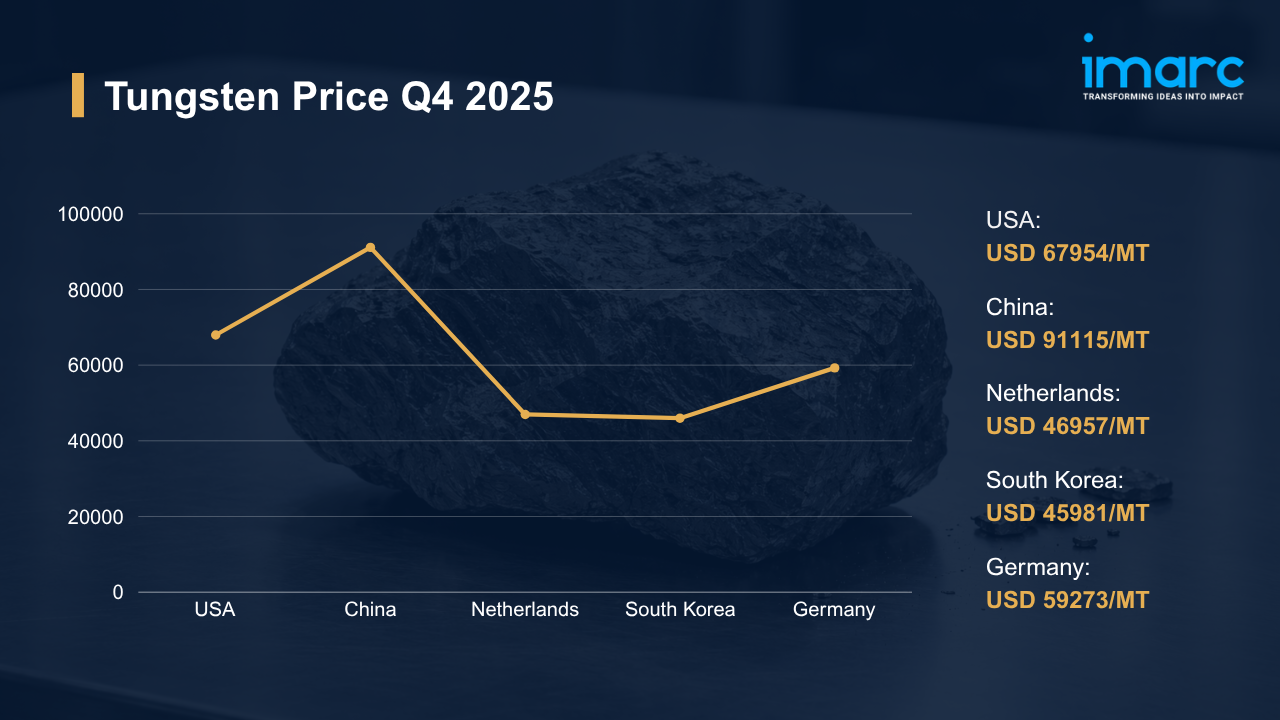
Summary:
Q4 2025 split tungsten markets in two across key demand segments. Driven by divergent downstream utilization and inventory discipline across industrial segments, tungsten prices swung between a 13.3% decline and a 13.8% gain QoQ, a range that captures how uneven procurement conditions became across tracked regions. Feedstock availability, converter run rates, and export order momentum each pulled in different directions. Adding to this uncertainty, as of March 8, 2026, oil prices surged more than 25% after hostilities began, squeezing energy-dependent processing costs globally.
Tungsten Price Q4 2025:
Regional prices (USD per MT) and QoQ changes Q4 vs Q3 2025:
| Region | Price (USD/MT) | QoQ Change | Direction |
|---|---|---|---|
| USA | 67954 | -13.3% | ↓ Decline |
| China | 91115 | +13.8% | ↑ Growth |
| Netherlands | 46957 | -12.2% | ↓ Decline |
| South Korea | 45981 | +10.1% | ↑ Growth |
| Germany | 59273 | -7.9% | ↓ Decline |
To access real-time prices Request Sample
Kindly note: IMARC’s pricing database tracks tungsten price movements across major global markets.
What Moved Prices:
USA:
- In Q4 2025, USA tungsten prices at USD 67954/MT reflect a 13.3% QoQ decline, the steepest tracked across all five markets. Hard metals fabricators and tooling producers across Gulf Coast and Midwest manufacturing corridors cut order volumes sharply as downstream utilization eased below seasonal norms, leaving distributor inventories adequate and spot bids without meaningful buyer support through most of December. Procurement stayed largely defensive throughout. The tungsten price chart traced this uninterrupted descent from October onwards.
- CIF-competitive offers arriving from major Asian-origin suppliers undercut domestically sourced material throughout the quarter, narrowing the margin at which US distributors could quote without losing orders and keeping offer recovery attempts short-lived. Aerospace tooling and defense segment demand held steady but lacked the volume momentum needed to absorb available stock. Buyers operated on near-zero restocking urgency.
China:
- In Q4 2025, tungsten prices in China climbed to USD 91115/MT, a 13.8% QoQ gain and the largest upward move across tracked markets. Alloy manufacturing hubs and electronics producers in Guangdong and Zhejiang drove sustained procurement at firmer-than-expected volumes, tightening spot availability at processing nodes and giving domestic sellers the pricing leverage to push offers materially higher through December.
- Export-oriented industrial production played a meaningful role in sustaining buying cycles, with sourcing strategies across APT and carbide intermediate buyers emphasizing forward inventory build aligned with confirmed downstream production schedules. At key export conversion facilities, output remained consistent. Buyers operating on fixed-price export contracts absorbed higher input costs without reducing order frequency, reinforcing the quarter-long upward price trajectory.
Netherlands:
- During Q4 2025, tungsten prices in the Netherlands fell to USD 46957/MT, a 12.2% QoQ drop, as demand from metal processing converters and industrial tooling producers softened against a backdrop of comfortable European distribution stock levels and restrained buying across precision manufacturing end users. Procurement urgency across the region’s Mittelstand-linked converter base dropped to near-quarter lows by November.
- Pushed lower by steady inflows of Asian-origin material at competitive landed prices, distributor offer levels found no floor throughout October and November, with sellers accepting discounts rather than carrying unsold inventory into the next quarter. European manufacturing indicators, while showing mild improvement, lacked the conviction needed to trigger forward stock accumulation. Contract discussions remained strictly volume-matched to confirmed near-term output requirements.
South Korea:
- In Q4 2025, tungsten prices in South Korea advanced to USD 45981/MT, up 10.1% QoQ, as electronics manufacturers, precision component producers, and industrial tooling converters collectively drove a sustained improvement in procurement activity. With semiconductor packaging demand holding firm and specialty tooling order books deepening through the quarter, buyers moved from hand-to-mouth sourcing towards inventory replenishment, providing sellers with reliable volume support at firmer price levels.
- Consistent downstream utilization rates at electronics fabricators and semiconductor substrate producers through November and December created the foundation for regular buying cycles, preventing the spot market softness seen elsewhere. Import flows from major producing countries remained available but could not undercut domestic offers materially, given the strength of confirmed order-driven demand. Procurement teams emphasized supply continuity over spot price optimization throughout the period.
Germany:
- In the fourth quarter of 2025, tungsten prices in Germany fell to USD 59273/MT, declining 7.9% from Q3, as automotive component manufacturers, machinery builders, and precision tooling producers across the Rhine corridor reduced procurement volumes, in line with moderated production schedules and improved import material availability. Spot bids weakened through October and held soft into December. Sellers offered discounts to maintain order volumes.
- Across the Mittelstand converter base, purchasing behavior reflected strict inventory discipline: contract volumes were matched to confirmed production requirements rather than forward demand expectations, limiting restocking activity and preventing any meaningful recovery in spot offer levels. Logistics costs along primary Rhine Valley transport corridors remained stable, removing the cost-side support that freight tightness might otherwise have provided. Procurement sentiment stayed cautious throughout.
Tungsten Price Outlook After the Israel–Iran–USA Conflict:
Rising Energy Costs and Processing Margin Pressure for Tungsten: Energy represents a significant input cost in tungsten processing. As of March 9, 2026, at USD 120 per barrel, Brent crude sat nearly double its end-2025 level, a move that lifts electricity and fuel costs across APT synthesis and carbide conversion facilities globally. These escalating expenses might compress producer margins and transmit into firmer spot offers within one to two quarters.
Regional Demand Uncertainty and Price Volatility for Tungsten: Elevated energy costs and sustained geopolitical uncertainty are prompting industrial buyers across Europe and Asia to reassess forward procurement commitments, prioritizing short contract cycles over volume-based agreements. Capacity utilization forecasts at key hard metals and tooling producers might be revised downward as input cost visibility worsens. This demand-side hesitation will likely translate into periodic price softness even where physical supply remains broadly balanced.
Immediate Market Reaction:
Buyers across major tungsten-consuming segments are tightening procurement cycles and reducing forward exposure as the conflict reshapes cost and logistics assumptions. The tungsten price index captures this shift in market tone, reflecting compressed bid-ask spreads and reduced spot transaction frequency across European and North American trading desks. Supply nodes in East Asia, which provide the bulk of globally traded APT and tungsten concentrate, face indirect exposure through rising bunker fuel and war-risk insurance surcharges embedded in CIF freight costs. Processors in Europe are recalculating landed cost models weekly as energy price assumptions shift.
Impact on Tungsten Prices:
The conflict might trigger several key changes in the tungsten market:
- Energy-Driven Production Cost Escalation: Processing tungsten from concentrate through to APT and carbide grades is energy-intensive at every stage, and rising fuel and electricity prices will push production economics higher across major smelting and conversion facilities. Producers with high energy exposure might raise offer floors to protect margins, transmitting upstream cost increases into spot and contract prices within one to two quarters. Buyers locked into fixed-price contracts will face renegotiation pressure.
- Trade Route and Logistics Cost Inflation: Tungsten intermediates moving from Chinese and Central Asian production centers towards European and North American processing markets transit through freight corridors now subject to war-risk surcharges and carrier suspensions. Longer alternative routes around the Cape of Good Hope add 10 to 14 days to delivery schedules and increase per-shipment costs meaningfully. Buyers dependent on just-in-time supply models might face availability gaps and forced spot purchases at elevated landed prices.
- Procurement Behavior Realignment Across Industrial Segments: Hard metals fabricators, tooling producers, and electronics manufacturers are already compressing procurement cycles and reducing forward contract exposure as conflict-driven uncertainty worsens cost visibility. This shift towards shorter buying horizons will create episodic demand volatility in spot markets, making price discovery more erratic and reducing the predictability of quarterly procurement budgets. Sellers may respond by rationing spot availability to protect contracted volume margins.
Energy cost pressure, logistics inflation, and demand-side caution will each independently sustain price instability across the tungsten market through the conflict period. Their combined effect might prove more disruptive than current forward positioning anticipates, particularly if elevated energy costs persist and freight route normalization remains constrained across key Asian export corridors.
Supply Chain Disruptions:
Tungsten’s supply chain, moving concentrate from China and Central Asia to processors in Europe and North America, relies on freight corridors now severely constrained. Logistical uncertainty has increased and shipping activity has decreased due to disruptions along important maritime routes. Procurement complexity is rising due to longer lead times, higher CIF landing prices for shipments, and rising war-risk insurance premiums and carrier suspensions. In the event that these disruptions continue, purchasers may experience material shortages and tighter availability throughout the impacted supply chains.
Constrained by deteriorating route security, freight operators are redirecting capacity around the Cape of Good Hope, adding 10 to 14 days to standard delivery schedules and absorbing bunker cost increases that will be passed through as surcharges. Buyers are responding with precautionary buffer-building at European distribution points, though limited spot availability is driving up acquisition costs. Producers in Asia will likely delay shipment decisions until improved security clarity emerges, placing additional pressure on European converter stock positions through mid-2026.
Global Market Overview:
Globally, the tungsten market reached a volume of 81537.50 Tons in 2025. Market projections indicate steady growth, with the market expected to reach 98098.10 Tons by 2034, with a compound annual growth rate (CAGR) of 2.08% during 2026-2034. Hard metals, aerospace tooling, and electronics manufacturing drive this expansion, reinforced by rising semiconductor packaging demand and defense procurement. Regulatory focus on critical mineral supply chain security is accelerating strategic investment in tungsten sourcing. The tungsten price trend through the forecast period reflects these structural demand tailwinds across key consuming industries globally.
Recent Highlights & Strategic Developments:
Recent strategic moves within the industry further illustrate evolving dynamics:
- In November 2025, Fireweed Metals Corp. completed a comprehensive drilling campaign and engineering assessments to advance a feasibility study for the Mactung tungsten project on the Yukon–Northwest Territories border, positioning the asset as a potential domestic supply solution against a backdrop of tightening global tungsten availability and growing strategic sourcing pressure from industrial buyers.
Tungsten Price Forecast (2026):
Through the first half of 2026, tungsten prices will remain under competing pressures from conflict-driven energy cost increases on the supply side and cautious procurement behavior from industrial buyers on the demand side. Spot transaction volumes might stay compressed as buyers limit forward exposure, while producers facing higher processing costs will resist discounting below revised cost-support levels. Price discovery will stay erratic.
Sustained hostilities will keep freight surcharges elevated and energy cost assumptions unstable, conditions that push tungsten offer levels higher regardless of underlying demand strength. Tooling and hard metals producers might defer capacity expansion decisions until cost visibility improves, dampening volume-based buying signals that would otherwise support price recovery. Conversely, if diplomatic channels stabilize the conflict by mid-2026, freight route normalization and easing energy prices might allow spot bids to recover toward pre-conflict levels. Monitoring the tungsten price forecast closely will be essential for procurement teams seeking to time contract renewals strategically.
Strategic Takeaways:
Looking ahead, the tungsten market is expected to grow, supported by hard metals, aerospace tooling, and electronics manufacturing demand as the primary structural drivers. Geopolitical disruption, energy cost volatility, and freight route instability will shape near-term price trajectories across these key industrial end use segments.
To navigate this complex landscape, stakeholders should:
- Monitor Geopolitical Risk Exposure: Track conflict escalation dynamics and assess how hostility-level shifts might affect tungsten pricing, feedstock availability, and logistics costs across primary supply corridors. Establish internal alert thresholds that trigger procurement or hedging action when predefined risk indicators are breached.
- Track Regional Price Differentials: Monitor quarterly pricing spreads across key supply markets, including China, Europe, and North America, to identify cost-advantaged procurement windows. Systematic benchmarking of tungsten price per MT against landed cost data will help procurement teams capture savings and time in sourcing decisions effectively.
- Diversify Supply Chain Routes: Evaluate alternative sourcing geographies and freight corridors to reduce dependence on conflict-exposed trade lanes through the Strait of Hormuz region. Secondary supplier agreements and contingency freight arrangements will provide critical resilience if primary shipping routes face sustained disruption.
- Adjust Procurement Strategy for Conflict Conditions: Adopt flexible contract structures with price reopener clauses and force majeure provisions to protect against geopolitical price spikes across supply channels. Precautionary inventory buffers might reduce exposure if physical availability tightens abruptly due to route disruption or producer output curtailment.
- Secure Secondary Supplier Agreements: Identify and qualify alternative tungsten concentrate and intermediate product suppliers outside primary sourcing geographies to build supply chain redundancy. Pre-negotiated standby agreements with secondary vendors will activate faster than spot market sourcing during disruption periods, reducing exposure to premium pricing under constrained availability conditions.
Subscription Plans & Customization:
IMARC offers flexible subscription models to suit varying needs:
- Monthly Updates — 12 deliverables/year
- Quarterly Updates — 4 deliverables/year
- Biannual Updates — 2 deliverables/year
Each includes detailed datasets (Excel + PDF) and post-report analyst support.
Get in Touch With Us
UNITED STATES
Phone: +1-201-971-6302
INDIA
Phone: +91-120-433-0800
UNITED KINGDOM
Phone: +44-753-714-6104
Email: [email protected]
Client Testimonials




.webp)




.webp)












