
Brazil Real Time Payments Market Size, Share, Trends and Forecast by Type of Payments and Region, 2026-2034
Brazil Real Time Payments Market Size, Share, Trends & Forecast (2026-2034)
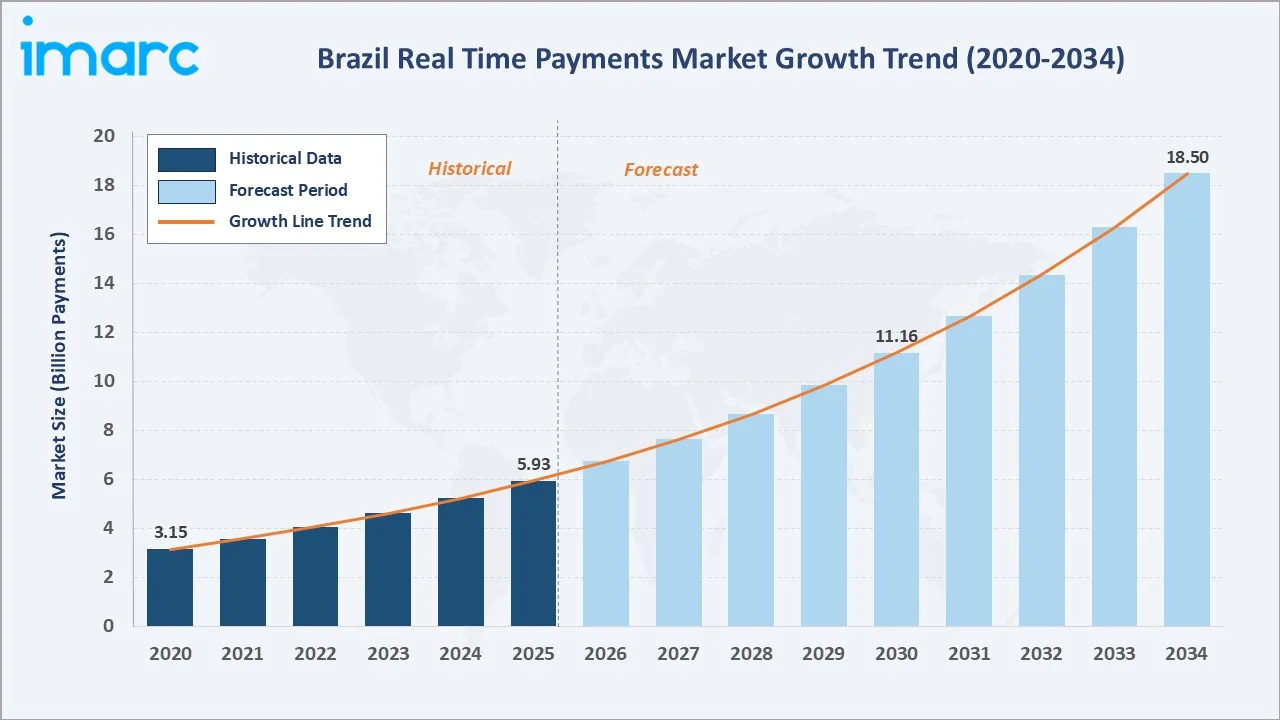
The Brazil real time payments market reached 5.93 Billion Payments in 2025 and is projected to reach 18.50 Billion Payments by 2034, growing at a CAGR of 13.47% during 2026-2034. The market is driven by the rapid adoption of Pix, expanding digital banking, fintech growth, and rising demand for instant, low-cost, and secure payment transactions. On April 6, 2024, Pix set a new single-day record by processing 250.5 million transactions worth BRL 124.4 billion. Compared with Brazil’s adult population of 162.9 million, this highlights how deeply Pix has become embedded in everyday payments. High transaction volumes show strong demand for instant, low-cost, and convenient digital payments across retail, e-commerce, bills, peer-to-peer transfers, and financial services. P2P (person-to-person) leads the payment type at 63.8%. Southeast leads regionally at 44.7%.
Market Snapshot
|
Metric |
Value |
|
Market Size (2025) |
5.93 Billion Payments |
|
Forecast Market Size (2034) |
18.50 Billion Payments |
|
CAGR (2026-2034) |
13.47% |
|
Base Year |
2025 |
|
Historical Period |
2020-2025 |
|
Forecast Period |
2026-2034 |
|
Dominant Type of Payments |
P2P (63.8%, 2025) |
|
Leading Region |
Southeast (44.7%, 2025) |
Brazil real-time payments market grew from 3.15 Billion Payments in 2020 to 5.93 Billion Payments in 2025, supported by rapid Pix adoption, digital banking expansion, and increasing mobile payment usage. The market is anchored at 11.16 Billion Payments by 2030, reflecting rising consumer and merchant preference for instant, low-cost payment methods. By 2034, transaction volume is forecast to reach 18.50 Billion Payments, driven by broader QR payments, fintech innovation, e-commerce growth, and real-time account-to-account transfers.
To get more information on this market, Request Sample
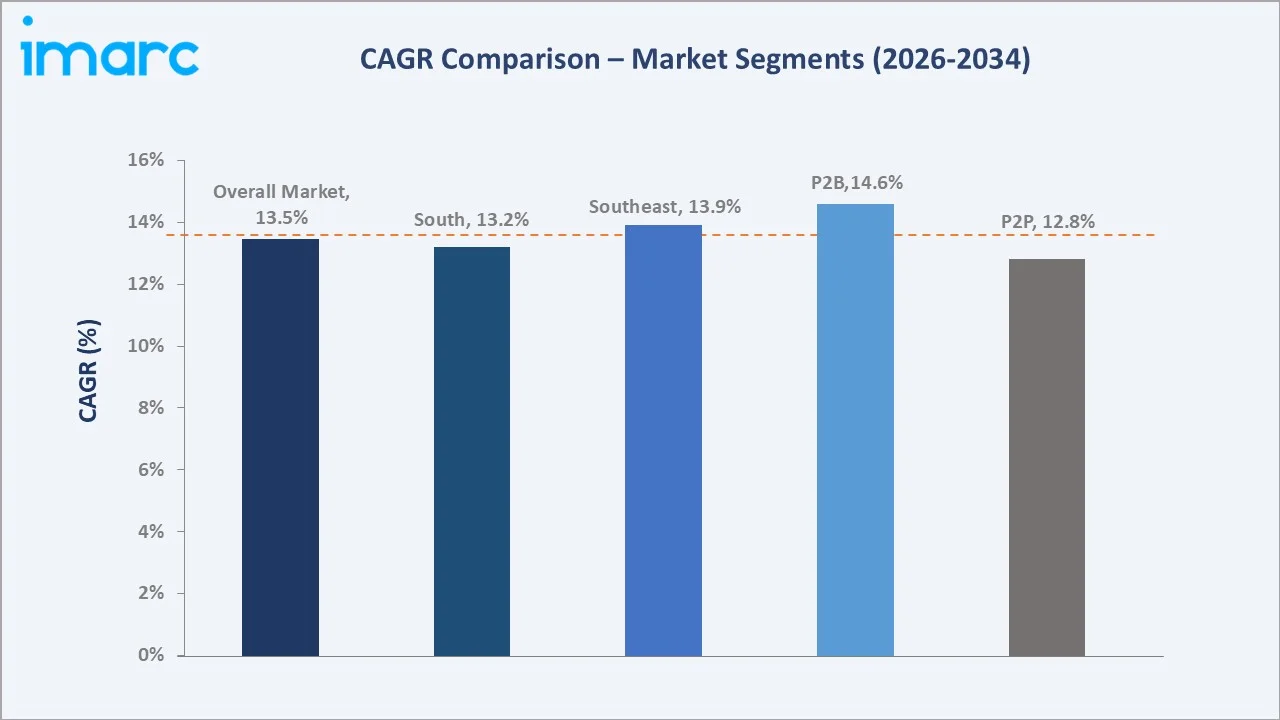
P2B grows fastest at ~14.6% CAGR through Pix merchant QR code acceptance, e-commerce checkout integration, and Pix recurring billing. P2P grows at ~12.8% CAGR as a mature, near-universally adopted everyday transaction method.
Executive Summary
Brazil real-time payments market is expanding rapidly, supported by strong Pix adoption, digital banking growth, and rising demand for instant account-to-account transfers. Consumers and merchants increasingly prefer real-time payments due to speed, low cost, convenience, and 24/7 availability. The market is also benefiting from QR payments, mobile wallets, fintech innovation, and e-commerce growth. Banks, payment processors, and technology providers are investing in secure, scalable platforms to handle rising transaction volumes. Continued digitalization and wider merchant acceptance are expected to sustain strong growth through 2034. P2P at 63.8% leads through everyday person-to-person transfer. Southeast leads regionally at 44.7%.
Key Market Insights
|
Insight |
Data |
|
Dominant Type of Payments |
P2P - 63.8% share (2025) |
|
Leading Region |
Southeast - 44.7% share (2025) |
|
Market Opportunity |
Pix recurring billing and subscription; Pix installment payment; Pix cross-border international expansion; merchant QR code informal sector formalization |
Key Analytical Observations Supporting The Above Data:
- P2P at 63.8%: P2P dominates as Pix is widely used for instant transfers between individuals. Its speed, zero or low cost, 24/7 availability, and mobile-first convenience have made it a preferred payment method for everyday transactions.
- Southeast at 44.7%: The Southeast region dominates due to its high concentration of consumers, banks, fintechs, merchants, and digital commerce activity. Strong smartphone penetration, urbanization, and financial infrastructure support higher Pix and instant payment transaction volumes.
Brazil Real Time Payments Market Overview
The Brazil real-time payments market encompasses instant account-to-account transfers, QR code payments, P2P transactions, merchant payments, bill payments, and digital wallet integrations. It includes banks, fintechs, payment processors, merchants, e-commerce platforms, and consumers using real-time payment rails such as Pix. The market also covers fraud monitoring, payment authentication, API connectivity, settlement infrastructure, and value-added services. Growing demand for fast, low-cost, and 24/7 payments is expanding adoption across retail, financial services, public payments, and digital commerce. Macroeconomic factors include rising smartphone penetration, expanding digital banking access, fintech growth, and increasing e-commerce transactions across Brazil. Urbanization, financial inclusion, merchant digitization, and demand for low-cost payment systems are further supporting real-time payment adoption.
Market Dynamics
To evaluate market opportunities, Request Sample
Market Drivers
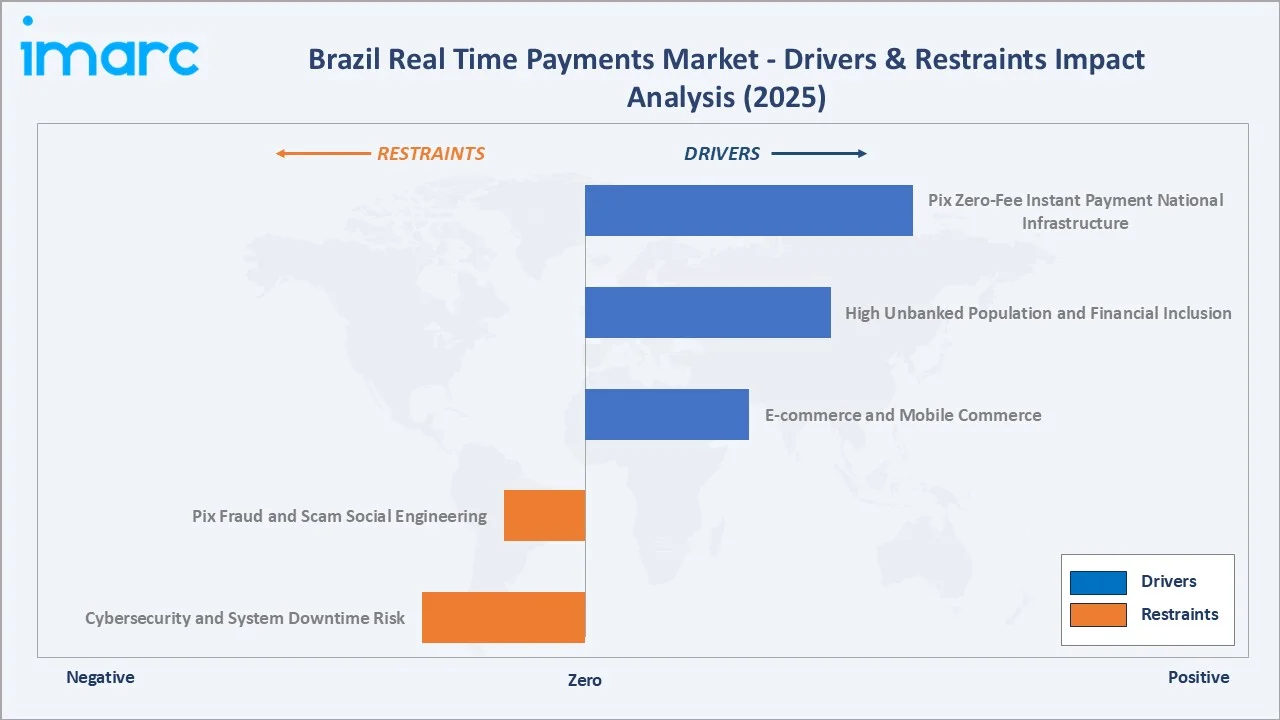
- Pix Zero-Fee Instant Payment National Infrastructure: Pix zero-fee instant payment national infrastructure makes fast, low-cost, and 24/7 transfers accessible to consumers, merchants, and businesses. Its account-to-account model reduces dependence on cash, cards, and traditional bank transfers while encouraging everyday digital payment usage. In Q1 2025, Pix transactions in Brazil remained largely P2P, accounting for 46% of total transactions, followed by P2B at 41% and B2P at 9%. Pix also reached a major milestone on April 6, 2024, processing 250.5 million transactions worth BRL 124.4 billion in a single day, showing how deeply it has become embedded in everyday financial activity across Brazil. As Pix becomes embedded in retail, e-commerce, bill payments, and P2P transfers, it continues to expand real-time payment volumes nationwide.
- High Unbanked Population and Financial Inclusion: Brazil has 213 million people, and 16% of the adult population is unbanked. High unbanked population and financial inclusion are expanding access to low-cost digital transactions for people outside traditional banking channels. Pix enables users to send and receive money instantly through mobile phones, reducing reliance on cash and branch-based banking. This supports wider participation in digital commerce, bill payments, government transfers, and peer-to-peer transactions. As more underserved consumers and small merchants adopt digital accounts, real-time payment volumes continue to rise across Brazil.
- E-commerce and Mobile Commerce: E-commerce and mobile commerce are increasing the demand for fast, secure, and seamless checkout experiences. Consumers increasingly prefer Pix, QR payments, and mobile-based transfers for online shopping, food delivery, travel bookings, and digital services. Real-time payments help merchants reduce payment delays, lower transaction costs, and improve cash flow. As smartphones, digital wallets, and online retail adoption expand, real-time payment volumes continue to grow across Brazil’s digital commerce ecosystem.
Market Restraints
- Pix Fraud and Scam Social Engineering: Pix fraud and scam social engineering are increasing concerns over unauthorized transfers, phishing, fake merchant requests, and impersonation scams. Because Pix transactions are instant and often irreversible, users and businesses may face higher financial risk when fraud occurs. These concerns can reduce consumer confidence and force banks, fintechs, and payment providers to invest heavily in fraud monitoring, transaction limits, authentication, and dispute-resolution systems. As scam tactics become more sophisticated, trust and security remain key challenges for broader real-time payment adoption.
- Cybersecurity and System Downtime Risk: Cybersecurity and system downtime risk raises concerns over transaction security, platform reliability, and service continuity. Since Pix and other instant payment systems operate 24/7, any outage, cyberattack, or processing delay can disrupt consumers, merchants, banks, and fintechs. These risks increase compliance, monitoring, backup infrastructure, and fraud-prevention costs for payment providers. Persistent reliability concerns may reduce user confidence and slow adoption among risk-sensitive businesses.
Market Opportunities
- Expansion of Pix for B2B and Merchant Payments: Expansion of Pix for B2B and merchant payments, moving Pix beyond P2P transfers into higher-value commercial transactions. Businesses can use instant account-to-account payments to reduce card processing costs, improve cash flow, and accelerate supplier or customer settlements. Merchants benefit from faster confirmation, QR-based checkout, and wider acceptance across online and offline channels. As regulated Pix participants and payment providers expand merchant solutions, B2B and retail payment volumes are expected to grow significantly.
- Expansion of Account-to-Account Payment Solutions: Expansion of account-to-account payment solutions enables direct transfers between bank accounts without relying on card networks. This reduces transaction costs, speeds up settlement, and improves cash flow for consumers, merchants, and businesses. In May 2026, Boku went live with Pix in Brazil, enabling global merchants to access one of the world’s largest real-time payments markets. After receiving a Payment Institution licence from Brazil’s Central Bank, Boku became a regulated Pix participant and can now support local payment acceptance. Through Boku, merchants can offer one-time account-to-account Pix payments via Brazil’s instant payments network, with both local and cross-border settlement options. As more fintechs and regulated Pix participants offer A2A solutions, adoption is expected to widen across retail and enterprise payment use cases.
Market Challenges
- Managing High Transaction Volumes and Platform Reliability: Managing high transaction volumes and platform reliability is challenging as Pix processes massive transaction loads across consumers, merchants, banks, fintechs, and businesses in real time. As usage expands into P2P, P2B, B2B, bill payments, and e-commerce, payment platforms must maintain speed, uptime, and secure settlement at scale. Any processing delay, failed transaction, or system outage can affect user trust and merchant operations. This requires continuous investment in cloud infrastructure, cybersecurity, backup systems, monitoring tools, and operational resilience.
- Ensuring User Trust in Instant and Irreversible Payments: Ensuring user trust in instant and irreversible payments is challenging as users have limited time to detect errors, scams, or unauthorized transfers once a transaction is completed. Instant settlement improves convenience but also increases concerns around fraud recovery, mistaken payments, and dispute handling. Banks and fintechs must strengthen authentication, transaction alerts, user education, and fraud detection to maintain confidence. Without strong trust and protection mechanisms, some consumers and businesses may remain cautious about using real-time payments for high-value transactions.
Emerging Market Trends
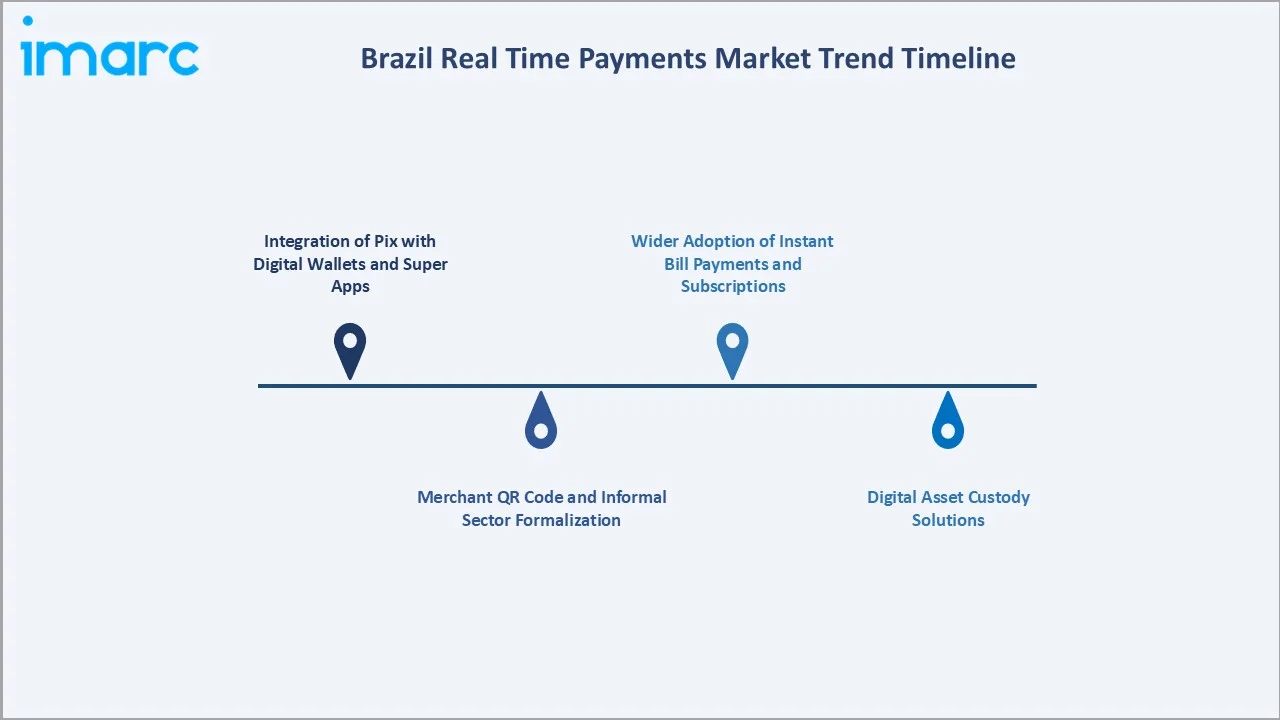
1. Integration of Pix with Digital Wallets and Super Apps
Integration of Pix with digital wallets and super apps is emerging as consumers increasingly prefer mobile-first, all-in-one financial platforms. Wallets and super apps can embed Pix for instant transfers, QR payments, bill payments, merchant checkout, and peer-to-peer transactions. This integration improves convenience, user engagement, and transaction frequency by keeping payments within familiar digital ecosystems. It also creates opportunities for fintechs, banks, retailers, and service platforms to offer value-added features such as loyalty, credit, fraud alerts, and personalized financial services.
2. Merchant QR Code and Informal Sector Formalization
Merchant QR codes and informal sector formalization are emerging as small retailers, street vendors, and microbusinesses increasingly accept Pix through simple QR codes. This enables low-cost digital payment acceptance without expensive card terminals or complex banking infrastructure. As informal merchants move toward digital receipts, traceable transactions, and faster settlements, they become more integrated into the formal financial ecosystem. This trend supports financial inclusion, SME digitization, tax transparency, and wider real-time payment adoption across Brazil.
3. Digital Asset Custody Solutions
Digital asset custody solutions are emerging as banks, fintechs, and institutions explore blockchain-based payment rails and tokenized financial assets. Secure custody infrastructure helps institutions safeguard digital assets while supporting compliant cross-border payments, treasury operations, and settlement services. In March 2026, Ripple announced a major expansion in Brazil, strengthening its role in institutional digital asset adoption across one of the region’s fastest-growing financial markets. With enhanced product capabilities and growing customer uptake, Ripple aims to serve institutions across cross-border payments, digital asset custody, prime brokerage, and treasury management. As Brazil strengthens virtual asset regulation, demand is rising for regulated custody platforms with strong security, auditability, and risk controls.
4. Wider Adoption of Instant Bill Payments and Subscriptions
Wider adoption of instant bill payments and subscriptions is emerging as consumers and businesses shift from delayed bank slips and card-based recurring payments to faster Pix-enabled transactions. Instant bill payments improve convenience, reduce payment confirmation time, and support better cash flow for utilities, telecoms, lenders, and digital service providers. Subscription platforms can use real-time payments for faster renewals, lower processing costs, and fewer failed payments. As Pix becomes embedded in recurring and invoice-based use cases, transaction volumes are expected to expand beyond everyday transfers.
Industry Value Chain Analysis
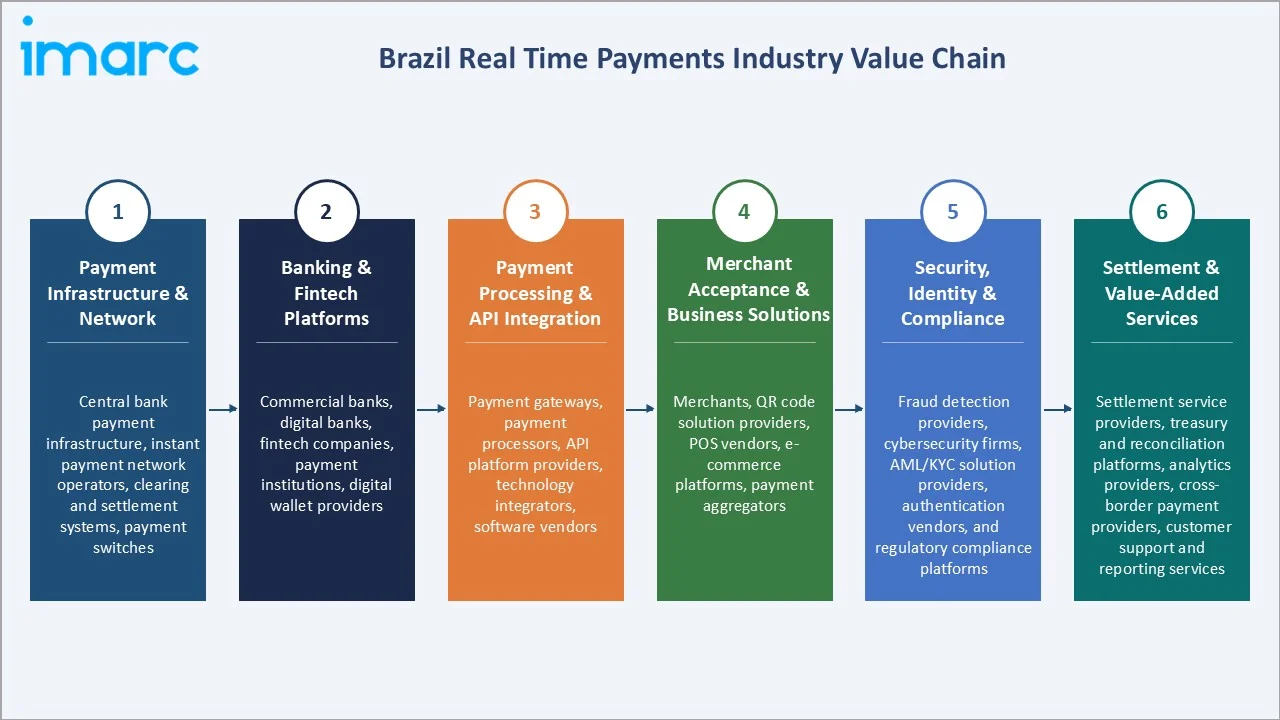
Brazil real time payments value chain integrates payment infrastructure & network, banking & fintech platforms, payment processing & API integration, merchant acceptance & business solutions, security, identity & compliance, and settlement & value-added services.
|
Stage |
Key Participants |
|
Payment Infrastructure & Network |
Central bank payment infrastructure, instant payment network operators, clearing and settlement systems, payment switches |
|
Banking & Fintech Platforms |
Commercial banks, digital banks, fintech companies, payment institutions, digital wallet providers |
|
Payment Processing & API Integration |
Payment gateways, payment processors, API platform providers, technology integrators, software vendors |
|
Merchant Acceptance & Business Solutions |
Merchants, QR code solution providers, POS vendors, e-commerce platforms, payment aggregators |
|
Security, Identity & Compliance |
Fraud detection providers, cybersecurity firms, AML/KYC solution providers, authentication vendors, and regulatory compliance platforms |
|
Settlement & Value-Added Services |
Settlement service providers, treasury and reconciliation platforms, analytics providers, cross-border payment providers, customer support and reporting services |
The banking & fintech platforms stage is the most value-added stage in the Brazil real-time payments value chain. It delivers core payment services such as transaction processing, account management, API integration, user experience, fraud prevention, and value-added financial products. Continuous innovation in Pix-enabled services, digital wallets, and merchant solutions enables providers to differentiate themselves and capture the highest value in the ecosystem.
Technology Landscape in the Brazil Real Time Payments Industry
Pix Infrastructure Technology
Pix infrastructure technology provides a national instant payment rail for 24/7 account-to-account transactions. It enables banks, fintechs, wallets, merchants, and payment institutions to process low-cost transfers, QR payments, bill payments, and merchant transactions in real time. The technology supports API connectivity, interoperability, instant settlement, and scalable transaction processing across Brazil’s financial ecosystem. As Pix usage expands, payment providers are investing in fraud analytics, cloud infrastructure, authentication, and merchant integration tools to enhance reliability and security.
Fraud Prevention and Security Technology
Fraud prevention and security technology protect instant Pix transactions from scams, phishing, account takeover, and unauthorized transfers. Advanced tools such as AI-based fraud detection, transaction monitoring, biometric authentication, device intelligence, and risk scoring help banks and fintechs identify suspicious activity in real time. These technologies improve user trust, reduce financial losses, and support safer adoption of Pix across P2P, merchant, B2B, and e-commerce payments.
Biometric Authentication Technology
Biometric authentication technology enables users to authorize Pix transactions through fingerprint or facial recognition instead of passwords. In February 2025, Belvo launched Biometric Pix in Brazil, enabling users to authorize Pix payments through fingerprint or device biometrics instead of passwords or banking app access. The solution improves payment speed, security, and convenience across retail, e-commerce, credit repayments, wallets, POS transactions, and digital platforms. It also reduces fraud risks and allows businesses to integrate biometric Pix through Belvo’s regulated infrastructure without heavy technology investment. This improves payment speed, strengthens security, and reduces fraud and unauthorized transactions across retail, e-commerce, mobile wallets, and POS terminals. As financial institutions and fintechs expand biometric Pix capabilities, secure and frictionless digital payment experiences are becoming a key competitive differentiator.
Market Segmentation Analysis
The report covers the following segments:
|
Segment Category |
Leading Segment |
Market Share |
Year |
|
Type of Payments |
P2P |
63.8% |
2025 |
|
Region |
Southeast |
44.7% |
2025 |

By Type of Payments
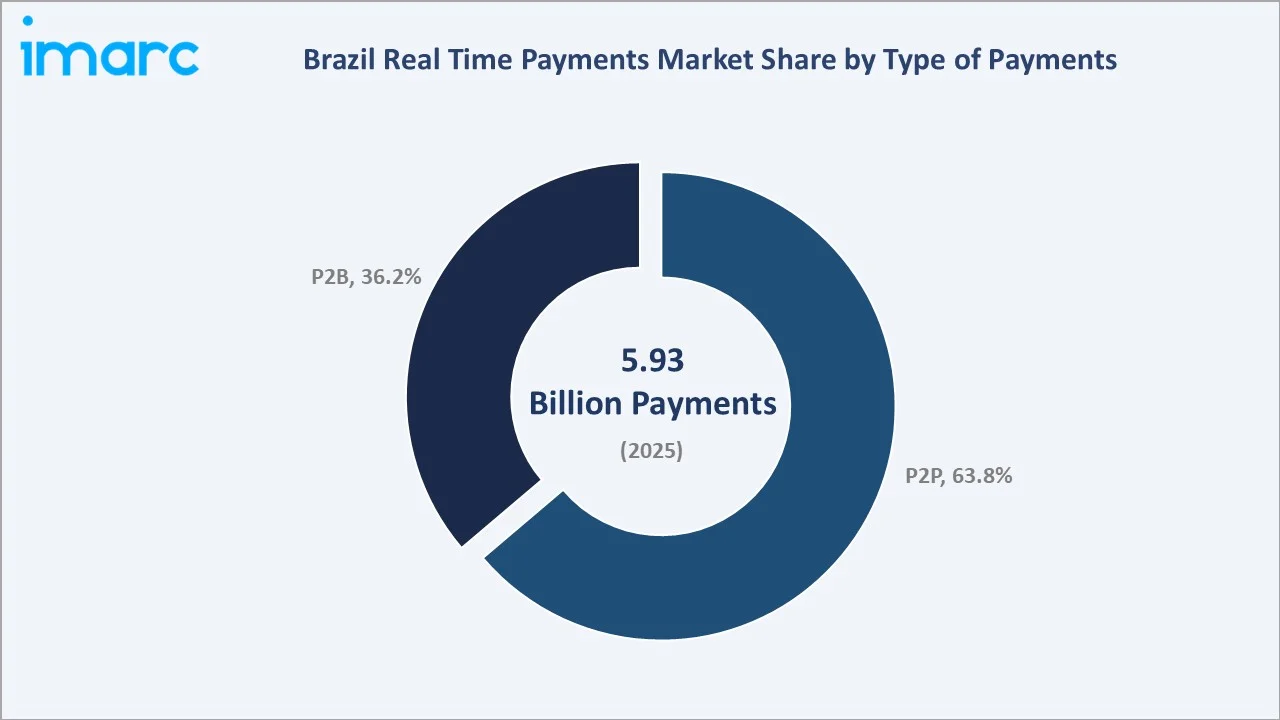
P2P leads at 63.8% (2025), through everyday person-to-person transfer, gig economy and informal worker income receipt, cash and TED/DOC legacy payment displacement, and remittance use cases.
To access detailed market analysis, Request Sample
P2B at 36.2% grows fastest at ~14.6% CAGR through merchant QR code acceptance, e-commerce checkout integration, Pix recurring subscription and utility billing, and informal sector formalization through low-cost merchant Pix QR acceptance.
Regional Market Insights
|
Region |
Share (2025) |
Key Brazil Real Time Payments Market Drivers & Characteristics |
|
Southeast |
44.7% |
Reflecting its large urban population, strong banking network, fintech concentration, e-commerce activity, and high merchant adoption of Pix-enabled payments. |
|
South |
21.8% |
Reflects strong digital banking usage, organized retail presence, SME payment adoption, and growing use of Pix for consumer, merchant, and business transactions. |
|
Northeast |
15.9% |
Reflects rising financial inclusion, expanding smartphone-based payments, Pix adoption among small merchants, and growing digital payment use in urban and semi-urban areas. |
|
Central-West |
9.4% |
Reflects increasing Pix use across agribusiness, services, trade, SMEs, and regional commerce, supported by improving banking and fintech access. |
|
North |
8.2% |
Reflects gradual adoption of mobile payments, Pix-based transfers, merchant QR payments, and digital financial services across remote and underserved communities. |
Southeast's 44.7% dominance is supported by its high concentration of population, financial institutions, fintech companies, merchants, and e-commerce activity. South's 21.8% follows with strong digital banking adoption and widespread use of Pix across retail and SMEs.
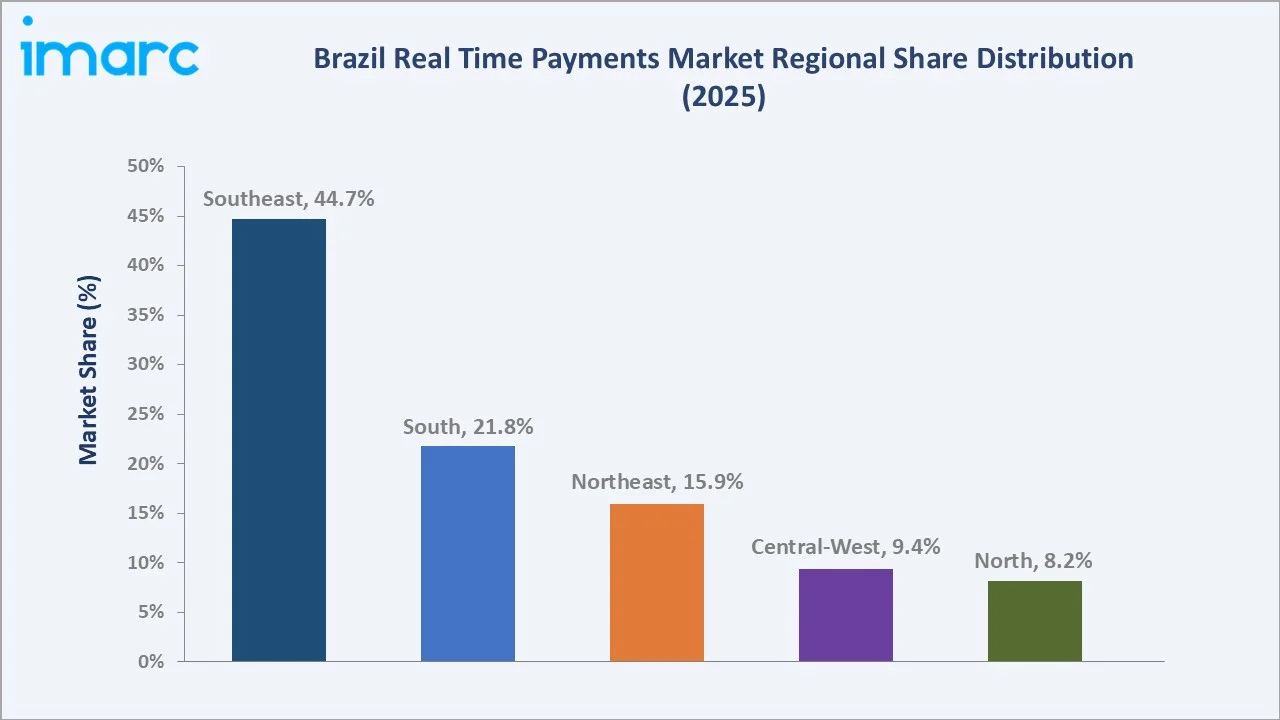
Northeast's 15.9% is witnessing rapid growth driven by financial inclusion and increasing smartphone penetration. Central-West's 9.4% benefits from expanding business transactions, agribusiness digitization, and growing merchant acceptance of instant payments. North's 8.2% steady increase in adoption through mobile banking, QR-code payments, and government-led digital financial inclusion initiatives, contributing to nationwide expansion of the real-time payments ecosystem.
Competitive Landscape
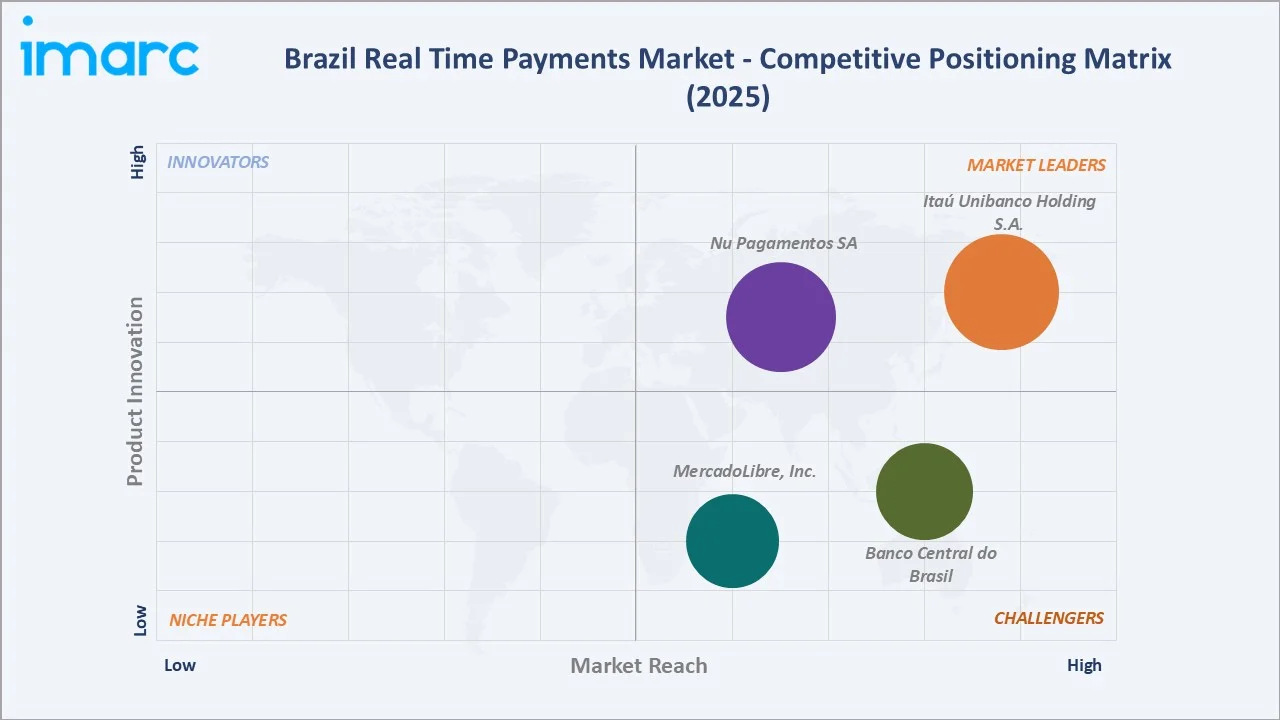
The Brazil real-time payments market is highly competitive, with banks, fintechs, payment institutions, gateways, and technology providers competing to expand Pix-enabled services. Key players focus on instant account-to-account payments, QR code acceptance, merchant solutions, digital wallets, biometric authentication, and fraud prevention. Large banks benefit from established customer bases and infrastructure, while fintechs drive innovation through faster onboarding and API-led payment products.
|
Company |
Key Offerings |
Market Position |
Core Strength |
|
Itaú Unibanco Holding S.A. |
Superapp |
Market Leader |
Itaú Unibanco Holding S.A. is a foundational pillar in Brazil's real-time payments ecosystem. As the largest private bank in Latin America, it drives massive transaction volumes through the Central Bank of Brazil’s PIX system, offering NFC proximity payments, embedded cross-border settlements, and advanced recurring payment capabilities for millions of users. |
|
Nu Pagamentos SA |
Nubank app |
Market Leader |
Nu Pagamentos SA, operating as Nubank, is the largest fintech bank in Latin America and a primary driver of Brazil's real-time payments revolution. By deeply integrating with the Central Bank's Pix system, Nubank made instant, 24/7 transfers accessible to Brazil's adult population. |
|
Banco Central do Brasil |
Instant Payment System |
Strong Challenger |
The Banco Central do Brasil acts as the architect, operator, and regulator of Brazil's real-time payments ecosystem. By launching the instant payment scheme Pix, the BCB transformed the country's financial infrastructure to promote total financial inclusion and modernize digital commerce. |
|
MercadoLibre, Inc. |
Mercado Pago |
Strong Challenger |
MercadoLibre, Inc., through its fintech arm Mercado Pago, serves as one of the principal architects and processors within Brazil’s real-time payments landscape. It operates as a vital financial intermediary, super-app, and key participant in the Central Bank of Brazil's instant payment network, Pix. |
Competition is increasing as regulated payment providers and global payment firms enter Brazil to support local and cross-border Pix transactions. Differentiation is mainly based on reliability, security, merchant integration, user experience, and value-added services such as reconciliation, analytics, and fraud monitoring.
Key Company Profiles
Itaú Unibanco Holding S.A.
Itaú Unibanco Holding S.A. is one of Brazil’s largest private financial institutions and a leading participant in the country’s real-time payments ecosystem. The bank offers comprehensive digital banking services, including Pix-based instant payments for retail, corporate, and merchant customers through its mobile banking platforms. Itaú has invested significantly in digital transformation, cloud technologies, API integration, artificial intelligence, and cybersecurity to enhance payment efficiency and customer experience.
- Key Offerings: Superapp.
- Recent Developments: In January 2026, Itaú Unibanco launched Tap-to-Pix directly within the Itaú Superapp, allowing customers to make Pix payments at card machines without scanning a QR code. Users can simply open the app, tap their phone, enter their password, and complete the transaction. The feature improves convenience and security for instant payments, expands Itaú’s Pix offering beyond Google Wallet, and supports Android users who prefer the bank’s own app.
- Strategic Focus: Centers on expanding Pix-enabled digital banking, merchant payment acceptance, and instant account-to-account services. The bank is strengthening mobile-first payment experiences, API connectivity, fraud prevention, and cybersecurity to support high transaction volumes and user trust.
Nu Pagamentos SA
Nu Pagamentos S.A., the payments arm of Nubank, is one of Brazil’s leading fintech companies and a major participant in the country’s real-time payments market. The company provides Pix-based instant payment services through its fully digital banking platform, serving millions of retail and small business customers. Its offerings include peer-to-peer transfers, merchant payments, QR code payments, bill payments, and account-to-account transactions integrated within its mobile application.
- Key Offerings: Nubank app.
- Recent Developments: In May 2025, Nubank launched tap-to-pay Pix, a new in-app feature that uses NFC technology to make in-person Pix payments faster and easier. The solution removes the need to scan QR codes, allowing customers with a registered Nubank Pix key to complete payments more conveniently through the app.
- Strategic Focus: Focuses on expanding Pix-enabled instant payments through its digital-first banking ecosystem. The company emphasizes mobile-based P2P transfers, merchant payments, QR code transactions, bill payments, and account-to-account payment services.
Market Concentration Analysis
The Brazil real-time payments market exhibits a moderately concentrated structure, with large banks, digital banks, fintechs, and regulated payment institutions competing alongside global payment technology providers. The widespread adoption of Pix has lowered entry barriers, enabling fintechs to rapidly gain market share through innovative digital payment solutions. Established banks continue to leverage their extensive customer bases, trusted brands, and integrated financial ecosystems to maintain strong positions. Competition is increasingly centered on payment speed, security, merchant acceptance, QR code solutions, biometric authentication, and value-added services. Continuous innovation, Open Finance initiatives, and supportive regulation are further intensifying competition and driving market expansion.
Investment & Growth Opportunities
Highest Growth Segments
P2B merchant Pix (~14.6% CAGR through QR code acceptance and e-commerce), Pix recurring (~18% CAGR from emerging base), Southeast e-commerce growing (~14% CAGR), South high-digital-adoption (~13.2% CAGR), Northeast financial inclusion (~15% CAGR), and Pix cross-border international (~20% CAGR from emerging base) represent Brazil real time payments highest-growth investment vectors through 2034.
Investment Themes
- Merchant QR code informal sector formalization: Investment in low-cost QR-based payment acceptance solutions can accelerate digital payments among micro-merchants and informal businesses, expanding financial inclusion while increasing transaction traceability and merchant onboarding.
- Pix cross-border international expansion: Growing interoperability between Pix and international payment networks creates opportunities to develop cross-border remittances, merchant payments, and global e-commerce solutions with faster settlement and lower transaction costs.
Future Market Outlook (2026-2034)
Brazil real time payments market is projected to grow from 5.93 Billion Payments in 2025 to 18.50 Billion Payments by 2034, delivering a 13.47% CAGR over the forecast period through Pix recurring payment mainstream adoption, merchant QR code informal sector formalization, open finance API-driven integration, and Pix installment payment expansion. The market's anchor value of 11.16 Billion Payments in 2030 represents Brazil real time payments at Pix mainstream and merchant formalization inflection.
Three structural forces are expected to shape the growth of Brazil’s real-time payments market through 2034. First, the continued expansion of the Pix ecosystem into merchant payments, recurring payments, NFC, and cross-border use cases will significantly increase transaction volumes. Second, rising financial inclusion, smartphone penetration, and digital banking adoption will accelerate real-time payment usage across consumers, SMEs, and underserved regions. Third, ongoing advances in open finance, API-driven payment infrastructure, cloud technologies, and AI-based fraud prevention will strengthen security, interoperability, and innovation, supporting long-term market expansion.
Research Methodology
Primary Research
Primary research comprised interviews with banks, fintechs, payment processors, merchants, digital wallet providers, and regulatory stakeholders. It also included discussions with SMEs and consumers to understand Pix usage, adoption barriers, fraud concerns, and payment preferences. These inputs helped validate market trends, regional demand, competitive positioning, and future growth opportunities.
Secondary Research
Secondary research encompassed central bank publications, Pix transaction data, fintech reports, company announcements, regulatory updates, and industry databases. It also included analysis of digital banking adoption, e-commerce growth, open finance developments, and payment technology trends. These sources supported market sizing, competitive benchmarking, and long-term growth forecasting.
Forecasting Models
Forecasting models combined historical Pix transaction volumes, digital payment adoption rates, macroeconomic indicators, smartphone penetration, and e-commerce growth trends to estimate future market performance. The analysis incorporated regulatory developments, Open Finance adoption, merchant digitization, and fintech innovation to refine projections. Scenario-based forecasting and trend analysis were used to assess market expansion through 2034 under varying adoption and technology assumptions.
Brazil Real Time Payments Market Report Coverage:
| Report Features | Details |
|---|---|
| Base Year of the Analysis | 2025 |
| Historical Period | 2020-2025 |
| Forecast Period | 2026-2034 |
| Units | Billion Payments |
| Scope of the Report | Exploration of Historical Trends and Market Outlook, Industry Catalysts and Challenges, Segment-Wise Historical and Future Market Assessment:
|
| Type of Payments Covered | P2P, P2B |
| Regions Covered | Southeast, South, Northeast, North, Central-West |
| Companies Covered | Itaú Unibanco Holding S.A., Nu Pagamentos SA, Banco Central do Brasil, MercadoLibre Inc., etc. |
| Customization Scope | 10% Free Customization |
| Post-Sale Analyst Support | 9-11 Weeks |
| Delivery Format | PDF and Excel through Email (We can also provide the editable version of the report in PPT/Word format on special request) |
Key Benefits for Stakeholders:
- IMARC’s industry report offers a comprehensive quantitative analysis of various market segments, historical and current market trends, market forecasts, and dynamics of the Brazil real time payments market from 2020-2034.
- The research report provides the latest information on the market drivers, challenges, and opportunities in the Brazil real time payments market.
- Porter's five forces analysis assist stakeholders in assessing the impact of new entrants, competitive rivalry, supplier power, buyer power, and the threat of substitution. It helps stakeholders to analyze the level of competition within the Brazil real time payments industry and its attractiveness.
- Competitive landscape allows stakeholders to understand their competitive environment and provides an insight into the current positions of key players in the market.
Frequently Asked Questions About the Brazil Real Time Payments Market Report
The Brazil real time payments market reached 5.93 Billion Payments in 2025, driven by the rapid adoption of Pix, rising digital banking usage, and growing demand for instant, low-cost account-to-account transactions. Expanding e-commerce, mobile wallets, merchant QR payments, financial inclusion initiatives, and fintech innovation are further accelerating real-time payment volumes across consumers, SMEs, and businesses.
The Brazil real time payments market grows at 13.47% CAGR during 2026-2034, reaching 18.50 Billion Payments by 2034. The CAGR reflects Pix zero-fee national infrastructure, financial inclusion, e-commerce growth, and open finance API integration.
P2P leads at 63.8% as Pix is widely used by individuals for instant money transfers, bill sharing, family payments, and everyday personal transactions. Its zero-cost, 24/7 availability and simple mobile-based usage make it the preferred real-time payment method for consumers across Brazil.
Southeast leads at 44.7% due to its strong concentration of population, banks, fintechs, merchants, and e-commerce activity. Higher digital banking penetration, retail density, and Pix adoption across São Paulo, Rio de Janeiro, and other urban centers support the region’s dominant position.
Leading companies include Itaú Unibanco Holding S.A., Nu Pagamentos SA, Banco Central do Brasil, and MercadoLibre, Inc., among others.
The market is projected to reach approximately 11.16 Billion Payments by 2030, supported by strong Pix adoption and expanding digital transaction use. Growth will be driven by rising P2P transfers, merchant QR payments, e-commerce transactions, and mobile banking penetration.
Three priority investment opportunities in Brazil's real-time payments market include expanding merchant payment acceptance, particularly QR code and NFC-based Pix solutions for SMEs and the informal economy. Investment in AI-driven fraud detection, biometric authentication, and cybersecurity offers strong potential as transaction volumes continue to rise. Another attractive area is cross-border Pix connectivity and open finance-enabled payment infrastructure, supporting international payments, embedded finance, digital wallets, and value-added payment services. These segments are expected to drive long-term growth and innovation through 2034.
Need more help?
- Speak to our experienced analysts for insights on the current market scenarios.
- Include additional segments and countries to customize the report as per your requirement.
- Gain an unparalleled competitive advantage in your domain by understanding how to utilize the report and positively impacting your operations and revenue.
- For further assistance, please connect with our analysts.
 Request Customization
 Speak to an Analyst
 Request Brochure
 Inquire Before Buying
Benefits of Customization
- Personalize this research
- Triangulate with your data
- Get data as per your format and definition
- Gain a deeper dive into a specific application, geography, customer, or competitor
- Any level of personalization
Get in Touch With Us
UNITED STATES
Phone: +1-201-971-6302
INDIA
Phone: +91-120-433-0800
UNITED KINGDOM
Phone: +44-753-714-6104
Email: [email protected]
Client Testimonials




.webp)




.webp)













Related Reports

Choose your plan
*Please note that the prices mentioned below are starting prices for each bundle type. Kindly contact our team for further details.*
Single User License
- 1 User License, Access on 2 Devices
- PDF Report + Excel Dataset (Password Protected)
- Lifetime Access
- No Printing Rights
- 10% Free Report Customization
- 10–12 Weeks of Analyst Support
Five User License
- Access for 5 Users, 2 Devices per User
- PDF Report + Excel Dataset (Password Protected)
- Lifetime Access
- Dedicated Account Manager
- 12–14 Weeks of Analyst Support
- No Printing Rights
- 15% Free Report Customization
- 25% Discount on Your Next Purchase
Corporate User License
- Unlimited User Access (Within Your Organization)
- PDF Report + Excel Dataset
- Lifetime Access
- Dedicated Account Manager
- 14–20 Weeks of Analyst Support
- No Printing Rights
- 20% Free Report Customization
- 30% Discount on Your Next Purchase
Essential Insights
What's included:
3 reports
- Lifetime Access
- PDF Reports
- Excel Datasets
- 2 Weeks of Free Analyst Support
- 2 User Licenses
- Access on 2 Devices
- Printing Rights
- Complimentary PowerPoint (PPT) Version
- Complimentary License Upgrade
Professional Access
What's included:
5 reports
- Lifetime Access
- PDF Reports
- Excel Datasets
- 8 Weeks of Free Analyst Support
- 2 User Licenses
- Access on 2 Devices
- Printing Rights
- Complimentary PowerPoint (PPT) Version
- Complimentary License Upgrade
Business Advantage
What's included:
8 reports
- Lifetime Access
- PDF Reports
- Excel Datasets
- 14 Weeks of Free Analyst Support
- 2 User Licenses
- Access on 2 Devices
- Printing Rights
- Complimentary PowerPoint (PPT) Version
- Complimentary License Upgrade
Enterprise Intelligence
What's included:
10 reports
- Lifetime Access
- PDF Reports
- Excel Datasets
- 20 Weeks of Free Analyst Support
- 2 User Licenses
- Access on 2 Devices
- Printing Rights
- Complimentary PowerPoint (PPT) Version
- Complimentary License Upgrade