
Europe Dairy Market Size, Share, Trends and Forecast by Product Type and Country, 2026-2034
Europe Dairy Market Summary:
The Europe dairy market size was valued at USD 2,60,481.45 Million in 2025 and is projected to reach USD 3,77,056.31 Million by 2034, growing at a compound annual growth rate of 4.20% from 2026-2034.
The Europe dairy market is one of the most developed and rapidly evolving categories in the global food industry, as it experiences high demand for healthy and diversified dairy products. The Europeans give high priority to healthy food products, leading to increased demand for protein-fortified yogurt, health-enhanced versions of milk, and functional dairy products. The Europe dairy market receives support from well-developed milk production infrastructure and advanced dairy farming systems in key milk-producing countries. Moreover, the food traditions in key nations of Europe are major drivers of consistent per-capita cheese consumption and the upgrading of traditional dairy foods.
Key Takeaways and Insights:
-
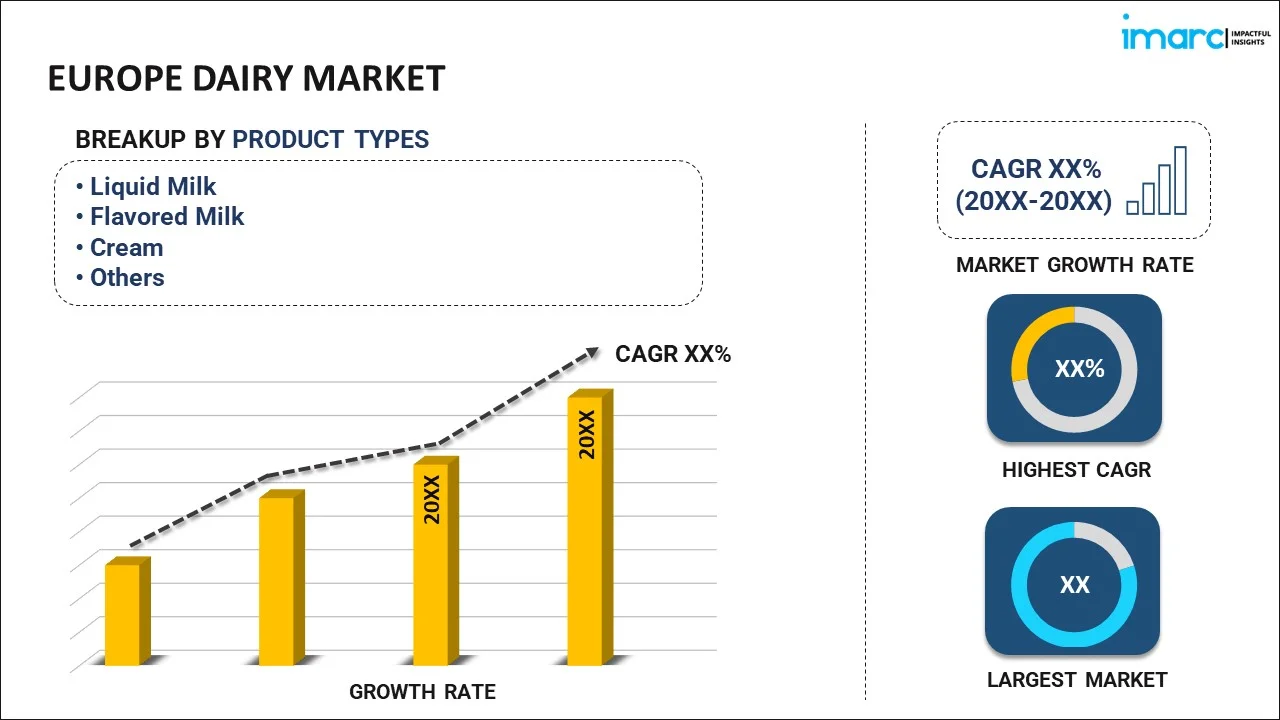
By Product Type: Liquid milk dominates the market with a share of 26% in 2025, driven by its fundamental role in European diets and extensive use across household, foodservice, and industrial applications.
-
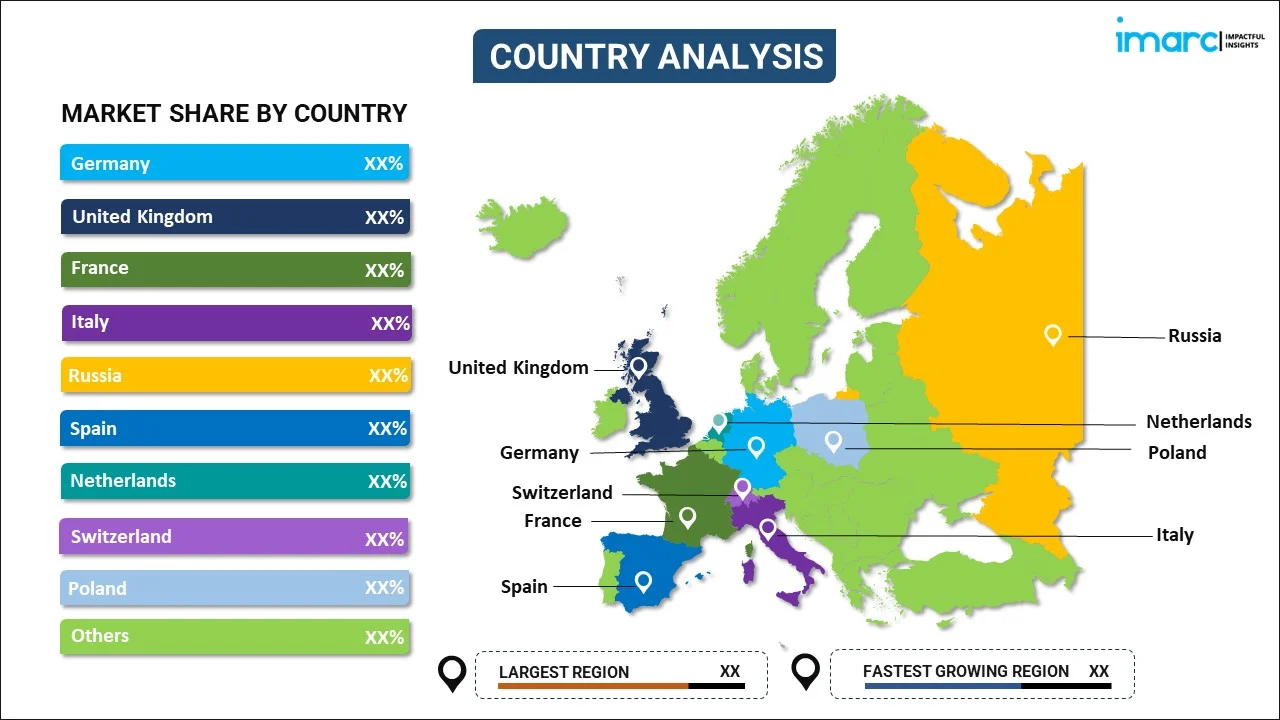
By Country: Germany leads the market with a share of 18% in 2025, supported by advanced dairy processing infrastructure and the country's position as Europe's largest milk producer.
-
Key Players: The Europe dairy market exhibits a fragmented competitive structure with multinational corporations and regional dairy cooperatives competing across various product categories. Leading players leverage scale, innovation capabilities, and established distribution networks to maintain market positions while focusing on sustainability initiatives and product diversification.
The European dairy market is a cornerstone of the region’s food industry, showcasing its culinary heritage and offering a wide range of products such as milk, cheese, butter, yogurt, and cream. Consumers across European nations recognize the nutritional significance of dairy products as essential sources of calcium, protein, vitamins, and minerals. The market caters to diverse tastes with each country contributing unique dairy specialties, showcasing cultural richness across the continent. In April 2025, leading cooperatives Arla Foods and Germany’s DMK Group announced plans to merge, aiming to form Europe’s largest dairy cooperative with over 12,000 farmer-owners and combined operations that would reshape the regional dairy landscape and boost competitiveness. The European dairy market is characterized by stringent quality regulations and standards, with companies investing heavily in sustainable farming practices and innovative product development to meet evolving consumer preferences.
Europe Dairy Market Trends:
Rising Demand for Functional and Fortified Dairy Products
European consumers are increasingly seeking dairy products with added health benefits, encouraging strong innovation in functional dairy formulations. Manufacturers are developing probiotic enriched yogurts, high protein milk beverages, and calcium fortified products aimed at athletes, elderly consumers, and health conscious buyers. In December 2025, Arla Foods Ingredients showcased new high protein concepts, including transparent yogurt and a whey based carbonated milk drink, at Fi Europe in Paris. Leading players are also expanding vitamin D enriched and gut friendly dairy portfolios.
Expansion of Lactose-Free Dairy Offerings
The lactose‑free dairy segment is rapidly expanding across Europe as awareness of lactose intolerance grows and diagnostic access improves. In 2024, Latvia’s Food Union expanded its Lakto brand with seven new lactose‑free yoghurts, including the ProBio line with no lactose and no added sugar, highlighting regional innovation and broader consumer appeal. Once a niche medical product, lactose‑free dairy is now mainstream, with retailers allocating prominent shelf space and processors investing in advanced lactase technologies for taste and performance parity with regular milk.
Emphasis on Sustainability and Carbon Footprint Reduction
Sustainability has become a key competitive factor in Europe’s dairy industry, with manufacturers adopting carbon footprint labeling and transparent supply chains. Cooperatives are investing in precision agriculture, renewable energy, and advanced manure management to reduce environmental impact. In 2025, Swiss producer Emmi validated its science‑based CO₂e reduction targets as part of its net‑zero strategy, strengthening commitments to lower emissions and promote circular packaging. Leading dairy companies are also introducing carbon‑neutral products, regenerative farming partnerships, and sustainable packaging to meet growing eco-conscious consumer demand.
Market Outlook 2026-2034:
The European dairy market is anticipated to see stable growth in the forecast period, owing to increasing health awareness, growing consumer preference for value-added and functional dairy products, and continued expansion of modern retail and e-commerce distribution channels. Product innovations aimed at value addition in nutrition, like protein-fortified, lactose-free, and fortified dairy products, are enhancing consumer connect across demographics and thereby helping to maintain demand on a sustained basis. The market generated a revenue of USD 2,60,481.45 Million in 2025 and is projected to reach a revenue of USD 3,77,056.31 Million by 2034, growing at a compound annual growth rate of 4.20% from 2026-2034.
Europe Dairy Market Report Segmentation:
|
Segment Category |
Leading Segment |
Market Share |
|
Product Type |
Liquid Milk |
26% |
|
Country |
Germany |
18% |
Product Type Insights:
To get more information on this market, Request Sample
- Liquid Milk
- Flavored Milk
- Cream
- Butter
- Cheese
- Yoghurt
- Ice Cream
- Anhydrous Milk Fat (AMF)
- Skimmed Milk Powder (SMP)
- Whole Milk Powder (WMP)
- Whey Protein
- Lactose Powder
- Curd
- Paneer
The liquid milk dominates with a market share of 26% of the total Europe dairy market in 2025.
Liquid milk maintains its position as the foundational dairy product across European markets, serving as an essential nutritional source for households and a critical input for foodservice and industrial applications. The segment benefits from established distribution networks delivering fresh and UHT milk varieties to consumers through supermarkets, convenience stores, and direct delivery channels. German and French dairy processors lead regional liquid milk production, with major agricultural regions collectively supplying substantial volumes to European dairy companies throughout the year.
Consumer preferences within the liquid milk segment are evolving toward premium and value-added offerings including organic milk, fortified variants, and lactose-free options. The integration of advanced processing technologies enables manufacturers to extend shelf life while preserving nutritional quality, supporting expanded distribution reach. In 2025, Indian dairy cooperative Amul partnered with Spain’s Cooperativa Ganadera del Valle de los Pedroches (COVAP) to launch Amul fresh milk in Madrid and Barcelona, marking a strategic entry into European liquid milk markets and underscoring how regional and global players are expanding distribution beyond traditional local producers.
Country Insights:
To get detailed regional analysis of this market, Request Sample
- Germany
- United Kingdom
- France
- Italy
- Russia
- Spain
- Netherlands
- Switzerland
- Poland
- Others
Germany exhibits a clear dominance with a 18% share of the total Europe dairy market in 2025.
Germany is the leading dairy-producing country in Europe because of highly developed dairy farming infrastructure as well as high quality standards, meeting EU norms. The German dairy industry has excellent processing capacity and established distribution chains to cater to other European union countries, among others. The demand for functional dairy foods such as high-protein yogurt and low-lactose variants, among others, in the German market encourages innovation among domestic dairy food manufacturers to match developing health and wellness trends.
The German dairy market is known for huge investments in sustainability programs and technical upgradation in farming and processing operations. Organic dairy farming in Germany has shown huge growth in the past years due to consumer demands for sustainable production methods. The major dairy cooperatives in Germany are now concentrating on higher margin businesses in cheese and foodservice markets and are establishing new aging warehouse capacity and production capacities to cater to the growing consumer demand for high-protein dairy products.
Market Dynamics:
Growth Drivers:
Why is the Europe Dairy Market Growing?
Rising Health Consciousness and Demand for Nutritious Dairy Products
European consumers are increasingly focusing on health and nutrition, driving strong demand for dairy products rich in protein, calcium, and vitamins. Dairy remains a key source of high‑quality protein, supporting muscle maintenance and bone density, while fermented products like probiotic yogurts and kefir are gaining popularity due to gut health benefits. In September 2025, John Deere and DeLaval expanded the Milk Sustainability Center across Europe, partnering with dsm‑firmenich to help farmers optimize milk production, improve nutrient efficiency, and reduce environmental impact through integrated data solutions. Manufacturers are responding with fortified and functional dairy items, including calcium‑enriched milk, protein‑packed yogurts, and vitamin‑enhanced products, catering to health‑conscious and immune‑focused consumers across the region.
Strong Dairy Heritage and Culinary Integration Across European Cuisines
Dairy products are central to European culinary traditions, with cheese, butter, and cream forming key ingredients in Italian, French, German, and British cuisines. The region produces hundreds of unique cheese varieties protected by geographical indications, ensuring quality and authenticity that command premium prices domestically and abroad. According to reports, PMF Distribution launched its MILKORA flavored milk range in Europe, including vanilla, strawberry, banana, and chocolate made from 100% fresh milk under EU standards, while announcing upcoming whole and semi‑skimmed options, expanding consumer choice within classic dairy categories. Cultural integration and premiumization trends sustain demand and support value growth through artisanal and specialty products, with France leading as a benchmark for quality.
Expansion of E-commerce and Modern Retail Distribution Channels
The digitalization of grocery retail and growth of e-commerce platforms are reshaping dairy distribution across Europe, opening new opportunities for consumer engagement. Valued at USD 3.96 Trillion in 2024, the European e-commerce market is projected to reach USD 8.46 Trillion by 2033, underscoring long-term growth potential for online dairy sales. Subscription-based models for fresh milk and yogurt are driving repeat orders, while major retailers offer both branded and private label products. Specialty dairy brands leverage direct-to-consumer channels to target health-conscious shoppers. Convenience stores also boost dairy sales through extended hours and strategic locations. Leading processors are investing in digital traceability systems to enhance supply chain transparency and strengthen consumer confidence in product quality and sourcing.
Market Restraints:
What Challenges the Europe Dairy Market is Facing?
Competition from Plant-Based Dairy Alternatives
The rising popularity of plant-based dairy alternatives presents competitive pressure on traditional dairy products, particularly among flexitarian consumers seeking dietary diversity. Sales of plant-based dairy products continue growing despite overall food inflation, with oat and pea protein formulations achieving improved taste and texture characteristics. Major retailers dedicate prominent shelf space to these alternatives, intensifying competition for consumer attention and purchase consideration.
Declining Farm Numbers and Agricultural Labor Shortages
The European dairy industry faces structural challenges from declining farm numbers and limited succession planning among aging farmer populations. Dairy farm consolidation continues across the region as smaller operations exit the industry due to economic pressures and labor availability constraints. These supply-side limitations may constrain production growth and increase procurement costs for dairy processors seeking consistent milk supplies.
Rising Production Costs and Economic Pressures
Inflationary pressures on feed costs, energy prices, and labor expenses challenge dairy producer profitability and constrain investment capacity. Economic uncertainties impact consumer purchasing power, potentially shifting demand toward more affordable dairy options and private label products. Manufacturing cost increases may compress margins unless producers successfully implement operational efficiencies and pass through selective price adjustments to maintain financial sustainability.
Competitive Landscape:
The Europe dairy market exhibits a fragmented competitive structure with multinational corporations competing alongside regional dairy cooperatives and specialty producers across diverse product categories. Large players including Lactalis and Danone leverage scale, innovation capabilities, and regulatory expertise to dominate retail and clinical nutrition segments, while regional dairies thrive on protected origin status and local consumer loyalty. Competition is shaped by stringent EU food safety, nutrition labeling, and geographical indication frameworks that create entry barriers while rewarding authenticity and compliance. Sustainability has emerged as a critical competitive factor, with carbon footprint transparency and circular packaging now representing consumer expectations rather than differentiators. Companies are actively pursuing product innovation strategies, particularly in developing health-conscious, lactose-free, and high-protein dairy products to address evolving consumer preferences.
Recent Developments:
-
In December 2025, Belgium-based precision fermentation startup Those Vegan Cowboys raised €6.25 million to scale production of cow-free casein and prepare for a crowdfunding campaign ahead of wider commercialization. The funding supports development of animal-free cheese ingredients, reinforcing Europe’s growing momentum in alternative dairy innovation.
-
In September 2025, AB Akola Group to invest €4.8 million in expanding its Sidabravo and Žibartonių dairy farms, installing advanced milking equipment and boosting infrastructure to increase herd size and milk output by about one-third, strengthening its dairy production capacity.
Europe Dairy Market Report Scope:
| Report Features | Details |
|---|---|
| Base Year of the Analysis | 2025 |
| Historical Period | 2020-2025 |
| Forecast Period | 2026-2034 |
| Units | Billion USD |
| Scope of the Report |
Exploration of Historical Trends and Market Outlook, Industry Catalysts and Challenges, Segment-Wise Historical and Future Market Assessment:
|
| Product Types Covered | Liquid Milk, Flavored Milk, Cream, Butter, Cheese, Yoghurt, Ice Cream, Anhydrous Milk Fat (AMF), Skimmed Milk Powder (SMP), Whole Milk Powder (WMP), Whey Protein, Lactose Powder, Curd, Paneer |
| Countries Covered | Germany, United Kingdom, France, Italy, Russia, Spain, Netherlands, Switzerland, Poland, Others |
| Customization Scope | 10% Free Customization |
| Post-Sale Analyst Support | 10-12 Weeks |
| Delivery Format | PDF and Excel through Email (We can also provide the editable version of the report in PPT/Word format on special request) |
Key Questions Answered in This Report
The Europe dairy market size was valued at USD 2,60,481.45 Million in 2025.
The Europe dairy market is expected to grow at a compound annual growth rate of 4.20% from 2026-2034 to reach USD 3,77,056.31 Million by 2034.
Liquid milk dominated the Europe dairy market with 26% market share, driven by its fundamental role in European diets and extensive applications across household, foodservice, and industrial channels throughout the region.
Key factors driving the Europe dairy market include rising health consciousness and demand for nutritious dairy products, strong dairy heritage integrated across European cuisines, expansion of e-commerce distribution channels, and growing consumer preference for functional and fortified dairy offerings.
Major challenges include competition from plant-based dairy alternatives, declining farm numbers and agricultural labor shortages, rising production costs driven by inflation in feed and energy prices, and regulatory compliance requirements across diverse European markets.
Need more help?
- Speak to our experienced analysts for insights on the current market scenarios.
- Include additional segments and countries to customize the report as per your requirement.
- Gain an unparalleled competitive advantage in your domain by understanding how to utilize the report and positively impacting your operations and revenue.
- For further assistance, please connect with our analysts.
 Request Customization
 Speak to an Analyst
 Request Brochure
 Inquire Before Buying
Benefits of Customization
- Personalize this research
- Triangulate with your data
- Get data as per your format and definition
- Gain a deeper dive into a specific application, geography, customer, or competitor
- Any level of personalization
Get in Touch With Us
UNITED STATES
Phone: +1-201-971-6302
INDIA
Phone: +91-120-433-0800
UNITED KINGDOM
Phone: +44-753-714-6104
Email: sales@imarcgroup.com
Client Testimonials




.webp)




.webp)












