
Europe Fintech Market Size, Share, Trends and Forecast by Deployment Mode, Technology, Application, End User, and Country, 2026-2034
Europe Fintech Market Summary:
The Europe fintech market size increased from USD 113.42 Billion in 2025 to USD 132.56 Billion in 2026 and is projected to reach USD 461.57 Billion by 2034, growing at a compound annual growth rate of 16.88% from 2026-2034.
The European fintech industry is registering strong growth due to the increasing adoption of digital technology, a congenial environment created by the governments for the growth of fintech companies, and the increasing acceptance by consumers for innovative financial services. The European market has a high adoption of smartphones, increasing e-commerce, and the emergence and growth of open banking systems that enable the easy sharing of data between the finance industry and tech companies. Consumers in the European market are accepting innovative financial services offered by fintech companies.
Key Takeaways and Insights:
- By Deployment Mode: On-premises dominates the market with a share of 35.09% in 2025, driven by enterprise demand for enhanced data security, regulatory compliance requirements, and greater control over sensitive financial information within banking institutions.
- By Technology: Application programming interface leads the market with a share of 25.12% in 2025, fueled by open banking mandates, seamless third-party integrations, and the growing need for interoperable financial ecosystems across European markets.
- By Application: Payment and fund transfer dominates the market with a share of 45.08% in 2025, attributed to surging digital transaction volumes, widespread adoption of contactless payments, and increasing cross-border remittance activities.
- By End User: Banking leads the market with a share of 50.1% share in 2025, owing to accelerated digital transformation initiatives, rising investments in technology infrastructure, and growing competition from challenger banks.
- By Country: Germany dominates the market with a share of 21% in 2025, supported by advanced digital banking infrastructure, high consumer adoption, strong regulatory clarity, and a well-funded fintech startup ecosystem.
- Key Players: The Europe fintech market exhibits a moderately fragmented competitive landscape, characterized by the presence of established technology giants, innovative startups, and traditional financial institutions actively pursuing digital transformation strategies to capture evolving consumer preferences and maintain market positioning.
The European fintech ecosystem is maturing as digital innovation reshapes financial services. Regulatory frameworks like the Payment Services Directive (PSD2) and open banking requirements have created a supportive environment, enabling better integration between traditional banks and new technology solutions. The rise of mobile-first banking, peer-to-peer lending, and digital wealth management reflects growing consumer demand for convenience, transparency, and personalization. In H1 2025, European fintech funding reached €5.2 billion, highlighting strong investor confidence and the sector’s rapid growth. Strategic collaborations between established firms and startups, alongside specialized fintech hubs in major cities, are strengthening the ecosystem and supporting sustainable expansion. These trends indicate that Europe’s fintech landscape is not only expanding in size but evolving in sophistication, bridging traditional finance with innovative digital solutions.
Europe Fintech Market Trends:
Rising Adoption of Embedded Finance Solutions
European businesses are increasingly embedding financial services directly into their platforms through embedded finance solutions. UK‑based provider Pleo launched “Pleo Embedded” in 2025, allowing partners to offer real‑time spend and cash management within business applications, reducing development complexity. This trend enables non‑financial companies to integrate banking, lending, insurance, and payment services seamlessly into customer journeys. The rise of banking‑as‑a‑service platforms and modular financial infrastructure helps retailers, tech firms, and service providers boost engagement and generate additional revenue through integrated financial offerings.
Expansion of Real-Time Payment Infrastructure
The rollout of instant payment regulations and pan‑European payment networks is transforming transaction processing. EBA Clearing’s RT1 system launched its OCT Instant Credit Transfer service in November 2024, allowing payment providers to process cross‑border instant euro transfers, extending real‑time payments beyond domestic systems. Financial institutions are upgrading infrastructure to support immediate fund transfers between accounts, meeting rising merchant and consumer demand for instant transactions. These advancements reduce liquidity constraints and operational complexities associated with traditional batch processing while strengthening the efficiency and reach of Europe’s payments ecosystem (ebaclearing.eu).
Integration of Artificial Intelligence in Financial Services
European fintech firms are increasingly adopting artificial intelligence and machine learning to boost efficiency, enhance risk management, and deliver personalized services. In 2025, Spanish AI‑focused fintech Dost raised €6.7 million to expand its generative AI platform, automating financial document processing for enterprise clients, tripling productivity, and cutting administrative costs. AI applications include fraud detection, credit scoring, automated customer service, and intelligent financial advisory. By leveraging AI, fintechs can analyze large datasets, detect patterns, make faster decisions, reduce operational costs, and improve service quality across multiple financial operations.
.webp)
Market Outlook 2026-2034:
The Europe fintech market is positioned for sustained expansion throughout the forecast period, driven by continued digital transformation across the financial services sector and evolving regulatory frameworks that encourage innovation while ensuring consumer protection. The convergence of technological advancements, changing consumer preferences, and supportive policy environments creates favorable conditions for market participants to develop and deploy innovative solutions. Strategic collaborations between traditional financial institutions and fintech innovators are expected to accelerate product development cycles and expand service offerings. The market generated a revenue of USD 113.42 Billion in 2025, which is expected to reach USD 132.56 Billion in 2026 and further grow to USD 461.57 Billion by 2034, at a compound annual growth rate of 16.88% from 2026-2034.
Europe Fintech Market Report Segmentation:
|
Segment Category |
Leading Segment |
Market Share |
|
Deployment Mode |
On-premises |
35.09% |
|
Technology |
Application Programming Interface |
25.12% |
|
Application |
Payment and Fund Transfer |
45.08% |
|
End User |
Banking |
50.1% |
|
Country |
Germany |
21% |
Deployment Mode Insights:
To get detailed analysis of this market, Request Sample
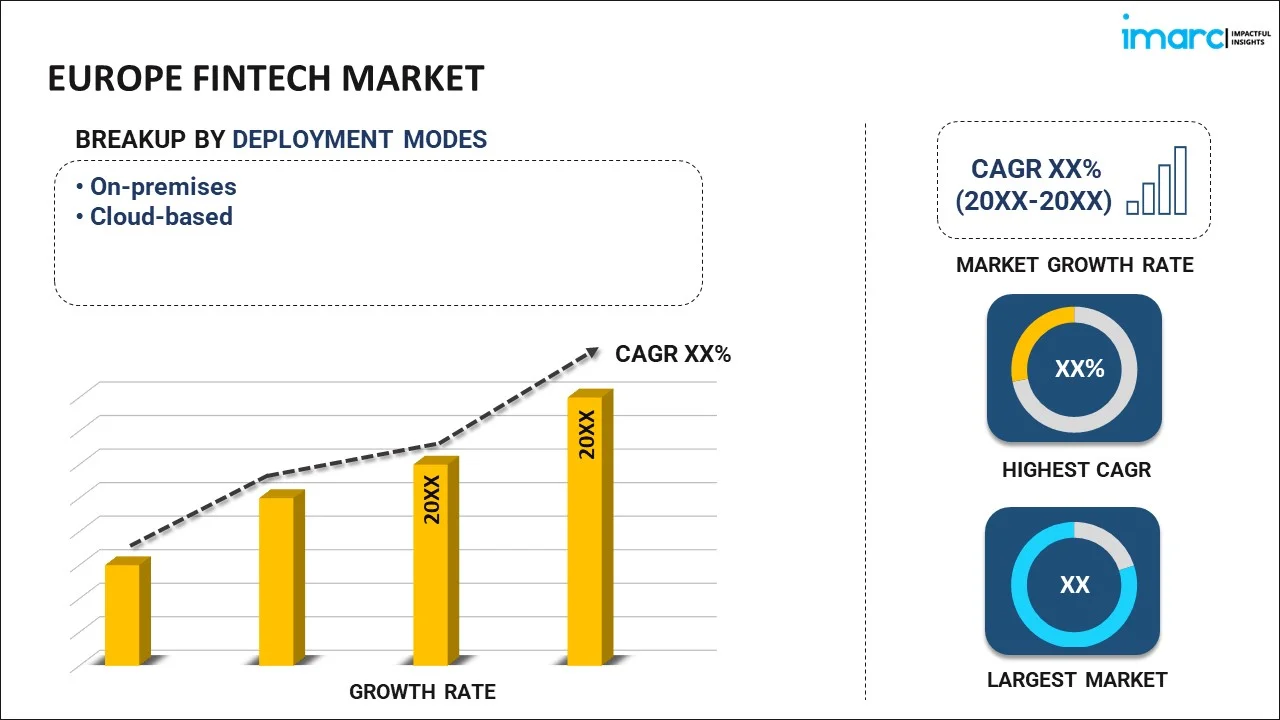
- On-premises
- Cloud-based
The on-premises dominates with a market share of 35.09% of the total Europe fintech market in 2025.
On‑premises deployment remains popular among European financial institutions that prioritize data sovereignty, regulatory compliance, and security. In 2025, 54% of European IT decision‑makers ranked data sovereignty above performance, and 31% chose on‑premises solutions to retain control over infrastructure, updates, and deployment. Banks and insurers favor this model to meet strict data protection regulations, customize solutions for operational needs, and ensure sensitive financial data stays within their controlled environments.
Financial institutions that use on-premises solutions are assured of lower dependence on third-party service providers and improved integration capabilities to support existing legacy systems. The deployment model also supports complex processing of transactions to ensure audit trails that are critical in reporting. Financial institutions that deal with high net-worth individuals as well as corporate clients also favor on-premises deployment models in response to increased expectations in relation to security.
Technology Insights:
- Application Programming Interface
- Artificial Intelligence
- Blockchain
- Robotic Process Automation
- Data Analytics
- Others
The application programming interface leads with a share of 25.12% of the total Europe fintech market in 2025.
Application programming interfaces can be considered as a technology enabler that facilitates seamless connectivity among different financial systems, applications, and providers across the European fintech landscape. The open banking regulatory framework has promoted application programming interface usage as it requires secure data-sharing practices among financial entities and third-party providers. This technology allows fintech businesses to access financial information from their clientele with due consent for developing new financial services such as account aggregation, payment initiation services, and customized financial management.
In addition to driving service innovation, APIs enhance operational efficiency by automating processes such as transaction verification, fraud detection, and real-time payment processing. They also enable collaboration between traditional banks and fintech startups, fostering a more competitive and inclusive financial ecosystem. By leveraging APIs, European fintech companies can quickly scale their offerings, integrate advanced analytics, and deliver personalized customer experiences, ultimately strengthening user trust and expanding market reach.
Application Insights:
- Payment and Fund Transfer
- Loans
- Insurance and Personal Finance
- Wealth Management
- Others
The payment and fund transfer dominates with a market share of 45.08% of the total Europe fintech market in 2025.
Payment and fund transfer applications are the largest segment in the European fintech market, fueled by growing consumer adoption of digital payments and merchant acceptance of electronic transactions. In 2024, digital payments made up over 60% of all online transactions in Europe, reflecting a clear shift toward cashless and instant methods. The rise of mobile wallets, contactless payments, and peer‑to‑peer platforms is changing how individuals and businesses transact, offering greater convenience, speed, and security compared to cash.
These solutions have gained significant traction, with businesses expanding their operations across European markets and consumers engaging in cross-border e-commerce activities. Fintech providers are well-positioned to help address traditional pain points associated with international transfers: high fees, slow processing times, and a lack of transparency. Instant payment infrastructure and harmonized regulatory frameworks across most European markets further facilitate the growth of digital payment adoption among retail and commercial customers.
End User Insights:
- Banking
- Insurance
- Securities
- Others
The banking leads with a share of 50.1% of the total Europe fintech market in 2025.
Banking is the dominant end-user segment of the European fintech market, with financial institutions accelerating digital transformation initiatives in response to evolving customer expectations and competitive pressures. Traditional banks are making significant investments in modernizing their technology infrastructures, developing digital channels, and entering into partnership strategies with fintech providers as part of efforts to raise service offerings and operational efficiencies. With the emergence of digital-only challenger banks, competition has mounted, and incumbent institutions have been driven toward rapid innovation throughout both customer-facing and back-office operations.
Banking organizations utilize fintech services in a variety of operational functions such as customer registration, payment services, loan management, and fraud control. This adoption and integration of technology allow banking organizations to personalize customer services and make informed decisions with reduced operational expenditures. Also, being compliant with regulations regarding increased use of technology and customer safeguarding practices continues to fuel technology adoption trends across European banking businesses.
Country Insights:
- Germany
- France
- United Kingdom
- Italy
- Spain
- Others
Germany exhibits a clear dominance with a 21% share of the total Europe fintech market in 2025.
Germany retains its number one position in the fintech ecosystem in Europe, thanks to its strong economic base, developed banking sector, and successful tech startup community. There are a number of fintech hotspots and innovation labs in Germany that attract budding entrepreneurs and talent from all over Europe and the world. The fintech industry in Germany has made considerable progress in areas such as digital banking, payments, and investment solutions for both domestic and foreign clients.
The fintech industry in Germany flourishes in an enabling regulatory framework that promotes innovation while protecting the consumer. The presence of robust venture capital investment, corporate ventures, and strategic alliances between traditional financial sector players and innovators in the technological field ensures the expansion of the fintech industry at a faster pace. Furthermore, the high level of digital literacy of the consumer base also favors the development of the fintech industry.
Market Dynamics:
Growth Drivers:
Why is the Europe Fintech Market Growing?
Accelerating Digital Transformation Across Financial Services
European financial institutions are pursuing extensive digital transformation to modernize how financial services are delivered and managed. Banks and insurers are upgrading legacy systems, enhancing digital channels, and adopting innovative technologies to stay competitive. In 2025, UniCredit partnered with Google Cloud for ten years to advance its digital transformation across 13 European markets, leveraging cloud, AI, and data analytics to boost agility and customer experience. This transformation spans customer applications, operations, and organizational structures, driven by evolving customer expectations, competition from digital-native providers, and the need for operational efficiency.
Supportive Regulatory Environment and Open Banking Initiatives
The European regulatory environment has evolved to foster fintech innovation while ensuring consumer protection and market stability. Frameworks such as the Payment Services Directive and open banking requirements enable secure data sharing, competition, and new market entry. In December 2025, the EU Council supported a digital euro with online and offline functionality, modernizing payments and enhancing sovereign digital options. Regulatory sandboxes and innovation hubs allow fintechs to test products safely, lowering entry barriers. Harmonized regulations across Europe help companies scale efficiently, expand markets, and accelerate growth for successful innovators.
Growing Consumer Preference for Digital Financial Services
European consumers are increasingly favoring digital financial services that provide convenience, accessibility, and superior user experiences compared to traditional banking. Widespread smartphone adoption improved digital infrastructure, and growing comfort with online transactions have boosted adoption across diverse demographics. In 2025, surveys indicated that around 45% of Europeans would likely use a digital euro for everyday payments, with interest highest among 18–34‑year‑olds. Younger consumers embrace mobile‑first apps for transactions, savings, investments, and insurance, driving long‑term growth. Providers offering intuitive, personalized, and seamless experiences strengthen customer loyalty and expand market presence in Europe’s fintech ecosystem.
Market Restraints:
What Challenges the Europe Fintech Market is Facing?
Regulatory Complexity and Compliance Burden
While European regulations generally support fintech innovation, the complexity of navigating diverse regulatory requirements across multiple jurisdictions creates challenges for market participants. Financial service providers must comply with overlapping national and supranational regulations covering data protection, anti-money laundering, consumer protection, and operational resilience. The administrative and financial burden of maintaining compliance across multiple regulatory frameworks can strain resources of smaller fintech companies and potentially slow innovation cycles.
Cybersecurity Threats and Data Privacy Concerns
The increasing digitalization of financial services exposes institutions and consumers to heightened cybersecurity risks including data breaches, fraudulent activities, and system vulnerabilities. Financial service providers must continuously invest in security infrastructure, monitoring capabilities, and incident response preparedness to protect sensitive customer information and maintain trust. Consumer concerns about data privacy and security can create hesitancy in adopting new digital financial services, potentially limiting market expansion.
Legacy System Integration Challenges
Established financial institutions often face significant challenges integrating modern fintech solutions with existing legacy technology infrastructure. Aging core banking systems may lack the flexibility, processing capabilities, or integration interfaces required to support innovative digital services effectively. The complexity and cost of technology modernization projects can delay digital transformation initiatives and limit the ability of incumbent institutions to respond quickly to competitive threats from digital-native providers.
Competitive Landscape:
The Europe fintech market exhibits a dynamic competitive landscape characterized by diverse participant categories including established technology companies, innovative startups, and traditional financial institutions pursuing digital strategies. Market participants compete across multiple dimensions including technological capabilities, user experience quality, product breadth, geographic reach, and brand recognition. Strategic partnerships between incumbents and fintech innovators have become increasingly common as organizations seek to combine complementary capabilities and accelerate market positioning. Investment activity remains robust as venture capital firms, corporate investors, and private equity participants seek opportunities in high-growth segments. Successful market participants demonstrate strong technology foundations, customer-centric approaches, and operational excellence while maintaining regulatory compliance and building sustainable business models.
Recent Developments:
- In Jan 2026, Zilch agrees to acquire Lithuania’s Fjord Bank to secure a European banking licence and accelerate its EU expansion, positioning the UK fintech for faster growth and potential IPO. The deal will establish Zilch’s European base in Vilnius and strengthen its regulatory footprint across the continent.
Europe Fintech Market Report Coverage:
| Report Features | Details |
|---|---|
| Base Year of the Analysis | 2025 |
| Historical Period | 2020-2025 |
| Forecast Period | 2026-2034 |
| Units | Billion USD |
| Scope of the Report | Exploration of Historical and Forecast Trends, Industry Catalysts and Challenges, Segment-Wise Historical and Predictive Market Assessment:
|
| Deployment Modes Covered | On-premises, Cloud-based |
| Technologies Covered | Application Programming Interface, Artificial Intelligence, Blockchain, Robotic Process Automation, Data Analytics, Others |
| Applications Covered | Payment and Fund Transfer, Loans, Insurance and Personal Finance, Wealth Management, Others |
| End Users Covered | Banking, Insurance, Securities, Others |
| Countries Covered | Germany, France, the United Kingdom, Italy, Spain, Others |
| Customization Scope | 10% Free Customization |
| Post-Sale Analyst Support | 10-12 Weeks |
| Delivery Format | PDF and Excel through Email (We can also provide the editable version of the report in PPT/Word format on special request) |
Frequently Asked Questions About the Europe Fintech Market Report
The Europe fintech market size increased from USD 113.42 Billion in 2025 to USD 132.56 Billion in 2026.
The Europe fintech market is expected to grow at a compound annual growth rate of 16.88% from 2026-2034 to reach USD 461.57 Billion by 2034.
On-premises dominated the Europe fintech market with a share of 35.09%, driven by enterprise demand for enhanced data security, regulatory compliance requirements, and greater control over sensitive financial information within banking and financial institutions.
Key factors driving the Europe fintech market include accelerating digital transformation initiatives across financial institutions, supportive regulatory frameworks promoting open banking and innovation, growing consumer preference for digital financial services, widespread smartphone adoption, and increasing investments in technology infrastructure by both established players and innovative startups.
Major challenges include regulatory complexity and compliance burden across multiple jurisdictions, heightened cybersecurity threats and data privacy concerns, legacy system integration difficulties faced by established financial institutions, intense competitive pressures from both digital-native providers and incumbent players, and the ongoing need to balance innovation with consumer protection requirements.
Need more help?
- Speak to our experienced analysts for insights on the current market scenarios.
- Include additional segments and countries to customize the report as per your requirement.
- Gain an unparalleled competitive advantage in your domain by understanding how to utilize the report and positively impacting your operations and revenue.
- For further assistance, please connect with our analysts.
 Request Customization
 Speak to an Analyst
 Request Brochure
 Inquire Before Buying
Benefits of Customization
- Personalize this research
- Triangulate with your data
- Get data as per your format and definition
- Gain a deeper dive into a specific application, geography, customer, or competitor
- Any level of personalization
Get in Touch With Us
UNITED STATES
Phone: +1-201-971-6302
INDIA
Phone: +91-120-433-0800
UNITED KINGDOM
Phone: +44-753-714-6104
Email: [email protected]
Client Testimonials




.webp)




.webp)













Related Reports

Choose your plan
*Please note that the prices mentioned below are starting prices for each bundle type. Kindly contact our team for further details.*
Single User License
- 1 User License, Access on 2 Devices
- PDF Report + Excel Dataset (Password Protected)
- Lifetime Access
- No Printing Rights
- 10% Free Report Customization
- 10–12 Weeks of Analyst Support
Five User License
- Access for 5 Users, 2 Devices per User
- PDF Report + Excel Dataset (Password Protected)
- Lifetime Access
- Dedicated Account Manager
- 12–14 Weeks of Analyst Support
- No Printing Rights
- 15% Free Report Customization
- 25% Discount on Your Next Purchase
Corporate User License
- Unlimited User Access (Within Your Organization)
- PDF Report + Excel Dataset
- Lifetime Access
- Dedicated Account Manager
- 14–20 Weeks of Analyst Support
- No Printing Rights
- 20% Free Report Customization
- 30% Discount on Your Next Purchase
Essential Insights
What's included:
3 reports
- Lifetime Access
- PDF Reports
- Excel Datasets
- 2 Weeks of Free Analyst Support
- 2 User Licenses
- Access on 2 Devices
- Printing Rights
- Complimentary PowerPoint (PPT) Version
- Complimentary License Upgrade
Professional Access
What's included:
5 reports
- Lifetime Access
- PDF Reports
- Excel Datasets
- 8 Weeks of Free Analyst Support
- 2 User Licenses
- Access on 2 Devices
- Printing Rights
- Complimentary PowerPoint (PPT) Version
- Complimentary License Upgrade
Business Advantage
What's included:
8 reports
- Lifetime Access
- PDF Reports
- Excel Datasets
- 14 Weeks of Free Analyst Support
- 2 User Licenses
- Access on 2 Devices
- Printing Rights
- Complimentary PowerPoint (PPT) Version
- Complimentary License Upgrade
Enterprise Intelligence
What's included:
10 reports
- Lifetime Access
- PDF Reports
- Excel Datasets
- 20 Weeks of Free Analyst Support
- 2 User Licenses
- Access on 2 Devices
- Printing Rights
- Complimentary PowerPoint (PPT) Version
- Complimentary License Upgrade