
Air Pillows Manufacturing Plant Project Report 2026: Industry Trends, Plant Setup, Machinery, Raw Materials, Investment Opportunities, Cost and Revenue
Air Pillows Manufacturing Plant Project Report (DPR) Summary:
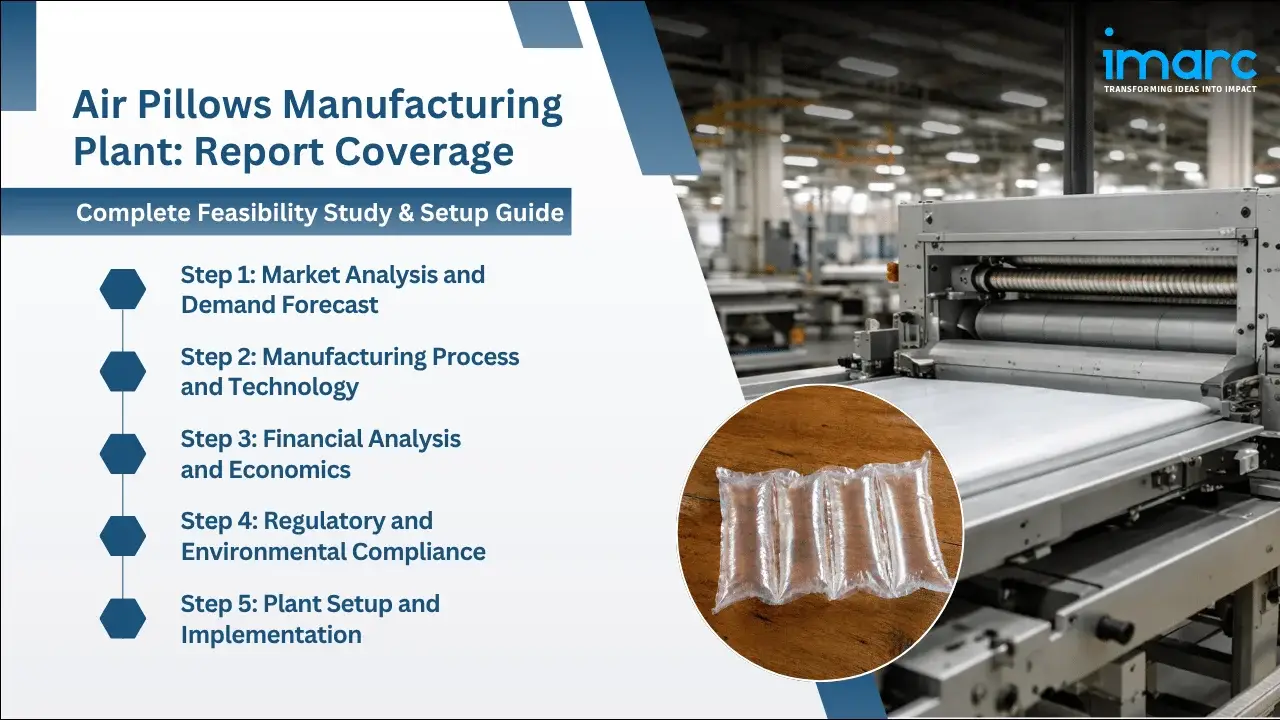
IMARC Group's comprehensive DPR report, titled "Air Pillows Manufacturing Plant Project Report 2026: Industry Trends, Plant Setup, Machinery, Raw Materials, Investment Opportunities, Cost and Revenue," provides a complete roadmap for setting up a air pillows manufacturing unit. The global air pillows market is driven by the rising demand for lightweight protective packaging solutions in e-commerce logistics and increasing adoption of sustainable void-fill materials in retail and industrial shipping. The global air pillows market size was valued at USD 1.61 Billion in 2025. According to IMARC Group estimates, the market is expected to reach USD 3.09 Billion by 2034, exhibiting a CAGR of 7.5% from 2026 to 2034.
This feasibility report covers a comprehensive market overview to micro-level information such as unit operations involved, raw material requirements, utility requirements, infrastructure requirements, machinery and technology requirements, manpower requirements, packaging requirements, transportation requirements, etc.
The air pillows manufacturing plant setup cost is provided in detail covering project economics, capital investments (CapEx), project funding, operating expenses (OpEx), income and expenditure projections, fixed costs vs. variable costs, direct and indirect costs, expected ROI and net present value (NPV), profit and loss account, financial analysis, etc.
Access the Detailed Feasibility Analysis, Request Sample
What are Air Pillows?
Air pillows function as packaging materials which provide protective capabilities through their lightweight design as they create empty space in shipping cartons to protect products from transportation impacts. The manufacturing process uses polyethylene materials which include LDPE and HDPE and biodegradable films that undergo sealing and inflation to create air-filled cushions. Air pillows provide excellent cushioning performance while using minimal material, thereby reducing packaging weight and overall shipping costs. The product serves as a void-fill solution which modern logistics operations find beneficial because of its compact storage before inflation and User-friendly operation and High shock absorption efficiency. The packaging system shows multiple advantages because it achieves cost savings and efficient use of space and works well with automated packaging machinery.
Key Investment Highlights
- Process Used: Film extrusion, sealing, air inflation, and cutting and winding.
- End-use Industries: E-commerce, logistics and warehousing, consumer goods, electronics, and pharmaceuticals.
- Applications: Used for void-fill packaging to protect products during storage, handling, and transportation.
Air Pillows Plant Capacity:
The proposed manufacturing facility is designed with an annual production capacity ranging between 500 - 2,000 MT, enabling economies of scale while maintaining operational flexibility.
Air Pillows Plant Profit Margins:
The project demonstrates healthy profitability potential under normal operating conditions. Gross profit margins typically range between 30-40%, supported by stable demand and value-added applications.
- Gross Profit: 30-40%
- Net Profit: 12-20%
Air Pillows Plant Cost Analysis:
The operating cost structure of a air pillows manufacturing plant is primarily driven by raw material consumption, particularly polyethylene (LDPE) film, which accounts for approximately 70-80% of total operating expenses (OpEx).
- Raw Materials: 70-80% of OpEx
- Utilities: 5-10% of OpEx
Financial Projection:
The financial projections for the proposed project have been developed based on realistic assumptions related to capital investment, operating costs, production capacity utilization, pricing trends, and demand outlook. These projections provide a comprehensive view of the project’s financial viability, ROI, profitability, and long-term sustainability.
Major Applications:
- E-commerce and Retail: used in void filling for cartons containing apparel, accessories, and household goods.
- Electronics: employed in protection of fragile devices such as smartphones, accessories, and components.
- Pharmaceuticals: utilized in safe transit of medical supplies and healthcare products.
- Industrial Goods: used in shock absorption for tools, spare parts, and mechanical components.
Why Air Pillows Manufacturing?
✓ Essential Packaging Solution: Air pillows serve as essential elements for contemporary protective packaging because they deliver lightweight cushioning which protects shipments from damage while decreasing shipping costs.
✓ Low to Moderate Entry Barriers: Manufacturers who want to enter the market need to invest in machinery as they can achieve efficient operations through standardized production technology and scalable processes which maintain product quality and production volume.
✓ Alignment with Sustainability Trends: The growing preference for recyclable packaging materials and downgauged packaging materials and eco-friendly packaging materials is driving the industry to switch from using bulky fillers to adopting air-based cushioning systems.
✓ Booming E-commerce and Logistics Sector: The online retail industry and third-party logistics sector and cross-border trade market have expanded rapidly which creates ongoing requirements for effective void-fill packaging solutions.
✓ Supply Chain Optimization Opportunity: The rising trend of businesses choosing local packaging suppliers enables them to decrease lead times and cut down inventory expenses and reduce their need for materials from international sources which benefits regional manufacturers.
Transforming Vision into Reality:
This report provides the comprehensive blueprint needed to transform your air pillows manufacturing vision into a technologically advanced and highly profitable reality.
Air Pillows Industry Outlook 2026:
The air pillows market is primarily driven by the rapid expansion of e-commerce, organized retail, and global logistics networks. As companies increasingly prioritize lightweight and cost-effective packaging, air pillows are gaining preference over traditional fillers such as paper, foam, and molded pulp. Their ability to reduce shipping weight, optimize warehouse space, and minimize material usage aligns well with cost-reduction strategies adopted by logistics providers and retailers. Furthermore, sustainability is major growth driver, with manufacturers focusing on recyclable polyethylene films, mono-material structures, and biodegradable alternatives. Regulatory pressure to reduce packaging waste and carbon emissions is accelerating innovation in air pillow materials and production processes. With increasing focus on sustainable packaging solutions, companies are innovating to reduce environmental impact while meeting the needs of e-commerce and logistics operations. For example, in 2023, SEE introduced a new line of BubbleWrap brand inflatable air pillows containing at least 95% recycled plastic to support sustainability goals. The BubbleWrap Extreme HRC Air Pillows combine post-industrial and post-consumer recycled content and can be inflated on demand using SEE’s Rocket system, delivering high output, reduced material usage, and efficient storage while maintaining protective performance. Such innovations reflect the growing air pillows market, driven by rising e-commerce demand, sustainability initiatives, and the need for efficient, lightweight, and protective packaging solutions. Overall, the air pillows industry is positioned for stable, long-term growth as protective packaging becomes an indispensable part of modern supply chains across the globe.
Leading Air Pillows Manufacturers:
Leading manufacturers in the global air pillows industry include several multinational companies with extensive production capacities and diverse application portfolios. Key players include:
- Sealed Air Corporation
- Pregis Corporation
- Storopack Hans Reichenecker GmbH
- Intertape Polymer Group Inc.
- Smurfit Kappa Group
- Automated Packaging Systems, Inc.
- Polyair Inter Pack Inc.
- Inflatable Packaging, Inc.
- Free-Flow Packaging International, Inc.
- Omniverse Foster Packaging Group
- Advanced Protective Packaging Ltd.
- Shorr Packaging Corp.
- 3G Packaging Corp.
all of which serve end-use sectors such as e-commerce, logistics, industrial packaging, and retail distribution sectors.
How to Setup a Air Pillows Manufacturing Plant?
Setting up a air pillows manufacturing plant requires evaluating several key factors, including technological requirements and quality assurance.
Some of the critical considerations include:
- Detailed Process Flow: The manufacturing process is a multi-step operation that involves several unit operations, material handling, and quality checks. Below are the main stages involved in the air pillows manufacturing process flow:
- Unit Operations Involved
- Mass Balance and Raw Material Requirements
- Quality Assurance Criteria
- Technical Tests
- Site Selection: The location must offer easy access to key raw materials such as polyethylene (LDPE) film, air, and ink for printing. Proximity to target markets will help minimize distribution costs. The site must have robust infrastructure, including reliable transportation, utilities, and waste management systems. Compliance with local zoning laws and environmental regulations must also be ensured.
- Plant Layout Optimization: The layout should be optimized to enhance workflow efficiency, safety, and minimize material handling. Separate areas for raw material storage, production, quality control, and finished goods storage must be designated. Space for future expansion should be incorporated to accommodate business growth.
- Equipment Selection: High-quality, corrosion-resistant machinery tailored for air pillows production must be selected. Essential equipment includes extrusion lines, air pillow machines, sealing units, compressors, and automated winding systems. All machinery must comply with industry standards for safety, efficiency, and reliability.
- Raw Material Sourcing: Reliable suppliers must be secured for raw materials like polyethylene (LDPE) film, air, and ink for printing to ensure consistent production quality. Minimizing transportation costs by selecting nearby suppliers is essential. Sustainability and supply chain risks must be assessed, and long-term contracts should be negotiated to stabilize pricing and ensure a steady supply.
- Safety and Environmental Compliance: Safety protocols must be implemented throughout the manufacturing process of air pillows. Advanced monitoring systems should be installed to detect leaks or deviations in the process. Effluent treatment systems are necessary to minimize environmental impact and ensure compliance with emission standards.
- Quality Assurance Systems: A comprehensive quality control system should be established throughout production. Analytical instruments must be used to monitor product concentration, purity, and stability. Documentation for traceability and regulatory compliance must be maintained.
Project Economics:
Establishing and operating a air pillows manufacturing plant involves various cost components, including:
- Capital Investment: The total capital investment depends on plant capacity, technology, and location. This investment covers land acquisition, site preparation, and necessary infrastructure.
- Equipment Costs: Equipment costs, such as those for extrusion lines, air pillow machines, sealing units, compressors, and automated winding systems, represent a significant portion of capital expenditure. The scale of production and automation level will determine the total cost of machinery.
- Raw Material Expenses: Raw materials, including polyethylene (LDPE) film, air, and ink for printing, are a major part of operating costs. Long-term contracts with reliable suppliers will help mitigate price volatility and ensure a consistent supply of materials.
- Infrastructure and Utilities: Costs associated with land acquisition, construction, and utilities (electricity, water, steam) must be considered in the financial plan.
- Operational Costs: Ongoing expenses for labor, maintenance, quality control, and environmental compliance must be accounted for. Optimizing processes and providing staff training can help control these operational costs.
- Financial Planning: A detailed financial analysis, including income projections, expenditures, and break-even points, must be conducted. This analysis aids in securing funding and formulating a clear financial strategy.
Capital Expenditure (CapEx) and Operational Expenditure (OpEx) Analysis:
Capital Investment (CapEx): Machinery costs account for the largest portion of the total capital expenditure. The cost of land and site development, including charges for land registration, boundary development, and other related expenses, forms a substantial part of the overall investment. This allocation ensures a solid foundation for safe and efficient plant operations.
Operating Expenditure (OpEx): In the first year of operations, the operating cost for the air pillows manufacturing plant is projected to be significant, covering raw materials, utilities, depreciation, taxes, packing, transportation, and repairs and maintenance. By the fifth year, the total operational cost is expected to increase substantially due to factors such as inflation, market fluctuations, and potential rises in the cost of key materials. Additional factors, including supply chain disruptions, rising consumer demand, and shifts in the global economy, are expected to contribute to this increase.
.webp)
Capital Expenditure Breakdown:
| Particulars | Cost (in US$) |
|---|---|
| Land and Site Development Costs | XX |
| Civil Works Costs | XX |
| Machinery Costs | XX |
| Other Capital Costs | XX |
To access CapEx Details, Request Sample
Operational Expenditure Breakdown:
| Particulars | In % |
|---|---|
| Raw Material Cost | 70-80% |
| Utility Cost | 5-10% |
| Transportation Cost | XX |
| Packaging Cost | XX |
| Salaries and Wages | XX |
| Depreciation | XX |
| Taxes | XX |
| Other Expenses | XX |
To access OpEx Details, Request Sample
Profitability Analysis:
| Particulars | Unit | Year 1 | Year 2 | Year 3 | Year 4 | Year 5 | Average |
|---|---|---|---|---|---|---|---|
| Total Income | US$ | XX | XX | XX | XX | XX | XX |
| Total Expenditure | US$ | XX | XX | XX | XX | XX | XX |
| Gross Profit | US$ | XX | XX | XX | XX | XX | XX |
| Gross Margin | % | XX | XX | XX | XX | XX | 30-40% |
| Net Profit | US$ | XX | XX | XX | XX | XX | XX |
| Net Margin | % | XX | XX | XX | XX | XX | 12-20% |
To access Financial Analysis, Request Sample
Latest Industry Developments:
- September 2025: Sealed Air Corporation expanded its AUTOBAG® portfolio with the launch of the 850HB Hybrid Bagging Machine. Designed for modern fulfillment centers, the system supports both poly and paper mailers, allowing greater material flexibility. The automated solution improves operational efficiency while helping customers adopt curbside-recyclable packaging formats and respond to evolving sustainability demands.
- February 2025: Storopack introduced AIRfiber, a paper-based air cushion solution designed to complement its protective packaging range. Featuring a water-soluble inner coating, the air pillows can be recycled alongside paper and corrugated cardboard. The coating dissolves during recycling without residue, enabling high-volume protection with minimal material while meeting established recycling standards.
Report Coverage:
| Report Features | Details |
|---|---|
| Product Name | Air Pillows |
| Report Coverage | Detailed Process Flow: Unit Operations Involved, Quality Assurance Criteria, Technical Tests, Mass Balance, and Raw Material Requirements Land, Location and Site Development: Selection Criteria and Significance, Location Analysis, Project Planning and Phasing of Development, Environmental Impact, Land Requirement and Costs Plant Layout: Importance and Essentials, Layout, Factors Influencing Layout Plant Machinery: Machinery Requirements, Machinery Costs, Machinery Suppliers (Provided on Request) Raw Materials: Raw Material Requirements, Raw Material Details and Procurement, Raw Material Costs, Raw Material Suppliers (Provided on Request) Packaging: Packaging Requirements, Packaging Material Details and Procurement, Packaging Costs, Packaging Material Suppliers (Provided on Request) Other Requirements and Costs: Transportation Requirements and Costs, Utility Requirements and Costs, Energy Requirements and Costs, Water Requirements and Costs, Human Resource Requirements and Costs Project Economics: Capital Costs, Techno-Economic Parameters, Income Projections, Expenditure Projections, Product Pricing and Margins, Taxation, Depreciation Financial Analysis: Liquidity Analysis, Profitability Analysis, Payback Period, Net Present Value, Internal Rate of Return, Profit and Loss Account, Uncertainty Analysis, Sensitivity Analysis, Economic Analysis Other Analysis Covered in The Report: Market Trends and Analysis, Market Segmentation, Market Breakup by Region, Price Trends, Competitive Landscape, Regulatory Landscape, Strategic Recommendations, Case Study of a Successful Venture |
| Currency | US$ (Data can also be provided in the local currency) |
| Customization Scope | The report can also be customized based on the requirement of the customer |
| Post-Sale Analyst Support | 10-12 Weeks |
| Delivery Format | PDF and Excel through email (We can also provide the editable version of the report in PPT/Word format on special request) |
Report Customization
While we have aimed to create an all-encompassing air pillows plant project report, we acknowledge that individual stakeholders may have unique demands. Thus, we offer customized report options that cater to your specific requirements. Our consultants are available to discuss your business requirements, and we can tailor the report's scope accordingly. Some of the common customizations that we are frequently requested to make by our clients include:
- The report can be customized based on the location (country/region) of your plant.
- The plant’s capacity can be customized based on your requirements.
- Plant machinery and costs can be customized based on your requirements.
- Any additions to the current scope can also be provided based on your requirements.
Why Buy IMARC Reports?
- The insights provided in our reports enable stakeholders to make informed business decisions by assessing the feasibility of a business venture.
- Our extensive network of consultants, raw material suppliers, machinery suppliers and subject matter experts spans over 100+ countries across North America, Europe, Asia Pacific, South America, Africa, and the Middle East.
- Our cost modeling team can assist you in understanding the most complex materials. With domain experts across numerous categories, we can assist you in determining how sensitive each component of the cost model is and how it can affect the final cost and prices.
- We keep a constant track of land costs, construction costs, utility costs, and labor costs across 100+ countries and update them regularly.
- Our client base consists of over 3000 organizations, including prominent corporations, governments, and institutions, who rely on us as their trusted business partners. Our clientele varies from small and start-up businesses to Fortune 500 companies.
- Our strong in-house team of engineers, statisticians, modeling experts, chartered accountants, architects, etc. has played a crucial role in constructing, expanding, and optimizing sustainable manufacturing plants worldwide.
Need more help?
- Speak to our experienced analysts for insights on the current market scenarios.
- Include additional segments and countries to customize the report as per your requirement.
- Gain an unparalleled competitive advantage in your domain by understanding how to utilize the report and positively impacting your operations and revenue.
- For further assistance, please connect with our analysts.


Factory Setup Services
IMARC Group's factory setup services streamline the entire establishment process, ensuring efficient planning, seamless execution, and optimal operational readiness for your manufacturing facility.


Site Selection Services
IMARC Group's site selection services optimize location choices for businesses, ensuring strategic, cost-effective, and efficient manufacturing operations.


Factory Audit Services
IMARC Group's plant audit services offer comprehensive evaluations of your industrial facility's health, efficiency, and regulatory compliance.


Regulatory Approvals, and Licensing Services
IMARC Group's regulatory approval and licensing services ensure businesses meet all compliance requirements, facilitating smooth and timely market entry.
 Inquire Before Buying
 Speak to an Analyst
 Request Brochure
 Request Customization
Related Reports

Frequently Asked Questions
Capital requirements generally include land acquisition, construction, equipment procurement, installation, pre-operative expenses, and initial working capital. The total amount varies with capacity, technology, and location.
To start an air pillows manufacturing business, one needs to conduct a market feasibility study, secure required licenses, arrange funding, select suitable land, procure equipment, recruit skilled labor, and establish a supply chain and distribution network.
Air pillow manufacturing requires raw materials such as high-density polyethylene (HDPE), low-density polyethylene (LDPE), linear low-density polyethylene (LLDPE), or co-extruded multilayer films. Additives such as anti-static agents, slip agents, and barrier coatings are used to enhance film performance. In sustainable operations, biodegradable and recycled resins like PLA or starch-based blends are also utilized.
An air pillow factory typically requires film extrusion and blowing machines, film slitting and perforating machines, inflation and sealing systems for forming air pillows, roll rewinding units, leak and burst testing machines, and automated packaging systems. Additional utilities include air compressors, control panels, material handling conveyors, and quality assurance systems for continuous monitoring of film thickness and seal integrity.
The main steps generally include:
-
Procurement and preparation of polymer resin based on film specification requirements
-
Extrusion or film blowing to produce thin and uniform plastic sheets suitable for air retention
-
Co-extrusion or surface treatment to improve barrier properties and seal strength
-
Slitting and perforation of film rolls into desired widths and lengths for inflation use
-
Inflation and heat sealing to form air-filled cushions or chambers for protective packaging
-
Leak and durability testing to ensure air retention, strength, and product reliability
-
Cutting, labeling, and packaging of finished air pillows for distribution
-
Storage and dispatch of finished rolls or pre-inflated products to end users or packaging facilities
Usually, the timeline can range from 12 to 24 months to start an air pillows manufacturing plant, depending on factors like site development, machinery installation, environmental clearances, safety measures, and trial runs.
Challenges may include high capital requirements, securing regulatory approvals, ensuring raw material supply, competition, skilled manpower availability, and managing operational risks.
Typical requirements include business registration, environmental clearances, factory licenses, fire safety certifications, and industry-specific permits. Local/state/national regulations may apply depending on the location.
The top air pillows manufacturers are:
-
Sealed Air Corporation
-
Pregis Corporation
-
Storopack
-
Intertape Polymer Group (IPG)
-
FLOETER / AirWave
Profitability depends on several factors including market demand, manufacturing efficiency, pricing strategy, raw material cost management, and operational scale. Profit margins usually improve with capacity expansion and increased capacity utilization rates.
Cost components typically include:
-
Land and Infrastructure
-
Machinery and Equipment
-
Building and Civil Construction
-
Utilities and Installation
-
Working Capital
Break even in an air pillows manufacturing business typically range from 4 to 7 years, depending on scale, regulatory compliance costs, raw material pricing, and market demand. Efficient manufacturing and export opportunities can help accelerate returns.
Governments may offer incentives such as capital subsidies, tax exemptions, reduced utility tariffs, export benefits, or interest subsidies to promote manufacturing under various national or regional industrial policies.
Financing can be arranged through term loans, government-backed schemes, private equity, venture capital, equipment leasing, or strategic partnerships. Financial viability assessments help identify optimal funding routes.
Choose your plan
*Please note that the prices mentioned below are starting prices for each bundle type. Kindly contact our team for further details.*
Single User License
- 1 User License, Access on 2 Devices
- PDF Report + Excel Dataset (Password Protected)
- Lifetime Access
- No Printing Rights
- 10% Free Report Customization
- 10–12 Weeks of Analyst Support
Five User License
- Access for 5 Users, 2 Devices per User
- PDF Report + Excel Dataset (Password Protected)
- Lifetime Access
- Dedicated Account Manager
- 12–14 Weeks of Analyst Support
- No Printing Rights
- 15% Free Report Customization
- 25% Discount on Your Next Purchase
Corporate User License
- Unlimited User Access (Within Your Organization)
- PDF Report + Excel Dataset
- Lifetime Access
- Dedicated Account Manager
- 14–20 Weeks of Analyst Support
- No Printing Rights
- 20% Free Report Customization
- 30% Discount on Your Next Purchase
Essential Insights
What's included:
3 reports
- Lifetime Access
- PDF Reports
- Excel Datasets
- 2 Weeks of Free Analyst Support
- 2 User Licenses
- Access on 2 Devices
- Printing Rights
- Complimentary PowerPoint (PPT) Version
- Complimentary License Upgrade
Professional Access
What's included:
5 reports
- Lifetime Access
- PDF Reports
- Excel Datasets
- 8 Weeks of Free Analyst Support
- 2 User Licenses
- Access on 2 Devices
- Printing Rights
- Complimentary PowerPoint (PPT) Version
- Complimentary License Upgrade
Business Advantage
What's included:
8 reports
- Lifetime Access
- PDF Reports
- Excel Datasets
- 14 Weeks of Free Analyst Support
- 2 User Licenses
- Access on 2 Devices
- Printing Rights
- Complimentary PowerPoint (PPT) Version
- Complimentary License Upgrade
Enterprise Intelligence
What's included:
10 reports
- Lifetime Access
- PDF Reports
- Excel Datasets
- 20 Weeks of Free Analyst Support
- 2 User Licenses
- Access on 2 Devices
- Printing Rights
- Complimentary PowerPoint (PPT) Version
- Complimentary License Upgrade