
Airport Terminal Operations Market Size, Share, Trends and Forecast by Operation Type, Airport Category, Technology, and Region, 2026-2034
Airport Terminal Operations Market Size and Share:
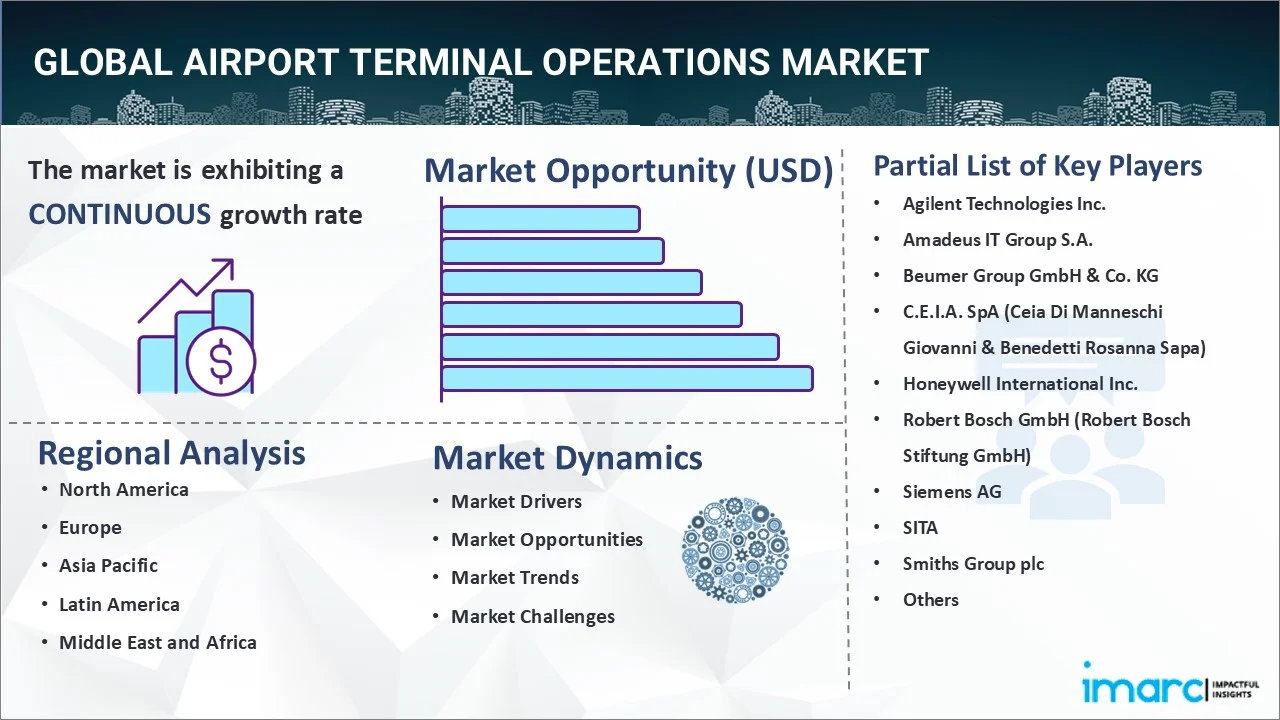
The global airport terminal operations market size was valued at USD 7.2 Billion in 2025. Looking forward, IMARC Group estimates the market to reach USD 14.04 Billion by 2034, exhibiting a CAGR of 7.03% from 2026-2034. Asia-Pacific currently dominates the market, holding a market share of 36.9% in 2025. The region benefits from its rapidly expanding aviation infrastructure, surging air travel demand driven by a growing middle class, and substantial government investments in airport modernization programs across countries such as China, India, and Southeast Asian nations, all collectively strengthening the airport terminal operations market share.
The global airport terminal operations market is witnessing robust growth, driven by a confluence of factors reshaping modern aviation infrastructure. The unprecedented surge in global passenger traffic is compelling airport authorities and operators to enhance terminal efficiency, security screening capabilities, and passenger processing systems. Expanding low-cost carrier networks are intensifying demand for streamlined check-in and baggage handling processes. The growing emphasis on contactless and biometric passenger verification has prompted widespread adoption of advanced identity management solutions. Additionally, heightened global security standards mandated by regulatory bodies such as the International Civil Aviation Organization (ICAO) and the Transportation Security Administration (TSA) are driving substantial investments in next-generation screening technologies. Increasing smart airport initiatives, anchored in digital transformation, IoT integration, and cloud-based operations management, are further bolstering the airport terminal operations market growth across developed and emerging economies alike.
The United States has emerged as a major region in the airport terminal operations market owing to many factors. The country's dense network of commercial airports, handled by entities such as the Federal Aviation Administration (FAA), sustains consistently high throughput of both domestic and international passengers. Robust federal funding allocations through the Airport Improvement Program (AIP) support continuous upgrades to terminal facilities, baggage systems, and access controls. The rapid uptake of PreCheck and Trusted Traveler Programs has elevated expectations for frictionless security screening experiences. Advanced threat detection systems and explosive detection technologies are mandatorily deployed across US airports. The Federal Aviation Administration is granting $970 million for improvements and renovations at 125 airports in the U.S., covering 46 states along with Guam and Palau. From the $970 million being granted by the FAA, $40 million will be designated for Tampa International Airport to install nine passenger boarding bridges and implement an automated people mover that links Terminal D to the main terminal, according to DOT. Austin-Bergstrom International Airport in Texas will allocate $33.2 million to add a minimum of 20 gates in Terminal B and link the new terminal to the current terminal via a 518-foot underground tunnel, while Denver International Airport will obtain $15 million to enhance efficiency and capacity by reconstructing its baggage handling system, which will feature oversized baggage lift replacements.
To get more information on this market Request Sample
Airport Terminal Operations Market Trends:
Growing Adoption of Biometric Technology
The rapid integration of biometric identification technologies is fundamentally transforming airport terminal operations. Facial recognition, iris scanning, and fingerprint verification systems are being deployed at check-in counters, immigration corridors, boarding gates, and security checkpoints to enhance both speed and accuracy in passenger processing. These technologies drastically reduce manual verification time, decrease queue lengths, and improve overall terminal throughput while simultaneously strengthening border security. Airlines and airport operators are partnering with technology providers to build end-to-end biometric corridors that allow passengers to move through the terminal using a single identity token. Government agencies are increasingly mandating the use of biometric documentation, particularly for international departures, raising compliance-driven adoption. The proliferation of digital travel credentials and mobile passport controls further augments biometric deployment. In 2026, Navi Mumbai International Airport has introduced the DigiYatra service, almost two months after starting commercial operations in December 2025. This contactless, paperless passenger processing system utilizes facial recognition technology, allowing travelers to navigate airport checkpoints without showing physical boarding passes or identification documents.
Expansion of Smart Airport Infrastructure
The global push toward smart airport development is significantly influencing the airport terminal operations market outlook. Airports are integrating Internet of Things (IoT) devices, artificial intelligence (AI)-powered analytics, and cloud-based operations management platforms to optimize terminal resource allocation, monitor real-time passenger flows, and manage gate assignments dynamically. Automated baggage handling systems equipped with RFID tracking and computer vision are minimizing mishandling incidents and improving luggage delivery accuracy. Smart energy management systems embedded within terminal buildings are improving sustainability profiles while reducing operational costs. Predictive maintenance solutions powered by sensor data are being used to preemptively address equipment failures in escalators, conveyors, and HVAC systems. According to the Airports Council International (ACI), by 2025, it is predicted that worldwide passenger traffic will hit 9.9 billion, exhibiting a 4.8% growth rate each year.
Rising Demand for Advanced Security Screening
Escalating global security threats and evolving regulatory mandates are driving accelerated deployment of next-generation screening systems within airport terminals, which is favorably shaping the airport terminal operations market forecast. Computed tomography (CT)-based checkpoint screening systems, which provide three-dimensional imagery of carry-on baggage, are progressively replacing legacy X-ray technologies across major international hubs. Explosive detection systems (EDS) capable of autonomous threat identification are being installed at checked baggage screening stations to meet enhanced compliance requirements. Automated screening lanes (ASL) equipped with parallel processing capabilities are being rolled out to improve throughput while maintaining stringent security standards. Enhanced liquids, aerosols, and gels (LAG) screening protocols following revised ICAO directives are prompting airports to procure additional inline screening infrastructure. In 2024, The Transportation Security Administration (TSA) has implemented units that utilize facial recognition technology to confirm travelers' identities throughout the security screening process at Bozeman-Yellowstone International Airport, Billings International Airport, Great Falls International Airport, Helena Regional Airport, and Missoula International Airport.
Airport Terminal Operations Industry Segmentation:
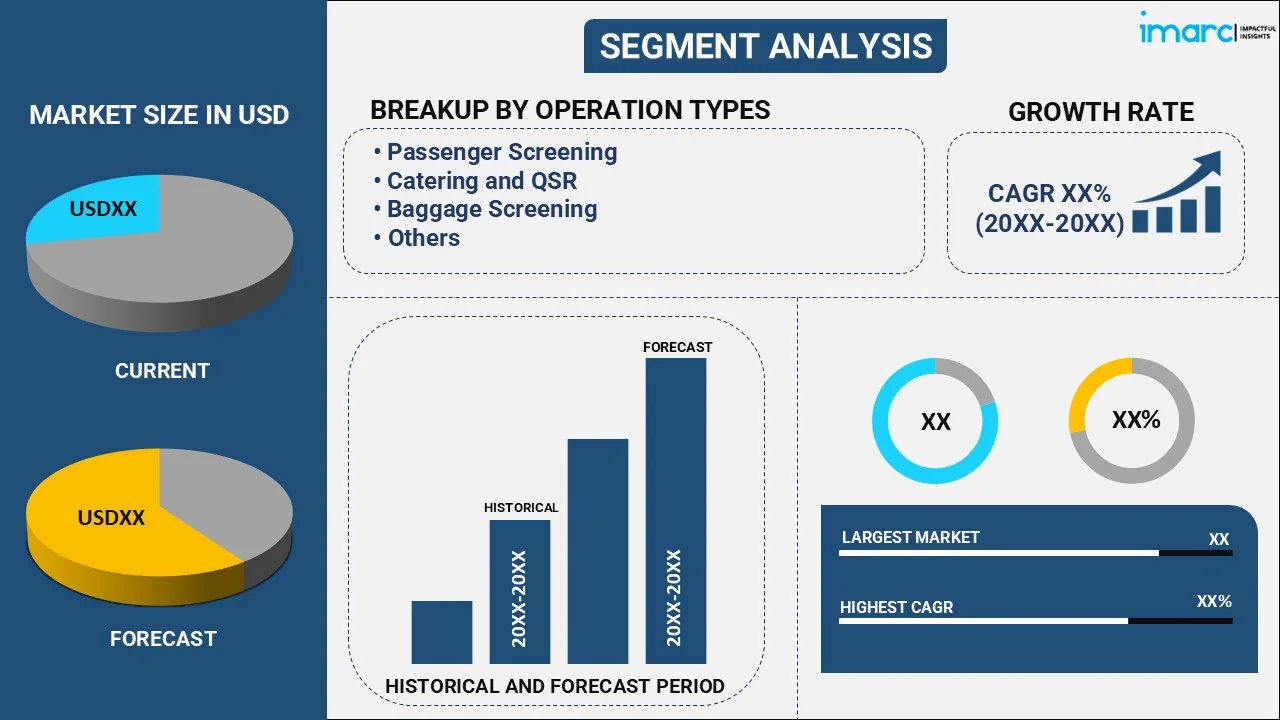
IMARC Group provides an analysis of the key trends in each segment of the global airport terminal operations market, along with forecast at the global, regional, and country levels from 2026-2034. The market has been categorized based on operation type, airport category, and technology.
Analysis by Operation Type:
To get detailed segment analysis of this market Request Sample
- Terminal Infrastructure Maintenance and Upgrade
- Passenger Screening
- Catering and QSR
- Baggage Screening
- Aircraft MRO
Baggage screening holds 25.9% of the market share. Baggage screening operations encompass the complete range of technologies, processes, and personnel deployed to inspect checked and carry-on baggage for prohibited items, explosive materials, and security threats within airport terminals. This segment's leading position is attributed to the universal regulatory mandate for 100% checked baggage screening across international and domestic airports, as established by ICAO standards and national aviation security programs. The continuous replacement of aging X-ray units with computed tomography (CT) checkpoint systems has generated substantial procurement activity globally. Airlines and airports are also required to adhere to strict compliance timelines set by regulatory authorities, accelerating technology refresh cycles. Furthermore, rising passenger volumes, particularly on long-haul and intercontinental routes, increase the cumulative demand for high-throughput baggage screening solutions.
Analysis by Airport Category:
- Class A
- Class B
- Class C
- Class D
- Class E
Class A leads the market with a share of 35.2%. Class A airports, encompassing major international hubs handling the highest volumes of intercontinental passenger traffic and multi-airline operations represent the largest and most operationally complex segment of the airport terminal operations landscape. Their leadership is reinforced by the breadth and depth of terminal services required, spanning multi-level security screening, advanced baggage handling, immigration processing, customs clearance, and extensive retail and hospitality facilities. These airports consistently operate at the frontier of technological adoption, investing heavily in automated check-in kiosks, self-service bag drops, biometric passenger corridors, and integrated terminal management systems. Capital expenditure cycles at Class A airports are more frequent and substantially larger compared to smaller airport categories, generating outsized demand for terminal operations solutions.

Analysis by Technology:
- Passenger Screening
- Baggage Scanners
- 5G Infrastructure
- E-Kiosk
- Others
Baggage scanners dominate the market, with a share of 28.7%. Baggage scanners constitute the foundational technology layer of airport terminal security operations, encompassing X-ray inspection systems, computed tomography (CT) scanners, explosive detection systems (EDS), and automated inline screening platforms deployed at both checkpoint and hold baggage processing stations. Their dominant position reflects the non-negotiable regulatory requirement for 100% baggage screening at all commercial airports, ensuring these systems command continuous investment regardless of economic cycles. Ongoing technology upgrades, particularly the global rollout of CT-based systems with three-dimensional threat imaging capabilities, are driving significant replacement demand. The integration of artificial intelligence-powered automated threat detection (ATD) algorithms within modern baggage scanners further elevates their capabilities while reducing reliance on manual operator interpretation.
Regional Analysis:
To get more information on the regional analysis of this market Request Sample
- North America
- United States
- Canada
- Asia-Pacific
- China
- Japan
- India
- South Korea
- Australia
- Indonesia
- Others
- Europe
- Germany
- France
- United Kingdom
- Italy
- Spain
- Russia
- Others
- Latin America
- Brazil
- Mexico
- Others
- Middle East and Africa
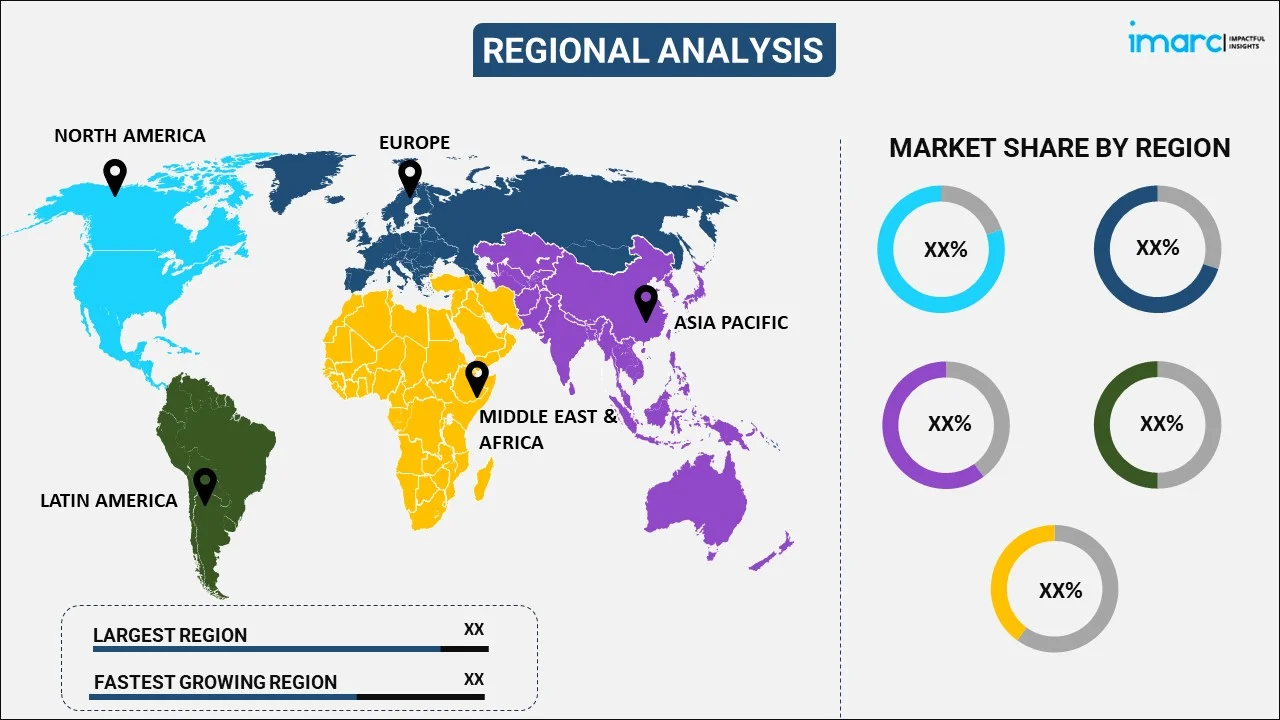
Asia-Pacific, accounting for 36.9% of the share, enjoys the leading position in the market. The region's dominance is underpinned by the extraordinary scale of aviation expansion occurring across China, India, and Southeast Asia, where passenger volumes are growing at rates that far outpace other global regions. Government-led airport construction and modernization programs are systematically upgrading terminal security infrastructure, check-in automation, and baggage handling capabilities across hundreds of airports. China's Civil Aviation Administration (CAAC) and India's Airports Authority (AAI) have both committed multi-year capital programs to bring domestic airports in line with international standards, stimulating demand for advanced terminal operations solutions. The proliferation of ultra-low-cost carriers and expanding regional connectivity are generating high passenger throughput at secondary and tertiary airports. According to the Civil Aviation Administration of China (CAAC), China's commercial airports handled over 1.53 billion passenger trips in 2025, marking a full recovery and surpassing pre-pandemic levels, further validating the region's leadership in airport terminal operations.
Key Regional Takeaways:
North America Airport Terminal Operations Market Analysis
North America represents a mature yet continuously evolving market for airport terminal operations, driven by sustained investments in infrastructure modernization, regulatory compliance upgrades, and the adoption of cutting-edge security technologies. The United States and Canada collectively operate one of the world's densest commercial aviation networks, supporting enormous annual passenger volumes across hub and spoke systems. The Federal Aviation Administration (FAA) and Transport Canada impose rigorous security and operational standards that necessitate frequent technology refresh cycles across terminal operators. The robust presence of major airline alliances and hub-and-spoke network models at airports such as Hartsfield-Jackson Atlanta, Dallas/Fort Worth, Toronto Pearson, and Los Angeles International reinforces consistently high demand for advanced baggage handling, biometric processing, and access control solutions. The continued expansion of Terminal 5 and similar large-scale infrastructure projects across North American airports sustains capital deployment in operations technology. In 2024, The Federal Aviation Administration (FAA) is granting $970 million from President Biden’s Bipartisan Investing in America initiative to 114 airports throughout the country, covering 44 states and three territories. This statement, which Secretary Buttigieg will present during the Administration’s Investing in America tour, fulfills President Biden’s promise to restore our nation’s infrastructure, reduce costs for families, generate quality jobs, and promote opportunities for all Americans.
United States Airport Terminal Operations Market Analysis
The United States represents the single largest national market within the global airport terminal operations landscape, characterized by an extensive network of commercial airports subject to some of the world's most stringent security mandates. The TSA's ongoing modernization roadmap—centered on deploying CT-based checkpoint screening, credential authentication technology (CAT) units, and automated screening lanes, continues to generate substantial procurement demand across major and regional airports. Federal investment programs, including the Airport Terminal Program funded through the Bipartisan Infrastructure Law, are channeling billions of dollars into terminal renovation and expansion projects that incorporate next-generation operations technologies. The growing passenger preference for contactless and self-service interactions is driving rapid adoption of automated check-in kiosks, self-service bag drop solutions, and biometric boarding gate systems. The integration of the TSA PreCheck program across an expanding number of US airports is reshaping security checkpoint configuration and resource deployment strategies. In 2026, Miami International Airport revealed a $1 billion initiative to renovate Concourse D by adding new aircraft gates, passenger boarding zones, and dining and shopping spaces.
Europe Airport Terminal Operations Market Analysis
Europe constitutes a significant market for airport terminal operations, characterized by a dense constellation of international airports operating under the strict regulatory frameworks of the European Union Aviation Safety Agency (EASA) and national civil aviation authorities. The region's emphasis on interoperability of security systems, particularly under the Schengen Area's harmonized border management protocols, drives continuous investment in advanced screening and identity verification technologies. The mandated rollout of CT baggage scanning technology under revised EU regulations has generated a major replacement wave for aging X-ray equipment across hundreds of European airports. Rising passenger traffic at hubs such as London Heathrow, Paris Charles de Gaulle, Frankfurt, and Amsterdam Schiphol sustains demand for high-capacity terminal operations solutions. In 2025, Spanish airport operator Aena (AENA.MC) announced its intention to increase its investments to 12.88 billion euros ($15.24 billion) over the 2027-2031 timeframe, with the goal of enhancing terminals to manage rising passenger traffic. The firm projects that Spanish airports will accommodate around 320 million travelers in 2025, reflecting a 3.4% rise from the prior year's record of 309 million, fueled by a thriving tourism sector that has helped position the Spanish economy as one of the fastest expanding in developed countries.
Asia-Pacific Airport Terminal Operations Market Analysis
Asia-Pacific's dominance in the airport terminal operations market reflects the extraordinary scale and pace of aviation growth across the region, where governments are prioritizing aviation infrastructure as a cornerstone of economic development strategies. China's ongoing construction of new international airports and India's UDAN regional connectivity scheme are expanding the number of airports requiring comprehensive terminal operations solutions. Southeast Asian nations, including Indonesia, Thailand, and Vietnam, are recording some of the world's fastest passenger volume growth rates, necessitating rapid capacity additions and technology upgrades at existing terminals. The region's airport operators are among the earliest adopters of fully automated baggage handling and biometric corridor technologies. In 2025, The Adani Group has started to grow its airport activities in India. It intends to allocate Rs. 1,350 billion (US$ 15 billion) within the next five years to enhance capacity for managing 200 million passengers annually. This initiative showcases the swift expansion of air travel within India's aviation sector, projected to double by 2030, achieving 300 million passengers each year, a strong indicator of sustained investment momentum driving the airport terminal operations market trends in the region.
Latin America Airport Terminal Operations Market Analysis
Latin America represents a developing but steadily growing market for airport terminal operations, as governments and private airport concessionaires increase investments to address capacity constraints and align with international aviation security standards. Brazil and Mexico, as the region's largest aviation markets, are the primary drivers of demand, with ongoing terminal expansion projects at São Paulo–Guarulhos International Airport and Mexico City's Felipe Ángeles International Airport incorporating advanced security screening and baggage handling infrastructure. The growing penetration of low-cost carriers is amplifying passenger traffic at secondary airports, prompting terminal capability upgrades. In 2025, Brazil's National Civil Aviation Agency (ANAC) announced USD 1.8 billion in planned investments for airport terminal upgrades across 22 airports under the country's airport privatization program, reflecting the region's increasing commitment to modern airport terminal operations standards.
Middle East and Africa Airport Terminal Operations Market Analysis
The Middle East and Africa region presents a dual-track market dynamic for airport terminal operations. Gulf Cooperation Council (GCC) nations, particularly Saudi Arabia and the United Arab Emirates, are investing aggressively in world-class terminal infrastructure as part of broader tourism and economic diversification agendas under Vision 2030 and similar national development frameworks. The ongoing expansion of Riyadh's King Salman International Airport, planned to become one of the world's largest, and continued development at Dubai's Al Maktoum International Airport represent landmark procurement opportunities. In 2026, The General Authority of Civil Aviation in Saudi Arabia (GACA) has declared the granting of an economic license to Universal Aviation for offering ground handling services at the general aviation terminal of King Fahd International Airport. With the license, the company will be permitted to deliver ground handling services and administer the general aviation terminal at the airport, having satisfied the economic criteria in line with the regulations and laws in effect in the Kingdom.
Competitive Landscape:
The global airport terminal operations market is characterized by a moderately consolidated competitive environment, where established multinational players in security technology, baggage handling systems, and aviation services hold significant market positions. Leading companies are differentiating through continuous investment in research and development, particularly in CT-based baggage screening, AI-augmented threat detection, and biometric passenger processing technologies. Strategic partnerships between airport authorities, airlines, and technology providers are increasingly common, accelerating deployment of integrated terminal management ecosystems. Companies are also pursuing geographic expansion strategies into high-growth Asia-Pacific and Middle Eastern markets, where large-scale airport infrastructure projects offer substantial revenue opportunities. Challenges such as complex procurement cycles, long certification timelines for security equipment, and evolving regulatory standards are intensifying competition on technology innovation and compliance expertise, compelling players to continuously enhance product portfolios and after-sales support capabilities to maintain competitive differentiation.
The report provides a comprehensive analysis of the competitive landscape in the airport terminal operations market with detailed profiles of all major companies, including:
- Agilent Technologies Inc.
- Amadeus IT Group S.A.
- Beumer Group GmbH & Co. KG
- C.E.I.A. SpA (Ceia Di Manneschi Giovanni & Benedetti Rosanna Sapa)
- Honeywell International Inc.
- Robert Bosch GmbH (Robert Bosch Stiftung GmbH)
- Siemens AG
- SITA
- Smiths Group plc
- TAV Technologies
Airport Terminal Operations Market Report Scope:
| Report Features | Details |
|---|---|
| Base Year of the Analysis | 2025 |
| Historical Period | 2020-2025 |
| Forecast Period | 2026-2034 |
| Units | Billion USD |
| Scope of the Report | Exploration of Historical Trends and Market Outlook, Industry Catalysts and Challenges, Segment-Wise Historical and Predictive Market Assessment:
|
| Operation Types Covered | Terminal Infrastructure Maintenance and Upgrade, Passenger Screening, Catering and QSR, Baggage Screening, Aircraft MRO |
| Airport Categories Covered | Class A, Class B, Class C, Class D, Class E |
| Technologies Covered | Passenger Screening, Baggage Scanners, 5G Infrastructure, E-Kiosk, Others |
| Regions Covered | Asia-Pacific, Europe, North America, Latin America, Middle East and Africa |
| Countries Covered | United States, Canada, Germany, France, United Kingdom, Italy, Spain, Russia, China, Japan, India, South Korea, Australia, Indonesia, Brazil, Mexico |
| Companies Covered | Agilent Technologies Inc., Amadeus IT Group S.A., Beumer Group GmbH & Co. KG, C.E.I.A. SpA (Ceia Di Manneschi Giovanni & Benedetti Rosanna Sapa), Honeywell International Inc., Robert Bosch GmbH (Robert Bosch Stiftung GmbH), Siemens AG, SITA, Smiths Group plc, TAV Technologies., etc. |
| Customization Scope | 10% Free Customization |
| Post-Sale Analyst Support | 10-12 Weeks |
| Delivery Format | PDF and Excel through Email (We can also provide the editable version of the report in PPT/Word format on special request) |
Key Benefits for Stakeholders:
- IMARC’s report offers a comprehensive quantitative analysis of various market segments, historical and current market trends, market forecasts, and dynamics of the airport terminal operations market from 2020-2034.
- The research study provides the latest information on the market drivers, challenges, and opportunities in the global airport terminal operations market.
- The study maps the leading, as well as the fastest-growing, regional markets. It further enables stakeholders to identify the key country-level markets within each region.
- Porter's Five Forces analysis assists stakeholders in assessing the impact of new entrants, competitive rivalry, supplier power, buyer power, and the threat of substitution. It helps stakeholders to analyze the level of competition within the airport terminal operations industry and its attractiveness.
- Competitive landscape allows stakeholders to understand their competitive environment and provides an insight into the current positions of key players in the market.
Frequently Asked Questions About the Airport Terminal Operations Market Report
The airport terminal operations market was valued at USD 7.2 Billion in 2025.
The airport terminal operations market is projected to exhibit a CAGR of 7.03% during 2026-2034, reaching a value of USD 14.04 Billion by 2034.
The airport terminal operations market is driven by rising global passenger traffic, escalating regulatory mandates for enhanced airport security, accelerating adoption of biometric and AI-powered screening technologies, government-led airport modernization programs, expanding smart airport initiatives, and the rapid growth of aviation infrastructure across emerging economies in Asia-Pacific and the Middle East.
Asia-Pacific currently dominates the airport terminal operations market, accounting for a share of 36.9%. The region benefits from large-scale government airport infrastructure investments, unprecedented air travel demand growth across China, India, and Southeast Asia, and active deployment of advanced terminal security and baggage handling technologies.
Some of the major players in the airport terminal operations market include Agilent Technologies Inc., Amadeus IT Group S.A., Beumer Group GmbH & Co. KG, C.E.I.A. SpA (Ceia Di Manneschi Giovanni & Benedetti Rosanna Sapa), Honeywell International Inc., Robert Bosch GmbH (Robert Bosch Stiftung GmbH), Siemens AG, SITA, Smiths Group plc, TAV Technologies., etc.
Need more help?
- Speak to our experienced analysts for insights on the current market scenarios.
- Include additional segments and countries to customize the report as per your requirement.
- Gain an unparalleled competitive advantage in your domain by understanding how to utilize the report and positively impacting your operations and revenue.
- For further assistance, please connect with our analysts.
 Request Customization
 Speak to an Analyst
 Request Brochure
 Inquire Before Buying
Benefits of Customization
- Personalize this research
- Triangulate with your data
- Get data as per your format and definition
- Gain a deeper dive into a specific application, geography, customer, or competitor
- Any level of personalization
Get in Touch With Us
UNITED STATES
Phone: +1-201-971-6302
INDIA
Phone: +91-120-433-0800
UNITED KINGDOM
Phone: +44-753-714-6104
Email: [email protected]
Client Testimonials




.webp)




.webp)













Related Reports

Choose your plan
*Please note that the prices mentioned below are starting prices for each bundle type. Kindly contact our team for further details.*
Single User License
- 1 User License, Access on 2 Devices
- PDF Report + Excel Dataset (Password Protected)
- Lifetime Access
- No Printing Rights
- 10% Free Report Customization
- 10–12 Weeks of Analyst Support
Five User License
- Access for 5 Users, 2 Devices per User
- PDF Report + Excel Dataset (Password Protected)
- Lifetime Access
- Dedicated Account Manager
- 12–14 Weeks of Analyst Support
- No Printing Rights
- 15% Free Report Customization
- 25% Discount on Your Next Purchase
Corporate User License
- Unlimited User Access (Within Your Organization)
- PDF Report + Excel Dataset
- Lifetime Access
- Dedicated Account Manager
- 14–20 Weeks of Analyst Support
- No Printing Rights
- 20% Free Report Customization
- 30% Discount on Your Next Purchase
Essential Insights
What's included:
3 reports
- Lifetime Access
- PDF Reports
- Excel Datasets
- 2 Weeks of Free Analyst Support
- 2 User Licenses
- Access on 2 Devices
- Printing Rights
- Complimentary PowerPoint (PPT) Version
- Complimentary License Upgrade
Professional Access
What's included:
5 reports
- Lifetime Access
- PDF Reports
- Excel Datasets
- 8 Weeks of Free Analyst Support
- 2 User Licenses
- Access on 2 Devices
- Printing Rights
- Complimentary PowerPoint (PPT) Version
- Complimentary License Upgrade
Business Advantage
What's included:
8 reports
- Lifetime Access
- PDF Reports
- Excel Datasets
- 14 Weeks of Free Analyst Support
- 2 User Licenses
- Access on 2 Devices
- Printing Rights
- Complimentary PowerPoint (PPT) Version
- Complimentary License Upgrade
Enterprise Intelligence
What's included:
10 reports
- Lifetime Access
- PDF Reports
- Excel Datasets
- 20 Weeks of Free Analyst Support
- 2 User Licenses
- Access on 2 Devices
- Printing Rights
- Complimentary PowerPoint (PPT) Version
- Complimentary License Upgrade