
Ammonium Tartrate Production Plant Project Report 2026: Industry Trends, Plant Setup, Machinery, Raw Materials, Investment Opportunities, Cost and Revenue
Ammonium Tartrate Production Plant Project Report (DPR) Summary:
IMARC Group's comprehensive DPR report, titled "Ammonium Tartrate Production Plant Project Report 2026: Industry Trends, Plant Setup, Machinery, Raw Materials, Investment Opportunities, Cost and Revenue," provides a complete roadmap for setting up an ammonium tartrate production unit. The ammonium tartrate market is driven by increasing demand from pharmaceutical research, biotechnology, analytical laboratories, chromatography, and specialty chemical applications. Growing investment in biologics development, analytical testing, and high-performance separation technologies continues to support demand for high-purity ammonium tartrate. According to IMARC Group, Asia-Pacific holds the largest share, accounting for 40.6% share in the global market.
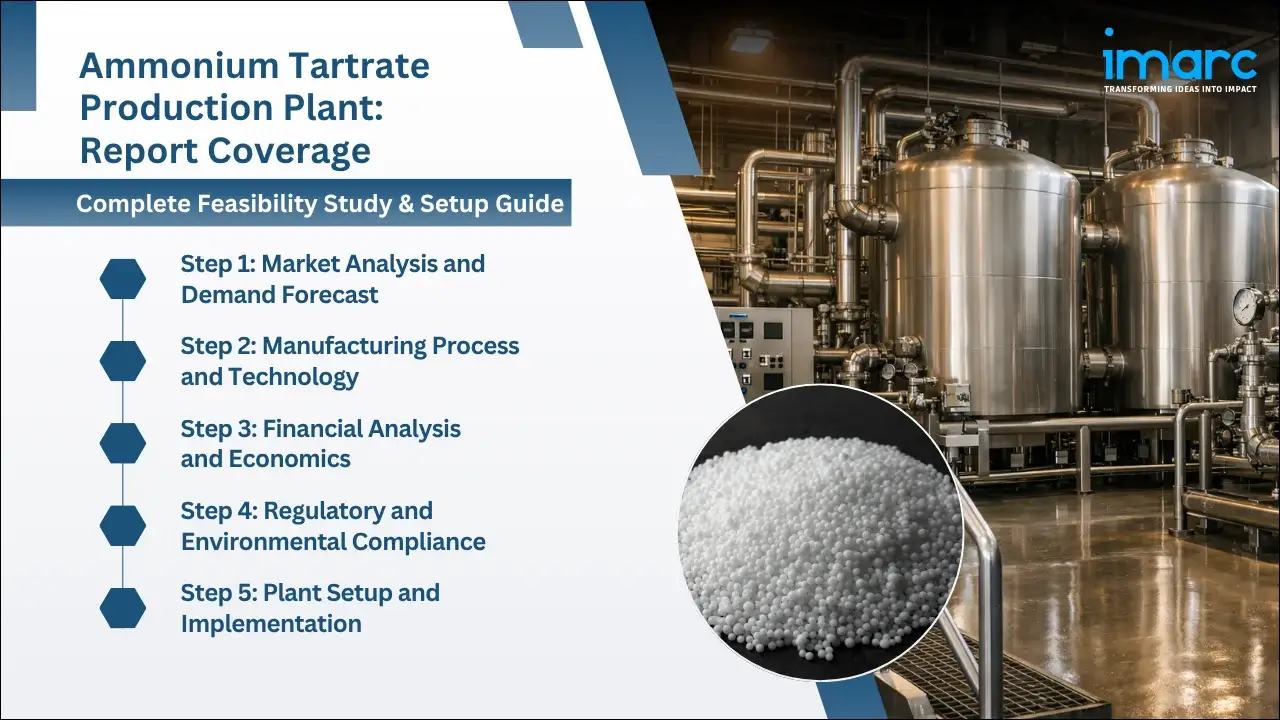
This feasibility report covers a comprehensive market overview to micro-level information such as unit operations involved, raw material requirements, utility requirements, infrastructure requirements, machinery and technology requirements, manpower requirements, packaging requirements, transportation requirements, etc.
The ammonium tartrate production plant setup cost is provided in detail covering project economics, capital investments (CapEx), project funding, operating expenses (OpEx), income and expenditure projections, fixed costs vs. variable costs, direct and indirect costs, expected ROI and net present value (NPV), profit and loss account, financial analysis, etc.
Access the Detailed Feasibility Analysis, Request Sample
What is Ammonium Tartrate ?
Ammonium tartrate is an ammonium salt of tartaric acid with the chemical formula (NH₄)₂C₄H₄O₆. It is a white, crystalline, extremely water-soluble substance that is often made by carefully neutralizing tartaric acid with ammonium carbonate, ammonium bicarbonate, or aqueous ammonia, then crystallizing, filtering, drying, testing for quality, and packaging. Given its remarkable buffering properties and compatibility with analytical methods, ammonium tartrate is widely used in chromatography, pharmaceutical research, biotechnology, analytical chemistry, and laboratory applications. It is also utilized as a specialty reagent in chemical synthesis and instrumental analysis. Commercial production places a strong priority on batch consistency, high purity, and adherence to laboratory-grade quality standards in order to provide reliable analytical performance.
Key Investment Highlights
- Process Used: Ammonium carbonate, ammonium bicarbonate, or aqueous ammonia are used to neutralize tartaric acid under controlled conditions. This is followed by crystallization, filtering, drying, quality testing, and packaging.
- End-use Industries: Pharmaceuticals, biotechnology, analytical laboratories, research institutions, specialty chemicals, and academic laboratories.
- Applications: Chromatography buffer, analytical reagent, laboratory chemical, pharmaceutical research, biotechnology, protein characterization, and specialty chemical synthesis.
Ammonium Tartrate Plant Capacity:
The proposed production facility is designed with an annual production capacity of 2,000 MT, enabling economies of scale while maintaining operational flexibility.
Ammonium Tartrate Plant Profit Margins:
The project demonstrates healthy profitability potential under normal operating conditions. Gross profit margins typically range between 24-32%, supported by stable demand and value-added applications.
- Gross Profit: 24-32%
- Net Profit: 14-20%
Ammonium Tartrate Plant Plant Project:
The operating cost structure of an ammonium tartrate production plant is primarily driven by raw material consumption, including tartaric acid, ammonia, and water, which accounts for approximately 58-68% of total operating expenses (OpEx).
- Raw Materials: 58-68% of OpEx
- Utilities: 6-10% of OpEx
Financial Projection:
The financial projections for the proposed project have been developed based on realistic assumptions related to capital investment, operating costs, production capacity utilization, pricing trends, and demand outlook. These projections provide a comprehensive view of the project’s financial viability, ROI, profitability, and long-term sustainability.
Major Applications:
- Pharmaceutical Research: Applied to quality control, pharmaceutical characterisation, and analytical method development.
- Biotechnology: Used in mass spectrometry, protein analysis, and antibody characterisation processes as a volatile buffer.
- Chromatography: Used in analytical techniques compatible with mass spectrometry, HPLC, and hydrophobic interaction chromatography (HIC).
- Analytical Laboratories: Utilized as a reference chemical, calibration element, analytical buffer, and laboratory reagent.
- Specialty Chemical Research: Used in materials research, coordination chemistry, and chemical synthesis where high-purity ammonium salts are needed.
Why Ammonium Tartrate Production?
- Growing Biopharmaceutical Industry: The need for high-purity analytical reagents is rising due to the growth of biologics and antibody-based treatments.
- Growing Analytical Testing: Consumption is still supported by the expanding use of mass spectrometry and chromatography in pharmaceutical quality control.
- Growth of Biotechnology Research: Laboratory demand is being driven by increased investment in biomolecular analysis and protein characterization.
- Growth in Research Laboratories: Purchases of specialty analytical chemicals continue to rise in academic, pharmaceutical, and contract research laboratories.
- High-value Specialty Chemical: Rather than huge production numbers, commercial production prioritizes purity, batch consistency, analytical certification, and regulatory compliance.
Transforming Vision into Reality:
This report provides the comprehensive blueprint needed to transform your ammonium tartrate production vision into a technologically advanced and highly profitable reality.
Ammonium Tartrate Industry Outlook 2026:
The ammonium tartrate market outlook remains positive, backed by a rise in analytical laboratory work, biotechnology innovation, and pharmaceutical research. The need for high-purity analytical buffers is still being driven by the increasing use of sophisticated chromatographic techniques for protein analysis, pharmaceutical quality control, and biologics characterization. According to the India Brand Equity Foundation (IBEF), the Indian pharmaceutical industry is projected to reach approximately US$130 billion by 2030, supported by expanding domestic manufacturing, exports, research investment, and government initiatives to strengthen pharmaceutical production. Throughout the projection period, the demand for specialized analytical chemicals like ammonium tartrate is anticipated to be sustained by the ongoing expansion of pharmaceutical R&D, biologics research, and analytical testing infrastructure.
Leading Ammonium Tartrate Producers:
Leading producers in the global ammonium tartrate industry include several multinational companies with extensive production capacities and diverse application portfolios. Key players include:
- Sisco Research Laboratories Pvt. Ltd.
- Merck KGaA
- Thermo Fisher Scientific Inc.
- Avantor Inc.
- Central Drug House (P) Ltd.
all of which serve end-use sectors such as pharmaceuticals, biotechnology, analytical laboratories, research institutions, specialty chemicals, and academic laboratories.
How to Setup an Ammonium Tartrate Production Plant?
Setting up an ammonium tartrate production plant requires evaluating several key factors, including technological requirements and quality assurance.
Some of the critical considerations include:
- Detailed Process Flow: The production process is a multi-step operation that involves several unit operations, material handling, and quality checks. Below are the main stages involved in the ammonium tartrate production process flow:
- Unit Operations Involved
- Mass Balance and Raw Material Requirements
- Quality Assurance Criteria
- Technical Tests
- Site Selection: The location must offer easy access to key raw materials such as tartaric acid, ammonia, and water. Proximity to target markets will help minimize distribution costs. The site must have robust infrastructure, including reliable transportation, utilities, and waste management systems. Compliance with local zoning laws and environmental regulations must also be ensured.
- Plant Layout Optimization: The layout should be optimized to enhance workflow efficiency, safety, and minimize material handling. Separate areas for raw material storage, production, quality control, and finished goods storage must be designated. Space for future expansion should be incorporated to accommodate business growth.
- Equipment Selection: High-quality, corrosion-resistant machinery tailored for ammonium tartrate production must be selected. Essential equipment includes tartaric acid storage tanks, ammonium carbonate or ammonia dosing systems, neutralization reactors, crystallizers, filtration units, centrifuges, vacuum or tray dryers, milling equipment, sieving machines, storage bins, weighing and packaging systems, dust collection units, and automated process control systems. All machinery must comply with industry standards for safety, efficiency, and reliability.
- Raw Material Sourcing: Reliable suppliers must be secured for raw materials such as tartaric acid, ammonia, and water to ensure consistent production quality. Minimizing transportation costs by selecting nearby suppliers is essential. Sustainability and supply chain risks must be assessed, and long-term contracts should be negotiated to stabilize pricing and ensure a steady supply.
- Safety and Environmental Compliance: Safety protocols must be implemented throughout the production process of ammonium tartrate . Advanced monitoring systems should be installed to detect leaks or deviations in the process. Effluent treatment systems are necessary to minimize environmental impact and ensure compliance with emission standards.
- Quality Assurance Systems: A comprehensive quality management system should be implemented across all stages of operations to ensure consistent product and service standards. Appropriate testing, monitoring, and validation processes must be established to evaluate performance, safety, reliability, and compliance with applicable regulatory and industry requirements. Standard operating procedures (SOPs), documentation protocols, and traceability mechanisms should be maintained to support transparency, risk management, and continuous improvement. Regular audits, inspections, and corrective action frameworks should also be integrated to enhance overall operational excellence.
Project Economics:
Establishing and operating an ammonium tartrate production plant involves various cost components, including:
- Capital Investment: The total capital investment depends on plant capacity, technology, and location. This investment covers land acquisition, site preparation, and necessary infrastructure.
- Equipment Costs: Equipment costs, such as those for tartaric acid storage tanks, ammonium carbonate or ammonia dosing systems, neutralization reactors, crystallizers, filtration units, centrifuges, vacuum or tray dryers, milling equipment, sieving machines, storage bins, weighing and packaging systems, dust collection units, and automated process control systems. The scale of production and automation level will determine the total cost of machinery.
- Raw Material Expenses: Raw materials, including tartaric acid, ammonia, and water are a major part of operating costs. Long-term contracts with reliable suppliers will help mitigate price volatility and ensure a consistent supply of materials.
- Infrastructure and Utilities: Costs associated with land acquisition, construction, and utilities (electricity, water, steam) must be considered in the financial plan.
- Operational Costs: Ongoing expenses for labor, maintenance, quality control, and environmental compliance must be accounted for. Optimizing processes and providing staff training can help control these operational costs.
- Financial Planning: A detailed financial analysis, including income projections, expenditures, and break-even points, must be conducted. This analysis aids in securing funding and formulating a clear financial strategy.
Capital Expenditure (CapEx) and Operational Expenditure (OpEx) Analysis:
Capital Investment (CapEx): Machinery costs account for the largest portion of the total capital expenditure. The cost of land and site development, including charges for land registration, boundary development, and other related expenses, forms a substantial part of the overall investment. This allocation ensures a solid foundation for safe and efficient plant operations.
Operating Expenditure (OpEx): In the first year of operations, the operating cost for the ammonium tartrate production plant is projected to be significant, covering raw materials, utilities, depreciation, taxes, packing, transportation, and repairs and maintenance. By the fifth year, the total operational cost is expected to increase substantially due to factors such as inflation, market fluctuations, and potential rises in the cost of key materials. Additional factors, including supply chain disruptions, rising consumer demand, and shifts in the global economy, are expected to contribute to this increase.
.webp)
Capital Expenditure Breakdown:
| Particulars | Cost (in US$) |
|---|---|
| Land and Site Development Costs | XX |
| Civil Works Costs | XX |
| Machinery Costs | XX |
| Other Capital Costs | XX |
To access CapEx Details, Request Sample
Operational Expenditure Breakdown:
| Particulars | In % |
|---|---|
| Raw Material Cost | 58-68% |
| Utility Cost | 6-10% |
| Transportation Cost | XX |
| Packaging Cost | XX |
| Salaries and Wages | XX |
| Depreciation | XX |
| Taxes | XX |
| Other Expenses | XX |
To access OpEx Details, Request Sample
Profitability Analysis:
| Particulars | Unit | Year 1 | Year 2 | Year 3 | Year 4 | Year 5 | Average |
|---|---|---|---|---|---|---|---|
| Total Income | US$ | XX | XX | XX | XX | XX | XX |
| Total Expenditure | US$ | XX | XX | XX | XX | XX | XX |
| Gross Profit | US$ | XX | XX | XX | XX | XX | XX |
| Gross Margin | % | XX | XX | XX | XX | XX | 24-32% |
| Net Profit | US$ | XX | XX | XX | XX | XX | XX |
| Net Margin | % | XX | XX | XX | XX | XX | 14-20% |
To access Financial Analysis, Request Sample
Latest Industry Development:
- January 2026: LCGC International (Chromatography Online) highlighted a rapid native hydrophobic interaction chromatography–mass spectrometry (HIC–MS) workflow that utilizes ammonium tartrate as a volatile mobile-phase salt for the characterization of antibody–drug conjugates (ADCs). Compared to traditional high-salt HIC approaches, the approach improves mass spectrometry compatibility and maintains native protein structure while enabling reliable drug-to-antibody ratio (DAR) and drug load distribution (DLD) characterization. Additionally, the procedure includes an online size-exclusion chromatography desalting step that supports real-time process analytical technology (PAT) monitoring during ADC bioconjugation and enables 22-minute high-resolution ADC characterization. The development highlights the increasing significance of ammonium tartrate in biologics quality control and sophisticated biopharmaceutical analytical procedures.
Report Coverage:
| Report Features | Details |
|---|---|
| Product Name | Ammonium Tartrate |
| Report Coverage | Detailed Process Flow: Unit Operations Involved, Quality Assurance Criteria, Technical Tests, Mass Balance, and Raw Material Requirements Land, Location and Site Development: Selection Criteria and Significance, Location Analysis, Project Planning and Phasing of Development, Environmental Impact, Land Requirement and Costs Plant Layout: Importance and Essentials, Layout, Factors Influencing Layout Plant Machinery: Machinery Requirements, Machinery Costs, Machinery Suppliers (Provided on Request) Raw Materials: Raw Material Requirements, Raw Material Details and Procurement, Raw Material Costs, Raw Material Suppliers (Provided on Request) Packaging: Packaging Requirements, Packaging Material Details and Procurement, Packaging Costs, Packaging Material Suppliers (Provided on Request) Other Requirements and Costs: Transportation Requirements and Costs, Utility Requirements and Costs, Energy Requirements and Costs, Water Requirements and Costs, Human Resource Requirements and Costs Project Economics: Capital Costs, Techno-Economic Parameters, Income Projections, Expenditure Projections, Product Pricing and Margins, Taxation, Depreciation Financial Analysis: Liquidity Analysis, Profitability Analysis, Payback Period, Net Present Value, Internal Rate of Return, Profit and Loss Account, Uncertainty Analysis, Sensitivity Analysis, Economic Analysis Other Analysis Covered in The Report: Market Trends and Analysis, Market Segmentation, Market Breakup by Region, Price Trends, Competitive Landscape, Regulatory Landscape, Strategic Recommendations, Case Study of a Successful Venture |
| Currency | US$ (Data can also be provided in the local currency) |
| Customization Scope | The report can also be customized based on the requirement of the customer |
| Post-Sale Analyst Support | 10-12 Weeks |
| Delivery Format | PDF and Excel through email (We can also provide the editable version of the report in PPT/Word format on special request) |
Report Customization
While we have aimed to create an all-encompassing ammonium tartrate production plant project report, we acknowledge that individual stakeholders may have unique demands. Thus, we offer customized report options that cater to your specific requirements. Our consultants are available to discuss your business requirements, and we can tailor the report's scope accordingly. Some of the common customizations that we are frequently requested to make by our clients include:
- The report can be customized based on the location (country/region) of your plant.
- The plant’s capacity can be customized based on your requirements.
- Plant machinery and costs can be customized based on your requirements.
- Any additions to the current scope can also be provided based on your requirements.
Why Buy IMARC Reports?
- The insights provided in our reports enable stakeholders to make informed business decisions by assessing the feasibility of a business venture.
- Our extensive network of consultants, raw material suppliers, machinery suppliers and subject matter experts spans over 100+ countries across North America, Europe, Asia Pacific, South America, Africa, and the Middle East.
- Our cost modeling team can assist you in understanding the most complex materials. With domain experts across numerous categories, we can assist you in determining how sensitive each component of the cost model is and how it can affect the final cost and prices.
- We keep a constant track of land costs, construction costs, utility costs, and labor costs across 100+ countries and update them regularly.
- Our client base consists of over 3000 organizations, including prominent corporations, governments, and institutions, who rely on us as their trusted business partners. Our clientele varies from small and start-up businesses to Fortune 500 companies.
- Our strong in-house team of engineers, statisticians, modeling experts, chartered accountants, architects, etc. has played a crucial role in constructing, expanding, and optimizing sustainable production plants worldwide.
Need more help?
- Speak to our experienced analysts for insights on the current market scenarios.
- Include additional segments and countries to customize the report as per your requirement.
- Gain an unparalleled competitive advantage in your domain by understanding how to utilize the report and positively impacting your operations and revenue.
- For further assistance, please connect with our analysts.


Factory Setup Services
IMARC Group's factory setup services streamline the entire establishment process, ensuring efficient planning, seamless execution, and optimal operational readiness for your manufacturing facility.


Site Selection Services
IMARC Group's site selection services optimize location choices for businesses, ensuring strategic, cost-effective, and efficient manufacturing operations.


Factory Audit Services
IMARC Group's plant audit services offer comprehensive evaluations of your industrial facility's health, efficiency, and regulatory compliance.


Regulatory Approvals, and Licensing Services
IMARC Group's regulatory approval and licensing services ensure businesses meet all compliance requirements, facilitating smooth and timely market entry.
 Inquire Before Buying
 Speak to an Analyst
 Request Brochure
 Request Customization
Related Reports

Frequently Asked Questions
Capital requirements generally include land acquisition, construction, equipment procurement, installation, pre-operative expenses, and initial working capital. The total amount varies with capacity, technology, and location.
To start an ammonium tartrate production business, one needs to conduct a market feasibility study, secure required licenses, arrange funding, select suitable land, procure equipment, recruit skilled labor, and establish a supply chain and distribution network.
Ammonium tartrate production requires raw materials such as tartaric acid and an ammonium source, such as ammonium carbonate or ammonia (or ammonium hydroxide). These are reacted, typically in an aqueous solution, to form ammonium tartrate.
An ammonium tartrate factory typically requires reactors with agitation, filtration units, crystallizers, centrifuges, drying equipment, storage tanks, pH-control systems, heat exchangers, water-treatment units, packaging machines, and material-handling systems, along with safety, ventilation, and quality-testing instruments.
The main steps generally include:
-
Preparing reactants in controlled mixing conditions
-
Reacting tartaric acid with ammonium source
-
Monitoring pH to guide salt formation
-
Filtering reaction mixture to remove impurities
-
Crystallizing ammonium tartrate under controlled cooling
-
Centrifuging crystals to remove moisture
-
Packaging, storage, and distribution
Usually, the timeline can range from 12 to 24 months to start an ammonium tartrate production plant, depending on factors like site development, machinery installation, environmental clearances, safety measures, and trial runs.
Challenges may include high capital requirements, securing regulatory approvals, ensuring raw material supply, competition, skilled manpower availability, and managing operational risks.
Typical requirements include business registration, environmental clearances, factory licenses, fire safety certifications, and industry-specific permits. Local/state/national regulations may apply depending on the location.
The top ammonium tartrate producers are:
-
Ningbo Jinzhan
-
Showa Kako
-
Muby Chemicals
-
Sigma-Aldrich
-
Loba Chemie
Profitability depends on several factors including market demand, production efficiency, pricing strategy, raw material cost management, and operational scale. Profit margins usually improve with capacity expansion and increased capacity utilization rates.
Cost components typically include:
-
Land and Infrastructure
-
Machinery and Equipment
-
Building and Civil Construction
-
Utilities and Installation
-
Working Capital
Break even in an ammonium tartrate production business typically range from 3 to 6 years, depending on scale, regulatory compliance costs, raw material pricing, and market demand. Efficient production and export opportunities can help accelerate returns.
Governments may offer incentives such as capital subsidies, tax exemptions, reduced utility tariffs, export benefits, or interest subsidies to promote manufacturing under various national or regional industrial policies.
Financing can be arranged through term loans, government-backed schemes, private equity, venture capital, equipment leasing, or strategic partnerships. Financial viability assessments help identify optimal funding routes.
Choose your plan
*Please note that the prices mentioned below are starting prices for each bundle type. Kindly contact our team for further details.*
Single User License
- 1 User License, Access on 2 Devices
- PDF Report + Excel Dataset (Password Protected)
- Lifetime Access
- No Printing Rights
- 10% Free Report Customization
- 10–12 Weeks of Analyst Support
Five User License
- Access for 5 Users, 2 Devices per User
- PDF Report + Excel Dataset (Password Protected)
- Lifetime Access
- Dedicated Account Manager
- 12–14 Weeks of Analyst Support
- No Printing Rights
- 15% Free Report Customization
- 25% Discount on Your Next Purchase
Corporate User License
- Unlimited User Access (Within Your Organization)
- PDF Report + Excel Dataset
- Lifetime Access
- Dedicated Account Manager
- 14–20 Weeks of Analyst Support
- No Printing Rights
- 20% Free Report Customization
- 30% Discount on Your Next Purchase
Essential Insights
What's included:
3 reports
- Lifetime Access
- PDF Reports
- Excel Datasets
- 2 Weeks of Free Analyst Support
- 2 User Licenses
- Access on 2 Devices
- Printing Rights
- Complimentary PowerPoint (PPT) Version
- Complimentary License Upgrade
Professional Access
What's included:
5 reports
- Lifetime Access
- PDF Reports
- Excel Datasets
- 8 Weeks of Free Analyst Support
- 2 User Licenses
- Access on 2 Devices
- Printing Rights
- Complimentary PowerPoint (PPT) Version
- Complimentary License Upgrade
Business Advantage
What's included:
8 reports
- Lifetime Access
- PDF Reports
- Excel Datasets
- 14 Weeks of Free Analyst Support
- 2 User Licenses
- Access on 2 Devices
- Printing Rights
- Complimentary PowerPoint (PPT) Version
- Complimentary License Upgrade
Enterprise Intelligence
What's included:
10 reports
- Lifetime Access
- PDF Reports
- Excel Datasets
- 20 Weeks of Free Analyst Support
- 2 User Licenses
- Access on 2 Devices
- Printing Rights
- Complimentary PowerPoint (PPT) Version
- Complimentary License Upgrade