
Appointment Scheduling Software Market Size, Share, Trends and Forecast by Type, Deployment Type, Organization Size, End Use Industry, and Region, 2026-2034
Appointment Scheduling Software Market Size and Share:
The global appointment scheduling software market size was valued at USD 447.76 Million in 2025. Looking forward, IMARC Group estimates the market to reach USD 1,181.91 Million by 2034, exhibiting a CAGR of 10.43% from 2026-2034. North America currently dominates the market, holding a market share of 43.2% in 2025. The region benefits from high digital adoption rates, a strong corporate sector presence, substantial investments in cloud-based technologies, and widespread integration of AI-powered scheduling tools across healthcare, finance, and professional services industries, all contributing to the appointment scheduling software market share.
The increased interest in operational efficiency in businesses around the world is fueling the adoption of automated appointment scheduling systems that help minimize administrative workload and avoid human errors. The emergence of remote and virtual work styles is encouraging businesses to adopt digital appointment scheduling systems that help manage virtual meetings and appointments. Moreover, the development of AI-powered appointment scheduling assistants is fueling the adoption of automation and reducing the likelihood of scheduling conflicts. It is helping businesses optimize the allocation of time. The increased focus on customer interactions and the delivery of differentiated services is compelling businesses to adopt advanced appointment scheduling systems that integrate CRM functionalities. Additionally, the need for regulatory compliance in the healthcare and financial services industries is fueling the adoption of appointment scheduling systems.
The United States has turned out to be an important region in the appointment scheduling software market because of various reasons. For instance, the focus on customer experience is prompting companies to invest in scheduling software that offers self-service booking capabilities and omnichannel communication capabilities like SMS and email reminders. As of 2024, the total number of small enterprises in the country stood at 34.8 million. This has created a need among small enterprises to automate processes using cost-effective scheduling software like appointment scheduling software. For instance, the rising popularity of telehealth services is boosting the growth of the market in the healthcare sector. Additionally, the rapid digitalization of service industries like salons, fitness centers, consulting services, and law firms is boosting the growth of the appointment scheduling software market in the country.
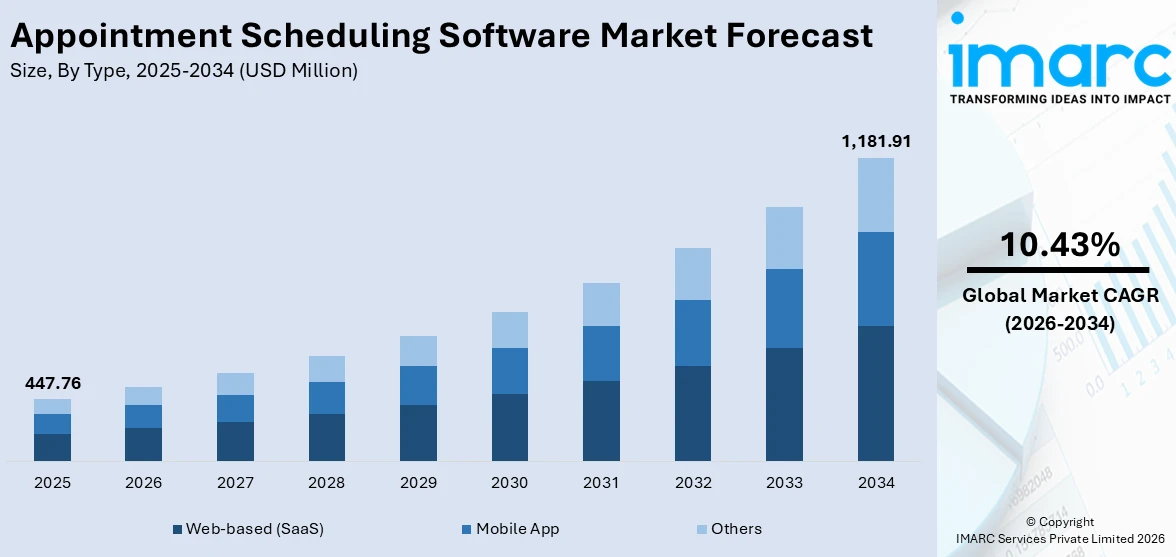
To get more information on this market Request Sample
Appointment Scheduling Software Market Trends:
Integration with AI and Automation
Artificial intelligence (AI) and automation are transforming the appointment scheduling software market, significantly reducing human effort while improving booking accuracy and operational efficiency. AI-driven scheduling platforms operate around the clock, enabling users to schedule, reschedule, or cancel appointments without any manual intervention. These intelligent systems analyze historical booking patterns and optimize suggested time slots to prevent overbooking while providing data-driven recommendations. Predictive analytics capabilities enable businesses to anticipate demand fluctuations, allocate resources more effectively, and enhance overall customer satisfaction levels. Automated reminders delivered through emails, SMS, or push notifications are substantially reducing missed appointments and improving revenue retention rates for service providers. In 2024, Alaska Airlines, collaborating with UP.Labs, launched a new software platform known as Odysee, designed to streamline flight scheduling, which is one of the most intricate aspects of an airline’s operations. The technology debuted with $5 million in initial funding sourced from UP.Partners, a venture firm located in Santa Monica, California. It was unveiled at the UP.Summit 2024 Community Day, an event featuring the newest transportation innovations, conducted on September 29, 2024.
Rising Adoption of Cloud-Based Solutions
Cloud-based appointment scheduling software is gaining substantial traction owing to its flexibility, accessibility, and cost-effectiveness, which represents a notable appointment scheduling software market outlook. Unlike traditional on-premises systems, cloud systems remove the need for significant infrastructure requirements while reducing the cost of maintenance without compromising the level of scalability. Organizations can easily integrate these systems with customer relationship management systems, payment gateway systems, and communication systems for efficient management of the workflow. Additionally, cloud systems ensure the synchronization of data in real-time using various devices, allowing the user to access and manage their schedules from anywhere and at any given time. Moreover, the enhanced level of security using encryption and multi-factor authentication ensures the efficient management of critical scheduling information. Organizations will benefit from the automatic update of the software, allowing for uninterrupted access to the latest versions of the system. IMARC Group states that the global cloud managed services market is expected to reach USD 172.1 Billion by 2034.
Growing Mobile Optimization and Accessibility
As global smartphone usage continues to rise, mobile optimization has become essential for appointment scheduling software, impacting the overall appointment scheduling software market forecast. Users prefer to book, edit, or even cancel appointments using their mobile devices. This has been found to offer improved convenience. Mobile scheduling applications offer improved user experience with user-friendly interfaces, real-time availability updates, and push notification services. Location-based scheduling services enable customers to book services at the nearest branch. This improves customer experience. Mobile assistants powered by AI help in the streamlined process of appointment management. Digital wallet integrations enable instant transactions. For example, in 2025, Shree Krishna Hospital in India launched a mobile application that enabled patients to register, view diagnostic reports, book home care services, and schedule appointments at their own time. Mobile design principles, device compatibility, and in-app booking capabilities continue to boost the adoption rate in service-oriented industries.
Appointment Scheduling Software Industry Segmentation:
IMARC Group provides an analysis of the key trends in each segment of the global appointment scheduling software market, along with forecast at the global, regional, and country levels from 2026-2034. The market has been categorized based on type, deployment type, organization size, and end use industry.
Analysis by Type:
- Web-based (SaaS)
- Mobile App
- Others
Web-based (SaaS) holds 62.5% of the market share. Web-based SaaS appointment scheduling solutions are favored for their accessibility, scalability, and cost-effectiveness, enabling businesses to manage bookings through cloud-based platforms without requiring on-premises infrastructure. These solutions offer real-time booking, automated reminders, and calendar synchronization features that streamline operations across diverse industries. The flexibility of subscription-based pricing plans reduces upfront costs while providing continuous access to the latest software updates and security improvements. The increasing acceptance of digital solutions, particularly among small and medium enterprises, continues to drive strong demand for SaaS-based scheduling platforms powered by AI and analytics capabilities.

Analysis by Deployment Type:
- On-premises
- Cloud-based
Cloud-based leads the market with a share of 72.5%. Cloud-based deployment offers flexibility, scalability, and cost-effectiveness for businesses seeking streamlined appointment scheduling software. Small and medium enterprises, along with service-based industries, prefer this model for its low upfront investment requirements, automatic updates, and remote accessibility features. Cloud-based solutions enable real-time appointment management, automated reminders, and mobile access for seamless connectivity across distributed teams and customer bases. Advanced security protocols, including encrypted data storage and multi-factor authentication, protect sensitive scheduling information while reducing IT overhead expenses. Integration with CRM platforms, payment gateways, and third-party applications further enhances operational efficiency, making cloud-based deployment the preferred choice for organizations prioritizing agility and digital transformation.
Analysis by Organization Size:
- Small and Medium Enterprises
- Large Enterprises
Small and medium enterprises dominates the market, with a share of 58.5%. Small and medium enterprises are increasingly recognizing the value of efficient scheduling solutions to compete effectively and optimize their operations. These organizations often face resource constraints that make manual appointment management impractical, driving adoption of automated scheduling platforms. The availability of affordable cloud-based solutions with subscription pricing models has made advanced scheduling capabilities accessible without significant upfront capital investment. SaaS-based scheduling platforms enable smaller organizations to access enterprise-grade features including AI-powered analytics, automated reminders, and CRM integration at manageable costs. The growing emphasis on digital transformation among smaller businesses continues to fuel demand for scheduling software as an essential operational efficiency tool.
Analysis by End Use Industry:
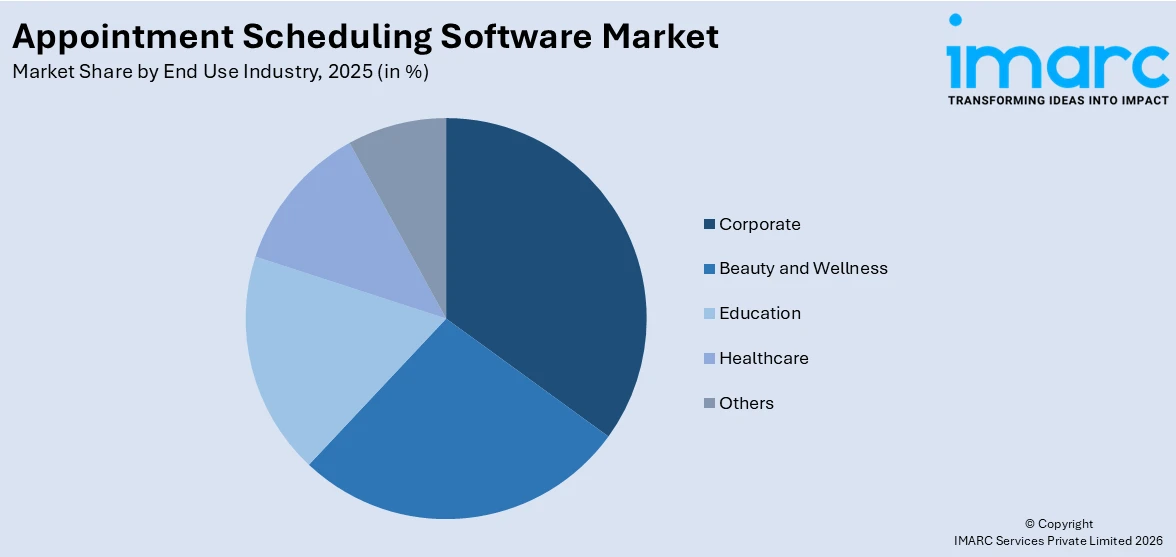
Access the comprehensive market breakdown Request Sample
- Corporate
- Beauty and Wellness
- Education
- Healthcare
- Others
Corporate represents the leading segment, with a market share of 26.5%. The corporate sector drives significant demand for appointment scheduling software to enhance operational efficiency, optimize workforce management, and improve client interaction processes. Businesses in consulting, legal, finance, and IT services rely on scheduling platforms for meeting coordination, reducing scheduling conflicts, and automating appointment reminders. Calendar synchronization, video conferencing integrations, and AI-assisted scheduling features empower enterprises to manage internal meetings, client appointments, and interviews seamlessly. The increasing prevalence of remote and hybrid work models continues to fuel corporate demand for digital scheduling tools that facilitate smooth collaboration and resource utilization across geographically dispersed teams.
Regional Analysis:
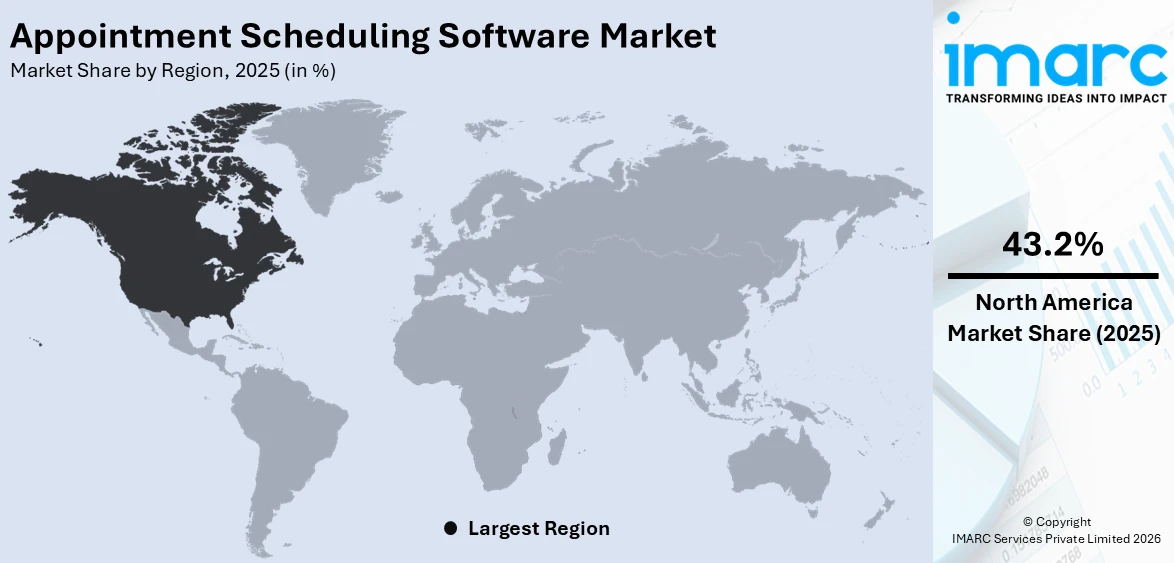
To get more information on the regional analysis of this market Request Sample
- North America
- United States
- Canada
- Asia Pacific
- China
- Japan
- India
- South Korea
- Australia
- Indonesia
- Others
- Europe
- Germany
- France
- United Kingdom
- Italy
- Spain
- Russia
- Others
- Latin America
- Brazil
- Mexico
- Others
- Middle East and Africa
North America, accounting for 43.2% of the share, enjoys the leading position in the market. The region benefits from high digital adoption rates, a strong corporate sector presence, and substantial demand for automation across healthcare, finance, retail, and IT industries. Cloud-based systems and SaaS deployment models are fueling market expansion, with businesses demanding remote accessibility, real-time scheduling capabilities, and seamless integration with CRM and communication tools. Moreover, approximately 22.8% of employed persons in the United States worked remotely at least partially in 2024, accelerating demand for digital scheduling solutions. Regulatory compliance requirements in industries such as healthcare and financial services further drive the adoption of secure and customizable scheduling platforms. The prevailing hybrid work model trend, combined with expanding telehealth services, continues to accelerate adoption across the region.
Key Regional Takeaways:
United States Appointment Scheduling Software Market Analysis
The United States holds 88.70% of the market share in North America. The U.S. appointment scheduling software industry is experiencing sustained growth, driven by increasing demand across the healthcare, education, and corporate sectors. The healthcare industry represents one of the most prominent end-users, with high adoption rates driven by the need for streamlined patient management and appointment coordination. Greater utilization of cloud-based technologies and AI-driven automation tools further accelerates market expansion across the country. Telehealth integration, automated reminders, and multi-platform support features are enhancing the capabilities of leading scheduling platforms. According to the U.S. Department of Health and Human Services, the 21st Century Cures Act continues to support digital health innovation, driving substantial investment in healthcare IT solutions including appointment scheduling platforms. Federal support for digital transformation in healthcare, combined with the rapid digitalization of professional services sectors, ensures sustained demand for scheduling software solutions. The growing preference for self-service booking options among consumers and the expansion of omnichannel communication capabilities further strengthen market dynamics.
Europe Appointment Scheduling Software Market Analysis
Europe's appointment scheduling software market is witnessing robust growth driven by the increasing digitalization of healthcare and service sectors. Countries such as Germany, the United Kingdom, and France have prioritized digital transformation in healthcare delivery, which has led to notable growth in scheduling software adoption across the region. The rising demand for telemedicine solutions and effective customer management systems in sectors such as beauty, retail, and professional services further supports market expansion. Moreover, a major number of enterprises in the European Union purchased cloud-computing services, reflecting a continued upward trend in digital adoption. AI integration for personalized scheduling and automated workflow management is gaining significant traction. Data privacy regulations, including GDPR, are compelling the adoption of secure and compliant scheduling platforms that meet stringent data protection standards, further propelling the appointment scheduling software market trends in the region.
Asia-Pacific Appointment Scheduling Software Market Analysis
The Asia-Pacific region is emerging as a rapidly growing market for appointment scheduling software, driven by accelerating digital transformation across healthcare, education, and corporate sectors. Rising smartphone penetration, expanding internet connectivity, and increasing adoption of cloud-based business solutions are fueling demand throughout the region. In May 2025, Karnataka launched an app for booking appointments with the CM. Governments in countries such as India, China, Japan, and Australia are actively promoting digital health initiatives, encouraging the integration of scheduling technologies across public and private healthcare systems to improve patient access.
Latin America Appointment Scheduling Software Market Analysis
Latin America's appointment scheduling software market is experiencing steady growth as businesses across the region increasingly embrace digital transformation to improve operational efficiency and customer engagement. The expanding service sector in countries such as Brazil and Mexico is driving demand for automated scheduling platforms that streamline appointment management and reduce administrative overhead. In 2025, Brazil's national digital health strategy accelerated the integration of electronic scheduling systems across public healthcare facilities, improving patient access and reducing wait times. The growing availability of affordable cloud-based solutions is enabling small and medium enterprises to adopt scheduling technologies previously accessible only to larger organizations.
Middle East and Africa Appointment Scheduling Software Market Analysis
The Middle East and Africa appointment scheduling software market is witnessing gradual expansion driven by increasing investments in digital infrastructure and the growing modernization of healthcare and service sectors. The United Arab Emirates and Saudi Arabia are leading digital transformation efforts in the region, with government-backed initiatives promoting the adoption of smart healthcare solutions. In 2025, Saudi Arabia's Vision 2030 digital health initiatives continued to drive adoption of electronic appointment management systems across public and private healthcare facilities, improving service accessibility and operational efficiency. The rising smartphone penetration and expanding internet connectivity across the region are further supporting the adoption of cloud-based scheduling platforms.
Competitive Landscape:
The appointment scheduling software market is characterized by intense competition, with established players and emerging entrants continuously innovating to expand their market presence. Leading companies are focusing on integrating advanced AI capabilities, natural language processing, and predictive analytics into their scheduling platforms to differentiate their offerings. Strategic partnerships, mergers, and acquisitions remain key growth strategies, as players seek to broaden their feature sets and geographical reach. The increasing emphasis on industry-specific solutions, particularly in healthcare, beauty and wellness, and corporate sectors, is driving product customization and vertical specialization. Cloud-based deployment and mobile-first design principles are being prioritized to meet the evolving expectations of digitally savvy customers. Companies are also investing in enhanced security features, including HIPAA compliance and GDPR adherence, to address growing data privacy concerns across regulated industries.
The report provides a comprehensive analysis of the competitive landscape in the appointment scheduling software market with detailed profiles of all major companies, including:
- 10to8 Ltd
- Acuity Scheduling Inc. (Squarespace Inc.)
- Appointy Software Inc.
- Melian Labs Inc.
- Mindbody Inc.
- Setmore Appointments
- SimplyBook.me
- Square Inc.
- SuperSaaS
- TimeTrade SilverCloud
Appointment Scheduling Software Market Report Scope:
| Report Features | Details |
|---|---|
| Base Year of the Analysis | 2025 |
| Historical Period | 2020-2025 |
| Forecast Period | 2026-2034 |
| Units | Million USD |
| Scope of the Report |
Exploration of Historical Trends and Market Outlook, Industry Catalysts and Challenges, Segment-Wise Historical and Future Market Assessment:
|
| Types Covered | Web-base (SaaS), Mobile App, Others |
| Deployment Types Covered | On-premises, Cloud-based |
| Organization Sizes Covered | Small and Medium Enterprises, Large Enterprises |
| End Use Industries Coverage | Corporate, Beauty and Wellness, Education, Healthcare, Others |
| Regions Covered | Asia Pacific, Europe, North America, Latin America, Middle East and Africa |
| Countries Covered | United States, Canada, Germany, France, United Kingdom, Italy, Spain, Russia, China, Japan, India, South Korea, Australia, Indonesia, Brazil, Mexico |
| Companies Covered | 10to8 Ltd, Acuity Scheduling Inc. (Squarespace Inc.), Appointy Software Inc., Melian Labs Inc., Mindbody Inc., Setmore Appointments, SimplyBook.me, Square Inc., SuperSaaS, TimeTrade SilverCloud, etc. |
| Customization Scope | 10% Free Customization |
| Post-Sale Analyst Support | 10-12 Weeks |
| Delivery Format | PDF and Excel through Email (We can also provide the editable version of the report in PPT/Word format on special request) |
Key Benefits for Stakeholders:
- IMARC’s report offers a comprehensive quantitative analysis of various market segments, historical and current market trends, market forecasts, and dynamics of the appointment scheduling software market from 2020-2034.
- The research study provides the latest information on the market drivers, challenges, and opportunities in the global appointment scheduling software market.
- The study maps the leading, as well as the fastest-growing, regional markets. It further enables stakeholders to identify the key country-level markets within each region.
- Porter's Five Forces analysis assists stakeholders in assessing the impact of new entrants, competitive rivalry, supplier power, buyer power, and the threat of substitution. It helps stakeholders to analyze the level of competition within the appointment scheduling software industry and its attractiveness.
- Competitive landscape allows stakeholders to understand their competitive environment and provides an insight into the current positions of key players in the market.
Frequently Asked Questions About the Appointment Scheduling Software Market Report
The appointment scheduling software market was valued at USD 447.76 Million in 2025.
The appointment scheduling software market is projected to exhibit a CAGR of 10.43% during 2026-2034, reaching a value of USD 1,181.91 Million by 2034.
The appointment scheduling software market is primarily driven by the rising demand for operational efficiency and automation across diverse industries, the expansion of remote and hybrid work models requiring digital scheduling tools, growing adoption of cloud-based SaaS solutions, increasing AI and chatbot integration for intelligent booking management, and the expanding digitalization of healthcare and professional services sectors.
North America currently dominates the appointment scheduling software market, accounting for a share of 43.2%. The region's dominance is attributed to high digital adoption rates, a strong corporate sector presence, substantial investments in cloud-based technologies, and widespread integration of AI-powered scheduling platforms.
Some of the major players in the appointment scheduling software market include 10to8 Ltd, Acuity Scheduling Inc. (Squarespace Inc.), Appointy Software Inc., Melian Labs Inc., Mindbody Inc., Setmore Appointments, SimplyBook.me, Square Inc., SuperSaaS, TimeTrade SilverCloud, etc.
Need more help?
- Speak to our experienced analysts for insights on the current market scenarios.
- Include additional segments and countries to customize the report as per your requirement.
- Gain an unparalleled competitive advantage in your domain by understanding how to utilize the report and positively impacting your operations and revenue.
- For further assistance, please connect with our analysts.
 Request Customization
 Speak to an Analyst
 Request Brochure
 Inquire Before Buying
Benefits of Customization
- Personalize this research
- Triangulate with your data
- Get data as per your format and definition
- Gain a deeper dive into a specific application, geography, customer, or competitor
- Any level of personalization
Get in Touch With Us
UNITED STATES
Phone: +1-201-971-6302
INDIA
Phone: +91-120-433-0800
UNITED KINGDOM
Phone: +44-753-714-6104
Email: [email protected]
Client Testimonials




.webp)




.webp)













Related Reports

Choose your plan
*Please note that the prices mentioned below are starting prices for each bundle type. Kindly contact our team for further details.*
Single User License
- 1 User License, Access on 2 Devices
- PDF Report + Excel Dataset (Password Protected)
- Lifetime Access
- No Printing Rights
- 10% Free Report Customization
- 10–12 Weeks of Analyst Support
Five User License
- Access for 5 Users, 2 Devices per User
- PDF Report + Excel Dataset (Password Protected)
- Lifetime Access
- Dedicated Account Manager
- 12–14 Weeks of Analyst Support
- No Printing Rights
- 15% Free Report Customization
- 25% Discount on Your Next Purchase
Corporate User License
- Unlimited User Access (Within Your Organization)
- PDF Report + Excel Dataset
- Lifetime Access
- Dedicated Account Manager
- 14–20 Weeks of Analyst Support
- No Printing Rights
- 20% Free Report Customization
- 30% Discount on Your Next Purchase
Essential Insights
What's included:
3 reports
- Lifetime Access
- PDF Reports
- Excel Datasets
- 2 Weeks of Free Analyst Support
- 2 User Licenses
- Access on 2 Devices
- Printing Rights
- Complimentary PowerPoint (PPT) Version
- Complimentary License Upgrade
Professional Access
What's included:
5 reports
- Lifetime Access
- PDF Reports
- Excel Datasets
- 8 Weeks of Free Analyst Support
- 2 User Licenses
- Access on 2 Devices
- Printing Rights
- Complimentary PowerPoint (PPT) Version
- Complimentary License Upgrade
Business Advantage
What's included:
8 reports
- Lifetime Access
- PDF Reports
- Excel Datasets
- 14 Weeks of Free Analyst Support
- 2 User Licenses
- Access on 2 Devices
- Printing Rights
- Complimentary PowerPoint (PPT) Version
- Complimentary License Upgrade
Enterprise Intelligence
What's included:
10 reports
- Lifetime Access
- PDF Reports
- Excel Datasets
- 20 Weeks of Free Analyst Support
- 2 User Licenses
- Access on 2 Devices
- Printing Rights
- Complimentary PowerPoint (PPT) Version
- Complimentary License Upgrade