
Argentina Public Transport Market Size, Share, Trends and Forecast by Mode of Transport, Ownership, Ticketing System, Fuel Type, End User, and Region, 2026-2034
Argentina Public Transport Market Summary:
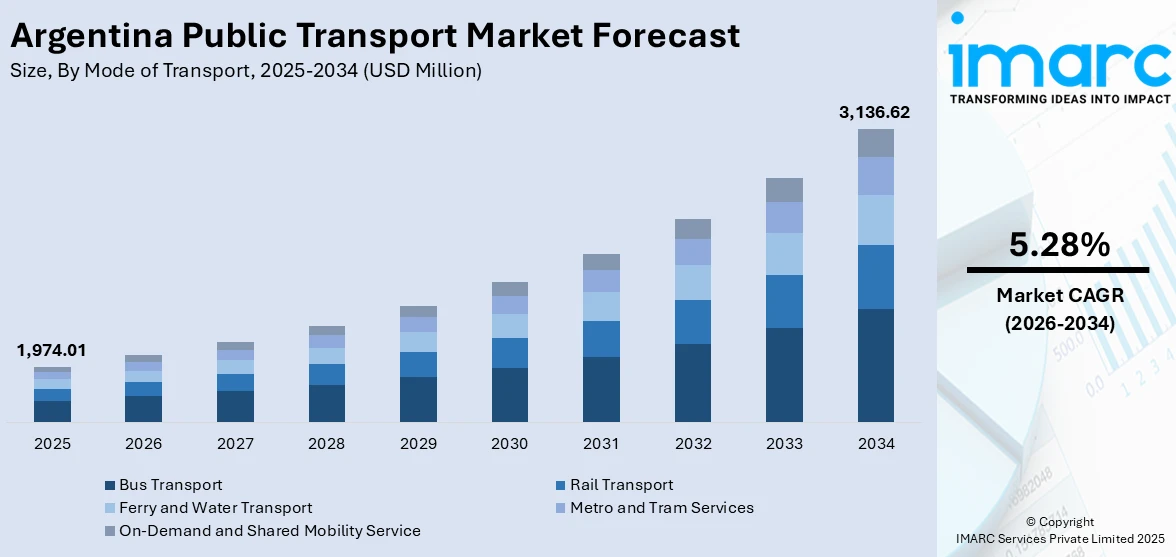
The Argentina public transport market size was valued at USD 1,974.01 Million in 2025 and is projected to reach USD 3,136.62 Million by 2034, growing at a compound annual growth rate of 5.28% from 2026-2034.
The public transport market in Argentina is showing continued traction influenced by trends such as urbanization, the government's efforts in modernizing transportation infrastructure, and the rise in demand for effective solutions in public transport. The securitization of digital ticketing systems, the rise in bus rapid transit corridors, and investments in renewing transport fleets are adding strength to the operational infrastructure of this space. Environmental concerns, along with changing patterns in transport modes, are further adding to Argentina public transport market share.
Key Takeaways and Insights:
-
By Mode of Transport: Bus transport dominates the market with a share of 46.3% in 2025, driven by the extensive urban and interurban bus network connecting metropolitan centers and suburban areas, high daily ridership volumes, and accessible fare structures that serve the majority of commuters nationwide.
-
By Ownership: Government/public-owned services lead the market with a share of 58.4% in 2025, reflecting the central role of state-operated transit systems, subsidized fare mechanisms, and public sector investment in maintaining and expanding transportation networks across urban and regional corridors.
-
By Ticketing System: Smart card ticketing holds the largest share at 42.7% in 2025, supported by the widespread adoption of the national electronic fare collection system across buses, subways, and trains, enabling seamless multimodal travel and efficient fare management for daily commuters.
-
By Fuel Type: Diesel dominates the market with a share of 64.8% in 2025, owing to the extensive reliance on conventional diesel-powered bus fleets across urban and intercity routes, established refueling infrastructure, and the gradual pace of alternative fuel adoption.
-
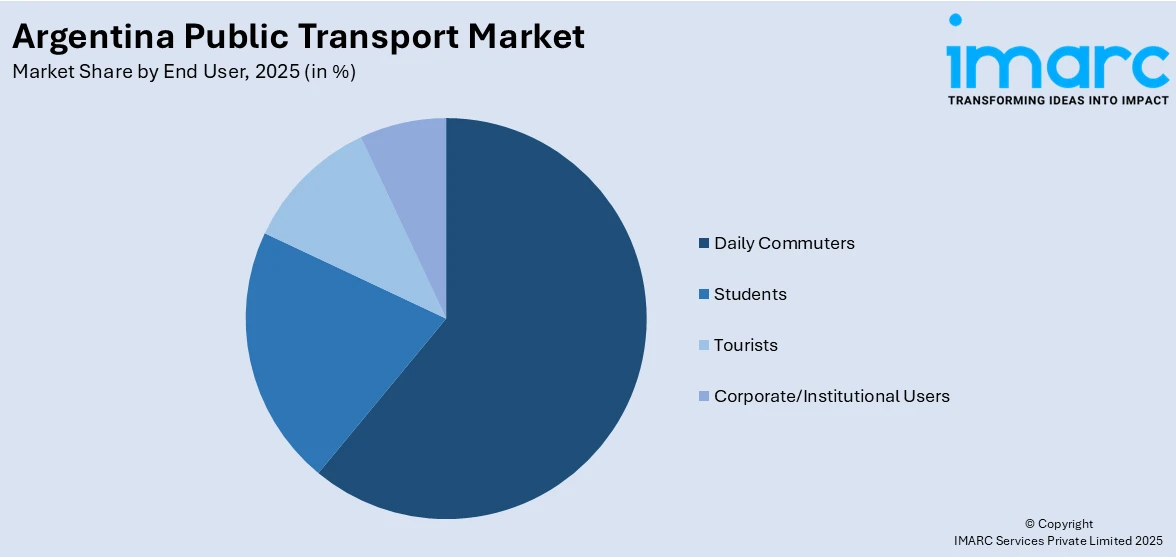
By End User: Daily commuters represent the largest segment with a share of 61.2% in 2025, driven by the high dependence of working populations on public transport for routine travel to workplaces, commercial districts, and educational institutions across major metropolitan areas.
-
By Region: Buenos Aires region leads the market with a share of 38.9% in 2025, driven by its dense population concentration, comprehensive multimodal transit network including subways, commuter railways, and bus rapid transit corridors serving millions of daily passengers.
-
Key Players: The Argentina public transport market exhibits a moderately consolidated competitive structure, with government-operated transit authorities, private bus concessionaires, and public-private partnerships competing across service delivery, fleet modernization, and digital infrastructure upgrades to enhance commuter experience and operational efficiency.
To get more information on this market Request Sample
The Argentina public transport market is developing as federal and municipal authorities, private operators, and technology providers collaborate in pursuit of delivering more reliable, accessible, and sustainable transit solutions across the country. In April 2024, Argentina’s government announced the rollout of contactless fare payments, allowing commuters to pay for buses, trains, and metro services using debit cards, credit cards, and digital wallets, reducing reliance on the traditional SUBE card system and supporting broader payment interoperability. A key driver of this growth is the modernization currently underway across legacy infrastructure, including the expansion of bus rapid transit corridors, the renewal of commuter rail fleets, and the digitization of fare collection systems that support seamless multimodal connectivity. Policy frameworks that are being pursued in light of improved urban mobility, reductions in traffic congestion, and greater access to cleaner transportation alternatives encourage further investment in the sector. The increase in urbanization rates, growing volume of ridership every day, and heightened expectations of commuters for an enhancement in the quality and conveniences offered by the services have contributed to a more dynamic competitive environment for public transport across the nation.
Argentina Public Transport Market Trends:
Digital Transformation of Fare Collection Systems
Argentina is experiencing an increased trend of digital and touchless payment systems being implemented in public transport operations across the country. Various transport bodies are looking to increase card payment, mobile payment, and near field communication technology alongside the use of traditional smart card technology for public transport operations. This is creating greater convenience for users as well as eliminating inefficiencies that are seen with the use of traditional currency for transactions. The progressive use of app-based top-up and QR technology is further adding to this move towards digital payment systems.
Expansion of Bus Rapid Transit Infrastructure
Cities are focusing on developing or improving dedicated bus rapid transit corridors with a purpose to enhance bus speed, reliability, and capacity on existing routes, especially within metropolitan cities that are usually congested with massive volumes of traffic. By developing dedicated corridors, cities are reducing travel times for many commuters, reducing congestion on the roads, and promoting the use of public transport over personal conveyances. In Argentina, investments in Buenos Aires’ BRT network have already demonstrated tangible results, with travel times for BRT users reduced by 53% between 2016 and 2019, alongside significant improvements in overall corridor speeds, reinforcing the effectiveness of dedicated bus lanes as a scalable urban mobility solution. These initiatives are supporting the Argentina public transport market growth through the adoption of more sustainable and efficiency-driven transport approaches.
Growing Integration of Clean Energy Transit Solutions
There is increased momentum towards the integration of electric-powered and compressed natural gas-powered vehicles into the urban bus transport environment as a wider decarbonization initiative. Authorities are experimenting with zero-emission buses, considering options such as battery-electric buses and hybrid buses that use less greenhouse gas-emitting technologies to combat greenhouse gases and improve air quality in dense urban locations, with the aim of meeting the overall national environment sustainability targets. Regulations to underpin the shift towards the adoption of clean fuel options are also boosting the concept of transitioning towards low-emission buses. In 2025, the Government of Buenos Aires announced that from January 2027 onward, all new buses added to the city’s public transport fleet must run on either electricity or compressed natural gas (CNG), supported by higher subsidies to accelerate the transition away from diesel.
Market Outlook 2026-2034:
Argentina's public transport market is positioned for steady advancement, underpinned by sustained infrastructure investments, evolving digital ecosystems, and rising commuter demand for efficient and accessible transit solutions. Continued modernization of rail and bus fleets, coupled with the integration of advanced fare collection technologies and expanded multimodal connectivity, is expected to enhance service quality and ridership across metropolitan and regional networks. The growing emphasis on fleet electrification, smart mobility platforms, and public-private collaboration is further anticipated to strengthen operational resilience and long-term sectoral competitiveness. The market generated a revenue of USD 1,974.01 Million in 2025 and is projected to reach a revenue of USD 3,136.62 Million by 2034, growing at a compound annual growth rate of 5.28% from 2026-2034.
Argentina Public Transport Market Report Segmentation:
|
Segment Category |
Leading Segment |
Market Share |
|
Mode of Transport |
Bus Transport |
46.3% |
|
Ownership |
Government/Public-Owned Services |
58.4% |
|
Ticketing System |
Smart Card Ticketing |
42.7% |
|
Fuel Type |
Diesel |
64.8% |
|
End User |
Daily Commuters |
61.2% |
|
Region |
Buenos Aires Region |
38.9% |
Mode of Transport Insights:
- Rail Transport
- Bus Transport
- Ferry and Water Transport
- Metro and Tram Services
- On-Demand and Shared Mobility Service
The bus transport dominates with a market share of 46.3% of the total Argentina public transport market in 2025.
Bus transport is at the core of Argentina’s transport landscape, as it provides urban and interurban transport for millions of passengers. The extensive metropolitan bus routes, interurban coach services, and bus rapid transit services operate at high frequencies over densely populated areas, linking settlements, business hubs, industrial parks, and educational hubs. In November 2024, Argentina secured World Bank–backed funding under the “Support to the Sustainability and Equity of Public Transport” program, aimed at improving bus service access for around 5 million vulnerable users in the Buenos Aires Metropolitan Area, strengthening fare support and route optimization. Their relative affordability, service routes, and extensive geographic coverage make bus transport the most accessible transport modality for the population, transcending all economic backgrounds.
The enhancement of bus lanes, the modernization of the bus fleet with improved safety and comfort features, and the integration of digital technologies to enable the payment of fares are making bus transport even more dominant in the market. Authorities are also considering the purchase of low-emission buses as well as electric buses to ensure that their operations are sustainable for the environment. Moreover, the integration of bus passenger information systems is making bus transport even more attractive and sustainable in the long term.
Ownership Insights:
- Government/Public-Owned Services
- Privately Owned/Contracted Services
- Public-Private Partnerships (PPP)
The government/public-owned services leads with a share of 58.4% of the total Argentina public transport market in 2025.
Government and publicly owned transit services account for the largest share of Argentina's public transport market, reflecting the central role of federal and municipal authorities in planning, funding, and operating mass transit networks. State-operated subway systems, commuter rail services, and subsidized bus operations serve as critical lifelines for urban populations, ensuring affordable and accessible transportation across major cities and metropolitan regions. Public ownership enables the implementation of fare subsidy programs and social discount schemes that maintain affordability for low-income commuters and vulnerable population groups.
The government's continued investment in infrastructure upgrades, fleet modernization, and service expansion underpins the sustained dominance of publicly owned transit operations. Ongoing reforms to optimize subsidy allocation, improve operational efficiency, and introduce performance-based management frameworks are aimed at enhancing service quality while maintaining fiscal discipline. Additionally, the strengthening of institutional coordination between federal and provincial transit authorities is enabling more cohesive network planning and resource deployment, ensuring that government-operated services remain the most utilized ownership model in the market.
Ticketing System Insights:
- Manual Ticketing
- Smart Card Ticketing
- Mobile App-Based Ticketing
- Contactless Payment Systems
The smart card ticketing dominates with a market share of 42.7% of the total Argentina public transport market in 2025.
Smart card ticketing has become the leading fare collection method in the country's public transport network due to the expansion of electronic fare cards that allow contactless travel between buses, subways, and trains, and other transit modes. Contactless smart card travel allows for an integrated, multi-modal system that lets people move from one mode of transportation to another on single journeys within one payment environment. This has greatly shortened boarding times, significantly lessened fare evasion, optimized general efficiency of the system, and allowed the transit authorities to gather data on all the trips taken, useful for operational plans.
The continued expansion of smart card coverage to more cities and transit modes reinforces its market leadership. Complementary features such as fare discounts for registered users, negative balance allowances, and integration with mobile top-up platforms enhance user convenience and encourage broader adoption. Introduction of digital companion applications that enable the management of remote balances and tracking of journeys is strengthening user engagement further. While transit authorities are now also accepting other forms of digital payment methods, smart card systems remain the foundational ticketing infrastructure that's supporting the transition toward a fully digitized fare ecosystem.
Fuel Type Insights:
- Diesel
- Electric
- Hybrid
- CNG/LPG
- Others
The diesel leads with a share of 64.8% of the total Argentina public transport market in 2025.
Diesel-powered vehicles continue to dominate Argentina's public transport fleet, underpinned by well-established refueling infrastructure, lower vehicle acquisition costs compared to alternative fuel options, and the widespread availability of diesel-compatible bus and rail equipment. The extensive network of urban and intercity bus routes relies predominantly on diesel engines, which offer proven reliability and operational range suited to the varied geographic and climatic conditions across the country's transit corridors. The mature supply chains for diesel parts and maintenance services further reinforce this operational dependence.
Despite the strong market position of diesel, authorities are actively exploring strategies to gradually transition toward cleaner fuel alternatives. Pilot programs for electric and compressed natural gas-powered buses are being introduced in select metropolitan areas, signaling a longer-term shift in fleet composition. However, the high upfront costs of alternative fuel vehicles, limited charging and refueling infrastructure, and the scale of the existing diesel fleet ensure that conventional diesel remains the predominant fuel type. The absence of comprehensive incentive frameworks for fleet conversion further sustains diesel's market dominance.
End User Insights:
Access the comprehensive market breakdown Request Sample
- Daily Commuters
- Students
- Tourists
- Corporate/Institutional Users
The daily commuters dominates with a market share of 61.2% of the total Argentina public transport market in 2025.
Daily commuters constitute the primary user base of Argentina's public transport system, relying on buses, subways, and commuter trains for routine travel to workplaces, commercial districts, and service centers. The high concentration of employment opportunities in major urban centers, combined with the relative affordability of public transit compared to private vehicle ownership and operation, drives consistent and substantial ridership volumes throughout peak and off-peak hours. Multi-trip fare discount structures and integrated transfer benefits across different transit modes further incentivize regular and sustained use.
The growing urban population and increasing cost of private transportation are reinforcing the dependence of working professionals and service sector employees on public transit networks. Improvements in service frequency, route coverage, and journey reliability are encouraging higher commuter satisfaction and sustained ridership growth. As transit authorities introduce enhanced digital tools for real-time tracking, route planning, and fare management, daily commuters benefit from a progressively more efficient and user-friendly transit experience that strengthens their long-term commitment to public transport utilization.
Regional Insights:
- Buenos Aires Region
- Litoral Region
- Northern Region
- Cordoba Region
- Cuyo Region
- Patagonia Region
Buenos Aires region exhibits a clear dominance with a 38.9% share of the total Argentina public transport market in 2025.
The Buenos Aires region commands the largest share of Argentina's public transport market, driven by its status as the country's most densely populated metropolitan area and primary economic hub. The region benefits from a comprehensive multimodal transit network that includes an extensive bus system, the nation's only subway system, commuter rail lines, and bus rapid transit corridors. Millions of daily passengers rely on these interconnected services for commuting, commerce, and access to essential services across the capital, its surrounding suburbs, and adjacent provincial municipalities. For example, in May 2025, Buenos Aires introduced its first fully electric public bus service, improving zero-emission mobility and accessibility across major city neighborhoods. The initiative promotes cleaner urban transport and gender inclusion by employing women drivers.
Ongoing investments in infrastructure modernization, digital payment integration, and fleet renewal are strengthening the region's transit capacity and service quality. The introduction of contactless fare payment technologies, expansion of dedicated bus lanes, and procurement of new rolling stock for commuter rail lines are enhancing operational efficiency and attractiveness of public transport within the Buenos Aires metropolitan area. Additionally, improvements in station accessibility, intermodal transfer facilities, and passenger safety infrastructure are further reinforcing the region's leading position in the national market.
Market Dynamics:
Growth Drivers:
Why is the Argentina Public Transport Market Growing?
Rapid Urbanization and Growing Metropolitan Population Density
Argentina’s continuing urbanization trend is significantly driving demand for efficient and scalable public transport solutions. With the vast majority of the population concentrated in urban and peri-urban areas, the pressure on existing transit infrastructure to accommodate rising passenger volumes is intensifying. Metropolitan regions are experiencing sustained growth in residential, commercial, and industrial activity, generating higher daily commuting flows that require expanded and more frequent transit services. The increasing density of urban settlements is making private vehicle ownership less practical for many residents due to traffic congestion, limited parking availability, and rising fuel and maintenance costs. This is naturally redirecting commuter preferences toward buses, subways, and commuter rail services that offer more time-efficient and cost-effective mobility alternatives. In a related development, Argentina plans to privatize and modernize its Belgrano Cargas railway network, aiming to cut freight costs, boost grain and mining exports, and attract $800M+ investment, signaling increased focus on modern rail infrastructure. As cities continue to expand outward, the need for extended route networks and feeder services connecting suburban communities to central transit hubs is further reinforcing the growth trajectory of the public transport sector.
Government Investment in Infrastructure Modernization and Fleet Renewal
Federal and municipal government investment in upgrading aging public transport infrastructure is a major catalyst for market expansion. Authorities are allocating resources toward the renewal of commuter rail rolling stock, modernization of subway systems, expansion of bus rapid transit corridors, and improvement of station facilities and accessibility features across the country. In January 2025, the Government of the City of Buenos Aires unveiled its Sistema Integrado de Movilidad Urbana, which includes a USD 370 million investment to purchase 214 new subway wagons and launch the city’s first fully electric bus lines, significantly modernizing key transit infrastructure and expanding clean, reliable services for daily commuters. These infrastructure investments are aimed at addressing longstanding service quality issues, reducing overcrowding, improving safety standards, and increasing the overall attractiveness of public transport. The procurement of new trains, buses, and signaling systems is enhancing operational reliability and capacity, while upgrades to stations and interchange hubs are improving the passenger experience. This sustained commitment to infrastructure modernization is building public confidence in transit systems and encouraging higher ridership, directly supporting the continued growth of the market.
Adoption of Digital Technologies and Smart Mobility Solutions
The progressive integration of digital technologies into public transport operations is enhancing system efficiency, passenger convenience, and overall market competitiveness. The deployment of electronic fare collection systems, contactless payment acceptance, real-time passenger information displays, and mobile transit applications is transforming how commuters interact with and utilize public transport services. In 2025, the Central Bank of Argentina (BCRA) issued regulations establishing QR‑code payment standards for public transport, enabling interoperable digital wallet and QR payments for transit fares alongside traditional systems, which was a key step in modernizing payment options and broadening accessibility for commuters nationwide. Digital innovations are streamlining fare management, reducing boarding times, and providing commuters with accurate journey planning tools that improve travel predictability and satisfaction. The expansion of smart card systems to additional cities and transit modes, combined with the introduction of alternative digital payment channels, is broadening the accessibility of public transport to previously underserved user segments. These technological advancements are also generating valuable operational data that transit authorities can leverage to optimize route planning, frequency scheduling, and resource allocation, further strengthening the overall efficiency and growth potential of the market.
Market Restraints:
What Challenges the Argentina Public Transport Market is Facing?
Fiscal Constraints and Subsidy Restructuring Pressures
Argentina’s public transport sector faces significant fiscal pressures stemming from ongoing government austerity measures and the restructuring of transit subsidy programs. The reduction and redistribution of operating subsidies directly impacts the ability of transport operators to maintain affordable fare levels while sustaining service quality. Provincial and municipal authorities confronted with reduced federal funding must either raise fares substantially or absorb costs from their own budgets, creating financial uncertainty that can delay fleet renewal, infrastructure upgrades, and route expansion plans across the network.
Aging Infrastructure and Deferred Maintenance Backlogs
A substantial portion of Argentina’s public transport infrastructure, including rail networks, bus terminals, and station facilities, suffers from decades of deferred maintenance and underinvestment. Deteriorating track conditions, outdated signaling systems, and aging rolling stock contribute to service disruptions, safety concerns, and reduced operational reliability. The scale of the maintenance backlog requires significant capital investment to address, and the pace of rehabilitation remains constrained by limited funding, bureaucratic delays, and competing fiscal priorities, hindering the sector’s ability to deliver consistent and modern transit services.
High Costs and Limited Availability of Alternative Fuel Vehicles
The transition from conventional diesel fleets to electric, hybrid, or compressed natural gas-powered vehicles faces significant barriers related to high acquisition costs, limited domestic manufacturing capacity, and insufficient charging and refueling infrastructure. The price premium for zero-emission buses and the absence of well-established supply chains for alternative fuel components create financial deterrents for operators considering fleet electrification. Without broader government incentives and scalable infrastructure investments, the pace of fleet decarbonization remains constrained, limiting the sector’s progress toward environmental sustainability targets.
Competitive Landscape:
The Argentina public transport market features a moderately fragmented competitive landscape characterized by a mix of government-operated transit authorities, private concessionaires, and public-private partnership models operating across diverse service segments. Competition is primarily driven by the ability to deliver reliable, high-frequency services while maintaining operational cost efficiency and meeting evolving regulatory standards. Operators are increasingly focusing on fleet modernization, digital payment integration, and service quality improvements to differentiate their offerings and attract higher ridership volumes. The market is also witnessing growing participation from international technology providers and vehicle manufacturers that are partnering with local operators to introduce advanced transit solutions, including intelligent transport systems, contactless fare technologies, and cleaner fuel vehicles. Strategic collaborations between transit authorities and private sector participants are fostering innovation in service delivery, route optimization, and passenger experience management. As the regulatory environment continues to evolve and sustainability requirements become more stringent, market participants are refining their operational strategies to strengthen their competitive positioning and capture emerging growth opportunities across the sector.
Recent Developments:
-
In September 2025, IVECO BUS delivered 20 compressed natural gas (CNG) buses to Metropol, marking the launch of Argentina’s first fully CNG-powered public transport routes in Escobar. The initiative aims to reduce carbon emissions, improve fuel efficiency, and modernize urban mobility across the Buenos Aires metropolitan region while supporting cleaner and more sustainable public transit operations.
Argentina Public Transport Market Report Coverage:
|
Report Features |
Details |
|
Base Year of the Analysis |
2025 |
|
Historical Period |
2020-2025 |
|
Forecast Period |
2026-2034 |
|
Units |
Million USD |
|
Scope of the Report |
Exploration of Historical Trends and Market Outlook, Industry Catalysts and Challenges, Segment-Wise Historical and Future Market Assessment:
|
|
Mode of Transports Covered |
Rail Transport, Bus Transport, Ferry and Water Transport, Metro and Tram Services, On-Demand and Shared Mobility Service |
|
Ownership Types Covered |
Government/Public-Owned Services, Privately Owned/Contracted Services, Public-Private Partnerships (PPP) |
|
Ticketing Systems Covered |
Manual Ticketing, Smart Card Ticketing, Mobile App-Based Ticketing, Contactless Payment Systems |
|
Fuel Types Covered |
Diesel, Electric, Hybrid, CNG/LPG, Others |
|
End Users Covered |
Daily Commuters, Students, Tourists, Corporate/Institutional Users |
|
Regions Covered |
Buenos Aires Region, Litoral Region, Northern Region, Cordoba Region, Cuyo Region, Patagonia Region |
|
Customization Scope |
10% Free Customization |
|
Post-Sale Analyst Support |
10-12 Weeks |
|
Delivery Format |
PDF and Excel through Email (We can also provide the editable version of the report in PPT/Word format on special request) |
Frequently Asked Questions About the Argentina Public Transport Market Report
The Argentina public transport market size was valued at USD 1,974.01 Million in 2025.
The Argentina public transport market is expected to grow at a compound annual growth rate of 5.28% from 2026-2034 to reach USD 3,136.62 Million by 2034.
Bus transport, holding the largest share of 46.3%, remains pivotal for Argentina’s public mobility, providing extensive urban and intercity connectivity, high-frequency services, and affordable fares that support the daily commuting needs of the majority of transit users nationwide.
Key factors driving the Argentina public transport market include rapid urbanization and growing metropolitan population density, government investment in infrastructure modernization and fleet renewal, adoption of digital fare collection technologies, expansion of bus rapid transit networks, and increasing commuter preference for affordable and sustainable mobility alternatives.
Major challenges include fiscal constraints from subsidy restructuring, aging infrastructure with significant deferred maintenance backlogs, high costs of transitioning to alternative fuel vehicles, limited charging infrastructure for electric fleets, macroeconomic volatility affecting investment capacity, and regulatory complexities in coordinating federal and provincial transit policies.
Need more help?
- Speak to our experienced analysts for insights on the current market scenarios.
- Include additional segments and countries to customize the report as per your requirement.
- Gain an unparalleled competitive advantage in your domain by understanding how to utilize the report and positively impacting your operations and revenue.
- For further assistance, please connect with our analysts.
 Request Customization
 Speak to an Analyst
 Request Brochure
 Inquire Before Buying
Benefits of Customization
- Personalize this research
- Triangulate with your data
- Get data as per your format and definition
- Gain a deeper dive into a specific application, geography, customer, or competitor
- Any level of personalization
Get in Touch With Us
UNITED STATES
Phone: +1-201-971-6302
INDIA
Phone: +91-120-433-0800
UNITED KINGDOM
Phone: +44-753-714-6104
Email: [email protected]
Client Testimonials




.webp)




.webp)













Related Reports

Choose your plan
*Please note that the prices mentioned below are starting prices for each bundle type. Kindly contact our team for further details.*
Single User License
- 1 User License, Access on 2 Devices
- PDF Report + Excel Dataset (Password Protected)
- Lifetime Access
- No Printing Rights
- 10% Free Report Customization
- 10–12 Weeks of Analyst Support
Five User License
- Access for 5 Users, 2 Devices per User
- PDF Report + Excel Dataset (Password Protected)
- Lifetime Access
- Dedicated Account Manager
- 12–14 Weeks of Analyst Support
- No Printing Rights
- 15% Free Report Customization
- 25% Discount on Your Next Purchase
Corporate User License
- Unlimited User Access (Within Your Organization)
- PDF Report + Excel Dataset
- Lifetime Access
- Dedicated Account Manager
- 14–20 Weeks of Analyst Support
- No Printing Rights
- 20% Free Report Customization
- 30% Discount on Your Next Purchase
Essential Insights
What's included:
3 reports
- Lifetime Access
- PDF Reports
- Excel Datasets
- 2 Weeks of Free Analyst Support
- 2 User Licenses
- Access on 2 Devices
- Printing Rights
- Complimentary PowerPoint (PPT) Version
- Complimentary License Upgrade
Professional Access
What's included:
5 reports
- Lifetime Access
- PDF Reports
- Excel Datasets
- 8 Weeks of Free Analyst Support
- 2 User Licenses
- Access on 2 Devices
- Printing Rights
- Complimentary PowerPoint (PPT) Version
- Complimentary License Upgrade
Business Advantage
What's included:
8 reports
- Lifetime Access
- PDF Reports
- Excel Datasets
- 14 Weeks of Free Analyst Support
- 2 User Licenses
- Access on 2 Devices
- Printing Rights
- Complimentary PowerPoint (PPT) Version
- Complimentary License Upgrade
Enterprise Intelligence
What's included:
10 reports
- Lifetime Access
- PDF Reports
- Excel Datasets
- 20 Weeks of Free Analyst Support
- 2 User Licenses
- Access on 2 Devices
- Printing Rights
- Complimentary PowerPoint (PPT) Version
- Complimentary License Upgrade