
Argentina Tire Market Size, Share, Trends and Forecast by Design, End-Use, Vehicle Type, Distribution Channel, Season, and Region, 2026-2034
Argentina Tire Market Summary:
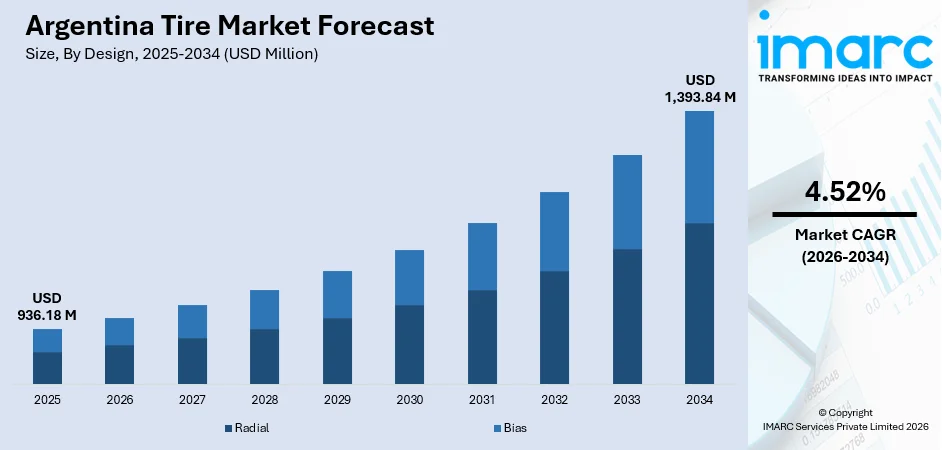
The Argentina tire market size was valued at USD 936.18 Million in 2025 and is projected to reach USD 1,393.84 Million by 2034, growing at a compound annual growth rate of 4.52% from 2026-2034.
The Argentina tire market is advancing steadily as expanding automotive production, rising vehicle ownership, and accelerating infrastructure investments strengthen demand across passenger and commercial vehicle segments. Increasing consumer preference for fuel-efficient and durable radial tires, coupled with the growth of the replacement tire segment, is reshaping purchasing patterns. Supportive government policies aimed at reducing import tariffs, a thriving logistics sector, and growing urbanization are further enhancing mobility requirements and reinforcing the Argentina tire market share.
Key Takeaways and Insights:
- By Design: Radial dominates the market with a share of 78.9% in 2025, owing to its superior fuel efficiency, enhanced road grip, and longer tread life that make it the preferred choice for passenger and commercial vehicles across Argentina.
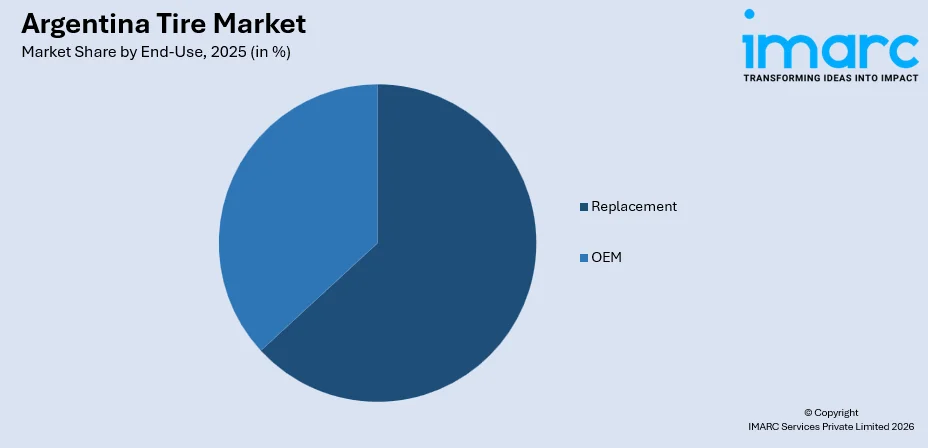
- By End-Use: Replacement leads the market with a share of 63.4% in 2025, driven by an expanding vehicle fleet, growing consumer awareness of road safety, and the increasing frequency of tire changes due to varied road conditions across the country.
- By Vehicle Type: Passenger cars represent the biggest segment with a market share of 44.8% in 2025, reflecting robust consumer demand for personal mobility, rising disposable incomes, and expanding urban populations that sustain steady tire procurement across metropolitan and regional centers.
- By Distribution Channel: Offline exhibits a clear dominance in the market with 71.6% share in 2025, supported by the widespread presence of authorized tire dealers, automotive service centers, and manufacturer-partnered retail networks that offer installation, maintenance, and expert consultation.
- By Season: All season tires reign the market with a share of 58.2% in 2025, owing to Argentina's varied climatic conditions that favor versatile tires capable of delivering reliable performance across dry, wet, and moderately cold driving environments.
- By Region: Buenos Aires Region comprises the largest region with 36.5% share in 2025, driven by the concentration of automotive manufacturing facilities, dense urban population, and the presence of major distribution hubs serving surrounding provinces.
- Key Players: The market is competitive and price-sensitive, shaped by import rules, currency volatility, and periodic supply gaps. Global brands and regional players compete with local manufacturers and a large replacement segment. Differentiation relies on distribution reach, availability, warranty/service, and value tiers, with growing demand for budget and mid-range options.
To get more information on this market Request Sample
The Argentina tire market is supported by a dynamic automotive sector undergoing significant recovery and expansion. The country's automotive production reached approximately 500,000 motor vehicles in 2024, with leading manufacturers such as Toyota, Stellantis, Volkswagen, and Ford producing most of all units assembled domestically. This robust production base directly fuels demand for both original equipment and replacement tires across all vehicle categories. The expansion of road infrastructure, increasing freight transportation requirements, and rising middle-class incomes further amplify tire consumption. Consumer awareness regarding tire safety, fuel efficiency, and environmental sustainability is driving preference toward advanced radial designs, eco-friendly materials, and digitally enabled purchasing channels. With continued government support for the automotive sector and infrastructure modernization, the tire market is positioned for sustained momentum throughout the forecast period.
Argentina Tire Market Trends:
Rising adoption of eco-friendly and sustainable tire technologies
The tire industry in Argentina is shifting its focus toward environmentally friendly products because manufacturers need to meet sustainability targets and consumers are changing their buying habits. The companies use recycled rubber materials together with bio-based components and low rolling resistance technology to achieve better fuel efficiency while decreasing their environmental impact. The trend exists because people now understand green transportation options better while they seek affordable driving solutions during periods of expensive fuel. Tire manufacturers will develop more environmentally friendly products because customers now consider sustainability as an important factor when making purchasing decisions for their passenger and commercial tires.
Expansion of digital and online tire distribution channels
The growth of e-commerce platforms is transforming tire purchasing behavior in Argentina, offering consumers wider product selection, competitive pricing, and doorstep delivery. According to a report by the International Trade Association, e-commerce accounts for roughly 4% of Argentina’s GDP. Online tire retailers and manufacturer-direct platforms are gaining traction, particularly among younger consumers seeking convenience and transparent pricing. Younger buyers, in particular, are driving this shift, favoring transparent pricing and seamless digital transactions over traditional in-store purchases.
Increasing demand for specialized tires for diverse applications
Argentina's diverse geography, ranging from urban centers to agricultural plains and rugged Patagonian terrain, is driving demand for application-specific tires. Specialized products for off-the-road vehicles, agricultural machinery, and all-terrain commercial vehicles are gaining importance as infrastructure and agribusiness sectors expand. FATE, Argentina's largest tire manufacturer with production capacity exceeding 5 million tires annually at its San Fernando facility, continues to produce radial and diagonal tires for automobiles, trucks, tractors, and road machinery to meet diverse requirements.
Market Outlook 2026-2034:
The Argentina tire market is expected to sustain positive growth momentum throughout the forecast period, underpinned by robust automotive sector recovery and accelerating infrastructure investments. Automobile production in Argentina totaled 44,454 units in August across nine industrial plants. ADEFA data indicates an average output of 2,222 vehicles per day, representing a 20% increase compared to July. Similarly, government initiatives aimed at reducing import tariffs and stimulating domestic manufacturing are creating a favorable business environment. The ongoing expansion of the vehicle fleet, supported by recovering real incomes and improved credit access, is expected to drive consistent demand for both original equipment and replacement tires. Additionally, growing consumer preference for fuel-efficient radial designs, all-season versatility, and technologically advanced tire solutions will continue to reshape market dynamics and revenue streams across all segments. The market generated a revenue of USD 936.18 Million in 2025 and is projected to reach a revenue of USD 1,393.84 Million by 2034, growing at a compound annual growth rate of 4.52% from 2026-2034.
Argentina Tire Market Report Segmentation:
|
Segment Category |
Leading Segment |
Market Share |
|
Design |
Radial |
78.9% |
|
End-Use |
Replacement |
63.4% |
|
Vehicle Type |
Passenger Cars |
44.8% |
|
Distribution Channel |
Offline |
71.6% |
|
Season |
All Season Tires |
58.2% |
|
Region |
Buenos Aires Region |
36.5% |
Design Insights:
- Radial
- Bias
Radial dominates with a market share of 78.9% of the total Argentina tire market in 2025.
Argentina adopted radial tires because their construction provides better fuel efficiency, road handling capabilities and longer tread life than bias-ply tires. Modern radial designs incorporate advanced rubber compounds and reinforcement materials that optimize performance under diverse driving conditions prevalent across the country's extensive highway network and urban roads.
The demand for radial tires continues to increase because Argentina's growing fleet of passenger cars and commercial vehicles now requires all automakers to use radial tires as their standard equipment. The need for radial tires increases because urban areas develop and people need to travel long distances while roadways throughout metropolitan areas improve. The local production of radial tires by manufacturers enables both domestic markets and export markets throughout South America to access affordable tires with dependable availability.
End-Use Insights:
Access the comprehensive market breakdown Request Sample
- OEM
- Replacement
Replacement leads with a share of 63.4% of the total Argentina tire market in 2025.
The replacement tire segment benefits from Argentina's steadily expanding vehicle fleet, where regular wear and tear, varying road conditions, and consumer safety awareness drive consistent demand for tire changes. As vehicles age and accumulate mileage across the country's diverse terrain, from urban roads in Buenos Aires to agricultural routes in the Pampas region, replacement frequency increases accordingly.
The replacement segment is further strengthened by the presence of well-established distribution networks comprising authorized dealers, specialty tire retailers, and automotive service centers that facilitate timely tire procurement across urban and regional markets. Consumer preference for trusted brands, professional installation services, and personalized product recommendations reinforces offline purchasing behavior within the replacement category. Argentina's growing used car market and increasing emphasis on vehicle maintenance and safety compliance are additional factors sustaining robust replacement tire demand throughout the forecast period.
Vehicle Type Insights:
- Passenger Cars
- Light Commercial Vehicles
- Medium and Heavy Commercial Vehicles
- Two Wheelers
- Three Wheelers
- Off-The-Road (OTR)
Passenger cars hold the largest share at 44.8% of the total Argentina tire market in 2025.
Passenger cars constitute the largest vehicle type segment in Argentina's tire market, reflecting strong consumer demand for personal mobility across the country's expanding urban and suburban populations. According to IMARC, Argentina’s passenger car market was valued at USD 12.60 billion in 2024 and is expected to expand to USD 24.97 billion by 2033, growing at a CAGR of 7.08% from 2025 to 2033. Rising disposable incomes, improving credit access, and a widening range of available vehicle models are encouraging new car purchases, directly stimulating tire demand.
The passenger car tire segment benefits from continuous innovation in tire technology, including low rolling resistance compounds, improved wet grip performance, and noise reduction features that enhance driving comfort. Consumer preference for radial tires in the passenger car category remains strong, driven by fuel efficiency advantages and longer service life.
Distribution Channel Insights:
- Offline
- Online
Offline accounts for the highest revenue share of 71.6% of the total Argentina tire market in 2025.
The offline distribution channel maintains its dominance in Argentina's tire market through a well-established network of authorized tire dealers, branded retail outlets, automotive service centers, and independent workshops spread across the country's vast geography. Consumers continue to prefer physical retail locations where they can receive expert advice on tire selection, professional installation, wheel alignment, and post-purchase maintenance services.
Offline distribution is further reinforced by strong manufacturer-retailer relationships that enable exclusive product availability, competitive pricing, and warranty-backed services. Automotive service centers and dealerships provide integrated tire solutions alongside routine vehicle maintenance, creating a seamless purchasing experience. The importance of tactile product evaluation, fitment verification, and immediate availability for urgent replacements sustains consumer reliance on brick-and-mortar channels, particularly in regional markets where digital infrastructure and e-commerce logistics remain in earlier stages of development.
Season Insights:
- All Season Tires
- Winter Tires
- Summer Tires
All season tires represent the leading segment with a 58.2% share of the total Argentina tire market in 2025.
All-season tires have established themselves as the preferred seasonal category in Argentina owing to the country's varied climatic conditions, which range from subtropical warmth in the north to temperate patterns in central regions and cold weather in Patagonia. These versatile tires deliver reliable performance across dry, wet, and moderately cold surfaces, eliminating the need for seasonal tire changes and offering cost-effective convenience.
The popularity of all-season tires is further supported by consumer preference for practical and economical tire solutions that perform adequately under diverse conditions encountered during daily commuting and intercity travel. Vehicle manufacturers increasingly equip new models with all-season tires as standard original equipment, reinforcing market penetration. As urbanization accelerates and road connectivity improves across Argentina's regions, the demand for tires that combine versatility, durability, and fuel efficiency continues to grow, positioning all-season products as the foundational choice for most vehicle owners.
Regional Insights:
- Buenos Aires Region
- Litoral Region
- Northern Region
- Cordoba Region
- Cuyo Region
- Patagonia Region
Buenos Aires Region comprises the largest region with a 36.5% share of the total Argentina tire market in 2025.
The Buenos Aires Region leads Argentina's tire market, driven by its concentration of automotive manufacturing facilities, dense urban population, and status as the country's primary economic and logistics hub. Major automakers including Toyota, Stellantis, and Ford operate assembly plants within Buenos Aires province, directly generating demand for original equipment tires. For instance, in April 2024, Stellantis announced a USD 270 Million investment at its El Palomar facility in Buenos Aires province to produce the new Peugeot 2008, reinforcing the region's position as a critical automotive production center that sustains robust tire consumption for both manufacturing and replacement purposes.
In addition, the region’s extensive dealership networks, service centers, and aftermarket distributors strengthen replacement tire demand across passenger and commercial vehicles. High vehicle density, frequent commuting, and strong logistics activity around the Port of Buenos Aires accelerate tire wear and replacement cycles. The presence of established transport corridors and warehousing clusters also supports fleet operations, further driving consistent demand for truck and light commercial vehicle tires throughout the Buenos Aires region.
Market Dynamics:
Growth Drivers:
Why is the Argentina Tire Market Growing?
Expanding automotive production and rising vehicle ownership
Argentina's automotive sector is experiencing a strong recovery that is directly amplifying tire demand across all segments. Multinational manufacturers have committed substantial capital investments to expand local production capabilities, generating increased requirements for original equipment tires. As such, in September 2024, Stellantis planned to invest USD 385 Million in its Córdoba, Argentina plant between 2025 and 2030 to build a new vehicle line and engine. This expansion directly increases tire procurement for factory-fitted applications. The resulting growth in domestic vehicle output, combined with rising consumer purchasing power and improved credit access, is accelerating both new vehicle sales and the expansion of the national vehicle fleet. As more vehicles enter circulation, the replacement tire segment benefits from sustained recurring demand driven by routine wear, safety requirements, and maintenance cycles.
Government infrastructure investments and trade policy reforms
Government initiatives targeting road modernization, highway expansion, and logistics corridor development are boosting tire demand by increasing vehicle utilization and freight mobility across Argentina's extensive transportation network. Upgraded road infrastructure encourages longer vehicle travel distances and higher commercial freight volumes, directly intensifying tire wear and replacement frequency. In October 2024, the Argentine government issued Decree No. 908/2024, reducing import tariffs on automotive tires from 35% to 16%, enhancing the affordability and availability of diverse tire products for consumers and businesses. These trade policy reforms complement broader economic stabilization measures that are restoring consumer confidence and business investment.
Growth of logistics, agriculture, and commercial transportation sectors
Argentina's expanding logistics infrastructure and thriving agricultural economy are generating consistent demand for commercial vehicle and off-the-road tires. The country's position as a major global agricultural producer requires extensive use of tractors, harvesters, and transport trucks, all of which depend on specialized tire solutions for optimal performance in demanding field and road conditions. In 2024, Argentina exported over USD 9 Billion in passenger vehicles, commercial vehicles, trucks, motorcycles, and parts, reflecting the scale of the automotive and logistics ecosystem that drives tire consumption. The growth of e-commerce and last-mile delivery services is further expanding the light commercial vehicle fleet, increasing demand for durable and reliable tires suited to frequent urban and suburban travel. As freight volumes continue to rise and supply chain networks expand across Argentine provinces, the commercial tire segment is positioned for sustained growth.
Market Restraints:
What Challenges the Argentina Tire Market is Facing?
Macroeconomic instability and currency fluctuations
Argentina's persistent inflation and currency devaluation cycles significantly impact the tire industry by increasing production costs for raw materials such as natural and synthetic rubber, steel cords, and chemical additives. These macroeconomic pressures erode consumer purchasing power, prompting buyers to delay tire replacements or opt for lower-cost alternatives including retreaded products. The resulting demand volatility creates uncertainty for manufacturers and distributors, complicating inventory planning and pricing strategies.
Trade barriers and limited premium product accessibility
Despite recent tariff reductions, regulatory complexities and residual trade barriers continue to limit the availability of premium and specialized imported tire products in Argentina. Foreign currency access restrictions and customs procedural requirements can delay import shipments and increase landed costs for international tire brands. These constraints reduce consumer choice and create competitive disadvantages for businesses that depend on imported premium tires to serve demanding vehicle applications and safety-conscious customers.
Fluctuating raw material prices and supply chain disruptions
Volatility in global prices of natural rubber, synthetic rubber, carbon black, and steel directly impacts tire manufacturing costs in Argentina. Supply chain disruptions stemming from international logistics challenges and dependency on imported raw materials create production uncertainties for domestic manufacturers. These fluctuations can compress profit margins, delay product launches, and force manufacturers to absorb costs or pass increases to consumers, potentially dampening overall market demand.
Competitive Landscape:
The Argentina tire market features a competitive landscape characterized by a blend of established domestic manufacturers and prominent multinational corporations. Local producers leverage cost-effective manufacturing, deep distribution networks, and strong brand recognition to maintain significant market share. International companies compete through advanced technology offerings, premium product positioning, and global research capabilities. Strategic partnerships with automotive original equipment manufacturers, investment in sustainable tire technologies, and expansion of retail and digital distribution channels are key competitive strategies. The market exhibits moderate consolidation, with companies continuously innovating in tire design, materials, and performance to differentiate themselves and capture evolving consumer preferences across passenger, commercial, and specialty vehicle segments.
Recent Developments:
- In November 2025, ROADSTAR Tires launched the R516 pattern, designed for demanding mining applications. Featuring deep tread for strong traction, cutting resistance, and reinforced sidewalls for impact protection, it improves durability and reduces downtime. Available in multiple heavy-duty sizes, the tire targets key mining markets including Argentina, Chile, Peru, and the Middle East.
- In July 2025, Argentina marked 50 years of the Tyre Industry Chamber (CIN), highlighting collaboration with INTI on regulation, recycling, and retreading. Milestones include the 2003 Recycling Commission, 2010 Regomax launch, and national waste laws. By 2025, 25 certified retreading plants are projected, strengthening circular economy leadership.
Argentina Tire Market Report Coverage:
|
Report Features |
Details |
|
Base Year of the Analysis |
2025 |
|
Historical Period |
2020-2025 |
|
Forecast Period |
2026-2034 |
|
Units |
Million USD |
|
Scope of the Report |
Exploration of Historical Trends and Market Outlook, Industry Catalysts and Challenges, Segment-Wise Historical and Future Market Assessment:
|
|
Designs Covered |
Radial, Bias |
|
End-Uses Covered |
OEM, Replacement |
|
Vehicle Types Covered |
Passenger Cars, Light Commercial Vehicles, Medium and Heavy Commercial Vehicles, Two Wheelers, Three Wheelers, Off-The-Road (OTR) |
|
Distribution Channels Covered |
Offline, Online |
|
Seasons Covered |
All Season Tires, Winter Tires, Summer Tires |
|
Regions Covered |
Buenos Aires Region, Litoral Region, Northern Region, Cordoba Region, Cuyo Region, Patagonia Region |
|
Customization Scope |
10% Free Customization |
|
Post-Sale Analyst Support |
10-12 Weeks |
|
Delivery Format |
PDF and Excel through Email (We can also provide the editable version of the report in PPT/Word format on special request) |
Frequently Asked Questions About the Argentina Tire Market Report
The Argentina tire market size was valued at USD 936.18 Million in 2025.
The Argentina tire market is expected to grow at a compound annual growth rate of 4.52% from 2026-2034 to reach USD 1,393.84 Million by 2034.
Radial dominated the market with a share of 78.9%, driven by superior fuel efficiency, enhanced durability, longer tread life, and widespread adoption across passenger and commercial vehicle categories in Argentina.
Key factors driving the Argentina tire market include expanding automotive production, rising vehicle ownership, government infrastructure investments, trade policy reforms reducing import tariffs, and growing logistics and agricultural sector demand.
Major challenges include macroeconomic instability and currency devaluation, fluctuating raw material prices, trade barriers limiting premium product accessibility, supply chain disruptions, and reduced consumer purchasing power affecting replacement tire demand.
Need more help?
- Speak to our experienced analysts for insights on the current market scenarios.
- Include additional segments and countries to customize the report as per your requirement.
- Gain an unparalleled competitive advantage in your domain by understanding how to utilize the report and positively impacting your operations and revenue.
- For further assistance, please connect with our analysts.
 Request Customization
 Speak to an Analyst
 Request Brochure
 Inquire Before Buying
Benefits of Customization
- Personalize this research
- Triangulate with your data
- Get data as per your format and definition
- Gain a deeper dive into a specific application, geography, customer, or competitor
- Any level of personalization
Get in Touch With Us
UNITED STATES
Phone: +1-201-971-6302
INDIA
Phone: +91-120-433-0800
UNITED KINGDOM
Phone: +44-753-714-6104
Email: [email protected]
Client Testimonials




.webp)




.webp)













Related Reports

Choose your plan
*Please note that the prices mentioned below are starting prices for each bundle type. Kindly contact our team for further details.*
Single User License
- 1 User License, Access on 2 Devices
- PDF Report + Excel Dataset (Password Protected)
- Lifetime Access
- No Printing Rights
- 10% Free Report Customization
- 10–12 Weeks of Analyst Support
Five User License
- Access for 5 Users, 2 Devices per User
- PDF Report + Excel Dataset (Password Protected)
- Lifetime Access
- Dedicated Account Manager
- 12–14 Weeks of Analyst Support
- No Printing Rights
- 15% Free Report Customization
- 25% Discount on Your Next Purchase
Corporate User License
- Unlimited User Access (Within Your Organization)
- PDF Report + Excel Dataset
- Lifetime Access
- Dedicated Account Manager
- 14–20 Weeks of Analyst Support
- No Printing Rights
- 20% Free Report Customization
- 30% Discount on Your Next Purchase
Essential Insights
What's included:
3 reports
- Lifetime Access
- PDF Reports
- Excel Datasets
- 2 Weeks of Free Analyst Support
- 2 User Licenses
- Access on 2 Devices
- Printing Rights
- Complimentary PowerPoint (PPT) Version
- Complimentary License Upgrade
Professional Access
What's included:
5 reports
- Lifetime Access
- PDF Reports
- Excel Datasets
- 8 Weeks of Free Analyst Support
- 2 User Licenses
- Access on 2 Devices
- Printing Rights
- Complimentary PowerPoint (PPT) Version
- Complimentary License Upgrade
Business Advantage
What's included:
8 reports
- Lifetime Access
- PDF Reports
- Excel Datasets
- 14 Weeks of Free Analyst Support
- 2 User Licenses
- Access on 2 Devices
- Printing Rights
- Complimentary PowerPoint (PPT) Version
- Complimentary License Upgrade
Enterprise Intelligence
What's included:
10 reports
- Lifetime Access
- PDF Reports
- Excel Datasets
- 20 Weeks of Free Analyst Support
- 2 User Licenses
- Access on 2 Devices
- Printing Rights
- Complimentary PowerPoint (PPT) Version
- Complimentary License Upgrade