
Asia Pacific E-Bike Market Size, Share, Trends and Forecast by Mode, Motor Type, Battery Type, Class, Design, Application, and Country, 2026-2034
Asia Pacific E-Bike Market Summary:
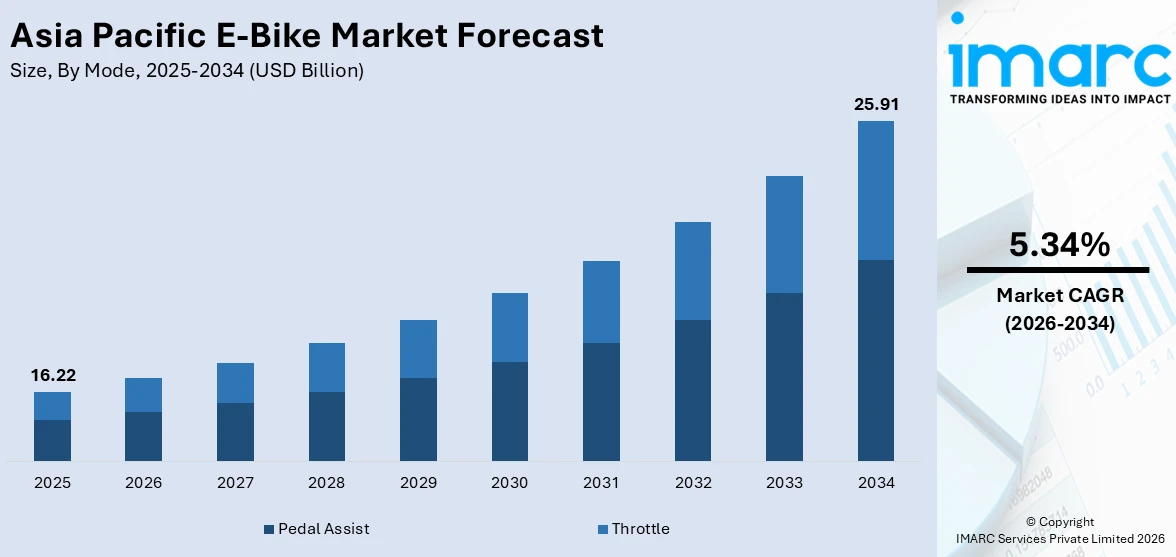
The Asia Pacific e-bike market grew from USD 16.22 Billion in 2025 to USD 17.09 Billion in 2026 and is projected to reach USD 25.91 Billion by 2034, growing at a compound annual growth rate of 5.34% from 2026-2034.
The Asia Pacific e-bike market is experiencing robust momentum as countries across the region prioritize sustainable urban mobility and invest in cycling infrastructure. Rapid urbanization, worsening traffic congestion in major metropolitan areas, and the growing environmental consciousness among individuals are accelerating e-bike adoption. Government incentives promoting electric two-wheelers, advancements in lithium-ion battery technology enabling longer range and lighter designs, and the expansion of dedicated cycling lanes are further strengthening the market demand. Additionally, the integration of smart connectivity features and Internet of Things (IoT)-enabled systems is attracting tech-savvy riders, while the proliferation of e-commerce is boosting cargo e-bike applications.
Key Takeaways and Insights:
- By Mode: Pedal assist dominates the market with a share of 65% in 2025, driven by its seamless integration of human effort and electric propulsion that appeals to health-conscious commuters seeking efficient, eco-friendly transportation across diverse urban terrains.
- By Motor Type: Hub motor leads the market with a share of 70% in 2025, owing to its cost-effectiveness, simplified maintenance requirements, and widespread adoption in affordable urban commuter e-bikes throughout densely populated Asian cities.
- By Battery Type: Lithium ion represents the largest segment with a market share of 84% in 2025, supported by its superior energy density, lightweight construction, and extended cycle life that align with consumer preferences for longer-range performance.
- By Class: Class I dominates the market with a share of 45% in 2025, reflecting regulatory frameworks across Asia Pacific that favor pedal-assist models with speed limits up to 25 km/h for safe urban commuting.
- By Design: Non-foldable leads the market with a share of 86% in 2025, preferred by individuals seeking robust frames, superior stability, and enhanced battery capacity for daily commuting and recreational purposes.
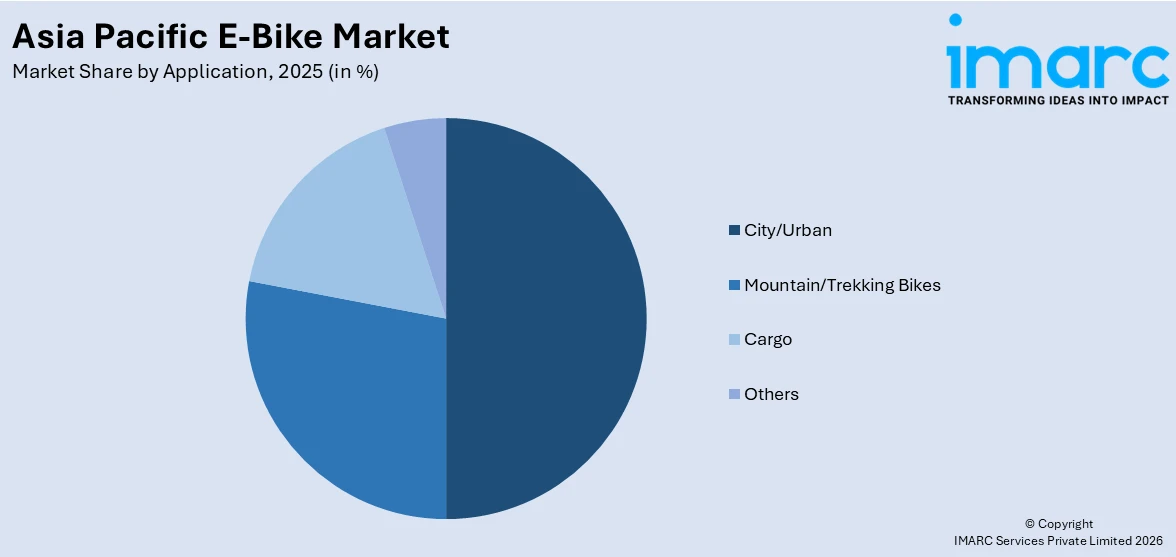
- By Application: City/urban represents the largest segment with a market share of 50% in 2025, due to the increasing urban congestion, expanding cycling infrastructure, and rising user demand for sustainable last-mile connectivity solutions.
- Key Players: The Asia Pacific e-bike market features intense competition among established manufacturers investing in advanced battery technologies, smart connectivity features, expanding distribution networks, and strategic partnerships to strengthen market share and accelerate sustainable mobility adoption across the region.
To get more information on this market Request Sample
The Asia Pacific e-bike market is witnessing significant growth as governments, industries, and individuals increasingly prioritize cleaner, more efficient urban mobility solutions. Rising fuel costs, growing traffic congestion, and aging populations seeking accessible and convenient transportation options are collectively encouraging the adoption of e-bikes. Furthermore, increasing investment in cycling infrastructure, such as dedicated bike lanes, parking facilities, and urban mobility programs, is enhancing safety, convenience, and overall user experience, making e-bikes a practical alternative for daily commuting. According to the latest Economic Survey 2023-24, it is projected that by 2030, over 40% of India’s population will reside in urban areas, underscoring the growing demand for efficient, sustainable transportation solutions. As urbanization continues and cities face mounting pressure to reduce congestion and emissions, e-bikes are emerging as a viable, environmentally friendly, and cost-effective mobility option, driving long-term market growth across the Asia Pacific region.
Asia Pacific E-Bike Market Trends:
Increasing Disposable Income and Middle-Class Expansion
Rising disposable incomes and the growth of the middle-class population in Asia Pacific countries are significantly boosting the adoption of e-bikes. For instance, in India, the Ministry of Statistics (MoSPI) reported that per capita Net National Income (a key proxy for disposable income) rose to ₹2,05,324 in FY2024–25, compared with ₹1,88,892 in FY2023–24, reflecting improved earnings and consumption capacity. Higher purchasing power allows people to invest in premium and technologically advanced mobility solutions, including electric bicycles. This economic trend is particularly notable in emerging markets, where rising wages and urban professional employment create demand for convenient, reliable, and modern transportation options. As households prioritize efficiency, comfort, and sustainability in daily commuting, e-bikes emerge as a preferred choice.
Enhanced Urban Mobility and Last-Mile Connectivity
E-bikes are increasingly meeting the growing demand for efficient last-mile transportation in congested urban environments by providing flexible and accessible mobility solutions. Their compact design allows riders to navigate narrow streets, reduce travel time, and seamlessly connect residential areas with public transit hubs, offices, and commercial centers. For instance, in 2024, SoftBank’s OpenStreet launched a fully electric, sit-down moped-style bicycle on its HELLO CYCLING bike-sharing platform in Japan. Designed for convenience with a top speed of 20 km/h and no pedaling required, the initiative, in collaboration with cities like Chiba and Saitama, exemplifies how e-bikes bridge public transit gaps while promoting environmentally friendly, last-mile solutions.
Improvements in Battery and Motor Systems
Continuous technological advancements in battery efficiency, motor performance, and energy management systems are significantly enhancing the functionality and appeal of e-bikes. Modern lithium-ion batteries offer longer ranges, faster charging, and improved durability, while advanced motors deliver smooth acceleration and higher torque, addressing previous concerns regarding reliability and maintenance. For example, in 2024, JATCO Ltd and HODAKA CORPORATION unveiled a prototype electric-assist bicycle featuring JATCO’s 2-in-1 drive unit, integrating a motor and gearbox, and signed an MOU for mass production by 2025. This collaboration leveraged automotive powertrain expertise, illustrating how technological innovation is driving user adoption and expanding the Asia Pacific e-bike market.
Market Outlook 2026-2034:
The Asia Pacific e-bike market is positioned for steady advancement, underpinned by sustained urbanization, evolving regulatory frameworks, and growing consumer preference for eco-friendly transportation. The market generated a revenue of USD 16.22 Billion in 2025, which is expected to reach USD 17.09 Billion in 2026 and further grow to USD 25.91 Billion by 2034, at a compound annual growth rate (CAGR) of 5.34% during 2026-2034. Increasing domestic manufacturing capabilities, advancements in battery technology, and expanding cycling infrastructure are expected to drive higher revenue streams across the region. Strategic government incentives and corporate sustainability commitments will further drive adoption, fostering a more competitive, mature, and innovation-driven e-bike landscape throughout Asia Pacific.
Asia Pacific E-Bike Market Report Segmentation:
| Segment Category | Leading Segment | Market Share |
|---|---|---|
| Mode | Pedal Assist | 65% |
| Motor Type | Hub Motor | 70% |
| Battery Type | Lithium Ion | 84% |
| Class | Class I | 45% |
| Design | Non-Foldable | 86% |
| Application | City/Urban | 50% |
Mode Insights:
- Throttle
- Pedal Assist
Pedal assist dominates with a market share of 65% of the total Asia Pacific e-bike market in 2025.
Pedal assist represent the largest segment attributed to its ability to provide a natural and enjoyable riding experience. This mode engages the motor only when the rider is pedaling, offering additional support while maintaining the feeling of a traditional bicycle. It allows for a more intuitive, efficient ride, as the rider can control the level of assistance based on their needs. This feature is particularly appealing in urban environments, where commuters seek a blend of exercise and convenience. Pedal assist also helps to extend the battery life of e-bikes, making it a more sustainable option for long-term use, especially in city commuting.
Moreover, pedal assist e-bikes cater to a wide array of users, ranging from casual riders to daily commuters, by offering customizable levels of support to match individual preferences. As the demand for eco-friendly transportation options rises across the Asia Pacific region, pedal assist system is gaining popularity for its combination of performance and sustainability. Riders can easily adjust the level of assistance, reduce physical strain and make longer rides more manageable. This flexibility, coupled with the environmentally friendly nature of pedal assist e-bikes, positions this mode as the leading choice for those seeking a balanced and practical solution for daily commuting and recreational cycling.
Motor Type Insights:
- Hub Motor
- Mid Drive
- Others
Hub motor leads with a market share of 70% of the total Asia Pacific e-bike market in 2025.
Hub motor dominates the market driven by its simplicity, efficiency, and compact design. This motor is integrated directly into the wheel hub, offering a streamlined, low-maintenance solution that reduces the complexity of the e-bike’s design. Hub motor is lighter and more cost-effective compared to mid-drive motors, making it a popular choice for both entry-level and mid-range e-bikes. Its direct-drive mechanism provides smooth, consistent power without the need for complex transmission systems, making it ideal for urban commuting where ease of use and minimal maintenance are essential. This efficiency and simplicity make hub motor a preferred choice among people.
Furthermore, the growing demand for affordable, reliable, and low-maintenance e-bikes in the Asia Pacific region further drives the popularity of hub motor. This motor offers excellent torque for city riding and are more energy-efficient for shorter commutes, which is particularly suitable for dense urban environments where e-bikes are used primarily for local travel. The integration of hub motor into a variety of e-bike models, ranging from budget-friendly commuter bikes to higher-performance versions, is making it a preferred choice.
Battery Type Insights:
- Lead Acid
- Lithium Ion
- Nickel-Metal Hydride (NiMH)
- Others
Lithium ion exhibits a clear dominance with a 84% share of the total Asia Pacific e-bike market in 2025.
Lithium-ion accounts for the majority the market share because of its superior energy density, long lifespan, and lightweight design. This battery offers a higher charge capacity compared to traditional lead-acid batteries, allowing e-bikes to travel longer distances on a single charge. The reduced weight of lithium-ion battery makes e-bikes more efficient and easier to handle, particularly in urban environments where portability is important. Furthermore, the faster charging times and lower maintenance requirements associated with lithium-ion battery adds to its appeal, making it the preferred choice for e-bike manufacturers and individuals who seek reliable, long-lasting, and cost-effective solutions for daily commuting.
In addition, the growing focus on sustainability and environmental impact is catalzying the demand for lithium-ion battery in the Asia Pacific e-bike market. This battery is more eco-friendly than alternatives, as they contain fewer harmful materials and are more easily recyclable. The ability of lithium-ion battery to maintain a consistent performance level over time also reduces the need for frequent replacements, making it a more sustainable option for long-term use. As the demand for eco-conscious transportation solutions continues to rise in the region, lithium-ion battery remains the top choice for e-bike users looking for efficient, durable, and green alternatives to traditional gasoline-powered vehicles.
Class Insights:
- Class I
- Class II
- Class III
Class I dominates with a market share of 45% of the total Asia Pacific e-bike market in 2025.
Class I holds the biggest market share because of its simplicity, safety, and wide applicability for urban commuting. This e-bike is equipped with a pedal-assist system that provides power only when the rider is pedaling, ensuring a smooth and natural cycling experience. This makes it ideal for riders who want the benefits of an e-bike without relying on a throttle, which can be less intuitive. Class I e-bike is also often more affordable than higher-class models, making it an attractive option for daily commuters seeking a cost-effective, eco-friendly mode of transport.
Moreover, the regulatory landscape in many Asia Pacific countries favors Class I e-bike due to its ease of integration into existing traffic systems. It does not require a special license or registration, which simplifies its adoption for the general public. This makes Class I e-bike accessible to a broader range of users, particularly in cities with limited infrastructure for more powerful e-bikes. As cities continue to focus on sustainable transportation and reducing traffic congestion, Class I is positioned to play a significant role in shaping the future of urban mobility, offering a balance of practicality, affordability, and eco-consciousness.
Design Insights:
- Foldable
- Non-Foldable
Non-foldable leads with a market share of 86% of the total Asia Pacific e-bike market in 2025.
Non-foldable represents the largest segment owing to its superior performance, durability, and comfort. This e-bike is designed for longer distances, making them more suitable for urban commuting, recreational riding, and even off-road cycling. Non-foldable model often comes with larger, more powerful batteries and motors, providing enhanced range and speed compared to foldable options. Its sturdy frame and robust construction make them ideal for various terrains, further appealing to people seeking reliable, long-lasting bikes for daily use or leisure. The design also allows for better stability and control, offering a smoother and safer ride, especially on rougher roads.
In addition, non-foldable segment caters to a wide range of user preferences, making it the go-to choice for many riders. While foldable e-bike offers portability, non-foldable bikes excel in comfort and performance. As urban populations grow, the need for long-lasting, high-performance e-bikes is becoming more prominent, with non-foldable model offering greater capacity for heavier loads and better structural integrity. The shift toward sustainable transportation in the Asia Pacific region further contributes to the growing demand for non-foldable e-bike, as it aligns with the region's environmental goals while offering the convenience of electric assistance for daily commuting or leisure activities.
Application Insights:
Access the comprehensive market breakdown Request Sample
- Mountain/Trekking Bikes
- City/Urban
- Cargo
- Others
City/urban exhibits a clear dominance with a 50% share of the total Asia Pacific e-bike market in 2025.
City/urban leads the market due to the growing demand for efficient, cost-effective, and environment-friendly transportation solutions. In highly populated cities with dense traffic, e-bikes offer a convenient way to navigate through congestion while reducing travel time and cost. The rise of eco-conscious individuals, coupled with the increasing cost of fuel and maintenance of traditional vehicles, is making e-bikes a popular alternative. Additionally, urban areas often have the necessary infrastructure, such as dedicated bike lanes and charging stations, that supports the use of e-bikes, making them a practical choice for commuters.
Moreover, government initiatives and policies promoting green mobility in urban regions are further accelerating the adoption of e-bikes in city settings. Many governments in the Asia Pacific region are incentivizing the use of EVs, including e-bikes, through subsidies and tax benefits. Urban residents are also drawn to the health benefits of cycling combined with the convenience of electric support, which encourages longer rides with less physical strain. As more cities invest in smart infrastructure and clean energy solutions, e-bikes are becoming an integral part of urban transportation systems, making them a crucial application in the market.
Country Insights:
- China
- Japan
- India
- South Korea
- Australia
- Indonesia
- Others
China is a significant market in the region due to its massive manufacturing capabilities and the growing demand for eco-friendly transportation. Urban congestion and government incentives promoting green mobility have boosted e-bike adoption. The country's strong infrastructure and increasing environmental awareness further support the expansion of the e-bike market.
Japan’s e-bike market is growing because individuals seek sustainable and efficient transportation solutions. The country’s aging population is catalyzing the demand for e-bikes as an alternative to traditional vehicles. This demographic shift is evident as the National Institute of Population and Social Security Research forecasted that by 2040, elderly individuals will comprise 34.8% of Japan's population. With advanced technology and high urban density, Japan is well-positioned for further growth in the e-bike market, focusing on convenience and environmental benefits.
India’s e-bike market is gaining momentum due to rising fuel prices, urbanization, and environmental concerns. The growing awareness about the environmental benefits of electric vehicles and government support for clean energy solutions is driving the demand for e-bikes. The affordability and convenience of e-bikes are especially appealing to India’s large, young population in congested cities.
South Korea’s e-bike market is on the rise, driven by a growing emphasis on sustainability and eco-friendly mobility solutions. The country’s advanced technological infrastructure and increasing health consciousness among individuals are boosting the demand for e-bikes. As urbanization continues, South Korea is becoming an attractive market for e-bikes as a convenient transportation option.
Australia’s e-bike market is growing as people shift toward greener, more sustainable transportation options. With increasing environmental awareness and a growing interest in outdoor activities, e-bikes are becoming popularity. Urban commuters, in particular, are attracted to their convenience and low running costs, making Australia a key player in the region’s e-bike growth.
Indonesia’s e-bike market is seeing rapid growth due to increasing urbanization, rising fuel prices, and government support for clean energy. The country’s dense population and traffic congestion make e-bikes an attractive transportation option. As more people seek affordable and eco-friendly alternatives, Indonesia is emerging as a growing market for e-bikes.
Others in the Asia Pacific region are also witnessing significant growth in the e-bike market, driven by urbanization and a focus on sustainable transportation. With rising environmental awareness and the increasing affordability of electric bicycles, nations like Vietnam, Malaysia, and Thailand are contributing to the region’s expanding e-bike market, signaling broad regional adoption.
.jpeg)
Market Dynamics:
Growth Drivers:
Why is the Asia Pacific E-Bike Market Growing?
Expansion of E-Commerce and Online Distribution Channels
The growth of e-commerce platforms and online retail channels is significantly enhancing the accessibility and adoption of e-bikes across the Asia Pacific region. People can easily compare models, review specifications, and make purchases with minimal effort, while manufacturers can reach remote and underserved markets, reducing dependence on traditional dealerships. For instance, India’s e-commerce industry was valued at INR 10,82,875 Crore (USD 125 billion) in 2024 and is projected to reach INR 29,88,735 crore (USD 345 billion) by 2030, growing at a 15% CAGR, according to IBEF. This rapid expansion of digital sales channels is accelerating market penetration and supporting sustained e-bike industry growth.
Innovation in Self-Charging and Regenerative Drive Technology
Technological innovation in regenerative drive systems is influencing the Asia Pacific e-bike market by enhancing convenience, efficiency, and sustainability. For instance, in 2025, Japan-based cleantech startup Hello Space unveiled its patented "MAG DRIVE" system at CES 2026, a semi-superconducting regenerative drive that allows e-bikes to charge their batteries through pedaling without generating magnetic resistance. This innovation reduced reliance on external charging infrastructure, improved energy efficiency, and supported longer ride durations. The technology was showcased alongside a self-powering "Smart E-bike" in collaboration with XERO and Toyota Tshusho Nexty Electronics Group, exemplifying how advanced energy-harvesting systems are boosting adoption and market growth across the region.
Cost-Effective and Energy-Efficient Transportation
E-bikes provide a cost-effective alternative to traditional fuel-powered vehicles, offering reduced operational and maintenance expenses. With lower energy usage compared to motorized vehicles, they allow users to minimize commuting costs while benefiting from affordable electricity or battery charging. Additionally, e-bikes require minimal servicing and do not depend on fuel price fluctuations, enhancing their economic appeal. As transportation costs rise in many urban areas, e-bikes emerge as a financially viable and energy-efficient mobility solution for daily commuting and short-distance travel. This cost advantage is a significant factor accelerating the adoption of e-bikes in the Asia Pacific region.
Market Restraints:
What Challenges the Asia Pacific E-Bike Market is Facing?
High Initial Purchase Costs Limiting Mass-Market Penetration
The upfront cost of e-bikes remains significantly higher than conventional bicycles and traditional two-wheelers across most Asia Pacific markets, creating a barrier for price-sensitive buyers. While long-term operational savings exist through reduced fuel and maintenance expenses, many potential buyers in emerging economies lack access to affordable financing options. This cost barrier is particularly pronounced in markets like India and Indonesia, where budget-conscious individuals represent the largest demographic segment.
Inadequate Charging Infrastructure in Emerging Markets
Despite ongoing development, many countries across Asia Pacific still face insufficient charging infrastructure, particularly in rural and semi-urban areas. The absence of widespread, easily accessible charging stations creates range anxiety among potential buyers and limits e-bike utility for longer-distance travel. This infrastructure gap is most pronounced in emerging economies where grid reliability and public charging accessibility remain significant challenges constraining broader adoption.
Safety Concerns and Regulatory Fragmentation Across Markets
Varying safety standards and regulatory frameworks across Asia Pacific countries create complexity for manufacturers and confusion among consumers. Incidents involving battery fires and illegal modifications have heightened safety concerns in certain markets. The lack of harmonized regional standards for e-bike classification, speed limits, and battery specifications increases compliance costs and restricts cross-border market expansion, slowing overall industry growth.
Competitive Landscape:
The Asia Pacific e-bike market features a highly competitive landscape characterized by the presence of established multinational manufacturers alongside innovative regional players competing across diverse product segments and price tiers. Market participants are investing heavily in advanced battery technologies, smart connectivity features, and lightweight frame materials to differentiate their offerings and capture client loyalty. Strategic partnerships between component suppliers and vehicle assemblers are accelerating product development cycles, while corporate sustainability commitments are driving fleet electrification initiatives. The competitive intensity is further heightened by expanding distribution networks, growing e-commerce penetration, and increasing brand marketing effectiveness in addressing evolving consumer preferences for eco-friendly urban mobility solutions.
Recent Developments:
- November 2025: A new shared e-bike service launched in Matsue, Japan, aiming to enhance regional mobility and tourism across Matsue and Izumo. This initiative integrated rail, waterway, and e-mobility options to create a seamless travel experience, boosting tourism in these mythologically rich cities. The service offered an eco-friendly way for visitors to explore historic sights, including former samurai residences in Matsue's Shiominawate district.
- May 2025: Reliance Jio announced its entry into the EV market with the launch of its e-bike. The bicycle features a modern design, advanced technology, and multiple variants targeting a wide range of customers. With a focus on comfort, safety, and connectivity, Jio aimed to tap into India's rapidly growing EV sector.
Asia Pacific E-Bike Market Report Scope:
| Report Features | Details |
|---|---|
| Base Year of the Analysis | 2025 |
| Historical Period | 2020-2025 |
| Forecast Period | 2026-2034 |
| Units | Billion USD |
| Scope of the Report | Exploration of Historical Trends and Market Outlook, Industry Catalysts and Challenges, Segment-Wise Historical and Predictive Market Assessment:
|
| Modes Covered | Throttle, Pedal Assist |
| Motor Types Covered | Hub Motor, Mid Drive, Others |
| Battery Types Covered | Lead Acid, Lithium Ion, Nickel-Metal Hydride (NiMH), Others |
| Classes Covered | Class I, Class II, Class III |
| Designs Covered | Foldable, Non- Foldable |
| Applications Covered | Mountain/Trekking Bikes, City/Urban, Cargo, Others |
| Countries Covered | China, Japan, India, South Korea, Australia, Indonesia, Others |
| Customization Scope | 10% Free Customization |
| Post-Sale Analyst Support | 10-12 Weeks |
| Delivery Format | PDF and Excel through Email (We can also provide the editable version of the report in PPT/Word format on special request) |
Frequently Asked Questions About the Asia Pacific E-Bike Market Report
The Asia Pacific e-bike market size increased from USD 16.22 Billion in 2025 to USD 17.09 Billion in 2026.
The Asia Pacific e-bike market is expected to grow at a compound annual growth rate of 5.34% from 2026-2034 to reach USD 25.91 Billion by 2034.
Pedal assist holds the largest share at 65% in 2025, driven by its alignment with regional regulatory speed limits, health-conscious consumer preferences, and versatility across diverse urban and suburban terrains throughout the Asia Pacific region.
Key factors driving the Asia Pacific e-bike market include the increasing demand for efficient last-mile urban mobility, with solutions that are compact, flexible, and environmentally friendly; for instance, in 2024, SoftBank’s OpenStreet launched a fully electric, sit-down bicycle on Japan’s HELLO CYCLING platform, enabling convenient, pedal-free travel and bridging gaps in public transit systems.
Major challenges include high initial purchase costs limiting mass-market penetration, inadequate charging infrastructure in emerging markets, safety concerns related to battery fires, regulatory fragmentation across countries, and limited user awareness about e-bike benefits in certain developing economies.
Need more help?
- Speak to our experienced analysts for insights on the current market scenarios.
- Include additional segments and countries to customize the report as per your requirement.
- Gain an unparalleled competitive advantage in your domain by understanding how to utilize the report and positively impacting your operations and revenue.
- For further assistance, please connect with our analysts.
 Request Customization
 Speak to an Analyst
 Request Brochure
 Inquire Before Buying
Benefits of Customization
- Personalize this research
- Triangulate with your data
- Get data as per your format and definition
- Gain a deeper dive into a specific application, geography, customer, or competitor
- Any level of personalization
Get in Touch With Us
UNITED STATES
Phone: +1-201-971-6302
INDIA
Phone: +91-120-433-0800
UNITED KINGDOM
Phone: +44-753-714-6104
Email: [email protected]
Client Testimonials




.webp)




.webp)













Related Reports

Choose your plan
*Please note that the prices mentioned below are starting prices for each bundle type. Kindly contact our team for further details.*
Single User License
- 1 User License, Access on 2 Devices
- PDF Report + Excel Dataset (Password Protected)
- Lifetime Access
- No Printing Rights
- 10% Free Report Customization
- 10–12 Weeks of Analyst Support
Five User License
- Access for 5 Users, 2 Devices per User
- PDF Report + Excel Dataset (Password Protected)
- Lifetime Access
- Dedicated Account Manager
- 12–14 Weeks of Analyst Support
- No Printing Rights
- 15% Free Report Customization
- 25% Discount on Your Next Purchase
Corporate User License
- Unlimited User Access (Within Your Organization)
- PDF Report + Excel Dataset
- Lifetime Access
- Dedicated Account Manager
- 14–20 Weeks of Analyst Support
- No Printing Rights
- 20% Free Report Customization
- 30% Discount on Your Next Purchase
Essential Insights
What's included:
3 reports
- Lifetime Access
- PDF Reports
- Excel Datasets
- 2 Weeks of Free Analyst Support
- 2 User Licenses
- Access on 2 Devices
- Printing Rights
- Complimentary PowerPoint (PPT) Version
- Complimentary License Upgrade
Professional Access
What's included:
5 reports
- Lifetime Access
- PDF Reports
- Excel Datasets
- 8 Weeks of Free Analyst Support
- 2 User Licenses
- Access on 2 Devices
- Printing Rights
- Complimentary PowerPoint (PPT) Version
- Complimentary License Upgrade
Business Advantage
What's included:
8 reports
- Lifetime Access
- PDF Reports
- Excel Datasets
- 14 Weeks of Free Analyst Support
- 2 User Licenses
- Access on 2 Devices
- Printing Rights
- Complimentary PowerPoint (PPT) Version
- Complimentary License Upgrade
Enterprise Intelligence
What's included:
10 reports
- Lifetime Access
- PDF Reports
- Excel Datasets
- 20 Weeks of Free Analyst Support
- 2 User Licenses
- Access on 2 Devices
- Printing Rights
- Complimentary PowerPoint (PPT) Version
- Complimentary License Upgrade