
Asia Pacific Geopolymer Market Size, Share, Trends and Forecast by Application, End Use Industry, and Country, 2026-2034
Asia Pacific Geopolymer Market Size, Share, Trends & Forecast (2026-2034)
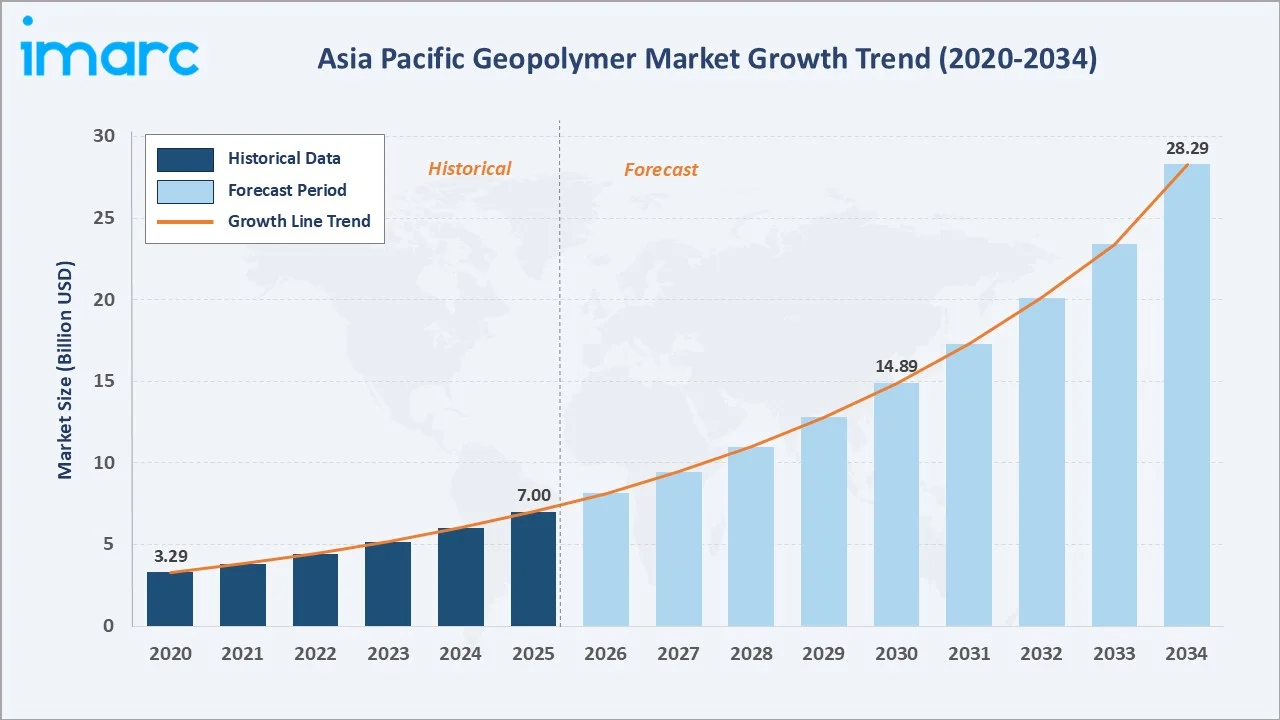
The Asia Pacific geopolymer market reached USD 7.00 Billion in 2025 and is projected to reach USD 28.29 Billion by 2034, exhibiting an exceptional CAGR of 16.28% during 2026-2034. India’s National Infrastructure Pipeline (NIP) was launched with an investment of approximately INR 111 lakh crore (USD 1.5 trillion) during FY2020–FY2025, with major allocations directed toward energy, roads, urban infrastructure, and railways. This large-scale infrastructure development is supporting the Asia Pacific geopolymer market by increasing demand for durable, low-carbon construction materials for highways, bridges, rail networks, urban development, and energy projects. Cement and concrete leads application at 55.8%, infrastructure dominates end-use industries at 38.7%, and China commands the largest country share at 39.6%.
Market Snapshot
|
Metric |
Value |
|
Market Size (2025) |
USD 7.00 Billion |
|
Forecast Market Size (2034) |
USD 28.29 Billion |
|
CAGR (2026-2034) |
16.28% |
|
Base Year |
2025 |
|
Historical Period |
2020-2025 |
|
Forecast Period |
2026-2034 |
|
Dominant Application |
Cement and Concrete – 55.8% (2025) |
|
Dominant End Use Industry |
Infrastructure – 38.7% (2025) |
|
Leading Country |
China – 39.6% (2025) |
The APAC geopolymer market grew from USD 3.29 Billion in 2020 to USD 7.00 Billion in 2025, driven by China’s carbon neutrality commitment accelerating low-carbon construction material adoption, Australia’s pioneering commercial geopolymer concrete deployment in major infrastructure projects, and South Korea and Japan’s industrial steel slag utilization mandates creating abundant low-cost geopolymer precursor supply. The market is projected to reach USD 14.89 Billion by 2030 and USD 28.29 Billion by 2034.
To get more information on this market, Request Sample
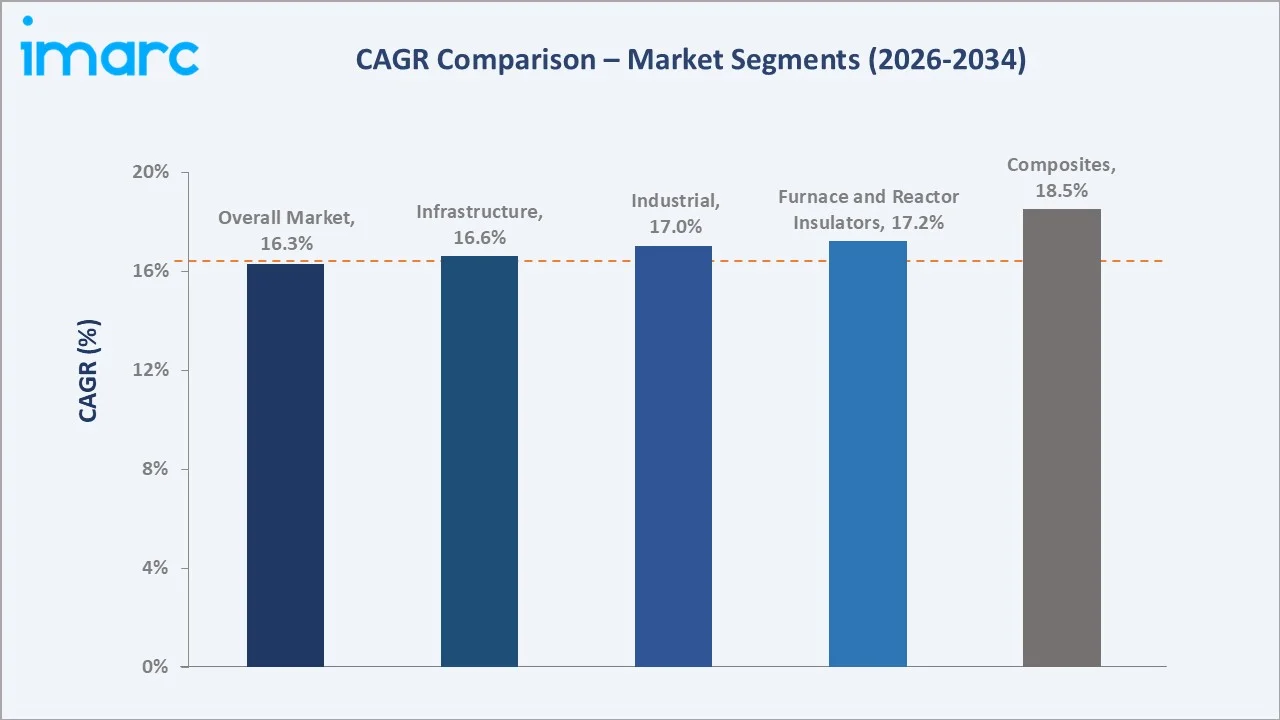
Composites application grows fastest at ~18.50% CAGR through aerospace, automotive, and defense material substitution. Furnace and reactor insulators grow at ~17.20% CAGR through high-temperature industrial process decarbonization. Industrial end use grows at ~17.00% CAGR through heavy industry emission reduction compliance. Infrastructure end use grows at ~16.60% CAGR through APAC’s infrastructure investment cycle.
Executive Summary
The Asia Pacific geopolymer market represents one of the construction materials sector’s most compelling structural growth stories, where a scientifically proven, low-carbon alternative to ordinary Portland cement (OPC) has finally reached commercial deployment scale across APAC’s massive construction, infrastructure, and industrial markets at precisely the moment when government carbon regulations, corporate net-zero commitments, and green building certification systems create overwhelming structural demand for materials that can reduce embodied carbon by 40-80% compared to conventional OPC-based concrete.
Cement and concrete’s 55.8% application dominance reflects geopolymer’s most mature and commercially proven deployment pathway. Infrastructure end users’ 38.7% market leadership reflects the alignment between geopolymer’s unique performance advantages and infrastructure project requirements where service life longevity, reduced maintenance cost, and climate resilience are primary specification criteria. China’s 39.6% country dominance reflects both the largest construction market’s scale and the Chinese government’s aggressive carbon trading and green building policy framework, creating the strongest regulatory pull for low-carbon construction materials of any APAC economy.
Key Market Insights
|
Insight |
Data |
|
Dominant Application |
Cement and Concrete – 55.8% share (2025) |
|
Dominant End Use Industry |
Infrastructure – 38.7% share (2025) |
|
Leading Country |
China – 39.6% share (2025) |
|
Market Opportunity |
APAC’s infrastructure investment pipeline creating structural geopolymer demand; China ETS carbon cost escalation driving OPC replacement economics; ASEAN green building certification growth; waste material valorization in high fly-ash-producing APAC economies |
Key Analytical Observations:
- Cement and Concrete at 55.8% (2025): Geopolymer’s cement and concrete application encompasses ready-mix geopolymer concrete, precast geopolymer structural elements, geopolymer blocks and pavers, geopolymer repair mortars, and geopolymer grout systems. This application’s market leadership reflects two concurrent commercial dynamics: technology maturity and economics convergence.
- Infrastructure at 38.7% (2025): Infrastructure’s dominant market position reflects the alignment between geopolymer concrete’s performance characteristics and infrastructure engineering requirements. The superior chemical resistance of geopolymer concrete to sulfate attack, chloride penetration, acid exposure, and alkali-silica reaction creates a direct service life advantage in infrastructure applications where structures must perform for 50-100 years in aggressive environments.
- China at 39.6% (2025): China leads due to its large-scale infrastructure development, extensive construction activity, and growing focus on low-carbon building materials. Strong industrial availability of fly ash and slag further supports cost-effective geopolymer production and adoption.
Asia Pacific Geopolymer Market Overview
The Asia Pacific geopolymer market encompasses low-carbon construction materials produced primarily from industrial by-products such as fly ash, slag, and other aluminosilicate materials. It covers geopolymer cement, concrete, binders, and composites used across buildings, roads, bridges, precast structures, and industrial applications. Macroeconomic factors include rapid urbanization, infrastructure investment, construction sector growth, industrial output, and government spending on sustainable development.
Market Dynamics
To evaluate market opportunities, Request Sample
Market Drivers
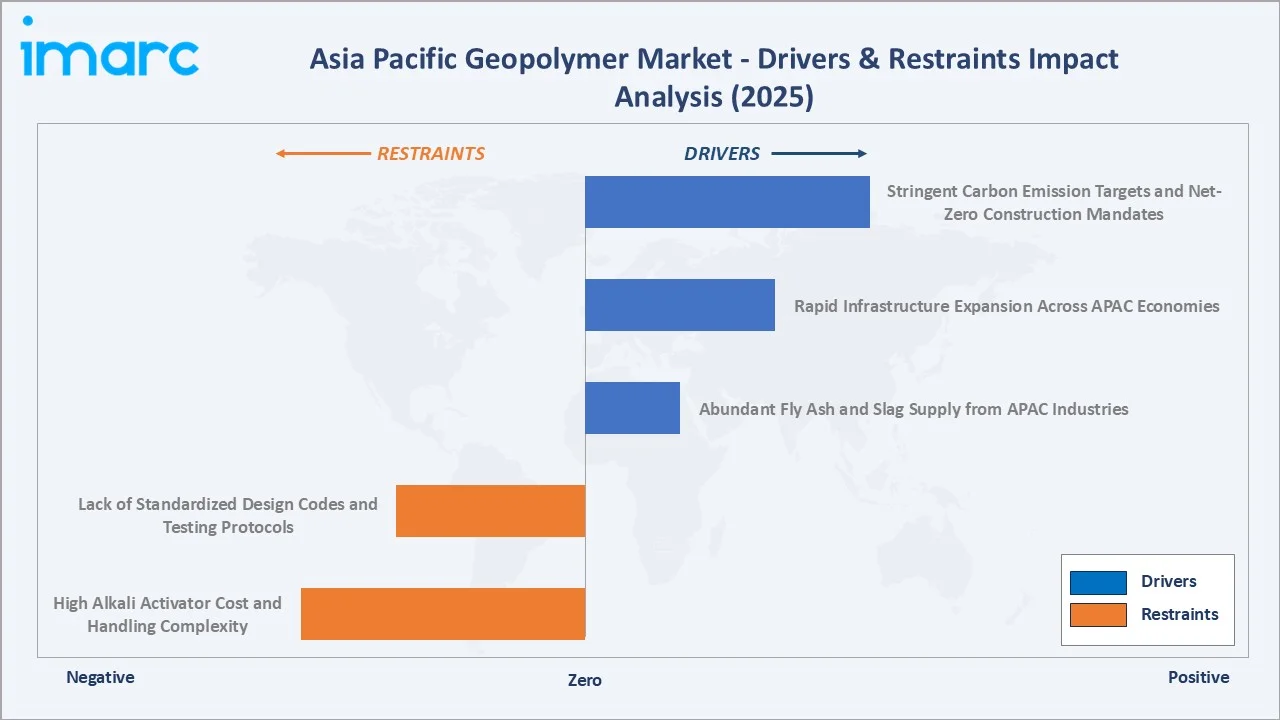
- Stringent Carbon Emission Targets and Net-Zero Construction Mandates: APAC’s geopolymer market is receiving unprecedented demand stimulus from the region’s carbon policy frameworks, where China’s National Carbon Emission Trading Scheme (ETS) covers 2,225 entities in China, covering 40% of national emissions and around 12% of global emissions (4.5 gigatons of CO2) has created a direct carbon cost for cement production, making geopolymer concrete economically competitive with OPC in carbon-constrained procurement for the first time in market history.
- Rapid Infrastructure Expansion Across APAC Economies: APAC’s construction and infrastructure market represents the largest building activity by volume, with China, India, Indonesia, Vietnam, and ASEAN collectively driving high annual construction investment that creates the fundamental demand base for any construction material innovation achieving scale adoption. By the end of 2024, the railway network reached around 162,000 km, about 16,000 km more than in 2020, while high-speed rail exceeded 48,000 km after adding roughly 10,000 km and connected 97% of cities with populations above 500,000. China’s highway network also expanded to 5.49 million km, including 191,000 km of expressways, providing coverage to 99% of cities with populations exceeding 200,000, under China’s 14th Five-Year Plan (2021–2025).
- Abundant Fly Ash and Slag Supply from APAC Industries: APAC’s industrial base generates the largest supply of geopolymer precursor materials at low or negative cost, creating favorable raw material economics for geopolymer concrete manufacturing that does not exist in European or North American markets. China produces about 600 million tons of fly ash annually from its coal-fired power generation fleet. This precursor supply abundance creates a structural raw material cost advantage for geopolymer concrete in APAC that positions the region as the lowest-cost geopolymer concrete market when the activator chemistry cost is managed effectively.
Market Restraints
- High Alkali Activator Cost and Handling Complexity: High alkali activator costs and handling complexity increase overall production and application expenses. Common activators such as sodium hydroxide and sodium silicate require careful storage, transportation, and worker safety measures due to their corrosive nature. These operational challenges can discourage smaller contractors and manufacturers from adopting geopolymer technologies, particularly in price-sensitive construction markets.
- Lack of Standardized Design Codes and Testing Protocols: The lack of standardized design codes and testing protocols creates uncertainty around material performance, structural reliability, and long-term durability. Differences in raw materials and mixed formulations further complicate uniform testing and certification. This limits acceptance among engineers, contractors, and regulators and slows the use of geopolymer materials in large-scale infrastructure and commercial construction projects.
Market Opportunities
- Carbon Credit and Green Bond Financing for Geopolymer Infrastructure: The expanding APAC carbon credit and green bond market creates a novel financing mechanism for geopolymer concrete adoption that did not exist five years ago. Infrastructure projects specifying geopolymer concrete instead of OPC concrete can claim verified carbon reduction credits under APAC’s voluntary and compliance carbon markets, generating carbon revenue that can partially offset any cost premium for geopolymer concrete versus OPC alternatives.
- ASEAN Green Building Market Expansion: Southeast Asia’s rapidly growing green building certification market creates structured demand for embodied carbon reduction in building materials that geopolymer concrete is uniquely positioned to address. ASEAN’s urban population growth is expected to reach around 70% by 2050, adding nearly 150 million people to ASEAN cities, driving the construction of new housing units and commercial buildings, creating a market scale where green building certification drives shifting material specifications toward low-embodied-carbon alternatives.
Market Challenges
- Variability in Raw Material Quality: Geopolymer production depends heavily on fly ash, slag, and other aluminosilicate materials whose chemical composition can vary across sources. This variability makes it difficult to maintain consistent strength, setting time, and durability. Manufacturers must therefore invest in material characterization and formulation adjustments to ensure reliable product performance.
- Difficulty in Scaling Commercial Production: Moving geopolymer technologies from pilot projects to large-scale commercial production remains challenging due to feedstock consistency, specialized processing requirements, and supply-chain constraints. Producers must maintain uniform formulations across large production volumes while meeting project-specific performance requirements. These issues can increase capital requirements and delay capacity expansion.
Emerging Market Trends
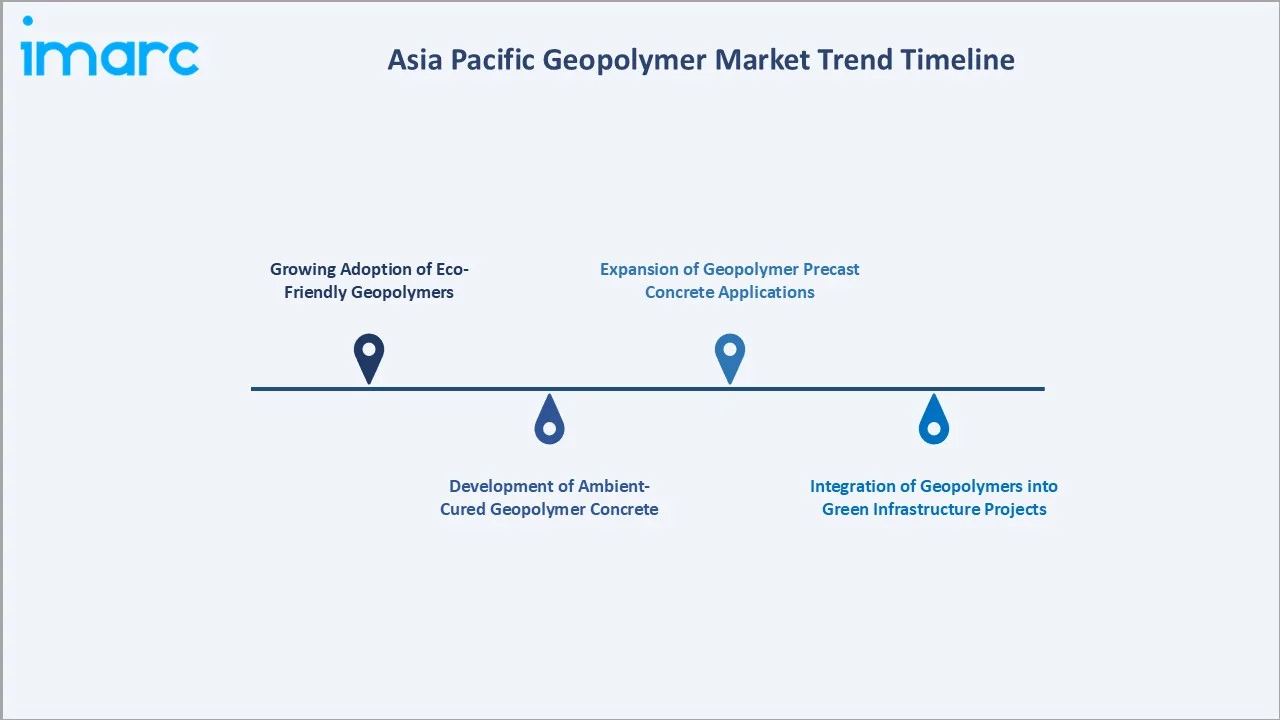
1. Growing Adoption of Eco-Friendly Geopolymers
The growing focus on sustainable construction is accelerating the adoption of eco-friendly geopolymers across the Asia Pacific region. In April 2026, CSIR–Advanced Materials and Processes Research Institute (CSIR-AMPRI) successfully developed and demonstrated India’s first fly ash-based, cement-free geopolymer roller-compacted concrete road. The eco-friendly road section was constructed within the institute’s campus and has been completed and opened for regular use. Demonstration projects, including cement-free geopolymer roads, are also strengthening confidence in their use for infrastructure and commercial applications.
2. Expansion of Geopolymer Precast Concrete Applications
Precast manufacturers are increasingly exploring geopolymer technology for blocks, pipes, panels, sleepers, pavers, and structural components. Factory-controlled production environments enable better management of geopolymer mixing, curing, and quality parameters. This helps overcome some of the challenges associated with on-site geopolymer concrete placement. Infrastructure and urban development projects are creating additional demand for prefabricated components. As a result, precast applications are emerging as an important commercialization pathway.
3. Development of Ambient-Cured Geopolymer Concrete
Research and commercial development are increasingly focused on geopolymer formulations that can achieve required strength under ambient curing conditions. Traditional heat-curing requirements can restrict on-site construction applications and increase energy consumption. Ambient-cured systems improve practicality for buildings, roads, and infrastructure projects. Advances in activator chemistry and blended precursor formulations are supporting this transition. Such technologies are expected to broaden the range of feasible geopolymer applications.
4. Integration of Geopolymers into Green Infrastructure Projects
Geopolymer materials are increasingly being considered for sustainable roads, bridges, drainage systems, rail infrastructure, and urban development projects. Their durability and potential for lower embodied emissions align with government objectives for climate-resilient infrastructure. Public-sector demonstration projects are helping to validate performance under real-world conditions. Successful deployments can improve confidence among engineers and contractors. Growing infrastructure investment across Asia Pacific is expected to accelerate this trend.
Industry Value Chain Analysis
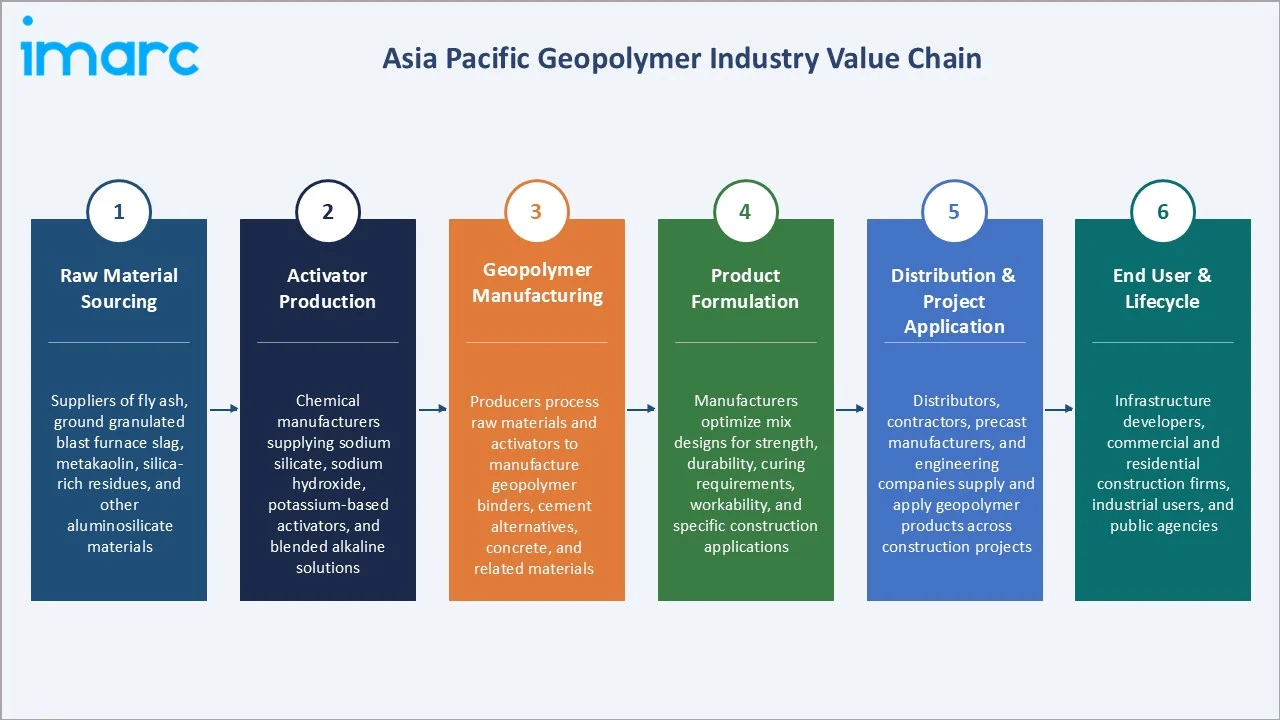
The APAC geopolymer value chain integrates industrial byproduct raw material sourcing, chemical activator production, geopolymer binder and product manufacturing, project specification and application, and end-of-life material valorization.
|
Stage |
Key Participants |
|
Raw Material Sourcing |
Suppliers of fly ash, ground granulated blast furnace slag, metakaolin, silica-rich residues, and other aluminosilicate materials. |
|
Activator Production |
Chemical manufacturers supplying sodium silicate, sodium hydroxide, potassium-based activators, and blended alkaline solutions. |
|
Geopolymer Manufacturing |
Producers process raw materials and activators to manufacture geopolymer binders, cement alternatives, concrete, and related materials. |
|
Product Formulation |
Manufacturers optimize mix designs for strength, durability, curing requirements, workability, and specific construction applications. |
|
Distribution & Project Application |
Distributors, contractors, precast manufacturers, and engineering companies supply and apply geopolymer products across construction projects. |
|
End User & Lifecycle |
Infrastructure developers, commercial and residential construction firms, industrial users, and public agencies. |
Geopolymer manufacturing represents the most value-added stage in the industry value chain, as it transforms relatively low-value industrial by-products into high-performance, low-carbon construction materials. This stage involves specialized processing, activator integration, quality control, and technical expertise to achieve required strength and durability. Product performance and differentiation created at this stage significantly influence the final commercial value.
Technology Landscape in the Asia Pacific Geopolymer Industry
Alkali-Activated Geopolymer Technology
This is the core technology used to produce geopolymers by activating aluminosilicate materials such as fly ash, GGBS, and metakaolin with alkaline solutions. Sodium silicate and sodium hydroxide are commonly used to initiate geopolymerization and develop binding properties. Technology development is increasingly focused on optimizing activator concentration and precursor combinations. Improved formulations support higher strength, chemical resistance, and durability.
Ambient-Curing Geopolymer Technology
Ambient-curing technology enables geopolymer concrete to develop strength at room temperature without energy-intensive heat curing. High-calcium precursors and optimized alkaline activators are being used to improve early-age strength and curing performance. This technology makes geopolymers more practical for cast-in-situ construction. It also reduces energy consumption and simplifies field application.
Fiber-Reinforced Geopolymer Technology
Fiber reinforcement technology incorporates steel, basalt, glass, synthetic, or other fibers into geopolymer matrices. Fibers help control crack propagation and improve tensile strength, toughness, and deformation capacity. The technology addresses the inherent brittle characteristics of geopolymer materials. It is particularly relevant for structural components and demanding infrastructure applications.
Market Segmentation Analysis
The report covers the following segments:
|
Segment Category |
Leading Segment |
Market Share |
Year |
|
Application |
Cement and Concrete |
55.8% |
2025 |
|
End Use Industry |
Infrastructure |
38.7% |
2025 |
|
Country |
China |
39.6% |
2025 |

By Application
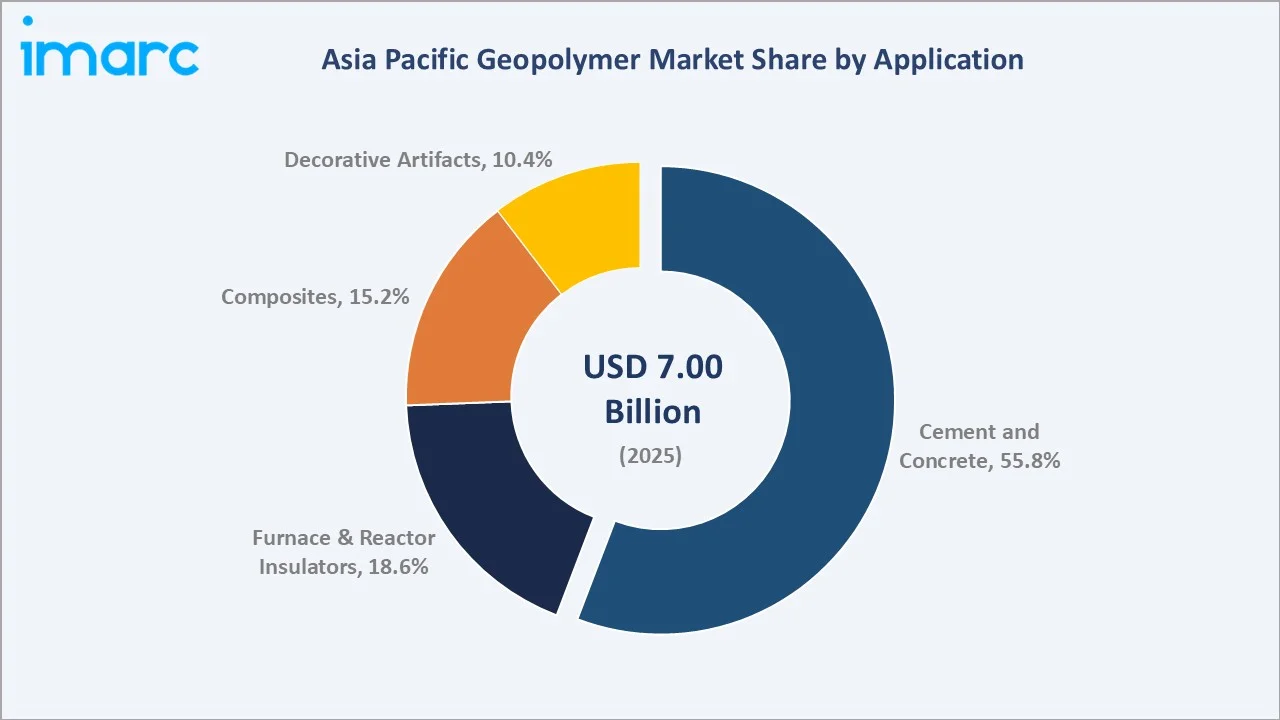
Cement and concrete lead at 55.8% (2025) through infrastructure and building construction’s dominant volume demand for structural geopolymer concrete. Furnace and reactor insulators at 18.6% serve APAC’s heavy industry high-temperature process applications.
To access detailed market analysis, Request Sample
Composites at 15.2% are growing fastest at ~18.50% CAGR through aerospace and transport material substitution. Decorative artifacts at 10.4% are growing through architectural and interior geopolymer material applications.
By End Use Industry
Infrastructure leads at 38.7% (2025) through APAC’s infrastructure investment cycle and geopolymer concrete’s superior durability in aggressive infrastructure environments.
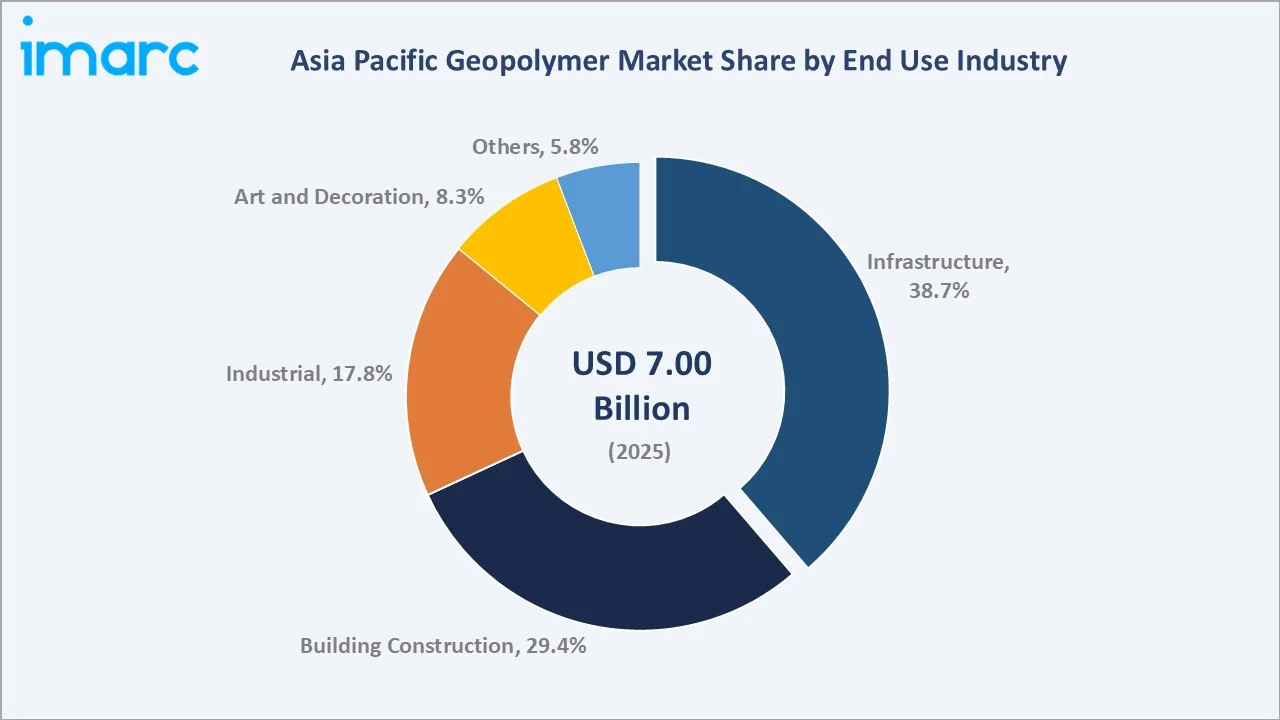
Building construction at 29.4% is growing through green building certification embodied carbon requirements. Industrial at 17.8% is growing at ~17.00% CAGR through heavy industry decarbonization compliance. Art and decoration at 8.3% through architectural geopolymer applications.
Regional Market Insights
|
Country |
Share (2025) |
Key APAC Geopolymer Market Drivers & Characteristics |
|
China |
39.6% |
Leads through large-scale infrastructure development, rapid urbanization, extensive industrial activity, and strong availability of fly ash and slag for geopolymer production. |
|
Japan |
15.8% |
Supported by advanced construction technologies, sustainable building practices, and increasing adoption of fly ash-based geopolymer concrete. |
|
India |
14.7% |
Rapid infrastructure expansion, urban development, and growing interest in low-carbon construction materials support market growth. |
|
South Korea |
10.1% |
Green construction initiatives, advanced material research, and emphasis on reducing embodied carbon support geopolymer adoption. |
|
Australia |
8.2% |
Strong focus on low-carbon concrete, industrial waste utilization, and geopolymer applications in roads, pavements, and infrastructure supports demand. |
|
Indonesia |
6.5% |
Urbanization, infrastructure construction, and availability of industrial by-products provide opportunities for geopolymer materials. |
|
Others |
5.1% |
Growing green building activity, infrastructure investment, and gradual adoption of alternative cementitious materials support market development. |
China leads the market with a 39.6% share in 2025, supported by extensive infrastructure development, industrial activity, and availability of fly ash and slag. Japan accounts for 15.8%, driven by advanced construction technologies, high-performance materials, and sustainable infrastructure applications. India holds 14.7%, benefiting from rapid urbanization, infrastructure investment, and increasing adoption of low-carbon construction materials. South Korea represents 10.1%, supported by green construction initiatives and advanced material development.
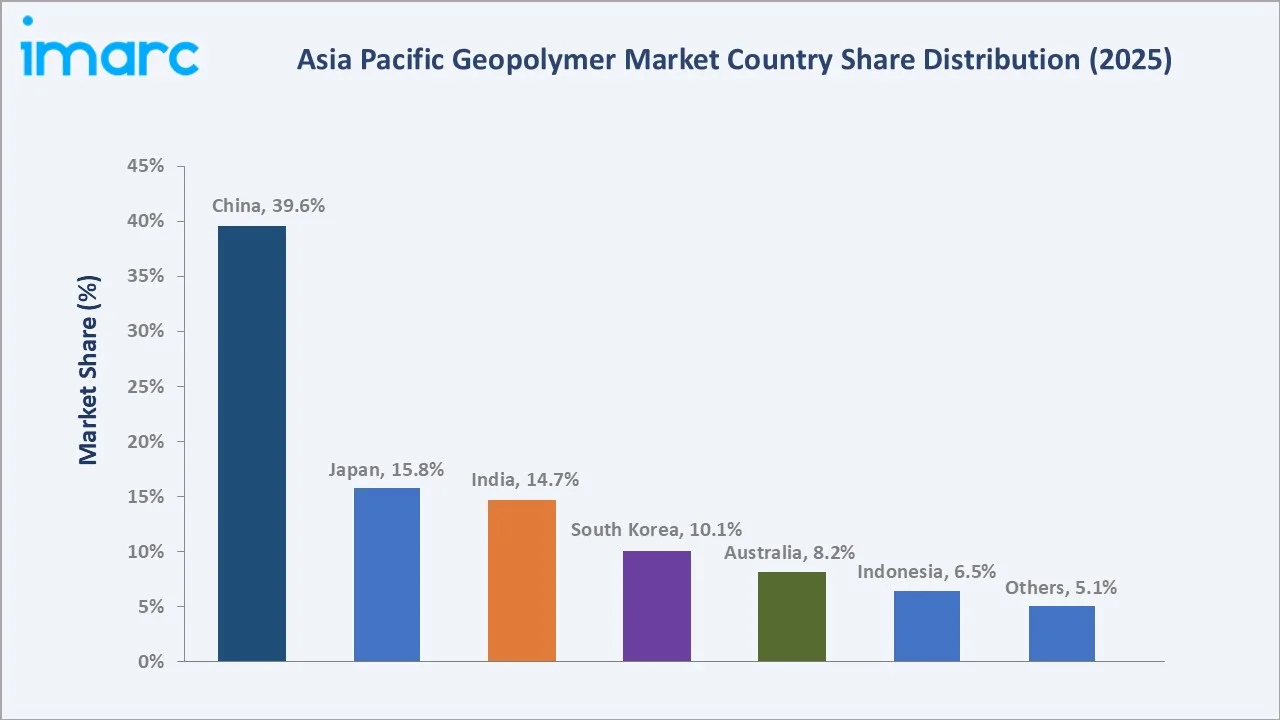
Australia captures 8.2%, with demand supported by sustainable construction practices and geopolymer technology development. Indonesia accounts for 6.5%, benefiting from expanding construction activity and infrastructure development. The remaining countries collectively hold 5.1%, supported by gradual adoption of alternative cementitious materials and green building practices.
Competitive Landscape
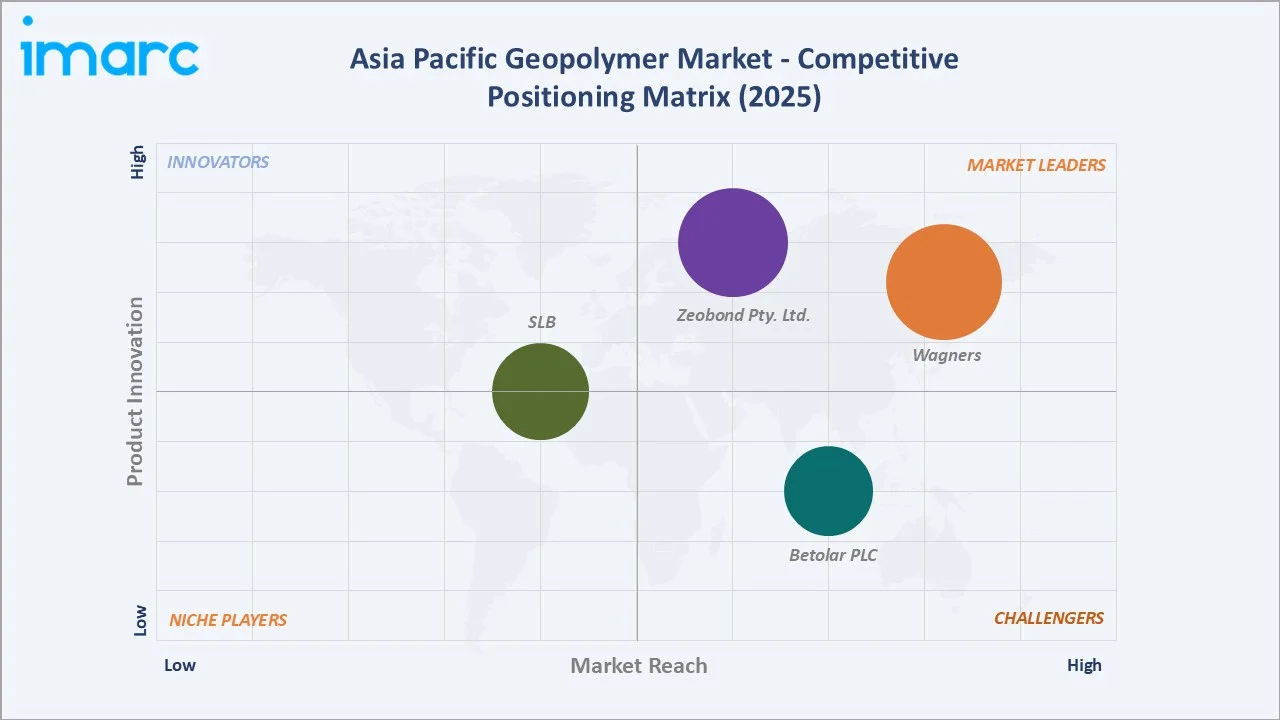
The Asia Pacific geopolymer market has a relatively consolidated competitive landscape, with established and specialized players competing through product innovation, technical expertise, and sustainable material solutions. Key companies focus on R&D, strategic partnerships, customized geopolymer formulations, and regional expansion to strengthen their positions in construction and infrastructure applications.
|
Company |
Key Products |
Market Position |
Core Strength |
|
Wagners |
Earth Friendly Concrete (EFC) |
Market Leader |
Their flagship Earth Friendly Concrete (EFC) utilizes industrial by-products (like fly ash) to reduce cement-related CO₂ emissions. |
|
Zeobond Pty. Ltd. |
E-Crete |
Market Leader |
Zeobond Pty. Ltd. is a pioneer in commercializing geopolymer cement and low-carbon concrete alternatives in the Asia-Pacific region. |
|
SLB |
EcoShield |
Established Player |
Plays a major role by driving the adoption of cement-free geopolymers, significantly reducing the carbon footprint of well construction. |
|
Betolar PLC |
Geoprime |
Challenger |
Betolar PLC drives the green transition in the Asia-Pacific (APAC) construction sector. |
APAC’s geopolymer competitive landscape is evolving from a pioneer-led market toward an industrially integrated market where steel producers and chemical companies leverage their precursor and activator supply chain positions to capture geopolymer value chain margin while technology companies monetize IP through licensing.
Key Company Profiles
Wagners
Wagners is a construction materials and services company that operates across construction materials and services and New Generation Building Materials, with activities spanning cement, concrete, aggregates, fly ash, precast concrete, reinforcing steel, transport, and engineering solutions. Within the Asia Pacific geopolymer market, Wagners is recognized for its proprietary Earth Friendly Concrete (EFC), a zero-cement concrete based on geopolymer technology that uses chemically activated industrial by-products, including fly ash and slag.
- Key Products: Earth Friendly Concrete (EFC).
- Strategic Focus: Expanding the commercialization and adoption of its proprietary Earth Friendly Concrete (EFC) as a zero-cement, low-carbon alternative to conventional concrete. The company emphasizes continuous R&D, utilization of fly ash and slag, and deployment of EFC across infrastructure, commercial buildings, precast products, and heavy-duty pavement applications.
Zeobond Pty. Ltd.
Zeobond Pty. Ltd. is a geopolymer technology company with a focus on developing and commercializing sustainable alternatives to conventional Portland cement. The company is recognized as an early commercial pioneer of geopolymer technology and has developed E-Crete, its proprietary geopolymer concrete solution manufactured primarily using industrial by-products such as fly ash and blast furnace slag.
- Key Products: E-Crete.
- Strategic Focus: Commercializing its E-Crete geopolymer technology as a sustainable alternative to conventional Portland cement concrete. The company emphasizes using industrial by-products such as fly ash and slag to reduce embodied carbon and support circular construction practices.
Market Concentration Analysis
The Asia Pacific geopolymer market exhibits a relatively consolidated structure, with a limited group of established and specialized companies holding notable competitive positions. Competition is primarily based on proprietary formulations, product performance, carbon reduction, technical expertise, and application-specific solutions. High R&D requirements, specialized activator chemistry, and the need for consistent raw material quality create barriers for new entrants. Strategic partnerships, technology licensing, and localized production are increasingly used to strengthen regional presence. Growing demand for low-carbon construction materials is nevertheless creating opportunities for emerging geopolymer technology providers.
Investment & Growth Opportunities
Highest Growth Segments
Composites (~18.50% CAGR) and furnace and reactor insulators (~17.20% CAGR) represent APAC’s highest-CAGR geopolymer investment segments through 2034, driven by aerospace and defense material substitution and industrial decarbonization, respectively.
Investment Themes
- One-Part Geopolymer Concrete Development: Investment in one-part or “just-add-water” geopolymer concrete offers opportunities to simplify on-site mixing by replacing corrosive liquid alkaline activators with solid activators. This can improve handling, storage, and scalability while supporting wider adoption in cast-in-situ construction, precast products, and infrastructure projects.
- ASEAN Geopolymer Market Entry: Investment in the ASEAN geopolymer market offers growth potential as regional governments promote low-carbon infrastructure and more sustainable construction practices. Establishing local production, partnerships, and feedstock supply networks can help companies capitalize on infrastructure expansion while utilizing locally available industrial by-products.
Future Market Outlook (2026-2034)
The Asia Pacific geopolymer market is projected to grow from USD 7.00 Billion in 2025 to USD 28.29 Billion by 2034, delivering an exceptional 16.28% CAGR that positions APAC as the fastest-growing regional construction materials market by growth rate, underpinned by the historic alignment of three structural forces that are simultaneously and irreversibly reshaping APAC’s construction material specification environment. The midpoint anchor of USD 14.89 Billion in 2030 confirms the structural consistency of APAC’s geopolymer growth trajectory across market cycles and external disruptions.
First, APAC’s carbon policy ecosystem is undergoing a fundamental and irreversible shift toward direct carbon pricing for construction materials that will make geopolymer concrete economically competitive with OPC concrete in an expanding geographic scope of APAC markets over the 2026-2034 forecast period. Second, APAC’s geopolymer standardization ecosystem is approaching a critical threshold where the development of comprehensive geopolymer concrete structural design codes in Australia, South Korea, and Japan will unlock routine engineering specification without project-by-project variance approval, removing the single most significant procurement barrier that has constrained geopolymer concrete adoption among conservative infrastructure engineering organizations. Third, APAC’s massive industrial ecology ensures that raw material availability will not constrain APAC geopolymer market scaling at any forecast volume through 2034.
Research Methodology
Primary Research
Primary research comprised in-depth interviews with geopolymer technology company leadership, construction and infrastructure project engineers who have specified geopolymer concrete, government infrastructure procurement officials, steel industry sustainability officers, and carbon market specialists advising on construction material carbon credit certification.
Secondary Research
Secondary research encompassed a detailed review of government publications, industry association reports, company annual reports, regulatory documents, technical journals, academic studies, and trade databases. The research also assessed infrastructure investment, construction activity, industrial by-product availability, sustainability regulations, and geopolymer technology developments across major Asia Pacific countries.
Forecasting Models
Forecasting models developed using historical APAC geopolymer market data (2020-2025), APAC construction market investment trajectory, ASEAN infrastructure gap financing commitment, country-specific carbon pricing escalation trajectory, national geopolymer standardization development timeline assessment, fly ash and GGBFS supply trajectory aligned to coal phase-out schedules and steel production capacity plans, alkali activator cost trajectory under geopolymer scale economies, and competitive market share modeling under vertically integrated producer versus technology licensing commercialization pathways.
Report Coverage:
| Report Features | Details |
|---|---|
| Base Year of the Analysis | 2025 |
| Historical Period | 2020-2025 |
| Forecast Period | 2026-2034 |
| Units | Billion USD |
| Scope of the Report | Exploration of Historical Trends and Market Outlook, Industry Catalysts and Challenges, Segment-Wise Historical and Future Market Assessment:
|
| Applications Covered | Cement and Concrete, Furnace and Reactor Insulators, Composites, Decorative Artifacts |
| End-Use Industries Covered | Building Construction, Infrastructure, Industrial, Art and Decoration, Others |
| Countries Covered | China, Japan, India, South Korea, Australia, Indonesia, Others |
| Companies Covered | Wagners, Zeobond Pty. Ltd., SLB, Betolar PLC, etc. |
| Customization Scope | 10% Free Customization |
| Post-Sale Analyst Support | 10-12 Weeks |
| Delivery Format | PDF and Excel through Email (We can also provide the editable version of the report in PPT/Word format on special request) |
Frequently Asked Questions About the Asia Pacific Geopolymer Market Report
The Asia Pacific geopolymer market reached USD 7.00 Billion in 2025, driven by rapid infrastructure development, urbanization, and rising demand for low-carbon construction materials. Increasing utilization of fly ash, slag, and other industrial by-products, along with government sustainability initiatives and green building adoption, further supported market growth.
The market grows at a 16.28% CAGR, reaching USD 28.29 Billion by 2034, supported by rising adoption of low-carbon construction materials, infrastructure expansion, and increasing utilization of industrial waste-based binders.
Cement and concrete leads at 55.8% (2025) through infrastructure and building construction’s dominant demand for structural geopolymer concrete systems.
Infrastructure leads at 38.7% (2025) through APAC’s infrastructure investment cycle combined with geopolymer concrete’s superior performance in aggressive infrastructure environments where service life and maintenance reduction justify specification.
China leads at 39.6% through the largest construction market, the most aggressive carbon trading scheme in APAC, and the largest fly ash supply.
Leading companies include Wagners, Zeobond Pty. Ltd., SLB, and Betolar PLC, among others.
The market is projected to reach USD 14.89 Billion by 2030, driven by expanding infrastructure construction, stronger green building adoption, and growing demand for low-carbon alternatives to conventional cement. Rising utilization of fly ash, slag, and other industrial by-products is also supporting broader commercial use of geopolymer materials across the region.
Top investment opportunities include one-part geopolymer concrete technology development, China ETS-aligned geopolymer concrete supply chain, ASEAN geopolymer market entry, fly ash geopolymer precursor supply business in India, and Geopolymer composites for aerospace and defense APAC market.
Need more help?
- Speak to our experienced analysts for insights on the current market scenarios.
- Include additional segments and countries to customize the report as per your requirement.
- Gain an unparalleled competitive advantage in your domain by understanding how to utilize the report and positively impacting your operations and revenue.
- For further assistance, please connect with our analysts.
 Request Customization
 Speak to an Analyst
 Request Brochure
 Inquire Before Buying
Benefits of Customization
- Personalize this research
- Triangulate with your data
- Get data as per your format and definition
- Gain a deeper dive into a specific application, geography, customer, or competitor
- Any level of personalization
Get in Touch With Us
UNITED STATES
Phone: +1-201-971-6302
INDIA
Phone: +91-120-433-0800
UNITED KINGDOM
Phone: +44-753-714-6104
Email: [email protected]
Client Testimonials




.webp)




.webp)













Related Reports

Choose your plan
*Please note that the prices mentioned below are starting prices for each bundle type. Kindly contact our team for further details.*
Single User License
- 1 User License, Access on 2 Devices
- PDF Report + Excel Dataset (Password Protected)
- Lifetime Access
- No Printing Rights
- 10% Free Report Customization
- 10–12 Weeks of Analyst Support
Five User License
- Access for 5 Users, 2 Devices per User
- PDF Report + Excel Dataset (Password Protected)
- Lifetime Access
- Dedicated Account Manager
- 12–14 Weeks of Analyst Support
- No Printing Rights
- 15% Free Report Customization
- 25% Discount on Your Next Purchase
Corporate User License
- Unlimited User Access (Within Your Organization)
- PDF Report + Excel Dataset
- Lifetime Access
- Dedicated Account Manager
- 14–20 Weeks of Analyst Support
- No Printing Rights
- 20% Free Report Customization
- 30% Discount on Your Next Purchase
Essential Insights
What's included:
3 reports
- Lifetime Access
- PDF Reports
- Excel Datasets
- 2 Weeks of Free Analyst Support
- 2 User Licenses
- Access on 2 Devices
- Printing Rights
- Complimentary PowerPoint (PPT) Version
- Complimentary License Upgrade
Professional Access
What's included:
5 reports
- Lifetime Access
- PDF Reports
- Excel Datasets
- 8 Weeks of Free Analyst Support
- 2 User Licenses
- Access on 2 Devices
- Printing Rights
- Complimentary PowerPoint (PPT) Version
- Complimentary License Upgrade
Business Advantage
What's included:
8 reports
- Lifetime Access
- PDF Reports
- Excel Datasets
- 14 Weeks of Free Analyst Support
- 2 User Licenses
- Access on 2 Devices
- Printing Rights
- Complimentary PowerPoint (PPT) Version
- Complimentary License Upgrade
Enterprise Intelligence
What's included:
10 reports
- Lifetime Access
- PDF Reports
- Excel Datasets
- 20 Weeks of Free Analyst Support
- 2 User Licenses
- Access on 2 Devices
- Printing Rights
- Complimentary PowerPoint (PPT) Version
- Complimentary License Upgrade