
Asia Pacific Maritime Information Market Size, Share, Trends and Forecast by Application, End User, and Country, 2026-2034
Asia Pacific Maritime Information Market Summary:
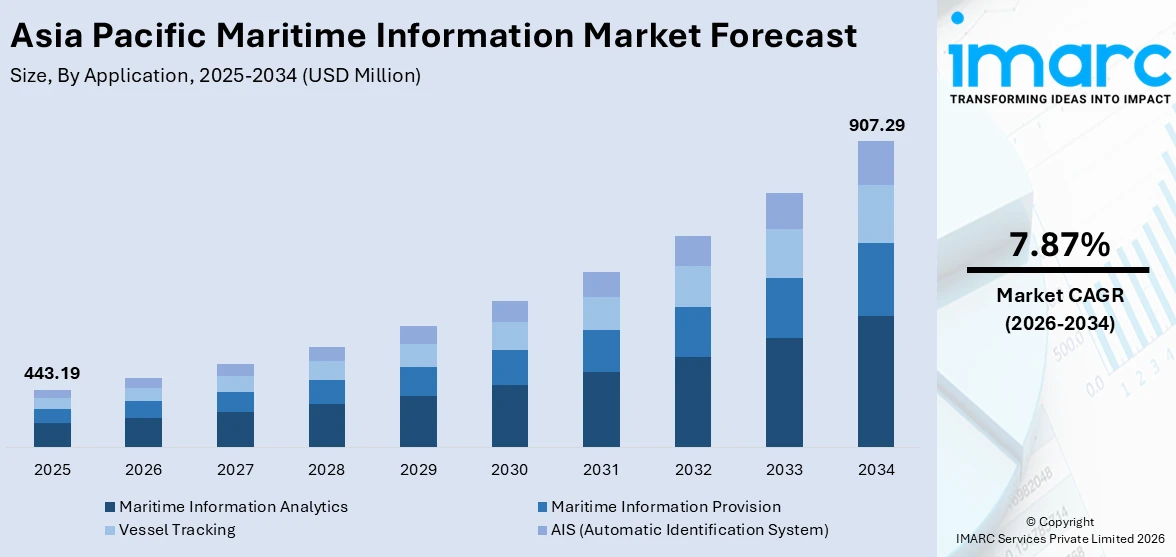
The Asia Pacific maritime information market size increased from USD 443.19 Million in 2025 to USD 494.86 Million in 2026 and is projected to reach USD 907.29 Million by 2034, growing at a compound annual growth rate of 7.87% from 2026-2034.
The Asia Pacific maritime information market is experiencing strong momentum, driven by the region’s expanding seaborne trade volumes, rising demand for real-time vessel tracking, and growing emphasis on maritime security. Governments across the region are investing in digital infrastructure to strengthen port operations and coastal surveillance. The integration of advanced analytics, satellite-based monitoring, and AI-powered traffic management systems is further supporting the Asia Pacific maritime information market share.
Key Takeaways and Insights:
- By Application: Maritime information analytics dominate the market with a share of 32% in 2025, driven by the rapid adoption of AI-powered data platforms and predictive analytics tools that enable stakeholders to optimize fleet performance and enhance operational decision-making across major shipping routes.
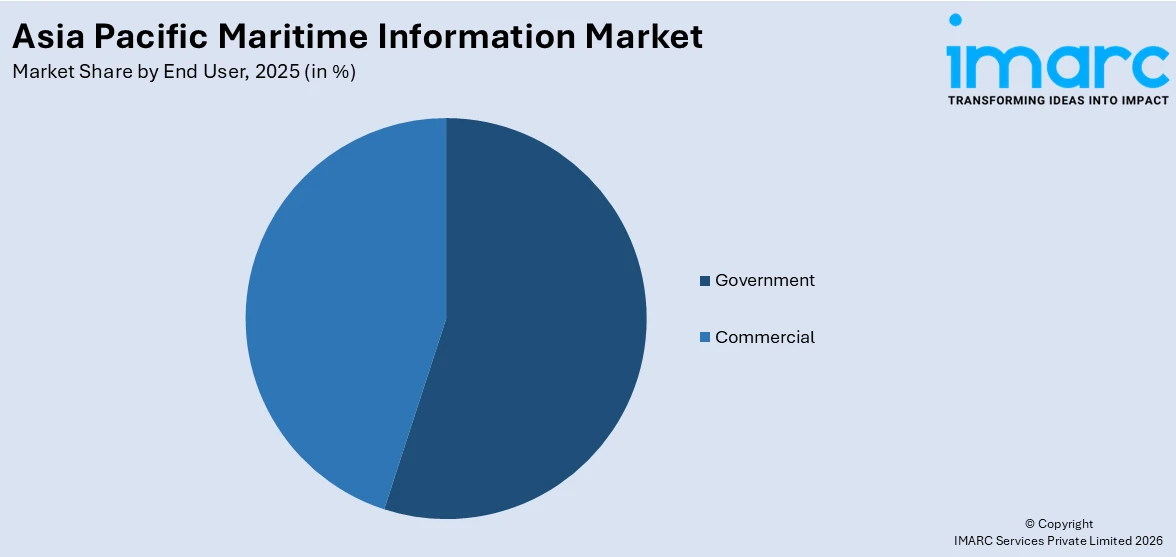
- By End User: Government leads the market with a share of 55% in 2025, reflecting strong investments by national defense agencies, coast guards, and maritime authorities in surveillance systems, border security solutions, and maritime domain awareness platforms across the region.
- Key Players: Leading companies in the Asia Pacific maritime information market are driving innovation through satellite-based AIS solutions, cloud analytics platforms, and AI-enabled vessel tracking technologies. Strategic acquisitions, partnerships with government agencies, and expansion into emerging maritime corridors are strengthening competitive positioning across the region.
To get more information on this market Request Sample
The Asia Pacific maritime information market is advancing as countries prioritize maritime safety, operational efficiency, and digital transformation across their shipping and port ecosystems. The region's dense shipping routes, including the Strait of Malacca and the South China Sea, necessitate sophisticated information systems for vessel monitoring, risk assessment, and traffic management. Governments are deploying next-generation technologies to strengthen situational awareness and ensure regulatory compliance across vast oceanic territories. Growing emphasis on maritime security, coupled with increasing trade volumes and port modernization programs, is fostering robust demand for integrated maritime information solutions. Advancements in satellite-based tracking, big data analytics, and IoT-enabled systems are further reshaping the market landscape. The expanding adoption of cloud-based platforms and AI-driven analytics is enabling both public and private maritime stakeholders to enhance decision-making, optimize fleet operations, and improve supply chain visibility across the region's interconnected maritime corridors.
Asia Pacific Maritime Information Market Trends:
Integration of AI and Machine Learning in Maritime Analytics
The Asia Pacific region is witnessing a significant shift toward AI-driven maritime analytics, as port authorities and shipping operators deploy machine learning algorithms for collision prediction, traffic optimization, and predictive maintenance. These technologies enable real-time decision-making and improve operational safety across congested waterways. For instance, in 2024, the Maritime and Port Authority of Singapore selected Kongsberg Norcontrol and Wärtsilä to develop an AI-enabled Next Generation Vessel Traffic Management System, incorporating advanced data analytics and machine learning capabilities to handle rising traffic volumes at one of the world’s busiest ports.
Rapid Adoption of Cloud-Based Maritime Information Platforms
Cloud-based solutions are transforming how maritime stakeholders access and manage operational data across the Asia Pacific. Fleet operators increasingly prefer software-as-a-service models that offer scalable analytics, automatic updates, and lower upfront costs compared to legacy on-premises systems. These platforms support high-resolution weather routing, predictive hull-fouling assessments, and fuel optimization. The shift toward cloud delivery is supporting the Asia Pacific maritime information market growth, enabling smaller operators to access advanced analytical tools previously available only to large shipping enterprises.
Expansion of Satellite-Based Vessel Tracking Systems
Satellite-powered AIS and vessel identification systems are gaining traction across the Asia Pacific, offering enhanced coverage over open oceans where terrestrial networks have limited reach. Countries with extensive maritime boundaries are investing in satellite constellations to strengthen surveillance and monitoring capabilities. For instance, in November 2025, by completing its acquisition of ORBCOMM's AIS division, S&P Global strengthened its analytics capabilities for government and commercial clients overseeing maritime operations throughout the region and increased the coverage of satellite vessel tracking globally.
Market Outlook 2026-2034:
The Asia Pacific maritime information market is driven by ongoing government investments in smart port infrastructure, enhancements in maritime security, and the adoption of AI-based analytics in the shipping industry. The ongoing port modernization initiatives in China, India, and Singapore are likely to provide a strong base for the Asia Pacific maritime information market in the coming years. The rise in international maritime collaboration, digitalization in logistics, and satellite-based surveillance are likely to further boost the market growth in the coming years. The market generated revenue of USD 443.19 Million in 2025, which is expected to reach USD 494.86 Million in 2026 and further grow to USD 907.29 Million by 2034, at a compound annual growth rate (CAGR) of 7.87% during 2026-2034.
Asia Pacific Maritime Information Market Report Segmentation:
| Segment Category | Leading Segment | Market Share |
|---|---|---|
|
Application |
Maritime Information Analytics |
32% |
|
End User |
Government |
55% |
Application Insights:
- Maritime Information Analytics
- Maritime Information Provision
- Vessel Tracking
- AIS (Automatic Identification System)
Maritime information analytics dominate with a market share of 32% of the total Asia Pacific maritime information market in 2025.
The segment of maritime information analytics has gained prominence in the Asia Pacific maritime information market, driven by the increasing need for data-driven information that can improve fleet performance, optimize routes, and reduce risks. Governments and industry players in the Asia Pacific have been using advanced information analytics tools that use artificial intelligence and big data technologies to analyze large amounts of data related to the shipping industry in real time. These tools have helped stakeholders predict maintenance requirements, identify fuel consumption patterns, and evaluate environmental compliance.
The growing use of predictive and prescriptive analytics technologies is significantly changing operational strategies for both public and private maritime companies in the Asia-Pacific region. Port authorities are now employing analytics-based digital twinning to improve berth allocation and cargo management, while shipping companies are employing machine learning algorithms to better predict disruptions and improve logistics management. Cloud-based analytics technologies are now helping smaller shipping companies benefit from sophisticated technologies that were traditionally only available to larger companies, improving route management, fuel management, and performance management in the Asia-Pacific region.
End User Insights:
Access the comprehensive market breakdown Request Sample
- Government
- Defense
- Intelligence and Security
- Search and Rescue
- Government Agency
- Others
- Commercial
- Port Management
- Business Intelligence
- Commercial Fishing
- Commercial Shipping
- Hydrographic and Charting
- Commercial Offshore
- Others
Government leads with a share of 55% of the total Asia Pacific maritime information market in 2025.
The government segment has the largest market share in the Asia Pacific region due to increasing investment in maritime security, modernization of defense forces, and surveillance activities in Asia Pacific countries. National defense forces and coast guard forces in Asia Pacific countries are increasingly using advanced vessel tracking solutions, AIS tracking solutions, and maritime domain awareness solutions to protect their territorial waters against piracy attacks and illegal fishing activities. The increasing complexities in geopolitical issues in the South China Sea and the Strait of Malacca are making Asia Pacific governments invest in advanced real-time intelligence solutions to deal with these issues effectively.
In addition to that, government agencies are also focusing on the integration of modern technologies to improve the efficiency of search and rescue operations, environmental protection, and enforcement of regulations in the vast oceanic areas. The government port departments of different countries in the region are also upgrading the traffic management systems to address the increasing number of vessels in the region. The development of automated identification systems, satellite-based systems, and AI-based systems is improving the coastal security systems of the countries in the region. The growing importance of digital infrastructure development in the region has helped the governments to develop better maritime operations in the region.
Country Insights:
- China
- Japan
- India
- South Korea
- Australia
- Indonesia
- Others
China leads the Asia Pacific maritime information market, supported by its position as a global maritime trade hub and robust investments in digital port infrastructure. The Belt and Road Initiative is expanding cross-border maritime collaboration, while advanced vessel tracking and analytics systems have been adopted across a majority of the country’s major ports to strengthen operational efficiency and maritime security capabilities.
The Japan maritime information market is boosted by the country’s advanced technology expertise and the need for efficient logistics in international trade. The government is actively promoting the development of autonomous navigation systems using the power of real-time analytics for compliance with safety regulations. The use of satellite tracking technology and artificial intelligence-based fleet management systems is strengthening Japan’s position as an essential driver of innovation in regional maritime transformation.
India’s maritime information market is growing at an unprecedented pace with the government’s Sagarmala Programme and Maritime Amrit Kaal Vision 2047. Port modernization, digitization, and the use of automated identification systems are improving operational efficiencies at major and non-major ports. The government launched the Sagarmala Startup Innovation Initiative in March 2025, promoting entrepreneurship in smart port technologies and maritime logistics.
The maritime information sector in South Korea is driven by the nation’s advanced shipbuilding capabilities and emphasis on smart shipping technology. Maritime operators are increasingly using analytics platforms for predictive maintenance and optimization of their shipping fleets. Government-backed digital transformation programs are encouraging maritime operators to use AI and IoT-based maritime solutions.
The maritime information sector in Australia is fueled by the nation’s extensive coastline and strategic emphasis on maritime domain awareness. The Australian government is giving high priority to maritime information systems for reducing carbon emissions, disaster response, and enhancing coastal surveillance. Investments in satellite-based monitoring and optimization of bulk commodity routes from the Pilbara region to Northeast Asia are driving the maritime information sector in Australia.
The Indonesian maritime information market is gaining traction and is fueled by its geo-strategic location in the Strait of Malacca and its Global Maritime Fulcrum strategy. Developments in Indonesian port cities and special economic zones are creating opportunities for ship tracking and maritime traffic management systems. The Indonesian government’s emphasis on digital infrastructure and maritime security is creating opportunities for growth in the Indonesian maritime information market.
Market Dynamics:
Growth Drivers:
Why is the Asia Pacific Maritime Information Market Growing?
Escalating Maritime Trade Volumes and Port Modernization
The Asia Pacific region serves as the epicenter of global maritime trade, with countries managing some of the world’s busiest ports and shipping routes. The continuous growth in seaborne trade volumes is compelling port authorities and logistics operators to adopt advanced maritime information systems for efficient cargo management, traffic coordination, and supply chain optimization. Rising containerized trade, expanding bulk commodity movements, and increasing inter-regional shipping activities require real-time data analytics and vessel tracking capabilities to minimize delays, reduce costs, and ensure operational efficiency. Governments across the region are investing heavily in port modernization programs that integrate digital technologies into existing infrastructure. For instance, Singapore’s Tuas mega-port project, which handled a record 41.12 million TEUs in 2024, is being developed as one of the world’s largest automated ports with plans to implement AI-powered traffic management and satellite monitoring systems. These large-scale infrastructure investments are creating sustained demand for maritime information solutions that support digital port ecosystems, smart logistics networks, and integrated trade intelligence platforms throughout the Asia Pacific region.
Growing Emphasis on Maritime Security and Surveillance
Increasing geopolitical tensions, territorial disputes, and transnational maritime threats are driving governments across the Asia Pacific to strengthen their maritime surveillance and intelligence capabilities. Countries bordering strategic waterways such as the South China Sea and the Strait of Malacca are deploying advanced vessel monitoring, AIS tracking, and maritime domain awareness platforms to protect territorial waters, combat piracy, and counter illegal fishing activities. The proliferation of unmanned maritime systems and the rising threat of cyberattacks on critical maritime infrastructure are further accelerating demand for secure, real-time information systems. National defense agencies are integrating satellite-based tracking with radar and optical feeds to create comprehensive command-and-control suites. For instance, the United States transferred decommissioned Coast Guard cutters to Sri Lanka and Malaysia in 2025 to enhance their maritime surveillance capacity, strengthening drug interdiction capabilities and regional stability across the Indo-Pacific. These collaborative security initiatives, combined with bilateral and multilateral defense agreements, are fostering demand for scalable maritime information solutions that enable cross-border intelligence sharing, coordinated patrol operations, and enhanced situational awareness across the Asia Pacific’s vast maritime domain.
Accelerating Digital Transformation and Technology Integration
The rapid integration of artificial intelligence, IoT, big data analytics, and cloud computing into maritime operations is transforming how stakeholders manage fleets, ports, and shipping logistics across the Asia Pacific. Digital transformation initiatives are enabling maritime operators to transition from reactive to predictive and prescriptive decision-making, improving fuel efficiency, reducing emissions, and enhancing navigational safety. The deployment of digital twins, machine learning algorithms, and edge-computing solutions is creating smarter, more resilient maritime ecosystems. Port authorities and private operators are investing in cloud-based platforms that offer scalable, cost-effective access to advanced analytical tools previously limited to large shipping enterprises. These technology-driven advancements are reshaping maritime information delivery models, enabling smaller operators and emerging markets to access sophisticated intelligence tools that enhance competitiveness and operational performance across the region’s maritime sector.
Market Restraints:
What Challenges the Asia Pacific Maritime Information Market is Facing?
Cybersecurity Vulnerabilities in Maritime Information Systems
The growing digitalization of maritime operations is exposing critical information systems to cybersecurity threats, including ransomware attacks, data breaches, and GPS spoofing incidents. The interconnected nature of modern vessel tracking, port management, and communication networks creates multiple points of vulnerability. Limited cybersecurity expertise within the maritime sector, coupled with the high cost of implementing robust defense protocols, continues to challenge the secure deployment and operation of maritime information platforms across the region.
Interoperability Challenges Across Diverse Maritime Systems
The Asia Pacific maritime information market faces significant interoperability challenges due to the diverse range of legacy systems, proprietary platforms, and varying technological standards across different countries and operators. The absence of unified data-sharing frameworks and standardized communication protocols limits seamless integration between vessel tracking, port management, and surveillance systems. These fragmentation issues reduce the efficiency of cross-border maritime cooperation and hinder the development of region-wide integrated information ecosystems.
High Implementation Costs and Infrastructure Gaps
The deployment of advanced maritime information systems requires substantial capital investment in satellite infrastructure, sensor networks, cloud computing platforms, and skilled personnel. Many developing economies within the Asia Pacific face budgetary constraints and infrastructure gaps that limit their ability to adopt cutting-edge maritime technologies. The high cost of maintaining and upgrading these systems, particularly in remote and underserved maritime regions, restricts universal coverage and slows the pace of digital transformation across smaller ports and emerging maritime markets.
Competitive Landscape:
The Asia Pacific maritime information market is a competitive market, given the growing presence of traditional technology vendors, data analytics companies, and defense companies in the Asia Pacific region. The companies are increasingly focusing on the deployment of satellite-based AIS technologies, cloud-based analytics, and AI-based ship tracking systems to enhance their market positions in the Asia Pacific region. The market is witnessing consolidation, with traditional players acquiring specialized maritime data companies to enhance their market positions in the Asia Pacific region. The Asia Pacific maritime information market is witnessing consolidation, with traditional players acquiring specialized maritime data companies to enhance their market positions in the Asia Pacific region.
Recent Developments:
- In April 2025, Kpler completed its acquisition of Spire Maritime. The acquisition gave Kpler control over Spire’s satellites and maritime AIS data stream, enhancing the company’s real-time maritime data analytics capabilities and strengthening its position in the maritime intelligence sector for global shipping and logistics insights.
- In April 2024, the Maritime and Port Authority of Singapore partnered with Amazon Web Services to develop a maritime AI–ML Digital Hub, the first such facility in the ASEAN region. The hub leverages cloud technologies to support trials of AI and generative AI capabilities on green and digital shipping corridors, optimizing routes, fuel consumption, and just-in-time arrivals for more efficient ship operations.
Asia Pacific Maritime Information Market Report Coverage:
| Report Features | Details |
|---|---|
| Base Year of the Analysis | 2025 |
| Historical Period | 2020-2025 |
| Forecast Period | 2026-2034 |
| Units | Million USD |
| Scope of the Report |
Exploration of Historical Trends and Market Outlook, Industry Catalysts and Challenges, Segment-Wise Historical and Future Market Assessment:
|
| Application | Maritime Information Analytics, Maritime Information Provision, Vessel Tracking, AIS (Automatic Identification System) |
| End User |
|
| Countries Covered | China, Japan, India, South Korea, Australia, Indonesia, Others |
| Customization Scope | 10% Free Customization |
| Post-Sale Analyst Support | 10-12 Weeks |
| Delivery Format | PDF and Excel through Email (We can also provide the editable version of the report in PPT/Word format on special request) |
Frequently Asked Questions About the Asia Pacific Maritime Information Market Report
The Asia Pacific maritime information market size increased from USD 443.19 Million in 2025 to USD 494.86 Million in 2026.
The Asia Pacific maritime information market is expected to grow at a compound annual growth rate of 7.87% from 2026-2034 to reach USD 907.29 Million by 2034.
Maritime information analytics, holding the largest share of 32%, drives the market through AI-powered predictive analytics, real-time fleet performance monitoring, and data-driven decision-making that optimizes operational efficiency across the region’s maritime industry.
Key factors driving the Asia Pacific maritime information market include escalating maritime trade volumes, increasing government investments in port modernization, growing maritime security concerns, rapid digital transformation, and expanding adoption of AI, IoT, and satellite-based tracking technologies.
Major challenges include cybersecurity vulnerabilities in digitalized maritime systems, interoperability issues across diverse legacy platforms, high implementation costs for advanced information infrastructure, limited skilled workforce, and infrastructure gaps in developing maritime economies across the region.
Need more help?
- Speak to our experienced analysts for insights on the current market scenarios.
- Include additional segments and countries to customize the report as per your requirement.
- Gain an unparalleled competitive advantage in your domain by understanding how to utilize the report and positively impacting your operations and revenue.
- For further assistance, please connect with our analysts.
 Request Customization
 Speak to an Analyst
 Request Brochure
 Inquire Before Buying
Benefits of Customization
- Personalize this research
- Triangulate with your data
- Get data as per your format and definition
- Gain a deeper dive into a specific application, geography, customer, or competitor
- Any level of personalization
Get in Touch With Us
UNITED STATES
Phone: +1-201-971-6302
INDIA
Phone: +91-120-433-0800
UNITED KINGDOM
Phone: +44-753-714-6104
Email: [email protected]
Client Testimonials




.webp)




.webp)













Related Reports

Choose your plan
*Please note that the prices mentioned below are starting prices for each bundle type. Kindly contact our team for further details.*
Single User License
- 1 User License, Access on 2 Devices
- PDF Report + Excel Dataset (Password Protected)
- Lifetime Access
- No Printing Rights
- 10% Free Report Customization
- 10–12 Weeks of Analyst Support
Five User License
- Access for 5 Users, 2 Devices per User
- PDF Report + Excel Dataset (Password Protected)
- Lifetime Access
- Dedicated Account Manager
- 12–14 Weeks of Analyst Support
- No Printing Rights
- 15% Free Report Customization
- 25% Discount on Your Next Purchase
Corporate User License
- Unlimited User Access (Within Your Organization)
- PDF Report + Excel Dataset
- Lifetime Access
- Dedicated Account Manager
- 14–20 Weeks of Analyst Support
- No Printing Rights
- 20% Free Report Customization
- 30% Discount on Your Next Purchase
Essential Insights
What's included:
3 reports
- Lifetime Access
- PDF Reports
- Excel Datasets
- 2 Weeks of Free Analyst Support
- 2 User Licenses
- Access on 2 Devices
- Printing Rights
- Complimentary PowerPoint (PPT) Version
- Complimentary License Upgrade
Professional Access
What's included:
5 reports
- Lifetime Access
- PDF Reports
- Excel Datasets
- 8 Weeks of Free Analyst Support
- 2 User Licenses
- Access on 2 Devices
- Printing Rights
- Complimentary PowerPoint (PPT) Version
- Complimentary License Upgrade
Business Advantage
What's included:
8 reports
- Lifetime Access
- PDF Reports
- Excel Datasets
- 14 Weeks of Free Analyst Support
- 2 User Licenses
- Access on 2 Devices
- Printing Rights
- Complimentary PowerPoint (PPT) Version
- Complimentary License Upgrade
Enterprise Intelligence
What's included:
10 reports
- Lifetime Access
- PDF Reports
- Excel Datasets
- 20 Weeks of Free Analyst Support
- 2 User Licenses
- Access on 2 Devices
- Printing Rights
- Complimentary PowerPoint (PPT) Version
- Complimentary License Upgrade