
Audio CODEC Market Size, Share, Trends and Forecast by Function, Component, End Use, and Region, 2026-2034
Audio CODEC Market Size and Share:
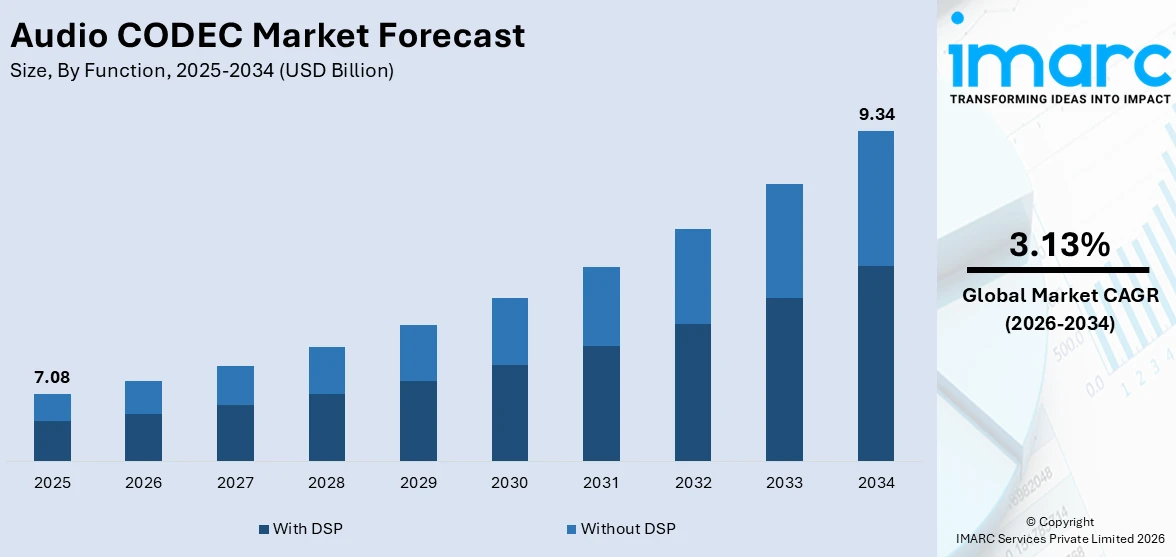
The global audio CODEC market size was valued at USD 7.08 Billion in 2025. Looking forward, IMARC Group estimates the market to reach USD 9.34 Billion by 2034, exhibiting a CAGR of 3.13% from 2026-2034. North America currently dominates the market, holding a market share of 33% in 2025. The region benefits from a mature consumer electronics ecosystem, strong demand for premium audio experiences in smartphones and wearables, widespread adoption of advanced Bluetooth codec technologies, and significant investments in semiconductor innovation across key industry players, all contributing to the audio CODEC market share.
The global audio CODEC market is driven by the rising proliferation of portable consumer electronics, including smartphones, tablets, laptops, and wearable devices, which require efficient audio encoding and decoding solutions. Growing consumer preference for high-fidelity audio experiences across music streaming, gaming, and video conferencing applications is further propelling demand. The rapid expansion of wireless audio technology, particularly true wireless stereo earbuds, over-ear headphones, and smart speakers, necessitates advanced codec architectures capable of delivering low-latency, high-resolution sound transmission. Additionally, the integration of voice assistant technologies into everyday devices is creating sustained demand for sophisticated audio processing capabilities. Furthermore, the ongoing evolution of automotive infotainment systems, which increasingly incorporate immersive audio environments, continues to support the audio CODEC market growth.
The United States has emerged as a major region in the audio CODEC market owing to many factors. The country maintains a highly developed consumer electronics industry with strong demand for premium audio devices across personal and professional applications. Increasing adoption of smart home technologies, including voice-controlled speakers and connected entertainment systems, is driving consistent demand for advanced audio codec solutions. The growing preference for wireless audio accessories among American consumers continues to expand the addressable market for codec manufacturers. For instance, in 2025, EarFun, the acclaimed wireless audio pioneer, unveiled its newest flagship wireless earbuds, the Air Pro 4+, a revolution that integrates Hi-Res Audio, sophisticated adaptive ANC, and a dual-driver setup, all for under $100, reflecting robust consumer investment in connected audio ecosystems. Moreover, the expanding enterprise communication sector, fueled by hybrid work arrangements and virtual collaboration platforms, is creating additional demand for high-quality audio processing in professional-grade conferencing equipment and headsets.
To get more information on this market Request Sample
Audio CODEC Market Trends:
Surging True Wireless Stereo Demand
The rapid expansion of true wireless stereo earbuds is significantly influencing the audio CODEC market, as these devices require advanced codec implementations to deliver seamless wireless audio performance. Consumers are increasingly adopting TWS earbuds for daily activities, including commuting, exercising, and remote work, driving manufacturers to incorporate more sophisticated audio encoding and decoding solutions. The growing demand for features such as active noise cancellation, transparency modes, and spatial audio has elevated the need for codecs that can handle complex signal processing while maintaining low power consumption and stable connectivity. The competitive landscape among TWS manufacturers is intensifying, with brands continuously improving audio quality and reducing latency through enhanced codec implementations. This surge in shipments demonstrates the expanding consumer base and underscores the critical role of audio codecs in enabling high-performance wireless audio experiences across all price segments.
Bluetooth LE Audio Codec Advancement
The introduction of Bluetooth Low Energy Audio, featuring the LC3 codec standard, is reshaping the audio CODEC market by offering superior audio quality at significantly reduced bitrates compared to legacy codecs. The LC3 codec delivers enhanced sound quality while operating at approximately 50% lower bitrate than the traditional SBC codec, enabling substantially better battery efficiency across wireless audio devices. This technological advancement supports emerging capabilities such as Auracast broadcast audio, which allows a single audio source to transmit to an unlimited number of receivers simultaneously, opening new use cases in public venues and commercial settings. Device manufacturers across smartphones, laptops, and wireless accessories are progressively integrating LE Audio support into their product lineups to capitalize on these improvements. For example, in 2025, the Windows 11 operating system integrated LE Audio support, enabling the LC3 codec across millions of personal computers worldwide. This ecosystem-level adoption accelerates the transition toward next-generation wireless audio standards and supports the positive audio CODEC market outlook.
AI-Powered Audio Processing Integration
The integration of artificial intelligence into audio codec architectures represents a transformative trend reshaping the market landscape. AI-enhanced codecs leverage machine learning algorithms to perform real-time noise suppression, voice enhancement, and adaptive equalization, delivering markedly improved audio experiences across diverse and challenging environments. These intelligent processing capabilities enable devices to automatically adjust audio parameters based on surrounding acoustic conditions, significantly enhancing call clarity and media playback quality. The convergence of AI with digital signal processing within codec chipsets is driving demand from smartphone manufacturers, headphone brands, and automotive audio system developers seeking differentiated audio performance. The technology also supports advanced voice recognition accuracy and personalized audio profiling, enhancing user engagement across multiple applications. This growing integration of AI-driven audio processing continues to support the audio CODEC market forecast, as manufacturers pursue increasingly intelligent and adaptive audio solutions across product categories. IMARC Group predicts that the global artificial intelligence market is projected to attain USD 949.0 Billion by 2034.
Audio CODEC Industry Segmentation:
IMARC Group provides an analysis of the key trends in each segment of the global audio CODEC market, along with forecast at the global, regional, and country levels from 2026-2034. The market has been categorized based on function, component, and end use.

Analysis by Function:
- With DSP
- Without DSP
With DSP holds 60% of the market share. Audio codecs equipped with integrated digital signal processors offer enhanced audio processing capabilities, including noise cancellation, echo suppression, and equalization, directly within the codec chipset. These solutions are increasingly preferred by device manufacturers seeking to deliver premium audio experiences without relying on external processing components, thereby reducing board space and design complexity. The integration of DSP functionality within audio codecs enables real-time audio manipulation, supporting features such as spatial audio rendering, voice enhancement, and adaptive sound profiling that are essential for modern consumer electronics. The growing demand for immersive audio in smartphones, headphones, and automotive infotainment systems is driving manufacturers to adopt DSP-equipped codecs at an accelerating pace. For instance, global smartphone shipments are reaching new heights, with the majority of premium and mid-range models incorporating DSP-equipped audio codecs to support advanced audio features and deliver superior listening experiences across diverse consumer applications and use cases.
Analysis by Component:
- Hardware
- Software
Hardware leads the market with a share of 55%. Hardware-based audio codecs encompass dedicated integrated circuits and chipsets designed for encoding and decoding audio signals within electronic devices. These components deliver reliable audio processing performance with consistent quality, low latency, and efficient power consumption, making them essential for battery-powered consumer electronics that demand uninterrupted audio functionality. Hardware codecs are embedded in smartphones, tablets, laptops, wearable devices, and automotive audio systems, where dedicated processing ensures uninterrupted audio functionality without burdening the main application processor or affecting overall system performance. The ongoing miniaturization of semiconductor components is enabling manufacturers to integrate increasingly powerful audio codec hardware into compact device form factors while maintaining thermal efficiency and signal integrity. Advances in fabrication processes are reducing chip sizes and power requirements, allowing for more capable codec hardware.
Analysis by End Use:
Access the comprehensive market breakdown Request Sample
- Computer
- Phones
- Tablets
- Over-Ear Headphones
- TWS
- Home Entertainment
- Commercial
- Automotive
- Portable
- Smart Home
- IoT
- Wearable
- AR/VR
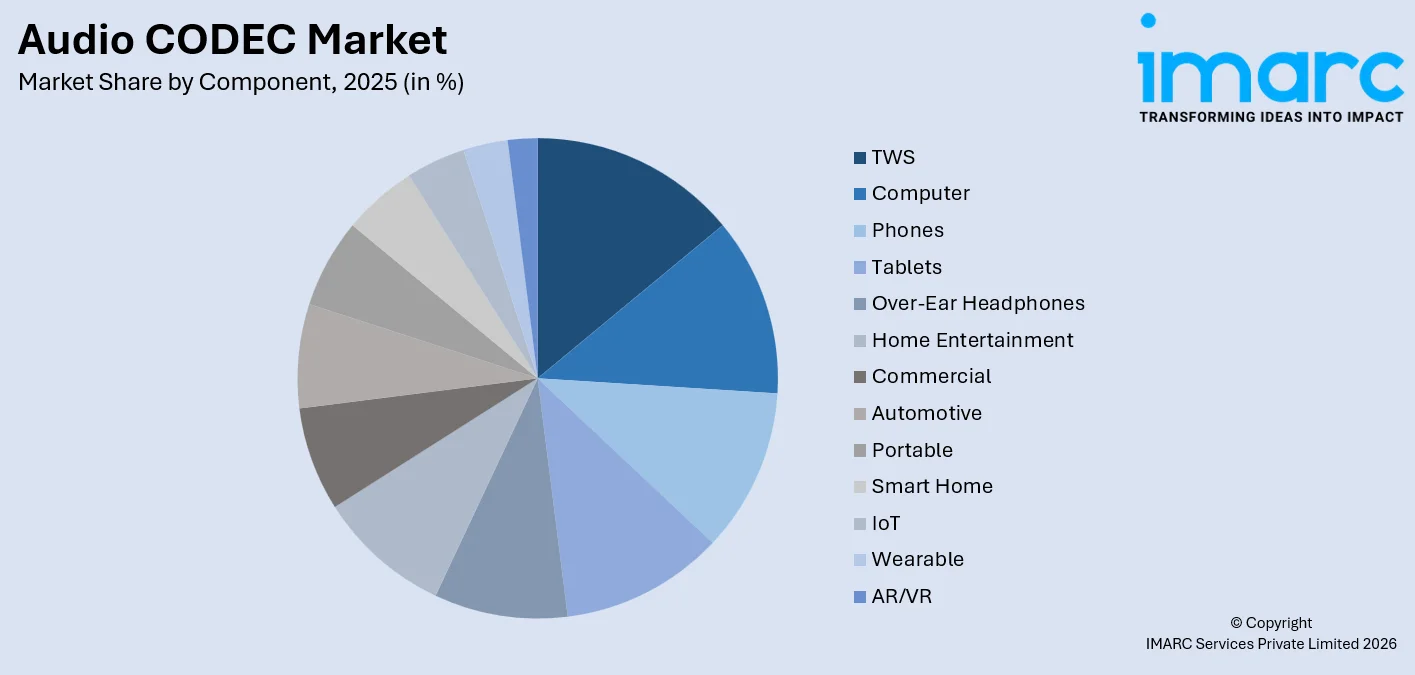
TWS represents the largest segment, with a market share of 12%. True wireless stereo earbuds represent the fastest-growing end use segment in the audio CODEC market, driven by strong consumer adoption across all demographics and geographies. TWS devices require highly efficient audio codecs capable of delivering high-quality stereo sound, active noise cancellation, and low-latency performance within extremely compact and power-constrained form factors. The competitive intensity among TWS manufacturers is accelerating innovation in codec technology, with brands continuously enhancing audio resolution, battery life, and connectivity stability. The segment benefits from expanding use cases beyond music listening, including fitness tracking, voice assistant interaction, and hands-free communication, which broadens the demand for versatile codec solutions that reflect current audio CODEC market trends.
Regional Analysis:
To get more information on the regional analysis of this market Request Sample
- North America
- United States
- Canada
- Asia Pacific
- China
- Japan
- India
- South Korea
- Australia
- Indonesia
- Others
- Europe
- Germany
- France
- United Kingdom
- Italy
- Spain
- Russia
- Others
- Latin America
- Brazil
- Mexico
- Others
- Middle East and Africa
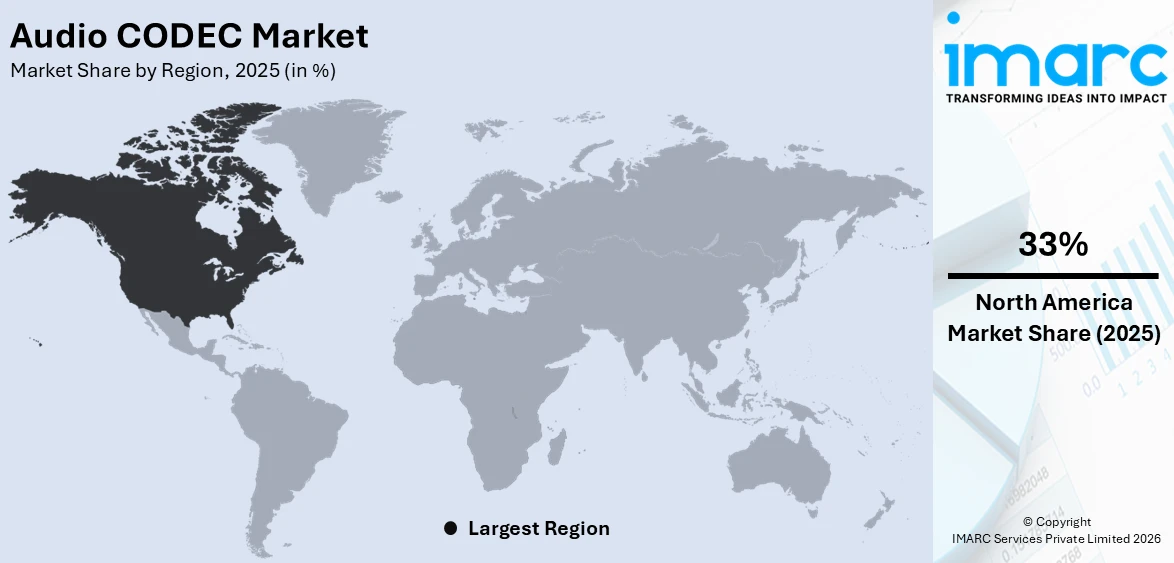
North America, accounting for 33% of the share, enjoys the leading position in the market. The region benefits from a highly developed consumer electronics ecosystem, strong enterprise adoption of advanced audio technologies, and a tech-savvy consumer base that consistently demands premium audio experiences across personal and professional use cases. The widespread integration of voice assistant platforms into household and automotive environments has created sustained demand for high-quality audio codec solutions across multiple device categories, including smart speakers, headphones, and connected vehicles. North American consumers demonstrate strong preferences for wireless audio products, driving continuous innovation in codec architectures that prioritize low latency, high resolution, and energy efficiency. The presence of leading semiconductor companies and technology innovators within the region further supports research and development activities that advance audio codec capabilities. For instance, in 2025, United States PC shipments are increasing driven by Windows 11 upgrade cycles and the emergence of AI-enabled personal computers, creating additional demand for advanced audio codec implementations across the computing segment.
Key Regional Takeaways:
United States Audio CODEC Market Analysis
The United States represents the dominant force within the North American audio CODEC market, driven by a combination of technological leadership, high consumer spending on electronics, and a robust enterprise communication sector. The country's mature smartphone market sustains consistent demand for advanced audio codecs, as consumers expect premium sound quality across music streaming, gaming, and video content consumption. The accelerating adoption of true wireless stereo earbuds among American consumers has created a significant market for compact, power-efficient codec solutions that deliver features such as active noise cancellation and spatial audio. The expanding smart home ecosystem, featuring voice-controlled speakers and connected entertainment systems, continues to drive demand for sophisticated audio processing capabilities. Enterprise applications further bolster the market, as hybrid work environments require professional-grade conferencing equipment with superior audio encoding and decoding performance. For instance, in 2025, approximately 87% of American consumers identified headphones as their primary audio listening device, underscoring the critical importance of high-performance codec technology in personal audio products. The ongoing rollout of next-generation wireless standards and increasing investment in AI-powered audio enhancement technologies continue to position the United States as a key driver of innovation in the audio CODEC market.
Europe Audio CODEC Market Analysis
The European audio CODEC market is characterized by strong consumer demand for high-quality audio experiences and a growing preference for premium wireless audio products across the region. Major markets including Germany, the United Kingdom, and France collectively account for a significant proportion of regional demand, driven by high disposable incomes and established consumer electronics distribution networks. European consumers demonstrate a distinctive preference for audio fidelity, with many prioritizing sound quality over basic functionality when purchasing wireless audio devices. The expanding adoption of smart speaker technologies across European households is creating additional demand for audio codec solutions that support voice interaction and multi-room audio streaming. Privacy-conscious European consumers increasingly favor devices with localized audio processing capabilities, supporting demand for codec architectures with embedded intelligence. In 2025, The German audio company beyerdynamic (the lowercase b is intentional for branding) has introduced a new set of headphones along with two new earbud models at IFA 2025, taking place in Berlin this week. The latest models are the Aventho 200, Amiron 200, and Amiron Zero, all designed for fashion-forward customers. The Aventho 200 is a flexible set of wireless, over-ear headphones featuring 45mm dynamic drivers. With ANC technology, users can effortlessly alternate between canceling unwanted noises and transparency mode, allowing them to hear their surroundings.
Asia-Pacific Audio CODEC Market Analysis
The Asia-Pacific region represents the fastest-growing market for audio codecs, driven by rapidly expanding smartphone penetration, a large and young consumer demographic, and the region's position as a global manufacturing hub for consumer electronics. Countries including China, Japan, India, South Korea, and Indonesia are collectively driving massive demand for audio codec solutions across personal electronics, wearable devices, and smart home products. The region's dominance in TWS earbuds manufacturing and consumption creates particularly strong demand for advanced wireless audio codecs that support high-resolution streaming and low-latency performance. Rising disposable incomes across countries within the region continue to expand the consumer base for audio devices requiring sophisticated codec implementations. In 2025, the nationwide median disposable income in China per capita reached 36,231 yuan, reflecting a nominal rise of 4.4 percent compared to the previous year.
Latin America Audio CODEC Market Analysis
The Latin American audio CODEC market is experiencing steady growth, supported by increasing smartphone adoption, expanding internet connectivity, and rising consumer interest in affordable wireless audio products across the region. Brazil and Mexico represent the largest markets in the region, with growing urban populations driving demand for personal audio devices and smart home technologies. The expanding adoption of budget-friendly true wireless earbuds is creating demand for cost-efficient codec solutions that deliver acceptable audio quality.
Middle East and Africa Audio CODEC Market Analysis
The Middle East and Africa audio CODEC market presents significant growth potential, driven by accelerating smartphone penetration, expanding telecommunications infrastructure, and a young demographic profile increasingly engaged with digital media consumption. The ongoing deployment of advanced mobile networks across the region is enabling broader access to streaming services and connected audio devices, creating new demand for codec solutions. For instance, in 2025, fifth-generation mobile connections across the Middle East and Africa reached major heights, driving wireless audio device adoption and codec demand. Growing urbanization and rising consumer spending power in key markets continue to expand the addressable market for audio codec manufacturers.
Competitive Landscape:
The competitive landscape of the audio CODEC market is characterized by continuous innovation and strategic differentiation among established semiconductor companies and emerging technology firms. Major players are investing heavily in research and development to advance codec architectures that support higher audio resolution, lower latency, and improved energy efficiency across diverse device applications. Strategic partnerships between codec manufacturers and device brands are intensifying, as companies seek to develop proprietary audio technologies that provide competitive advantages in premium consumer electronics. The market is witnessing increased consolidation through mergers and acquisitions, as larger semiconductor companies expand their audio product portfolios to capture growing demand. Companies are also focusing on software-defined codec solutions that offer flexibility and over-the-air update capabilities, complementing traditional hardware-based approaches. Sustainability considerations are becoming increasingly relevant, with manufacturers developing energy-efficient codec designs that extend battery life in portable devices while maintaining audio performance standards.
The report provides a comprehensive analysis of the competitive landscape in the audio CODEC market with detailed profiles of all major companies, including:
- Analog Devices, Inc.
- Barix AG
- Cirrus Logic, Inc.
- Fraunhofer IIS
- Qualcomm Technologies, Inc.
- Realtek Semiconductor Corp.
- Renesas Electronics Corporation
- Sony Semiconductor Solutions Corporation
- STMicroelectronics
- Synopsys, Inc.
- Texas Instruments Incorporated
Audio CODEC Market Report Scope:
| Report Features | Details |
|---|---|
| Base Year of the Analysis | 2025 |
| Historical Period | 2020-2025 |
| Forecast Period | 2026-2034 |
| Units | Billion USD |
| Scope of the Report | Exploration of Historical Trends and Market Outlook, Industry Catalysts and Challenges, Segment-Wise Historical and Predictive Market Assessment:
|
| Functions Covered | With DSP, Without DSP |
| Components Covered | Hardware, Software |
| End Uses Covered | Computer, Phones, Tablets, Over-Ear Headphones, TWS, Home Entertainment, Commercial, Automotive, Portable, Smart Home, IoT, Wearable, AR/VR |
| Regions Covered | Asia Pacific, Europe, North America, Latin America, Middle East and Africa |
| Countries Covered | United States, Canada, Germany, France, United Kingdom, Italy, Spain, Russia, China, Japan, India, South Korea, Australia, Indonesia, Brazil, Mexico |
| Companies Covered | Analog Devices, Inc., Barix AG, Cirrus Logic, Inc., Fraunhofer IIS, Qualcomm Technologies, Inc., Realtek Semiconductor Corp., Renesas Electronics Corporation, Sony Semiconductor Solutions Corporation, STMicroelectronics, Synopsys, Inc., Texas Instruments Incorporated, etc. |
| Customization Scope | 10% Free Customization |
| Post-Sale Analyst Support | 10-12 Weeks |
| Delivery Format | PDF and Excel through Email (We can also provide the editable version of the report in PPT/Word format on special request) |
Key Benefits for Stakeholders:
- IMARC’s report offers a comprehensive quantitative analysis of various market segments, historical and current market trends, market forecasts, and dynamics of the audio CODEC market from 2020-2034.
- The research study provides the latest information on the market drivers, challenges, and opportunities in the global audio CODEC market.
- The study maps the leading, as well as the fastest-growing, regional markets. It further enables stakeholders to identify the key country-level markets within each region.
- Porter's Five Forces analysis assists stakeholders in assessing the impact of new entrants, competitive rivalry, supplier power, buyer power, and the threat of substitution. It helps stakeholders to analyze the level of competition within the audio CODEC industry and its attractiveness.
- Competitive landscape allows stakeholders to understand their competitive environment and provides an insight into the current positions of key players in the market.
Frequently Asked Questions About the Audio CODEC Market Report
The audio CODEC market was valued at USD 7.08 Billion in 2025.
The audio CODEC market is projected to exhibit a CAGR of 3.13% during 2026-2034, reaching a value of USD 9.34 Billion by 2034.
The audio CODEC market is driven by the growing proliferation of wireless audio devices, increasing consumer demand for high-fidelity audio experiences, the rapid expansion of true wireless stereo earbuds, the adoption of advanced Bluetooth codec standards such as LC3, and the integration of artificial intelligence into audio processing architectures across smartphones, wearables, and smart home devices.
North America currently dominates the audio CODEC market, accounting for a share of 33%. The region benefits from a highly developed consumer electronics ecosystem, strong enterprise adoption of advanced audio technologies, and a tech-savvy consumer base driving consistent demand for premium audio codec solutions.
Some of the major players in the audio CODEC market include Analog Devices, Inc., Barix AG, Cirrus Logic, Inc., Fraunhofer IIS, Qualcomm Technologies, Inc., Realtek Semiconductor Corp., Renesas Electronics Corporation, Sony Semiconductor Solutions Corporation, STMicroelectronics, Synopsys, Inc., Texas Instruments Incorporated, etc.
Need more help?
- Speak to our experienced analysts for insights on the current market scenarios.
- Include additional segments and countries to customize the report as per your requirement.
- Gain an unparalleled competitive advantage in your domain by understanding how to utilize the report and positively impacting your operations and revenue.
- For further assistance, please connect with our analysts.
 Request Customization
 Speak to an Analyst
 Request Brochure
 Inquire Before Buying
Benefits of Customization
- Personalize this research
- Triangulate with your data
- Get data as per your format and definition
- Gain a deeper dive into a specific application, geography, customer, or competitor
- Any level of personalization
Get in Touch With Us
UNITED STATES
Phone: +1-201-971-6302
INDIA
Phone: +91-120-433-0800
UNITED KINGDOM
Phone: +44-753-714-6104
Email: [email protected]
Client Testimonials




.webp)




.webp)













Related Reports

Choose your plan
*Please note that the prices mentioned below are starting prices for each bundle type. Kindly contact our team for further details.*
Single User License
- 1 User License, Access on 2 Devices
- PDF Report + Excel Dataset (Password Protected)
- Lifetime Access
- No Printing Rights
- 10% Free Report Customization
- 10–12 Weeks of Analyst Support
Five User License
- Access for 5 Users, 2 Devices per User
- PDF Report + Excel Dataset (Password Protected)
- Lifetime Access
- Dedicated Account Manager
- 12–14 Weeks of Analyst Support
- No Printing Rights
- 15% Free Report Customization
- 25% Discount on Your Next Purchase
Corporate User License
- Unlimited User Access (Within Your Organization)
- PDF Report + Excel Dataset
- Lifetime Access
- Dedicated Account Manager
- 14–20 Weeks of Analyst Support
- No Printing Rights
- 20% Free Report Customization
- 30% Discount on Your Next Purchase
Essential Insights
What's included:
3 reports
- Lifetime Access
- PDF Reports
- Excel Datasets
- 2 Weeks of Free Analyst Support
- 2 User Licenses
- Access on 2 Devices
- Printing Rights
- Complimentary PowerPoint (PPT) Version
- Complimentary License Upgrade
Professional Access
What's included:
5 reports
- Lifetime Access
- PDF Reports
- Excel Datasets
- 8 Weeks of Free Analyst Support
- 2 User Licenses
- Access on 2 Devices
- Printing Rights
- Complimentary PowerPoint (PPT) Version
- Complimentary License Upgrade
Business Advantage
What's included:
8 reports
- Lifetime Access
- PDF Reports
- Excel Datasets
- 14 Weeks of Free Analyst Support
- 2 User Licenses
- Access on 2 Devices
- Printing Rights
- Complimentary PowerPoint (PPT) Version
- Complimentary License Upgrade
Enterprise Intelligence
What's included:
10 reports
- Lifetime Access
- PDF Reports
- Excel Datasets
- 20 Weeks of Free Analyst Support
- 2 User Licenses
- Access on 2 Devices
- Printing Rights
- Complimentary PowerPoint (PPT) Version
- Complimentary License Upgrade