
Australia Autonomous Vehicles Market Size, Share, Trends and Forecast by Propulsion Type, Level, Vehicle Type, and Region, 2026-2034
Australia Autonomous Vehicles Market Overview:
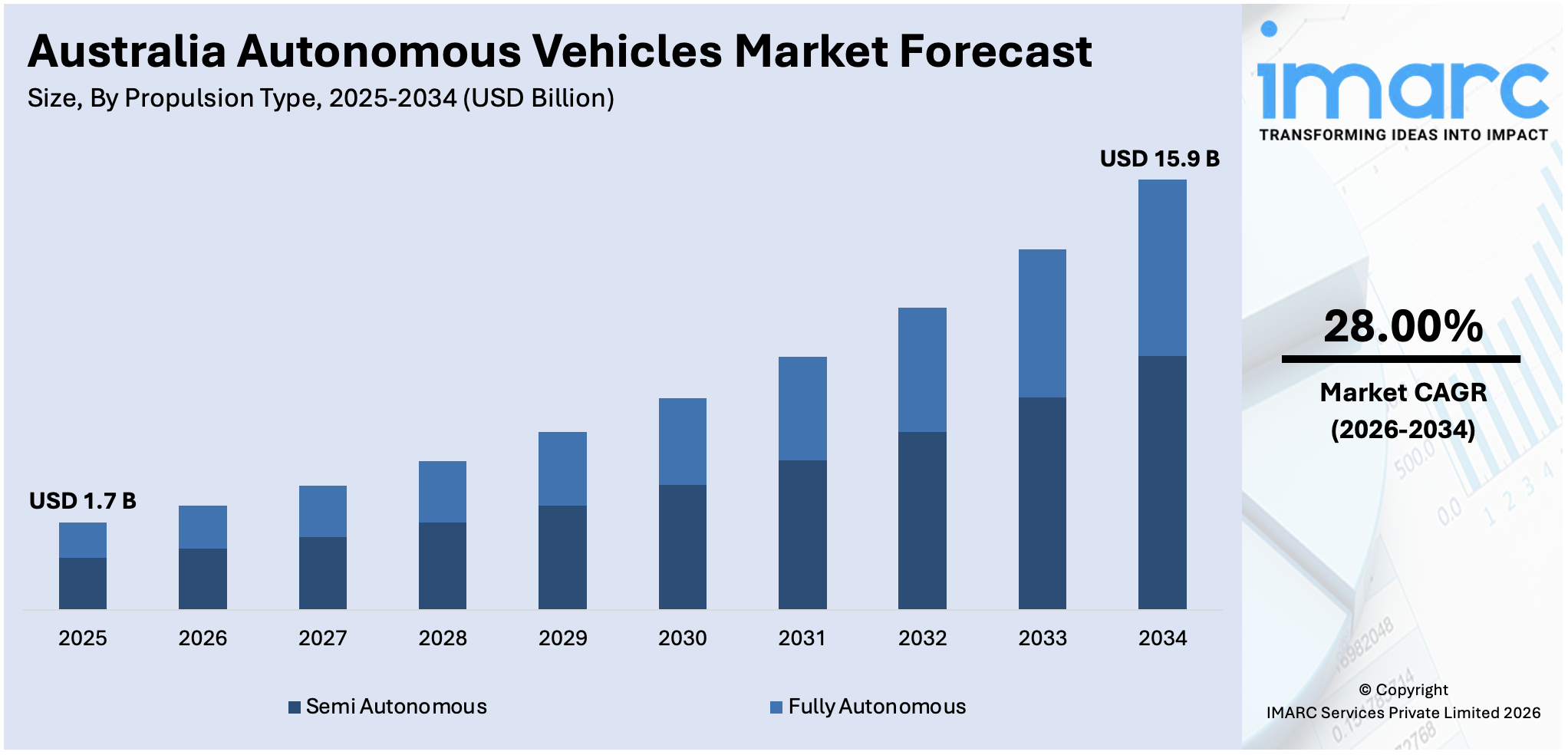
The Australia autonomous vehicles market size reached USD 1.7 Billion in 2025. Looking forward, the market is expected to reach USD 15.9 Billion by 2034, exhibiting a growth rate (CAGR) of 28.00% during 2026-2034. The Australia autonomous vehicles market share is expanding, driven by the rising pressure to reduce carbon emissions, favorable government policies focusing on the implementation of road safety measures, continual improvements in sensor and camera technologies and smart infrastructure, and the increasing number of collaborations between automotive and tech companies.
|
Report Attribute
|
Key Statistics
|
|---|---|
|
Base Year
|
2025
|
|
Forecast Years
|
2026-2034
|
|
Historical Years
|
2020-2025
|
| Market Size in 2025 | USD 1.7 Billion |
| Market Forecast in 2034 | USD 15.9 Billion |
| Market Growth Rate (2026-2034) | 28.00% |
Key Trends of Australia Autonomous Vehicles Market:
Increasing demand for automotive safety and energy-efficient vehicles
The rising need for advanced automotive safety and fuel-efficient vehicles is impelling the Australia autonomous vehicles market growth. The introduction of stringent emission regulations has motivated car manufacturers to develop next-generation clean energy vehicles such as battery electric vehicles (BEVs) and electric vehicles (EVs). The purchase of vehicles that are emission-free or fuel and energy-saving, equipped with advanced technologies and a high level of autonomy to operate is on the rise. This can be attributed to increasing prices of fossil fuels, which are in limited supply. As a result, they achieve improved effectiveness by driving effectively and managing energy usage. The manufacturers are also focusing on working together with developers of autonomous car technology to fulfill the needs of the high population.
To get more information on this market Request Sample
Expansion of ride-sharing services
The expansion of ride-sharing services is offering a favorable Australia autonomous vehicles market outlook. With high employment rates and people going to offices, the need for ride-share services is high. As per the data provided on the official website of the Australian Bureau of Statistics, in February 2024, 14 Million individuals were in employment in Australia. 2.6 Million individuals began their employment in the same month. Ride-sharing platforms have transformed urban mobility by giving convenient, cost-effective, and flexible transportation options. As these services grow, there is a high demand for efficient and scalable transportation solutions, which autonomous vehicles can address. Furthermore, the increasing adoption of ride-sharing services highlights a shift in user preferences from personal car ownership to shared mobility. Autonomous vehicles can reduce operational costs for ride-sharing companies by eliminating the need for human drivers, thereby allowing these companies to offer competitive pricing and improved service availability. Moreover, they align well with the business model of ride-sharing services, which often aim to maximize vehicle utilization. This capability allows ride-sharing companies to optimize their fleet management and improve service frequency, meeting the increasing requirement for on-demand transportation. Besides, the integration of these vehicles into ride-sharing fleets also addresses some of the challenges associated with human drivers, such as inconsistent service quality and varying driving skills. By deploying autonomous vehicles, ride-sharing companies can ensure a uniform and reliable user experience. Additionally, AVs can contribute to better safety and lower accident rates, further enhancing the appeal of ride-sharing services.
Growth Drivers of Australia Autonomous Vehicles Market:
Regulatory Reform and Safety Legislation Leading the Way
Among the growth drivers for Australia's automated vehicle industry is changing regulation and safety legislation that is progressively favorable to automated mobility. The National Transport Commission and federal transport authorities are developing frameworks to allow commercial operation of automated vehicles, authorizing trials, first-supply standards, and in-service safety regulation. Due to the large distances, remote roads, and state and territory jurisdictions in Australia, there needs to be consistent, national regulatory alignment, harmonizing rules between states lowers barriers for manufacturers and service providers. Furthermore, Australian public safety culture is robust, as governments are conservative, so there need to be safety proof points, trials, and demonstrations. This stimulates AV developers to test locally intensively, e.g., in mining areas, rural roads, or controlled proving grounds. Hence, systems can operate effectively in various terrain, weather, and traffic conditions that exist throughout Australia's urban, suburban, rural, and outback areas. Approval for low-speed shuttles, autonomous mining haulage, and remote zone logistics vehicles promotes opportunities for innovation and investment, further increasing the Australia autonomous vehicles market demand.
Infrastructure, Connectivity, and Geographic Necessities
Australia's distinctive geography and infrastructure requirements strongly underpin demand for autonomous vehicle technologies. Since a great many communities are isolated or distant, with substantial distances of highway linking towns and extensive rural areas, there is a significant motivation to use AVs for freight, mining haulage, and public service provision. Autonomous haul trucks are being tested in mining areas to enhance productivity, safety within dangerous areas, and cost of operations. Additionally, the agendas of upgrading the country's infrastructure, like upgrading road quality, upgrading broadband / telecom networks (mobile coverage in regional regions), and enabling smart roads & sensors, form critical enabling foundations for AV deployment. Also, urban traffic congestion in Australia's capital cities (Sydney, Melbourne, Brisbane) pressures transport planners to look toward autonomous shuttles, traffic flow optimization, and mobility as a service (MaaS) models. These connectivity and infrastructure enhancements underpin the transition from testbeds to live‑world deployment.
Market Demand, Sustainability Pressures, and Technological Innovation
As per the Australia autonomous vehicles market analysis, technological advancement in sensors, AI, connectivity, and energy systems is another powerful impetus in the AV industry, coupled with sustainability issues and transforming consumer demand. Australian carmakers, tech companies, and start‑ups are investing in perception systems, autonomous control, mapping, and testing under local conditions such as extreme heat, varied terrain, or coastal or dusty. The increasing preference for electric vehicles and low emission mobility meets with autonomy, whereby AV systems combined with clean propulsion are more appealing in procurement and policy contexts. Besides, Australia's mining and logistics industries are dealing with operational cost increases and a shortage of labor; autonomous solutions can save costs, reduce the risk exposure for humans, and improve efficiency. Consumers are becoming open to advanced driver-assistance systems, with those features being viewed as stepping stones for a fully autonomous vehicle. All of this, including innovation, environmental issues, and a desire for safer, efficient transportation, come together to fuel the growth of AVs in Australia.
Opportunities of Australia Autonomous Vehicles Market:
Opportunity Spaces in Specialized Industries like Mining and Remote Logistics
The geography of Australia, with its expansive remote areas and mineral‑rich mining areas, offers distinctive opportunity spaces for autonomous vehicle application in specialized industries. Autonomous haulage systems are already being utilized by mining entities in areas like the Pilbara, where autonomous trucks and equipment minimize risk to operators in dangerous environments, increase productivity, and enable operations to be continuous even in harsh climates. Moreover, remote logistics like shipping to rural areas, sheep stations, or over long roads where human drivers experience fatigue, hazardous weather, or long distances of travel, can be revolutionized by autonomous vehicles. There is also potential for prototypes of self-driving utility vehicles for "dull and dangerous" tasks: local Australian innovators are testing robots and utility cars to perform tasks that are repetitive, in dusty or high-heat conditions, or in maintenance of infrastructure. The intersection of resource development, intelligent rural communities, and infrastructure deficits generates need for autonomous solutions that are highly rugged, resilient, and capable of being powered successfully off grid or in low‑connectivity areas.
Low‑Speed Transit, Pods, and Urban Public Transport Innovations
A significant opportunity exists in low‑speed autonomous transport systems (L‑SATS), pods, and urban shuttle services in peri urban and urban environments throughout Australia. Urban and suburban areas with congested traffic or infrastructure needs are keen to roll out driverless shuttles or micro‑pods for "first‑mile/last‑mile" linkages, targeting retirement villages, university campuses, business parks, and tourist zones. States such as South Australia are becoming hosts for future mobility labs, enticing firms to establish research, testing, and deployment in zones where regulations will be favorable. For example, global autonomous vehicle providers are setting up Asia‑Pacific headquarters or research and development operations in cities such as Adelaide to design, pilot, and produce pod‑based vehicles to meet niche mobility demands. These cars are normally used within controlled environments (such as campus or precinct) before scaling up. This provides manufacturers, technology providers, and host governments with an opportunity to learn, adapt, and standardize safety, passenger experience, integration with transport systems, and user acceptance. The urban transit markets thereby present a chance for vehicle manufacturers, and for players in an ecosystem with sensor manufacturers, software companies, insurers, maintenance service providers, and infrastructure planners.
Regulatory Innovation, Research Collaboration, and Local Talent Ecosystem
Australia's robust academic, research, and regulatory foundation provides scope for leadership in autonomous systems innovation. Universities and research institutions are also working with private and public sector industry partners to create perception data sets, road-scene segmentation software tailored to Australian conditions, and trials of heavy vehicle platooning on key freight routes. Local governments are introducing trial permits and regulatory sandboxes to facilitate demonstration of autonomous shuttles, robo-taxis, and connected/autonomous freight in particular jurisdictions. Also, state governments are funding future mobility laboratories and enabling areas, which provide the local firms with space to trial, refine, and demonstrate technologies in actual environments subject to safety, liability, and insurance controls. In addition, having on‑local talent as a technical pool, who are proficient in robotics, sensor fusion, machine learning, mapping, and safety engineering, provides scope for local innovation. Supply chain opportunities emerge as well, as sensor, battery, software, and edge computing components that are tuned to Australia’s climate (heat, dust, varied terrain) will have demand. The opportunity also extends to servicing and maintaining autonomous fleets like training mechanics, establishing calibration and support infrastructure, after‑sales safety and diagnostics, as deployment expands.
Government Initiatives of Australia Autonomous Vehicles Market:
National Regulatory Framework and the Automated Vehicle Safety Law
A pillar of Australia's government commitment to autonomous vehicles is building a unified national regulatory approach with the National Transport Commission (NTC) in partnership with the federal, state, and territory governments. The strategy consists of the Draft Automated Vehicle Safety Law (AVSL), which will enshrine safety obligations and liabilities throughout the life cycle of autonomous driving systems. Under the legislation, companies instead of human drivers will be responsible for making sure automated driving systems are safe on the first supply and through ongoing use on public roads. The government is also transitioning existing vehicle standards law (like the Road Vehicle Standards Act) to match new autonomous‑vehicle needs and amending state and territory road rules. This helps to ensure that AVs are not hindered by patchwork regulations when crossing borders, or in different jurisdictions. In addition to legislative efforts, public consultation has been conducted to elicit comments from citizens, industry, and research communities on issues like remote operation, modifications, repairs, and role clarification between occupants of vehicles and system operators. The program demonstrates Australia's acknowledgment that transparent regulation is needed for the public's trust, for facilitating investment, and for secure commercial deployment of autonomous mobility solutions.
Support for Trials, Demonstrations, and Local Innovation
Another significant government program in Australia is the encouragement of trial programs, pilots, and local innovation in connected and autonomous vehicle technology. Several territories and states have created programs to allow, monitor, and review AVs in controlled and semi‑controlled environments, to test performance in Australian conditions, like temperature, distance, varied road types, and distant areas, on a systematic basis. Governments, for instance, have granted permits to low-speed shuttles, robo‑taxis, and automatic "leader‑follower" systems in mining or delivery environments. There are collaborations between national transport research institutions and foreign companies to introduce autonomous driving solutions and trial deployment to Australia, involving open‑source and software platforms modified for local use. Governments also invest in data‑collection infrastructure, like mapping, sensors, road‑scene datasets customized to Australian scenery, to assist AV developers in training perception and decision‑making systems under dust, extreme sun glare, and country roads conditions. State and federal funding is invested in university research, testing of ADAS (advanced driver assistance systems), and conversion prototypes (e.g. optionally crewed vehicles) to learn how automation can be integrated with current fleets, compliance with regulations, and safety assurance.
State‑Level Programs, Smart Infrastructure, and Cross‑Jurisdictional Harmonization
At the territory and state level, Australian governments are forging ahead with readiness plans, infrastructural adjustments, and harmonization initiatives to prepare the enabling environment so that when autonomous vehicles scale up, the support environment is ready. For instance, states have issued Connected and Automated Vehicles (CAV) readiness strategies that trace the way road networks, signs, traffic signals, and telecommunications infrastructure need to change to accommodate AV use. The Northern Territory government and others have experimented with autonomous buses or shuttles to learn about public attitudes, road safety, and operational needs. State governments are also working together with federal agencies through the Transport and Infrastructure Council to harmonize rules, insurance and liability regimes, vehicle certification, enforcement, and crash requirements. Smart infrastructure projects, like intelligent traffic light systems that can talk to vehicles, enhanced mapping, and enhanced road asset condition monitoring, are also state government programs. By making roads and roadside infrastructure fit for purpose, jurisdictions intend to minimize friction for deployment, reducing costs for operators, and enhancing security and reliability for users. All of this underpins the case for autonomous vehicles moving beyond regulation into actionable infrastructure and cross‑jurisdiction coordination.
Australia Autonomous Vehicles Market Segmentation:
IMARC Group provides an analysis of the key trends in each segment of the market, along with forecasts at the region level for 2026-2034. Our report has categorized the market based on propulsion type, level, and vehicle type.
Propulsion Type Insights:
- Semi Autonomous
- Fully Autonomous
The report has provided a detailed breakup and analysis of the market based on the propulsion types. This includes semi autonomous and fully autonomous.
Level Insights:
- Level 1
- Level 2
- Level 3
- Level 4
- Level 5
A detailed breakup and analysis of the market based on the levels have also been provided in the report. This includes level 1, level 2, level 3, level 4, and level 5.
Vehicle Type Insights:
Access the comprehensive market breakdown Request Sample
- Passenger Car
- Commercial Car
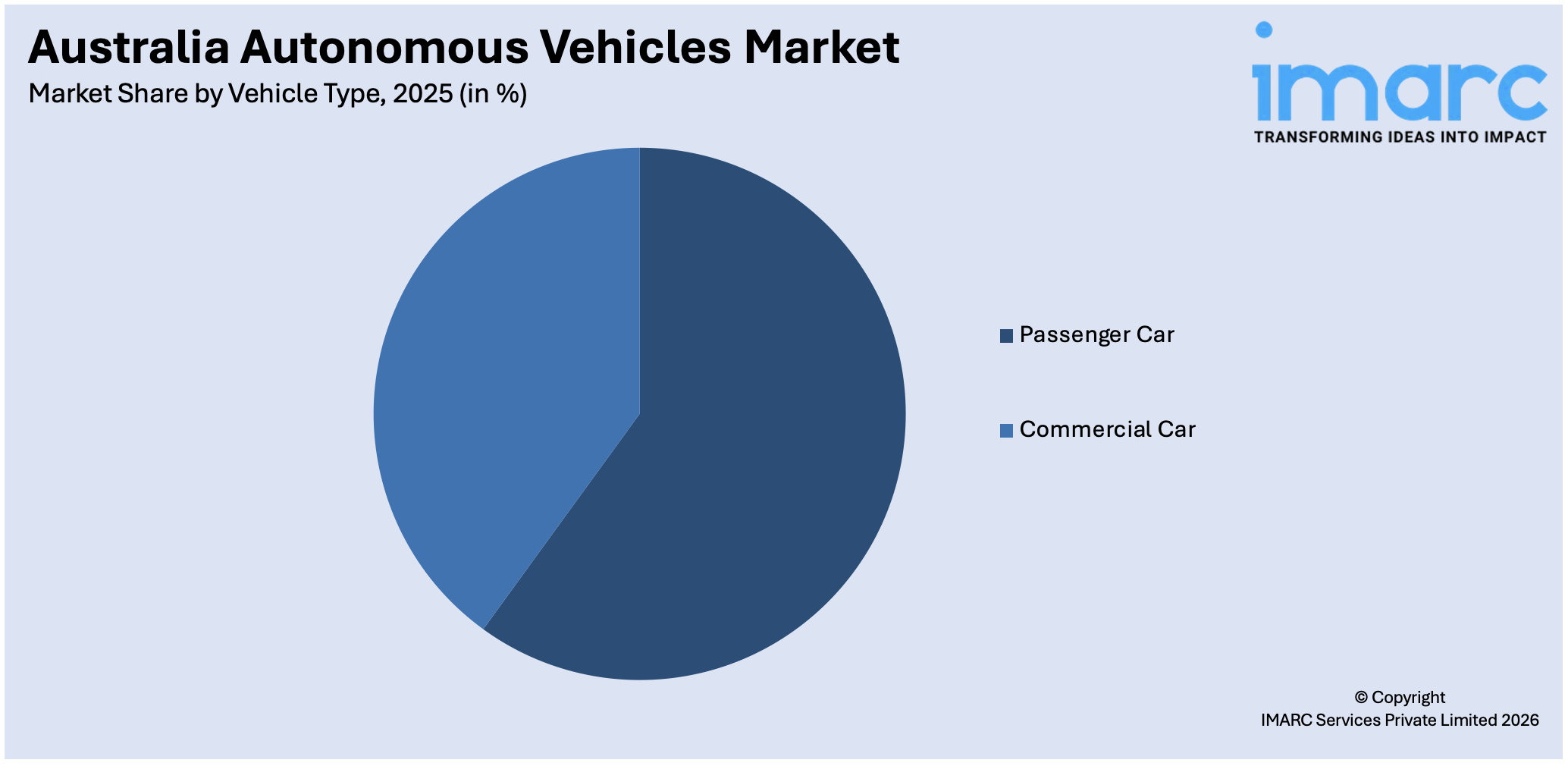
The report has provided a detailed breakup and analysis of the market based on the vehicle types. This includes passenger car and commercial car.
Regional Insights:
- Australia Capital Territory & New South Wales
- Victoria & Tasmania
- Queensland
- Northern Territory & Southern Australia
- Western Australia
The report has also provided a comprehensive analysis of all the major regional markets, which include Australia Capital Territory & New South Wales, Victoria & Tasmania, Queensland, Northern Territory & Southern Australia, and Western Australia.
Competitive Landscape:
The market research report has also provided a comprehensive analysis of the competitive landscape. Competitive analysis such as market structure, key player positioning, top winning strategies, competitive dashboard, and company evaluation quadrant has been covered in the report. Also, detailed profiles of all major companies have been provided.
Australia Autonomous Vehicles Market News:
- In January 2025, Applied EV, the Melbourne-based automotive manufacturing firm, launched the newly developed autonomous logistics vehicle, known as the "Blanc Robot”. It aimed to enhance the intelligence and safety of last-mile logistics in Australia. The firm revealed its intention to launch the initial 100 units of the Blanc Robot by the middle of 2025.
- In October 2024, Scania and Regroup, an Australia-based services provider, announced the introduction of the world's first fleet of Scania autonomous in-pit mining trucks in the Pilbara, Australia, with deployment scheduled at Element 25's Butcherbird mine. Scania, Regroup, and Element 25 teamed up to finalize the details of this solution and to synchronize with the expansion of the Butcherbird mine in the country.
Australia Autonomous Vehicles Market Report Coverage:
| Report Features | Details |
|---|---|
| Base Year of the Analysis | 2025 |
| Historical Period | 2020-2025 |
| Forecast Period | 2026-2034 |
| Units | Billion USD |
| Scope of the Report |
Exploration of Historical Trends and Market Outlook, Industry Catalysts and Challenges, Segment-Wise Historical and Future Market Assessment:
|
| Propulsion Types Covered | Semi Autonomous, Fully Autonomous |
| Levels Covered | Level 1, Level 2, Level 3, Level 4, Level 5 |
| Vehicle Types | Passenger Car, Commercial Car |
| Regions Covered |
Australia Capital Territory & New South Wales, Victoria & Tasmania, Queensland, Northern Territory & Southern Australia, Western Australia |
| Customization Scope | 10% Free Customization |
| Post-Sale Analyst Support | 10-12 Weeks |
| Delivery Format | PDF and Excel through Email (We can also provide the editable version of the report in PPT/Word format on special request) |
Key Benefits for Stakeholders:
- IMARC’s industry report offers a comprehensive quantitative analysis of various market segments, historical and current market trends, market forecasts, and dynamics of the Australia autonomous vehicles market from 2020-2034.
- The research report provides the latest information on the market drivers, challenges, and opportunities in the Australia autonomous vehicles market.
- Porter's five forces analysis assist stakeholders in assessing the impact of new entrants, competitive rivalry, supplier power, buyer power, and the threat of substitution. It helps stakeholders to analyze the level of competition within the Australia autonomous vehicles industry and its attractiveness.
- Competitive landscape allows stakeholders to understand their competitive environment and provides an insight into the current positions of key players in the market.
Frequently Asked Questions About the Australia Autonomous Vehicles Market Report
The Australia autonomous vehicles market was valued at USD 1.7 Billion in 2025.
The Australia autonomous vehicles market is projected to exhibit a CAGR of 28.00% during 2026-2034.
The Australia autonomous vehicles market is expected to reach a value of USD 15.9 Billion by 2034.
Key trends in Australia autonomous vehicles market include increased real-world trials, integration with smart city infrastructure, and growing applications in freight, mining, and public transport. There is a shift toward electric autonomous fleets, enhanced regulatory frameworks, and stronger public-private collaborations, positioning Australia as a testbed for emerging mobility technologies.
The Australia autonomous vehicles market is driven by strong government support, expansive testing environments, and rising demand for transport innovation in mining, freight, and urban mobility. Investments in smart infrastructure, regulatory advancements, and the country’s need for long-distance, efficient transport solutions further accelerate development and adoption of autonomous vehicle technologies.
Need more help?
- Speak to our experienced analysts for insights on the current market scenarios.
- Include additional segments and countries to customize the report as per your requirement.
- Gain an unparalleled competitive advantage in your domain by understanding how to utilize the report and positively impacting your operations and revenue.
- For further assistance, please connect with our analysts.
 Request Customization
 Speak to an Analyst
 Request Brochure
 Inquire Before Buying
Benefits of Customization
- Personalize this research
- Triangulate with your data
- Get data as per your format and definition
- Gain a deeper dive into a specific application, geography, customer, or competitor
- Any level of personalization
Get in Touch With Us
UNITED STATES
Phone: +1-201-971-6302
INDIA
Phone: +91-120-433-0800
UNITED KINGDOM
Phone: +44-753-714-6104
Email: [email protected]
Client Testimonials




.webp)




.webp)













Related Reports

Choose your plan
*Please note that the prices mentioned below are starting prices for each bundle type. Kindly contact our team for further details.*
Single User License
- 1 User License, Access on 2 Devices
- PDF Report + Excel Dataset (Password Protected)
- Lifetime Access
- No Printing Rights
- 10% Free Report Customization
- 10–12 Weeks of Analyst Support
Five User License
- Access for 5 Users, 2 Devices per User
- PDF Report + Excel Dataset (Password Protected)
- Lifetime Access
- Dedicated Account Manager
- 12–14 Weeks of Analyst Support
- No Printing Rights
- 15% Free Report Customization
- 25% Discount on Your Next Purchase
Corporate User License
- Unlimited User Access (Within Your Organization)
- PDF Report + Excel Dataset
- Lifetime Access
- Dedicated Account Manager
- 14–20 Weeks of Analyst Support
- No Printing Rights
- 20% Free Report Customization
- 30% Discount on Your Next Purchase
Essential Insights
What's included:
3 reports
- Lifetime Access
- PDF Reports
- Excel Datasets
- 2 Weeks of Free Analyst Support
- 2 User Licenses
- Access on 2 Devices
- Printing Rights
- Complimentary PowerPoint (PPT) Version
- Complimentary License Upgrade
Professional Access
What's included:
5 reports
- Lifetime Access
- PDF Reports
- Excel Datasets
- 8 Weeks of Free Analyst Support
- 2 User Licenses
- Access on 2 Devices
- Printing Rights
- Complimentary PowerPoint (PPT) Version
- Complimentary License Upgrade
Business Advantage
What's included:
8 reports
- Lifetime Access
- PDF Reports
- Excel Datasets
- 14 Weeks of Free Analyst Support
- 2 User Licenses
- Access on 2 Devices
- Printing Rights
- Complimentary PowerPoint (PPT) Version
- Complimentary License Upgrade
Enterprise Intelligence
What's included:
10 reports
- Lifetime Access
- PDF Reports
- Excel Datasets
- 20 Weeks of Free Analyst Support
- 2 User Licenses
- Access on 2 Devices
- Printing Rights
- Complimentary PowerPoint (PPT) Version
- Complimentary License Upgrade