
Australia DevOps Market Size, Share, Trends and Forecast by Type, Deployment Model, Organization Size, Tool, Industry Vertical, and Region, 2026-2034
Australia DevOps Market Summary:
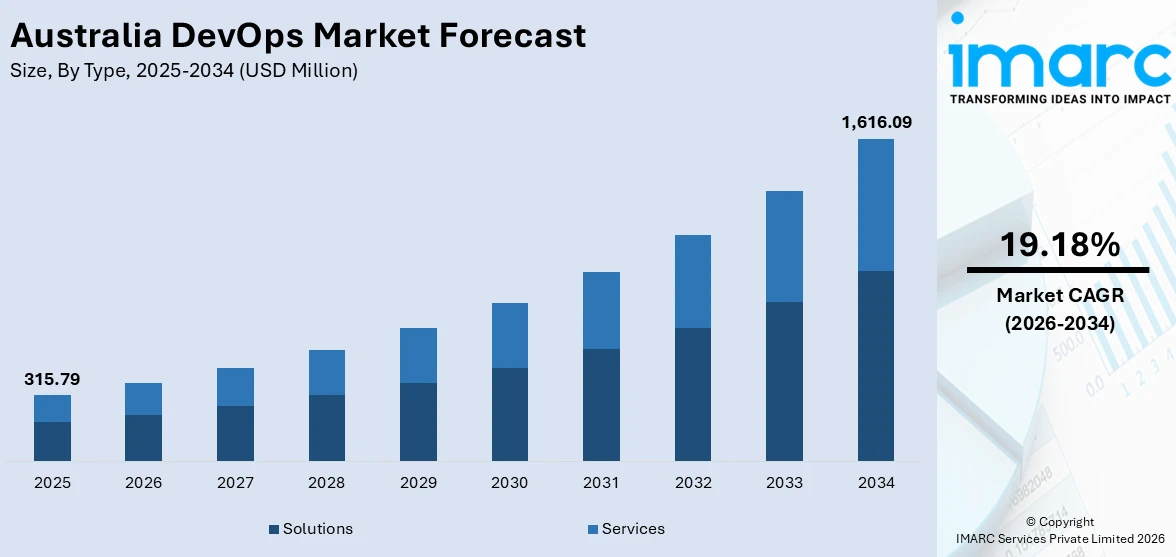
The Australia DevOps market size was valued at USD 315.79 Million in 2025 and is projected to reach USD 1,616.09 Million by 2034, growing at a compound annual growth rate of 19.18% during 2026-2034.
The Australia DevOps market is driven by increasing adoption of cloud computing, microservices architecture, and automation across enterprises seeking faster software delivery and improved operational efficiency. Organizations are investing in DevOps practices to enhance collaboration between development and operations teams, support continuous integration and deployment, and accelerate digital transformation initiatives. Growing demand for scalable IT infrastructure, rising use of containerization technologies, and expansion of agile development frameworks are further supporting DevOps adoption across industries in Australia.
Key Takeaways and Insights:
- By Type: Solutions represent the largest segment with a market share of 62.8% in 2025, owing to the widespread deployment of purpose-built DevOps software platforms enabling continuous integration, delivery, and monitoring across enterprise-scale development and operations environments.
- By Deployment Model: Public cloud leads the market with a share of 49.6% in 2025, supported by the scalability, cost efficiency, and rapid provisioning advantages that public cloud environments provide for DevOps pipeline automation and collaborative development.
- By Organization Size: Large enterprises dominate the market with a share of 58.9% in 2025, reflecting their capacity for sustained investment in comprehensive DevOps toolchains, skilled engineering teams, and multi-environment deployment architectures.
- By Tool: Development tools represent the largest segment with a market share of 40.7% in 2025, underpinned by strong demand for integrated source control, CI/CD pipeline management, and AI-assisted coding platforms across Australia's technology-intensive enterprise sector.
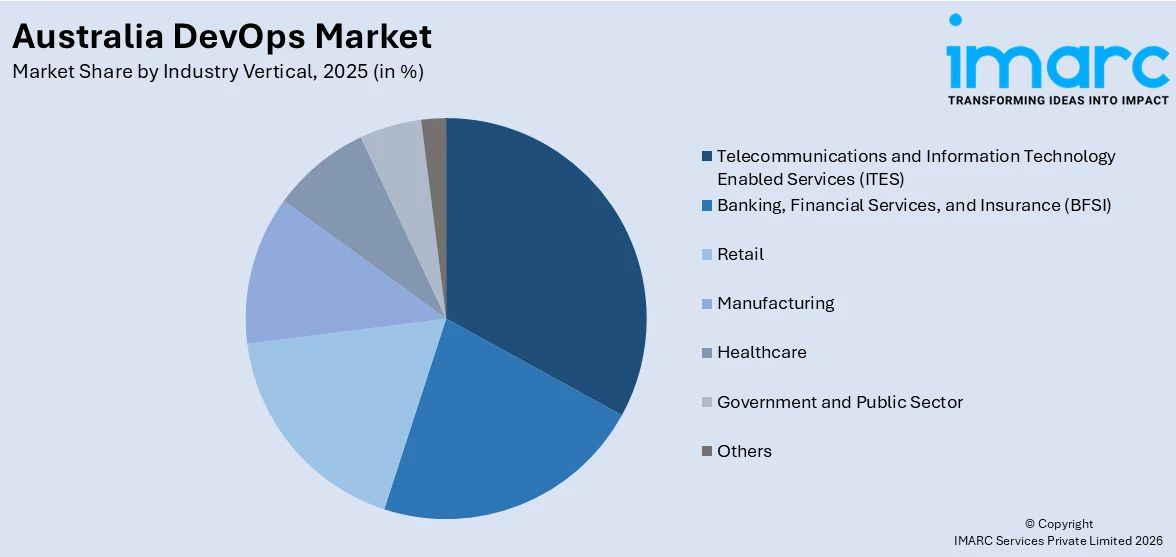
- By Industry Vertical: Telecommunications and information technology enabled services (ITES) lead the market with a share of 26.9% in 2025, driven by the sector's relentless demand for rapid service deployment, network automation, and agile software delivery to support evolving digital connectivity services.
- By Region: Australia Capital Territory and New South Wales dominate the market with a share of 35.9% in 2025, anchored by Sydney's role as Australia's primary technology hub and the concentration of federal government agencies in Canberra driving sustained DevOps adoption.
- Key Players: The Australia DevOps Market is characterized by a competitive mix of global technology vendors and specialist DevOps consultancies competing to deliver integrated platforms, managed services, and cloud-native automation capabilities to enterprise and public-sector customers.
To get more information on this market Request Sample
The DevOps market in Australia is expanding due to the rising demand for faster software delivery, automation of repetitive processes, and increased adoption of cloud-native applications and microservices architectures. Organizations are investing in AI-enabled tools, platform engineering, and observability solutions to improve operational efficiency, reduce downtime, and enhance collaboration between development and operations teams. Security automation and compliance requirements are further accelerating the adoption of DevOps practices. The market is also fueled by enterprises seeking to optimize resource allocation and streamline CI/CD pipelines while supporting large-scale digital transformation initiatives. In 2025, AWS launched the AWS DevOps Agent, an AI-powered virtual team member designed to automate infrastructure monitoring and incident management, with Commonwealth Bank of Australia among the first enterprise adopters, reporting measurable improvements in system reliability and operational efficiency. This example highlights how AI-driven DevOps solutions are directly contributing to productivity gains and supporting the broader growth of the Australian DevOps market.
Australia DevOps Market Trends:
Growing Adoption of AI for Smarter DevOps Operations
Organizations are increasingly integrating AI into DevOps workflows to automate monitoring, optimize incident management, and enhance software delivery efficiency. AI helps reduce manual effort, predict potential failures, and improve decision-making in complex environments, driving faster, more reliable deployments and stronger operational resilience. Enterprises are also focusing on embedding security throughout development and improving developer experiences through intelligent tooling. Evidence of this trend was seen at the DevOps Summit VIC 2025 in Melbourne, where Australia’s top technology leaders explored AI integration, modern DevSecOps practices, and strategies for resilient software delivery. Attendees discussed balancing AI with human ingenuity, securing code, and enhancing continuous improvement processes, highlighting the practical impact of AI-driven DevOps adoption on organizational performance and productivity.
Expansion of DevOps Capabilities through Strategic Acquisitions
Companies are leveraging mergers and acquisitions (M&A) to rapidly expand their DevOps, cloud, and digital engineering capabilities. This approach allows organizations to acquire specialized expertise, scale service offerings, and strengthen their presence across global markets. Such consolidation supports faster deployment of end-to-end DevOps solutions, enhances technological innovation, and enables enterprises to meet growing client demands for integrated software delivery services. Synechron’s acquisition of Melbourne-based iGreenData in 2024, exemplifies this trend, combining iGreenData’s data-centric expertise with Synechron’s global digital transformation consulting strengths. The integration enhanced Synechron’s payments technology solutions, expanded its DevOps capabilities in Australia, and positioned the company to better serve clients across multiple time zones, demonstrating how strategic acquisitions accelerate market growth and capability expansion.
Rising Adoption of Cloud Computing and Hybrid IT Environments
The growing shift of organizations toward cloud and hybrid IT environments is driving the adoption of DevOps solutions in Australia. Businesses are implementing cloud platforms to improve scalability, reduce infrastructure costs, and enhance operational efficiency. DevOps practices facilitate continuous integration and deployment across distributed systems, enabling faster application delivery and streamlined workflows. Reflecting this trend, in 2026, Red Hat launched Red Hat AI Enterprise, a unified hybrid cloud platform designed to deploy and manage AI models, agents, and applications across data centers and public clouds. This initiative underscores the increasing need for integrated, automated, and agile DevOps frameworks to support complex, multi-environment IT operations, driving innovation and efficiency across enterprises.
Market Outlook 2026-2034:
The Australia DevOps Market is projected to sustain robust double-digit growth throughout forecast period, driven by the irreversible momentum of enterprise digital transformation, public cloud investment, and AI-augmented automation. The market generated a revenue of USD 315.79 Million in 2025 and is projected to reach a revenue of USD 1,616.09 Million by 2034, growing at a compound annual growth rate of 19.18% from 2026-2034. Continued large enterprise investment in DevOps solutions, expansion of public cloud infrastructure, and the telecommunications sector's demand for agile delivery will sustain growth momentum.
Australia DevOps Market Report Segmentation:
| Segment Category | Leading Segment | Market Share |
|---|---|---|
|
Type |
Solutions |
62.8% |
|
Deployment Model |
Public Cloud |
49.6% |
|
Organization Size |
Large Enterprises |
58.9% |
|
Tool |
Development Tools |
40.7% |
|
Industry Vertical |
Telecommunications and Information Technology Enabled Services (ITES) |
26.9% |
|
Region |
Australia Capital Territory & New South Wales |
35.9% |
Type Insights:
- Solutions
- Services
Solutions dominate with a market share of 62.8% of the total Australia DevOps market in 2025.
Solutions lead the market driven by their ability to provide integrated platforms that support end-to-end software development and deployment processes. These solutions include tools for continuous integration, continuous delivery, configuration management, and performance monitoring, enabling organizations to streamline workflows and improve operational efficiency. Businesses increasingly rely on comprehensive DevOps solutions to reduce development cycles, enhance collaboration, and maintain system reliability. The growing demand for automation and real-time application management further strengthens adoption. As organizations pursue faster and more efficient software delivery, solutions play a central role in supporting DevOps implementation.
The solutions segment also benefits from organizations that adopt advanced platforms that integrate multiple DevOps functions into a unified environment. These solutions are evolving to include features such as artificial intelligence, analytics, and enhanced security capabilities, improving decision-making and risk management. Companies are prioritizing scalable and customizable solutions that align with their operational requirements and digital transformation goals. Increased focus on cloud-based deployments and hybrid infrastructures is also supporting demand. As DevOps practices mature across industries, solutions remain essential for enabling efficient, secure, and continuous software development processes in Australia.
Deployment Model Insights:
- Public Cloud
- Private Cloud
- Hybrid Cloud
Public cloud leads with a market share of 49.6% of the total Australia DevOps market in 2025.
Public cloud is the leading segment as its flexibility, scalability, and cost efficiency in managing modern application environments. Organizations are increasingly adopting public cloud platforms to support continuous integration, continuous delivery, and rapid deployment of applications. These platforms enable seamless collaboration across distributed teams and provide on-demand access to computing resources, reducing infrastructure constraints. The ability to scale resources based on workload requirements further enhances operational efficiency. As businesses focus on accelerating digital transformation, public cloud adoption continues to grow, reinforcing its leading role in enabling DevOps practices across Australia.
Public cloud dominance is also supported by the growing enterprises investment in cloud-native technologies, containerization, and automated deployment pipelines to streamline development processes. These platforms support integration of advanced tools for monitoring, security, and performance optimization within DevOps workflows. Increasing reliance on remote operations and distributed development teams is further driving the demand for cloud-based environments. Organizations are prioritizing agility, faster release cycles, and improved system reliability through public cloud adoption. As the need for scalable and resilient infrastructure rises, public cloud remains a key deployment mode supporting DevOps growth and innovation in Australia.
Organization Size Insights:
- Large Enterprises
- Medium-Sized Enterprises
- Small-Sized Enterprises
Large enterprises exhibit a clear dominance with a 58.9% share of the total Australia DevOps market in 2025.
Large enterprises hold the biggest market share because of their extensive IT infrastructure and continuous need for efficient software development and deployment processes. These organizations manage complex applications, large user bases, and high transaction volumes, requiring reliable and scalable DevOps practices. Adoption of automation, continuous integration, and continuous delivery helps them enhance operational efficiency and reduce downtime. Large enterprises also possess the financial resources and technical expertise to invest in advanced DevOps tools and platforms. Their focus on digital transformation and system optimization further strengthens their leading position across the Australian DevOps landscape.
Large enterprises continue to maintain their leadership as they expand investments in cloud computing, microservices architecture, and advanced automation frameworks to support evolving business needs. These organizations prioritize integration of security, monitoring, and analytics within DevOps pipelines to ensure stable and secure operations. Strong emphasis on innovation and faster time-to-market drives continuous improvement in development processes. Collaboration across multiple teams and departments is streamlined through DevOps adoption, improving overall productivity. As enterprise-level digital initiatives grow, large enterprises remain the primary contributors to DevOps adoption and technological advancement across industries in Australia.
Tool Insights:
- Development Tools
- Testing Tools
- Operation Tools
Development tools dominate with a market share of 40.7% of the total Australia DevOps market in 2025.
Development tools represent the largest segment attributed to their critical role in enabling efficient coding, testing, and application deployment across modern software environments. These tools support continuous integration and continuous delivery processes, allowing development teams to build, test, and release applications with greater speed and accuracy. Increasing demand for automation, faster release cycles, and improved collaboration between teams is driving widespread adoption. Organizations are leveraging development tools to enhance productivity, reduce errors, and ensure consistent performance. As software complexity increases, these tools remain essential for managing workflows and maintaining development efficiency.
Development tools continue to dominate the market as enterprises invest in advanced platforms that support version control, code quality monitoring, and seamless integration with other DevOps components. These tools are evolving to incorporate artificial intelligence and analytics, enabling smarter development processes and faster issue resolution. Growing reliance on cloud-based environments and scalable architectures is further supporting their adoption. Organizations are prioritizing tools that enhance collaboration and streamline development pipelines. As digital transformation accelerates, development tools remain a key component in driving DevOps efficiency and supporting continuous innovation across industries in Australia.
Industry Vertical Insights:
Access the comprehensive market breakdown Request Sample
- Telecommunications and Information Technology Enabled Services (ITES)
- Banking, Financial Services, and Insurance (BFSI)
- Retail
- Manufacturing
- Healthcare
- Government and Public Sector
- Others
Telecommunications and information technology enabled services (ITES) lead with a market share of 26.9% of the total Australia DevOps market in 2025.
Telecommunications and ITES dominate the market owing to their continuous need for rapid software development, deployment, and system integration. These sectors rely heavily on cloud computing, network management, and digital platforms that require seamless updates and minimal downtime. DevOps practices enable faster release cycles, improved collaboration between development and operations teams, and enhanced service delivery. The increasing demand for scalable applications, real-time data processing, and customer-centric digital services is further driving adoption. As these industries prioritize agility and performance, DevOps remains essential to maintaining competitive and operational efficiency standards.
Telecommunications and ITES continue to strengthen their leading position as organizations invest in automation tools, containerization, and microservices architecture to support evolving digital ecosystems. These industries are focusing on integrating security and compliance within DevOps pipelines to ensure reliable and secure service delivery. Rising adoption of 5G, cloud-native technologies, and digital transformation initiatives is further accelerating demand for advanced DevOps solutions. Continuous innovation and increasing service complexity require efficient development and deployment frameworks. As digital services expand across sectors, these industries remain central to driving DevOps adoption and technological advancement in Australia.
Regional Insights:
- Australia Capital Territory & New South Wales
- Victoria & Tasmania
- Queensland
- Northern Territory & Southern Australia
- Western Australia
Australia Capital Territory and New South Wales exhibit a clear dominance with a 35.9% share of the total Australia DevOps market in 2025.
Australia Capital Territory and New South Wales lead the market due to their strong concentration of technology firms, government agencies, and enterprise headquarters adopting modern software development practices. These regions host a large number of IT service providers and cloud-native organizations that actively implement DevOps tools to enhance deployment speed and system reliability. The presence of skilled professionals, advanced digital infrastructure, and supportive innovation ecosystems further accelerates adoption. Additionally, increasing demand for agile development, continuous integration, and automation across industries is strengthening DevOps implementation, reinforcing the leading position of these regions within the national market.
Australia Capital Territory and New South Wales continue to maintain their leadership as organizations invest in cloud platforms, automation frameworks, and advanced development pipelines to improve operational efficiency. Enterprises in these regions are focusing on integrating security, monitoring, and analytics within DevOps workflows to support scalable and resilient applications. Strong collaboration between public sector bodies and private technology firms is also encouraging digital transformation initiatives. The growing startup activity and expansion of software-driven businesses are further supporting demand for DevOps solutions. As digital adoption accelerates, these regions remain key hubs driving innovation and DevOps maturity across Australia.
Market Dynamics:
Growth Drivers:
Why is the Australia DevOps Market Growing?
Demand for Faster Software Delivery and Time-to-Market Reduction
Australian organizations are increasingly prioritizing rapid software deployment to remain competitive in dynamic markets. DevOps practices, including continuous integration and continuous delivery, reduce the time required to develop, test, and release applications. This approach allows organizations to respond quickly to market changes, customer feedback, and emerging business opportunities. By automating build, test, and deployment processes, DevOps minimizes errors and enhances operational efficiency. The growing need for agile, iterative software development is driving the adoption of DevOps tools and frameworks. Companies are investing in integrated solutions to streamline workflows, ensure faster release cycles, and maintain high-quality standards in their application development processes.
Rising Focus on Operational Efficiency and Cost Optimization
Organizations are adopting DevOps to optimize IT operations and reduce costs associated with software development and infrastructure management. Automated deployment pipelines, proactive monitoring, and centralized configuration management enable efficient resource utilization. DevOps practices help minimize downtime, reduce errors, and improve system reliability, leading to lower operational expenditures. Businesses are seeking solutions that streamline repetitive tasks, enhance productivity, and improve collaboration between teams. The focus on cost-effective operations is driving investment in DevOps tools and platforms. As organizations aim to achieve both agility and financial efficiency, DevOps adoption becomes essential to manage IT complexity while delivering consistent performance.
Growing Emphasis on Quality Assurance and Risk Mitigation
Maintaining high-quality software and minimizing operational risks is a key driver for DevOps adoption in Australia. Continuous integration, automated testing, and monitoring practices enable organizations to detect and resolve issues early in the development lifecycle. DevOps enhances collaboration between development and operations teams, reducing errors during deployment and ensuring consistent application performance. Regulatory compliance and security standards further reinforce the need for structured DevOps workflows. By integrating quality assurance into continuous development processes, organizations can mitigate risks, improve reliability, and maintain customer trust. The emphasis on robust and secure application delivery is fostering widespread adoption of DevOps frameworks and tools.
Market Restraints:
What Challenges the Australia DevOps Market is Facing?
Shortage of Skilled DevOps Professionals Constraining Implementation Capacity
Australia’s DevOps market is constrained by a limited pool of professionals with expertise in cloud platforms, automation tools, and continuous integration and deployment practices. Organizations are finding it difficult to recruit specialists capable of managing complex DevOps pipelines and modern infrastructure environments. The shortage of qualified talent is slowing DevOps adoption, increasing hiring and training costs, and delaying implementation of advanced automation strategies across enterprise IT environments.
Cultural and Organizational Resistance Impeding DevOps Transformation
Adoption of DevOps practices in Australia is often slowed by organizational resistance to operational and cultural change. Many enterprises continue to rely on traditional development and IT management structures that separate development, testing, and operations teams. This separation limits collaboration and slows decision-making. Difficulty aligning teams around shared responsibilities and automated workflows can delay DevOps implementation and reduce the efficiency gains organizations expect from modernization efforts.
Integration Complexity with Legacy Systems Elevating Adoption Barriers
Australia’s DevOps adoption is hindered by the continued reliance on legacy IT systems that lack compatibility with modern automation and cloud-native environments. Integrating outdated infrastructure with current DevOps tools and continuous delivery pipelines requires significant time, investment, and technical effort. These challenges increase implementation complexity, slow modernization initiatives, and limit the ability of organizations to fully leverage scalable, automated software development and deployment practices.
Competitive Landscape:
Key players in the Australia DevOps market are focusing on expanding cloud-native capabilities, automation platforms, and end-to-end software delivery solutions to support enterprise digital transformation. Companies are investing in advanced CI/CD tools, infrastructure as code, and AI-driven automation to improve deployment speed and system reliability. Strategic partnerships with cloud providers, continuous product innovation, and expansion of managed DevOps services are common approaches. Firms are also strengthening consulting, integration, and support offerings while scaling local delivery capabilities through acquisitions and new service launches to enhance market presence and address evolving enterprise requirements.

Recent Developments:
- October 2025: The DevOps Summit NSW 2025 in Sydney will bring together Technology and Engineering leaders across APAC to explore emerging DevOps trends and practical AI applications. Attendees will learn how automation and continuous improvement streamline the SDLC, improving product quality, accelerating delivery, and reducing operational costs. The event also offers networking opportunities and actionable insights for aligning engineering practices with business objectives.
- March 2025: Former Versent executives Robert Frendo and Carl Rigoni have launched Nexifi, a Melbourne-based technology consultancy focused on digital, data & AI, cloud & DevOps, CRM, and customer experience solutions. The firm bought together over 30 professionals, including the SixSix team, to provide outcome-driven, integrated product and engineering services. Nexifi aimed to deliver high-value, end-to-end solutions while prioritizing employee and client experience in the Australian market.
Australia DevOps Market Report Coverage:
| Report Features | Details |
|---|---|
| Base Year of the Analysis | 2025 |
| Historical Period | 2020-2025 |
| Forecast Period | 2026-2034 |
| Units | Million USD |
| Scope of the Report | Exploration of Historical Trends and Market Outlook, Industry Catalysts and Challenges, Segment-Wise Historical and Future Market Assessment:
|
| Types Covered | Solutions, Services |
| Deployment Models Covered | Public Cloud, Private Cloud, Hybrid Cloud |
| Organization Sizes Covered | Large Enterprises, Medium-Sized Enterprises, Small-Sized Enterprises |
| Tools Covered | Development Tools, Testing Tools, Operation Tools |
| Industry Verticals Covered | Telecommunications and Information Technology Enabled Services (ITES), Banking, Financial Services, and Insurance (BFSI), Retail, Manufacturing, Healthcare, Government and Public Sector, Others |
| Regions Covered | Australia Capital Territory & New South Wales, Victoria & Tasmania, Queensland, Northern Territory & Southern Australia, Western Australia |
| Customization Scope | 10% Free Customization |
| Post-Sale Analyst Support | 10-12 Weeks |
| Delivery Format | PDF and Excel through Email (We can also provide the editable version of the report in PPT/Word format on special request) |
Frequently Asked Questions About the Australia DevOps Market Report
The Australia DevOps market size was valued at USD 315.79 Million in 2025.
The Australia DevOps market is expected to grow at a compound annual growth rate of 19.18% during 2026-2034 to reach USD 1,616.09 Million by 2034.
Solutions hold the largest revenue share of 62.8% in 2025, driven by enterprise adoption of integrated DevOps software platforms enabling continuous integration, delivery, and monitoring across complex multi-environment technology landscapes.
Key factors driving the Australia DevOps market include strategic mergers and acquisitions to enhance capabilities, scale services, and expand global reach. For example, Synechron’s 2024 acquisition of Melbourne-based iGreenData combined expertise and strengthened DevOps and digital engineering offerings, accelerating service delivery and market growth.
Major challenges include a shortage of skilled DevOps professionals, cultural and organizational resistance to cross-functional transformation, and the technical complexity of integrating modern DevOps pipelines with legacy information technology systems across large enterprises and government agencies.
Need more help?
- Speak to our experienced analysts for insights on the current market scenarios.
- Include additional segments and countries to customize the report as per your requirement.
- Gain an unparalleled competitive advantage in your domain by understanding how to utilize the report and positively impacting your operations and revenue.
- For further assistance, please connect with our analysts.
 Request Customization
 Speak to an Analyst
 Request Brochure
 Inquire Before Buying
Benefits of Customization
- Personalize this research
- Triangulate with your data
- Get data as per your format and definition
- Gain a deeper dive into a specific application, geography, customer, or competitor
- Any level of personalization
Get in Touch With Us
UNITED STATES
Phone: +1-201-971-6302
INDIA
Phone: +91-120-433-0800
UNITED KINGDOM
Phone: +44-753-714-6104
Email: [email protected]
Client Testimonials




.webp)




.webp)













Related Reports

Choose your plan
*Please note that the prices mentioned below are starting prices for each bundle type. Kindly contact our team for further details.*
Single User License
- 1 User License, Access on 2 Devices
- PDF Report + Excel Dataset (Password Protected)
- Lifetime Access
- No Printing Rights
- 10% Free Report Customization
- 10–12 Weeks of Analyst Support
Five User License
- Access for 5 Users, 2 Devices per User
- PDF Report + Excel Dataset (Password Protected)
- Lifetime Access
- Dedicated Account Manager
- 12–14 Weeks of Analyst Support
- No Printing Rights
- 15% Free Report Customization
- 25% Discount on Your Next Purchase
Corporate User License
- Unlimited User Access (Within Your Organization)
- PDF Report + Excel Dataset
- Lifetime Access
- Dedicated Account Manager
- 14–20 Weeks of Analyst Support
- No Printing Rights
- 20% Free Report Customization
- 30% Discount on Your Next Purchase
Essential Insights
What's included:
3 reports
- Lifetime Access
- PDF Reports
- Excel Datasets
- 2 Weeks of Free Analyst Support
- 2 User Licenses
- Access on 2 Devices
- Printing Rights
- Complimentary PowerPoint (PPT) Version
- Complimentary License Upgrade
Professional Access
What's included:
5 reports
- Lifetime Access
- PDF Reports
- Excel Datasets
- 8 Weeks of Free Analyst Support
- 2 User Licenses
- Access on 2 Devices
- Printing Rights
- Complimentary PowerPoint (PPT) Version
- Complimentary License Upgrade
Business Advantage
What's included:
8 reports
- Lifetime Access
- PDF Reports
- Excel Datasets
- 14 Weeks of Free Analyst Support
- 2 User Licenses
- Access on 2 Devices
- Printing Rights
- Complimentary PowerPoint (PPT) Version
- Complimentary License Upgrade
Enterprise Intelligence
What's included:
10 reports
- Lifetime Access
- PDF Reports
- Excel Datasets
- 20 Weeks of Free Analyst Support
- 2 User Licenses
- Access on 2 Devices
- Printing Rights
- Complimentary PowerPoint (PPT) Version
- Complimentary License Upgrade