
Australia Diaper Market Size, Share, Trends and Forecast by Product Type, Distribution Channel, and Region, 2026-2034
Australia Diaper Market Summary:
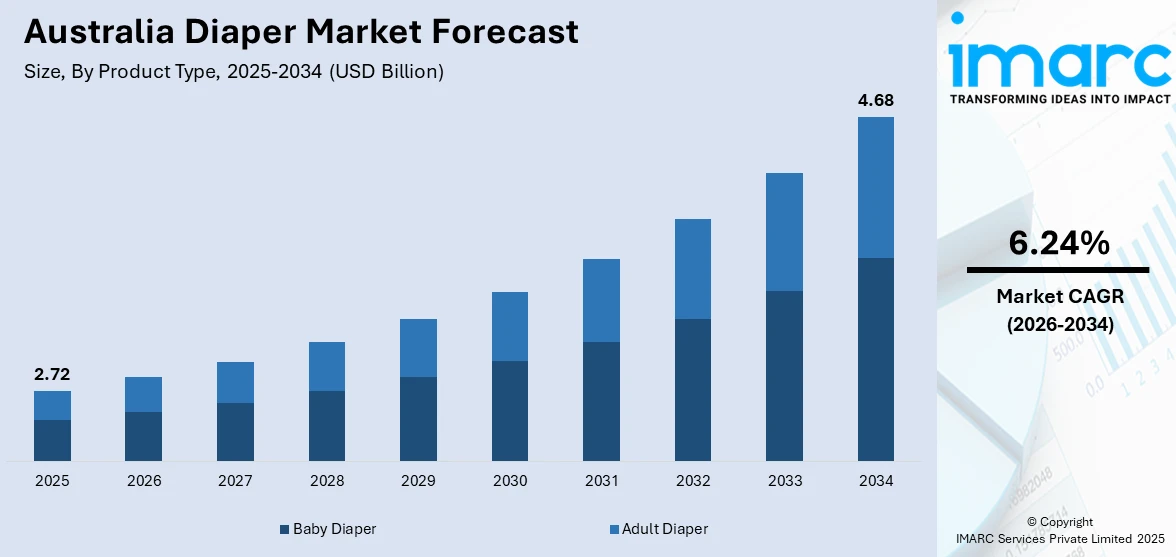
The Australia diaper market size was valued at USD 2.72 Billion in 2025 and is projected to reach USD 4.68 Billion by 2034, growing at a compound annual growth rate of 6.24% from 2026-2034. The Australia diaper market is experiencing robust expansion, driven by rising consumer awareness about infant hygiene standards, increasing demand for premium and eco-friendly products, and shifting preferences towards sustainable materials. Modern parents are prioritizing comfort, skin protection, and convenience in their purchasing decisions. The growing elderly population is simultaneously driving demand for adult incontinence products, further diversifying the market landscape across distribution channels.
To get more information on this market Request Sample
Key Takeaways and Insights:
- By Product Type: Baby diaper dominates the market with a share of 70% in 2025, owing to strong parental focus on infant hygiene, widespread availability across retail channels, and continuous product innovations in absorbency and skin protection. Rising disposable incomes among young families are further propelling premium baby diaper adoption.
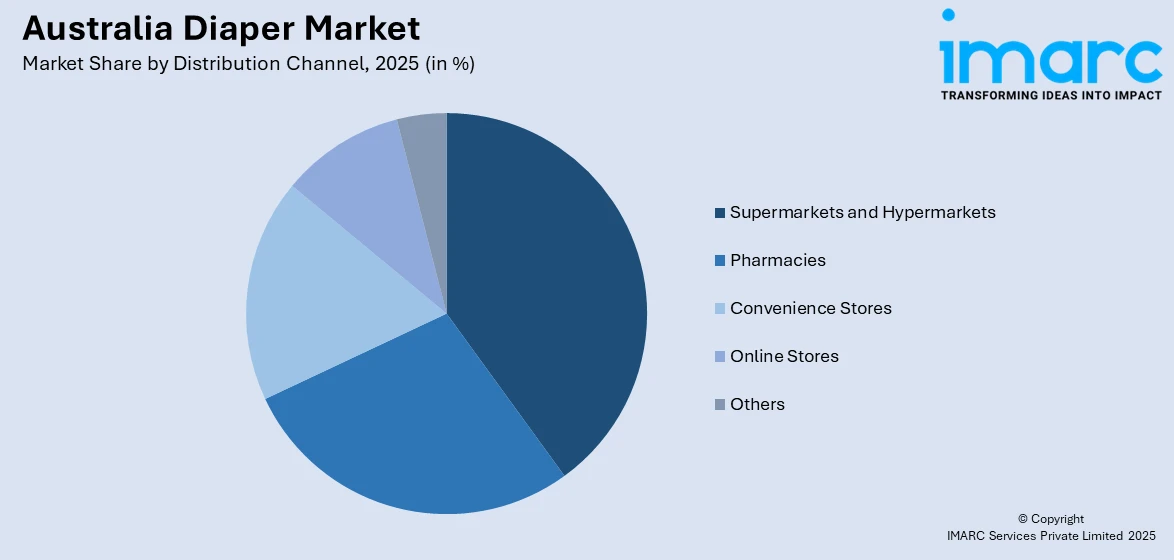
- By Distribution Channel: Supermarkets and hypermarkets lead the market with a share of 29% in 2025. This dominance is driven by the convenience of one-stop shopping experiences, competitive pricing strategies, extensive product assortments, and the trusted presence of major retail chains across the country.
- By Region: Australia Capital Territory & New South Wales represents the largest region with 28% share in 2025, driven by the dense population in the Sydney metropolitan area, increased disposable incomes allowing premium product purchases, and strong retail infrastructure facilitating a variety of diaper options.
- Key Players: Key players drive the Australia diaper market by expanding product portfolios, improving absorbency technologies, and strengthening nationwide distribution networks. Their investments in sustainability initiatives, marketing campaigns, and partnerships with healthcare providers boost awareness and accelerate adoption across diverse consumer segments. Some of the key players operating in the market include Aiwibi Baby Care, ComfyKoalas, Ecoriginals, Kimberly-Clark Australia, Noopii, Ontex Healthcare, Rascals International Limited, and Unicharm Corporation.
The Australia diaper market is propelled by multiple interconnected growth drivers that collectively shape its expansion trajectory. Rising awareness about infant hygiene standards among modern parents continues to fuel demand for high-quality disposable and premium diaper products that prioritize skin health and comfort. The growing elderly population is simultaneously creating substantial demand for adult incontinence products, expanding the overall market scope. According to the 2025 Population Statement, released by the Government’s Centre for Population, in five years, the population of Australians aged 85 and above will rise by 25% to 753,000. Technological innovations in absorbent materials and sustainable manufacturing processes are attracting environmentally conscious consumers seeking eco-friendly alternatives. The expansion of e-commerce platforms has revolutionized distribution dynamics, making diaper products more accessible than ever. The proliferation of premium product offerings, featuring advanced leak protection, breathable materials, and hypoallergenic formulations, continues to attract discerning parents willing to invest in superior infant care solutions.
Australia Diaper Market Trends:
Rising Demand for Eco-Friendly and Sustainable Diapers
Environmental consciousness is significantly reshaping consumer preferences across the Australia diaper market, with parents increasingly seeking biodegradable and organic alternatives to conventional disposable products. Manufacturers are responding by introducing plant-based fibers, minimal plastic packaging, and compostable materials that reduce landfill impact. This shift is also driving demand for transparency in sourcing, certifications, and clear eco-labeling on diaper products. Social media influence and parenting communities are also accelerating awareness and trial of eco-conscious diaper brands.
Growth of Premium and High-Tech Diaper Products
Australian parents are increasingly prioritizing premium diaper products that deliver exceptional comfort, superior skin protection, and advanced technological features. Higher disposable incomes are enabling families to invest in diapers featuring wetness indicators, hypoallergenic materials, and enhanced absorbency systems. As per Trading Economics, in Australia, disposable personal income rose to 445019 AUD Million in the third quarter of 2025, up from 437382 AUD Million in the second quarter of 2025. Product innovations include zinc-enriched protective layers, ultra-thin cores with improved moisture distribution, and breathable materials that maintain skin health. These premium offerings address parental concerns about nappy rash, irritation, and overnight protection while commanding higher price points in the competitive marketplace.
Expansion of E-Commerce and Subscription Services
The digital transformation of retail channels is revolutionizing how Australian parents purchase diaper products, with online platforms offering unprecedented convenience and variety. Subscription-based delivery services are gaining popularity, providing automatic replenishment, competitive pricing, and doorstep delivery that suits busy family lifestyles. E-commerce platforms enable easy product comparison, customer reviews, and access to specialty brands unavailable in traditional retail stores. As per IMARC Group, the Australia e-commerce market size was valued at USD 604.1 Billion in 2025. The proliferation of mobile shopping applications and improved logistics infrastructure continues to accelerate online diaper sales across metropolitan and regional markets.
Market Outlook 2026-2034:
The Australia diaper market demonstrates strong growth potential, driven by evolving consumer preferences, demographic shifts, and technological advancements in product development. The combination of rising infant hygiene awareness, expanding elderly population requiring incontinence products, and growing demand for sustainable alternatives positions the market for sustained expansion. The market generated a revenue of USD 2.72 Billion in 2025 and is projected to reach a revenue of USD 4.68 Billion by 2034, growing at a compound annual growth rate of 6.24% from 2026-2034. Manufacturers are investing in research and development (R&D) activities to introduce innovative products, featuring advanced absorbent technologies, skin-friendly materials, and eco-conscious formulations. The expansion of distribution networks, including e-commerce platforms and subscription services, will enhance product accessibility across urban and regional markets.
Australia Diaper Market Report Segmentation:
|
Segment Category |
Leading Segment |
Market Share |
|
Product Type |
Baby Diaper |
70% |
|
Distribution Channel |
Supermarkets and Hypermarkets |
29% |
|
Region |
Australia Capital Territory & New South Wales |
28% |
Product Type Insights:
- Baby Diaper
- Disposable Diapers
- Training Diapers
- Cloth Diapers
- Swim Pants
- Biodegradable Diapers
- Adult Diaper
- Pad Type
- Flat Type
- Pant Type
Baby diaper dominates with a market share of 70% of the total Australia diaper market in 2025.
The baby diaper segment maintains commanding market leadership, driven by fundamental parental priorities of infant hygiene, comfort, and skin protection. Advanced features, including better absorbency, breathable materials, and hypoallergenic formulas that protect sensitive newborn skin, are becoming more popular among modern parents. Families in both urban and rural locations can easily get it, owing to its widespread availability through pharmacies, supermarkets, and digital platforms. Convenient, high-performance baby diaper solutions are gaining importance as urbanization and working parents become more involved.
Manufacturers are launching premium products with zinc-enriched protective layers, wetness indications, and ultra-thin absorbent cores, which are driving the segment's growth. Convenience factors make disposable newborn diapers important, but parents who care about the environment are increasingly using biodegradable alternatives. Regional birth statistics reveal encouraging trends, with Newcastle and the Hunter Valley reporting 8,130 births in 2024, representing a 4.6% increase from 2023, indicating sustained demographic support for baby diaper demand. Premium and eco-friendly product variants are increasingly capturing market attention as parents prioritize both performance and sustainability.
Distribution Channel Insights:
Access the comprehensive market breakdown Request Sample
- Supermarkets and Hypermarkets
- Pharmacies
- Convenience Stores
- Online Stores
- Others
Supermarkets and hypermarkets lead with a share of 29% of the total Australia diaper market in 2025.
Supermarkets and hypermarkets maintain distribution channel leadership through extensive retail networks, competitive pricing strategies, and comprehensive product assortments that satisfy diverse consumer preferences. Large retail chains include sections specifically for baby care that provide both private-label and regional brand products at reasonable prices. Parents can maximize time efficiency for busy families by combining regular supermarket shopping with diaper purchases because of the one-stop shopping convenience. Impulsive purchases and product visibility are further enhanced by large regional presence and high foot traffic volumes.
Major supermarket chains' private-label diaper brands are gaining popularity among consumers by providing high-quality goods at affordable prices. Strategic shelf placement, loyalty programs, and regular promotions help the supermarket channel by influencing consumer decisions. Value pack alternatives, dermatologist-tested claims, and better packaging are boosting consumer trust in private-label products. Retailers aim to match stock with regional demand trends with the help of data-driven inventory management. Additionally, private-label items stand out on store shelves, due to partnerships with manufacturers for exclusive variants.
Regional Insights:
- Australia Capital Territory & New South Wales
- Victoria & Tasmania
- Queensland
- Northern Territory & Southern Australia
- Western Australia
Australia Capital Territory & New South Wales exhibits a clear dominance with a 28% share of the total Australia diaper market in 2025.
Australia Capital Territory & New South Wales collectively command the largest regional market share, driven by population concentration in the Sydney metropolitan area and surrounding urban centers. According to the Australian Bureau of Statistics, the population of children aged 0-4 years in New South Wales represented 5.8% of the state population in 2023, creating substantial baseline demand for baby diaper products. The region benefits from higher disposable income levels, sophisticated retail infrastructure, and diverse distribution channels serving both premium and budget-conscious consumer segments.
Premium and environment-friendly diaper products are widely used in the area, which reflects consumer preferences for sustainability and high quality. Throughout the projected period, the presence of large shops, pharmacies, and growing e-commerce infrastructure guarantees complete product accessibility throughout urban and suburban regions, ensuring sustained regional market leadership. Convenient, high-performing diaper solutions are in high demand due to urban living trends and a large percentage of working parents. Across the region, parenting communities and active health awareness campaigns have an impact on well-informed purchase decisions.
Market Dynamics:
Growth Drivers:
Why is the Australia Diaper Market Growing?
Rising Awareness about Infant Hygiene and Healthcare
Increasing parental awareness regarding infant hygiene standards and skin health is fundamentally driving demand for quality diaper products across Australia. Modern parents are more informed about the importance of maintaining proper diapering practices to prevent rashes, infections, and skin irritation in babies. Healthcare professionals and pediatricians actively recommend frequent diaper changes and the use of gentle, skin-friendly products, influencing consumer purchasing decisions towards premium offerings. Educational campaigns and online resources have empowered parents with knowledge about selecting appropriate diaper products based on absorbency, material composition, and hypoallergenic properties. This heightened awareness extends beyond baby care to adult incontinence management. Industry reports indicated that incontinence affected one in four adult Australians in 2023. The emphasis on maintaining dignity and quality of life for affected individuals is driving healthcare facilities and families to invest in comfortable, discreet Australia adult diaper solutions.
Technological Innovations in Product Development
In Australia, continuous technological advancements in diaper manufacturing are creating products with superior performance characteristics that attract discerning consumers willing to invest in quality. Innovations in absorbent materials include superabsorbent polymers that lock moisture away from baby's skin, providing extended dryness periods of up to twelve hours. Manufacturers are developing ultra-thin cores that maintain high absorbency while reducing bulk for improved comfort and mobility. Advanced features, such as wetness indicators, adjustable fit systems, and breathable backsheets, address specific parental concerns about convenience and infant comfort. Product safety innovations include zinc-enriched protective layers designed to prevent nappy rash. Smart diaper technology featuring wetness sensors and mobile application connectivity represents the emerging frontier of product innovation, appealing to tech-savvy parents seeking real-time monitoring capabilities.
Expansion of Distribution Channels and E-Commerce Growth
The proliferation of distribution channels, particularly digital commerce platforms, is significantly enhancing product accessibility and driving market growth across Australia. Traditional retail channels, including supermarkets, pharmacies, and convenience stores, continue to expand their diaper product offerings while competing on price and promotional activities. The e-commerce transformation has revolutionized consumer purchasing behavior, with online platforms offering convenient home delivery, subscription services, and comprehensive product comparisons. Subscription-based diaper delivery services are gaining substantial popularity, providing automatic replenishment at competitive prices while eliminating the inconvenience of store visits. Major retailers have invested significantly in their online shopping infrastructure, offering click-and-collect services and express delivery options. The digital channel particularly appeals to parents seeking specialty products unavailable in local stores, enabling access to international brands and niche eco-friendly alternatives.
Market Restraints:
What Challenges is the Australia Diaper Market Facing?
Environmental Concerns and Sustainability Pressures
Disposable diaper manufacturers face mounting challenges from growing environmental awareness among consumers. Increasing concern over waste generation and plastic usage is driving skepticism towards conventional products. Brands are under pressure to redesign materials, reduce environmental impact, and communicate sustainability efforts clearly. Failure to adapt risks reputational damage and loss of market relevance as eco-conscious parents increasingly factor environmental responsibility into purchasing decisions.
Rising Cost of Living and Affordability Pressures
Escalating living expenses present a significant challenge for diaper manufacturers, as households become more price sensitive. Parents are prioritizing essential spending and seeking economical diaper options without compromising basic quality. This shift places pressure on premium brands, compresses margins, and intensifies competition from private-label products, forcing manufacturers to rethink pricing strategies, value propositions, and pack-size offerings.
Competition from Reusable Alternatives
The increasing acceptance of reusable cloth diapers poses a growing challenge to the disposable diaper segment. Enhanced functionality, improved comfort, and greater convenience have strengthened the appeal of reusable options. Sustainability-driven purchasing behavior further accelerates this trend, compelling disposable diaper manufacturers to defend market share through innovation, differentiation, and stronger environmental positioning.
Competitive Landscape:
The Australia diaper market features intense competition among established multinational corporations, regional manufacturers, and emerging eco-focused brands. Market leaders maintain dominance through extensive distribution networks, strong brand recognition, and continuous product innovation investments. Premium segment competition centers on technological differentiation, with manufacturers introducing advanced absorbency systems, skin protection features, and convenient design elements. Private-label brands from major retailers are capturing budget-conscious consumer segments through competitive pricing and acceptable quality standards. Emerging sustainable brands are disrupting traditional market dynamics by targeting environmentally conscious consumers with biodegradable and organic product offerings. Strategic partnerships between manufacturers and retailers enhance market penetration and brand visibility across distribution channels.
Some of the key players include:
- Aiwibi Baby Care
- ComfyKoalas
- Ecoriginals
- Kimberly-Clark Australia
- Noopii
- Ontex Healthcare
- Rascals International Limited
- Unicharm Corporation
Australia Diaper Market Report Coverage:
| Report Features | Details |
|---|---|
| Base Year of the Analysis | 2025 |
| Historical Period | 2020-2025 |
| Forecast Period | 2026-2034 |
| Units | Billion USD |
| Scope of the Report |
Exploration of Historical Trends and Market Outlook, Industry Catalysts and Challenges, Segment-Wise Historical and Future Market Assessment:
|
| Product Types Covered |
|
| Distribution Channels Covered | Supermarkets and Hypermarkets, Pharmacies, Convenience Stores, Online Stores, Others |
| Regions Covered | Australia Capital Territory & New South Wales, Victoria & Tasmania, Queensland, Northern Territory & Southern Australia, Western Australia |
| Companies Covered | Aiwibi Baby Care, ComfyKoalas, Ecoriginals, Kimberly-Clark Australia, Noopii, Ontex Healthcare, Rascals International Limited, Unicharm Corporation, etc. |
| Customization Scope | 10% Free Customization |
| Post-Sale Analyst Support | 10-12 Weeks |
| Delivery Format | PDF and Excel through Email (We can also provide the editable version of the report in PPT/Word format on special request) |
Frequently Asked Questions About the Australia Diaper Market Report
The Australia diaper market size was valued at USD 2.72 Billion in 2025.
The Australia diaper market is expected to grow at a compound annual growth rate of 6.24% from 2026-2034 to reach USD 4.68 Billion by 2034.
Baby diaper dominated the market with a share of 70%, driven by strong parental focus on infant hygiene, widespread retail availability, and continuous product innovations in absorbency and skin protection technologies.
Key factors driving the Australia diaper market include rising awareness about infant hygiene, technological innovations in product development, growing elderly population requiring incontinence products, and expansion of e-commerce distribution channels.
Major challenges include environmental concerns about disposable diaper waste in landfills, rising cost of living pressures on household budgets, competition from government-incentivized reusable cloth diaper alternatives, and supply chain constraints affecting product availability.
Need more help?
- Speak to our experienced analysts for insights on the current market scenarios.
- Include additional segments and countries to customize the report as per your requirement.
- Gain an unparalleled competitive advantage in your domain by understanding how to utilize the report and positively impacting your operations and revenue.
- For further assistance, please connect with our analysts.
 Request Customization
 Speak to an Analyst
 Request Brochure
 Inquire Before Buying
Benefits of Customization
- Personalize this research
- Triangulate with your data
- Get data as per your format and definition
- Gain a deeper dive into a specific application, geography, customer, or competitor
- Any level of personalization
Get in Touch With Us
UNITED STATES
Phone: +1-201-971-6302
INDIA
Phone: +91-120-433-0800
UNITED KINGDOM
Phone: +44-753-714-6104
Email: [email protected]
Client Testimonials




.webp)




.webp)













Related Reports

Choose your plan
*Please note that the prices mentioned below are starting prices for each bundle type. Kindly contact our team for further details.*
Single User License
- 1 User License, Access on 2 Devices
- PDF Report + Excel Dataset (Password Protected)
- Lifetime Access
- No Printing Rights
- 10% Free Report Customization
- 10–12 Weeks of Analyst Support
Five User License
- Access for 5 Users, 2 Devices per User
- PDF Report + Excel Dataset (Password Protected)
- Lifetime Access
- Dedicated Account Manager
- 12–14 Weeks of Analyst Support
- No Printing Rights
- 15% Free Report Customization
- 25% Discount on Your Next Purchase
Corporate User License
- Unlimited User Access (Within Your Organization)
- PDF Report + Excel Dataset
- Lifetime Access
- Dedicated Account Manager
- 14–20 Weeks of Analyst Support
- No Printing Rights
- 20% Free Report Customization
- 30% Discount on Your Next Purchase
Essential Insights
What's included:
3 reports
- Lifetime Access
- PDF Reports
- Excel Datasets
- 2 Weeks of Free Analyst Support
- 2 User Licenses
- Access on 2 Devices
- Printing Rights
- Complimentary PowerPoint (PPT) Version
- Complimentary License Upgrade
Professional Access
What's included:
5 reports
- Lifetime Access
- PDF Reports
- Excel Datasets
- 8 Weeks of Free Analyst Support
- 2 User Licenses
- Access on 2 Devices
- Printing Rights
- Complimentary PowerPoint (PPT) Version
- Complimentary License Upgrade
Business Advantage
What's included:
8 reports
- Lifetime Access
- PDF Reports
- Excel Datasets
- 14 Weeks of Free Analyst Support
- 2 User Licenses
- Access on 2 Devices
- Printing Rights
- Complimentary PowerPoint (PPT) Version
- Complimentary License Upgrade
Enterprise Intelligence
What's included:
10 reports
- Lifetime Access
- PDF Reports
- Excel Datasets
- 20 Weeks of Free Analyst Support
- 2 User Licenses
- Access on 2 Devices
- Printing Rights
- Complimentary PowerPoint (PPT) Version
- Complimentary License Upgrade