
Australia Government Cloud Market Size, Share, Trends and Forecast by Component, Deployment Model, Service Model, Application, and Region, 2026-2034
Australia Government Cloud Market Summary:
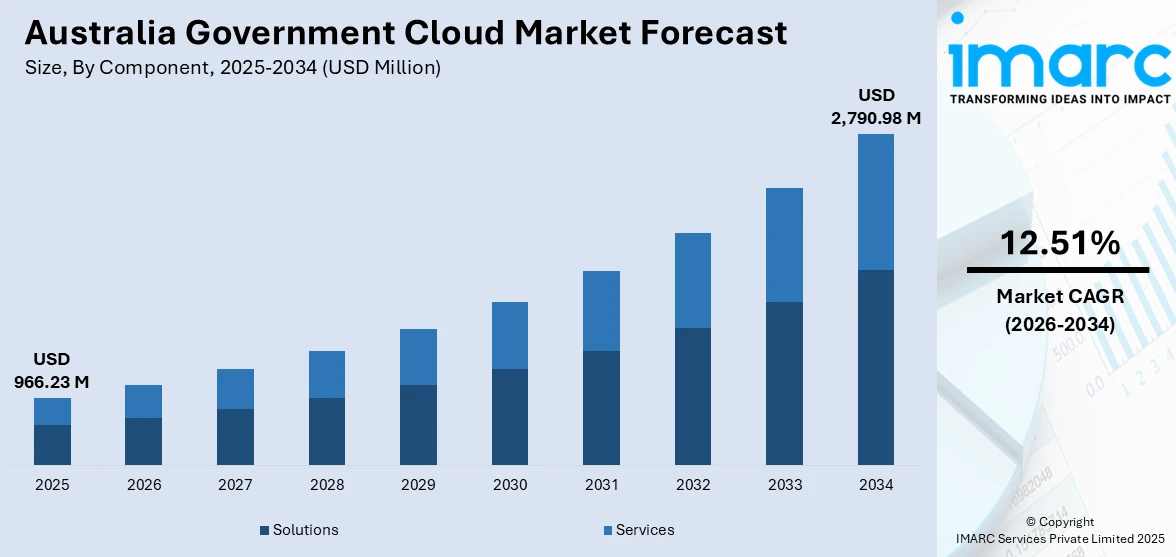
The Australia government cloud market size was valued at USD 966.23 Million in 2025 and is projected to reach USD 2,790.98 Million by 2034, growing at a compound annual growth rate of 12.51% from 2026-2034.
The Australian government cloud market is experiencing robust expansion driven by comprehensive digital transformation initiatives across federal, state, and local government agencies. The Digital Transformation Agency's whole-of-government cloud computing policy is accelerating the adoption of secure, scalable cloud platforms to modernize legacy ICT systems. Growing emphasis on data sovereignty, enhanced citizen service delivery, and integration of artificial intelligence technologies are creating sustained demand for cloud infrastructure across the Australian public sector. These factors collectively contribute to the expanding Australia government cloud market share.
Key Takeaways and Insights:
- By Component: Solutions dominate the market with a share of 59.8% in 2025, driven by strong demand for comprehensive cloud management platforms, security solutions, and analytics capabilities that enable government agencies to effectively manage complex digital infrastructure and deliver enhanced citizen services.
- By Deployment Model: Hybrid cloud leads the market with a share of 44.3% in 2025, attributed to government requirements for maintaining sensitive data on-premise while leveraging public cloud scalability, meeting data sovereignty mandates, and enabling flexible workload management across secure environments.
- By Service Model: Infrastructure as a service represents the largest segment with a market share of 42.1% in 2025, owing to government agencies' need for scalable computing resources, storage capabilities, and networking infrastructure to support mission-critical applications and digital transformation initiatives.
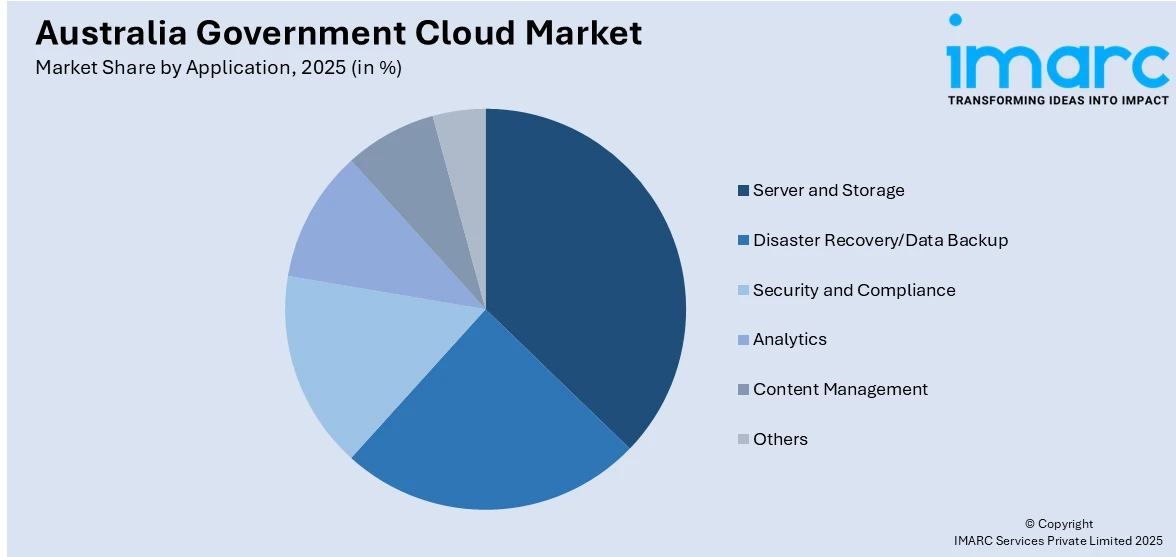
- By Application: Server and storage lead the market with a share of 34.5% in 2025, reflecting the fundamental requirement for secure data storage, processing capacity, and computational resources essential to government operations and service delivery frameworks.
- By Region: Australia Capital Territory & New South Wales dominate with 36.2% market share in 2025, driven by concentration of federal government departments in Canberra and major state agencies in Sydney, along with established cloud infrastructure and advanced digital government capabilities.
- Key Players: The Australia government cloud market exhibits a moderately consolidated competitive structure, featuring major global hyperscalers alongside specialized domestic providers. Competition centers on security certifications, data sovereignty compliance, and delivery of comprehensive managed services tailored to public sector requirements.
To get more information on this market Request Sample
The Australian government cloud market is fundamentally shaped by the national digital transformation agenda and evolving regulatory frameworks. The Digital Transformation Agency's cloud-first policy mandates that agencies consider cloud solutions for all new digital initiatives, accelerating migration from legacy systems. Government investment in secure cloud infrastructure is substantial, exemplified by the partnership between the Australian Signals Directorate and AWS to develop a Top Secret Cloud for defense and intelligence agencies, representing a commitment of approximately AUD 2 billion over the next decade. This initiative demonstrates the strategic importance placed on sovereign cloud capabilities for handling classified information while driving innovation in the cybersecurity and data analytics sectors. This focus on secure, scalable cloud platforms is also encouraging broader adoption of advanced digital services across government departments, improving interoperability, service delivery efficiency, and resilience while fostering a stronger domestic cloud and cybersecurity ecosystem.
Australia Government Cloud Market Trends:
Accelerated Adoption of Hybrid and Multi-Cloud Architectures
Government agencies are increasingly embracing hybrid and multi-cloud deployment models to balance data sovereignty requirements with operational flexibility. This approach enables agencies to maintain sensitive workloads on-premise or in private cloud environments while leveraging public cloud scalability for less sensitive applications. For instance, the Digital Transformation Agency's whole-of-government cloud computing policy, effective from July 2026, actively encourages agencies to consider hybrid or multi-cloud models when pure cloud solutions are not justified, ensuring strategic alignment with security and compliance mandates.
Integration of Artificial Intelligence and Generative AI Technologies
Australian government agencies are rapidly integrating AI capabilities within cloud platforms to enhance service delivery and operational efficiency. For instance, the Digital Transformation Agency completed one of the world's largest generative AI workplace trials in 2024, involving over 7,600 staff across 60 government agencies using Microsoft 365 Copilot. Participants reported significant productivity gains, with time savings reallocated to higher-value activities, including strategic planning and stakeholder engagement. This successful trial has positioned Australia as a global leader in responsible AI implementation within government.
Enhanced Focus on Data Sovereignty and Sovereign Cloud Solutions
Data sovereignty has become a critical factor shaping cloud adoption within the Australian government, increasing demand for locally-hosted sovereign cloud solutions. Regulatory frameworks provide guidelines for secure domestic data management, ensuring sensitive information remains under national jurisdiction. Cloud providers are expanding local infrastructure to meet these requirements, enabling agencies to leverage advanced cloud services while maintaining compliance. Recent initiatives highlight the emphasis on in-country processing of data and interactions, demonstrating the priority placed on protecting government information, supporting regulatory adherence, and fostering trust in cloud-based platforms for public-sector operations.
Market Outlook 2026-2034:
The Australia government cloud market is set for steady long-term growth as digital transformation efforts intensify across federal, state, and local agencies. Cloud-first mandates are prompting departments to modernize IT environments, replace aging on-premise systems, and adopt more flexible digital service models. Rising emphasis on data-driven governance, automation, and secure information management is further strengthening demand for scalable cloud platforms. Investments in advanced analytics, artificial intelligence, and cybersecurity capabilities are also accelerating cloud adoption, positioning cloud infrastructure as a core enabler of efficient, resilient, and future-ready public sector operations. The market generated a revenue of USD 966.23 Million in 2025 and is projected to reach a revenue of USD 2,790.98 Million by 2034, growing at a compound annual growth rate of 12.51% from 2026-2034.
Australia Government Cloud Market Report Segmentation:
|
Segment Category |
Leading Segment |
Market Share |
|
Component |
Solutions |
59.8% |
|
Deployment Model |
Hybrid Cloud |
44.3% |
|
Service Model |
Infrastructure as a Service |
42.1% |
|
Application |
Server and Storage |
34.5% |
|
Region |
Australia Capital Territory & New South Wales |
36.2% |
Component Insights:
- Solutions
- Services
Solutions dominate with a market share of 59.8% of the total Australia government cloud market in 2025.
The solutions segment encompasses cloud management platforms, security solutions, analytics tools, and application development frameworks essential for government digital operations. Government agencies require comprehensive solution stacks that address complex requirements including identity management, compliance monitoring, and workload orchestration. The Digital Transformation Agency's GovAI platform exemplifies this demand, offering a central resource for agencies to access AI tools, guidance, and learning materials that enhance cloud-based service delivery capabilities.
The growing complexity of government IT environments and increasing emphasis on cybersecurity are driving demand for integrated solution offerings. Cloud security and compliance solutions are particularly critical, with government agencies facing stringent requirements under the Protective Security Policy Framework. The segment benefits from continuous innovation by cloud providers who are developing specialized government-grade solutions addressing unique public sector needs including secure collaboration, data protection, and regulatory compliance frameworks.
Deployment Model Insights:
- Hybrid Cloud
- Private Cloud
- Public Cloud
Hybrid cloud leads with a share of 44.3% of the total Australia government cloud market in 2025.
Hybrid cloud deployments enable government agencies to maintain critical workloads and sensitive data within controlled on-premise or private cloud environments while leveraging public cloud resources for scalability and innovation. This approach addresses data sovereignty requirements mandated by the Australian Hosting Certification Framework while providing operational flexibility. Macquarie Cloud Services launched Macquarie Flex in June 2024, an Australian-first hybrid cloud solution utilizing strategic partnerships with Dell Technologies and Microsoft to serve government and enterprise customers.
The hybrid model supports government agencies transitioning from legacy systems by allowing gradual migration without disrupting essential services. Agencies can maintain existing investments in on-premise infrastructure while incrementally adopting cloud capabilities based on workload requirements and security classifications. The whole-of-government cloud computing policy explicitly encourages agencies to consider hybrid or multi-cloud models when pure cloud solutions are not justified, validating the strategic importance of this deployment approach.
Service Model Insights:
- Infrastructure as a Service
- Platform as a Service
- Software as a Service
Infrastructure as a service exhibits clear dominance with a 42.1% share of the total Australia government cloud market in 2025.
Infrastructure as a Service (IaaS) offers government agencies flexible and scalable computing, storage, and networking resources necessary to support mission-critical applications and large-scale data operations. This model allows agencies to quickly provision infrastructure without the need for upfront investment in physical hardware, accelerating digital transformation initiatives. Expanding local data center capacity by major cloud providers highlights the growing demand for IaaS solutions, enabling public-sector organizations to efficiently manage workloads, improve service delivery, and adopt advanced technologies while maintaining operational agility.
The IaaS segment supports government requirements for disaster recovery, business continuity, and workload migration from aging legacy systems. Agencies leverage IaaS for development and testing environments, enabling rapid prototyping of digital services before production deployment. The segment continues to evolve with the integration of advanced capabilities, including AI-accelerated computing and specialized configurations for handling classified government information, further strengthening its market position.
Application Insights:
Access the comprehensive market breakdown Request Sample
- Server and Storage
- Disaster Recovery/Data Backup
- Security and Compliance
- Analytics
- Content Management
- Others
Server and storage represent the largest share of 34.5% of the total Australia government cloud market in 2025.
Server and storage applications form the foundational layer of government cloud infrastructure, supporting all digital government operations from citizen services to internal administrative functions. The exponential growth in government data volumes, driven by the digitalization of services and increased data collection, necessitates scalable and secure storage solutions. For instance, Komatsu Australia partnered with Macquarie Cloud Services in May 2025 through a multimillion-dollar agreement to enhance cloud computing infrastructure, focusing on disaster recovery, data protection, and operational performance.
Government agencies require high-performance computing capabilities for processing large datasets, running complex analytical workloads, and supporting real-time service delivery. The segment benefits from ongoing investments in local data center infrastructure by major cloud providers, ensuring low-latency access and compliance with data residency requirements. Advanced storage technologies including object storage and data tiering, enable agencies to optimize costs while maintaining accessibility for mission-critical applications.
Region Insights:
- Australia Capital Territory & New South Wales
- Victoria & Tasmania
- Queensland
- Northern Territory & Southern Australia
- Western Australia
Australia Capital Territory & New South Wales lead with a share of 36.2% of the total Australia government cloud market in 2025.
The Australian Capital Territory and New South Wales region dominates the government cloud market due to the concentration of federal government departments and major agencies in Canberra, combined with the significant state government operations in Sydney. This region hosts the Digital Transformation Agency and key defense and intelligence organizations driving cloud adoption. Over 140 Commonwealth, state, and territory agencies already utilize cloud services for critical functions including transport, health, education, and tax collection.
The region benefits from mature digital infrastructure including established data center presence from major cloud providers. Microsoft announced the extension of its Azure infrastructure to Western Australia with an Azure Extended Zone in Perth by mid-2025, demonstrating ongoing investment in expanding cloud capabilities across all Australian regions. The Western Australian Government's Digital Industries Acceleration Strategy and Digital Inclusion Leadership Forum support continued infrastructure development to ensure equitable access to cloud services nationwide.
Market Dynamics:
Growth Drivers:
Why is the Australia Government Cloud Market Growing?
Government Digital Transformation Policies and Cloud-First Mandates
The Australian government’s extensive digital transformation agenda is driving widespread cloud adoption across public sector agencies. Mandatory policies require that all new digital and ICT initiatives leverage cloud solutions, with agencies incorporating strategic cloud planning into their investment frameworks and phasing out legacy systems. Complementary standards for government websites and digital services further encourage modernization, fueling sustained demand for cloud infrastructure. This coordinated approach ensures agencies can enhance operational efficiency, improve service delivery to citizens, and maintain secure, scalable, and future-ready digital environments.
Significant Hyperscaler Infrastructure Investments
Leading global cloud providers are making substantial investments in Australian infrastructure, significantly expanding capacity and capabilities to support both government and enterprise demand. These initiatives include the development of new data centers, AI platforms, and training partnerships to build local expertise. Such investments enable low-latency access to advanced cloud services while ensuring compliance with domestic data residency requirements, supporting secure and scalable operations. This infrastructure expansion strengthens the country’s digital ecosystem, facilitates the modernization of public-sector systems, and underpins broader adoption of cloud solutions across critical government and commercial functions.
Growing Emphasis on Artificial Intelligence Integration
Artificial intelligence is becoming a core driver of government cloud adoption as agencies seek to enhance productivity and service delivery. The Australian Government's AI Plan for the APS sets actions to build capability, strengthen oversight, and embed accountability across the public service. The Policy for Responsible Use of AI in Government provides principles ensuring AI is used ethically and transparently. Cloud platforms deliver the critical infrastructure needed for AI deployment, offering advanced computing power, machine learning services, and robust data analytics capabilities. Successful trials with government staff have demonstrated the efficiency and productivity gains achievable through cloud-based AI tools, encouraging broader adoption across agencies. This integration enables public-sector organizations to streamline operations, enhance decision-making, and implement intelligent services while leveraging scalable and secure cloud environments to support advanced AI workloads.
Market Restraints:
What Challenges the Australia Government Cloud Market is Facing?
Cybersecurity Skills Shortage and Workforce Gaps
Australia continues to face a shortage of experienced cybersecurity and cloud professionals, creating challenges for public-sector cloud adoption. Government agencies often struggle to secure the specialized talent needed to manage complex cloud environments, maintain robust security postures, and address emerging cyber risks. Competition with the private sector further complicates recruitment and retention, increasing reliance on external providers and slowing in-house capability development.
Complex Data Sovereignty and Compliance Requirements
Adopting cloud services requires government agencies to comply with a complex mix of data protection, security, and hosting regulations. Overlapping frameworks create administrative burdens and increase the risk of misinterpretation or inconsistent implementation. Limited internal expertise in navigating these requirements can delay cloud projects, raise compliance costs, and constrain agencies’ ability to fully leverage cloud-based innovation while meeting governance obligations.
Legacy System Integration and Migration Complexity
Many government agencies operate aging ICT systems that present significant challenges for cloud migration. Legacy systems can be end-of-life, unsupported by vendors, and increasingly incompatible with modern security standards. Procurement frameworks often favor capital expenditure over operational funding models suited to cloud subscriptions, creating barriers to modernization. A risk-averse organizational culture further inhibits innovation and cloud adoption.
Competitive Landscape:
The Australia government cloud market features a competitive landscape characterized by major global hyperscalers competing alongside specialized domestic providers. Market participants differentiate through security certifications, data sovereignty compliance, and specialized government-grade service offerings. Competition extends beyond infrastructure provision to encompass managed services, professional consulting, and training programs that support government digital transformation. Strategic partnerships between cloud providers and government agencies, evidenced by whole-of-government agreements and specialized secure cloud initiatives, shape competitive positioning and market access. The evolving regulatory environment and emphasis on sovereign cloud solutions create opportunities for providers demonstrating strong local presence and compliance capabilities.
Recent Developments:
- June 2025: Amazon announced plans to invest AUD 20 billion from 2025 to 2029 to expand and maintain its data center infrastructure in Australia. The investment supports cloud computing and artificial intelligence demand, accelerating AI adoption and modernization of Australian organizations while ensuring local data residency requirements are met.
- January 2025: The Digital Transformation Agency announced a renewed whole-of-government agreement with AWS, building on the previous 2019 arrangement. The partnership promises improved value, reliability, and security while streamlining procurement processes for over 140 Commonwealth, state, and territory agencies using AWS for critical services.
- December 2024: Microsoft announced the extension of its global datacenter footprint to Western Australia with the deployment of an Azure Extended Zone to Perth by mid-2025. The expansion brings cloud services closer to users in Western Australia, reducing latency and supporting the WA Government's Digital Industries Acceleration Strategy.
Australia Government Cloud Market Report Coverage:
|
Report Features |
Details |
|
Base Year of the Analysis |
2025 |
|
Historical Period |
2020-2025 |
|
Forecast Period |
2026-2034 |
|
Units |
Million USD |
|
Scope of the Report |
Exploration of Historical Trends and Market Outlook, Industry Catalysts and Challenges, Segment-Wise Historical and Future Market Assessment:
|
|
Components Covered |
Solutions, Services |
|
Deployment Models Covered |
Hybrid Cloud, Private Cloud, Public Cloud |
|
Service Models Covered |
Infrastructure as a Service, Platform as a Service, Software as a Service |
|
Applications Covered |
Server and Storage, Disaster Recovery/Data Backup, Security and Compliance, Analytics, Content Management, Others |
|
Regions Covered |
Australia Capital Territory & New South Wales, Victoria & Tasmania, Queensland, Northern Territory & Southern Australia, Western Australia |
|
Customization Scope |
10% Free Customization |
|
Post-Sale Analyst Support |
10-12 Weeks |
|
Delivery Format |
PDF and Excel through Email (We can also provide the editable version of the report in PPT/Word format on special request) |
Frequently Asked Questions About the Australia Government Cloud Market Report
The Australia government cloud market size was valued at USD 966.23 Million in 2025.
The Australia government cloud market is expected to grow at a compound annual growth rate of 12.51% from 2026-2034 to reach USD 2,790.98 Million by 2034.
Solutions dominated the Australia government cloud market with a 59.8% share in 2025, driven by strong demand for comprehensive cloud management platforms, security solutions, and analytics capabilities essential for government digital operations.
Key factors driving the Australia government cloud market include mandatory cloud-first government policies, significant hyperscaler infrastructure investments, growing AI integration requirements, emphasis on data sovereignty, and accelerating digital transformation initiatives across federal and state agencies.
Major challenges include significant cybersecurity skills shortage, complex data sovereignty and compliance requirements, legacy system integration difficulties, procurement framework constraints favoring capital over operational expenditure, and organizational resistance to cloud adoption.
Need more help?
- Speak to our experienced analysts for insights on the current market scenarios.
- Include additional segments and countries to customize the report as per your requirement.
- Gain an unparalleled competitive advantage in your domain by understanding how to utilize the report and positively impacting your operations and revenue.
- For further assistance, please connect with our analysts.
 Request Customization
 Speak to an Analyst
 Request Brochure
 Inquire Before Buying
Benefits of Customization
- Personalize this research
- Triangulate with your data
- Get data as per your format and definition
- Gain a deeper dive into a specific application, geography, customer, or competitor
- Any level of personalization
Get in Touch With Us
UNITED STATES
Phone: +1-201-971-6302
INDIA
Phone: +91-120-433-0800
UNITED KINGDOM
Phone: +44-753-714-6104
Email: [email protected]
Client Testimonials




.webp)




.webp)













Related Reports

Choose your plan
*Please note that the prices mentioned below are starting prices for each bundle type. Kindly contact our team for further details.*
Single User License
- 1 User License, Access on 2 Devices
- PDF Report + Excel Dataset (Password Protected)
- Lifetime Access
- No Printing Rights
- 10% Free Report Customization
- 10–12 Weeks of Analyst Support
Five User License
- Access for 5 Users, 2 Devices per User
- PDF Report + Excel Dataset (Password Protected)
- Lifetime Access
- Dedicated Account Manager
- 12–14 Weeks of Analyst Support
- No Printing Rights
- 15% Free Report Customization
- 25% Discount on Your Next Purchase
Corporate User License
- Unlimited User Access (Within Your Organization)
- PDF Report + Excel Dataset
- Lifetime Access
- Dedicated Account Manager
- 14–20 Weeks of Analyst Support
- No Printing Rights
- 20% Free Report Customization
- 30% Discount on Your Next Purchase
Essential Insights
What's included:
3 reports
- Lifetime Access
- PDF Reports
- Excel Datasets
- 2 Weeks of Free Analyst Support
- 2 User Licenses
- Access on 2 Devices
- Printing Rights
- Complimentary PowerPoint (PPT) Version
- Complimentary License Upgrade
Professional Access
What's included:
5 reports
- Lifetime Access
- PDF Reports
- Excel Datasets
- 8 Weeks of Free Analyst Support
- 2 User Licenses
- Access on 2 Devices
- Printing Rights
- Complimentary PowerPoint (PPT) Version
- Complimentary License Upgrade
Business Advantage
What's included:
8 reports
- Lifetime Access
- PDF Reports
- Excel Datasets
- 14 Weeks of Free Analyst Support
- 2 User Licenses
- Access on 2 Devices
- Printing Rights
- Complimentary PowerPoint (PPT) Version
- Complimentary License Upgrade
Enterprise Intelligence
What's included:
10 reports
- Lifetime Access
- PDF Reports
- Excel Datasets
- 20 Weeks of Free Analyst Support
- 2 User Licenses
- Access on 2 Devices
- Printing Rights
- Complimentary PowerPoint (PPT) Version
- Complimentary License Upgrade