
Australia Hand Tools Market Size, Share, Trends and Forecast by Type, Distribution Channel, End User, and Region, 2026-2034
Australia Hand Tools Market Size, Share, Trends & Forecast (2026-2034)
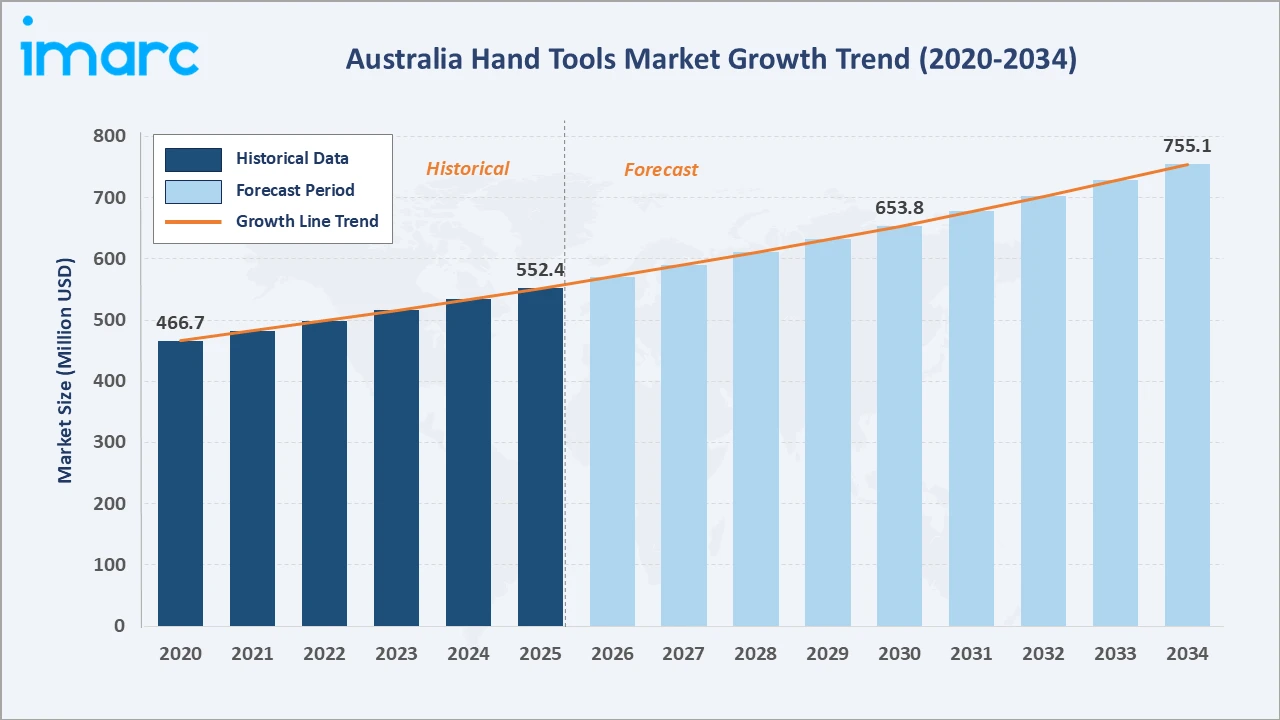
The Australia hand tools market grew from USD 552.4 Million in 2025 to USD 576.6 Million in 2026 and is projected to reach USD 755.1 Million by 2034, expanding at a CAGR of 3.43% during 2026-2034. Rising construction and infrastructure investment, automotive sector expansion and vehicle maintenance demand, and growing DIY home renovation activity are the primary growth catalysts.
Market Snapshot
|
Metric |
Value |
|
Base Year Market Size (2025) |
USD 552.4 Million |
|
Market Size (2026) |
USD 576.6 Million |
|
Forecast Market Size (2034) |
USD 755.1 Million |
|
CAGR (2026-2034) |
3.43% |
|
Base Year |
2025 |
|
Historical Period |
2020-2025 |
|
Forecast Period |
2026-2034 |
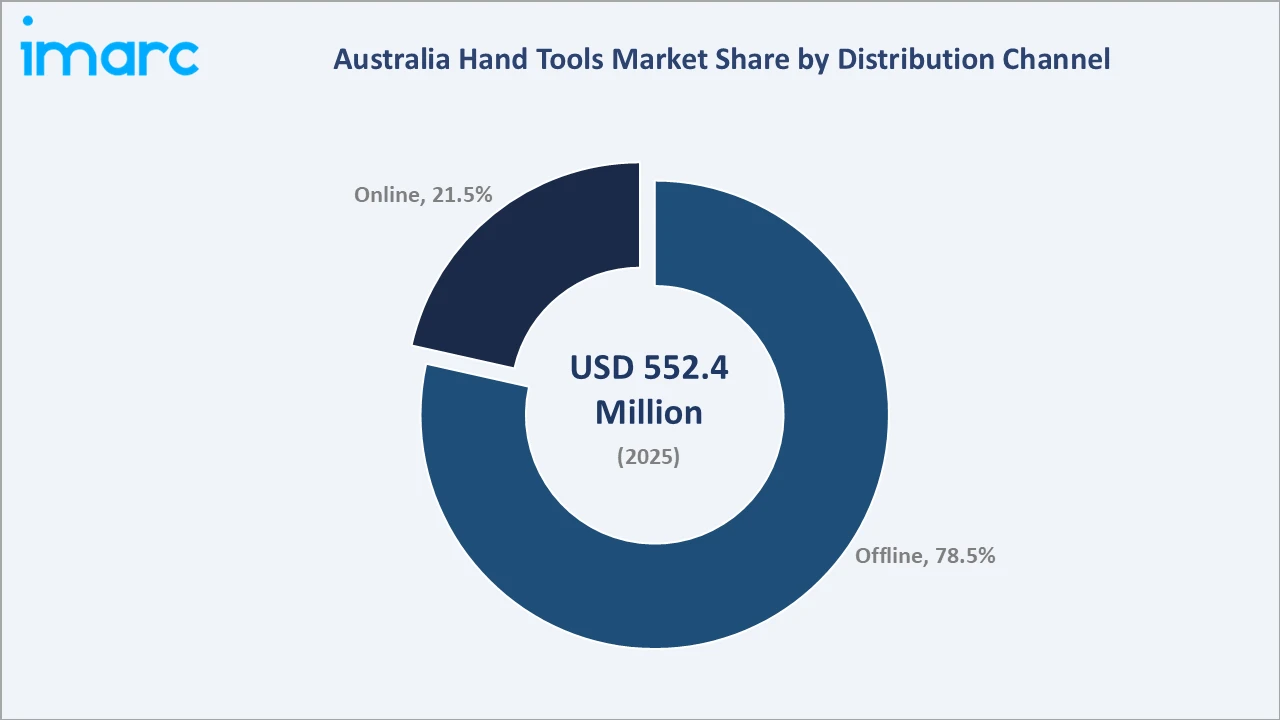
Australian Capital Territory and New South Wales lead the national hand tools landscape, holding a 34.6% share in 2025, anchored by the region's concentrated construction activity and dense retail infrastructure. Offline retail commands the largest share of the distribution channel segment at 78.5%, reflecting continued preference for in-store product evaluation and trade counter purchasing across industrial and commercial buyers.
To get more information on this market, Request Sample
The Australia hand tools market is underpinned by three structural forces: rising construction and infrastructure investment, automotive sector expansion and vehicle maintenance demand, and growing DIY home renovation activity. Each force independently reinforces category growth, sustaining steady CAGR expansion through 2034 despite competition from low-cost imported tool alternatives.
Executive Summary
The Australia hand tools market is experiencing steady expansion, driven by rising construction and infrastructure investment, automotive sector expansion, and growing DIY home renovation activity. The market size increased from USD 552.4 Million in 2025 to USD 576.6 Million in 2026 and is forecast to reach USD 755.1 Million by 2034, growing at a CAGR of 3.43%.
Offline retail dominates the distribution channel segment with a 78.5% share in 2025, encompassing hardware stores, trade counters, and specialty tool retailers, while online distribution accounts for 21.5%, reflecting growing e-commerce adoption and promotional toolkit bundling.
Industrial applications lead the end-user segment at 44.8% share (2025), supported by sustained demand from construction, manufacturing, and trade professionals, while commercial (32.7%) and DIY (22.5%) serve varied consumer and business needs. Australian Capital Territory and New South Wales lead regionally at 34.6%, anchored by the region's concentrated construction activity and dense retail infrastructure.
Key Market Insights
|
Insight |
Data |
|
Largest Distribution Channel Segment |
Offline – 78.5% share (2025) |
|
Fastest Growing Distribution Channel Segment |
Online – ~5.6% CAGR (2026-2034) |
|
Largest End-User Segment |
Industrial – 44.8% share (2025) |
|
Leading Region |
Australian Capital Territory & New South Wales – 34.6% share (2025) |
|
Top Companies |
Stanley Black & Decker, Inc., Apex Tool Group, LLC, Stealth Group Holdings Ltd, Sydney Tools Pty Ltd |
Key Analytical Observations Supporting The Above Data:
- Offline retail accounts for 78.5% of the Australia hand tools market in 2025. This dominance reflects continued preference for in-store evaluation and trade counter purchasing among industrial and commercial buyers.
- Industrial remains the leading end-user segment at 44.8% share (2025), supported by sustained demand from construction, manufacturing, and trade professionals.
- Commercial demand is expanding steadily at 32.7% share (2025), as service and maintenance businesses increasingly invest in professional-grade tool inventories.
- The Australian Capital Territory and New South Wales's 34.6% share (2025) reflects the region's concentrated construction activity and dense retail infrastructure.
- Rising online retail adoption and promotional toolkit bundling are broadening the addressable market across DIY and commercial buyer segments.
Australia Hand Tools Market Overview
The Australia hand tools market encompasses wrenches, pliers, screwdrivers, hammers, cable cutters, and other manually operated tools distributed across offline and online retail channels, serving industrial, commercial, and DIY end users. The Australia hand tools ecosystem spans raw material suppliers, manufacturing and forging specialists, and an expanding distribution network across hardware retailers, trade counters, and e-commerce platforms.
Macroeconomic drivers include expanding infrastructure projects and rising construction sector activity, growing automotive maintenance demand amid an aging vehicle population, and supportive retail expansion across offline and online channels. Manufacturers and distributors are simultaneously investing in exclusive distribution partnerships and omnichannel retail strategies to strengthen market presence, positioning the Australia hand tools sector for continued steady growth through 2034 despite competition from low-cost imported alternatives.
Market Dynamics
To evaluate market opportunities, Request Sample
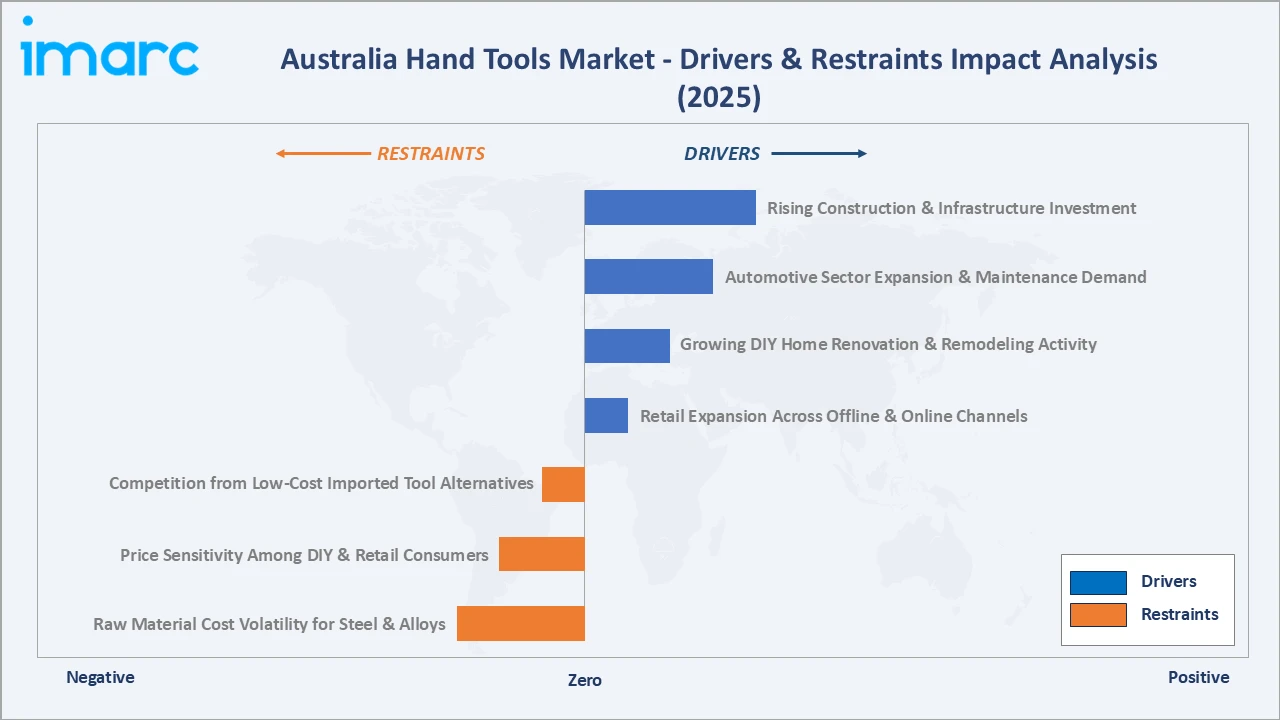
Market Drivers
- Rising Construction & Infrastructure Investment: Government and private sector funding for roads, bridges, railways, and buildings is driving sustained demand for professional-grade hand tools throughout Australia. The Albanese Labor Government’s 2026–27 Budget provides AUD 12.1 billion in new portfolio investments, including AUD 10.3 billion for transport infrastructure projects, AUD 976 million for broader transport initiatives, and AUD 803 million for community infrastructure.
- Automotive Sector Expansion & Maintenance Demand: Australia’s new vehicle market remained stable in October, recording 99,588 sales, a 1.2% increase compared with October 2024. Growing vehicle production and an aging vehicle population are accelerating demand for specialized maintenance and repair tools.
- Growing DIY Home Renovation & Remodeling Activity: Rising urban housing renovation and remodeling activity is expanding demand for hand tools among homeowners and DIY enthusiasts.
- Retail Expansion Across Offline & Online Channels: Promotional offers, toolkit bundling, and expanding e-commerce presence are broadening market accessibility for consumers and trade buyers alike.
Market Restraints
- Competition from Low-Cost Imported Tool Alternatives: Imported budget tool alternatives create pricing pressure and market share competition for domestic manufacturers and distributors.
- Price Sensitivity Among DIY & Retail Consumers: Cost-conscious DIY and retail buyers can delay premium tool purchases, moderating category revenue growth in price-sensitive segments.
- Raw Material Cost Volatility for Steel & Alloys: Fluctuations in steel and alloy input prices can impact manufacturing costs and profit margins across the value chain. By March 2026, Australian steel prices rose by about 5% due to higher fuel, freight, energy, and raw-material costs linked to Middle East disruptions, with short-term volatility expected to continue.
Market Opportunities
- Exclusive Distribution Partnership Expansion: Rising exclusive distribution agreements, such as those securing international power tool and hand tool brand rights, present opportunities for domestic distributors.
- Omnichannel Retail & E-commerce Growth: Growing online retail adoption creates opportunities for manufacturers and retailers investing in digital sales and fulfillment infrastructure.
- Specialized Automotive & Industrial Tool Innovation: Rising complexity of modern vehicles and industrial equipment offers tool manufacturers new specialty product opportunities.
Market Challenges
- Balancing Cost and Quality: Manufacturers and distributors must balance raw material and import costs with the need to deliver durable, competitively priced tools.
- Addressing Channel Fragmentation: Ensuring consistent brand presence and pricing across offline and online channels requires ongoing retail strategy coordination.
Emerging Market Trends
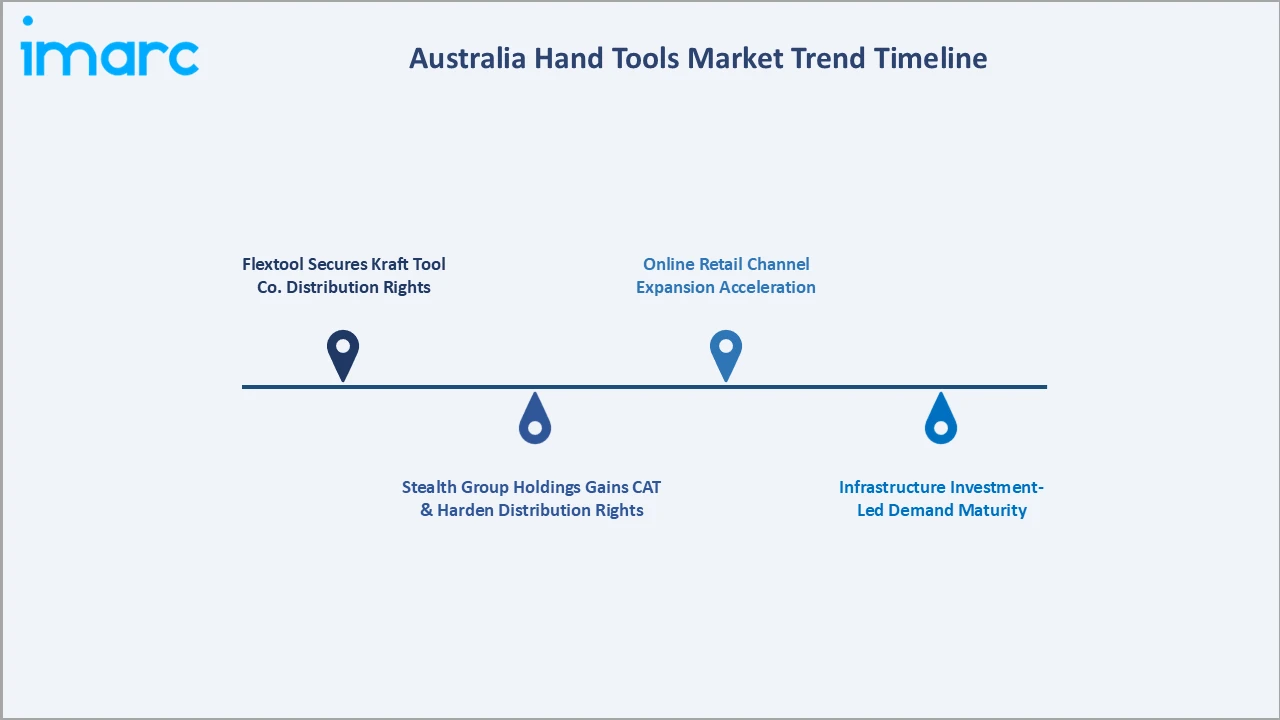
1. Flextool Secures Kraft Tool Co. Distribution Rights
Domestic distributors are increasingly securing exclusive rights to international tool brands, strengthening product portfolios and expanding market reach across trade and retail channels. In July 2024, Flextool secured exclusive Australian distribution rights for Kraft Tool Co., expanding its portfolio with professional construction hand tools and the W. Rose masonry tool brand. The partnership strengthens Flextool’s offering across concrete, masonry, rendering, plastering, and tiling applications in Australia.
2. Stealth Group Holdings Gains CAT & Harden Distribution Rights
Growing exclusive distribution agreements for established international brands are enabling Australian distributors to broaden their hand tools and power tools offerings. In February 2025, Stealth Group Holdings secured exclusive distribution rights for CAT® Power Tools, Wesco Power Tools, and Harden Hand Tools across Australia and New Zealand under three- to five-year agreements. The partnerships are expected to expand its high-margin product portfolio, strengthen omnichannel market reach, and support its FY2028 revenue target of AUD 300 million.
3. Online Retail Channel Expansion Acceleration
Rising investment in e-commerce platforms and digital retail infrastructure is driving faster adoption of online hand tools purchasing among commercial and DIY buyers. Australian-specific marketplaces and trade-focused digital platforms are expanding next-day delivery coverage across metropolitan and regional areas, enabling professional tradespeople and DIY consumers to access broad hand tool assortments without dependence on physical store proximity or traditional wholesale distribution channels.
4. Infrastructure Investment-Led Demand Maturity
Sustained government and private infrastructure investment is supporting steady, long-term demand maturity for professional-grade hand tools across construction and industrial applications. Australia's federal and state infrastructure pipeline is sustaining consistent procurement demand for professional-grade striking, cutting, and fastening hand tools among civil construction contractors and specialist trade operators throughout the forecast period.
Industry Value Chain Analysis
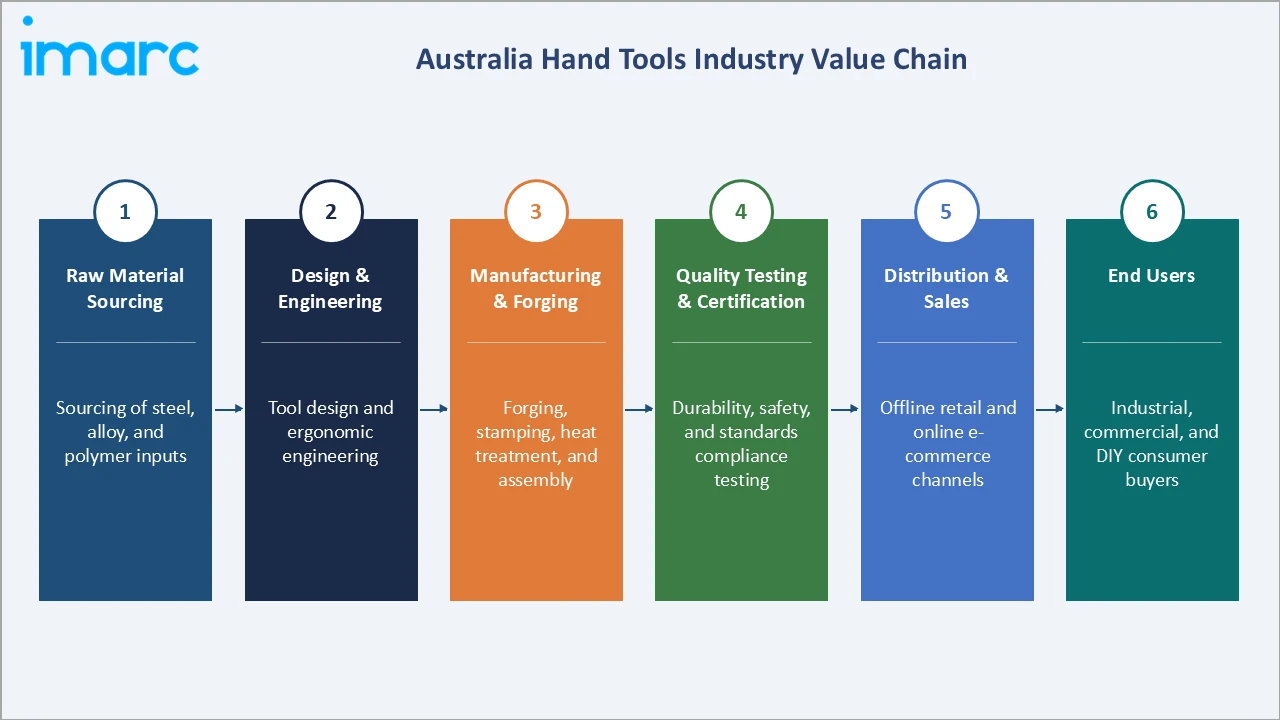
The Australia hand tools value chain spans raw material sourcing through end-user delivery, with each stage occupied by specialized raw material suppliers, manufacturing and forging specialists, and distribution partners whose performance directly influences product durability, quality, and cost efficiency.
|
Stage |
Key Activities |
|
Raw Material Sourcing |
Sourcing of steel, alloy, and polymer inputs |
|
Design & Engineering |
Tool design and ergonomic engineering |
|
Manufacturing & Forging |
Forging, stamping, heat treatment, and assembly |
|
Quality Testing & Certification |
Durability, safety, and standards compliance testing |
|
Distribution & Sales |
Offline retail and online e-commerce channels |
|
End Users |
Industrial, commercial, and DIY consumer buyers |
Technology Landscape in the Australia Hand Tools Industry
Ergonomic & Precision Tool Design
Manufacturers are advancing ergonomic handle design and precision engineering to improve user comfort, supporting broader adoption among professional and DIY users. Bi-material grip systems incorporating thermoplastic rubber overmoulding, anti-vibration handle inserts, and anatomically contoured shaft geometries are being developed to reduce operator fatigue and repetitive strain injury risk.
Exclusive Brand Distribution Partnerships
Growing investment in exclusive distribution agreements for international tool brands is expanding product portfolios and strengthening retail presence across Australia. Australian distributors are securing exclusive import and distribution rights for European and North American professional tool brands to differentiate product assortments from mass-market competitors.
Digital Retail & E-commerce Platform Development
Providers are engineering digital retail platforms and fulfillment infrastructure to extend reach across demanding trade and consumer purchasing channels. Australian hand tool retailers are investing in trade account portals with project-based bulk ordering, real-time inventory visibility, and integrated invoicing capabilities, enabling commercial contractors and facilities maintenance operators to manage tool procurement digitally within existing ERP and procurement management workflows.
Durable & Corrosion-Resistant Material Innovation
Expanding research into corrosion-resistant alloys and durable coatings is strengthening product performance, supporting premium positioning across professional trade use cases. Chrome vanadium steel formulations with phosphate and black oxide surface treatments, as well as stainless steel variants for marine and food processing environments, are being adopted by tool manufacturers targeting Australia's coastal construction, offshore resources, and food and beverage facility maintenance segments.
Market Segmentation Analysis
The report covers the following segments:
|
Segment Category |
Leading Segment |
Market Share |
Year |
|
Distribution Channel |
Offline |
78.5% |
2025 |
|
End User |
Industrial |
44.8% |
2025 |
|
Type |
🔒 |
🔒 |
2025 |
|
Region |
Australia Capital Territory & New South Wales |
34.6% |
2025 |

By Distribution Channel
Offline retail dominates with a 78.5% share in 2025. This segment encompasses hardware stores, trade counters, and specialty tool retailers, supported by continued preference for in-store product evaluation and trade purchasing.
To access detailed market analysis, Request Sample
Online distribution represents 21.5% (2025) of the market, reflecting growing e-commerce adoption and promotional toolkit bundling among consumers and trade buyers, a segment expected to expand steadily as digital retail infrastructure matures.
By End User
Industrial applications lead the end-user segment at 44.8% share (2025), supported by sustained demand from construction, manufacturing, and trade professionals.
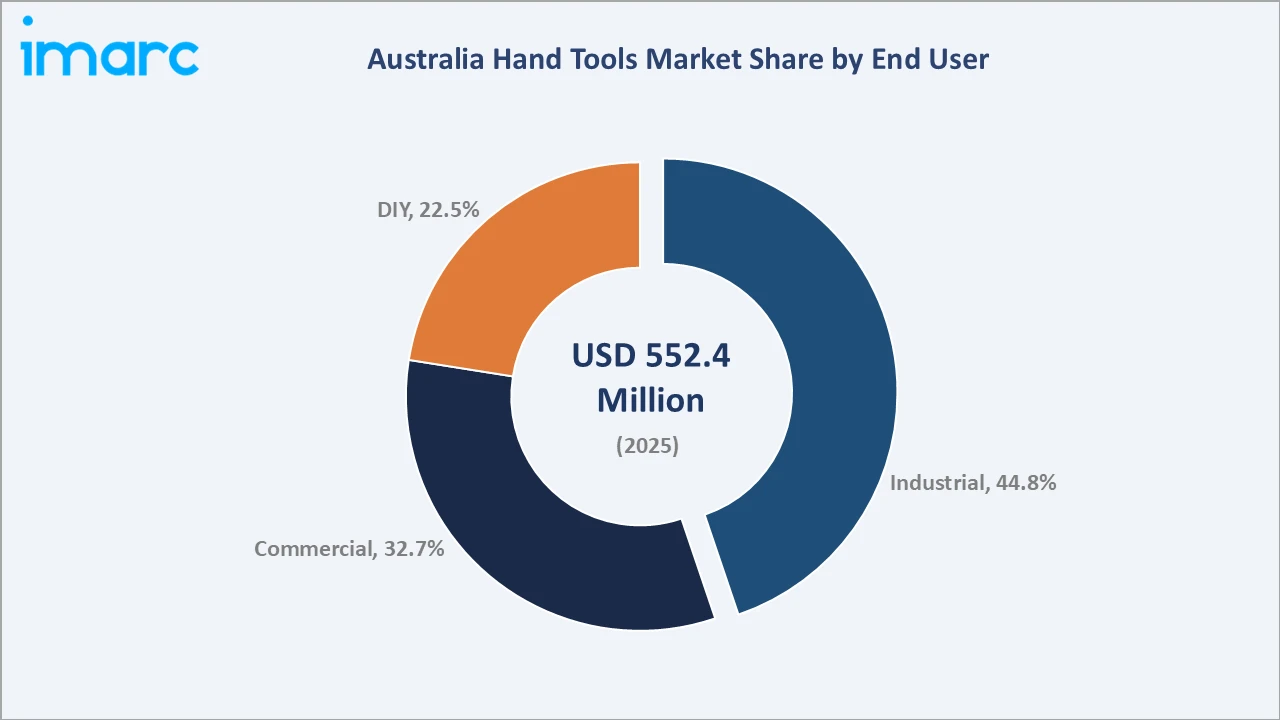
Commercial (32.7%) and DIY (22.5%) continue to serve varied consumer and business needs, with commercial demand expanding steadily as service and maintenance businesses increasingly invest in professional-grade tool inventories.
Regional Market Insights
Australian Capital Territory and New South Wales's market leadership (34.6%, 2025) reflects the region's concentrated construction activity and dense retail infrastructure across metropolitan and regional trade centers. Growing infrastructure investment and expanding retail networks combine to sustain its dominant position through 2034.
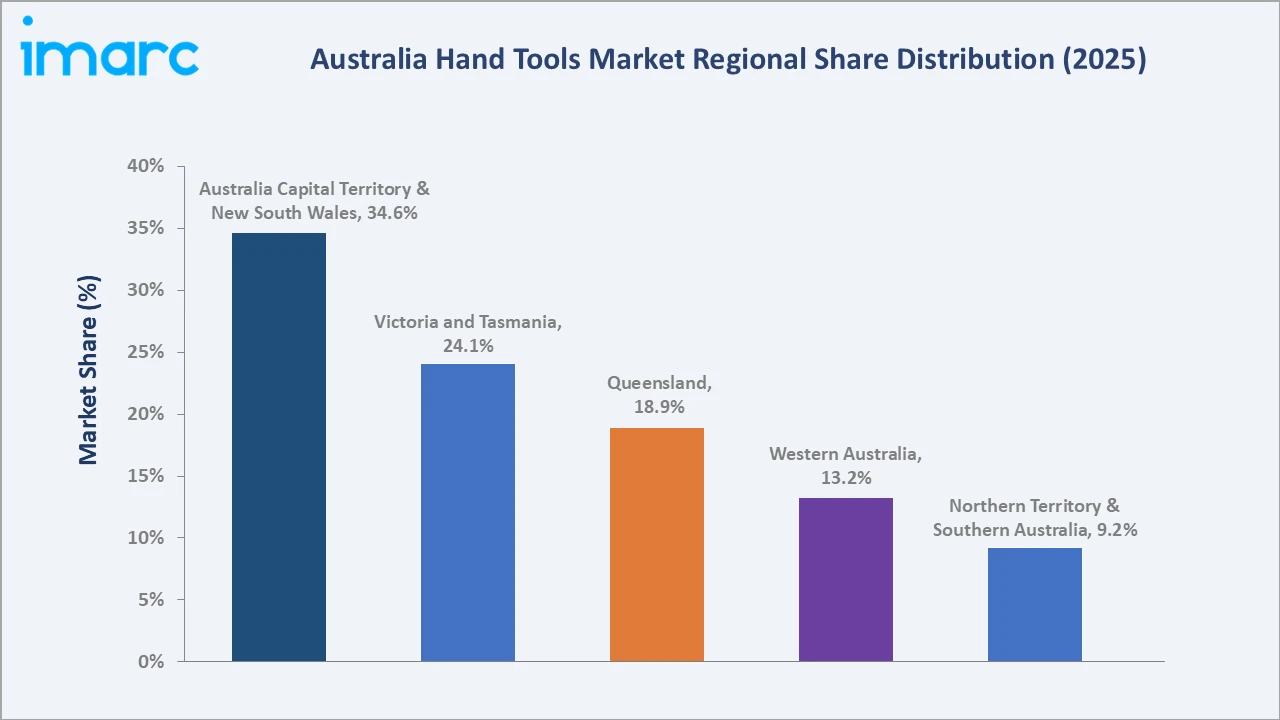
Victoria and Tasmania at 24.1% (2025) represent the second-largest hand tools market nationally. A strong manufacturing base and expanding trade retail presence are sustaining steady growth, positioning the region as a key contributor alongside the Australian Capital Territory and New South Wales through the forecast period.
|
Region |
Share (2025) |
Key Growth Drivers |
|
Australia Capital Territory & New South Wales |
34.6% |
Concentrated construction activity and dense retail infrastructure |
|
Victoria & Tasmania |
24.1% |
Strong manufacturing base and expanding trade and retail presence |
|
Queensland |
18.9% |
Rising infrastructure investment and expanding residential construction |
|
Western Australia |
13.2% |
Growing mining sector maintenance demand and industrial activity |
|
Northern Territory & South Australia |
9.2% |
Emerging infrastructure development and expanding regional retail |
Competitive Landscape
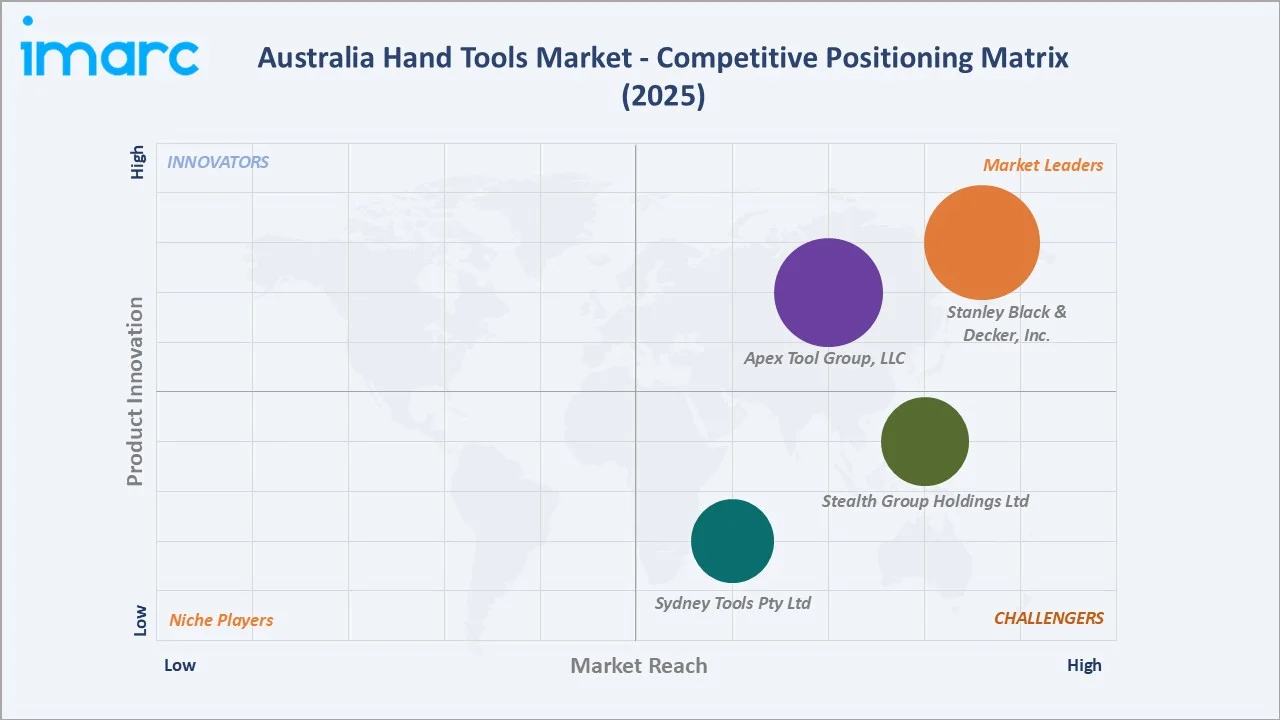
The Australia hand tools market exhibits moderate concentration, with leading manufacturers and distributors collectively holding a significant share of market revenue in 2025, reflecting sustained investment in product innovation and distribution reach.
|
Company Name |
Brand Name |
Market Position |
Core Strength |
|
Stanley Black & Decker, Inc. |
STANLEY, DEWALT, CRAFTSMAN, BLACK+DECKER, LENOX, IRWIN |
Market Leader |
Global brand recognition and extensive hand tools product portfolio |
|
Apex Tool Group, LLC |
Apex, Crescent, GEARWRENCH |
Market Leader |
Diversified professional tool manufacturing and distribution network |
|
Stealth Group Holdings Ltd |
Heatleys and C&L Tool Centre |
Strong Challenger |
Exclusive distribution rights for CAT, Wesco, and Harden brands |
|
Sydney Tools Pty Ltd |
Sydney Tools |
Challenger |
Extensive retail footprint and strong trade customer relationships |
Stanley Black & Decker, Inc. and Apex Tool Group, LLC dominate through comprehensive global product portfolios and extensive distribution capacity, supported by continuous R&D investment. Stealth Group Holdings Ltd and Sydney Tools Pty Ltd compete through exclusive distribution rights and retail footprint, respectively.
Key Company Profiles
Stanley Black & Decker, Inc.
Stanley Black & Decker, Inc. is one of the leading global tool manufacturers with an extensive hand tools portfolio spanning wrenches, pliers, screwdrivers, and hammers distributed across a vast Australian retail network.
- Product Portfolio: Hand tools, storage solutions, and professional-grade tool sets under STANLEY, DEWALT, CRAFTSMAN, BLACK+DECKER, LENOX, and IRWIN.
- Recent Developments: In April 2026, Stanley Black & Decker, Inc. reported Q1 2026 net sales of USD 3.8 billion, up 3% year over year, with a 30.1% gross margin. Tools & Outdoor segment generated USD 3.34 billion in Q1 2026 sales, up 2% year over year, although organic revenue declined 1% due to weaker North American retail volumes.
- Strategic Focus: Strengthening trade and retail distribution reach; expanding professional-grade product innovation across emerging categories.
Apex Tool Group, LLC
Apex Tool Group, LLC’s subsidiary Apex Tool Group Australia is a leading provider of professional hand tools with a diversified manufacturing and distribution portfolio serving industrial, commercial, and trade customers across the country.
- Product Portfolio: Wrenches, pliers, cable cutters, and specialty industrial hand tools under the Apex, Crescent, and GEARWRENCH brands.
- Strategic Focus: Scaling industrial tool manufacturing capabilities; deepening trade and commercial distribution partnerships.
Market Concentration Analysis
The Australia hand tools market exhibits moderate concentration, with Stanley Black & Decker, Inc. and Apex Tool Group, LLC collectively accounting for a significant share of total category revenue in 2025, reflecting sustained R&D investment, brand loyalty, and extensive distribution infrastructure nationwide.
Consolidation pressure remains limited as leading manufacturers and distributors maintain distinct strategic positioning: Stanley Black & Decker, Inc., and Apex Tool Group, LLC, through comprehensive multi-category portfolios; Stealth Group Holdings Ltd through integrated ecosystem and exclusive distribution positioning; and Sydney Tools Pty Ltd through retail footprint and domestic manufacturing differentiation, rather than pursuing direct M&A consolidation.
Investment & Growth Opportunities
Fastest Growing Segments
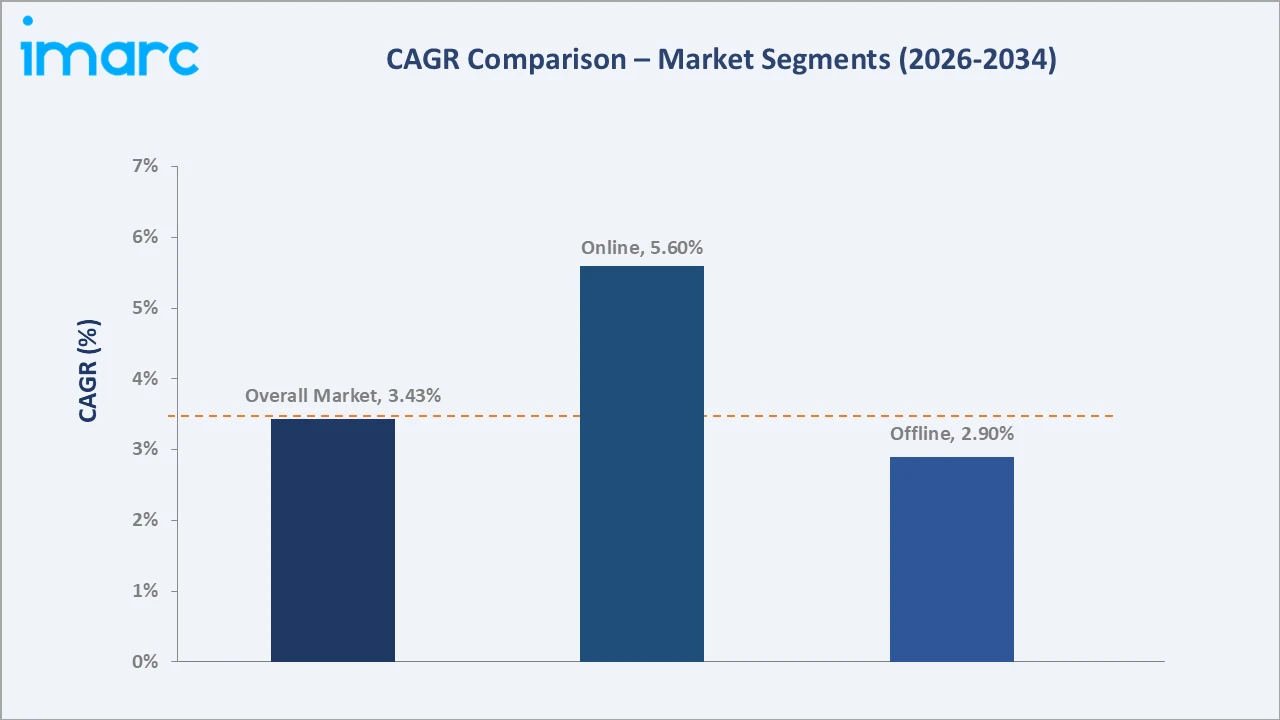
Online distribution (~5.6% CAGR) represents the highest-growth investment vector through 2034, driven by accelerating e-commerce adoption and continuous innovation across digital retail and fulfillment technologies. This subcategory addresses a rapidly expanding addressable market within the national hand tools ecosystem.
Emerging Market Expansion
Western Australia and the Northern Territory & South Australia collectively represent an incremental growth opportunity beyond the Australian Capital Territory, New South Wales, Victoria, and Tasmania by 2034, as rising infrastructure investment and expanding mining and industrial activity accelerate category penetration in these regional markets.
Venture and Institutional Investment Trends
- Distributor investment toward exclusive international brand partnerships is creating opportunities for domestic retailers serving the hand tools sector.
- Growing automotive maintenance and industrial demand is sustaining institutional interest in specialty tool manufacturing and distribution platforms.
- Omnichannel retail and e-commerce innovation, led by major distributors, is opening opportunities for technology and logistics vendors serving the national hand tools industry.
Future Market Outlook (2026-2034)
The Australia hand tools market is positioned for steady, infrastructure-driven expansion through 2034. From a base of USD 552.4 Million in 2025 and USD 576.6 Million in 2026, the market is projected to reach USD 755.1 Million by 2034, representing substantial incremental value creation at a CAGR of 3.43%. This growth is underpinned by rising construction and infrastructure investment, automotive sector expansion, and growing DIY home renovation activity.
The distribution channel segment will continue evolving through 2034, with online retail gaining further share as e-commerce adoption accelerates. This shift creates opportunities for manufacturers and distributors investing in digital retail infrastructure, exclusive brand partnerships, and omnichannel strategies to capture the next phase of the Australia hand tools market growth.
Research Methodology
Primary Research
Primary research comprised structured interviews with industry participants across 2024-2025, including tool manufacturer executives, retail and distribution channel managers, trade professionals, and construction industry analysts across Australia. Expert input validated market sizing, segmentation trends, and regional consumption patterns.
Secondary Research
Secondary research encompassed manufacturer annual reports, hand tools industry association publications, and retail trade press covering distribution trends, regulatory standards, and regional market dynamics across major states and territories.
Forecasting Models
Market size estimations were derived using top-down and bottom-up forecasting, incorporating distribution channel and end-user segment transitions and retailer capacity disclosures. A base-case CAGR of 3.43% reflects consensus estimates validated against announced infrastructure investment timelines and retailer strategic expansion plans.
Australia Hand Tools Market Report Coverage:
| Report Features | Details |
|---|---|
| Base Year of the Analysis | 2025 |
| Historical Period | 2020-2025 |
| Forecast Period | 2026-2034 |
| Units | Million USD |
| Scope of the Report |
Exploration of Historical Trends and Market Outlook, Industry Catalysts and Challenges, Segment-Wise Historical and Future Market Assessment:
|
| Types Covered | Wrench, Plier, Screw Drivers, Hammers, Cable Cutter, Others |
| Distribution Channels Covered | Offline, Online |
| End Users Covered | DIY, Commercial, Industrial |
| Regions Covered | Australia Capital Territory & New South Wales, Victoria & Tasmania, Queensland, Northern Territory & Southern Australia, Western Australia |
| Companies Covered | Stanley Black & Decker Inc., Apex Tool Group LLC, Stealth Group Holdings Ltd, Sydney Tools Pty Ltd., etc. |
| Customization Scope | 10% Free Customization |
| Post-Sale Analyst Support | 10-12 Weeks |
| Delivery Format | PDF and Excel through Email (We can also provide the editable version of the report in PPT/Word format on special request) |
Key Benefits for Stakeholders:
- IMARC’s industry report offers a comprehensive quantitative analysis of various market segments, historical and current market trends, market forecasts, and dynamics of the Australia hand tools market from 2020-2034.
- The research report provides the latest information on the market drivers, challenges, and opportunities in the Australia hand tools market.
- Porter's five forces analysis assist stakeholders in assessing the impact of new entrants, competitive rivalry, supplier power, buyer power, and the threat of substitution. It helps stakeholders to analyze the level of competition within the Australia hand tools industry and its attractiveness.
- Competitive landscape allows stakeholders to understand their competitive environment and provides an insight into the current positions of key players in the market.
Frequently Asked Questions About the Australia Hand Tools Market Report
The Australia hand tools market size is estimated at USD 576.6 Million in 2026.
The market is expected to grow at a CAGR of 3.43% during 2026-2034, reaching USD 755.1 Million by 2034, driven by rising construction and infrastructure investment and automotive sector expansion.
Australian Capital Territory and New South Wales lead with a 34.6% share in 2025, anchored by the region's concentrated construction activity and dense retail infrastructure.
Offline retail dominates with a 78.5% share in 2025, driven by continued preference for in-store product evaluation and trade counter purchasing.
Industrial applications lead with a 44.8% share in 2025, supported by sustained demand from construction, manufacturing, and trade professionals.
Some of the key players include Stanley Black & Decker, Inc., Apex Tool Group, LLC, Stealth Group Holdings Ltd, and Sydney Tools Pty Ltd.
Online distribution is growing fastest at an estimated 5.6% CAGR as e-commerce adoption accelerates among consumers and trade buyers.
Key challenges include competition from low-cost imported tool alternatives, price sensitivity among DIY and retail consumers, and raw material cost volatility for steel and alloys.
Exclusive distribution partnership expansion, omnichannel retail and e-commerce growth, and specialized automotive and industrial tool innovation represent leading investment opportunities.
Commercial, at 32.7% share, is expanding steadily as service and maintenance businesses increasingly invest in professional-grade tool inventories.
Need more help?
- Speak to our experienced analysts for insights on the current market scenarios.
- Include additional segments and countries to customize the report as per your requirement.
- Gain an unparalleled competitive advantage in your domain by understanding how to utilize the report and positively impacting your operations and revenue.
- For further assistance, please connect with our analysts.
 Request Customization
 Speak to an Analyst
 Request Brochure
 Inquire Before Buying
Benefits of Customization
- Personalize this research
- Triangulate with your data
- Get data as per your format and definition
- Gain a deeper dive into a specific application, geography, customer, or competitor
- Any level of personalization
Get in Touch With Us
UNITED STATES
Phone: +1-201-971-6302
INDIA
Phone: +91-120-433-0800
UNITED KINGDOM
Phone: +44-753-714-6104
Email: [email protected]
Client Testimonials




.webp)




.webp)













Related Reports

Choose your plan
*Please note that the prices mentioned below are starting prices for each bundle type. Kindly contact our team for further details.*
Single User License
- 1 User License, Access on 2 Devices
- PDF Report + Excel Dataset (Password Protected)
- Lifetime Access
- No Printing Rights
- 10% Free Report Customization
- 10–12 Weeks of Analyst Support
Five User License
- Access for 5 Users, 2 Devices per User
- PDF Report + Excel Dataset (Password Protected)
- Lifetime Access
- Dedicated Account Manager
- 12–14 Weeks of Analyst Support
- No Printing Rights
- 15% Free Report Customization
- 25% Discount on Your Next Purchase
Corporate User License
- Unlimited User Access (Within Your Organization)
- PDF Report + Excel Dataset
- Lifetime Access
- Dedicated Account Manager
- 14–20 Weeks of Analyst Support
- No Printing Rights
- 20% Free Report Customization
- 30% Discount on Your Next Purchase
Essential Insights
What's included:
3 reports
- Lifetime Access
- PDF Reports
- Excel Datasets
- 2 Weeks of Free Analyst Support
- 2 User Licenses
- Access on 2 Devices
- Printing Rights
- Complimentary PowerPoint (PPT) Version
- Complimentary License Upgrade
Professional Access
What's included:
5 reports
- Lifetime Access
- PDF Reports
- Excel Datasets
- 8 Weeks of Free Analyst Support
- 2 User Licenses
- Access on 2 Devices
- Printing Rights
- Complimentary PowerPoint (PPT) Version
- Complimentary License Upgrade
Business Advantage
What's included:
8 reports
- Lifetime Access
- PDF Reports
- Excel Datasets
- 14 Weeks of Free Analyst Support
- 2 User Licenses
- Access on 2 Devices
- Printing Rights
- Complimentary PowerPoint (PPT) Version
- Complimentary License Upgrade
Enterprise Intelligence
What's included:
10 reports
- Lifetime Access
- PDF Reports
- Excel Datasets
- 20 Weeks of Free Analyst Support
- 2 User Licenses
- Access on 2 Devices
- Printing Rights
- Complimentary PowerPoint (PPT) Version
- Complimentary License Upgrade