
Australia High Purity Alumina Market Size, Share, Trends and Forecast by Purity Level, Production Method, Application, and Region, 2026-2034
Australia High Purity Alumina Market Summary:
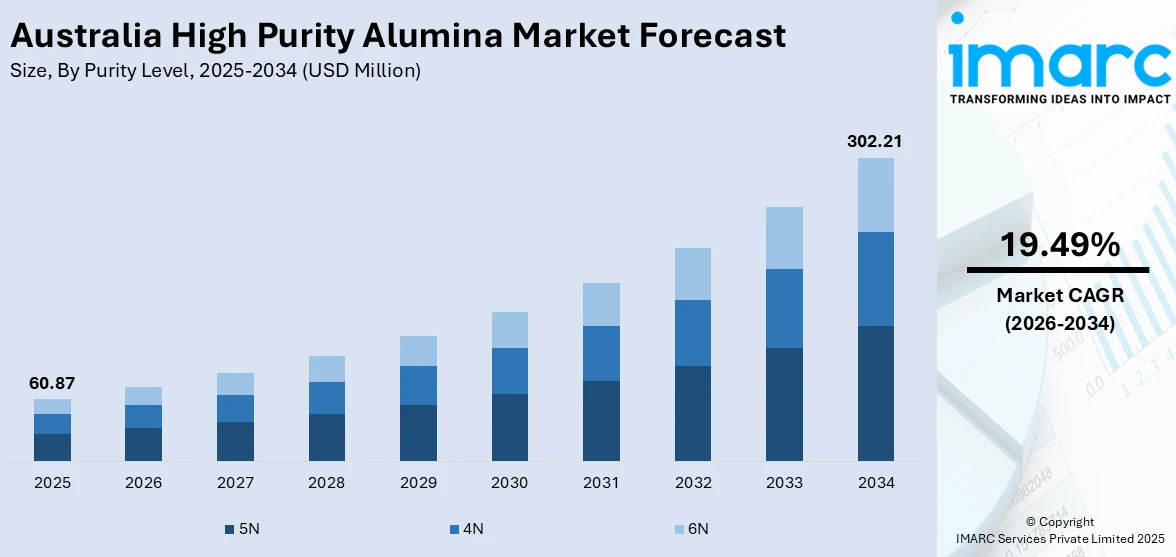
The Australia high purity alumina market size was valued at USD 60.87 Million in 2025 and is projected to reach USD 302.21 Million by 2034, growing at a compound annual growth rate of 19.49% from 2026-2034.
The Australia high purity alumina market is witnessing significant growth, driven by rising demand from electronics, LED lighting, and lithium-ion battery sectors, coupled with increasing adoption in aerospace and automotive applications, ongoing technological advancements in production processes, stringent quality requirements, and expanding industrial investments, while market dynamics are influenced by raw material availability, regulatory standards, and competition among domestic and international manufacturers.
Key Takeaways and Insights:
- By Purity Level: 5N dominates the market with a share of 46.3% in 2025, preferred for high-performance electronics, optical components, and battery applications requiring exceptional purity and consistency.
- By Production Method: Hydrolysis of aluminium alkoxide leads the market, and accounts for 51.7% of the share in 2025, providing superior purity, even particle distribution and stable process control.
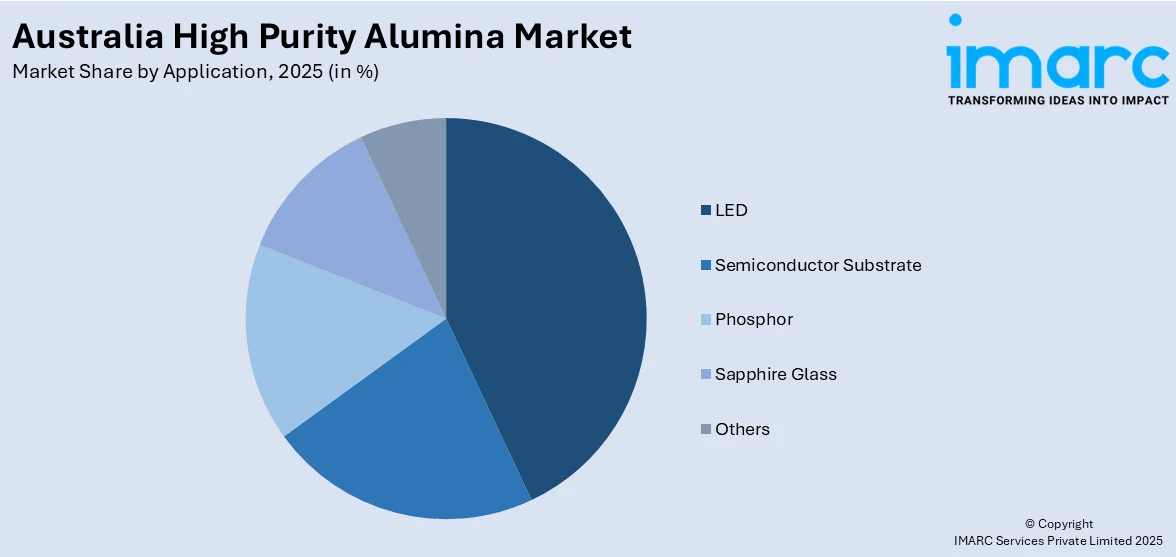
- By Application: LED accounted for the highest market share of 42.8% in 2025, driven by demand for high-brightness, energy-efficient, and durable lighting solutions.
- By Region: Australia Capital Territory & New South Wales held the largest market segment in 2025, capturing 35.1% share, supported by industrial hubs and advanced manufacturing facilities.
- Key Players: Leading manufacturers are prioritizing technological innovation, advanced high-purity production, and strategic collaborations, driving intensified competition while expanding their presence across key sectors, including electronics, battery, and optical applications, ultimately strengthening market position and fostering growth in emerging high-tech industries.
To get more information on this market Request Sample
The Australia high purity alumina market is experiencing steady growth, driven by expanding demand across electronics, LED lighting, lithium-ion batteries, and advanced ceramics applications. In line with this, the increasing adoption of high-performance energy storage systems and electric vehicles is driving demand for ultra-pure alumina with consistent particle size and superior chemical stability. Manufacturers are also investing in advanced production techniques, such as hydrolysis and calcination, to enhance product quality and yield. As such, in July 2024, Rio Tinto launched the Yarwun Hydrogen Calcination Pilot in Queensland, retrofitting a calciner to use hydrogen, cutting 3,000 tonnes of CO₂ annually, producing 6,000 tonnes of alumina, with support from Sumitomo, ARENA, and CQH2. Additionally, government support for industrial innovation, coupled with the presence of skilled labor and robust supply chains in key regions, strengthens market prospects. Moreover, emerging applications in aerospace, optical devices, and wear-resistant coatings are broadening the market scope. As environmental compliance and resource efficiency gain importance, companies are emphasizing sustainable sourcing and process optimization to maintain competitiveness and meet stringent quality standards.
Australia High Purity Alumina Market Trends:
Increased Adoption in Energy Storage and EV Batteries
Australia’s high purity alumina market is witnessing heightened demand from the energy storage and electric vehicle (EV) sectors, where superior purity levels are critical for lithium‑ion battery performance and longevity. As domestic and regional battery manufacturing initiatives grow, manufacturers are prioritizing high purity alumina to improve cathode stability and enhance charge efficiency. For instance, in January 2026, Alpha HPA secured USD 75 Million from the National Reconstruction Fund to expand its Gladstone high-purity alumina facility, producing 10,000 tonnes annually for AI semiconductors and lithium-ion batteries, creating 550 jobs, boosting supply chain resilience, and cutting emissions by 70 percent. This trend is supported by investments in local supply capabilities, strategic partnerships, and quality assurance measures that align with stringent battery industry requirements.
Technological Advancements in Production Processes
Producers in Australia are increasingly investing in advanced manufacturing technologies to improve yield, purity control, and process efficiency for high purity alumina. Similarly, ongoing innovations in hydrolysis, calcination, and precursor refinement are enabling more consistent particle size distribution and reduced impurities, meeting the rigorous standards of electronics and optical applications. The heightened emphasis on digital process monitoring, automation, and quality analytics is also helping companies enhance operational performance and differentiate their offerings in a competitive market landscape.
Expansion of Downstream Applications Beyond Traditional Sectors
The Australian high purity alumina market is experiencing diversification as downstream applications extend beyond electronics and LEDs into advanced ceramics, wear‑resistant coatings, and aerospace components. Industries requiring exceptional thermal stability and chemical inertness are adopting high purity alumina for structural and functional purposes. For example, in December 2024, Impact Minerals is developing the Lake Hope high-purity alumina project in Western Australia, using a simple “dig and deliver” model with low-cost, efficient processing, targeting 10,000 tpa HPA for LEDs, batteries, sapphire glass, and high-tech applications. This broadened application base is prompting suppliers to tailor product grades to specific industrial needs, supporting market expansion and encouraging cross‑sector collaborations between material developers and end‑users.
Market Outlook 2026-2034:
The Australia high purity alumina market is projected to expand as demand intensifies from advanced electronics, semiconductor fabrication, and next-generation energy storage systems, supported by domestic investment in high-technology manufacturing and export growth. As such, in January 2026, Lava Blue and Halocell Energy partner to create a domestic high-purity perovskite and alumina supply chain, leveraging Lava Blue’s alumina production from local feedstocks to reduce costs, accelerate next-generation solar deployment, and strengthen Australia’s renewable energy and manufacturing capabilities. In accordance with this, heightened focus on quality certification, process scalability, and supply chain resilience will drive competitive differentiation. Apart from this, strategic collaborations, research into environmentally sustainable production methods, and increased integration with regional industrial clusters are expected to enhance market stability and long-term growth prospects. The market generated a revenue of USD 60.87 Million in 2025 and is projected to reach a revenue of USD 302.21 Million by 2034, growing at a compound annual growth rate of 19.49% from 2026-2034.
Australia High Purity Alumina Market Report Segmentation:
|
Segment Category |
Leading Segment |
Market Share |
|
Purity Level |
5N |
46.3% |
|
Production Method |
Hydrolysis of Aluminium Alkoxide |
51.7% |
|
Application |
LED |
42.8% |
|
Region |
Australia Capital Territory & New South Wales |
35.1% |
Purity Level Insights:
- 4N
- 5N
- 6N
5N dominates with a market share of 46.3% of the total Australia high purity alumina market in 2025.
The 5N grade is extensively used in electronics, optical components, and advanced ceramics, where performance reliability and consistency are essential. Its ability to meet stringent technical specifications makes it the preferred choice for manufacturers targeting high-end industrial and technological applications.
The dominance of 5N purity alumina is further supported by increasing investments in advanced processing technologies and quality control systems. Manufacturers emphasize achieving uniform particle size, low impurity levels, and stable physical properties to meet evolving industry requirements. Moreover, growing adoption in emerging technologies, including energy storage and optoelectronics, continues to reinforce the strong market position of 5N high purity alumina in Australia.
Production Method Insights:
- Hydrolysis of Aluminium Alkoxide
- Hydrochloric Acid Leaching
- Others
Hydrolysis of Aluminium Alkoxide dominates with a market share of 51.7% of the total Australia high purity alumina market in 2025.
The method allows precise control over chemical composition, making it suitable for high-performance applications in electronics and lighting industries. Its efficiency and consistency deliver reliable output that meets demanding international quality standards.
The method’s dominance is strengthened by its scalability and adaptability to advanced manufacturing environments. Similarly, continuous improvements in process optimization and yield enhancement have reduced production inefficiencies while maintaining high purity levels. As demand for premium-grade alumina increases, hydrolysis-based production remains a preferred approach, supporting long-term market growth and technological advancement across key end-use sectors. For instance, in May 2025, Andromeda Metals produced ultra-high-purity 4N alumina in South Australia using a novel kaolin-based process that avoids traditional aluminium metal hydrolysis, cutting emissions by 68% and positioning the company to supply growing demand from LEDs, batteries, and semiconductor applications.
Application Insights:
Access the comprehensive market breakdown Request Sample
- LED
- Semiconductor Substrate
- Phosphor
- Sapphire Glass
- Others
LED leads with a share of 42.8% of the total Australia high purity alumina market in 2025.
High purity alumina is essential for LED substrates due to its excellent thermal conductivity, optical clarity, and durability. These properties enable improved performance, longer product lifespan, and reduced energy consumption in lighting systems.
The segment’s leadership is reinforced by government initiatives promoting energy efficiency and infrastructure modernization. Accordingly, Australia’s energy strategies launched in December 2025 aim to deliver reliable, affordable, and secure energy while cutting emissions 43% by 2030 and reaching net zero by 2050, through clean electricity, efficiency, hydrogen, transport reform, fuel security, offshore renewables, low-energy buildings, and national collaboration frameworks. The growing use of LEDs in residential, commercial, and industrial settings continues to drive demand for high-quality alumina substrates. Besides this, ongoing technological advancements in LED design further expand material requirements, sustaining the application’s dominant position in the Australian market.
Region Insights:
- Australia Capital Territory & New South Wales
- Victoria & Tasmania
- Queensland
- Northern Territory & Southern Australia
- Western Australia
Australia Capital Territory & New South Wales exhibits a clear dominance with a 35.1% share of the total Australia high purity alumina market in 2025.
The region benefits from proximity to research institutions, skilled labor, and established supply chains, fostering favorable conditions for high-purity alumina production and consumption across multiple high-technology sectors. For example, in January 2026, Capral Aluminium hosted the USD 20 Million “Made Right Here” campaign launch at its Smithfield, New South Wales, facility, highlighting NSW’s manufacturing strength, Australian-made aluminium, and high-purity alumina inputs that support advanced industries, jobs, resilient supply chains, and lower-carbon production.
Regional dominance is further driven by investments in electronics, energy storage, and advanced materials manufacturing. The presence of key end-use industries ensures consistent demand, while supportive regulatory frameworks encourage industrial development. As innovation and industrial activity continue to expand, Australia Capital Territory & New South Wales remain central to the growth trajectory of the high purity alumina market.
Market Dynamics:
Growth Drivers:
Why is the Australia High Purity Alumina Market Growing?
Strengthening Domestic Refining and Supply Security
The Australia high purity alumina market is witnessing increased emphasis on domestic refining capabilities to enhance supply security and reduce reliance on imported intermediates. Accordingly, in December 2025, Tomago Aluminium planned to invest AUD 1 Billion to keep its New South Wales smelter operating beyond 2028, backed by renewable energy plans that would support Australia’s alumina refineries, aluminium value chain, jobs, and global manufacturing competitiveness. Producers are prioritizing local resource utilization and vertically integrated operations to ensure stable feedstock availability. This trend is driven by heightened sensitivity to global supply disruptions and the strategic importance of high purity materials. Moreover, strengthening domestic refining supports cost control, improves lead times, and reinforces Australia’s position as a reliable supplier within regional high-technology value chains.
Rising Importance of Long-Term Offtake Agreements
Long-term offtake agreements are becoming increasingly prominent in the Australia high purity alumina market, particularly with electronics, LED, and advanced materials manufacturers. These contracts provide pricing stability, predictable demand, and investment security for producers, while ensuring consistent supply for end users. The trend reflects growing alignment between material suppliers and downstream industries, supporting capacity planning and risk mitigation. Such agreements are also encouraging capital investment in specialized production facilities and quality assurance systems.
Greater Emphasis on ESG Compliance and Reporting
Environmental, social, and governance considerations are gaining prominence in the Australia high purity alumina market, influencing production strategies and corporate positioning. Manufacturers are increasingly adopting transparent ESG reporting, focusing on emissions reduction, responsible resource extraction, and energy-efficient operations. Compliance with sustainability benchmarks is becoming critical for securing contracts with global technology companies. This trend is reshaping competitive dynamics, as strong ESG performance enhances credibility, supports regulatory compliance, and improves access to international markets and long-term partnerships.
Market Restraints:
What Challenges the Australia High Purity Alumina Market is Facing?
High Capital and Operating Cost Requirements
The Australia high purity alumina market faces challenges associated with substantial capital investment and operating costs. Establishing advanced refining facilities requires significant expenditure on specialized equipment, energy-intensive processes, and skilled technical labor. Ongoing costs related to purification, quality control, and maintenance further strain profitability. These financial barriers can limit new market entrants and slow capacity expansion, particularly for smaller players, thereby constraining overall market growth and reducing competitive diversity within the industry.
Technical Complexity and Process Sensitivity
Producing high purity alumina involves technically complex processes that are highly sensitive to impurities, process conditions, and raw material quality. Minor deviations can significantly impact product specifications, leading to yield losses or quality rejections. Maintaining consistent purity levels requires advanced monitoring systems, rigorous testing, and continuous process optimization. This complexity increases operational risk and limits production flexibility, posing challenges for manufacturers attempting to scale operations while maintaining compliance with stringent end-user requirements.
Exposure to Global Demand Cycles
The Australia high purity alumina market is closely linked to global demand cycles in electronics, LED manufacturing, and energy storage industries. Fluctuations in these downstream sectors can lead to demand volatility, affecting production planning and revenue stability. Economic slowdowns, shifts in technology adoption, or changes in trade policies may reduce consumption levels. This exposure creates uncertainty for producers, complicating long-term investment decisions and increasing reliance on diversified application portfolios to mitigate market risks.
Competitive Landscape:
The competitive landscape of the Australia high purity alumina market is defined by a combination of established domestic producers and international participants competing on purity levels, process efficiency, and supply reliability. Companies focus on advanced refining technologies, capacity optimization, and stringent quality assurance to meet demanding specifications from electronics, LED, and energy storage industries. Competitive positioning is further shaped by long-term supply agreements, vertical integration strategies, and investments in sustainable production practices. Barriers to entry remain high due to capital intensity and technical complexity, encouraging consolidation and strategic collaborations to strengthen market presence, improve cost structures, and support long-term growth in high-value applications.
Recent Developments:
- In January 2026, Gladstone, Queensland, leveraged its heavy industrial infrastructure to produce high-purity alumina for AI chip cooling, combining cost-efficient energy, skilled labor, and logistics. This regional hub supports global AI growth, reduces reliance on Asian suppliers, and fosters economic development, advanced manufacturing, and renewable energy integration while addressing thermal management challenges.
- In September 2025, Alpha HPA’s Smart SX Technology revolutionized high purity alumina (HPA) production, offering scalable, low-carbon, and resource-efficient processes. From EV batteries to semiconductors and synthetic sapphire, Stage Two Gladstone facility will make Australia a global leader in sustainable, ultra-high purity aluminium materials, meeting growing industrial demand.
Australia High Purity Alumina Market Report Coverage:
|
Report Features |
Details |
|
Base Year of the Analysis |
2025 |
|
Historical Period |
2020-2025 |
|
Forecast Period |
2026-2034 |
|
Units |
Million USD |
|
Scope of the Report |
Exploration of Historical Trends and Market Outlook, Industry Catalysts and Challenges, Segment-Wise Historical and Future Market Assessment:
|
|
Purity Levels Covered |
4N, 5N, 6N |
|
Production Methods Covered |
Hydrolysis of Aluminium Alkoxide, Hydrochloric Acid Leaching, Others |
|
Applications Covered |
LED, Semiconductor Substrate, Phosphor, Sapphire Glass, Others |
|
Regions Covered |
Australia Capital Territory & New South Wales, Victoria & Tasmania, Queensland, Northern Territory & Southern Australia, Western Australia |
|
Customization Scope |
10% Free Customization |
|
Post-Sale Analyst Support |
10-12 Weeks |
|
Delivery Format |
PDF and Excel through Email (We can also provide the editable version of the report in PPT/Word format on special request) |
Frequently Asked Questions About the Australia High Purity Alumina Market Report
The Australia high purity alumina market size was valued at USD 60.87 Million in 2025.
The Australia high purity alumina market is expected to grow at a compound annual growth rate of 19.49% from 2026-2034 to reach USD 302.21 Million by 2034.
5N dominated the market with 46.3% share in 2025, reflecting its strong demand in electronics, LED lighting, and lithium-ion battery applications. Its balance of cost-effectiveness and high performance made it the preferred choice across multiple industrial sectors.
Key factors driving the Australia high purity alumina market include rising demand for lithium-ion batteries, semiconductors, and LED lighting, coupled with government support for domestic HPA production, technological advancements in purification processes, and increased investment in regional manufacturing facilities.
Major challenges in the Australia high purity alumina market include high production costs, complex purification requirements, reliance on imported raw materials, fluctuating global demand, and competition from low-cost international producers.
Need more help?
- Speak to our experienced analysts for insights on the current market scenarios.
- Include additional segments and countries to customize the report as per your requirement.
- Gain an unparalleled competitive advantage in your domain by understanding how to utilize the report and positively impacting your operations and revenue.
- For further assistance, please connect with our analysts.
 Request Customization
 Speak to an Analyst
 Request Brochure
 Inquire Before Buying
Benefits of Customization
- Personalize this research
- Triangulate with your data
- Get data as per your format and definition
- Gain a deeper dive into a specific application, geography, customer, or competitor
- Any level of personalization
Get in Touch With Us
UNITED STATES
Phone: +1-201-971-6302
INDIA
Phone: +91-120-433-0800
UNITED KINGDOM
Phone: +44-753-714-6104
Email: [email protected]
Client Testimonials




.webp)




.webp)













Related Reports

Choose your plan
*Please note that the prices mentioned below are starting prices for each bundle type. Kindly contact our team for further details.*
Single User License
- 1 User License, Access on 2 Devices
- PDF Report + Excel Dataset (Password Protected)
- Lifetime Access
- No Printing Rights
- 10% Free Report Customization
- 10–12 Weeks of Analyst Support
Five User License
- Access for 5 Users, 2 Devices per User
- PDF Report + Excel Dataset (Password Protected)
- Lifetime Access
- Dedicated Account Manager
- 12–14 Weeks of Analyst Support
- No Printing Rights
- 15% Free Report Customization
- 25% Discount on Your Next Purchase
Corporate User License
- Unlimited User Access (Within Your Organization)
- PDF Report + Excel Dataset
- Lifetime Access
- Dedicated Account Manager
- 14–20 Weeks of Analyst Support
- No Printing Rights
- 20% Free Report Customization
- 30% Discount on Your Next Purchase
Essential Insights
What's included:
3 reports
- Lifetime Access
- PDF Reports
- Excel Datasets
- 2 Weeks of Free Analyst Support
- 2 User Licenses
- Access on 2 Devices
- Printing Rights
- Complimentary PowerPoint (PPT) Version
- Complimentary License Upgrade
Professional Access
What's included:
5 reports
- Lifetime Access
- PDF Reports
- Excel Datasets
- 8 Weeks of Free Analyst Support
- 2 User Licenses
- Access on 2 Devices
- Printing Rights
- Complimentary PowerPoint (PPT) Version
- Complimentary License Upgrade
Business Advantage
What's included:
8 reports
- Lifetime Access
- PDF Reports
- Excel Datasets
- 14 Weeks of Free Analyst Support
- 2 User Licenses
- Access on 2 Devices
- Printing Rights
- Complimentary PowerPoint (PPT) Version
- Complimentary License Upgrade
Enterprise Intelligence
What's included:
10 reports
- Lifetime Access
- PDF Reports
- Excel Datasets
- 20 Weeks of Free Analyst Support
- 2 User Licenses
- Access on 2 Devices
- Printing Rights
- Complimentary PowerPoint (PPT) Version
- Complimentary License Upgrade