
Australia Horticulture Market Report by Cultivation Type (Food Plant, Ornament Plant), Propagation (Vegetative, Seed, Breeding, Layering and Cutting, Grafting, and Others), Application (Greenhouse, Vertical Farms, Indoor Farms), and Region 2026-2034
Australia Horticulture Market Overview:
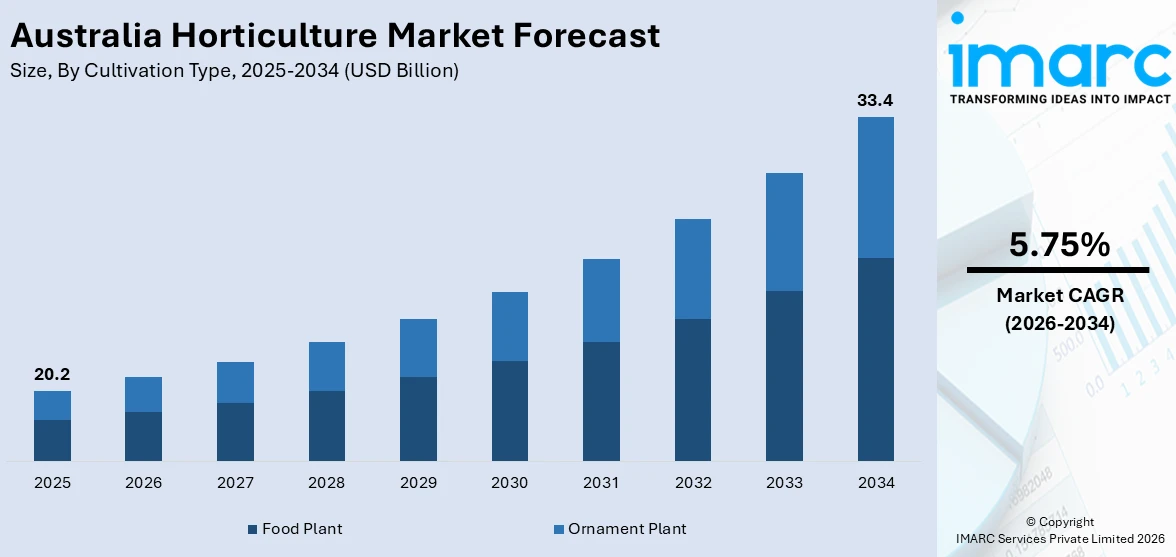
The Australia horticulture market size reached USD 20.2 Billion in 2025. Looking forward, the market is projected to reach USD 33.4 Billion by 2034, exhibiting a growth rate (CAGR) of 5.75% during 2026-2034. The market is primarily driven by rising domestic and export demand, continual technological advancements in farming practices, robust government support and agricultural policies including subsidies, R&D grants, export promotion, and biosecurity measures, and considerable rise in urban agriculture.
|
Report Attribute
|
Key Statistics
|
|---|---|
|
Base Year
|
2025
|
|
Forecast Years
|
2026-2034
|
|
Historical Years
|
2020-2025
|
| Market Size in 2025 | USD 20.2 Billion |
| Market Forecast in 2034 | USD 33.4 Billion |
| Market Growth Rate 2026-2034 | 5.75% |
Key Trends of Australia Horticulture Market:
Rising Domestic and Export Demand
The horticulture sector in Australia is seeing a notable rise in growth as a result of the growing need for fresh produce both within the country and for exportation. With consumers becoming increasingly aware about their health, there is a noticeable trend toward eating fresh fruits and vegetables, leading to an increase in demand within the country. Moreover, the high quality and safety reputation of Australian horticultural products make them in high demand in international markets. The nation's geographical position and beneficial trade deals with important global allies like China and Japan improve its chances for exporting even more. Australian producers are taking advantage of these markets by adhering to strict quality standards and utilizing advanced production techniques to make sure their products are competitive on a global scale. The increasing focus on high-quality fruits and vegetables in global markets is driving local farmers to implement creative agricultural methods to fulfill these requirements.
To get more information on this market Request Sample
Technological Advancements in Farming Practices
Technological advancements in farming practices are significantly driving growth in the Australian horticulture market. Innovations such as precision agriculture, automated irrigation systems, and advanced greenhouse technologies are revolutionizing how horticultural products are grown and managed. Precision agriculture uses data analytics and GPS technology to optimize planting, fertilization, and harvesting processes, leading to increased yields and reduced resource wastage. Automated irrigation systems ensure efficient water use, which is particularly crucial in Australia’s variable climate. Furthermore, the development of climate-controlled greenhouses allows for year-round production, regardless of external weather conditions. These technologies enhance productivity and improve the quality of horticultural products, making them more competitive in both domestic and international markets.
Government Support and Agricultural Policy
The growth of the Australian horticulture market is greatly influenced by government support and agricultural policy. Both federal and state governments have put in place different initiatives and rewards to help the horticultural industry, such as subsidies for building infrastructure, grants for research and development, and financial support for sustainable farming techniques. Measures aimed at improving exports, like trade deals and support with marketing, are also strengthening the expansion of the market. In addition, efforts to improve biosecurity measures safeguard Australian horticultural products from pests and diseases, maintaining their competitiveness in global markets. It is essential for the government to prioritize enhancing the sector's ability to recover and be sustainable by implementing policy frameworks and providing financial assistance to encourage innovation and uphold market stability. These measures provide support for investments in horticulture and enhance the industry's health and competitiveness.
Growth Drivers of Australia Horticulture Market:
Favorable Climate and Soil Conditions
Australia boasts a diverse range of climate zones, from temperate to tropical, along with fertile soils that create optimal conditions for horticultural farming. This natural advantage enables farmers to cultivate a wide array of fruits, vegetables, and flowers year-round, catering to both seasonal and off-season demands. Regions with ideal sunlight, rainfall, and soil quality lead to higher yields and improved produce quality, which is crucial for satisfying consumer preferences. The favorable environmental conditions lessen the need for artificial interventions and lower production expenses, thereby enhancing profitability. Collectively, these factors bolster the competitiveness of horticultural enterprises in both domestic and international markets, ultimately driving Australia horticulture market demand as growers consistently supply high-quality and diverse produce.
Health and Nutrition Awareness
Increased consumer awareness about the advantages of fresh, organic, and nutrient-dense produce is a major factor propelling the Australian horticulture market. Evolving lifestyles and heightened health consciousness are motivating people to incorporate more fruits, vegetables, and functional crops into their diets. This movement is further amplified by marketing initiatives, nutritional education, and the growing availability of certified organic options. Horticultural businesses and farmers are adapting by embracing sustainable practices, minimizing pesticide use, and prioritizing quality standards to meet the needs of health-oriented consumers. As individuals increasingly focus on nutrition and wellness, the demand for high-quality produce escalates, enhancing the prominence and competitiveness of horticultural offerings. These shifts are directly impacting the Australia horticulture market share in both domestic and export sectors.
Investment in Supply Chain Infrastructure
A focus on efficient supply chain infrastructure is crucial for the growth of Australia’s horticulture market. Investments in state-of-the-art cold storage facilities, refrigerated transportation, and advanced logistics frameworks help ensure the freshness and quality of perishable products as they move from farms to consumers. Enhanced distribution networks minimize post-harvest losses and widen market access for growers, including those located in remote areas. Technology-driven tracking systems facilitate prompt delivery and effective inventory management, supporting both domestic retail and export operations. Robust supply chain capabilities enable growers to meet international quality benchmarks, thereby increasing competitiveness. Such investments streamline operations and broaden market prospects, driving continued Australia horticulture market growth throughout the industry.
Opportunities of Australia Horticulture Market:
Development of Organic and Specialty Produce
The rising interest in organic, exotic, and functional crops is presenting considerable opportunities in the Australian horticulture sector. More consumers are looking for produce that is free from chemicals, rich in nutrients, and offers unique tastes or appearances. This demand is prompting growers to diversify their crop selections. Specialty fruits, vegetables, and herbs appeal to health-focused consumers and provide farmers with opportunities for premium pricing. This trend encourages investments in sustainable farming methods, organic certifications, and tailored marketing strategies to attract niche markets. By prioritizing high-value specialty produce, horticultural enterprises can stand out in a competitive landscape. This emphasis on quality and uniqueness is anticipated to boost profitability and long-term market stability.
Value-Added Products
Transforming fresh horticultural produce into items like juices, sauces, dried fruits, and packaged snacks is becoming a profitable avenue. According to Australia horticulture market analysis, adding value helps farmers and agribusinesses extend the shelf life of perishable goods, decrease waste, and access wider consumer markets. Packaged and processed products cater to urban consumers looking for convenience while also meeting export quality requirements. By investing in processing facilities and branding strategies, growers can secure higher profit margins compared to sales of raw produce. This strategy also encourages innovation in flavors, packaging, and functional product development, enhancing market competitiveness and providing horticultural businesses with more consistent revenue streams in both domestic and international markets.
Rural Development and Farm Modernization
Upgrading farms and enhancing infrastructure in rural areas represents a significant growth opportunity for the Australian horticulture industry. Investments in irrigation systems, machinery, storage facilities, and transportation networks significantly improve production efficiency and minimize post-harvest losses. Modernizing rural farms also allows for the adoption of advanced technologies, including precision agriculture, climate monitoring, and automated harvesting tools. These advancements boost crop yields and quality and facilitate access to both domestic and international markets by meeting elevated quality standards. Strengthening farm infrastructure in rural regions bolsters local economies, creates job opportunities, and promotes sustainable growth. Collectively, these improvements play a significant role in expanding the reach and profitability of the horticulture sector, reinforcing market growth.
Australia Horticulture Market Segmentation:
IMARC Group provides an analysis of the key trends in each segment of the market, along with forecasts at the country level for 2026-2034. Our report has categorized the market based on cultivation type, propagation, and application.
Cultivation Type Insights:
- Food Plant
- Fruit
- Nut Crop
- Vegetable
- Others
- Ornament Plant
- Flowers
- Turf
- Others
The report has provided a detailed breakup and analysis of the market based on the cultivation type. This includes food plant (fruit, nut crop, vegetable, others), ornament plant (flowers, turf, others).
Propagation Insights:
- Vegetative
- Seed
- Breeding
- Layering and Cutting
- Grafting
- Others
A detailed breakup and analysis of the market based on the propagation have also been provided in the report. This includes vegetative, seed, breeding, layering and cutting, grafting and others.
Application Insights:
Access the comprehensive market breakdown Request Sample
- Greenhouse
- Vertical Farms
- Indoor Farms
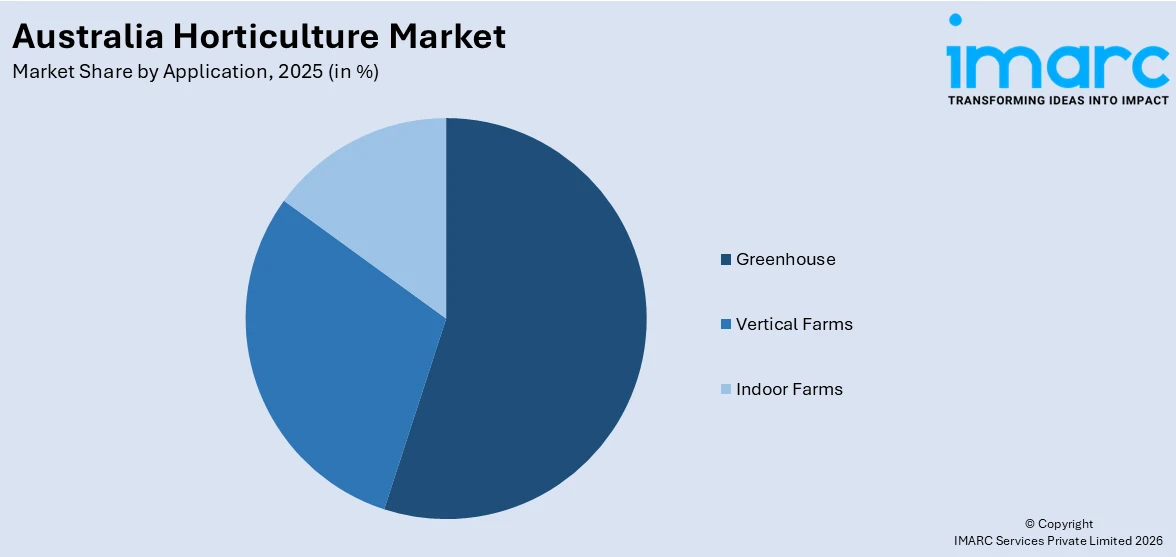
The report has provided a detailed breakup and analysis of the market based on the application. This includes greenhouse, vertical farms, and indoor farms.
Regional Insights:
- Australia Capital Territory & New South Wales
- Victoria & Tasmania
- Queensland
- Northern Territory & Southern Australia
- Western Australia
The report has also provided a comprehensive analysis of all the major regional markets, which include Australia Capital Territory & New South Wales, Victoria & Tasmania, Queensland, Northern Territory & Southern Australia, and Western Australia.
Competitive Landscape:
The market research report has also provided a comprehensive analysis of the competitive landscape. Competitive analysis such as market structure, key player positioning, top winning strategies, competitive dashboard, and company evaluation quadrant has been covered in the report. Also, detailed profiles of all major companies have been provided.
Australia Horticulture Market News:
- In September 2025, the ARC and Western Sydney University launched the Training Centre for Smart and Sustainable Horticulture. This initiative aims to bolster Australia’s protected cropping industry through innovative training, focusing on sustainable practices, crop health, and technology integration to enhance food security and industry resilience.
- In July 2025, a Japanese delegation from the Ministry of Agriculture visited Australia to explore counter-seasonal horticulture export opportunities. The tour, facilitated by Hort Innovation and DAFF, aimed to strengthen trade relationships, showcasing Australia's quality produce. This visit follows recent agreements to enhance collaboration between the two countries.
- In November 2024, Australian farmers launched a groundbreaking USD 60 Million venture capital fund, the world's first dedicated to horticulture. Partnering with Artesian, Hort Innovation aims to invest in tech startups that enhance the sustainability and productivity of fruit, vegetable, and nut growers, with initial investments expected in 2025.
- In June 2024, Hort Innovation, a major Australian horticulture R&D corporation, announced a USD 500 Million goal for its "Frontiers R&D" initiative, aiming to advance research and development in Australia's $16.3 billion horticulture industry. The initiative focuses on enhancing productivity, sustainability, and global competitiveness.
Australia Horticulture Market Report Coverage:
| Report Features | Details |
|---|---|
| Base Year of the Analysis | 2025 |
| Historical Period | 2020-2025 |
| Forecast Period | 2026-2034 |
| Units | Billion USD |
| Scope of the Report | Exploration of Historical Trends and Market Outlook, Industry Catalysts and Challenges, Segment-Wise Historical and Future Market Assessment:
|
| Cultivation Types Covered |
|
| Propagations Covered | Vegetative, Seed, Breeding, Layering and Cutting, Grafting, Others |
| Applications Covered | Greenhouse, Vertical Farms, Indoor Farms |
| Regions Covered | Australia Capital Territory & New South Wales, Victoria & Tasmania, Queensland, Northern Territory & Southern Australia, Western Australia |
| Customization Scope | 10% Free Customization |
| Post-Sale Analyst Support | 10-12 Weeks |
| Delivery Format | PDF and Excel through Email (We can also provide the editable version of the report in PPT/Word format on special request) |
Key Benefits for Stakeholders:
- IMARC’s industry report offers a comprehensive quantitative analysis of various market segments, historical and current market trends, market forecasts, and dynamics of the Australia horticulture market from 2020-2034.
- The research report provides the latest information on the market drivers, challenges, and opportunities in the Australia horticulture market.
- Porter's five forces analysis assist stakeholders in assessing the impact of new entrants, competitive rivalry, supplier power, buyer power, and the threat of substitution. It helps stakeholders to analyze the level of competition within the Australia horticulture industry and its attractiveness.
- Competitive landscape allows stakeholders to understand their competitive environment and provides an insight into the current positions of key players in the market.
Frequently Asked Questions About the Australia Horticulture Market Report
The horticulture market in Australia was valued at USD 20.2 Billion in 2025.
The Australia horticulture market is projected to exhibit a compound annual growth rate (CAGR) of 5.75% during 2026-2034.
The Australia horticulture market is expected to reach a value of USD 33.4 Billion by 2034.
The Australia horticulture market is seeing trends such as increased adoption of precision farming and smart irrigation systems, growth in organic and sustainable produce, and rising use of greenhouse and vertical farming technologies. Export-oriented production and advanced supply chain solutions are also shaping market developments.
Key growth drivers include favorable climatic conditions, government support for modern farming practices, and rising domestic and international demand for fresh fruits and vegetables. Technological advancements in crop management, increasing focus on value-added horticultural products, and expanding e-commerce channels for fresh produce are further boosting market growth.
Need more help?
- Speak to our experienced analysts for insights on the current market scenarios.
- Include additional segments and countries to customize the report as per your requirement.
- Gain an unparalleled competitive advantage in your domain by understanding how to utilize the report and positively impacting your operations and revenue.
- For further assistance, please connect with our analysts.
 Request Customization
 Speak to an Analyst
 Request Brochure
 Inquire Before Buying
Benefits of Customization
- Personalize this research
- Triangulate with your data
- Get data as per your format and definition
- Gain a deeper dive into a specific application, geography, customer, or competitor
- Any level of personalization
Get in Touch With Us
UNITED STATES
Phone: +1-201-971-6302
INDIA
Phone: +91-120-433-0800
UNITED KINGDOM
Phone: +44-753-714-6104
Email: [email protected]
Client Testimonials




.webp)




.webp)













Related Reports

Choose your plan
*Please note that the prices mentioned below are starting prices for each bundle type. Kindly contact our team for further details.*
Single User License
- 1 User License, Access on 2 Devices
- PDF Report + Excel Dataset (Password Protected)
- Lifetime Access
- No Printing Rights
- 10% Free Report Customization
- 10–12 Weeks of Analyst Support
Five User License
- Access for 5 Users, 2 Devices per User
- PDF Report + Excel Dataset (Password Protected)
- Lifetime Access
- Dedicated Account Manager
- 12–14 Weeks of Analyst Support
- No Printing Rights
- 15% Free Report Customization
- 25% Discount on Your Next Purchase
Corporate User License
- Unlimited User Access (Within Your Organization)
- PDF Report + Excel Dataset
- Lifetime Access
- Dedicated Account Manager
- 14–20 Weeks of Analyst Support
- No Printing Rights
- 20% Free Report Customization
- 30% Discount on Your Next Purchase
Essential Insights
What's included:
3 reports
- Lifetime Access
- PDF Reports
- Excel Datasets
- 2 Weeks of Free Analyst Support
- 2 User Licenses
- Access on 2 Devices
- Printing Rights
- Complimentary PowerPoint (PPT) Version
- Complimentary License Upgrade
Professional Access
What's included:
5 reports
- Lifetime Access
- PDF Reports
- Excel Datasets
- 8 Weeks of Free Analyst Support
- 2 User Licenses
- Access on 2 Devices
- Printing Rights
- Complimentary PowerPoint (PPT) Version
- Complimentary License Upgrade
Business Advantage
What's included:
8 reports
- Lifetime Access
- PDF Reports
- Excel Datasets
- 14 Weeks of Free Analyst Support
- 2 User Licenses
- Access on 2 Devices
- Printing Rights
- Complimentary PowerPoint (PPT) Version
- Complimentary License Upgrade
Enterprise Intelligence
What's included:
10 reports
- Lifetime Access
- PDF Reports
- Excel Datasets
- 20 Weeks of Free Analyst Support
- 2 User Licenses
- Access on 2 Devices
- Printing Rights
- Complimentary PowerPoint (PPT) Version
- Complimentary License Upgrade