
Australia Hospitality Market Size, Share, Trends and Forecast by Type, Segment, and Region 2026-2034
Australia Hospitality Market Summary:
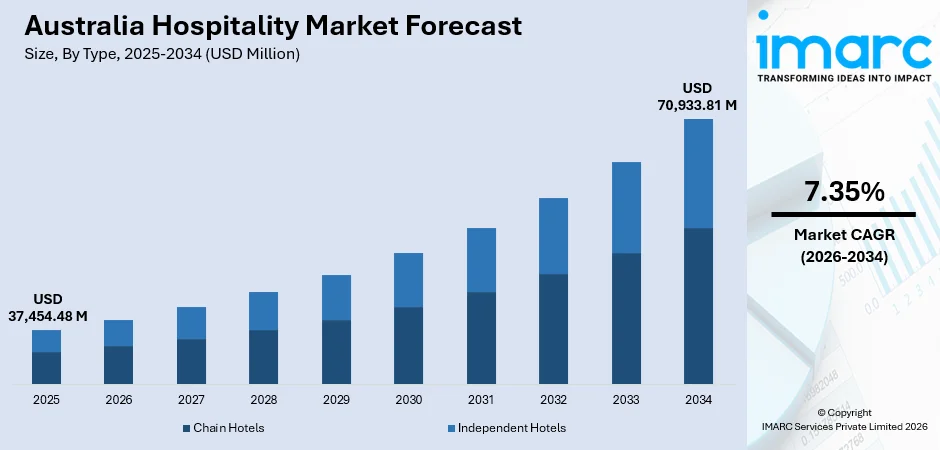
The Australia hospitality market size was valued at USD 37454.48 Million in 2025 and is projected to reach USD 70933.81 Million by 2034, growing at a compound annual growth rate of 7.35% from 2026-2034.
Australia’s hospitality market is expanding steadily, supported by rising domestic and international tourism, increasing demand for premium accommodation and dining experiences, growth of event and leisure activities, and continued investment in service modernization, while operators focus on digital booking platforms, customer experience enhancement, and sustainable practices to strengthen competitiveness across the sector.
Key Takeaways and Insights:
- By Type: Chain Hotels dominate the market with a share of 58.4% in 2025, supported by strong brand presence, standardized services, and wide customer trust nationwide.
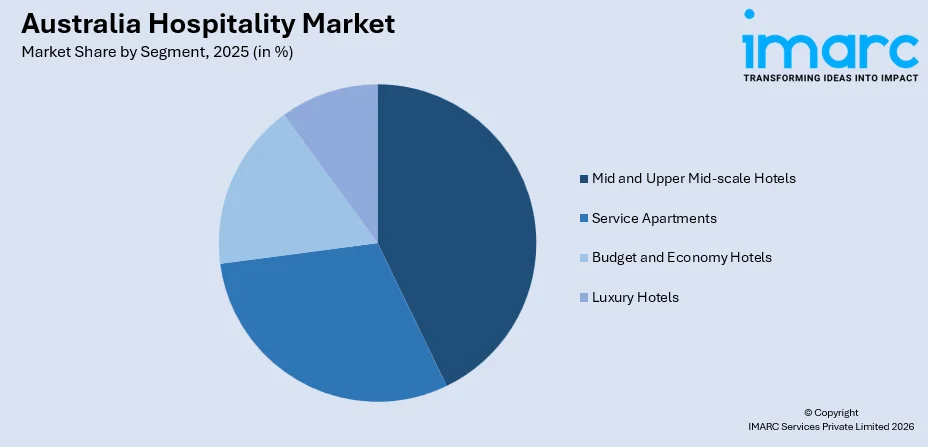
- By Segment: Mid-scale and upper mid-scale hotels held the largest market share with 42.7% in 2025, fueled by their balance of affordability, comfort, and increasing demand from both business and leisure travelers.
- By Region: Australia Capital Territory and New South Wales held the biggest segment, capturing 34.1% market share, in 2025, driven by strong tourism arrivals, major corporate centres, and well-established urban hospitality infrastructure.
- Key Players: The market is competitive, with major chains and local operators focusing on service quality, digital booking integration, loyalty programs, and sustainable operations. Players compete through brand expansion, experience-driven offerings, and strategic partnerships to attract travelers.
To get more information on this market Request Sample
The hospitality industry in Australia is expanding because both travel activities and customer demand for personalized experience-based services continue to grow. The Australian Bureau of Statistics reported that November 2025 experienced 831,170 short-term visitor arrivals which represented a 19.5% increase and 937,320 short-term resident returns which showed a 0.6% increase resulting in 1,849,990 total arrivals that marked an 8.4% rise compared to the previous year's corresponding period. The growth of the industry receives additional support through increasing hotel occupancy rates in urban areas, the development of new coastal resort projects and the rising need for convention centers and event spaces. The market is gaining advantages from both the return of international travelers and the continuous growth of domestic travel in important states. Hospitality operators now use technological solutions which include contactless systems, intelligent room control and data-based guest interaction systems to achieve better operational performance. Hospitality establishments expand their food and beverage offerings to adapt to the evolving dining preferences of their customers. The industry requires ongoing investment in workforce training and new service development to respond effectively to increasing market competition.
Australia Hospitality Market Trends:
Expansion of Luxury and Boutique Accommodation Offerings
Australia’s hospitality market is witnessing rising investment in luxury resorts and boutique hotels that cater to high-spending travelers. For instance, in January 2026, Emirates and Marriott International announced their plan to open the world’s first Ritz-Carlton Lodge in Australia’s Wolgan Valley. The 40-lodge resort spans a 7,000-acre conservancy, creating around 150 local jobs and enhancing NSW’s luxury and eco-tourism sector. Operators are focusing on exclusive design concepts, wellness-oriented amenities, and premium services to attract international tourists and affluent domestic visitors. This trend is particularly strong in key leisure destinations, where demand for unique stays continues to increase. Moreover, luxury and boutique positioning is becoming an important driver of differentiation in the sector.
Growth of Sustainable and Eco-Friendly Hospitality Practices
Sustainability has become a major trend in Australia’s hospitality industry, with hotels and resorts adopting eco-friendly building standards, energy-efficient operations, and waste reduction programs. For example, the Fullerton Hotel Sydney supports sustainability through the Green Stay Initiative, planting a tree in Byron Bay for each multi-night guest who opts out of daily housekeeping, and partnering with Hotels for Trees and ReForest Now to restore native forests. Hospitality providers are responding to growing traveler interest in environmentally responsible accommodation choices. Many operators are also integrating locally sourced food offerings and community-based tourism initiatives. Additionally, sustainable hospitality is increasingly shaping brand reputation and long-term market competitiveness.
Rising Influence of Alternative Lodging Models
Australia's hospitality industry currently experiences these trends because both competition levels and demand for alternative lodging options are rising. The new lodging options attract travelers who prefer flexible arrangements and extended stays and need home-like amenities. Hospitality operators have expanded their services by adding apartment-style accommodations and mixed-use developments which satisfy different guest requirements. The traditional hotel industry must create new services and better guest experiences because market changes require them to compete in an evolving hospitality industry that includes both leisure and business travel.
Market Outlook 2026-2034:
Australia’s hospitality market outlook remains favorable as tourism promotion, infrastructure development, and rising travel spending continue to support sector expansion. In 2025, Australia’s travel and tourism sector is projected to reach a record high, with the World Travel & Tourism Council (WTTC) estimating its contribution to the national economy at USD 314.4 billion. Future growth is expected to be driven by increased demand for integrated hospitality complexes, expansion of regional tourism hubs, and stronger investment in upgraded accommodation capacity. Operators are also likely to enhance revenue through diversified experiences, including culinary tourism and entertainment-focused services. Apart from this, continued recovery in international travel will further strengthen market prospects. The market generated a revenue of USD 37454.48 Million in 2025 and is projected to reach a revenue of USD 70933.81 Million by 2034, growing at a compound annual growth rate of 7.35% from 2026-2034.
Australia Hospitality Market Report Segmentation:
|
Segment Category |
Leading Segment |
Market Share |
|
Type |
Chain Hotels |
58.4% |
|
Segment |
Mid and Upper Mid-scale Hotels |
42.7% |
|
Region |
Australia Capital Territory & New South Wales |
34.1% |
Type Insights:
- Chain Hotels
- Independent Hotels
Chain Hotels dominates with a market share of 58.4% of the total Australia hospitality market in 2025.
The company achieves market dominance through its extensive operations across the country while maintaining its consistent service delivery and its ability to retain customers who show strong brand loyalty. The chain operators derive their advantages from established operational systems together with their ability to reach more customers through marketing, while serving both business travelers and leisure travelers at important tourist and commercial locations.
The segment continues to strengthen through ongoing expansion of branded properties, refurbishment investments, and partnerships with global travel platforms. For instance, in March 2025, Minor Hotels Australasia announced its fifth franchised Australian property, Oaks Redcliffe Mon Komo Suites, and appointed Russell Cool as Director of Franchising, supporting expansion plans as the group targets 850 global properties by 2027. Likewise, chain hotels increasingly adopt advanced guest service technologies and standardized sustainability initiatives to enhance market competitiveness. Their scale advantages in pricing, distribution, and service delivery ensure continued leadership within Australia’s hospitality landscape.
Segment Insights:
Access the comprehensive market breakdown Request Sample
- Service Apartments
- Budget and Economy Hotels
- Mid and Upper Mid-scale Hotels
- Luxury Hotels
Mid and Upper Mid-scale Hotels leads with a share of 42.7% of the total Australia hospitality market in 2025.
The leadership reflects strong consumer demand for accommodations that balance affordability, comfort, and consistent service quality. In accordance with this, mid-scale hotels are widely favoured by business travellers, domestic tourists, and families seeking reliable stays without premium luxury pricing.
Growth in this segment is also being driven by rising travel activity across both urban and regional destinations. Operators are upgrading facilities, enhancing digital guest services, and introducing flexible packages to address evolving traveller preferences. As a result, mid-scale hotels continue to play a central role in overall market expansion due to their accessibility and broad appeal.
Region Insights:
- Australia Capital Territory & New South Wales
- Victoria & Tasmania
- Queensland
- Northern Territory & Southern Australia
- Western Australia
Australia Capital Territory & New South Wales exhibits a clear dominance with a 34.1% share of the total Australia hospitality market in 2025.
The region benefits from high tourism inflows, strong business travel volumes, and the presence of major cultural and commercial centers. Furthermore, demand for accommodation is consistently supported by events, conferences, and government-related travel activity.
Regional leadership is reinforced by extensive hotel infrastructure, diversified lodging formats, and continuous investment in tourism development. Accordingly, the NSW Government has launched the Visitor Economy Strategy 2035, targeting USD 91 Billion in annual visitor spend, 40,000 hotel rooms, 8.5 million airline seats and 150,000 jobs by 2035 through investment, events, aviation growth and data-led tourism development. Hospitality providers in this region are also early adopters of service upgrades and experience-focused offerings, sustaining their leading position in Australia’s hospitality market.
Market Dynamics:
Growth Drivers:
Why is the Australia Hospitality Market Growing?
Increasing Demand for Wellness-Oriented Hospitality Services
Australia’s hospitality industry is seeing growing demand for wellness-focused offerings, including spa retreats, fitness-centred stays, and health-conscious dining options. As such, in March 2025, IHG Hotels & Resorts and Strategic Alliance announced its plan to open the 150-room InterContinental Barossa Resort & Spa in 2028, bringing the first globally branded luxury hotel to South Australia’s Barossa wine region and strengthening IHG’s luxury portfolio. Hotels and resorts are integrating wellness programs to attract travelers seeking relaxation and lifestyle improvement. This trend is particularly relevant in premium leisure destinations, where guests prioritize holistic experiences. Wellness-driven hospitality is becoming a key differentiator for operators aiming to enhance customer value and long-term loyalty.
Expansion of Smart Hospitality Technologies
Hospitality providers in Australia are increasingly embracing smart technologies to enhance guest convenience and streamline operations. Hotels and resorts are adopting digital room access, automated check-in and check-out systems, and AI-supported concierge services to improve efficiency and service reliability. These innovations help reduce staffing pressures while maintaining consistent service standards. In addition, data-driven platforms enable personalised guest interactions, allowing operators to tailor services, preferences, and offers in real time. The growing adoption of smart hospitality solutions is reshaping accommodation experiences across both urban and resort markets.
Growing Focus on Regional and Indigenous Tourism Experiences
Australia’s hospitality market is seeing increased emphasis on regional travel and indigenous cultural tourism offerings. For instance, several initiatives were implemented through the Queensland Government’s USD 10 Million Year of Indigenous Tourism 2020–2021 and the Australian Government’s USD 40 Million Indigenous Tourism Program, with the Year of Indigenous Tourism later extended into 2022–2023. Operators are also developing accommodation packages that incorporate local heritage experiences, eco-tourism activities, and community-based tourism partnerships. This trend supports tourism diversification beyond major cities and appeals to travelers seeking authentic, location-specific stays. Besides this, rapid regional and cultural integration is strengthening the hospitality sector’s experiential appeal.
Market Restraints:
What Challenges the Australia Hospitality Market is Facing?
Labor Shortages and Workforce Retention Issues
Australia’s hospitality industry continues to experience persistent labour shortages, particularly across skilled and customer-facing roles such as chefs, housekeeping staff, food and beverage professionals, and front-office personnel. High employee turnover, intensified by irregular working hours and rising wage expectations, places ongoing pressure on operators. These workforce gaps can disrupt service quality, restrict operational capacity, and limit the ability of hotels to capitalise on peak travel demand. Addressing these challenges requires sustained investment in training, improved employee benefits, career development pathways, and more flexible workforce models to support long-term sector stability.
Rising Operating Costs and Margin Pressure
Hospitality providers across Australia are facing steadily increasing operating costs, including higher energy prices, food and beverage expenses, property maintenance, insurance, and regulatory compliance requirements. These cost pressures are particularly challenging for mid-scale and independent operators with limited pricing power. As expenses rise, many hotels are forced to increase room rates, which may impact price-sensitive domestic travelers. Managing margins in this environment requires a strong focus on operational efficiency, technology adoption, supplier optimisation, and cost-control strategies to remain competitive while maintaining service standards.
Seasonal Demand Volatility and Market Uncertainty
Australia’s hospitality sector is significantly influenced by seasonal tourism patterns, economic conditions, and evolving travel behaviours, leading to fluctuating demand levels throughout the year. Regional and leisure-focused destinations are especially vulnerable to off-peak occupancy declines, resulting in uneven revenue streams and capacity underutilisation. Market uncertainty is further heightened by external factors such as weather events, global travel disruptions, and changing consumer confidence. To manage volatility, operators are increasingly focusing on dynamic pricing, diversified revenue sources, targeted marketing, and flexible operational planning to improve resilience.
Competitive Landscape:
Australia’s hospitality market is highly competitive, with international hotel chains and well-established domestic operators expanding across both urban centres and leisure destinations. Competition is driven by service differentiation, strong loyalty programmes, and ongoing investment in guest experience enhancements. Additionally, independent and boutique hotels compete through personalized services and destination-specific experiences. Market participants are also prioritizing digital distribution, sustainability initiatives, and strategic tourism partnerships to improve occupancy. Pricing pressure is most evident in mid-scale segments, while luxury operators focus on exclusivity, premium experiences, continuous property upgrades, and high workforce quality to sustain competitive advantage.
Recent Developments:
- In October 2025, Choice Hotels International launched MainStay Suites in Australia, adding 581 rooms across seven properties, marking its first expansion outside North America. Targeting extended-stay demand, the brand offers apartment-style comfort for business, government, and project-based travelers, strengthening Choice Hotels’ Australian portfolio and reinforcing its global extended-stay growth strategy.
- In July 2025, Paradox Hotels & Resorts debuted in Australia, rebranding Sydney’s historic Radisson Blu Plaza Hotel as Paradox Sydney. The 364-room heritage property combines luxury accommodation, award-winning dining, modern facilities, and culturally inspired design, continuing operations during gradual refurbishment to reflect the Paradox brand.
Australia Hospitality Market Report Coverage:
|
Report Features |
Details |
|
Base Year of the Analysis |
2025 |
|
Historical Period |
2020-2025 |
|
Forecast Period |
2026-2034 |
|
Units |
Million USD |
|
Scope of the Report |
Exploration of Historical Trends and Market Outlook, Industry Catalysts and Challenges, Segment-Wise Historical and Future Market Assessment:
|
|
Types Covered |
Chain Hotels, Independent Hotels |
|
Segments Covered |
Service Apartments, Budget and Economy Hotels, Mid and Upper Mid-scale Hotels, Luxury Hotels |
|
Regions Covered |
Australia Capital Territory & New South Wales, Victoria & Tasmania, Queensland, Northern Territory & Southern Australia, Western Australia |
|
Customization Scope |
10% Free Customization |
|
Post-Sale Analyst Support |
10-12 Weeks |
|
Delivery Format |
PDF and Excel through Email (We can also provide the editable version of the report in PPT/Word format on special request) |
Frequently Asked Questions About the Australia Hospitality Market Report
The Australia hospitality market size was valued at USD 37454.48 Million in 2025
The Australia hospitality market is expected to grow at a compound annual growth rate of 7.35% from 2026-2034 to reach USD 70933.81 Million by 2034.
Chain Hotels dominated the market with 58.4% share in 2025, driven by brand recognition, loyalty programs, extensive networks, consistent service standards, and investment in guest experience enhancements across urban and leisure destinations.
Key factors driving the Australia hospitality market include rising domestic and international tourism, increased demand for leisure and business travel, expansion of hotel chains, digital distribution strategies, sustainability initiatives, personalized guest experiences, and investments in property upgrades and workforce quality.
Major challenges in the Australia hospitality market include labor shortages, high staff turnover, rising operational costs, seasonal demand fluctuations, market uncertainty, competitive pricing pressures, and the need for continuous investment in infrastructure, technology, and guest services to maintain profitability and quality standards.
Need more help?
- Speak to our experienced analysts for insights on the current market scenarios.
- Include additional segments and countries to customize the report as per your requirement.
- Gain an unparalleled competitive advantage in your domain by understanding how to utilize the report and positively impacting your operations and revenue.
- For further assistance, please connect with our analysts.
 Request Customization
 Speak to an Analyst
 Request Brochure
 Inquire Before Buying
Benefits of Customization
- Personalize this research
- Triangulate with your data
- Get data as per your format and definition
- Gain a deeper dive into a specific application, geography, customer, or competitor
- Any level of personalization
Get in Touch With Us
UNITED STATES
Phone: +1-201-971-6302
INDIA
Phone: +91-120-433-0800
UNITED KINGDOM
Phone: +44-753-714-6104
Email: [email protected]
Client Testimonials




.webp)




.webp)













Related Reports

Choose your plan
*Please note that the prices mentioned below are starting prices for each bundle type. Kindly contact our team for further details.*
Single User License
- 1 User License, Access on 2 Devices
- PDF Report + Excel Dataset (Password Protected)
- Lifetime Access
- No Printing Rights
- 10% Free Report Customization
- 10–12 Weeks of Analyst Support
Five User License
- Access for 5 Users, 2 Devices per User
- PDF Report + Excel Dataset (Password Protected)
- Lifetime Access
- Dedicated Account Manager
- 12–14 Weeks of Analyst Support
- No Printing Rights
- 15% Free Report Customization
- 25% Discount on Your Next Purchase
Corporate User License
- Unlimited User Access (Within Your Organization)
- PDF Report + Excel Dataset
- Lifetime Access
- Dedicated Account Manager
- 14–20 Weeks of Analyst Support
- No Printing Rights
- 20% Free Report Customization
- 30% Discount on Your Next Purchase
Essential Insights
What's included:
3 reports
- Lifetime Access
- PDF Reports
- Excel Datasets
- 2 Weeks of Free Analyst Support
- 2 User Licenses
- Access on 2 Devices
- Printing Rights
- Complimentary PowerPoint (PPT) Version
- Complimentary License Upgrade
Professional Access
What's included:
5 reports
- Lifetime Access
- PDF Reports
- Excel Datasets
- 8 Weeks of Free Analyst Support
- 2 User Licenses
- Access on 2 Devices
- Printing Rights
- Complimentary PowerPoint (PPT) Version
- Complimentary License Upgrade
Business Advantage
What's included:
8 reports
- Lifetime Access
- PDF Reports
- Excel Datasets
- 14 Weeks of Free Analyst Support
- 2 User Licenses
- Access on 2 Devices
- Printing Rights
- Complimentary PowerPoint (PPT) Version
- Complimentary License Upgrade
Enterprise Intelligence
What's included:
10 reports
- Lifetime Access
- PDF Reports
- Excel Datasets
- 20 Weeks of Free Analyst Support
- 2 User Licenses
- Access on 2 Devices
- Printing Rights
- Complimentary PowerPoint (PPT) Version
- Complimentary License Upgrade