
Australia Industrial Coatings Market Size, Share, Trends and Forecast by Product, Technology, End User, and Region, 2026-2034
Australia Industrial Coatings Market Summary:
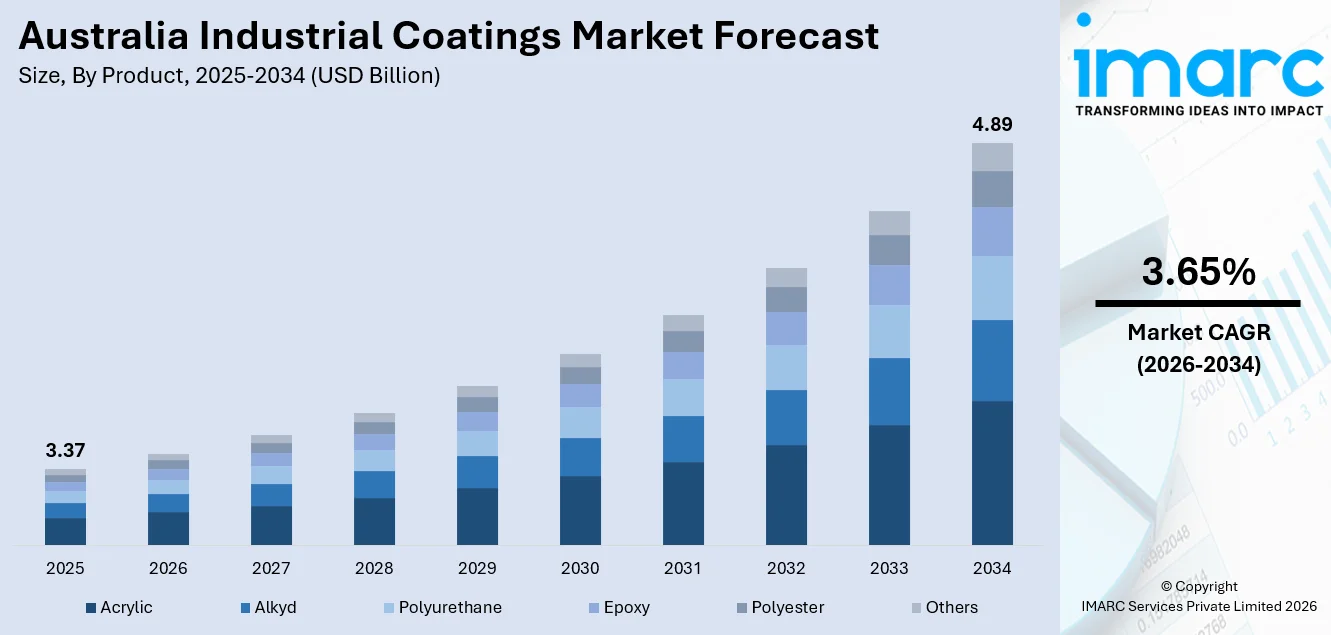
The Australia industrial coatings market size was valued at USD 3.37 Billion in 2025 and is projected to reach USD 4.89 Billion by 2034, growing at a compound annual growth rate of 3.65% from 2026-2034.
The Australia industrial coatings market is expanding steadily, driven by robust infrastructure development, growing manufacturing activity, and rising demand for protective surface solutions across diverse industrial sectors. Increasing environmental awareness and stricter regulatory frameworks are accelerating the shift toward sustainable, low-emission coating technologies. Advancements in formulation science, coupled with expanding applications in mining, marine, and energy sectors, continue to strengthen the Australia industrial coatings market share.
Key Takeaways and Insights:
- By Product: Acrylic dominates the market with a share of 28.5% in 2025, owing to its exceptional versatility, superior weather resistance, and compatibility with eco-friendly water-based formulations. Expanding construction and infrastructure projects are fueling sustained demand for acrylic-based protective solutions.
- By Technology: Solvent borne leads the market with a share of 42.5% in 2025, driven by its established performance credentials in heavy-duty industrial applications requiring superior adhesion, chemical resistance, and durability across demanding operating environments.
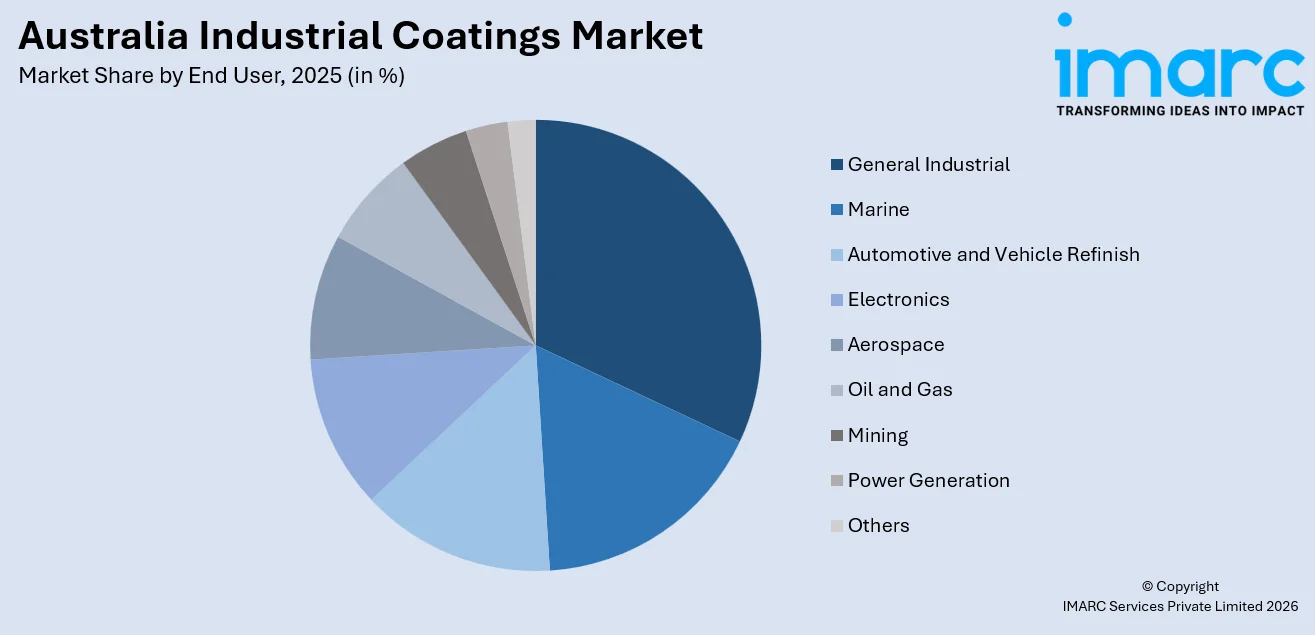
- By End User: General industrial holds the largest segment with a market share of 32.5% in 2025, reflecting broad-based demand for protective coatings across manufacturing facilities, warehouses, processing plants, and commercial structures that require consistent surface protection.
- By Region: Australia Capital Territory & New South Wales represents the largest region with 34.8% share in 2025, driven by the concentration of industrial manufacturing, large-scale infrastructure investment, and Sydney metropolitan construction activity supporting sustained protective coating consumption.
- Key players: Key players drive the Australia industrial coatings market by expanding product portfolios, investing in sustainable formulation technologies, strengthening nationwide distribution networks, and forming strategic partnerships to advance innovation, enhance market penetration, and meet evolving regulatory requirements.
To get more information on this market Request Sample
The Australia industrial coatings market is moving ahead as industries, infrastructure developers, and manufacturers focus on the need for high-performance surface protection coatings that can resist the harsh climatic conditions in Australia. The rising urbanization, along with the large-scale government infrastructure development initiatives, is fueling the demand for protective and decorative industrial coatings in the construction, transportation, and energy sectors. The rising focus on environmental sustainability is driving the adoption of low-emission and water-based coating technologies that meet the stringent regulatory requirements while offering superior protective properties. In addition, the rising growth of the mining industry in Western Australia and Queensland requires specialized coatings that can protect heavy machinery and infrastructure from the abrasive effects of particles, moisture, and chemicals. Technological innovations, such as nanotechnology-based and self-healing coatings, are expanding application areas and fueling market growth in the industrial sector. The rising demand for corrosion-resistant coatings in marine and offshore applications further supports market growth.
Australia Industrial Coatings Market Trends:
Rising adoption of sustainable and low-VOC coating formulations
Environmental sustainability is reshaping the Australian industrial coatings landscape as manufacturers transition toward low-volatile organic compound and water-based formulations. Stricter regulatory frameworks and growing environmental consciousness are compelling industries to adopt coatings that minimize emissions while maintaining performance standards. New VOC limits for coatings in Australia took effect in January 2024 under the Green Building Council of Australia guidelines, further accelerating the shift. This regulatory impetus is fostering innovation in bio-based resins and eco-friendly formulations, driving the Australia industrial coatings market growth across construction, manufacturing, and infrastructure applications.
Integration of nanotechnology and smart coating solutions
Advanced nanotechnology is increasingly being integrated into industrial coating formulations to deliver enhanced protective capabilities, including self-healing, hydrophobic, and antimicrobial properties. These next-generation coatings respond to environmental stimuli such as temperature and humidity changes, providing proactive maintenance and extending asset lifespans. In October 2024, ACM CRC, LaserBond, and the University of Sydney announced a collaborative project to develop an automated laser cladding system for metal matrix composite coatings, targeting improved wear and corrosion resistance for mining, marine, and defense applications. Such innovations are expanding the frontier of industrial coating performance across demanding sectors.
Expanding application of powder coatings for architectural and industrial use
Powder coating technology is gaining significant traction in Australia due to its superior durability, minimal waste generation, and absence of solvent emissions. These attributes align with the country's stringent environmental standards and the construction sector's sustainability goals. In January 2025, AkzoNobel launched its Interpon D Futura Collection in Australia and New Zealand, offering sustainable powder coatings backed by 25-year warranties and Environmental Product Declarations. The growing preference for powder-based solutions across automotive, aerospace, and architectural applications is reinforcing this transformative trend in the market.
Market Outlook 2026-2034:
The Australia industrial coatings market is poised for positive growth during the forecast period, driven by major infrastructure development initiatives, industrialization, and changing environmental regulations. The government's focus on major infrastructure development projects such as transportation infrastructure, energy infrastructure, and public buildings will continue to fuel demand for advanced protective coatings. The expansion of the mining industry's operational activities continues to fuel demand for corrosion-resistant and abrasion-resistant coating solutions, while the energy shift towards renewable sources presents new development opportunities for specialized industrial coatings. Advances in sustainable formulation chemistry and intelligent coating systems will further enhance the market's growth outlook during the forecast period. The market generated a revenue of USD 3.37 Billion in 2025 and is projected to reach a revenue of USD 4.89 Billion by 2034, growing at a compound annual growth rate of 3.65% from 2026-2034.
Australia Industrial Coatings Market Report Segmentation:
| Segment Category | Leading Segment | Market Share |
|---|---|---|
|
Product |
Acrylic |
28.5% |
|
Technology |
Solvent Borne |
42.5% |
|
End User |
General Industrial |
32.5% |
|
Region |
Australia Capital Territory & New South Wales |
34.8% |
Product Insights:
- Acrylic
- Alkyd
- Polyurethane
- Epoxy
- Polyester
- Others
Acrylic dominates with a market share of 28.5% of the total Australia industrial coatings market in 2025.
Acrylic coatings have established themselves as the preferred product type across the Australian industrial coatings landscape owing to their exceptional versatility, outstanding weather resistance, and superior adhesion properties on diverse substrates. These coatings deliver excellent ultraviolet stability and color retention, making them particularly suitable for exterior applications in Australia's harsh climatic conditions. The growing demand for water-based acrylic formulations aligns with tightening environmental regulations, as these products offer significantly lower volatile organic compound emissions compared to traditional alternatives while maintaining robust protective performance.
The construction and infrastructure sectors represent primary consumption channels for acrylic coatings, where they protect buildings, bridges, and public structures from weathering and corrosion. The Australian Government's continued infrastructure spending, supported by large-scale public investment pipelines spanning transportation, housing, and energy projects, sustains demand for high-performance acrylic coating solutions. The growing adoption of acrylic coatings in renewable energy installations, including solar farms and wind energy infrastructure, further reinforces consumption across emerging industrial applications. Additionally, the compatibility of acrylic resins with sustainable formulation technologies positions them favorably as manufacturers respond to market preferences for environmentally responsible products across industrial and architectural applications.
Technology Insights:
- Solvent Borne
- Water Borne
- Powder Based
- Others
Solvent borne leads with a share of 42.5% of the total Australia industrial coatings market in 2025.
Solvent-borne coatings maintain their leadership position in the Australian market due to their proven track record of delivering superior adhesion, chemical resistance, and surface finish quality across demanding industrial applications. These coatings perform exceptionally well under extreme conditions encountered in mining operations, oil and gas facilities, and marine environments, where robust protection against corrosion, abrasion, and chemical exposure is essential. The established infrastructure for solvent-borne coating application and the familiarity of industrial applicators with these systems further reinforce their market dominance.
Heavy industrial sectors, including mining, power generation, and heavy manufacturing, continue to rely on solvent-borne formulations for critical asset protection where performance requirements remain stringent. However, the segment is undergoing gradual transformation as manufacturers develop high-solid and hybrid solvent-borne formulations that reduce volatile organic compound content while preserving performance attributes. This evolutionary approach allows industries to meet tightening environmental regulations without compromising the protective capabilities that solvent-borne coatings deliver in Australia's most challenging operating environments.
End User Insights:
Access the comprehensive market breakdown Request Sample
- General Industrial
- Marine
- Automotive and Vehicle Refinish
- Electronics
- Aerospace
- Oil and Gas
- Mining
- Power Generation
- Others
General industrial exhibits a clear dominance with a 32.5% share of the total Australia industrial coatings market in 2025.
The general industrial segment commands the largest end-user share driven by the breadth of manufacturing and processing activities across Australia that require protective coating solutions. Factories, warehouses, processing facilities, and commercial structures rely on industrial coatings to protect equipment, structural steel, flooring, and storage systems from corrosion, chemical exposure, and mechanical wear. The ongoing expansion of manufacturing capabilities and warehouse development across major metropolitan and regional centres sustains this segment's leadership position in the market.
Australia's industrial modernization programs, including advanced manufacturing initiatives and logistics infrastructure upgrades, continue to generate strong coating demand. The growing emphasis on workplace safety and asset preservation in industrial settings elevates requirements for high-performance protective coatings that extend equipment lifespans and reduce maintenance costs. The Industrial Chemicals Environmental Management Standard, which establishes guidelines for managing industrial chemicals in Australia, further shapes coating selection and application standards across the general industrial sector.
Regional Insights:
- Australia Capital Territory & New South Wales
- Victoria & Tasmania
- Queensland
- Northern Territory & Southern Australia
- Western Australia
Australia Capital Territory & New South Wales represents the leading region with a 34.8% share of the total Australia industrial coatings market in 2025.
New South Wales and the Australian Capital Territory hold the largest market share in the industrial coatings market, due to the presence of manufacturing industries, commercial construction, and infrastructure development around the Sydney metropolitan area. The region receives substantial investments from the government in transportation infrastructure projects, such as the expansion of the Sydney Metro and the development of the Western Sydney International Airport, which creates a huge demand for protective coating solutions for steel, concrete, and transportation equipment.
The region’s diverse industrial base, including food processing, pharmaceuticals, electronics manufacturing, and defense, provides a broad-based demand for coatings. New South Wales has been a major recipient of the increased infrastructure expenditure in the national pipeline, with the state benefiting from a substantial growth in its five-year infrastructure outlook, driven by major transportation, housing, and energy transmission projects. The growth of commercial and residential construction projects in the Sydney metropolitan region further boosts the demand for protective and decorative industrial coatings. This capital expenditure, combined with the presence of major coating manufacturers and distribution channels, makes the region the main consumption center for industrial coatings in Australia.
Market Dynamics:
Growth Drivers:
Why is the Australia Industrial Coatings Market Growing?
Accelerating infrastructure development and government investment
Australia's unprecedented infrastructure expansion is a primary catalyst for industrial coatings demand, as large-scale construction projects require extensive protective coating applications for structural steel, concrete surfaces, pipelines, and transportation assets. The Australian Government's Major Public Infrastructure Pipeline continues to grow substantially, driven by significant additions in housing, energy transmission, and transportation projects that have reversed previous declines in the national investment outlook. Transport infrastructure remains the largest expenditure category, while building projects have also expanded considerably, led by residential and health facility developments. These investments translate directly into coating demand for corrosion protection, weatherproofing, and aesthetic finishing across bridges, tunnels, railways, and public buildings. Federal budget commitments for new and existing infrastructure projects further reinforce the sustained pipeline of construction activity requiring protective coating solutions. Regional infrastructure demand is also rising sharply, with Queensland and Northern Territory experiencing consecutive years of significant increases in public investment, creating new opportunities for industrial coating consumption beyond metropolitan centres.
Expanding mining and resource sector activities
Australia's mining industry, serving as a cornerstone of the national economy and a leading contributor to export revenues, remains a substantial driver of industrial coatings consumption. Mining operations expose equipment and infrastructure to abrasive particles, moisture, and harsh chemicals, creating persistent demand for specialized protective coatings that resist corrosion, abrasion, and chemical degradation. The continued development of critical mineral projects, supported by long-term government strategies aimed at strengthening domestic processing capabilities and securing strategic supply chains, is generating new coating requirements for processing facilities, storage infrastructure, and transportation networks. The expanding scope of lithium, rare earth, and other critical mineral extraction activities across Western Australia, Queensland, and Tasmania necessitates advanced industrial coating solutions that safeguard assets throughout exploration, processing, and logistics operations. Additionally, the growing emphasis on downstream value-added mineral processing within Australia is creating incremental demand for high-performance coatings in refining and manufacturing facilities that operate under chemically intensive conditions.
Strengthening environmental regulations and sustainability mandates
Tightening environmental regulations are propelling innovation and market growth by accelerating the transition toward sustainable coating technologies. Australia's updated VOC limits for coatings, established under the Green Building Council guidelines, have introduced stricter emission standards that compel manufacturers to develop low-emission alternatives across industrial and architectural applications. The Industrial Chemicals Environmental Management Standard provides additional frameworks for managing industrial chemicals, influencing coating formulation and application practices. The Australian Paint Approval Scheme further promotes the adoption of low-VOC paints by categorising products based on their emission content, offering a transparent pathway for specifiers and contractors to select safer materials. These regulatory developments are stimulating investment in water-borne, powder-based, and bio-derived coating technologies that deliver equivalent protective performance with significantly reduced environmental impact. Additionally, Australia's commitment to achieving net-zero emissions by 2050 is creating sustained demand for eco-friendly industrial coatings across construction, manufacturing, and infrastructure maintenance applications, expanding the overall addressable market.
Market Restraints:
What Challenges the Australia Industrial Coatings Market is Facing?
Volatility in raw material prices and supply chain disruptions
The Australian industrial coatings market faces persistent challenges from fluctuating raw material prices, as the sector relies heavily on imported resins, pigments, solvents, and chemical additives that are susceptible to global commodity price swings. Petrochemical derivatives, which form the basis of many coating formulations, are particularly vulnerable to crude oil price volatility and geopolitical disruptions, creating uncertainty in production cost management and downstream pricing stability.
Stringent regulatory compliance costs and complexity
While environmental regulations drive positive market transformation, they also impose substantial compliance burdens on coating manufacturers, particularly smaller operators with limited resources. Meeting evolving VOC emission standards, chemical registration requirements under the Industrial Chemicals Act, and workplace health and safety obligations demands significant investment in reformulation, testing, documentation, and process modification, potentially constraining market participation for cost-sensitive producers.
Skilled labor shortages in coating application and maintenance
The Australian industrial coatings market is constrained by a shortage of qualified coating applicators and maintenance professionals, particularly in regional and remote locations where mining and infrastructure projects generate the greatest demand. The specialized nature of industrial coating application, requiring technical expertise in surface preparation, environmental control, and quality assurance, creates workforce gaps that can delay project timelines and elevate application costs across the industry.
Competitive Landscape:
The Australia industrial coatings market has a very competitive environment with the presence of established multinational companies and local specialists. The companies are investing heavily in research and development to develop new formulations that meet the changing demands of performance and environmental regulations. The key focus areas include enhancing sustainable product offerings, improving distribution channels in both urban and rural areas, and developing customized solutions for particular industrial sectors. The competition is increasing through collaborations with end-user industries, technology licensing agreements, and capacity enhancements that allow for quicker reaction to the growing demand in the market. Digital technology, such as automatic color matching and process improvement software, is emerging as a competitive differentiator as companies attempt to improve application efficiency and service delivery.
Australia Industrial Coatings Market Report Coverage:
| Report Features | Details |
|---|---|
| Base Year of the Analysis | 2025 |
| Historical Period | 2020-2025 |
| Forecast Period | 2026-2034 |
| Units | Billion USD |
| Scope of the Report | Exploration of Historical Trends and Market Outlook, Industry Catalysts and Challenges, Segment-Wise Historical and Future Market Assessment:
|
| Products Covered | Acrylic, Alkyd, Polyurethane, Epoxy, Polyester, Others |
| Technologies Covered | Solvent Borne, Water Borne, Powder Based, Others |
| End Users Covered | General Industrial, Marine, Automotive and Vehicle Refinish, Electronics, Aerospace, Oil and Gas, Mining, Power Generation, Others |
| Regions Covered | Australia Capital Territory & New South Wales, Victoria & Tasmania, Queensland, Northern Territory & Southern Australia, Western Australia |
| Customization Scope | 10% Free Customization |
| Post-Sale Analyst Support | 10-12 Weeks |
| Delivery Format | PDF and Excel through Email (We can also provide the editable version of the report in PPT/Word format on special request) |
Frequently Asked Questions About the Australia Industrial Coatings Market Report
The Australia industrial coatings market size was valued at USD 3.37 Billion in 2025.
The Australia industrial coatings market is expected to grow at a compound annual growth rate of 3.65% from 2026-2034 to reach USD 4.89 Billion by 2034.
Acrylic dominated the market with a share of 28.5%, driven by its exceptional versatility, weather resistance, compatibility with sustainable water-based formulations, and broad applicability across construction, infrastructure, and manufacturing sectors.
Key factors driving the Australia industrial coatings market include accelerating infrastructure development, expanding mining activities, tightening environmental regulations, growing demand for sustainable low-VOC coating solutions, and technological advancements in protective coating formulations.
Major challenges include volatile raw material prices, stringent regulatory compliance costs, skilled labor shortages in coating application, supply chain disruptions affecting imported chemical inputs, and rising production costs impacting manufacturer profitability.
Need more help?
- Speak to our experienced analysts for insights on the current market scenarios.
- Include additional segments and countries to customize the report as per your requirement.
- Gain an unparalleled competitive advantage in your domain by understanding how to utilize the report and positively impacting your operations and revenue.
- For further assistance, please connect with our analysts.
 Request Customization
 Speak to an Analyst
 Request Brochure
 Inquire Before Buying
Benefits of Customization
- Personalize this research
- Triangulate with your data
- Get data as per your format and definition
- Gain a deeper dive into a specific application, geography, customer, or competitor
- Any level of personalization
Get in Touch With Us
UNITED STATES
Phone: +1-201-971-6302
INDIA
Phone: +91-120-433-0800
UNITED KINGDOM
Phone: +44-753-714-6104
Email: [email protected]
Client Testimonials




.webp)




.webp)













Related Reports

Choose your plan
*Please note that the prices mentioned below are starting prices for each bundle type. Kindly contact our team for further details.*
Single User License
- 1 User License, Access on 2 Devices
- PDF Report + Excel Dataset (Password Protected)
- Lifetime Access
- No Printing Rights
- 10% Free Report Customization
- 10–12 Weeks of Analyst Support
Five User License
- Access for 5 Users, 2 Devices per User
- PDF Report + Excel Dataset (Password Protected)
- Lifetime Access
- Dedicated Account Manager
- 12–14 Weeks of Analyst Support
- No Printing Rights
- 15% Free Report Customization
- 25% Discount on Your Next Purchase
Corporate User License
- Unlimited User Access (Within Your Organization)
- PDF Report + Excel Dataset
- Lifetime Access
- Dedicated Account Manager
- 14–20 Weeks of Analyst Support
- No Printing Rights
- 20% Free Report Customization
- 30% Discount on Your Next Purchase
Essential Insights
What's included:
3 reports
- Lifetime Access
- PDF Reports
- Excel Datasets
- 2 Weeks of Free Analyst Support
- 2 User Licenses
- Access on 2 Devices
- Printing Rights
- Complimentary PowerPoint (PPT) Version
- Complimentary License Upgrade
Professional Access
What's included:
5 reports
- Lifetime Access
- PDF Reports
- Excel Datasets
- 8 Weeks of Free Analyst Support
- 2 User Licenses
- Access on 2 Devices
- Printing Rights
- Complimentary PowerPoint (PPT) Version
- Complimentary License Upgrade
Business Advantage
What's included:
8 reports
- Lifetime Access
- PDF Reports
- Excel Datasets
- 14 Weeks of Free Analyst Support
- 2 User Licenses
- Access on 2 Devices
- Printing Rights
- Complimentary PowerPoint (PPT) Version
- Complimentary License Upgrade
Enterprise Intelligence
What's included:
10 reports
- Lifetime Access
- PDF Reports
- Excel Datasets
- 20 Weeks of Free Analyst Support
- 2 User Licenses
- Access on 2 Devices
- Printing Rights
- Complimentary PowerPoint (PPT) Version
- Complimentary License Upgrade