
Australia Industrial Lubricants Market Size, Share, Trends and Forecast by Product Type, Base Oil, End-Use Industry, and Region, 2026-2034
Australia Industrial Lubricants Market Overview:
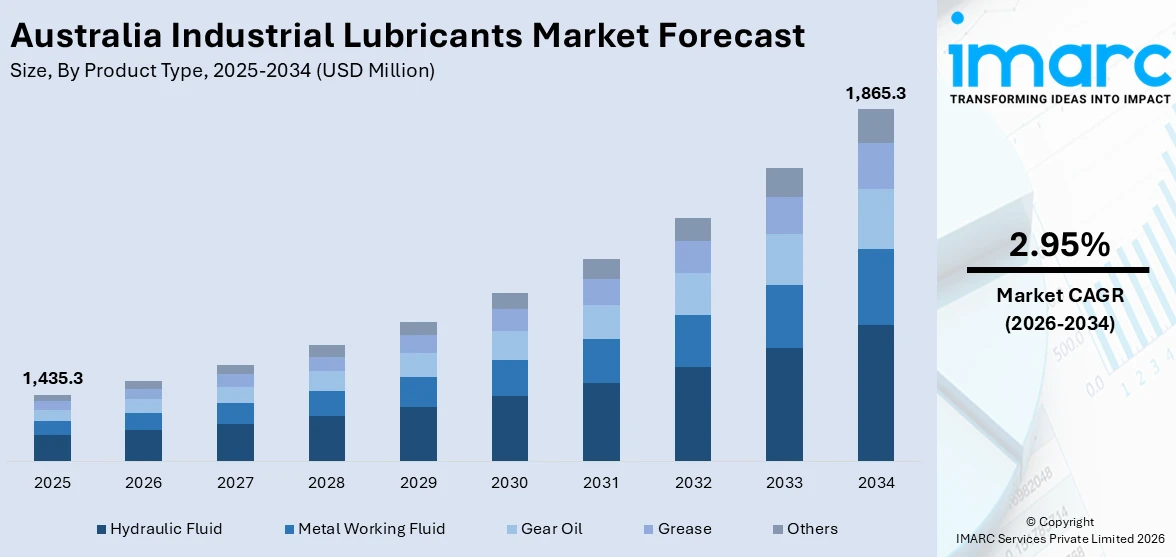
The Australia industrial lubricants market size reached USD 1,435.3 Million in 2025. Looking forward, the market is expected to reach USD 1,865.3 Million by 2034, exhibiting a growth rate (CAGR) of 2.95% during 2026-2034. Increasing equipment deployment across major industries, the expansion of mining operations, rising mechanization in the agricultural sector, and large-scale infrastructure projects in transport and housing are propelling the market growth. Additional growth drivers include the increasing use of automation in manufacturing, growth in marine and offshore engineering activities, and the transition to synthetic and environmentally friendly bio-based lubricants. Other factors contributing to the Australia industrial lubricants market share include longer lubricant service life, use of predictive maintenance tools, adoption of energy-efficient machinery, original equipment manufacturer (OEM) specific lubricant requirements, imports of advanced machinery, and efforts to minimize equipment downtime.
|
Report Attribute
|
Key Statistics
|
|---|---|
|
Base Year
|
2025
|
|
Forecast Years
|
2026-2034
|
|
Historical Years
|
2020-2025
|
| Market Size in 2025 | USD 1,435.3 Million |
| Market Forecast in 2034 | USD 1,865.3 Million |
| Market Growth Rate 2026-2034 | 2.95% |
Key Trends of Australia Industrial Lubricants Market:
Mining and Metallurgy Expansion
Australia's industrial lubricant market is supported by the continued expansion of the metallurgy and mining industries. These two industries utilize massive, high-powered machines that run long hours in intense conditions like intense heat, dust, and heavy loads. As a result, there is a need for lubricants that reduce wear, protect against failure, and increase the lifespan of expensive equipment. In areas like Western Australia and Queensland, where mining activity is very high, companies desire heavy-duty lubricants that are long-lasting and reduce the need for constant servicing, especially as many sites are remote and hard to access. As mining companies increase production and invest in new sites, their need for effective and efficient lubricants is increasing.
To get more information on this market Request Sample
Mechanization in Agriculture
Agriculture is becoming technology-driven, with farmers using modern machinery to improve productivity. This shift is leading to greater use of industrial lubricants in tractors, harvesters, and other farm equipment. These machines operate in tough conditions, such as dust, mud, high temperatures, and need lubricants that can protect engines and hydraulic systems from wear and rust. As machinery becomes advanced, farmers are paying more attention to the type and quality of lubricants they use. Standard oils are being replaced with specialized products designed for specific systems. Additionally, there is awareness about the role of regular lubrication in preventing machine breakdowns during critical times like harvesting. Furthermore, dealerships and service providers are helping to guide product choices and maintenance schedules, which is supporting the Australia industrial lubricants market growth.
Growth in Construction Activities
Construction is one of the fastest-growing sectors in Australia, and it plays a big role in driving lubricant consumption. Projects related to roads, bridges, commercial buildings, and housing developments are increasing in cities such as Sydney, Melbourne, and Brisbane. For instance, the Mandurah Estuary Bridge duplication project in Western Australia is currently under construction. Valued at USD 136 million, the project involves adding a second two-lane bridge and a shared pedestrian and cycling path. Heavy machinery used on these sites, like excavators, graders, and loaders, relies on industrial lubricants to perform under continuous stress and changing weather. These machines can’t afford breakdowns, which is why construction companies are focusing on maintenance practices that include using better quality oils with longer life. High-load and temperature-resistant lubricants are becoming common, especially for equipment that runs all day. In addition to this, companies are beginning to use oil analysis to track equipment health and plan maintenance more efficiently. With infrastructure development remaining a national priority, the need for high-performing lubricants in construction is likely to grow, reinforcing the sector’s importance and further influencing the Australia industrial lubricants market growth.
Growth Drivers of Australia Industrial Lubricants Market:
Increased Manufacturing Activity and Equipment Modernization
Manufacturing activity in Australia is in a phase of change, with growing automation, adoption of advanced machinery, and indigenous production drive industrial lubricant demand. With manufacturers replacing aging equipment and implementing new technology, there is a greater requirement for high-performance lubricants to meet faster operating speeds, greater loads, and tighter tolerances. This is most applicable in industries like food processing, auto parts, chemicals, and metal working, which are industries that span the major regions of Victoria and South Australia. Furthermore, most manufacturers are looking to enhance energy efficiency and minimize downtime, both of which are factors that have direct dependency on lubricants' quality and compatibility. With Australia prioritizing the augmentation of its domestic production capacity and supply chain resilience, the machinery used in such facilities needs consistent lubrication to support continuous operations. This continuous industrial transformation provides a robust market for sophisticated, specialized, and synthetic lubricants made for today's manufacturing conditions.
Development of Infrastructure and Large-Scale Construction Activities
Australia's increased investment in infrastructure and large-scale construction activities is yet another main inducer for the industrial lubricants market. Large projects like road and rail developments, solar and wind power installations, airport facilities, and inner-city regeneration programs require the operation of heavy machinery such as cranes, bulldozers, tunnelling machines, and earthmovers. These pieces of equipment need to be constantly lubricated in order to perform effectively under long hours and harsh weather conditions. The building boom in the larger states of New South Wales, Victoria, and Queensland guarantees high demand for industrial lubricants in various applications. In addition, public-sector-led infrastructure investments typically involve tightly defined schedules and performance requirements, so there is minimal tolerance for equipment failure or downtime. Lubricants that enable long equipment life, withstand wear, and sustain performance in high-stress conditions are thus highly sought after. As the construction industry continues to develop and expand, industrial lubricant suppliers have more chances to deliver custom solutions to meet sector-specific performance requirements, which further contributes to the growth in Australia industrial lubricants market demand.
Marine and Port Operations in Major Coastal Regions
Australia's very large coastline and dependency on seaborne trade generate strong demand for industrial lubricants in the marine and port operations industry. Major commercial ports of Sydney, Melbourne, Brisbane, Fremantle, and Darwin deal with huge quantities of cargo, necessitating heavy equipment like cranes, forklifts, tugs, and loaders that need to be in top operating condition. Such conditions subject equipment to salt air, high humidity, and extended operation, which are factors that subject mechanical parts to extreme stress. Specialist marine-grade lubricants are needed for corrosion protection, load-carrying capability, and long-term equipment protection in such hostile environments. Moreover, the constant development of port facilities and logistics automation investment also boosts the demand for high-performance lubricants that are specific to marine and coastal operations. As Australia continues to evolve and take on a greater role in international trade, the preservation and efficiency of port facilities will continue to be vital, providing lubricant manufacturers and suppliers with an ongoing opportunity to contribute to this important industry.
Opportunities of Australia Industrial Lubricants Market:
Expansion of Renewable Energy and Related Infrastructure
According to the Australia industrial lubricants market analysis, increasing investment in renewable energy holds important opportunities for the lubricants sector. With solar farms, wind farms, and battery storage schemes expanding fast in areas such as South Australia, Victoria, and Western Australia, the demand for energy-related machinery lubricants is also on the rise. Wind turbines, for instance, need very specialized lubricants to provide smooth and trouble-free operation of gearboxes, bearings, and hydraulic systems under varying environmental conditions. Solar panel manufacturing and massive energy storage plants also contain equipment that relies on effective lubrication to minimize wear and energy use. As the renewable energy market matures, demand for long-life and environmentally acceptable lubricants will increase in step. Suppliers able to provide customized solutions, particularly those with compatibility for low-emission objectives and green operations, are poised to drive this expansion. The incorporation of smart monitoring systems in renewable plants also increases the demand for lubricants that are traceable for performance and condition, which creates room for predictive maintenance solutions.
Increase in Defense and Aerospace Manufacturing
Australia's increasing emphasis on its defense capabilities and aerospace manufacturing is contributing toward a niche yet high-value segment for industrial lubricants. As regional security plans and defense alliances, the nation is ramping up local production of defense equipment, naval ships, aircraft parts, and military vehicles. These are processes involving precision lubrication under high-stress and high-performance scenarios. South Australian and Queensland facilities emerging as defense production centers are installing sophisticated machinery and robots that expect dependable lubrication solutions to ensure operational reliability. Also, the aerospace industry, which is servicing both defense and commercial airlines, is growing, with investments going into maintenance, repair, and overhaul (MRO) activities. Lubricants applied in the aerospace industry need to be of high quality, have temperature resistances, and carry regulatory approvals, presenting a niche market for high-quality products. Organizations that can realize such technical specifications and forge relationships in the government and private defense industries can leverage this industrial trend over the long term.
Growing Need for Green and Synthetic Lubricants
Sustainability objectives and stricter environment laws are transforming demand within Australia industrial lubricant market share, especially in favor of synthetic and eco-friendly lubricants. Companies are being increasingly put under pressure to lower their environmental footprint, in terms of emissions along with in waste management, chemicals usage, and safety at workplaces. This has developed an expanding market for lubricants with low toxicity and biodegradability, particularly in industries such as mining, agriculture, marine, and building, where machinery functions in environmentally sensitive environments. In areas such as Tasmania and coastal Queensland, regulations are even more stringent due to proximity to nature reserves, forcing companies to find lubricants that have minimal ecological impact. Synthetic lubricants are also becoming popular for longer service life, better performance under extreme conditions, and compatibility with new equipment. Companies that provide green standards-aligned products, yet continue to satisfy the stringent requirements of heavy industry, are well placed to take advantage of this shift. Having the capacity to provide sustainability certification support can also provide a competitive advantage when tendering for major industrial projects.
Australia Industrial Lubricants Market Segmentation:
IMARC Group provides an analysis of the key trends in each segment of the market, along with forecasts at the country and regional levels for 2026-2034. Our report has categorized the market based on product type, base oil, and end-use industry.
Product Type Insights:
- Hydraulic Fluid
- Metal Working Fluid
- Gear Oil
- Grease
- Others
The report has provided a detailed breakup and analysis of the market based on the product type. This includes hydraulic fluid, metal working fluid, gear oil, grease, and others.
Base Oil Insights:
Access the comprehensive market breakdown Request Sample
- Mineral Oil
- Synthetic Oil
- Bio-based Oil
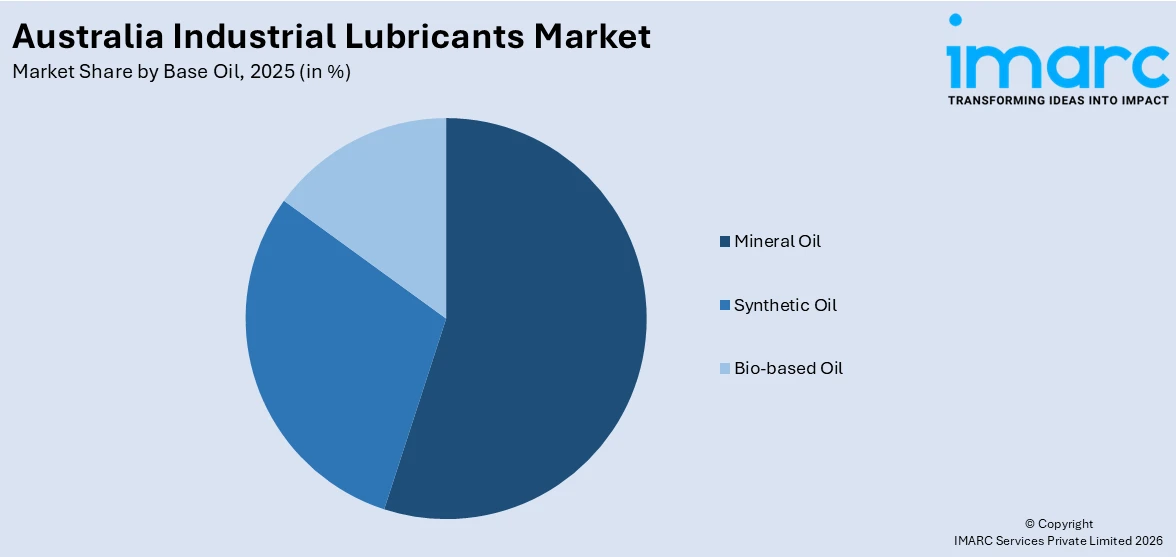
A detailed breakup and analysis of the market based on the base oil have also been provided in the report. This includes mineral oil, synthetic oil, and bio-based oil.
End-Use Industry Insights:
- Construction
- Metal and Mining
- Cement Production
- Power Generation
- Automotive
- Chemical Production
- Oil and Gas
- Textile Manufacturing
- Food Processing
- Agriculture
- Pulp and Paper
- Others
The report has provided a detailed breakup and analysis of the market based on the end-use industry. This includes construction, metal and mining, cement production, power generation, automotive, chemical production, oil and gas, textile manufacturing, food processing, agriculture, pulp and paper, and others.
Regional Insights:
- Australia Capital Territory & New South Wales
- Victoria & Tasmania
- Queensland
- Northern Territory & Southern Australia
- Western Australia
The report has also provided a comprehensive analysis of all the major regional markets, which include Australia Capital Territory & New South Wales, Victoria & Tasmania, Queensland, Northern Territory & Southern Australia, and Western Australia.
Competitive Landscape:
The market research report has also provided a comprehensive analysis of the competitive landscape. Competitive analysis such as market structure, key player positioning, top winning strategies, competitive dashboard, and company evaluation quadrant has been covered in the report. Also, detailed profiles of all major companies have been provided.
Australia Industrial Lubricants Market News:
- In 2024, Viva Energy launched Shell Panolin biodegradable lubricants in Australia, targeting industries like construction and mining. The range is designed to reduce environmental harm while maintaining high performance in heavy-duty applications. These lubricants meet global eco-label standards and support companies aiming to meet stricter sustainability and operational efficiency goals.
- In August 2024, SKF declared its purchase of John Sample Group's (JSG) Lubrication and Flow Management divisions, a strategy designed to enhance its lubrication management solutions, especially in the expanding India and Southeast Asia (ISEA) markets. JSG, based in Sydney, Australia, is recognized for offering sophisticated lubrication management solutions and services in sectors like mining, construction, pulp and paper, and food and beverages. The purchase is in line with SKF's plan to minimize early bearing failures, more than half of which result from inadequate lubrication and contamination. By leveraging JSG's broad customer base and distribution channels, SKF seeks to provide more complete lubrication solutions that enhance machine reliability while also supporting sustainability initiatives in industrial maintenance.
- In December 2024, following almost three years of thorough research and development, LIQUI MOLY, a well-known provider of high-quality lubricants, additives, and automotive care products, is excited to reveal the introduction of its new general motor oils for the Australian market, crafted and formulated in Germany and now proudly manufactured in Thailand. LIQUI MOLY is committed to assisting the Australian automotive sector with innovative, dependable, and accessible solutions that cater to local requirements. The choice to produce the Special Tec T oils at LIQUI MOLY’s new factory in Thailand was tactical, allowing the company to provide its reliable German-engineered quality at very competitive prices, more aligned with the needs of the Australian market.
Australia Industrial Lubricants Market Report Coverage:
| Report Features | Details |
|---|---|
| Base Year of the Analysis | 2025 |
| Historical Period | 2020-2025 |
| Forecast Period | 2026-2034 |
| Units | Million USD |
| Scope of the Report |
Exploration of Historical Trends and Market Outlook, Industry Catalysts and Challenges, Segment-Wise Historical and Future Market Assessment:
|
| Product Types Covered | Hydraulic Fluid, Metal Working Fluid, Gear Oil, Grease, Others |
| Base Oils Covered | Mineral Oil, Synthetic Oil, Bio-based Oil |
| End-Use Industries Covered | Construction, Metal and Mining, Cement Production, Power Generation, Automotive, Chemical Production, Oil and Gas, Textile Manufacturing, Food Processing, Agriculture, Pulp and Paper, Others |
| Regions Covered | Australia Capital Territory & New South Wales, Victoria & Tasmania, Queensland, Northern Territory & Southern Australia, Western Australia |
| Customization Scope | 10% Free Customization |
| Post-Sale Analyst Support | 10-12 Weeks |
| Delivery Format | PDF and Excel through Email (We can also provide the editable version of the report in PPT/Word format on special request) |
Key Benefits for Stakeholders:
- IMARC’s industry report offers a comprehensive quantitative analysis of various market segments, historical and current market trends, market forecasts, and dynamics of the Australia industrial lubricants market from 2020-2034.
- The research report provides the latest information on the market drivers, challenges, and opportunities in the Australia industrial lubricants market.
- Porter's five forces analysis assist stakeholders in assessing the impact of new entrants, competitive rivalry, supplier power, buyer power, and the threat of substitution. It helps stakeholders to analyze the level of competition within the Australia industrial lubricants industry and its attractiveness.
- Competitive landscape allows stakeholders to understand their competitive environment and provides an insight into the current positions of key players in the market.
Frequently Asked Questions About the Australia Industrial Lubricants Market Report
The Australia industrial lubricants market was valued at USD 1,435.3 Million in 2025.
The Australia industrial lubricants market is projected to exhibit a CAGR of 2.95% during 2026-2034.
The Australia industrial lubricants market is expected to reach a value of USD 1,865.3 Million by 2034.
Key trends in Australia industrial lubricants market include rising adoption of synthetic and biodegradable lubricants, growing demand for high-performance products in extreme conditions, and increased focus on predictive maintenance. Integration with smart monitoring systems and alignment with environmental regulations are also shaping product innovation across mining, manufacturing, and construction sectors.
The Australia industrial lubricants market is driven by expanding manufacturing activity, large-scale infrastructure development, and the country’s resource-intensive sectors like mining and agriculture. Rising equipment modernization, harsh operating conditions, and the need for high-performance, durable lubricants across diverse industries further fuel demand, alongside growing interest in sustainability and advanced machinery maintenance.
Need more help?
- Speak to our experienced analysts for insights on the current market scenarios.
- Include additional segments and countries to customize the report as per your requirement.
- Gain an unparalleled competitive advantage in your domain by understanding how to utilize the report and positively impacting your operations and revenue.
- For further assistance, please connect with our analysts.
 Request Customization
 Speak to an Analyst
 Request Brochure
 Inquire Before Buying
Benefits of Customization
- Personalize this research
- Triangulate with your data
- Get data as per your format and definition
- Gain a deeper dive into a specific application, geography, customer, or competitor
- Any level of personalization
Get in Touch With Us
UNITED STATES
Phone: +1-201-971-6302
INDIA
Phone: +91-120-433-0800
UNITED KINGDOM
Phone: +44-753-714-6104
Email: [email protected]
Client Testimonials




.webp)




.webp)













Related Reports

Choose your plan
*Please note that the prices mentioned below are starting prices for each bundle type. Kindly contact our team for further details.*
Single User License
- 1 User License, Access on 2 Devices
- PDF Report + Excel Dataset (Password Protected)
- Lifetime Access
- No Printing Rights
- 10% Free Report Customization
- 10–12 Weeks of Analyst Support
Five User License
- Access for 5 Users, 2 Devices per User
- PDF Report + Excel Dataset (Password Protected)
- Lifetime Access
- Dedicated Account Manager
- 12–14 Weeks of Analyst Support
- No Printing Rights
- 15% Free Report Customization
- 25% Discount on Your Next Purchase
Corporate User License
- Unlimited User Access (Within Your Organization)
- PDF Report + Excel Dataset
- Lifetime Access
- Dedicated Account Manager
- 14–20 Weeks of Analyst Support
- No Printing Rights
- 20% Free Report Customization
- 30% Discount on Your Next Purchase
Essential Insights
What's included:
3 reports
- Lifetime Access
- PDF Reports
- Excel Datasets
- 2 Weeks of Free Analyst Support
- 2 User Licenses
- Access on 2 Devices
- Printing Rights
- Complimentary PowerPoint (PPT) Version
- Complimentary License Upgrade
Professional Access
What's included:
5 reports
- Lifetime Access
- PDF Reports
- Excel Datasets
- 8 Weeks of Free Analyst Support
- 2 User Licenses
- Access on 2 Devices
- Printing Rights
- Complimentary PowerPoint (PPT) Version
- Complimentary License Upgrade
Business Advantage
What's included:
8 reports
- Lifetime Access
- PDF Reports
- Excel Datasets
- 14 Weeks of Free Analyst Support
- 2 User Licenses
- Access on 2 Devices
- Printing Rights
- Complimentary PowerPoint (PPT) Version
- Complimentary License Upgrade
Enterprise Intelligence
What's included:
10 reports
- Lifetime Access
- PDF Reports
- Excel Datasets
- 20 Weeks of Free Analyst Support
- 2 User Licenses
- Access on 2 Devices
- Printing Rights
- Complimentary PowerPoint (PPT) Version
- Complimentary License Upgrade