
Australia IT Training Market Size, Share, Trends and Forecast by Application, End User, and Region, 2026-2034
Australia IT Training Market Size, Share, Trends & Forecast (2026-2034)
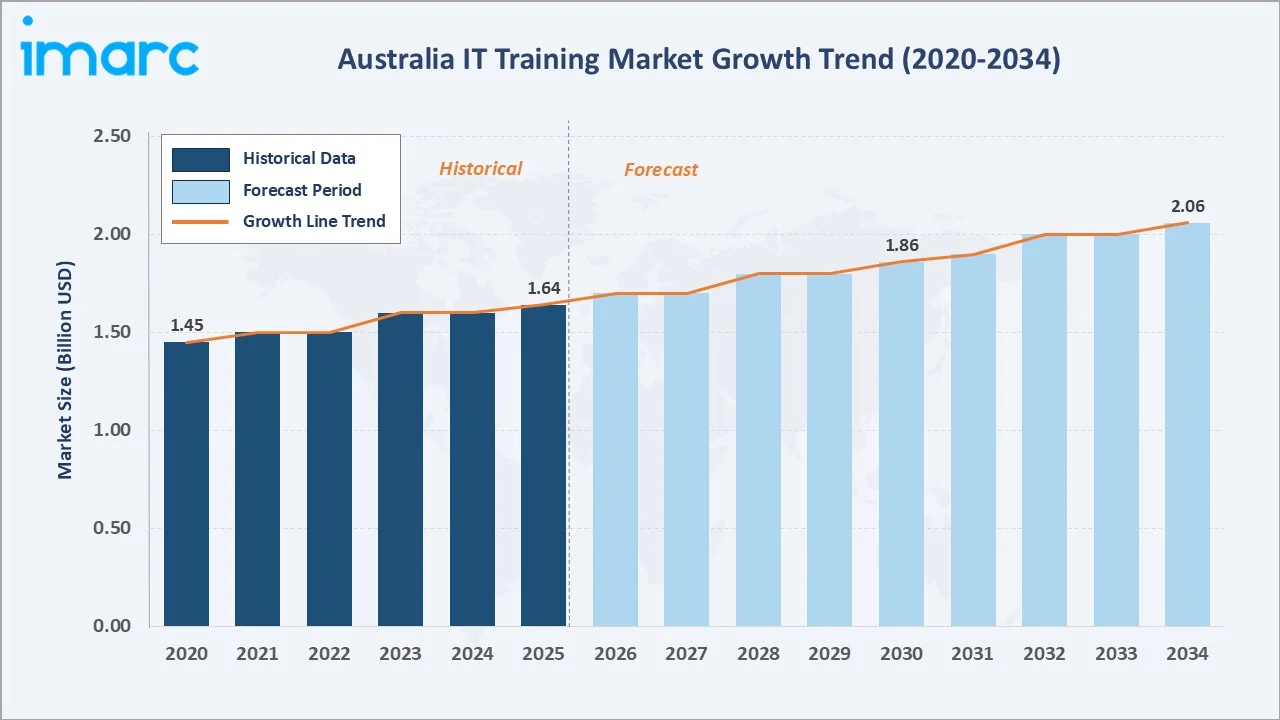
The Australia IT training market reached USD 1.64 Billion in 2025 and is projected to reach USD 2.06 Billion by 2034, expanding at a CAGR of 2.49% during 2026-2034. Rising demand for cybersecurity skills development, coupled with growing enterprise digital transformation initiatives and increasing government support for digital skills programs, are the primary growth catalysts.
Market Snapshot
|
Metric |
Value |
|
Market Size (2025) |
USD 1.64 Billion |
|
Forecast Market Size (2034) |
USD 2.06 Billion |
|
CAGR (2026-2034) |
2.49% |
|
Base Year |
2025 |
|
Historical Period |
2020-2025 |
|
Forecast Period |
2026-2034 |
Australia Capital Territory & New South Wales leads the national IT training landscape, holding a 40.3% share in 2025, anchored by the region's concentration of corporate headquarters and government digital skills initiatives. Enterprise application and software training commands the largest share of the application segment at 31.8%, reflecting sustained corporate demand for software proficiency and enterprise systems adoption.
To get more information on this market, Request Sample
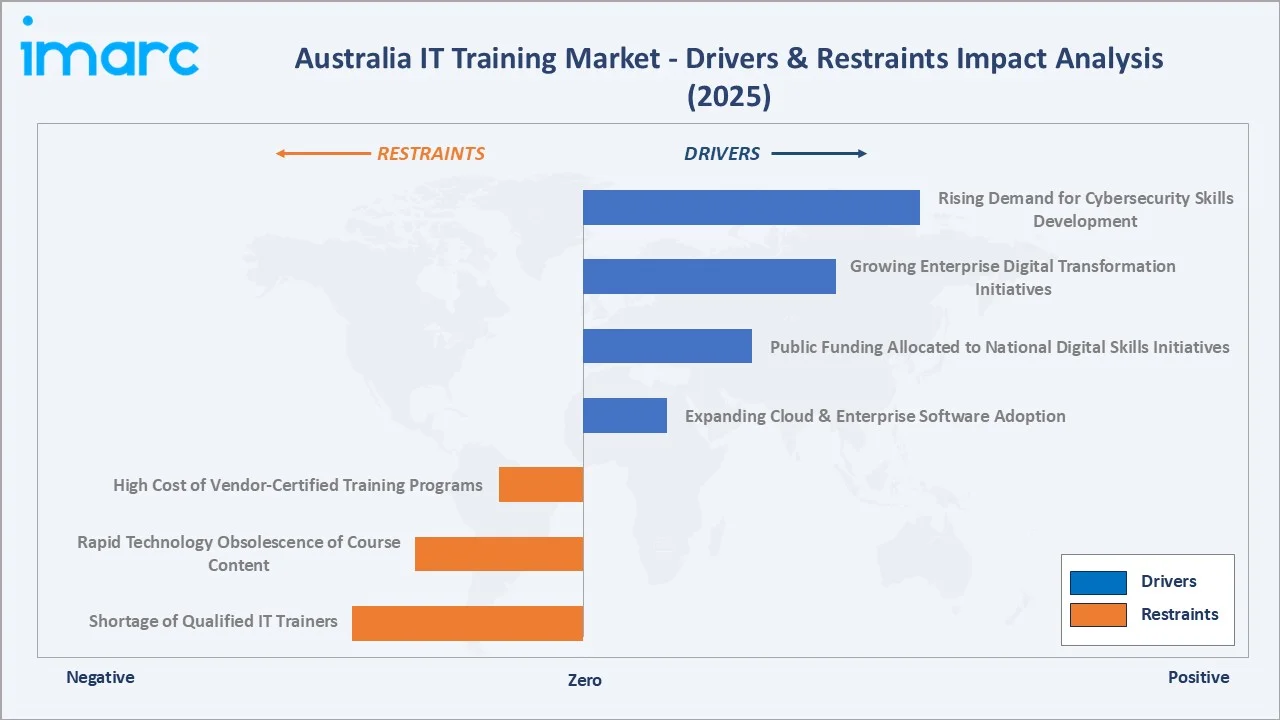
The Australia IT training market is underpinned by three structural forces: rising demand for cybersecurity skills development, growing enterprise digital transformation initiatives, and increasing government support for digital skills programs. Each force independently reinforces category growth, sustaining steady CAGR expansion through 2034 despite the high cost of vendor-certified training programs.
Executive Summary
The Australia IT training market is experiencing steady expansion, driven by rising cybersecurity skills demand, growing enterprise digital transformation initiatives, and increasing government support for digital skills programs. The market was valued at USD 1.64 Billion in 2025 and is forecast to reach USD 2.06 Billion by 2034, growing at a CAGR of 2.49%.
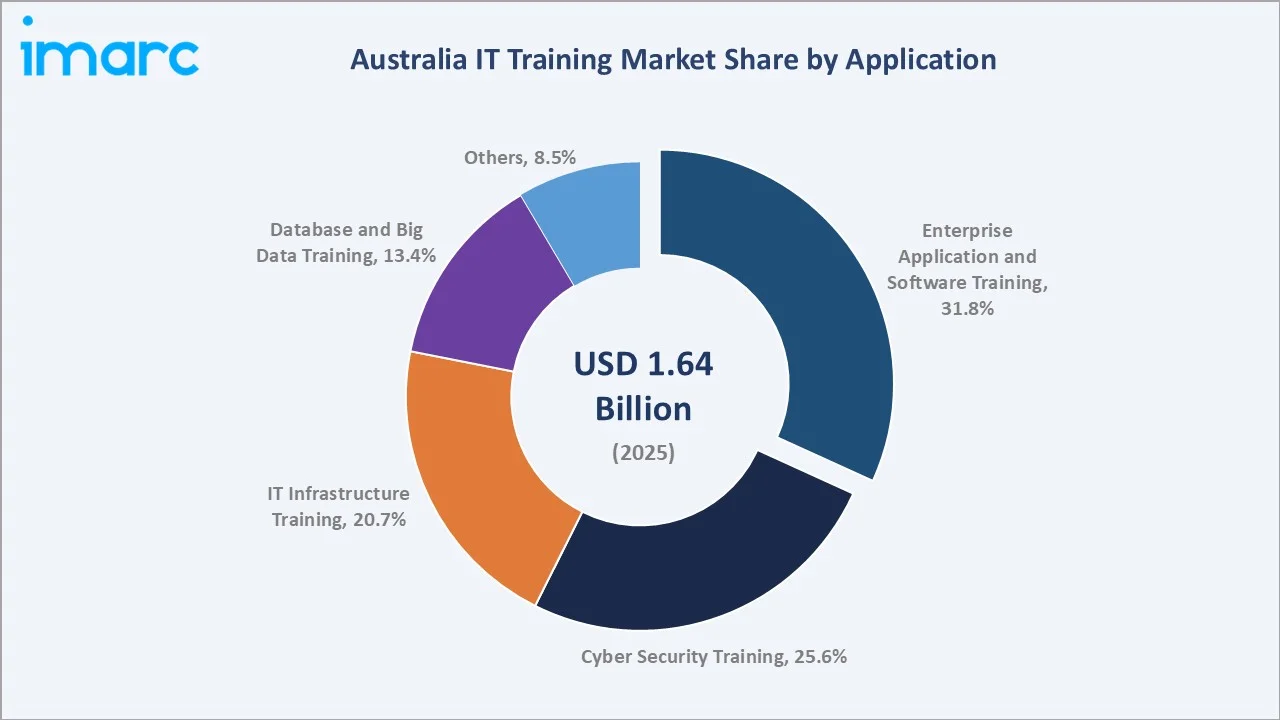
Enterprise application and software training dominates the application segment with a 31.8% share in 2025, encompassing enterprise resource planning, productivity software, and business systems training, while cyber security training accounts for 25.6%, IT infrastructure training for 20.7%, database and big data training for 13.4%, and other applications for 8.5%, reflecting the market's broad curriculum diversity.
Corporate leads the end user segment at 63.7% share, supported by sustained enterprise investment in employee upskilling and vendor-certified training programs, followed by schools and colleges at 24.9%, and other end users at 11.4%. Australia Capital Territory & New South Wales leads regionally at 40.3%, anchored by the region's concentration of corporate headquarters and government digital skills initiatives.
Key Market Insights
|
Insight |
Data |
|
Largest Application Segment |
Enterprise Application and Software Training – 31.8% share (2025) |
|
Fastest Growing Application Segment |
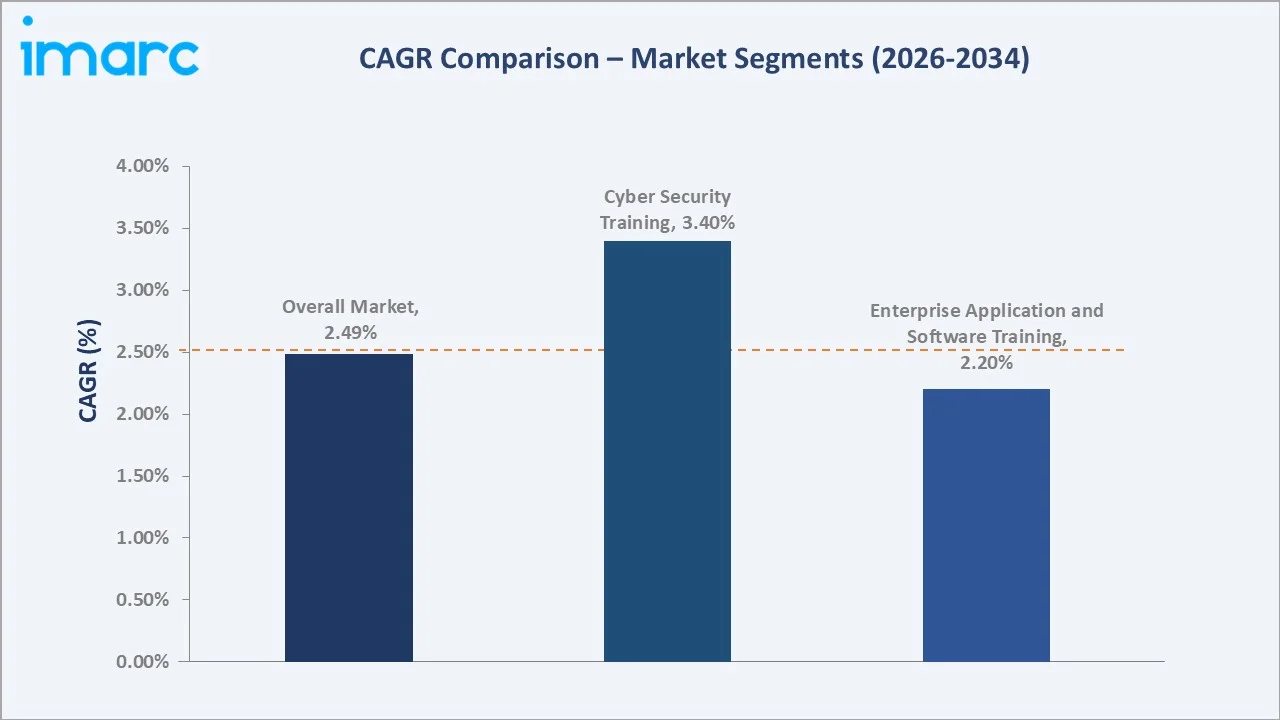
Cyber Security Training – ~3.4% CAGR (2026-2034) |
|
Largest End User Segment |
Corporate – 63.7% share (2025) |
|
Leading Region |
Australia Capital Territory & New South Wales – 40.3% share (2025) |
|
Top Companies |
EdventureCo, TAFE NSW, Thales Group, Logitrain Pty Ltd, SEEK Limited |
Key Analytical Observations Supporting the Above Data:
- Enterprise application and software training accounts for 31.8% of the Australia IT training market in 2025. This dominance reflects sustained corporate demand for software proficiency and enterprise systems adoption.
- Corporate remains the leading end user segment at 63.7% share (2025), supported by sustained enterprise investment in employee upskilling and vendor-certified training programs.
- Cyber security training is expanding steadily at 25.6% share (2025), as growing regulatory and enterprise focus on data protection continues to drive category growth.
- Australia Capital Territory & New South Wales's 40.3% share (2025) reflects its concentration of corporate headquarters and government digital skills initiatives.
- Rising convergence of IT training with cloud certification and AI skills curricula is broadening the addressable market across corporate, education, and government segments.
Australia IT Training Market Overview
The Australia IT training market encompasses enterprise application and software training, cyber security training, IT infrastructure training, database and big data training, and other application categories delivered to corporate, schools and colleges, and other end users, offering vendor-certified and vocational curricula for a wide range of IT skill development needs. The IT training ecosystem spans curriculum developers, training delivery platform providers, and an expanding network of instructor certification and enterprise partnership providers.
Macroeconomic drivers include rising demand for cybersecurity skills development, growing enterprise digital transformation initiatives, and increasing government support for digital skills programs. Training providers are simultaneously investing in cloud certification programs, blended learning formats, and expanded AI and data skills curricula to improve program relevance, positioning the Australia IT training sector for continued steady growth through 2034 despite the high cost of vendor-certified training programs.
Market Dynamics
To get more information on this market, Request Sample
Market Drivers
- Rising Demand for Cybersecurity Skills Development: Australia is strengthening data protection requirements for enterprises and government entities through the Privacy Act 1988 and Australian Privacy Principles (APPs), which mandate secure handling, transparency, and protection of personal information. Growing enterprise and government focus on data protection is driving sustained cybersecurity training adoption across corporate and public sector applications.
- Growing Enterprise Digital Transformation Initiatives: Rising enterprise investment in digital systems modernization is accelerating demand for enterprise application and software training programs. In March 2026, Persistent Systems launched the Melbourne Innovation Center as a strategic hub to accelerate AI-driven enterprise modernization, digital product innovation, and platform transformation across Australia and New Zealand (ANZ) region.
- Public Funding Allocated to National Digital Skills Initiatives: Australia is expanding public and industry-backed digital skills initiatives to build an AI-ready workforce, with programs targeting millions of citizens through accessible training and workforce development efforts. For example, Microsoft committed to helping 3 million Australians develop workforce-ready AI skills by 2028, supported through partnerships with government, industry, education, and community organizations.
- Expanding Cloud & Enterprise Software Adoption: Rising enterprise migration to cloud-based systems is increasing demand for vendor-certified cloud training and certification programs. Australian enterprises are increasingly adopting AWS cloud migration to modernize legacy infrastructure, improve scalability, enhance security, and support digital transformation initiatives.
Market Restraints
- High Cost of Vendor-Certified Training Programs: Significant costs associated with vendor certification and specialized IT training can constrain smaller enterprises and limit program accessibility.
- Shortage of Qualified IT Trainers: Persistent shortage of experienced, industry-certified trainers can limit training providers' capacity to scale program delivery. Demand for digital skills continues to rise, with the country expected to require 312,000 additional technology workers by 2030, including more than 60,000 new tech professionals annually to meet workforce needs.
- Rapid Technology Obsolescence of Course Content: Fast-evolving technology standards require continuous curriculum updates, increasing operational costs for training providers.
Market Opportunities
- Cloud Certification Program Expansion: Growing enterprise demand for cloud-certified professionals presents opportunities for training providers expanding vendor-aligned certification offerings.
- AI & Data Skills Curriculum Development: Rising demand for artificial intelligence and data analytics skills offers opportunities for providers expanding specialized technical curricula.
- Blended Learning Format Expansion: Growing preference for flexible, blended training delivery creates opportunities for providers investing in hybrid classroom and virtual learning models.
Market Challenges
- Balancing Program Depth and Accessibility: Providers must balance comprehensive, vendor-certified curriculum depth with the need to maintain training program affordability.
- Addressing Scalable Trainer Capacity: Ensuring sufficient qualified instructor capacity to meet growing enterprise and vocational training demand requires ongoing recruitment and development investment.
Emerging Market Trends
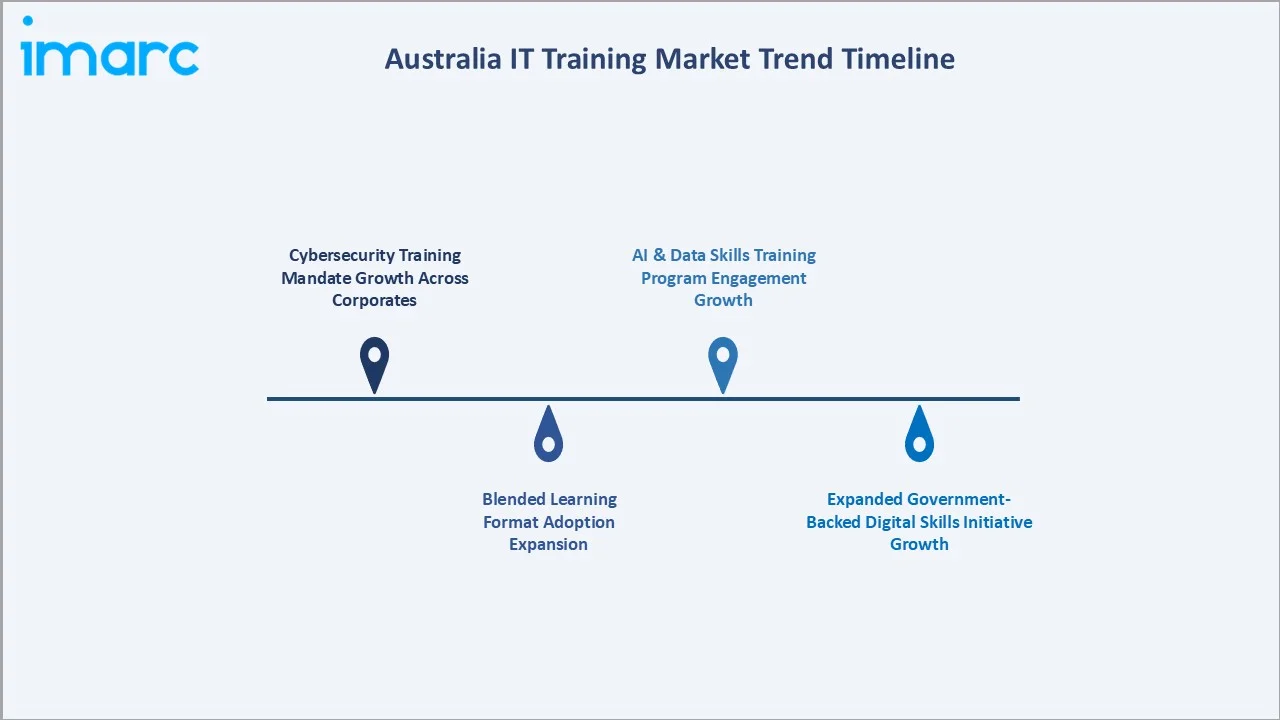
1. Cybersecurity Training Mandate Growth Across Corporates
Enterprises are increasingly mandating cybersecurity training programs for employees, driving sustained demand for structured, certification-aligned security curricula. For instance, Australia’s Information Security Manual (ISM) mandates annual cybersecurity awareness training for all personnel, establishing it as a formal security control rather than merely a recommended practice.
2. Blended Learning Format Adoption Expansion
Growing adoption of blended classroom and virtual learning formats is expanding training accessibility and improving completion rates across corporate and vocational segments. In Australia’s IT training market, organizations are increasingly adopting hybrid learning models to deliver flexible upskilling programs in areas such as cloud computing, cybersecurity, artificial intelligence, and software development.
3. AI & Data Skills Training Program Engagement Growth
Rising enterprise and individual engagement with AI and data analytics training programs is accelerating demand for specialized technical curricula beyond traditional IT infrastructure courses. In April 2026, Microsoft announced Australia’s largest AI skilling commitment, aiming to equip 3 million Australians with workforce-ready AI skills by 2028 through partnerships with government, industry, education, and community organizations.
4. Expanded Government-Backed Digital Skills Initiative Growth
Growing government-backed digital skills funding and initiatives are driving expansion of accessible IT training program adoption across the national education and vocational training system. The Australian Government is providing AUD 1,000 grants to community organizations through the Be Connected program to host free digital skills events during Get Online Week 2026, supporting digital inclusion and confidence-building among local communities.
Industry Value Chain Analysis
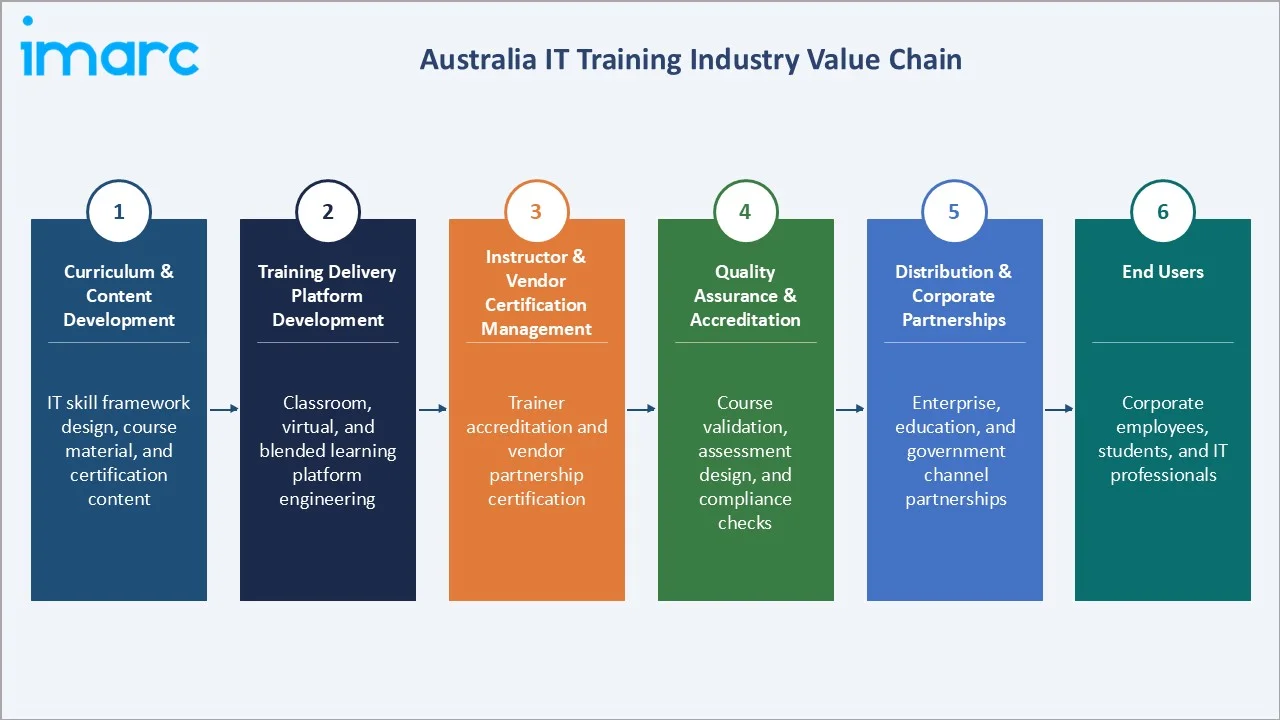
The Australia IT training value chain spans curriculum development through end user delivery, with each stage occupied by specialized content developers, training platform providers, and enterprise partnership providers whose performance directly influences program relevance, certification value, and cost-effectiveness.
|
Stage |
Key Activities |
|
Curriculum & Content Development |
IT skill framework design, course material, and certification content |
|
Training Delivery Platform Development |
Classroom, virtual, and blended learning platform engineering |
|
Instructor & Vendor Certification Management |
Trainer accreditation and vendor partnership certification |
|
Quality Assurance & Accreditation |
Course validation, assessment design, and compliance checks |
|
Distribution & Corporate Partnerships |
Enterprise, education, and government channel partnerships |
|
End Users |
Corporate employees, students, and IT professionals |
Technology Landscape in the Australia IT Training Industry
Advanced Cybersecurity Curriculum Technology
Training providers are advancing cybersecurity curriculum technology to improve certification accuracy and industry relevance, supporting broader adoption among corporate and government applications. In May 2025, Fortinet launched a cybersecurity curriculum for Australian classrooms to strengthen digital resilience by equipping students and educators with foundational cybersecurity knowledge and skills.
Cloud Certification Program Development
Growing investment in cloud certification program technology is expanding vendor-aligned training capacity, addressing rising enterprise demand for certified cloud professionals. Australia’s Whole-of-Government Cloud Computing Policy promotes secure, scalable, and efficient cloud adoption across government agencies, enabling modernization of public sector IT infrastructure and digital services.
Blended & Virtual Learning Delivery Systems
Providers are engineering advanced blended and virtual learning delivery systems to extend accessibility across demanding corporate and vocational student segments. Platforms integrating learning management systems (LMS), virtual labs, and remote instructor-led training are enabling flexible, scalable, and industry-aligned skill development.
AI & Data Analytics Curriculum Innovation
Expanding investment in AI and data analytics curriculum development is strengthening technical skill relevance, supporting premium positioning across leading enterprise IT training programs. Australian training providers are increasingly incorporating generative AI, machine learning, and data analytics tools into courses to address evolving workforce requirements and digital transformation needs.
Market Segmentation Analysis
The report covers the following segments:
|
Segment Category |
Leading Segment |
Market Share |
Year |
|
Application |
Enterprise Application and Software Training |
31.8% |
2025 |
|
End User |
Corporate |
63.7% |
2025 |
|
Region |
ACT & New South Wales |
40.3% |
2025 |

By Application
Enterprise application and software training dominates with a 31.8% share in 2025. This segment encompasses enterprise resource planning, productivity software, and business systems training, supported by sustained corporate demand for software proficiency.
To access detailed market analysis, Request Sample
Cyber security training represents 25.6% of the market (2025), followed by IT infrastructure training at 20.7%, database and big data training at 13.4%, and others at 8.5%, reflecting the market's broad curriculum diversity across technical skill domains.
By End User
Corporate leads the end user segment at 63.7% share (2025), supported by sustained enterprise investment in employee upskilling and vendor-certified training programs.
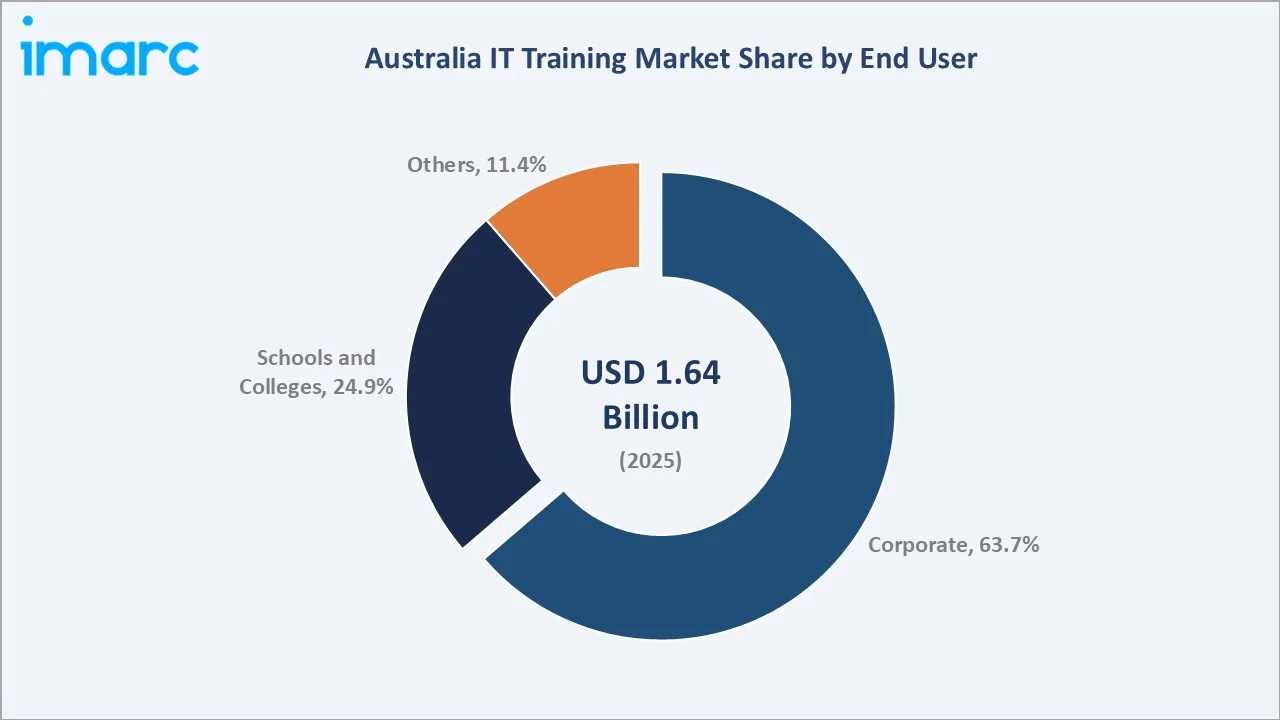
Schools and colleges account for 24.9% of the market (2025), reflecting growing vocational and academic IT curriculum adoption, while other end users represent 11.4%, encompassing government agencies and individual learners.
Regional Market Insights
Australia Capital Territory & New South Wales's market leadership (40.3%, 2025) reflects the region's concentration of corporate headquarters and government digital skills initiatives. Growing cybersecurity training mandates and expanding blended learning capacity combine to sustain its dominant position through 2034.
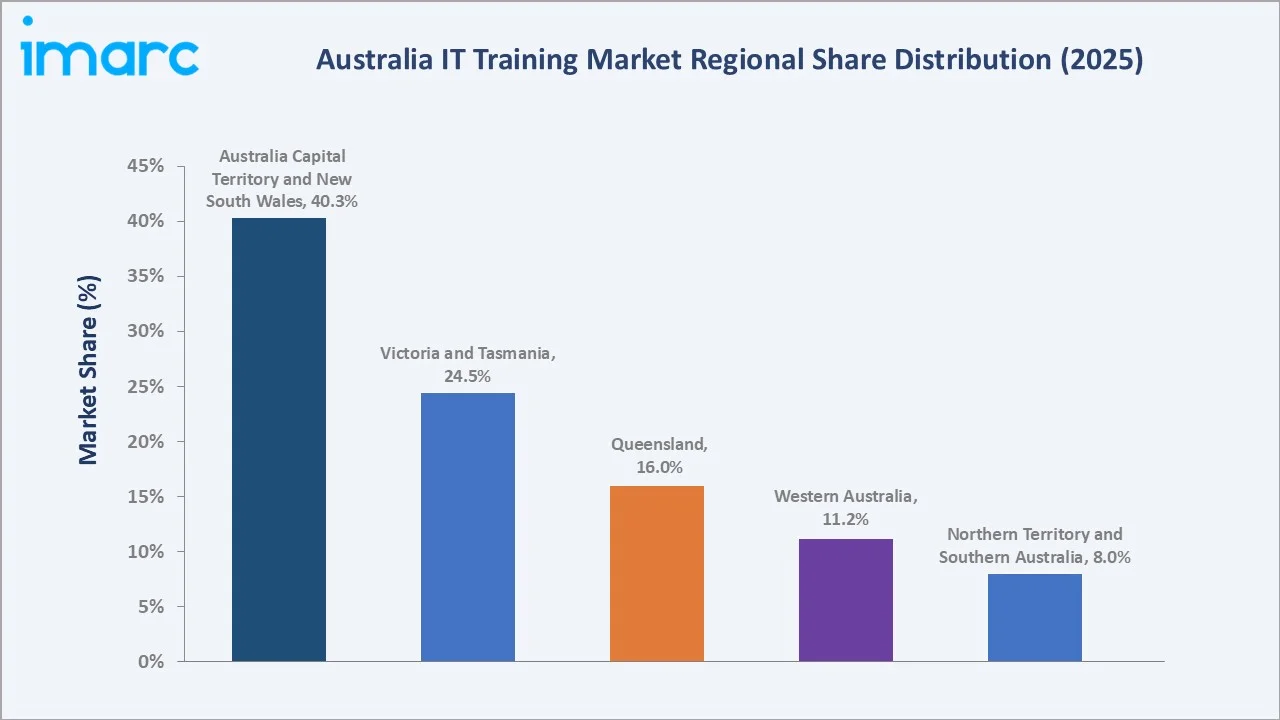
Victoria & Tasmania at 24.5% (2025) represents the second-largest Australia IT training market regionally. Growing enterprise digital transformation and expanding vocational education adoption are sustaining steady growth, positioning the region as a key contributor alongside Australia Capital Territory & New South Wales through the forecast period.
|
Region |
Share (2025) |
Key Growth Drivers |
|
Australia Capital Territory & New South Wales |
40.3% |
Concentration of corporate headquarters and government digital skills initiatives |
|
Victoria & Tasmania |
24.5% |
Growing enterprise digital transformation and expanding vocational education adoption |
|
Queensland |
16.0% |
Rising corporate cybersecurity training adoption and expanding regional training infrastructure |
|
Western Australia |
11.2% |
Emerging enterprise IT training adoption and expanding mining and resources sector digitalization |
|
Northern Territory & Southern Australia |
8.0% |
Growing government-backed digital skills funding and gradual enterprise training adoption |
Competitive Landscape
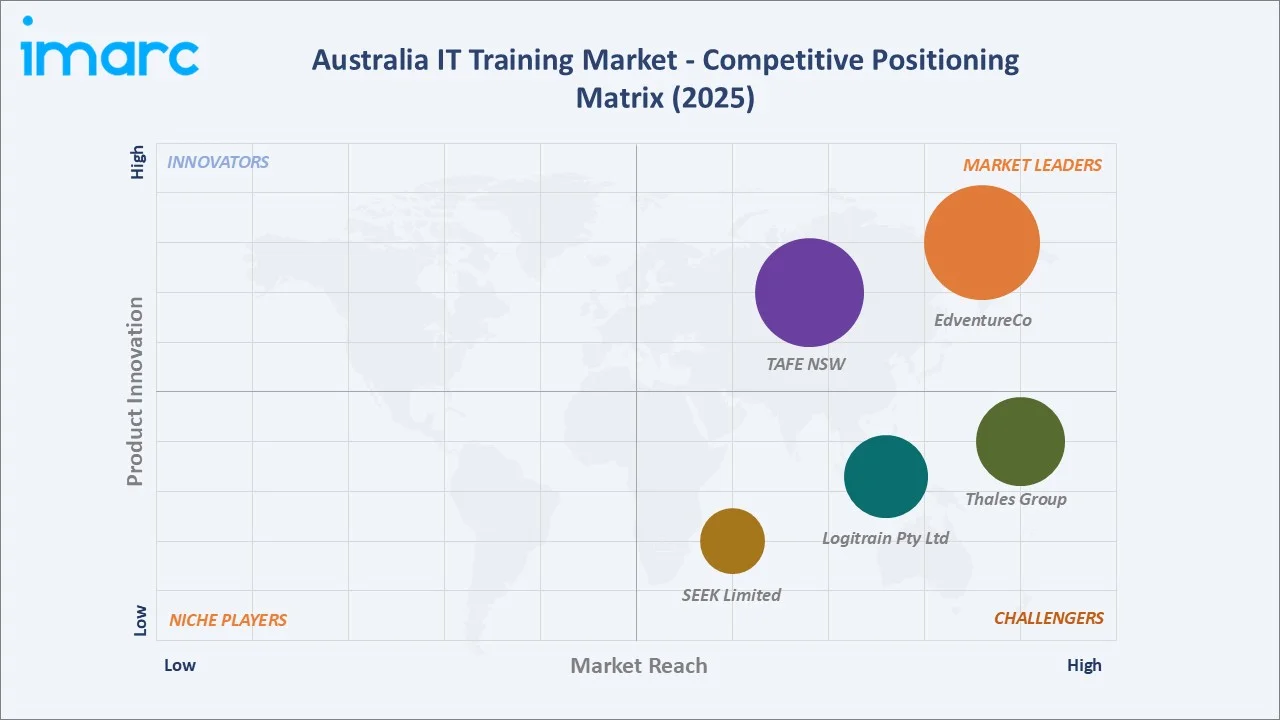
The Australia IT training market exhibits moderate concentration, with leading providers collectively holding a significant share of market revenue in 2025, reflecting sustained investment in curriculum innovation and enterprise reach.
|
Company Name |
Brand Name |
Market Position |
Core Strength |
|
EdventureCo |
Lumify Learn, Lumify Work, Lumify People, Nexacu, City Desktop, Wizard Corporate Training & Solutions, among others |
Market Leader |
One of the leading vendor-authorized IT training providers with an extensive Microsoft, AWS, and Cisco certification portfolio |
|
TAFE NSW |
TAFE NSW |
Market Leader |
Established government-recognized vocational institution with strong IT diploma and certificate offerings |
|
Thales Group |
Thales, ALC Training |
Strong Challenger |
Specialized IT governance and enterprise architecture training provider with strong ITIL and TOGAF presence |
|
Logitrain Pty Ltd |
Logitrain |
Strong Challenger |
Established job-ready IT training provider with strong internship and employability program integration |
|
SEEK Limited |
Dynamic Web Training |
Challenger |
Specialized creative and digital skills training provider with strong design and development curricula |
EdventureCo and TAFE NSW dominate through comprehensive vendor-certified and vocational curriculum portfolios and extensive enterprise reach, supported by continuous investment. Thales Group, Logitrain Pty Ltd, and SEEK Limited compete through targeted governance training specialization, employability program integration, and advanced technical curriculum differentiation, respectively.
Key Company Profiles
EdventureCo
EdventureCo’s subsidiary Lumify Group is one of the leading vendor-authorized IT training providers delivering Microsoft, AWS, Cisco, and security certification programs across Australia.
- Product Portfolio: Vendor-authorized certification courses, cloud computing training, and cybersecurity certification programs under Lumify Learn, Lumify Work, Lumify People, Nexacu, Wizard Corporate Training & Solutions, and City Desktop, among others.
- Recent Developments: In August 2024, Lumify Group acquired Wizard Corporate Training to expand its corporate ICT, professional development, and digital skills training portfolio, adding 25 new courses across professional development, application IT training, and customized programs.
- Strategic Focus: Strengthening vendor-authorized certification breadth; expanding cloud and cybersecurity training capacity across enterprise segments.
TAFE NSW
TAFE NSW is a leading government-recognized vocational education institution with a strong presence across IT networking, cloud engineering, and cybersecurity certificate and diploma programs.
- Product Portfolio: Vocational certificates, diplomas, and accredited IT training programs under the TAFE NSW brand.
- Recent Developments: In April 2026, TAFE NSW’s Industry Accelerator Program moved to full implementation after a successful pilot involving 34 advanced manufacturing teachers, with 50 digital and finance teachers. The program strengthens vocational training by enabling educators to gain current industry insights and share knowledge across TAFE NSW’s workforce to improve industry-aligned learning outcomes.
- Strategic Focus: Scaling accredited vocational IT program delivery; deepening industry and government partnership integration.
Market Concentration Analysis
The Australia IT training market exhibits moderate concentration, with EdventureCo, TAFE NSW, and Thales Group collectively accounting for a significant share of total category revenue in 2025, reflecting sustained curriculum investment, enterprise loyalty, and extensive training reach across the industry.
Consolidation pressure remains limited as leading providers maintain distinct strategic positioning: EdventureCo and TAFE NSW through comprehensive vendor-certified and vocational program portfolios, Thales Group and Logitrain Pty Ltd through governance framework and employability program scale positioning, and SEEK Limited through diversified creative and specialized technical curriculum differentiation, rather than pursuing direct M&A consolidation.
Investment & Growth Opportunities
Fastest Growing Segments
Cyber security training (~3.4% CAGR) represents the highest-growth investment vector through 2034, driven by expanding enterprise regulatory focus and continuous innovation across data protection curricula. This subcategory addresses a rapidly expanding addressable market within the Australia IT training ecosystem.
Emerging Market Expansion
The Western Australia and Northern Territory & Southern Australia regional markets collectively represent an incremental growth opportunity beyond Australia Capital Territory & New South Wales, Victoria & Tasmania, and Queensland by 2034, as rising enterprise digitalization and expanding government-backed funding accelerate category penetration in these emerging regions.
Venture and Institutional Investment Trends
- Provider investment toward cloud certification and AI and data skills curricula is creating opportunities for technology vendors serving the IT training sector.
- Growing enterprise cybersecurity training demand is sustaining institutional interest in specialty certification program providers.
- Blended learning format innovation, led by major providers, is opening opportunities for technology and platform vendors serving the Australia IT training industry.
Future Market Outlook (2026-2034)
The Australia IT training market is positioned for steady, skills-driven expansion through 2034. From a base of USD 1.64 Billion in 2025, the market is projected to reach USD 2.06 Billion by 2034, representing incremental value creation at a CAGR of 2.49%. This growth is underpinned by rising cybersecurity skills demand, growing enterprise digital transformation initiatives, and increasing government support for digital skills programs.
The application and end user segment will continue evolving through 2034, with cyber security training gaining further share as regulatory and enterprise data protection priorities accelerate. This shift creates opportunities for providers investing in cloud certification programs, blended learning formats, and expanded AI and data skills curricula to capture the next phase of the Australia IT training market growth.
Research Methodology
Primary Research
Primary research comprised structured interviews with industry participants across 2024-2025, including IT training provider executives, corporate learning and development managers, vocational education administrators, and digital skills policy experts across major Australian regions. Expert input validated market sizing, segmentation trends, and regional consumption patterns.
Secondary Research
Secondary research encompassed provider annual reports, vocational education association publications, and trade press covering curriculum innovation, regulatory trends, and regional market dynamics across Australia.
Forecasting Models
Market size estimations were derived using top-down and bottom-up forecasting, incorporating application and end user segment transitions and provider program disclosures. A base-case CAGR of 2.49% reflects consensus estimates validated against announced program investment timelines and provider strategic development plans.
Australia IT Training Market Report Coverage:
| Report Features | Details |
|---|---|
| Base Year of the Analysis | 2025 |
| Historical Period | 2020-2025 |
| Forecast Period | 2026-2034 |
| Units | Billion USD |
| Scope of the Report |
Exploration of Historical Trends and Market Outlook, Industry Catalysts and Challenges, Segment-Wise Historical and Future Market Assessment:
|
| Applications Covered | IT Infrastructure Training, Enterprise Application and Software Training, Cyber Security Training, Database and Big Data Training, Others |
| End Users Covered | Corporate, Schools and Colleges, Others |
| Regions Covered | Australia Capital Territory & New South Wales, Victoria & Tasmania, Queensland, Northern Territory & Southern Australia, Western Australia |
| Companies Covered | EdventureCo, TAFE NSW, Thales Group, Logitrain Pty Ltd, SEEK Limited, etc. |
| Customization Scope | 10% Free Customization |
| Post-Sale Analyst Support | 10-12 Weeks |
| Delivery Format | PDF and Excel through Email (We can also provide the editable version of the report in PPT/Word format on special request) |
Key Benefits for Stakeholders:
- IMARC’s industry report offers a comprehensive quantitative analysis of various market segments, historical and current market trends, market forecasts, and dynamics of the Australia IT training market from 2020-2034.
- The research report provides the latest information on the market drivers, challenges, and opportunities in the Australia IT training market.
- Porter's five forces analysis assist stakeholders in assessing the impact of new entrants, competitive rivalry, supplier power, buyer power, and the threat of substitution. It helps stakeholders to analyze the level of competition within the Australia IT training industry and its attractiveness.
- Competitive landscape allows stakeholders to understand their competitive environment and provides an insight into the current positions of key players in the market.
Frequently Asked Questions About the Australia IT Training Market Report
The Australia IT training market reached USD 1.64 Billion in 2025 and is projected to reach USD 2.06 Billion by 2034.
The market is expected to grow at a CAGR of 2.49% during 2026-2034, driven by rising cybersecurity skills demand and growing enterprise digital transformation initiatives.
Australia Capital Territory & New South Wales leads with a 40.3% share in 2025, anchored by the region's concentration of corporate headquarters and government digital skills initiatives.
Enterprise application and software training dominates with a 31.8% share in 2025, driven by sustained corporate demand for software proficiency and enterprise systems adoption.
Corporate leads with a 63.7% share in 2025, supported by sustained enterprise investment in employee upskilling and vendor-certified training programs.
Some of the key players include EdventureCo, TAFE NSW, Thales Group, Logitrain Pty Ltd, and SEEK Limited.
Cyber security training is growing fastest at an estimated 3.4% CAGR as enterprise and regulatory focus on data protection accelerates.
Key challenges include the high cost of vendor-certified training programs, shortage of qualified IT trainers, and rapid technology obsolescence of course content.
Cloud certification program expansion, AI and data skills curriculum development, and blended learning format expansion represent leading investment opportunities.
Schools and colleges, at 24.9% share, continue to reflect growing vocational and academic IT curriculum adoption, complementing corporate training demand.
Need more help?
- Speak to our experienced analysts for insights on the current market scenarios.
- Include additional segments and countries to customize the report as per your requirement.
- Gain an unparalleled competitive advantage in your domain by understanding how to utilize the report and positively impacting your operations and revenue.
- For further assistance, please connect with our analysts.
 Request Customization
 Speak to an Analyst
 Request Brochure
 Inquire Before Buying
Benefits of Customization
- Personalize this research
- Triangulate with your data
- Get data as per your format and definition
- Gain a deeper dive into a specific application, geography, customer, or competitor
- Any level of personalization
Get in Touch With Us
UNITED STATES
Phone: +1-201-971-6302
INDIA
Phone: +91-120-433-0800
UNITED KINGDOM
Phone: +44-753-714-6104
Email: [email protected]
Client Testimonials




.webp)




.webp)













Related Reports

Choose your plan
*Please note that the prices mentioned below are starting prices for each bundle type. Kindly contact our team for further details.*
Single User License
- 1 User License, Access on 2 Devices
- PDF Report + Excel Dataset (Password Protected)
- Lifetime Access
- No Printing Rights
- 10% Free Report Customization
- 10–12 Weeks of Analyst Support
Five User License
- Access for 5 Users, 2 Devices per User
- PDF Report + Excel Dataset (Password Protected)
- Lifetime Access
- Dedicated Account Manager
- 12–14 Weeks of Analyst Support
- No Printing Rights
- 15% Free Report Customization
- 25% Discount on Your Next Purchase
Corporate User License
- Unlimited User Access (Within Your Organization)
- PDF Report + Excel Dataset
- Lifetime Access
- Dedicated Account Manager
- 14–20 Weeks of Analyst Support
- No Printing Rights
- 20% Free Report Customization
- 30% Discount on Your Next Purchase
Essential Insights
What's included:
3 reports
- Lifetime Access
- PDF Reports
- Excel Datasets
- 2 Weeks of Free Analyst Support
- 2 User Licenses
- Access on 2 Devices
- Printing Rights
- Complimentary PowerPoint (PPT) Version
- Complimentary License Upgrade
Professional Access
What's included:
5 reports
- Lifetime Access
- PDF Reports
- Excel Datasets
- 8 Weeks of Free Analyst Support
- 2 User Licenses
- Access on 2 Devices
- Printing Rights
- Complimentary PowerPoint (PPT) Version
- Complimentary License Upgrade
Business Advantage
What's included:
8 reports
- Lifetime Access
- PDF Reports
- Excel Datasets
- 14 Weeks of Free Analyst Support
- 2 User Licenses
- Access on 2 Devices
- Printing Rights
- Complimentary PowerPoint (PPT) Version
- Complimentary License Upgrade
Enterprise Intelligence
What's included:
10 reports
- Lifetime Access
- PDF Reports
- Excel Datasets
- 20 Weeks of Free Analyst Support
- 2 User Licenses
- Access on 2 Devices
- Printing Rights
- Complimentary PowerPoint (PPT) Version
- Complimentary License Upgrade