
Australia Lip Care Products Market Size, Share, Trends and Forecast by Product, Distribution Channel, and Region, 2026-2034
Australia Lip Care Products Market Overview:
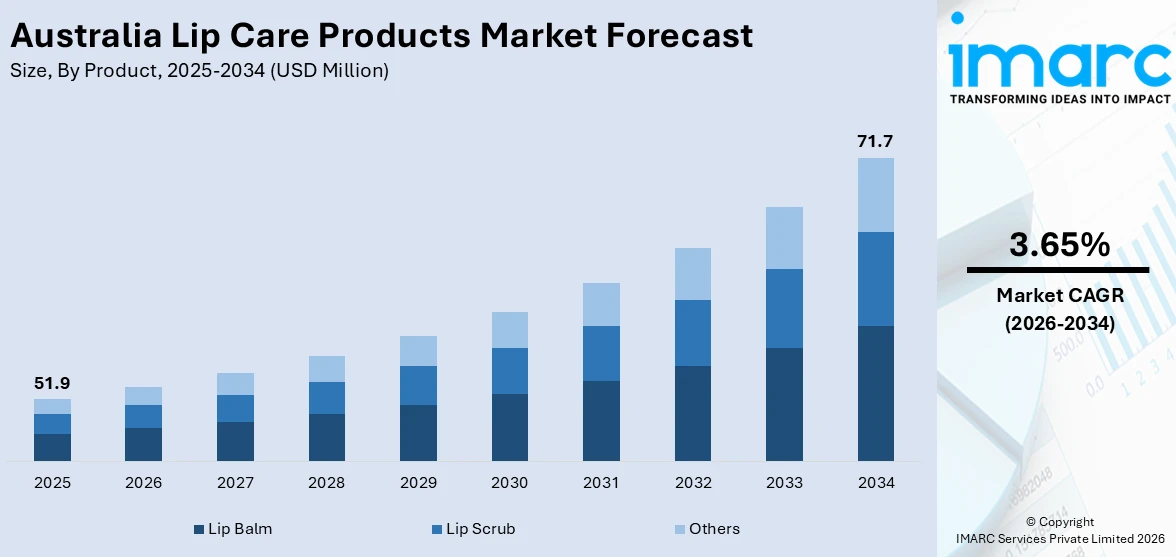
The Australia lip care products market size reached USD 51.9 Million in 2025. Looking forward, the market is expected to reach USD 71.7 Million by 2034, exhibiting a growth rate (CAGR) of 3.65% during 2026-2034. The rise of e-commerce is expanding market reach, with more people shopping online for lip care products, driven by convenience, product variety, and influencer marketing. Additionally, multifunctional beauty products are gaining popularity as individuals seek convenience and efficiency, thereby contributing to the expansion of the Australia lip care products market share.
|
Report Attribute
|
Key Statistics
|
|---|---|
|
Base Year
|
2025
|
|
Forecast Years
|
2026-2034
|
|
Historical Years
|
2020-2025
|
| Market Size in 2025 | USD 51.9 Million |
| Market Forecast in 2034 | USD 71.7 Million |
| Market Growth Rate 2026-2034 | 3.65% |
Key Trends of Australia Lip Care Products Market:
Rise of E-Commerce and Online Shopping
The expansion of e-commerce is contributing to the market growth, as more people choose online platforms for the ease of shopping from home. This change is facilitating the exploration of various lip care products, enabling price comparisons, allowing users to read reviews, and helping to make knowledgeable buying choices with little effort. Established brands and new niche companies are gaining from the extended reach that e-commerce provides, allowing them to aim for a larger audience beyond conventional physical stores. Social media channels, influencer promotions, and online advertising boost product visibility, leading to a rise in online buying. The availability of these products online is fostering competition in the market, encouraging brands to innovate and distinguish themselves to draw in buyers. The rising number of e-commerce platforms are supporting the Australia lip care products market growth by enhancing sales and client engagement. The Australian e-commerce market was estimated to be worth USD 536.0 Billion in 2024 and is anticipated to attain USD 1,568.60 Billion by 2034, with a compound annual growth rate (CAGR) of 12.70% from 2025 to 2034. This swift expansion reflects a significant shift toward online shopping, which continues to support the lip care industry by providing users with convenient access to a wide range of products and enabling brands to capture a larger market share.
To get more information on this market Request Sample
Increased Focus on Multitasking Beauty Products
Individuals are progressively leaning toward multifunctional beauty products, offering both convenience and effectiveness. In the lip care industry, this trend is evident in the growing demand for products that offer multiple benefits, including moisture and a subtle hint of color. As beauty routines become more efficient, individuals are seeking products that provide essential skincare benefits while enhancing their appearance. Lip balms, glosses, and tints that offer benefits such as hydration, sun protection, and a natural shade in a single product are gaining popularity. The appeal of these multitasking lip care products lies in their ability to address multiple concerns simultaneously, saving time without compromising on results. For example, in 2024, the Australian brand Bangn Body introduced its Lip and Cheek Gloss Balm, a vegan, multifunctional product that provides tint, moisture, and shine for the lips, cheeks, and eyelids. The product quickly gained popularity, attracting over 50,000 individuals to the waitlist and highlighting the desire for multifunctional beauty products. As people increasingly favor straightforward and effective solutions, brands are adapting by innovating and developing dual-purpose products that cater to the rising demand for practicality and efficiency in beauty routines. This trend is leading to a shift towards more multifunctional products, catering to the changing demands of beauty-conscious and time-sensitive users.
Growth Drivers of Australia Lip Care Products Market:
Increasing Consumer Awareness About Lip Health and Protection
Rising consciousness towards lip health and the need to protect the lips against environmental stressors is strongly influencing the market demand. Consumers are understanding more and more that the lips need special care because they have fragile skin texture with no oil glands and are more prone to dryness, chapping, and sun damage. This increasing consciousness is encouraging consumers to spend money on good-quality lip care products that provide hydration, nourishment, and protection from the sun. The increasing incidence of lip-related issues, combined with educational efforts by dermatologists and skincare specialists, is inducing active lip care habits. Also, the harmful consequences of ultraviolet (UV) radiation on the lips have made lip products with SPF protection more popular. Consumers look for products containing natural ingredients, antioxidants, and vitamins that offer therapeutic advantages beyond plain moisturization. This is especially evident among younger generations who are better educated on skincare and preventive treatment. As awareness continues to expand through social media, beauty influencers, and healthcare professionals, the demand for premium lip care solutions is experiencing substantial growth, thereby positively influencing the Australia lip care products market analysis.
Rise of Clean Beauty and Natural Ingredient Preferences
The increasing demand for clean beauty and natural ingredients is beginning to become an important growth factor for the Australian lip care products market. People are getting more aware of the ingredients in their personal care products and are now looking for formulations without harsh chemicals, parabens, sulfates, and fragrance chemicals. This is motivated by fears over possible health hazards posed by some chemical ingredients, especially by products that are consumed unknowingly due to their proximity to the lips. Australian consumers are turning towards lip products that contain organic, natural, and sustainably extracted ingredients like shea butter, coconut oil, beeswax, and plant extracts. Demand for cruelty-free and vegan lip care is also increasing, as it falls in line with wider trends of ethical consumption. Companies that focus on transparency around ingredient sourcing and manufacturing practices are building consumer trust and loyalty. Social media influencers and beauty bloggers further add voice to the clean beauty movement with arguments for safer, greener product options. This trend is compelling manufacturers to reformulate existing products and develop new lines that meet clean beauty standards, thereby expanding the market and attracting health-conscious consumers who prioritize ingredient integrity and environmental responsibility.
Growing Male Grooming Market and Gender-Neutral Beauty Products
The expanding male grooming market and the rising acceptance of gender-neutral beauty products are creating new growth opportunities for the Australian lip care products industry. Traditional gender barriers in beauty and personal care are diminishing as men increasingly embrace skincare and grooming routines that include lip care. This cultural shift is driven by changing social attitudes, increased representation of male beauty in media, and growing awareness of the importance of self-care among men. Male consumers are seeking lip care solutions that address specific concerns such as dryness, chapping, and weathering from outdoor activities, sports, and occupational exposure. The demand for subtle, unscented, or masculinely marketed lip care products is rising, prompting brands to develop targeted offerings for this demographic. Additionally, the emergence of gender-neutral beauty products that appeal to all consumers regardless of gender identity is further broadening the market base. This inclusivity trend is particularly resonant with younger generations who prioritize diversity and representation in beauty marketing. The growing acceptance of lip care as an essential component of overall grooming, rather than a purely feminine concern, is dismantling stereotypes and expanding the consumer base, thereby contributing substantially to market growth and diversification.
Opportunities of Australia Lip Care Products Market:
Expansion of Premium and Luxury Lip Care Segments
The growing affluence and willingness of Australian consumers to invest in premium and luxury lip care products present a significant opportunity for market expansion. As disposable incomes rise and consumers become more discerning about product quality, there is increasing demand for high-end lip care solutions that offer superior formulations, exclusive ingredients, and sophisticated packaging. Luxury beauty brands are capitalizing on this trend by introducing premium lip care lines featuring rare botanical extracts, advanced anti-aging technologies, and innovative delivery systems. The prestige associated with luxury brands, combined with the perceived efficacy of premium ingredients, is attracting consumers who view lip care as an investment in their overall appearance and well-being. This segment is particularly appealing to beauty enthusiasts who seek indulgent, spa-quality experiences in their daily routines. The opportunity extends to specialized treatments such as overnight lip masks, intensive repair serums, and professional grade exfoliating products that command higher price points. Additionally, limited-edition collections, collaborations with celebrities or influencers, and artisanal formulations are creating excitement and exclusivity in the premium segment. As the Australia lip care products market demand for luxury experiences continues to grow, brands could differentiate themselves through innovation, storytelling, and exceptional product performance, thereby capturing a more profitable segment of the market.
Leveraging Digital Marketing and Influencer Partnerships
The proliferation of digital platforms and the influence of social media personalities present substantial opportunities for brands to enhance visibility and drive sales in the Australian lip care products market. Digital marketing strategies, including targeted social media campaigns, search engine optimization, and content marketing, enable brands to reach specific demographic segments with personalized messaging. Influencer partnerships have become particularly effective, as beauty influencers and content creators command significant followings and can authentically demonstrate product benefits through reviews, tutorials, and before-and-after transformations. These collaborations generate user-generated content that builds trust and credibility among potential customers. The opportunity extends to micro-influencers who often have highly engaged niche audiences, providing cost-effective marketing channels for emerging brands. Live streaming, interactive Q&A sessions, and virtual product launches create real-time engagement and foster community building around brands. Additionally, user reviews and testimonials shared across digital platforms serve as powerful social proof that influences purchasing decisions. The ability to track metrics, analyze consumer behavior, and adjust strategies in real-time makes digital marketing highly efficient and measurable. As the market analysis reveals increasing digital engagement, brands that effectively leverage these channels can significantly expand their reach, build brand loyalty, and convert online engagement into sales, particularly among younger, digitally-native consumers.
Innovation in Specialized and Therapeutic Lip Care Products
The development of specialized and therapeutic lip care products addressing specific concerns represents a compelling opportunity for market differentiation and growth. Consumers are seeking targeted solutions for conditions such as severe dryness, cracking, hyperpigmentation, fine lines, and sensitivity. This demand creates opportunities for brands to develop advanced formulations incorporating active ingredients like hyaluronic acid, peptides, ceramides, and growth factors that deliver clinical-level results. Therapeutic lip care products designed to treat medical conditions such as chronic cheilitis, eczema, or post-procedure recovery offer another growth avenue, particularly when recommended by dermatologists or healthcare professionals. The opportunity extends to age-defying lip care products that address concerns such as volume loss, definition blurring, and wrinkle formation around the lip area. Innovations in product formats, such as overnight lip masks, lip patches, plumping glosses, and tinted treatments that combine care with color, are attracting consumers seeking convenience and multifunctionality. Additionally, personalized lip care solutions tailored to individual needs, skin types, and climate conditions represent an emerging frontier. As consumers become more educated about specific lip concerns and available treatments, brands that invest in research and development to create scientifically backed, results-driven products can establish themselves as category leaders and command premium positioning in the increasingly sophisticated market.
Challenges of Australia Lip Care Products Market:
Intense Market Competition and Brand Differentiation Difficulties
The Australian lip care products market faces significant challenges due to intense competition among numerous domestic and international brands vying for market share. The relatively low barriers to entry in the lip care segment have led to market saturation, with countless products offering similar benefits at comparable price points. This crowded marketplace makes it increasingly difficult for brands, particularly new entrants and smaller companies, to differentiate themselves and capture consumer attention. Established multinational corporations leverage their extensive distribution networks, substantial marketing budgets, and brand recognition to maintain dominant positions, making it challenging for emerging brands to gain visibility. The proliferation of private-label and store-brand alternatives offered by major retailers at lower price points further intensifies competitive pressure, particularly in the mass market segment. Consumers face overwhelming choice, often leading to decision paralysis or reliance on familiar brands rather than experimenting with new options. The challenge of differentiation is compounded by the difficulty in communicating unique value propositions in a market where many products claim similar benefits. Brands must invest significantly in marketing, innovation, and consumer education to stand out, which may not be financially viable for smaller players. Additionally, the rapid pace of beauty trends means that products can quickly become outdated, requiring constant innovation and reformulation to remain relevant and competitive in this dynamic market environment.
Regulatory Compliance and Ingredient Transparency Requirements
Navigating the complex regulatory landscape governing cosmetic and personal care products presents ongoing challenges for lip care product manufacturers in Australia. The Therapeutic Goods Administration (TGA) and other regulatory bodies enforce strict standards regarding product safety, ingredient disclosure, labeling requirements, and marketing claims. Compliance with these regulations requires significant investment in testing, documentation, and quality assurance processes, particularly for brands making therapeutic or medicinal claims. The challenge intensifies for companies importing products or ingredients from overseas, as they must ensure compliance with both Australian standards and international regulations. Increasing consumer demand for ingredient transparency has raised expectations beyond regulatory minimums, with consumers expecting comprehensive disclosure of all ingredients, their sources, and potential allergens or irritants. This transparency requirement extends to manufacturing processes, sustainability practices, and ethical sourcing, creating additional compliance burdens. Small and medium-sized enterprises may struggle with the resources required for comprehensive regulatory compliance and the ongoing monitoring of evolving standards. Additionally, the rise of social media means that any regulatory violations, ingredient controversies, or safety concerns can quickly become public, potentially causing significant reputational damage. The challenge is further complicated by varying international standards, making it difficult for brands with global ambitions to create formulations that satisfy all jurisdictional requirements while maintaining product consistency and efficacy across markets.
Supply Chain Disruptions and Raw Material Price Volatility
The Australian lip care products market faces persistent challenges related to supply chain vulnerabilities and fluctuating raw material costs that impact profitability and operational stability. The industry relies heavily on imported ingredients, particularly specialty oils, botanical extracts, and active compounds sourced from various global regions. Geopolitical tensions, trade disputes, pandemic-related disruptions, and climate change effects on agricultural production create uncertainty in supply chain reliability and consistency. Transportation delays, port congestion, and increased freight costs directly impact product availability and pricing structures. The volatility in raw material prices, particularly for natural and organic ingredients that are increasingly preferred by consumers, makes it challenging to maintain consistent profit margins and pricing strategies. Brands may face difficult decisions between absorbing increased costs, which reduces profitability, or passing costs to consumers, which risks pricing themselves out of competitive positions. The challenge extends to packaging materials, where sustainability requirements are driving demand for eco-friendly alternatives that often command premium prices and may have limited supplier options. Small-scale manufacturers with limited purchasing power are particularly vulnerable to these disruptions, as they lack the negotiating leverage and inventory buffers that larger corporations maintain. Additionally, the complexity of maintaining quality standards across diverse supplier networks, ensuring ethical sourcing practices, and verifying sustainability claims adds operational complexity that requires robust supply chain management capabilities and ongoing investment in supplier relationships and risk mitigation strategies.
Australia Lip Care Products Market Segmentation:
IMARC Group provides an analysis of the key trends in each segment of the market, along with forecasts at the country and regional levels for 2026-2034. Our report has categorized the market based on product and distribution channel.
Product Insights:
- Lip Balm
- Lip Scrub
- Others
The report has provided a detailed breakup and analysis of the market based on the product. This includes lip balm, lip scrub, and others.
Distribution Channel Insights:
Access the comprehensive market breakdown Request Sample
- Hypermarkets and Supermarkets
- Pharmacy and Drug Stores
- Specialty Stores
- Online
- Others
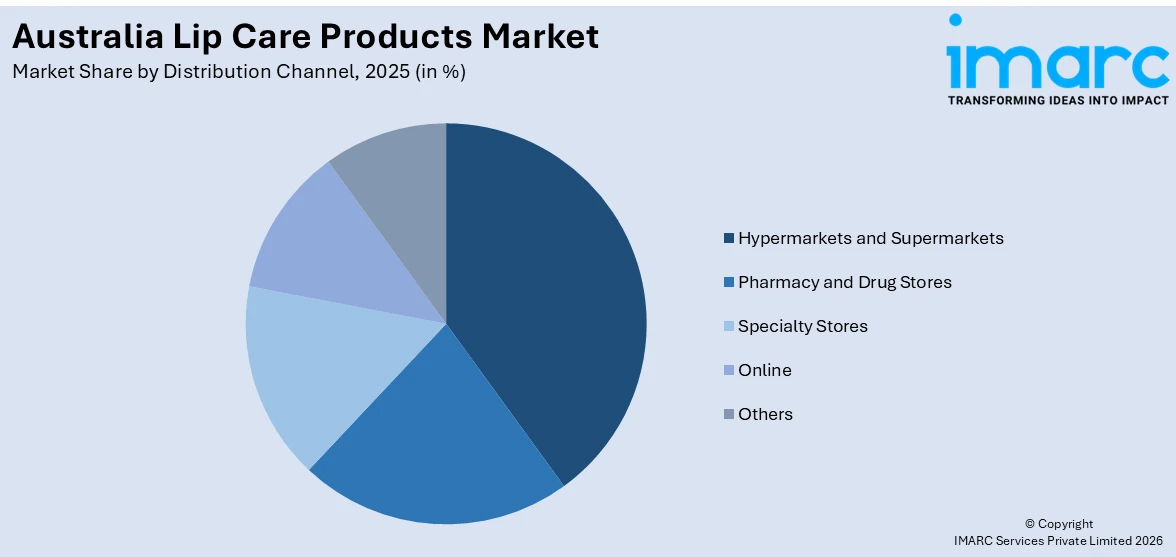
A detailed breakup and analysis of the market based on the distribution channel have also been provided in the report. This includes hypermarkets and supermarkets, pharmacy and drug stores, specialty stores, online, and others.
Regional Insights:
- Australia Capital Territory & New South Wales
- Victoria & Tasmania
- Queensland
- Northern Territory & Southern Australia
- Western Australia
The report has also provided a comprehensive analysis of all the major regional markets, which include Australia Capital Territory & New South Wales, Victoria & Tasmania, Queensland, Northern Territory & Southern Australia, and Western Australia.
Competitive Landscape:
The market research report has also provided a comprehensive analysis of the competitive landscape. Competitive analysis such as market structure, key player positioning, top winning strategies, competitive dashboard, and company evaluation quadrant has been covered in the report. Also, detailed profiles of all major companies have been provided.
Australia Lip Care Products Market News:
- In April 2025, MECCA officially launched Isamaya Beauty in Australia, bringing the brand’s innovative, skincare-infused makeup line to stores and online. Created by makeup artist Isamaya Ffrench, the Core Collection includes products like contour sticks, lip balms, and serums.
- In March 2025, Australian brand Lanolips launched its new Hyaluronic Lip Oil in two sheer shades, including Honey and Raspberry. Infused with lanolin and hyaluronic acid, the lip oils offer glossy, non-sticky hydration.
Australia Lip Care Products Market Report Coverage:
| Report Features | Details |
|---|---|
| Base Year of the Analysis | 2025 |
| Historical Period | 2020-2025 |
| Forecast Period | 2026-2034 |
| Units | Million USD |
| Scope of the Report |
Exploration of Historical Trends and Market Outlook, Industry Catalysts and Challenges, Segment-Wise Historical and Future Market Assessment:
|
| Products Covered | Lip Balm, Lip Scrub, Others |
| Distribution Channels Covered | Hypermarkets and Supermarkets, Pharmacy and Drug Stores, Specialty Stores, Online, Others |
| Regions Covered | Australia Capital Territory & New South Wales, Victoria & Tasmania, Queensland, Northern Territory & Southern Australia, Western Australia |
| Customization Scope | 10% Free Customization |
| Post-Sale Analyst Support | 10-12 Weeks |
| Delivery Format | PDF and Excel through Email (We can also provide the editable version of the report in PPT/Word format on special request) |
Key Questions Answered in This Report:
- How has the Australia lip care products market performed so far and how will it perform in the coming years?
- What is the breakup of the Australia lip care products market on the basis of product?
- What is the breakup of the Australia lip care products market on the basis of distribution channel?
- What is the breakup of the Australia lip care products market on the basis of region?
- What are the various stages in the value chain of the Australia lip care products market?
- What are the key driving factors and challenges in the Australia lip care products market?
- What is the structure of the Australia lip care products market and who are the key players?
- What is the degree of competition in the Australia lip care products market?
Key Benefits for Stakeholders:
- IMARC’s industry report offers a comprehensive quantitative analysis of various market segments, historical and current market trends, market forecasts, and dynamics of the Australia lip care products market from 2020-2034.
- The research report provides the latest information on the market drivers, challenges, and opportunities in the Australia lip care products market.
- Porter's five forces analysis assist stakeholders in assessing the impact of new entrants, competitive rivalry, supplier power, buyer power, and the threat of substitution. It helps stakeholders to analyze the level of competition within the Australia lip care products industry and its attractiveness.
- Competitive landscape allows stakeholders to understand their competitive environment and provides an insight into the current positions of key players in the market.
Frequently Asked Questions About the Australia Lip Care Products Market Report
The lip care products market in Australia was valued at USD 51.9 Million in 2025.
The Australia lip care products market is projected to exhibit a CAGR of 3.65% during 2026-2034.
The Australia lip care products market is projected to reach a value of USD 71.7 Million by 2034.
The market is experiencing rapid growth driven by the expansion of e-commerce platforms that provide convenient access to diverse product ranges and enable comparison shopping. Additionally, the growing preference for multitasking beauty products that combine hydration, color, and sun protection in a single formulation is reshaping consumer purchasing patterns and driving innovation across the industry.
The Australia lip care products market demand is driven by increasing consumer awareness about lip health and protection needs, rising preference for clean beauty and natural ingredient formulations, and the expanding male grooming segment embracing lip care routines. Additionally, growing affluence, the effectiveness of digital marketing, and innovation in specialized therapeutic products further accelerate growth across the market.
Need more help?
- Speak to our experienced analysts for insights on the current market scenarios.
- Include additional segments and countries to customize the report as per your requirement.
- Gain an unparalleled competitive advantage in your domain by understanding how to utilize the report and positively impacting your operations and revenue.
- For further assistance, please connect with our analysts.
 Request Customization
 Speak to an Analyst
 Request Brochure
 Inquire Before Buying
Benefits of Customization
- Personalize this research
- Triangulate with your data
- Get data as per your format and definition
- Gain a deeper dive into a specific application, geography, customer, or competitor
- Any level of personalization
Get in Touch With Us
UNITED STATES
Phone: +1-201-971-6302
INDIA
Phone: +91-120-433-0800
UNITED KINGDOM
Phone: +44-753-714-6104
Email: [email protected]
Client Testimonials




.webp)




.webp)













Related Reports

Choose your plan
*Please note that the prices mentioned below are starting prices for each bundle type. Kindly contact our team for further details.*
Single User License
- 1 User License, Access on 2 Devices
- PDF Report + Excel Dataset (Password Protected)
- Lifetime Access
- No Printing Rights
- 10% Free Report Customization
- 10–12 Weeks of Analyst Support
Five User License
- Access for 5 Users, 2 Devices per User
- PDF Report + Excel Dataset (Password Protected)
- Lifetime Access
- Dedicated Account Manager
- 12–14 Weeks of Analyst Support
- No Printing Rights
- 15% Free Report Customization
- 25% Discount on Your Next Purchase
Corporate User License
- Unlimited User Access (Within Your Organization)
- PDF Report + Excel Dataset
- Lifetime Access
- Dedicated Account Manager
- 14–20 Weeks of Analyst Support
- No Printing Rights
- 20% Free Report Customization
- 30% Discount on Your Next Purchase
Essential Insights
What's included:
3 reports
- Lifetime Access
- PDF Reports
- Excel Datasets
- 2 Weeks of Free Analyst Support
- 2 User Licenses
- Access on 2 Devices
- Printing Rights
- Complimentary PowerPoint (PPT) Version
- Complimentary License Upgrade
Professional Access
What's included:
5 reports
- Lifetime Access
- PDF Reports
- Excel Datasets
- 8 Weeks of Free Analyst Support
- 2 User Licenses
- Access on 2 Devices
- Printing Rights
- Complimentary PowerPoint (PPT) Version
- Complimentary License Upgrade
Business Advantage
What's included:
8 reports
- Lifetime Access
- PDF Reports
- Excel Datasets
- 14 Weeks of Free Analyst Support
- 2 User Licenses
- Access on 2 Devices
- Printing Rights
- Complimentary PowerPoint (PPT) Version
- Complimentary License Upgrade
Enterprise Intelligence
What's included:
10 reports
- Lifetime Access
- PDF Reports
- Excel Datasets
- 20 Weeks of Free Analyst Support
- 2 User Licenses
- Access on 2 Devices
- Printing Rights
- Complimentary PowerPoint (PPT) Version
- Complimentary License Upgrade