
Australia Management Consulting Market Size, Share, Trends and Forecast by Type, Organization Size, Industry Vertical, and Region, 2026-2034
Australia Management Consulting Market Size, Share, Trends & Forecast (2026-2034)
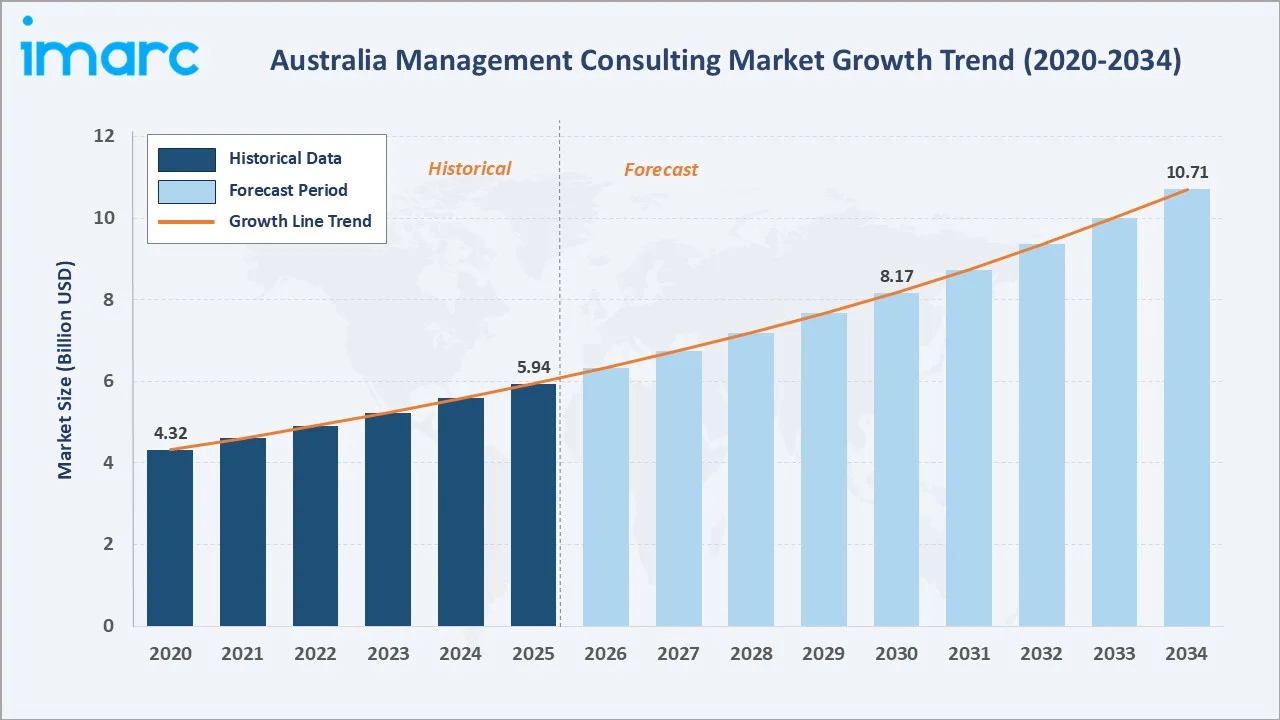
The Australia management consulting market was valued at USD 5.94 Billion in 2025 and is projected to reach USD 10.71 Billion by 2034, exhibiting a CAGR of 6.56% during 2026-2034. Rising regulatory complexity, sustained enterprise investment in digital and AI-led transformation, and expanding advisory demand across mining, financial services, and government are the primary drivers shaping market growth.
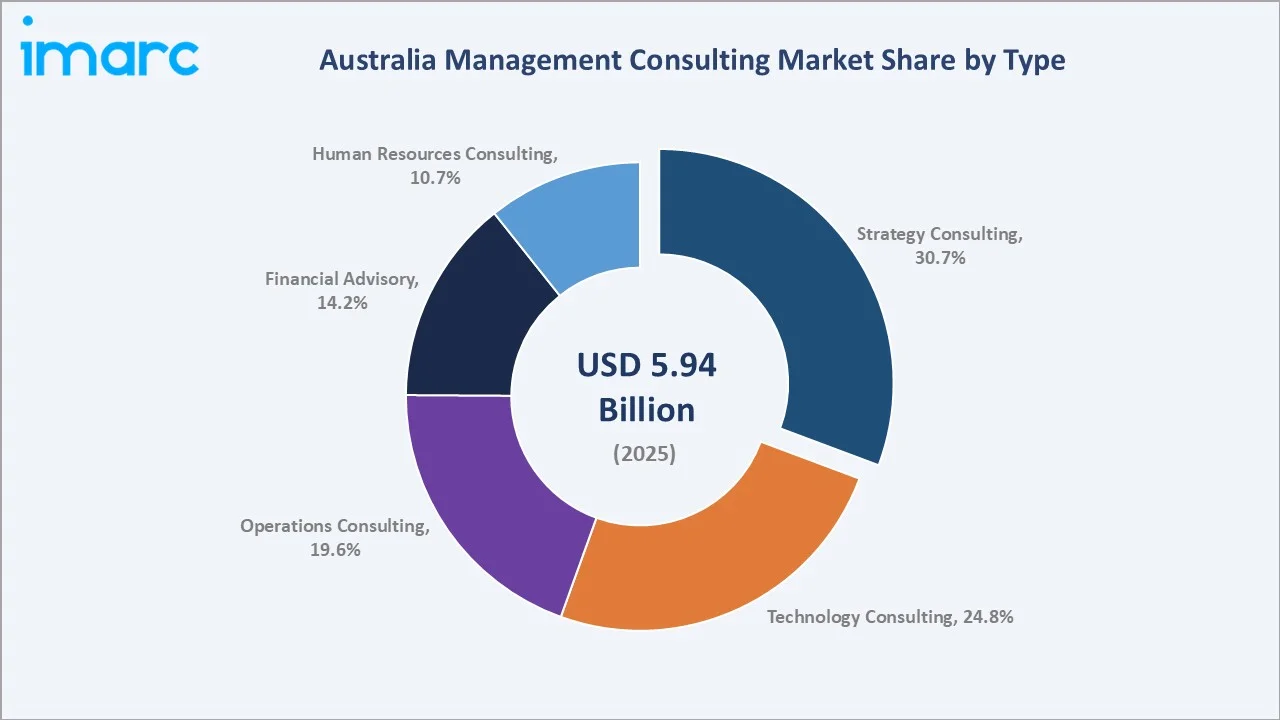
Strategy consulting leads the type segment at 30.7%, large enterprises command 67.4% of the organization size segment, and Australia Capital Territory & New South Wales holds 37.8% regional share.
Market Snapshot
|
Metric |
Value |
|
Market Size (2025) |
USD 5.94 Billion |
|
Forecast Market Size (2034) |
USD 10.71 Billion |
|
CAGR (2026-2034) |
6.56% |
|
Base Year |
2025 |
|
Historical Period |
2020-2025 |
|
Forecast Period |
2026-2034 |
|
Largest Region |
Australia Capital Territory & New South Wales (37.8%, 2025) |
|
Second Largest Region |
Victoria & Tasmania (25.6%, 2025) |
|
Leading Type |
Strategy Consulting (30.7%, 2025) |
|
Leading Organization Size Segment |
Large Enterprises (67.4%, 2025) |
The Australia management consulting market expanded from USD 4.32 Billion in 2020 to USD 5.94 Billion in 2025, supported by growing regulatory obligations and steady demand for operational efficiency programs across large enterprises. Anchored at USD 8.17 Billion in 2030, the forecast to USD 10.71 Billion by 2034 is underpinned by accelerating AI-led transformation mandates, deeper technology consulting penetration, and expanding small and medium-sized enterprise adoption of external advisory services.
To get more information on this market, Request Sample
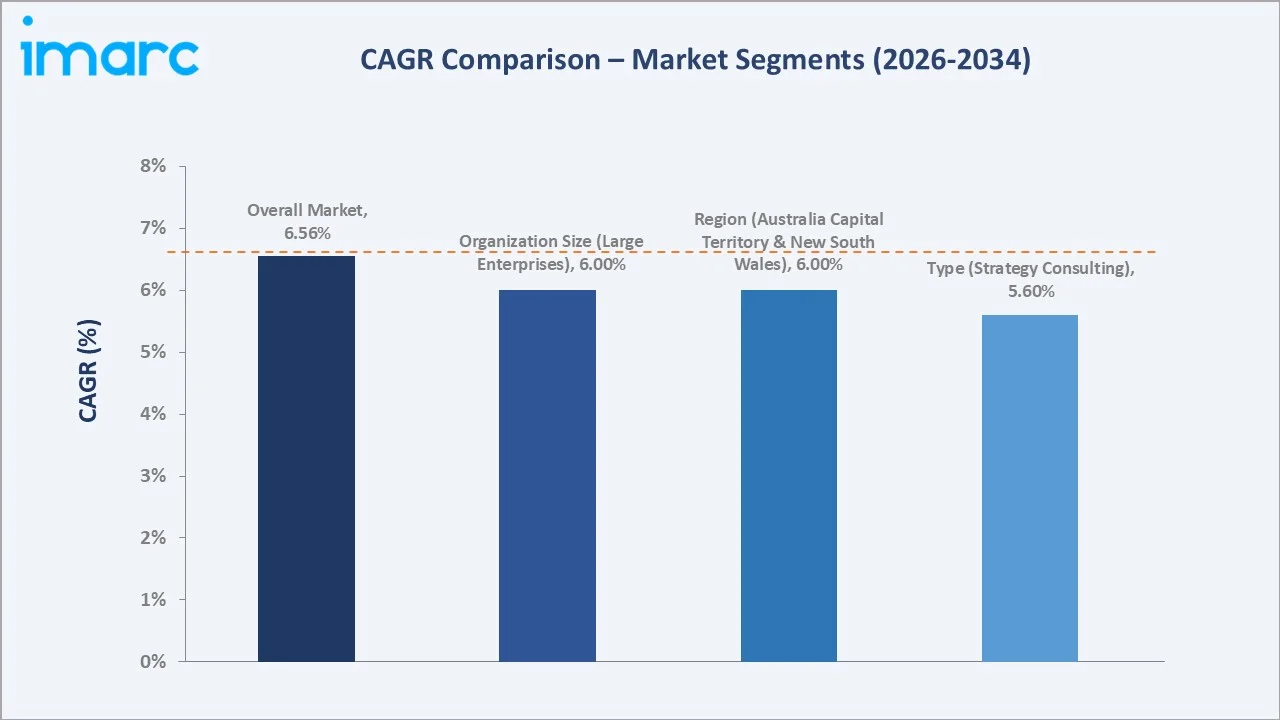
CAGR trajectories across type, organization size, and regional sub-segments show technology consulting and small and medium-sized enterprises expanding faster than the overall 6.56% market CAGR, driven by digital transformation budgets, AI-enabled advisory tools, and broader enterprise adoption of specialized consulting services.
Executive Summary
The Australia management consulting industry size is on a steady growth trajectory from USD 4.32 Billion in 2020 to USD 10.71 Billion by 2034. The industry has evolved from traditional strategy and operations advisory toward technology-led, outcome-focused engagement models spanning financial services, mining, government, and healthcare sectors. Rising regulatory complexity, sustained boardroom focus on cost transformation, and growing appetite for AI-enabled decision-making are encouraging enterprises to engage external advisory expertise more consistently.
Strategy consulting leads the type segment at 30.7%, fueled by continued demand for growth and transformation roadmaps. Large enterprises dominate the organization size segment at 67.4% in 2025, supported by complex multi-jurisdictional operations and sustained transformation budgets. Australia Capital Territory & New South Wales commands 37.8% of the regional share, led by concentrated corporate headquarters presence, deep talent pools, and proximity to federal and state government decision-makers.
Key Market Insights
|
Insight |
Data |
|
Leading Type |
Strategy Consulting - 30.7% share (2025) |
|
Second Largest Type |
Technology Consulting - 24.8% share (2025) |
|
Leading Organization Size |
Large Enterprises - 67.4% share (2025) |
|
Second Largest Organization Size |
Small and Medium-Sized Enterprises - 32.6% share (2025) |
|
Leading Region |
Australia Capital Territory & New South Wales - 37.8% share (2025) |
|
Second Largest Region |
Victoria & Tasmania - 25.6% share (2025) |
|
Top Companies |
Deloitte, PwC, EY, KPMG International Limited, Accenture, McKinsey & Company |
Key Analytical Observations Expanding On the Data Above:
- Strategy consulting leadership at 30.7% reflects sustained enterprise demand for growth strategy, M&A advisory, and corporate transformation roadmaps across large Australian corporates and government agencies.
- Technology consulting at 24.8% is expanding as enterprises prioritize cloud migration, cybersecurity, and AI-enabled operating models across the financial services and resources sectors.
- Large enterprises at 67.4% continue to anchor demand through multi-year transformation programs, complex regulatory reporting requirements, and enterprise-wide digital modernization initiatives.
- Small and medium-sized enterprises at 32.6% are increasingly engaging consulting services as digital-first delivery models lower advisory costs.
- Australia Capital Territory & New South Wales at 37.8% leads regional share, anchored by Sydney's position as the primary corporate and financial hub and Canberra's concentration of federal government advisory mandates.
Australia Management Consulting Market Overview
Management consulting refers to advisory services that help organizations improve performance through strategy formulation, operational restructuring, technology implementation, financial advisory, and human capital transformation. This Australia management consulting industry analysis shows the market spans strategy consulting, technology consulting, operations consulting, financial advisory, and human resources consulting delivered to large enterprises and small and medium-sized enterprises across the financial services, government, mining, healthcare, and retail sectors.
The Australian consulting ecosystem integrates global professional services networks, boutique strategy firms, technology and analytics vendors, professional accreditation bodies, and public sector procurement frameworks. Together, they enable delivery of advisory services within an increasingly digital, outcome-driven engagement environment.
Market Dynamics
To evaluate market opportunities, Request Sample
Market Drivers
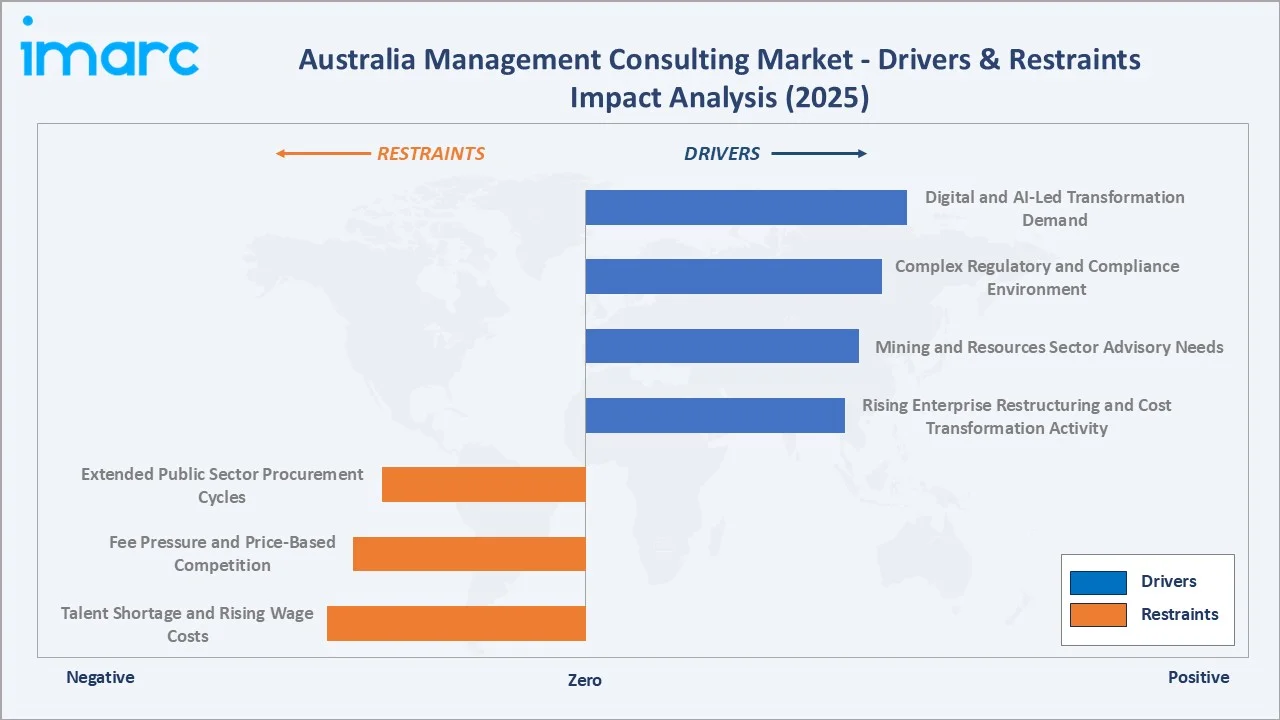
- Digital and AI-Led Transformation Demand: Enterprises across the banking, mining, and government sectors are accelerating investment in AI-enabled operating models, driving sustained demand for technology and change-management consulting expertise.
- Complex Regulatory and Compliance Environment: Evolving financial services, environmental, and workplace regulations are compelling organizations to engage external advisory support for compliance design and implementation.
- Mining and Resources Sector Advisory Needs: Continued capital investment in resources and energy transition projects is generating strong demand for operational and infrastructure advisory services, particularly in Western Australia and Queensland. Seven new large-scale renewable energy initiatives, accounting for 1598 MW of additional generation capacity and USD 2.4 Billion in capital investment, were financially secured in the fourth quarter of 2024, according to the Clean Energy Council's Quarterly Clean Energy Investment Report.
- Rising Enterprise Restructuring and Cost Transformation Activity: Economic uncertainty and margin pressure are pushing large enterprises toward structured cost-transformation programs. This is increasing demand for advisory services focused on operational efficiency, organizational redesign, and sustainable cost optimization.
Market Restraints
- Talent Shortage and Rising Wage Costs: Intense competition for experienced consultants and data specialists is increasing delivery costs and lengthening recruitment cycles across the industry.
- Fee Pressure and Price-Based Competition: Growing client sophistication and the entry of lower-cost delivery models are compressing fee structures, particularly for standardized advisory engagements.
- Extended Public Sector Procurement Cycles: Lengthy government tendering and approval processes can delay engagement starts and create revenue timing uncertainty for firms reliant on public sector mandates.
Market Opportunities
- ESG and Sustainability Advisory Growth: Expanding corporate sustainability reporting obligations are creating new advisory revenue streams around emissions strategy, climate risk, and sustainable finance, an area increasingly overlapping with the Australia environmental consulting services market.
- Mid-Market and SME Advisory Expansion: Digital-first delivery models are enabling consulting firms to profitably serve small and medium-sized enterprises that were previously underserved by traditional engagement structures.
Market Challenges
- Balancing Automation with Client Trust: As firms embed AI into advisory delivery, maintaining transparency and client confidence in machine-assisted recommendations remains an ongoing challenge.
- Retaining Senior Advisory Talent: High demand for experienced consultants across in-house corporate strategy teams is increasing attrition risk for traditional consulting firms.
Emerging Market Trends
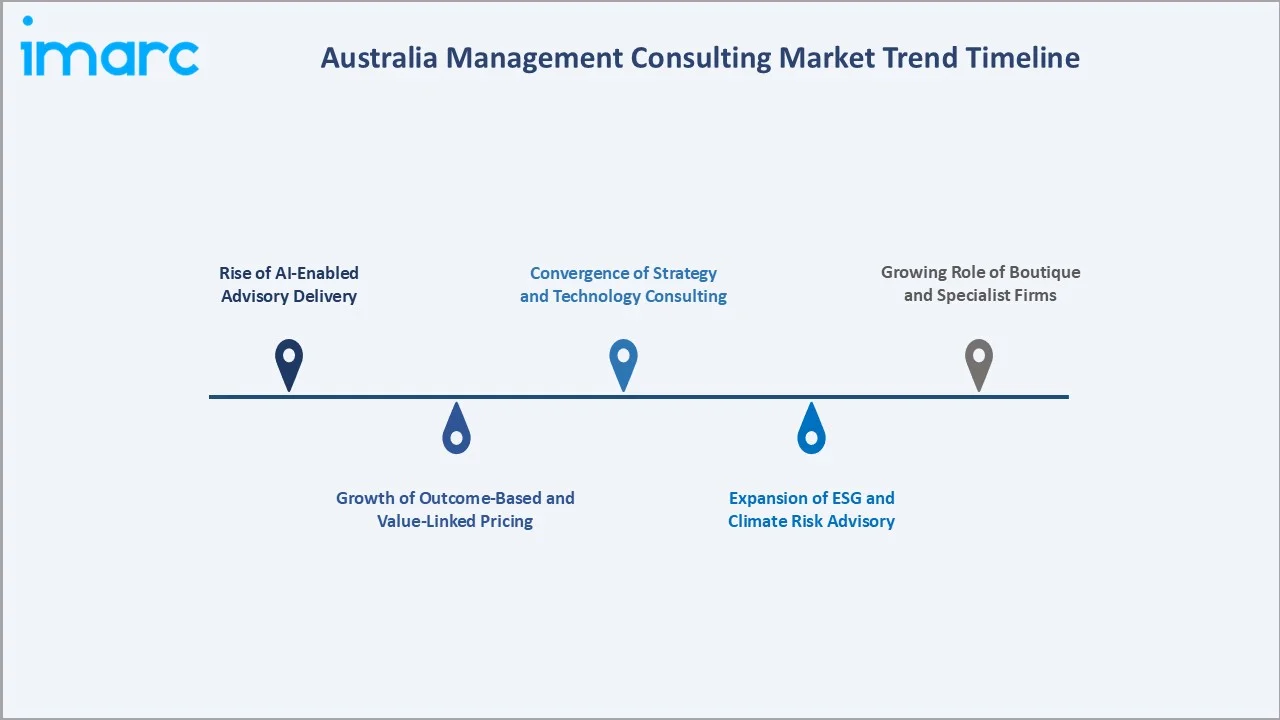
1. Rise of AI-Enabled Advisory Delivery
Consulting firms are embedding generative AI and analytics tools into research, benchmarking, and reporting workflows to accelerate engagement delivery. This shift is also enabling consultants to provide more data-driven recommendations and support faster decision-making across client organizations.
2. Growth of Outcome-Based and Value-Linked Pricing
Among the Australia business consulting market trends 2026 gaining momentum, clients are increasingly negotiating fee structures tied to measurable transformation outcomes rather than time-based billing, reshaping engagement economics across the industry.
3. Expansion of ESG and Climate Risk Advisory
Mandatory sustainability disclosure requirements are prompting enterprises to seek specialized advisory support for emissions strategy, climate scenario planning, and green finance structuring.
4. Convergence of Strategy and Technology Consulting
Firms are increasingly bundling strategic advisory with implementation and technology delivery capabilities to offer end-to-end transformation services.
5. Growing Role of Boutique and Specialist Firms
Niche advisory firms focused on specific sectors or capabilities are gaining share from generalist providers, particularly in mining, healthcare, and public sector consulting.
Industry Value Chain Analysis
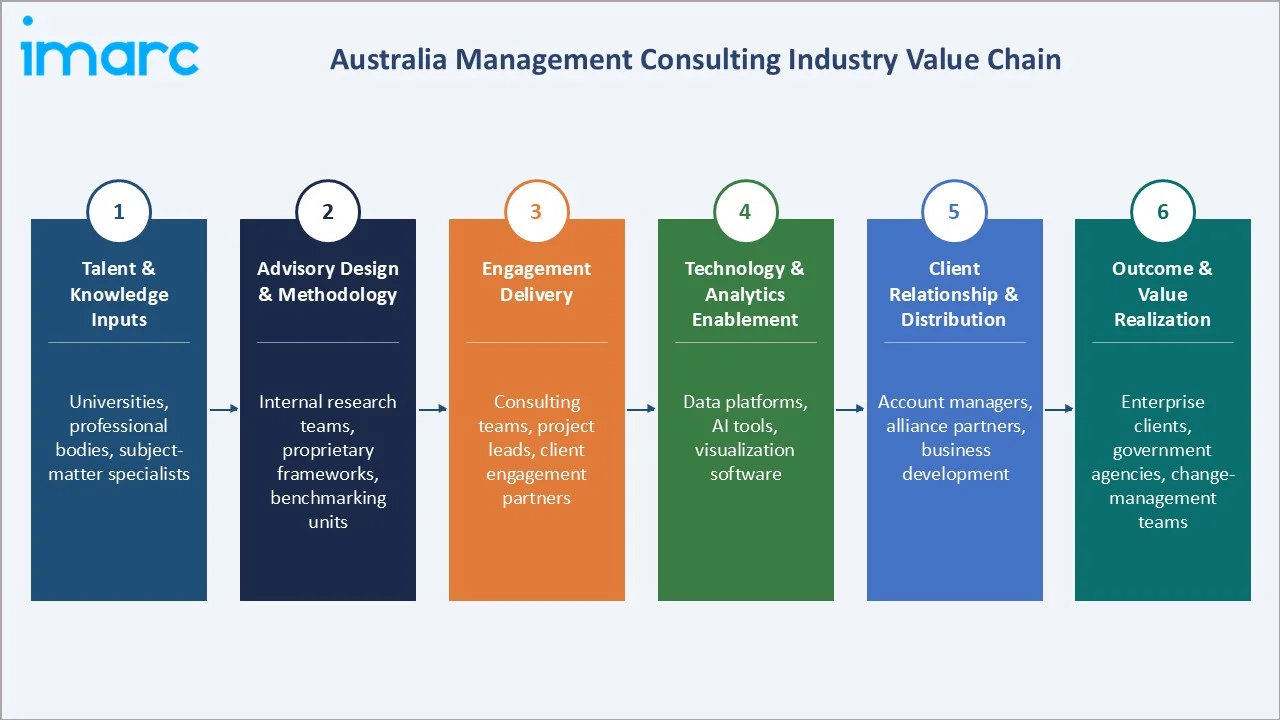
The Australia management consulting value chain spans six stages from talent and knowledge inputs through client delivery and outcome realization. Advisory design, engagement delivery, and technology enablement capture the highest value-add, while client relationship management and distribution increasingly determine sustainable competitive position across the industry.
|
Stage |
Key Players / Examples |
|
Talent & Knowledge Inputs |
Universities, professional bodies, and subject-matter specialists supplying research capability and technical expertise |
|
Advisory Design & Methodology |
Internal research teams, proprietary frameworks, and industry benchmarking units developing advisory approaches |
|
Engagement Delivery |
Consulting teams, project leads, and client engagement partners executing advisory mandates |
|
Technology & Analytics Enablement |
Data platforms, AI tools, and visualization software supporting insight generation and delivery |
|
Client Relationship & Distribution |
Account management teams, alliance partners, and business development functions managing client relationships |
|
Outcome & Value Realization |
Enterprise clients, government agencies, and change-management teams embedding recommended transformations |
Vertically integrated consulting firms, particularly those combining proprietary methodologies, in-house technology platforms, and direct client relationships, are positioned to capture greater value than providers dependent on third-party delivery partners.
Technology Landscape in the Australia Management Consulting Industry
AI and Automation in Advisory Delivery
Consulting firms operating in Australia are embedding generative AI, natural language processing, and workflow automation into research, drafting, and analytics functions to accelerate engagement delivery and improve consistency of client deliverables.
Cloud-Based Collaboration and Data Platforms
Cloud-native project management and data-sharing platforms are enabling distributed consulting teams to collaborate seamlessly across metropolitan and regional client sites, supporting hybrid delivery models across large enterprises and government engagements.
Advanced Analytics and Visualization Tools
Predictive analytics, scenario modelling, and interactive visualization dashboards are becoming standard components of strategy and operations engagements, helping clients translate complex datasets into actionable transformation roadmaps.
Cybersecurity and Data Governance Capabilities
Growing client sensitivity around data privacy and cybersecurity is prompting consulting firms to strengthen governance frameworks and embed security-by-design principles within technology-led advisory engagements.
Market Segmentation Analysis
The report covers the following segments:
|
Segment Category |
Leading Segment |
Market Share |
Year |
|
Type |
Strategy Consulting |
30.7% |
2025 |
|
Organization Size |
Large Enterprises |
67.4% |
2025 |
|
Industry Vertical |
🔒 |
🔒 |
2025 |
|
Region |
Australia Capital Territory & New South Wales |
37.8% |
2025 |

By Type
Strategy consulting leads the type segment with 30.7% share in 2025, driven by sustained enterprise demand for growth strategy, portfolio optimization, and large-scale transformation roadmaps across financial services, mining, and government clients. The segment benefits from deep executive relationships, high engagement value, and repeat mandate cycles with large enterprises.
To access detailed market analysis, Request Sample
Technology consulting follows at 24.8% in 2025, propelled by enterprise investment in cloud migration, cybersecurity, and AI-enabled operating models.
By Organization Size
Large enterprises dominate with 67.4% share in 2025, supported by complex multi-jurisdictional operations, substantial transformation budgets, and continuous demand for regulatory and technology advisory support. The segment's scale and recurring engagement cycles make it the primary revenue base for most consulting firms operating in Australia.
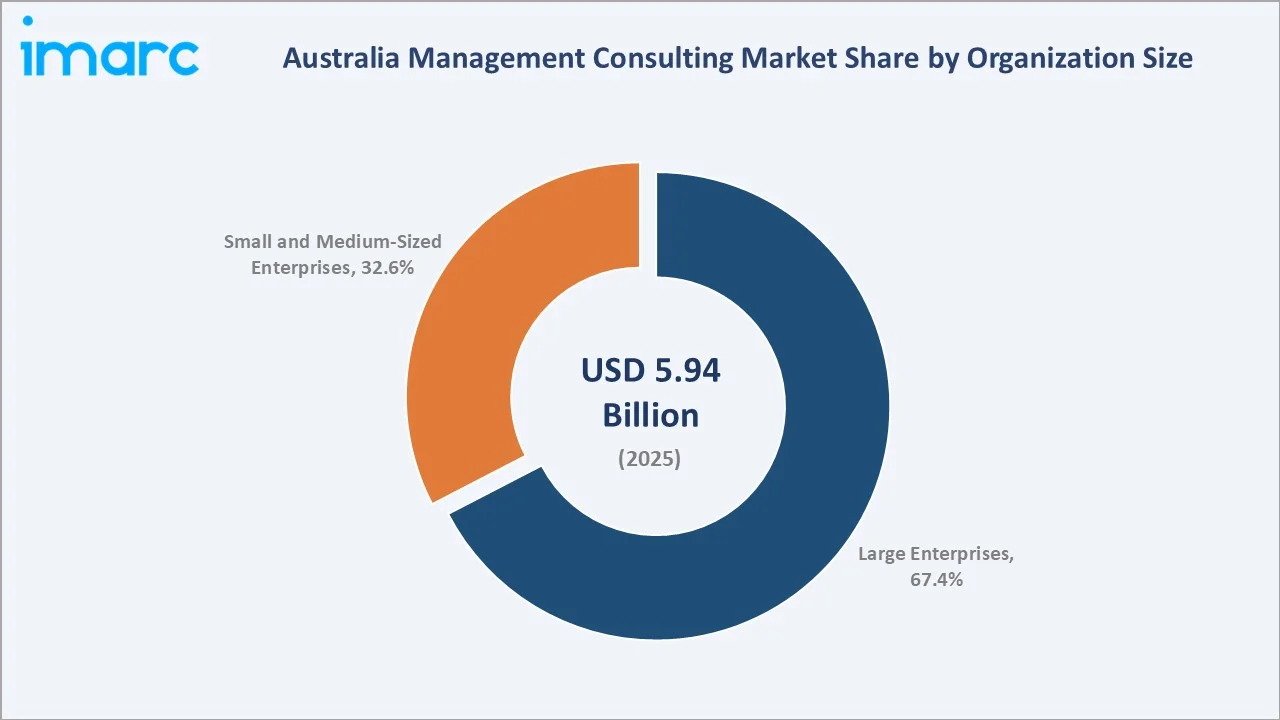
Small and medium-sized enterprises account for 32.6% of the segment in 2025, expanding as digital-first delivery models and fractional advisory offerings make consulting services more accessible to smaller organizations. Rising adoption of cloud-based tools is further lowering the cost barrier to structured advisory engagement for this segment.
Regional Market Insights
|
Region |
Share (2025) |
Key Growth Drivers |
|
Australia Capital Territory & New South Wales |
37.8% |
Concentrated corporate headquarters presence, strong government advisory demand, and deep availability of skilled consulting talent |
|
Victoria & Tasmania |
25.6% |
Diverse industry base, strong professional services ecosystem, and established corporate advisory relationships |
|
Queensland |
15.8% |
Expanding resources and infrastructure investment supporting growing demand for operational and project advisory services |
|
Western Australia |
11.4% |
Mining and energy sector digitalization driving specialized operational and technology consulting demand |
|
Northern Territory & Southern Australia |
9.4% |
Emerging infrastructure and public sector projects supporting gradual expansion of advisory engagement |
Australia Capital Territory & New South Wales at 37.8% in 2025 leads the regional landscape, anchored by Sydney's position as the country's primary financial and corporate hub and Canberra's concentration of federal government advisory mandates. Deep talent availability and established client relationships continue to support the region's leadership across both strategy and technology consulting segments.
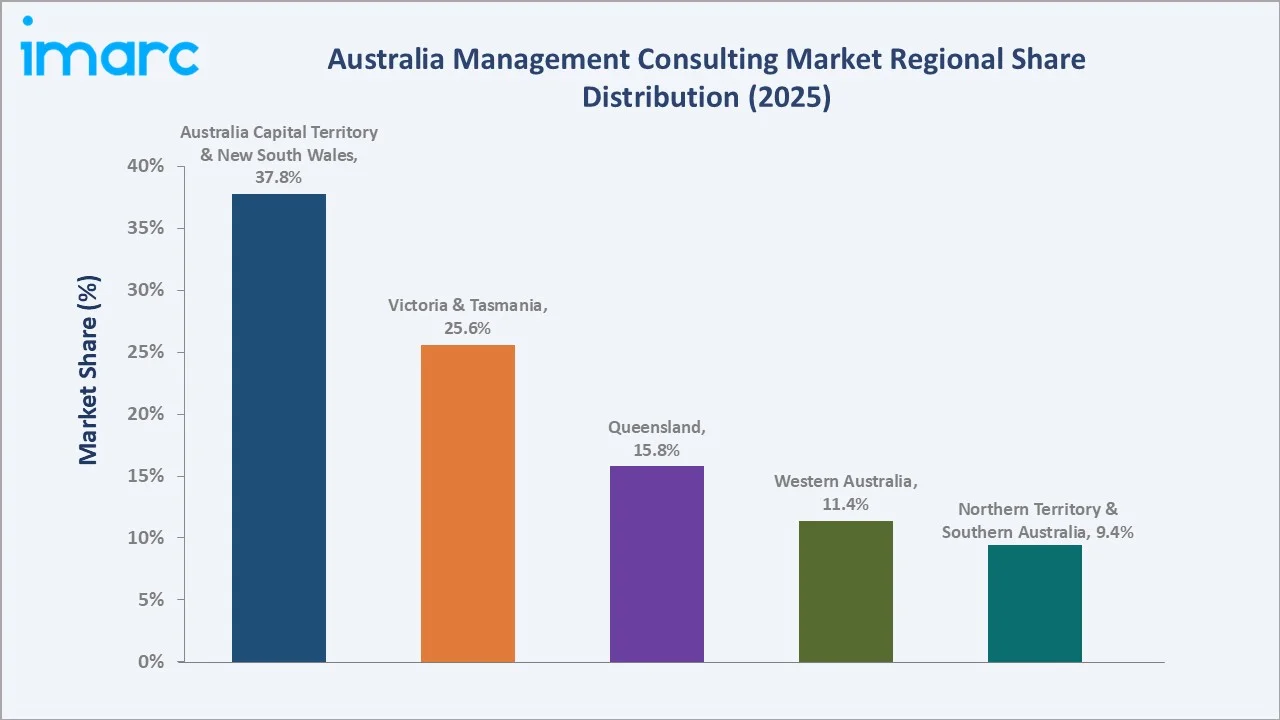
Western Australia, at 11.4% share, is the fastest growing region. Sustained mining and resources sector investment, rising infrastructure advisory demand, and surging technology consulting engagement tied to energy transition projects are fueling the expansion of the segment.
Competitive Landscape
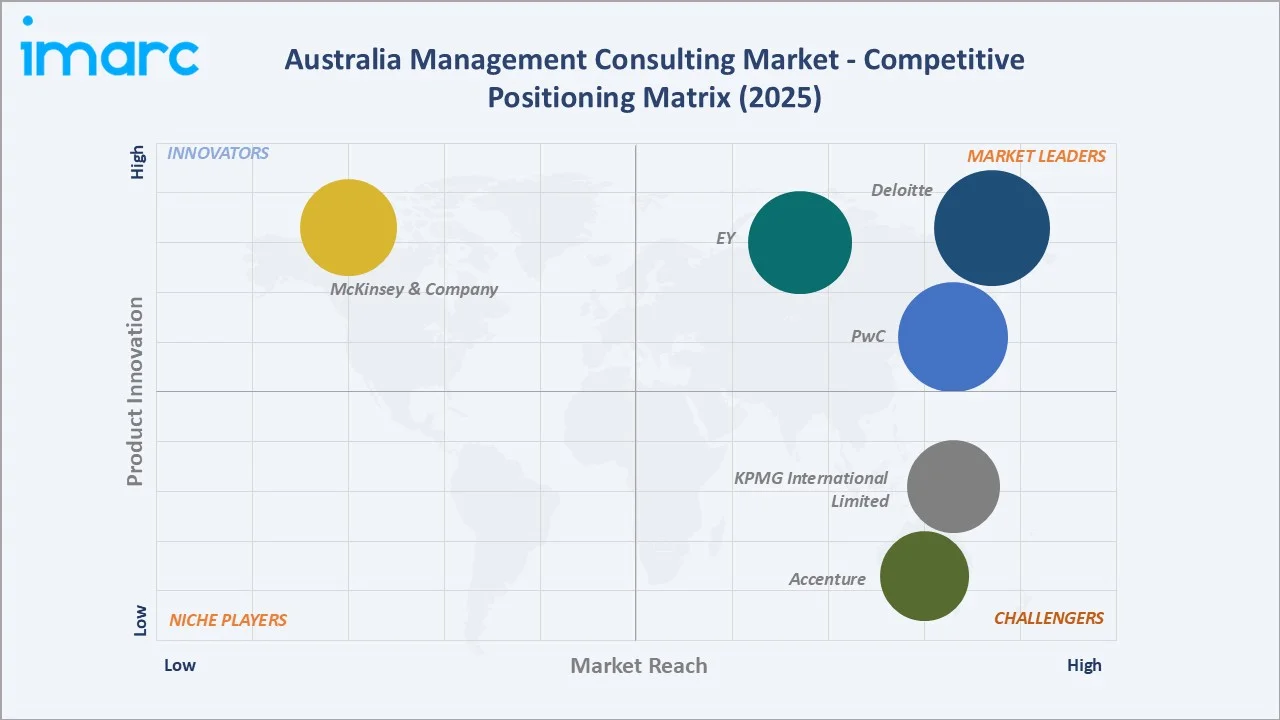
The Australia management consulting market is moderately concentrated, with global professional services networks and strategy-focused firms competing alongside specialized boutique advisories. Brand reputation, sector expertise, technology capability, and government panel accreditation form the key competitive differentiators across the industry.
|
Company Name |
Flagship Service Line |
Position |
Strategic Focus |
|
Deloitte |
Deloitte Consulting |
Leader |
Broad-based advisory capability spanning strategy, technology, and human capital consulting for enterprise and government clients |
|
PwC |
PwC Consulting Services |
Leader |
Integrated advisory services combining strategy, risk, and technology-led transformation capabilities |
|
EY |
EY-Parthenon |
Leader |
Strategy and transformation advisory supported by broad assurance and technology delivery capability |
|
KPMG International Limited |
KPMG Consulting |
Challenger |
Advisory services focused on risk, regulatory, and operational consulting for enterprise and public sector clients |
|
Accenture |
Accenture Reinvention Services |
Challenger |
Technology-led transformation and digital delivery capability supporting large-scale implementation programs |
|
McKinsey & Company |
McKinsey & Company |
Innovator |
Premium strategy advisory with deep sector expertise and senior executive engagement model |
Key players include Deloitte, PwC, EY, KPMG International Limited, Accenture, and McKinsey & Company, among others.
Key Company Profiles
Deloitte
Deloitte is a global professional services network headquartered in London, United Kingdom. In Australia, the firm provides strategy, technology, risk, and human capital consulting to large enterprises and government clients nationwide.
- Product Portfolio: Strategy and transformation consulting, technology and digital delivery, risk advisory, and human capital consulting for Australian enterprise and public sector clients.
- Recent Developments: The firm continues to expand its consulting capabilities in Australia, with increasing emphasis on digital transformation, technology modernization, and business strategy services.
- Strategic Focus: Deepening integrated strategy-to-execution capability across technology, risk, and human capital consulting for large Australian enterprises and government agencies.
PwC
PwC is a global professional services network headquartered in London, United Kingdom. Its Australian practice supports private sector enterprise clients across strategy, risk, and technology-led transformation.
- Product Portfolio: Management consulting, risk and regulatory advisory, deals and corporate finance advisory, and technology consulting services for Australian private sector clients.
- Recent Developments: The firm continues to strengthen its technology and AI advisory capabilities to support enterprise clients across financial services and resources sectors in Australia.
- Strategic Focus: Expanding integrated advisory offerings that combine strategy, risk, and technology consulting for large Australian private sector enterprise clients.
EY
EY is a global professional services organization headquartered in London, United Kingdom. In Australia, its consulting practice, including EY-Parthenon, delivers strategy and transformation advisory to enterprise and government clients.
- Product Portfolio: Strategy consulting through EY-Parthenon, technology consulting, risk advisory, and people advisory services for Australian clients.
- Recent Developments: The firm continues to invest in AI-enabled advisory tools and expand its technology consulting capability to support enterprise transformation programs.
- Strategic Focus: Growing integrated strategy and technology consulting capability while strengthening sector-specific advisory offerings for Australian clients.
Market Concentration Analysis
The Australia management consulting market is moderately fragmented, with global professional services networks and strategy-focused firms competing alongside a large base of boutique and specialist advisory providers across sectors including financial services, mining, government, and healthcare.
Barriers to entry include the need for deep sector expertise, established executive relationships, government panel accreditation, and the scale required to deliver large, multi-year transformation programs. These factors favor well-established incumbents with diversified service portfolios and broad client networks.
Consolidation is gradually increasing as larger firms acquire specialized boutique consultancies to strengthen technology, data, and sector-specific capabilities. Strategic alliances with technology vendors and analytics providers are further reinforcing competitive positioning across the market.
Investment & Growth Opportunities
Fastest-Growing Segments
Technology consulting is the fastest-expanding type segment, driven by enterprise investment in AI, cloud, and cybersecurity advisory services. Small and medium-sized enterprises represent the fastest-growing organization size segment as digital-first delivery models lower the cost of engagement.
Emerging Markets
Western Australia is the fastest growing region, anchored by mining and resources sector digitalization and expanding infrastructure advisory demand. The market represents significant opportunity for firms able to deliver sector-specific, technology-enabled advisory services.
Venture & Investment Trends
Investment is concentrated in AI-enabled advisory platforms, specialized boutique consultancies, and technology-integrated delivery models that align with evolving client expectations for outcome-based, digitally enabled engagement.
Future Market Outlook (2026-2034)
The Australia management consulting market is forecast to expand from USD 5.94 Billion in 2025 to USD 10.71 Billion by 2034 at a CAGR of 6.56%, adding approximately USD 4.77 Billion in incremental market value over the forecast period.
Four forces will shape the market through 2034: accelerating enterprise adoption of AI-enabled advisory tools; growing demand for ESG and climate risk consulting; deeper convergence of strategy and technology delivery capabilities; and rising small and medium-sized enterprise engagement with structured advisory services.
By 2034, the Australia management consulting market is expected to be defined by technology-integrated, outcome-based engagement models, with technology consulting and small and medium-sized enterprise demand collectively accounting for a meaningfully higher share of overall market activity.
Research Methodology
Primary Research
Primary research included structured interviews with consulting firm partners, corporate strategy and transformation leads, technology vendors, and industry association representatives, validating market sizing, segment mix, and regional demand patterns.
Secondary Research
Secondary sources included Australian Bureau of Statistics publications, Jobs and Skills Australia industry data, government procurement disclosures, and annual reports, press releases, and public disclosures from leading consulting firms.
Forecasting Models
Market forecasts used top-down and bottom-up models combining enterprise advisory spend, sector-wise transformation budgets, organization size adoption patterns, and macroeconomic variables. Scenario analysis addressed regulatory change, technology adoption pace, and public sector procurement cycles.
Australia Management Consulting Market Report Coverage:
| Report Features | Details |
|---|---|
| Base Year of the Analysis | 2025 |
| Historical Period | 2020-2025 |
| Forecast Period | 2026-2034 |
| Units | Billion USD |
| Scope of the Report |
Exploration of Historical Trends and Market Outlook, Industry Catalysts and Challenges, Segment-Wise Historical and Future Market Assessment:
|
| Types Covered |
|
| Organization Sizes Covered | Large Enterprises, Small and Medium-Sized Enterprises |
| Industry Verticals Covered | BFSI, IT and Telecom, Manufacturing, Retail and E-Commerce, Public Sector, Healthcare, Others |
| Regions Covered | Australia Capital Territory & New South Wales, Victoria & Tasmania, Queensland, Northern Territory & Southern Australia, Western Australia |
| Companies Covered | Deloitte, PwC, EY, KPMG International Limited, Accenture, McKinsey & Company, etc. |
| Customization Scope | 10% Free Customization |
| Post-Sale Analyst Support | 10-12 Weeks |
| Delivery Format | PDF and Excel through Email (We can also provide the editable version of the report in PPT/Word format on special request) |
Key Benefits for Stakeholders:
- IMARC’s industry report offers a comprehensive quantitative analysis of various market segments, historical and current market trends, market forecasts, and dynamics of the Australia management consulting market from 2020-2034.
- The research report provides the latest information on the market drivers, challenges, and opportunities in the Australia management consulting market.
- Porter's five forces analysis assist stakeholders in assessing the impact of new entrants, competitive rivalry, supplier power, buyer power, and the threat of substitution. It helps stakeholders to analyze the level of competition within the Australia management consulting industry and its attractiveness.
- Competitive landscape allows stakeholders to understand their competitive environment and provides an insight into the current positions of key players in the market.
Frequently Asked Questions About the Australia Management Consulting Market Report
The Australia management consulting market was valued at USD 5.94 Billion in 2025, driven by rising regulatory complexity, digital transformation demand, and sustained enterprise advisory spending across sectors.
The market is projected to grow at a CAGR of 6.56% from 2026-2034, reaching USD 10.71 Billion, supported by accelerating AI-led transformation and technology consulting demand.
Strategy consulting leads the type segment at 30.7% in 2025, driven by sustained enterprise demand for growth strategy, portfolio optimization, and large-scale transformation roadmaps.
Large enterprises dominate the organization size segment at 67.4% in 2025, supported by complex multi-jurisdictional operations and sustained transformation budgets.
Australia Capital Territory & New South Wales commands 37.8% share in 2025, led by concentrated corporate headquarters presence and strong government advisory demand.
Western Australia is the fastest growing region, driven by mining and resources sector digitalization and expanding infrastructure and energy transition advisory demand.
Leading players include Deloitte, PwC, EY, KPMG International Limited, Accenture, and McKinsey & Company, among others.
AI, automation, and advanced analytics are helping consulting firms accelerate delivery, personalize insights, and expand technology-led transformation offerings for clients.
Talent shortages, rising wage costs, fee pressure from price-based competition, and extended public sector procurement cycles are key challenges for industry participants.
Need more help?
- Speak to our experienced analysts for insights on the current market scenarios.
- Include additional segments and countries to customize the report as per your requirement.
- Gain an unparalleled competitive advantage in your domain by understanding how to utilize the report and positively impacting your operations and revenue.
- For further assistance, please connect with our analysts.
 Request Customization
 Speak to an Analyst
 Request Brochure
 Inquire Before Buying
Benefits of Customization
- Personalize this research
- Triangulate with your data
- Get data as per your format and definition
- Gain a deeper dive into a specific application, geography, customer, or competitor
- Any level of personalization
Get in Touch With Us
UNITED STATES
Phone: +1-201-971-6302
INDIA
Phone: +91-120-433-0800
UNITED KINGDOM
Phone: +44-753-714-6104
Email: [email protected]
Client Testimonials




.webp)




.webp)













Related Reports

Choose your plan
*Please note that the prices mentioned below are starting prices for each bundle type. Kindly contact our team for further details.*
Single User License
- 1 User License, Access on 2 Devices
- PDF Report + Excel Dataset (Password Protected)
- Lifetime Access
- No Printing Rights
- 10% Free Report Customization
- 10–12 Weeks of Analyst Support
Five User License
- Access for 5 Users, 2 Devices per User
- PDF Report + Excel Dataset (Password Protected)
- Lifetime Access
- Dedicated Account Manager
- 12–14 Weeks of Analyst Support
- No Printing Rights
- 15% Free Report Customization
- 25% Discount on Your Next Purchase
Corporate User License
- Unlimited User Access (Within Your Organization)
- PDF Report + Excel Dataset
- Lifetime Access
- Dedicated Account Manager
- 14–20 Weeks of Analyst Support
- No Printing Rights
- 20% Free Report Customization
- 30% Discount on Your Next Purchase
Essential Insights
What's included:
3 reports
- Lifetime Access
- PDF Reports
- Excel Datasets
- 2 Weeks of Free Analyst Support
- 2 User Licenses
- Access on 2 Devices
- Printing Rights
- Complimentary PowerPoint (PPT) Version
- Complimentary License Upgrade
Professional Access
What's included:
5 reports
- Lifetime Access
- PDF Reports
- Excel Datasets
- 8 Weeks of Free Analyst Support
- 2 User Licenses
- Access on 2 Devices
- Printing Rights
- Complimentary PowerPoint (PPT) Version
- Complimentary License Upgrade
Business Advantage
What's included:
8 reports
- Lifetime Access
- PDF Reports
- Excel Datasets
- 14 Weeks of Free Analyst Support
- 2 User Licenses
- Access on 2 Devices
- Printing Rights
- Complimentary PowerPoint (PPT) Version
- Complimentary License Upgrade
Enterprise Intelligence
What's included:
10 reports
- Lifetime Access
- PDF Reports
- Excel Datasets
- 20 Weeks of Free Analyst Support
- 2 User Licenses
- Access on 2 Devices
- Printing Rights
- Complimentary PowerPoint (PPT) Version
- Complimentary License Upgrade