
Australia Millet Market Size, Share, Trends and Forecast by Product Type, Application, Distribution Channel, and Region 2026-2034
Australia Millet Market Summary:
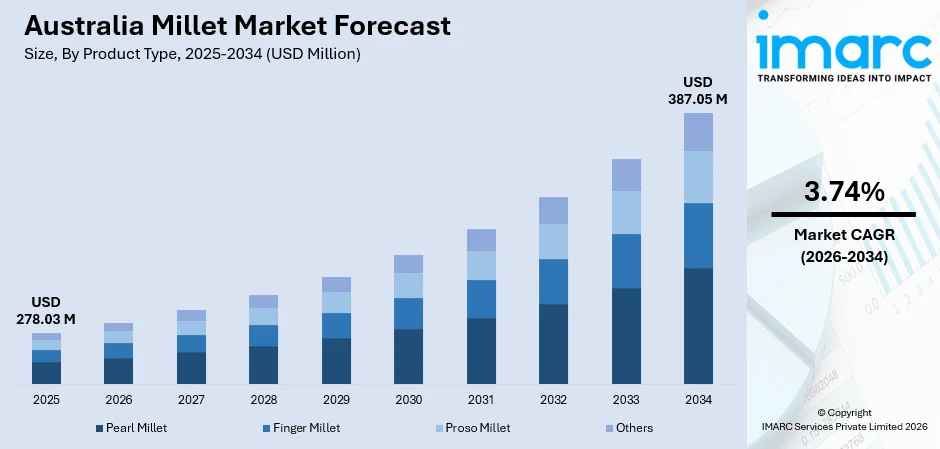
The Australia millet market size was valued at USD 278.03 Million in 2025 and is projected to reach USD 387.05 Million by 2034, growing at a compound annual growth rate of 3.74% from 2026-2034.
Australia’s millet market is expanding steadily, supported by rising consumer demand for nutritious gluten-free grains, increasing adoption in health-focused diets, growing use in animal feed applications, and expanding interest in sustainable crop cultivation, while producers and food manufacturers continue investing in product innovation and diversified distribution channels across domestic and export markets.
Key Takeaways and Insights:
- By Product Type: Pearl millet dominates the market with a share of 41.6% in 2025, supported by its wide use in food processing and increasing preference for nutrient-rich grains.
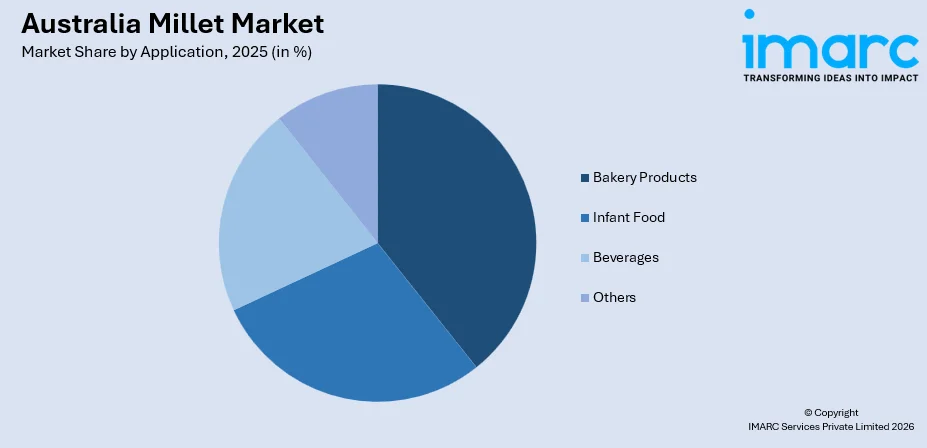
- By Application: Bakery products accounted for the highest market share of 36.9% in 2025, fueled by increasing incorporation of millet flour in breads, cookies, and health-oriented baked goods.
- By Distribution Channel: Supermarkets and hypermarkets lead the market with a share of 47.8% in 2025, driven by strong retail presence and growing shelf space for health-focused products.
- By Region: Australia Capital Territory & New South Wales represent the largest segment with a market share of 32.5% in 2025, owing to higher consumer awareness, urban demand, and concentration of food processing activities.
- Key Players: The market is moderately competitive, with domestic grain producers and health food companies focusing on expanding millet-based bakery ingredients, developing gluten-free product lines, improving sustainable cultivation practices, and strengthening retail and export distribution channels to support the growth of Australia’s nutritious grains sector.
To get more information on this market Request Sample
Australia’s millet market is developing as farmers and food manufacturers explore alternative grains suited to changing dietary preferences and climate-resilient agriculture. Millet is gaining recognition for its versatility in processed foods, cereals, plant-based formulations, and specialty beverages. Demand is supported by increasing interest from consumers seeking nutrient-dense grains rich in fiber, minerals, and protein. The market is also benefiting from its role in livestock and bird feed, where millet offers a reliable energy source. Agricultural research initiatives are encouraging improved millet cultivation techniques, supporting higher yields and quality standards. Export opportunities are gradually expanding, particularly toward Asia-Pacific markets with established millet consumption. In 2022, millet yield in Australia reached 10,226 hg/ha, marking a 0.010% increase compared to the previous year, according to an industry report.
Australia Millet Market Trends:
Growing Use of Millet in Functional Snack Products
Australia’s millet market is witnessing increasing incorporation of millet into functional snack categories, including energy bars, roasted grain mixes, and healthy crisps. As such, in July 2025, Grainwell’s premium puffed millet powered Grainbow’s rainbow-colored foods in Australia, delivering vibrant colors, superior texture, and consistent quality. The partnership makes healthy eating fun, nutritious, and visually appealing for children and families. Food manufacturers are utilizing millet as an ingredient to appeal to consumers seeking clean-label, nutrient-rich snack alternatives. This trend is supported by rising demand for convenient foods with enhanced dietary benefits. Millet-based snacks are gaining shelf presence in health food stores and premium retail outlets.
Expansion of Millet-Based Plant Milk and Beverage Innovations
Millet is emerging as an ingredient in Australia’s expanding plant-based beverage segment. Producers are developing millet-based drinks and dairy alternatives to meet demand for allergen-friendly and sustainable beverage options. This trend reflects broader consumer interest in non-soy and non-almond plant milk varieties. Millet beverages are also being positioned as easily digestible products with natural nutritional value, supporting innovation in the alternative drinks market.
Increasing Adoption of Millet in Specialty Pet and Bird Feed
The Australia millet market is experiencing growing demand from the pet care sector, particularly for premium birdseed and small animal feed products. Millet is valued for its digestibility and energy content, making it a preferred grain in specialty feed formulations. This trend is supported by increasing expenditure on pet nutrition and rising interest in natural, grain-based feed ingredients. A recent industry survey reveals that Australian pet owners spend approximately USD 21.3 Billion annually on their pets, with nearly half of this, USD 9.8 Billion, allocated to pet food. Millet-based feed products are expanding through both retail and online channels.
Market Outlook 2026-2034:
Australia’s millet market outlook remains positive as interest grows in diversified grain production and emerging health-focused food categories. As such, the Government invested USD 5 Million in new WA nodes of the Australian Plant Phenomics Network, using advanced digital phenotyping to augment grains research, improve crop yields, and support sustainable, data-driven farming innovations. Future expansion is expected to be supported by increasing cultivation in semi-arid regions, rising demand from niche organic food segments, and broader adoption in foodservice applications. Similarly, increasing investment in processing infrastructure and improved supply chain connectivity will enhance market accessibility. Apart from this, heightened export demand from regional markets may further strengthen growth potential, positioning millet as an increasingly valuable crop in Australia. The market generated a revenue of USD 278.03 Million in 2025 and is projected to reach a revenue of USD 387.05 Million by 2034, growing at a compound annual growth rate of 3.74% from 2026-2034.
Australia Millet Market Report Segmentation:
|
Segment Category |
Leading Segment |
Market Share |
|
Product Type |
Pearl Millet |
41.6% |
|
Application |
Bakery Products |
36.9% |
|
Distribution Channel |
Supermarkets and Hypermarkets |
47.8% |
|
Region |
Australia Capital Territory & New South Wales |
32.5% |
Product Type Insights:
- Pearl Millet
- Finger Millet
- Proso Millet
- Others
Pearl millet dominates with a market share of 41.6% of the total Australia millet market in 2025.
Its dominance is supported by strong adaptability to Australian growing conditions and rising demand from food manufacturers seeking nutrient-rich grain alternatives. Pearl millet is widely used in flour blends and processed food applications, strengthening its position within the domestic millet supply chain.
The segment continues to expand as agricultural producers increase cultivation to meet demand from health-oriented consumers and specialty grain processors. Pearl millet benefits from its high fiber and mineral content, making it suitable for value-added food products. Ongoing improvements in farming practices and distribution networks are expected to reinforce its leadership.
Application Insights:
Access the comprehensive market breakdown Request Sample
- Infant Food
- Bakery Products
- Beverages
- Others
Bakery Products leads with a share of 36.9% of the total Australia millet market in 2025.
The leadership reflects increasing use of millet flour in breads, muffins, and specialty baked goods aimed at health-conscious consumers. For instance, in August 2025, Avora Foods announced its plan to open in Melbourne, bringing Sri Lankan-inspired breads such as curry leaf, millet-based kurakkan, red rice, and garlic-infused loaves, alongside gluten-free, vegan, multi-grain, and traditional Sri Lankan favourites. Millet-based bakery products are gaining traction due to demand for gluten-free and nutrient-dense alternatives in modern diets.
Growth in this segment is supported by innovation from bakeries and food brands introducing millet-enriched formulations. Rising consumer interest in ancient grains and functional ingredients is encouraging wider adoption across retail outlets. The bakery segment remains central in driving millet consumption through diversified product offerings.
Distribution Channel Insights:
- Supermarket and Hypermarkets
- Traditional Grocery Stores
- Online Stores
- Others
Supermarkets and hypermarkets millet dominates with a market share of 47.8% of the total Australia millet market in 2025.
The prominence is driven by strong consumer preference for purchasing millet products through organized retail formats offering convenience and product variety. Large retail chains provide broad access to packaged millet grains, flours, and value-added items across urban centers.
The segment continues to strengthen as retailers expand shelf space for health-focused grains and organic food categories. Supermarkets also support competitive pricing and promotional activities, encouraging higher household adoption. Their nationwide distribution reach reinforces their role as the primary sales channel for millet products in Australia.
Region Insights:
- Australia Capital Territory & New South Wales
- Victoria & Tasmania
- Queensland
- Northern Territory & Southern Australia
- Western Australia
Australia Capital Territory & New South Wales exhibits a clear dominance with a 32.5% share of the total Australia millet market in 2025.
The region benefits from higher consumer awareness of healthy diets, strong retail penetration, and greater availability of specialty grain products. The Australian Bureau of Statistics (ABS) reported that retail sales in New South Wales rose by 1.7%, while the Australian Capital Territory saw a 1.5% increase. In line with this, urban demand contributes significantly to millet-based food consumption trends.
Regional leadership is further supported by concentrated food processing activity and distribution infrastructure. Health food stores, supermarkets, and bakery chains in this area actively promote millet-based offerings. Moreover, continued interest in nutritious grain alternatives is expected to sustain the region’s leading market position in Australia.
Market Dynamics:
Growth Drivers:
Why is the Australia Millet Market Growing?
Increasing Use of Millet in Gluten-Free Brewing Applications
Australia’s millet market is seeing emerging interest from craft beverage producers using millet as a gluten-free grain base in brewing. Millet-based beers and fermented drinks are gaining attention among consumers seeking alternative alcoholic beverages with dietary compatibility. This trend is encouraging experimentation with millet as a substitute for barley and wheat. Breweries are exploring millet for its mild flavor profile and suitability in specialty product innovation. For example, in October 2025, Gluten-free brewery TWØBAYS Brewing Co has launched a crowdfunding campaign via OnMarket to expand production, distribution, and a new city venue. Using alternative grains like millet, Australia’s growing gluten-free beer market is leading.
Rising Demand for Ready-to-Cook Millet Food Products
The Australian millet industry is experiencing notable growth, driven by demand for ready-to-cook and convenience-focused products. Pre-packaged grains, instant porridge mixes, and millet-based meal kits are increasingly popular among consumers seeking quick, nutritious alternatives to rice and quinoa. Food brands are targeting busy lifestyles, promoting millet as a healthy, versatile option suitable for everyday meals. These convenience-oriented formats simplify preparation, making it easier for households to incorporate millet into their diets. As a result, millet is expanding beyond niche markets, gaining traction in mainstream grocery categories and everyday meal planning.
Expansion of Millet Cultivation in Sustainable Farming Programs
Millet cultivation is gaining traction in Australia as part of sustainable agriculture initiatives, thanks to its low water requirements and resilience in arid regions. Farmers are increasingly using millet as a rotational crop to enhance soil health, reduce reliance on water-intensive grains, and support climate-adaptive farming practices. This approach aligns with national priorities for environmentally sustainable agriculture and helps mitigate climate risks. Expanded millet cultivation not only strengthens long-term supply but also contributes to market stability. As awareness grows, more farmers are adopting millet, reinforcing its role in sustainable, resilient cropping systems.
Market Restraints:
What Challenges the Australia Millet Market is Facing?
Limited Consumer Awareness and Low Mainstream Penetration
Australia’s millet market faces challenges due to limited consumer familiarity compared to widely consumed grains such as oats, wheat, and rice. Many households remain unaware of millet’s culinary uses and nutritional benefits, restricting demand growth. Low penetration in everyday diets reduces volume sales and limits incentives for large-scale product development. Expanding consumer education and marketing remains essential to improve adoption beyond niche health-focused segments.
Supply Constraints and Fragmented Production Base
The domestic millet supply chain in Australia remains relatively small and fragmented, with limited large-scale cultivation compared to major cereal crops. Seasonal yield variability and restricted processing infrastructure can affect consistent availability. These supply constraints may lead to higher prices and dependence on imports for certain millet varieties. Strengthening farming scale, storage networks, and processing investment is necessary for stable market expansion.
Competition from Established Alternative Grains
Millet competes with other health-oriented grains such as quinoa, chia, buckwheat, and sorghum, which already have stronger consumer acceptance in Australia. These alternatives benefit from wider retail presence, established branding, and greater product diversity. Competitive pressure makes it difficult for millet-based products to secure shelf space and attract mainstream buyers. Market growth depends on differentiation through unique product positioning and broader food industry integration.
Competitive Landscape:
Australia’s millet market is moderately competitive, with participation from domestic grain growers, specialty food producers, and health-focused ingredient suppliers. Competition is further shaped by product differentiation in millet-based flours, cereals, snacks, and feed applications. Smaller companies focus on organic and premium positioning, while larger agribusiness players explore millet as a sustainable crop alternative within diversified grain portfolios. Market players compete through retail expansion, value-added processing, and export development. At the same time, limited large-scale production encourages niche branding strategies, while rising demand for alternative grains supports the gradual entry of new participants.
Recent Developments:
- In March 2025, Former Australian PM Anthony Abbott visited NAFED’s Millet Experience Centre at Dilli Haat, New Delhi, exploring India’s millet initiatives, ready-to-cook and ready-to-eat products, and culinary innovations. He praised millets as nutritious, climate-resilient “super grains” and suggested similar awareness programs could benefit Australia.
- In February 2024, APEDA facilitated the export of 14.3 tonnes of ready-to-cook millets from India, led by Sangrur farmer Dilpreet Singh, valued at USD 45,803, to Australia. The shipment, including diverse millet grains and flours, reflects growing Australian demand and global interest in nutritious, value-added millet products.
Australia Millet Market Report Coverage:
|
Report Features |
Details |
|
Base Year of the Analysis |
2025 |
|
Historical Period |
2020-2025 |
|
Forecast Period |
2026-2034 |
|
Units |
Million USD |
|
Scope of the Report |
Exploration of Historical Trends and Market Outlook, Industry Catalysts and Challenges, Segment-Wise Historical and Future Market Assessment:
|
|
Product Types Covered |
Pearl Millet, Finger Millet, Proso Millet, Others |
|
Applications Covered |
Infant Food, Bakery Products, Beverages, Others |
|
Distribution Channels Covered |
Supermarket and Hypermarkets, Traditional Grocery Stores, Online Stores, Others |
|
Regions Covered |
Australia Capital Territory & New South Wales, Victoria & Tasmania, Queensland, Northern Territory & Southern Australia, Western Australia |
|
Customization Scope |
10% Free Customization |
|
Post-Sale Analyst Support |
10-12 Weeks |
|
Delivery Format |
PDF and Excel through Email (We can also provide the editable version of the report in PPT/Word format on special request) |
Frequently Asked Questions About the Australia Millet Market Report
The Australia millet market size was valued at USD 278.03 Million in 2025.
The Australia millet market is expected to grow at a compound annual growth rate of 3.74% from 2026-2034 to reach USD 387.05 Million by 2034.
Pearl millet dominated the market with 41.6% share in 2025. Its dominance is attributed to widespread cultivation, high consumer demand for nutritious and versatile grains, and strong adoption in both traditional and convenience-focused food products.
Key factors driving the Australia millet market include rising health-conscious consumer demand, increased adoption of millet in ready-to-cook and convenience foods, government support for climate-resilient crops, sustainable farming practices, and expanding awareness of millet’s nutritional benefits across urban and regional populations.
Major challenges in the Australia millet market include limited consumer awareness compared to rice and quinoa, supply chain constraints, variable yield due to climatic conditions, lack of large-scale processing infrastructure, and higher production costs, which may hinder price competitiveness and widespread adoption in mainstream food products.
Need more help?
- Speak to our experienced analysts for insights on the current market scenarios.
- Include additional segments and countries to customize the report as per your requirement.
- Gain an unparalleled competitive advantage in your domain by understanding how to utilize the report and positively impacting your operations and revenue.
- For further assistance, please connect with our analysts.
 Request Customization
 Speak to an Analyst
 Request Brochure
 Inquire Before Buying
Benefits of Customization
- Personalize this research
- Triangulate with your data
- Get data as per your format and definition
- Gain a deeper dive into a specific application, geography, customer, or competitor
- Any level of personalization
Get in Touch With Us
UNITED STATES
Phone: +1-201-971-6302
INDIA
Phone: +91-120-433-0800
UNITED KINGDOM
Phone: +44-753-714-6104
Email: [email protected]
Client Testimonials




.webp)




.webp)













Related Reports

Choose your plan
*Please note that the prices mentioned below are starting prices for each bundle type. Kindly contact our team for further details.*
Single User License
- 1 User License, Access on 2 Devices
- PDF Report + Excel Dataset (Password Protected)
- Lifetime Access
- No Printing Rights
- 10% Free Report Customization
- 10–12 Weeks of Analyst Support
Five User License
- Access for 5 Users, 2 Devices per User
- PDF Report + Excel Dataset (Password Protected)
- Lifetime Access
- Dedicated Account Manager
- 12–14 Weeks of Analyst Support
- No Printing Rights
- 15% Free Report Customization
- 25% Discount on Your Next Purchase
Corporate User License
- Unlimited User Access (Within Your Organization)
- PDF Report + Excel Dataset
- Lifetime Access
- Dedicated Account Manager
- 14–20 Weeks of Analyst Support
- No Printing Rights
- 20% Free Report Customization
- 30% Discount on Your Next Purchase
Essential Insights
What's included:
3 reports
- Lifetime Access
- PDF Reports
- Excel Datasets
- 2 Weeks of Free Analyst Support
- 2 User Licenses
- Access on 2 Devices
- Printing Rights
- Complimentary PowerPoint (PPT) Version
- Complimentary License Upgrade
Professional Access
What's included:
5 reports
- Lifetime Access
- PDF Reports
- Excel Datasets
- 8 Weeks of Free Analyst Support
- 2 User Licenses
- Access on 2 Devices
- Printing Rights
- Complimentary PowerPoint (PPT) Version
- Complimentary License Upgrade
Business Advantage
What's included:
8 reports
- Lifetime Access
- PDF Reports
- Excel Datasets
- 14 Weeks of Free Analyst Support
- 2 User Licenses
- Access on 2 Devices
- Printing Rights
- Complimentary PowerPoint (PPT) Version
- Complimentary License Upgrade
Enterprise Intelligence
What's included:
10 reports
- Lifetime Access
- PDF Reports
- Excel Datasets
- 20 Weeks of Free Analyst Support
- 2 User Licenses
- Access on 2 Devices
- Printing Rights
- Complimentary PowerPoint (PPT) Version
- Complimentary License Upgrade